
Generic Electives (GE) GE-1 Ideas in Indian Political Thought
Unit II · 25 min read · Updated 27 Nov 2026
As per the University of Delhi (DU) Generic Elective (GE) syllabus offered by the Department of Political Science
Contents
- 2.1 Tarabai Shinde and Her Context
- Maharashtra in the Nineteenth Century
- The Vijayalakshmi Case
- Features of Tarabai’s Thought
- Women Writers of Nineteenth-Century Maharashtra
- 2.2 Stri Purush Tulana: The Main Arguments
- Double Standards of Morality
- Critique of Religion and Myth
- Critique of Colonial Modernity
- Women’s Faults as Social Products
- Reception of the Book
- The Structure of Stri Purush Tulana
- 2.3 Tarabai Shinde and the Idea of Gender
- Tarabai in Comparative Perspective
- Caste and Gender
- Significance and Relevance
- Gender Concepts Students Should Know
- 2.4 Important Questions
- Discuss Tarabai Shinde’s critique of patriarchy in Stri Purush Tulana.
- Examine Tarabai Shinde’s views on widowhood, marriage and the condition of women in colonial Maharashtra.
- How did Tarabai Shinde critique both religious tradition and colonial modernity?
- Assess the significance of Tarabai Shinde in the history of Indian feminist thought.
- Short Notes
स्त्री पैदा नहीं होती, बल्कि बनाई जाती है।
One is not born, but rather becomes, a woman.
— Simone de Beauvoir, The Second Sex (1949)
IIN 1882, a young woman from Buldhana in the Berar region of Maharashtra published a short Marathi book called Stri Purush Tulana, A Comparison of Women and Men. Its author, Tarabai Shinde, angrily attacked the hypocrisy of men who blamed women for every vice while committing worse faults themselves. At a time when even reformers spoke on behalf of women, Tarabai spoke as a woman, criticising not only Hindu custom but also the new colonial modernity. This chapter studies her life and context, the main arguments of her text, and her place in the history of Indian thinking on gender, i.e. the social and cultural roles assigned to men and women.

2.1 Tarabai Shinde and Her Context
Tarabai Shinde (c. 1850–1910) was born in Buldhana in Berar, in a Maratha family. Her father, Bapuji Hari Shinde, was an official in the revenue department and a member of Jyotirao Phule’s Satyashodhak Samaj, which challenged Brahmanical authority. Unusually for a girl of her time, Tarabai was educated at home in Marathi, Sanskrit and English. Little is known about her later life, but her single book made her one of the earliest feminist voices in modern India.
Maharashtra in the Nineteenth Century
Tarabai wrote in a society undergoing rapid change. Western education, the press and Christian missionaries challenged Hindu customs, and reformers debated child marriage, enforced widowhood and women’s education. Jyotirao and Savitribai Phule had opened a school for girls in Pune in 1848, the Widow Remarriage Act had been passed in 1856, and reformers such as M.G. Ranade led the Prarthana Samaj. Yet most reform was led by upper-caste men who spoke on behalf of women. Orthodox Hindus, meanwhile, defended custom against both reformers and the colonial state.
The Vijayalakshmi Case
The immediate trigger of Tarabai’s book was the case of Vijayalakshmi, a young Brahmin widow in Surat who was tried in 1881 for killing her newborn illegitimate child, and was sentenced to death, later commuted to transportation for life. Newspapers condemned her as an example of women’s immorality. Tarabai was outraged that the newspapers blamed the widow while ignoring the man who had made her pregnant and the society that condemned widows to a life of shame and deprivation. She wrote Stri Purush Tulana to show that men, not women, were the real source of wickedness.
Features of Tarabai’s Thought
- A woman’s voice. Unlike male reformers, Tarabai spoke for herself and for women, from their experience.
- A general critique of men. She did not attack only one custom but the whole structure of male power and its moral double standards.
- Across castes. Though connected with the non-Brahmin movement, she criticised men of all castes, not only Brahmins.
- Against tradition and modernity. She attacked both Hindu custom and religious texts and the hypocrisy of Western-educated men under colonial rule.
- Satire and anger. She used irony, humour and passionate argument to expose male hypocrisy.
- Social explanation. She argued that women’s faults were the product of their conditions, created by men, not of their nature.
Women Writers of Nineteenth-Century Maharashtra
Tarabai was part of a small but important group of women who began to write in nineteenth-century Maharashtra. Savitribai Phule published poems such as Kavya Phule (1854) and worked as a teacher. Muktabai Salve, a fourteen-year-old Mang girl in Phule’s school, wrote an essay in 1855 on the suffering of the Mang and Mahar castes, often described as one of the earliest Dalit writings. Pandita Ramabai wrote Stri Dharma Niti (1882) and The High-Caste Hindu Woman (1887), and Anandibai Joshi became one of the first Indian women to study medicine, in the United States in 1886. Together they show that women were beginning to speak for themselves in public.
2.2 Stri Purush Tulana: The Main Arguments
Stri Purush Tulana, i.e. a comparison of women and men, examines the qualities that society usually attributes to women, such as deceit, lust, fickleness and cruelty, and shows that men display these qualities far more. Tarabai’s method was to turn the accusations against women back on men.
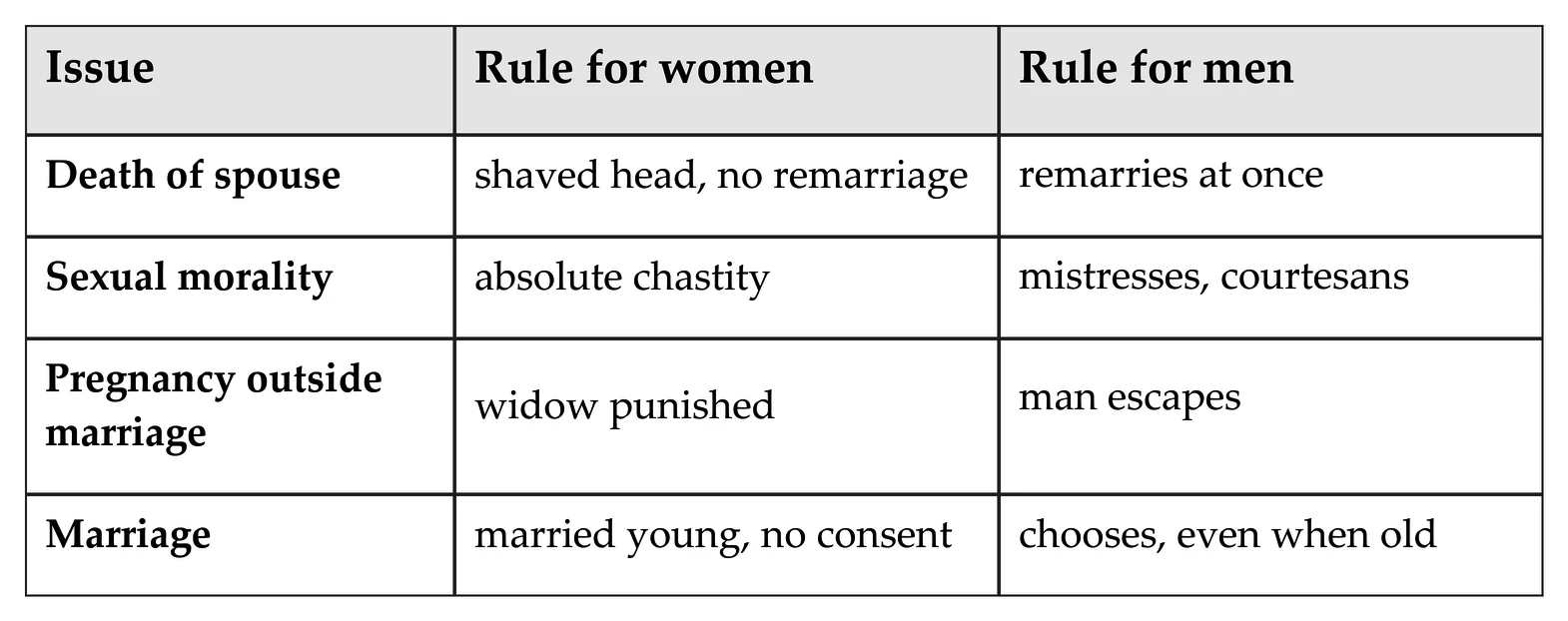
Double Standards of Morality
- Widowhood. A widow, even a child widow, had to shave her head, wear coarse clothes, avoid celebrations and live without remarriage, while a widower could remarry immediately, even an old man marrying a young girl.
- Chastity. Women were expected to be absolutely faithful, while men visited courtesans and kept mistresses without shame.
- Blame for sin. When a widow became pregnant, she alone was punished, while the man responsible escaped, as in the Vijayalakshmi case.
- Marriage. Girls were married young, often to much older men, and had no say in their marriages, yet were blamed if marriages failed.
- Domestic labour. Women did endless work at home for their husbands’ families without recognition, while men claimed to be the providers.
Critique of Religion and Myth
Tarabai challenged the authority of religious texts and mythology used to justify women’s subordination. She pointed out that the scriptures were written by men, and she reinterpreted stories from the epics and Puranas to show male misconduct, such as the treatment of Sita by Rama and the gods’ own deceptions. If women were to be judged by the standards of these stories, she argued, men would be found far guiltier. This critique of religious authority, coming from a woman, was bold and shocking to her contemporaries.
Critique of Colonial Modernity
Tarabai did not see colonial modernity as a liberation for women. She mocked Western-educated men who adopted English habits, drank, smoked and wasted money while preaching reform, and who demanded that their wives be both modern and obedient. In her view, the new educated class had not abandoned patriarchy but had added new forms of hypocrisy to old ones. This made her a critic of both tradition and the colonial reform agenda.
Women’s Faults as Social Products
Tarabai admitted that women sometimes behaved badly, but she argued that their faults came from their lack of education, their dependence on men and the harsh conditions imposed on them. If women had the same freedom and opportunities as men, they would show greater virtue. This argument anticipated the modern idea that gender roles are socially constructed rather than natural.
Reception of the Book
The book provoked hostile reactions in Pune’s press, and Tarabai wrote nothing more that survives. Jyotirao Phule defended her in his writings in 1885, calling her a courageous daughter of the Satyashodhak movement. The text was largely forgotten until it was republished in Marathi in 1975, and Rosalind O’Hanlon translated it into English with a detailed study, A Comparison Between Women and Men (1994).
The Structure of Stri Purush Tulana
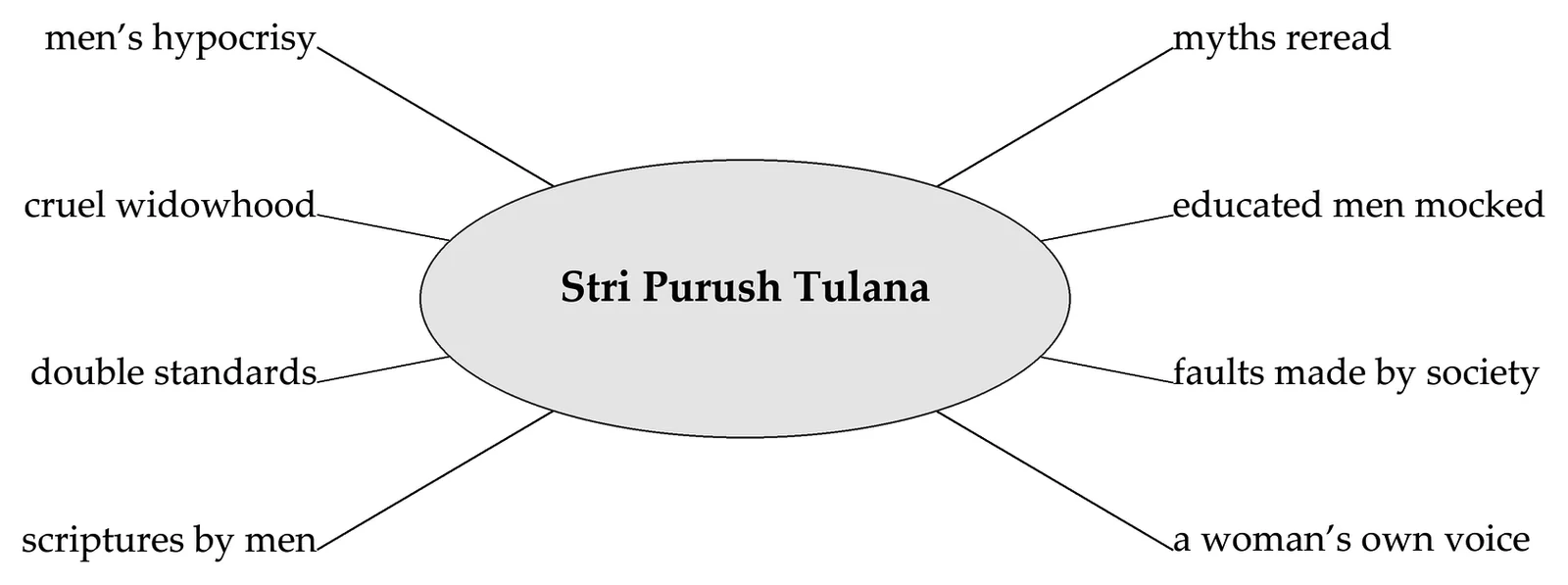
The text is organised as a series of comparisons. Tarabai lists the vices attributed to women, such as deceit, lust, recklessness and cruelty, and then shows, through examples from daily life, mythology and contemporary events, that men commit these vices more often and on a larger scale. She addresses men directly, often sarcastically, asking how they dare to accuse women when their own conduct is so much worse. The book ends by insisting that women deserve sympathy and justice rather than condemnation.
2.3 Tarabai Shinde and the Idea of Gender
Sex refers to biological differences between males and females, while gender refers to the social roles, behaviours and expectations that a society attaches to being a man or a woman. Feminist thinkers argue that gender inequality is created by society, not by nature. Simone de Beauvoir, in The Second Sex (1949), expressed this by saying that one is not born, but becomes, a woman. Tarabai Shinde, writing seventy years earlier, made a similar argument in her own idiom.
Tarabai in Comparative Perspective
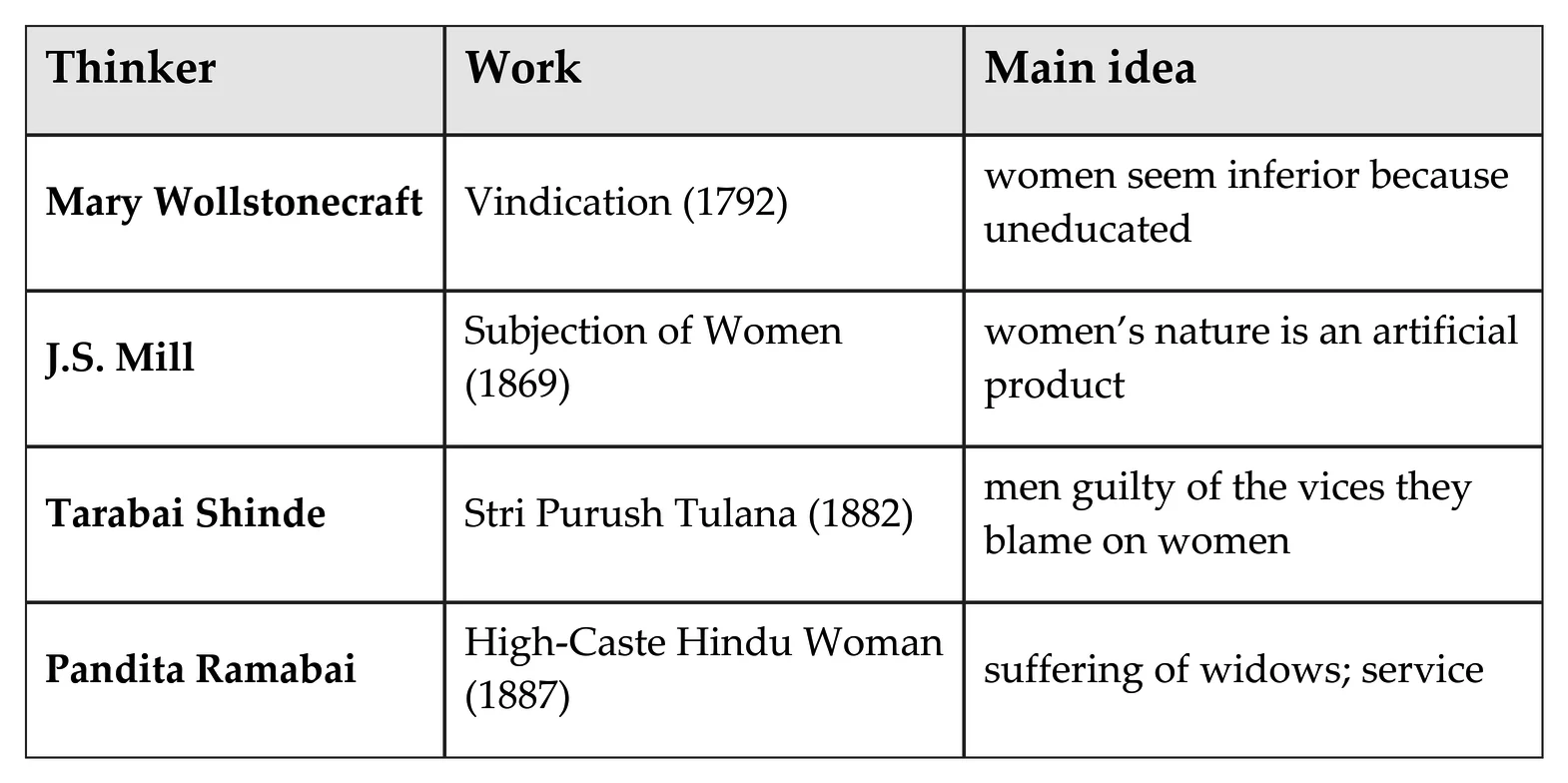
- Mary Wollstonecraft. In A Vindication of the Rights of Woman (1792), Wollstonecraft argued that women appeared inferior only because they were denied education, an argument close to Tarabai’s view of women’s faults.
- J.S. Mill. In The Subjection of Women (1869), Mill argued that the legal subordination of women was wrong and that their supposed nature was an artificial product of their condition.
- Pandita Ramabai. In The High-Caste Hindu Woman (1887), Ramabai described the suffering of upper-caste widows and later founded the Sharada Sadan (1889) for them.
- Savitribai Phule. As a teacher and poet, she worked for the education of girls and lower castes and supported widows.
- Male reformers. Unlike Rammohan Roy, Vidyasagar or Ranade, who sought specific legal reforms on behalf of women, Tarabai criticised the whole system of male domination from a woman’s point of view.
Caste and Gender
Scholars have connected Tarabai’s work with the non-Brahmin tradition of Phule. Uma Chakravarti, in an essay of 1993, used the term Brahmanical patriarchy to describe how caste and gender hierarchies support each other, especially through control over upper-caste women’s sexuality. Sharmila Rege, in Writing Caste/Writing Gender (2006), argued for a Dalit feminist standpoint that recognises the combined oppression of caste and gender. Tarabai’s emphasis on widowhood and chastity shows how gender oppression was linked with caste purity, though her critique extended to men of all castes.
Significance and Relevance
Tarabai Shinde is now recognised as one of the first modern Indian feminist thinkers. Her text shows that Indian women were not passive victims waiting to be rescued by reformers but could analyse their own oppression. Her critique of moral double standards, the blaming of women for sexual violence and the burden of domestic labour remains relevant to contemporary debates on gender justice, from the treatment of widows to the culture of victim-blaming in cases of sexual violence.
Gender Concepts Students Should Know
- Patriarchy. A system of social structures and practices in which men dominate, oppress and exploit women, as defined by Sylvia Walby in Theorizing Patriarchy (1990).
- Public and private. Feminists criticise the division between a public sphere of politics, seen as male, and a private sphere of family, seen as female and outside politics.
- Double standard. Applying stricter moral rules to women than to men for the same conduct, which Tarabai exposed in matters of widowhood and sexuality.
- Intersectionality. Kimberlé Crenshaw’s term (1989) for the way different forms of oppression, such as caste, class and gender, combine and shape each other.
2.4 Important Questions
- Question 1 Discuss Tarabai Shinde’s critique of patriarchy in Stri Purush Tulana.
- Question 2 Examine Tarabai Shinde’s views on widowhood, marriage and the condition of women in colonial Maharashtra.
- Question 3 How did Tarabai Shinde critique both religious tradition and colonial modernity?
- Question 4 Assess the significance of Tarabai Shinde in the history of Indian feminist thought.
DU asks the same idea in different words. So learn one broad answer for each question below; the same answer works for every question joined by OR.
Important Question 1
Discuss Tarabai Shinde’s critique of patriarchy in Stri Purush Tulana.
OR
Examine Tarabai Shinde’s comparison between men and women.
OR
How did Tarabai Shinde expose the double standards of nineteenth-century Indian society?
Model Answer
“I do not wish them to have power over men; but over themselves.”
— Mary Wollstonecraft, A Vindication of the Rights of Woman (1792)
Introduction. Tarabai Shinde’s Stri Purush Tulana (1882) is one of the earliest feminist texts in modern India. Written in Marathi in response to the trial of a young widow, it compares the qualities attributed to women with the conduct of men and shows that men are guilty of the very vices for which they blame women. Its critique of patriarchy was remarkable for its boldness and for being written by a woman from her own experience.
1. Context of the Text
Tarabai wrote in nineteenth-century Maharashtra, where reformers debated widow remarriage, child marriage and women’s education, but where women themselves rarely spoke in public. She belonged to a family linked with Jyotirao Phule’s Satyashodhak Samaj.
2. The Trigger: Vijayalakshmi
In 1881, Vijayalakshmi, a young Brahmin widow in Surat, was tried for killing her illegitimate newborn child. The press condemned her as immoral. Tarabai was angered that the man responsible and the cruel conditions of widowhood were ignored.
3. The Method of Comparison
Tarabai took the vices that society attributed to women, such as deceit, lust and cruelty, and showed that men displayed them more. By turning the accusations back on men, she exposed the injustice of a society that judged the sexes by different standards.
4. Widowhood
Widows had to shave their heads, wear coarse clothes, avoid celebrations and live without remarriage, while widowers could remarry at once. Tarabai condemned this cruelty, which drove some widows to desperation.
5. Chastity and Sexual Morality
Women were expected to be perfectly chaste, while men kept mistresses and visited courtesans. When a woman was seduced and became pregnant, she alone was punished, which Tarabai saw as the height of hypocrisy.
6. Marriage and Domestic Labour
Girls were married young to older men without consent and spent their lives working for their husbands’ families. Tarabai showed that women’s domestic labour was unrecognised and that wives had no security against cruel husbands.
7. Critique of Religious Authority
Tarabai pointed out that religious texts were written by men and used to justify women’s subordination. She reinterpreted stories from the epics to show the misconduct of male heroes and gods, challenging the authority of tradition.
8. Critique of Educated Men
She mocked Western-educated men who adopted English habits, drank and wasted money while lecturing women on morality, showing that colonial modernity had not ended patriarchy.
9. Women’s Faults Explained
Tarabai accepted that women sometimes behaved badly, but argued that their faults arose from ignorance, dependence and oppression created by men, not from their nature. Given equal opportunities, women would be more virtuous.
10. A Woman’s Voice
Unlike male reformers who spoke on behalf of women, Tarabai wrote as a woman, analysing her own society. This gave her critique an authenticity and anger rarely found in reform writing.
11. Across Castes
Though linked with the non-Brahmin movement, Tarabai criticised men of all castes, showing that patriarchy was a general structure of power, not a feature of one caste alone.
12. Reception
The book was attacked in the press, but Jyotirao Phule defended Tarabai. Forgotten for decades, it was republished in 1975 and translated by Rosalind O’Hanlon in 1994.
13. Comparison with Western Feminism
Her argument resembles Mary Wollstonecraft’s claim that women’s apparent inferiority came from lack of education, and J.S. Mill’s argument that women’s nature was an artificial product of their condition.
14. Satire as a Weapon
Tarabai used irony and satire to expose men’s hypocrisy, mocking their claims to virtue by listing their faults in vivid detail. Her sharp, angry style was unusual for a woman writer of her time and made her critique hard to ignore, though it also provoked hostility.
15. Evaluation
Tarabai’s critique of patriarchy was ahead of its time, exposing moral double standards and the social construction of women’s faults, though her reach was limited by the hostility of her society.
Conclusion. Thus, in Stri Purush Tulana Tarabai Shinde exposed the double standards of patriarchy in widowhood, chastity, marriage and religion, turning society’s accusations against women back on men. Writing as a woman and criticising both tradition and colonial modernity, she became one of the first voices of modern Indian feminism.
Important Question 2
Examine Tarabai Shinde’s views on widowhood, marriage and the condition of women in colonial Maharashtra.
OR
Discuss Tarabai Shinde’s critique of the treatment of widows.
OR
How did Tarabai Shinde explain the social construction of women’s faults?
Model Answer
“The legal subordination of one sex to the other is wrong in itself, and now one of the chief hindrances to human improvement.”
— J.S. Mill, The Subjection of Women (1869)
Introduction. The condition of women, especially widows, was a central issue in nineteenth-century India. Reformers campaigned for widow remarriage and against child marriage, but Tarabai Shinde went further, analysing how marriage and widowhood formed a system that subordinated women and then blamed them for its consequences. Her views offer an early analysis of how gender roles are shaped by society.
1. Women in Colonial Maharashtra
Most women were uneducated, married young and lived under the authority of husbands and in-laws. Upper-caste widows faced severe restrictions, while lower-caste women faced both caste and gender oppression.
2. The Reform Debates
Reformers such as Vidyasagar, Ranade and Phule campaigned for widow remarriage and women’s education. The Widow Remarriage Act of 1856 legalised remarriage, but social resistance meant that few widows remarried.
3. Tarabai on Enforced Widowhood
Tarabai described how widows, including child widows, were forced to shave their heads, wear coarse clothes, eat simple food and live as outcasts in their own homes, often exploited by male relatives.
4. The Contrast with Widowers
While widows were condemned to lifelong mourning, widowers remarried immediately, often marrying young girls. Tarabai saw this contrast as proof that rules of morality were made by men for their own benefit.
5. Widows and Sexual Exploitation
Tarabai argued that widows, denied remarriage and security, were vulnerable to seduction and exploitation by men, and that when they became pregnant, society punished them while the men escaped, as in the Vijayalakshmi case.
6. Child Marriage
Girls were married before puberty, often to much older men, without consent. Tarabai criticised the misery this caused, including early widowhood and loveless marriages.
7. Life in the Marital Home
Wives worked endlessly for their husbands’ families, endured abuse from husbands and in-laws and had no right to leave. Tarabai showed that the home, idealised by reformers and traditionalists alike, was often a place of suffering for women.
8. Education and Dependence
Denied education and property, women depended entirely on men. Tarabai argued that this dependence, not women’s nature, explained their weaknesses, anticipating later feminist arguments about education and independence.
9. The Social Construction of Faults
Tarabai’s central argument was that women’s faults were produced by their conditions. If women lied or deceived, it was because they were powerless and oppressed; given freedom, they would be more virtuous than men.
10. Comparison with Pandita Ramabai
Pandita Ramabai’s The High-Caste Hindu Woman (1887) also described the suffering of widows and founded a home for them, combining analysis with practical service, while Tarabai’s contribution was a fierce critique.
11. Comparison with Male Reformers
Male reformers sought legal changes such as widow remarriage, but often accepted women’s domestic role. Tarabai questioned the entire moral order that made women responsible for family honour.
12. Brahmanical Patriarchy
Scholars such as Uma Chakravarti show that restrictions on upper-caste widows were linked with caste purity, which required control over women’s sexuality. Tarabai’s critique of widowhood exposed this link.
13. Contemporary Relevance
Many of Tarabai’s concerns remain relevant, such as the stigma faced by widows, child marriage, domestic violence and the blaming of women for sexual violence.
14. Widows in Law and Practice
Even after the Widow Remarriage Act of 1856, a widow who remarried lost her rights in her first husband’s property, and social pressure kept most widows from remarrying. Tarabai’s critique showed that legal reform alone could not change customs rooted in male control over women’s lives and property.
15. Evaluation
Tarabai’s analysis of widowhood and marriage went beyond calls for reform to a critique of the structure of patriarchy, making her an early theorist of gender as a social construction.
Conclusion. Thus, Tarabai Shinde showed that enforced widowhood, child marriage and the burdens of married life formed a system that subordinated women and then blamed them for its consequences. By explaining women’s faults as products of their conditions, she anticipated the modern understanding of gender as socially constructed.
Important Question 3
How did Tarabai Shinde critique both religious tradition and colonial modernity?
OR
Discuss Tarabai Shinde as a critic of tradition and of Western-educated men.
OR
Examine Tarabai Shinde’s use of religion and mythology in her critique of patriarchy.
Model Answer
“I measure the progress of a community by the degree of progress which women have achieved.”
— B.R. Ambedkar, address at the Depressed Classes Women’s Conference, Nagpur (1942)
Introduction. Nineteenth-century Indian debates on women were usually framed as a contest between tradition, defended by the orthodox, and modernity, promoted by reformers and the colonial state. Tarabai Shinde refused to take either side. She criticised the religious traditions that justified women’s subordination and the colonial modernity of Western-educated men who claimed to be reformers but remained patriarchal.
1. Tradition versus Modernity
Most debates on women set tradition against reform. Orthodox Hindus defended scripture and custom, while reformers appealed to reason and, often, to colonial law. Women’s own voices were rarely heard.
2. Scriptures Written by Men
Tarabai argued that religious texts were written by men and reflected their interests. Their rules for women, such as absolute obedience and chastity, served men’s convenience rather than any divine justice.
3. Reinterpreting Mythology
Tarabai used stories from the epics and Puranas to show the misconduct of male heroes and gods, such as Rama’s treatment of Sita. If women were judged by these stories, she argued, men would appear far worse.
4. Challenging Ideals of Womanhood
Ideals such as the devoted wife (pativrata) were used to demand women’s sacrifice. Tarabai questioned why women alone should sacrifice while men enjoyed freedom without responsibility.
5. Religion and Caste
Her criticism of scripture aligned with Phule’s attack on Brahmanical authority, showing how religious texts supported both caste and gender hierarchies.
6. Critique of Educated Men
Tarabai mocked Western-educated men who adopted English dress, drank, smoked and visited courtesans while lecturing women on virtue. Their modernity did not include respect for women.
7. Modernity as New Patriarchy
In her view, colonial modernity added new demands on women, to be both educated and obedient, modern and traditional, without giving them real freedom, so patriarchy took new forms.
8. Critique of the Press
Tarabai criticised newspapers, the new voice of modern public opinion, for condemning Vijayalakshmi while ignoring the man responsible, showing how modern institutions reproduced old prejudices.
9. Beyond the Reform Agenda
While reformers sought specific changes through law, Tarabai attacked the moral basis of male domination itself, a broader and more radical critique than that of most male reformers.
10. Comparison with Partha Chatterjee’s Argument
Partha Chatterjee argued that nationalists placed women in the inner, spiritual domain of tradition while accepting Western ways in the outer world. Tarabai’s critique exposes how both domains served men.
11. Women as Thinkers
By criticising both tradition and modernity, Tarabai showed that women could be independent thinkers, not merely objects of reform, an important insight for Indian feminist history.
12. Limits of Her Critique
Her critique was mainly moral and rhetorical; she did not propose a detailed programme of reform, and her book reached only a small audience before being forgotten for nearly a century.
13. Contemporary Relevance
Her refusal to choose between tradition and modernity anticipates postcolonial feminist arguments that both indigenous customs and Western models can be patriarchal.
14. Women’s Agency
By criticising both tradition and modernity in her own voice, Tarabai demonstrated women’s agency, i.e. their capacity to think and act for themselves. Feminist historians stress that she was not a passive victim but an active critic who analysed the sources of her oppression.
15. Connection with the Non-Brahmin Movement
Her critique of Brahmanical scripture and priestly authority echoed Jyotirao Phule’s arguments in Gulamgiri (1873). The Satyashodhak Samaj gave her a context in which a woman’s challenge to religious authority could be defended, as Phule himself did in 1885.
16. Evaluation
Tarabai’s double critique made her a uniquely independent voice, challenging the authority of scripture and the hypocrisy of modern reformers alike.
Conclusion. Thus, Tarabai Shinde criticised religious tradition for justifying women’s subordination through male-written scriptures and myths, and colonial modernity for producing educated men who remained patriarchal. Her double critique made her a pioneering, independent feminist thinker who refused to accept either side of the tradition-versus-reform debate.
Important Question 4
Assess the significance of Tarabai Shinde in the history of Indian feminist thought.
OR
Compare Tarabai Shinde with other nineteenth-century thinkers on the women’s question.
OR
Why is Tarabai Shinde regarded as one of the first modern Indian feminists?
Model Answer
“The personal is political.”
— Carol Hanisch, title of her essay (1969), a slogan of second-wave feminism
Introduction. Tarabai Shinde wrote only one known book, yet she is now recognised as one of the founders of modern Indian feminist thought. Her Stri Purush Tulana (1882) analysed gender relations from a woman’s point of view, criticised the structure of male power and anticipated many later feminist ideas. Her significance becomes clear when she is compared with other thinkers of her time and with later feminist theory.
1. A Pioneering Text
Stri Purush Tulana is among the earliest analytical texts on gender written by an Indian woman. It turned the discussion of women’s condition into a critique of men’s conduct and power.
2. Speaking for Herself
Most nineteenth-century writing on women was by male reformers. Tarabai’s voice as a woman analysing her own society marks the beginning of women’s own intellectual tradition in modern India.
3. Gender as Social Construction
Her argument that women’s faults were products of their conditions anticipated the distinction between sex and gender later developed by Simone de Beauvoir and others.
4. The Personal as Political
By analysing marriage, widowhood, sexuality and domestic labour, Tarabai showed that relations within the family were relations of power, an idea later summed up in the feminist slogan that the personal is political.
5. Comparison with Rammohan Roy and Vidyasagar
Rammohan Roy campaigned against sati and Vidyasagar for widow remarriage, using scripture to justify reform. Tarabai went further, questioning the authority of scripture and the entire moral order.
6. Comparison with Phule
Jyotirao Phule attacked Brahmanical authority and worked for the education of women and lower castes. Tarabai shared his critique of Brahmanical religion and extended it to men of all castes.
7. Comparison with Pandita Ramabai
Pandita Ramabai documented the suffering of high-caste widows and founded institutions for them. Both were early women thinkers, but Ramabai combined analysis with organised service, while Tarabai offered a sharper polemic.
8. Comparison with Western Feminists
Like Mary Wollstonecraft (1792) and J.S. Mill (1869), Tarabai linked women’s apparent inferiority to their education and conditions, showing that similar insights arose independently in different societies.
9. Caste and Gender
Her work has been linked with the idea of Brahmanical patriarchy developed by Uma Chakravarti and the Dalit feminist standpoint of Sharmila Rege, which stress the intersection of caste and gender.
10. Rediscovery
Forgotten for decades, the text was republished in 1975 and translated by Rosalind O’Hanlon in 1994, during a period when Indian feminist scholars were recovering women’s voices from history.
11. Influence on Feminist History
Feminist historians such as Susie Tharu and K. Lalita, in Women Writing in India (1991), included Tarabai among early women writers, showing that Indian women had their own tradition of critical thought.
12. Limitations
Her text reached few readers in her lifetime, offered little in the way of programme or organisation and was written mainly from the perspective of upper-caste women’s experience of widowhood.
13. Contemporary Relevance
Her critique of victim-blaming, moral double standards and the burden of domestic labour speaks directly to present-day debates on sexual violence, widows’ rights and unpaid care work.
14. Tarabai and Today’s Feminist Movements
Indian women’s movements since the 1970s, which campaigned against dowry deaths, custodial rape and domestic violence, echo Tarabai’s anger at a society that blames women for the wrongs done to them. Her text is now taught as part of a long Indian tradition of women’s resistance, not as an isolated cry.
15. Evaluation
Tarabai Shinde’s significance lies in her originality and courage. She showed that Indian women could theorise their own oppression, and her ideas remain a resource for Indian feminist thought.
Conclusion. Thus, Tarabai Shinde is significant as one of the first Indian women to analyse gender relations from her own point of view. Going beyond male reformers, she exposed patriarchal double standards, treated women’s faults as socially produced and criticised both tradition and modernity, anticipating key ideas of later feminism.
Short Notes
(a) Stri Purush Tulana
The Marathi book written by Tarabai Shinde in 1882, comparing the vices attributed to women with the conduct of men and exposing the double standards of patriarchy.
(b) Brahmanical patriarchy
A term used by Uma Chakravarti for the way caste hierarchy and the control of women’s sexuality, especially of upper-caste women, support each other.
(c) Sex and gender
Sex refers to biological differences between males and females, while gender refers to the social roles and expectations attached to being a man or a woman.
More notes: GE-1 Ideas in Indian Political Thought
These notes are prepared by PADHO TO AISE for study help. They are not an official publication.