
Generic Electives (GE) GE-1 Ideas in Indian Political Thought
Unit I · 27 min read · Updated 27 Nov 2026
As per the University of Delhi (DU) Generic Elective (GE) syllabus offered by the Department of Political Science
Contents
- 1.1 Kautilya and the Arthashastra
- The Four Sciences
- Features of Kautilya’s Political Thought
- The Saptanga Theory
- 1.2 Dharma in Kautilya’s Thought
- Dharma as Social Order
- The Four Sources of Law
- Rajadharma: The Duty of the King
- Dharma and Artha
- Dharma in the Wider Indian Tradition
- 1.3 Danda and Dandaniti
- Why Danda Is Necessary
- Features of Kautilya’s Theory of Danda
- Realist or Moralist
- Kautilya Today
- Key Terms in Kautilya
- Kautilya and Ashoka Compared
- 1.4 Important Questions
- Explain the significance of dharma and danda in Kautilya’s political thought.
- Discuss Kautilya’s concept of danda and dandaniti.
- Discuss Kautilya’s views on the king and rajadharma.
- Kautilya is often called the Indian Machiavelli. Discuss.
- Short Notes
प्रजा के सुख में राजा का सुख है और प्रजा के हित में राजा का हित।
In the happiness of his subjects lies the happiness of the king; in their welfare his welfare.
— Kautilya, Arthashastra 1.19 (trans. R. Shamasastry)
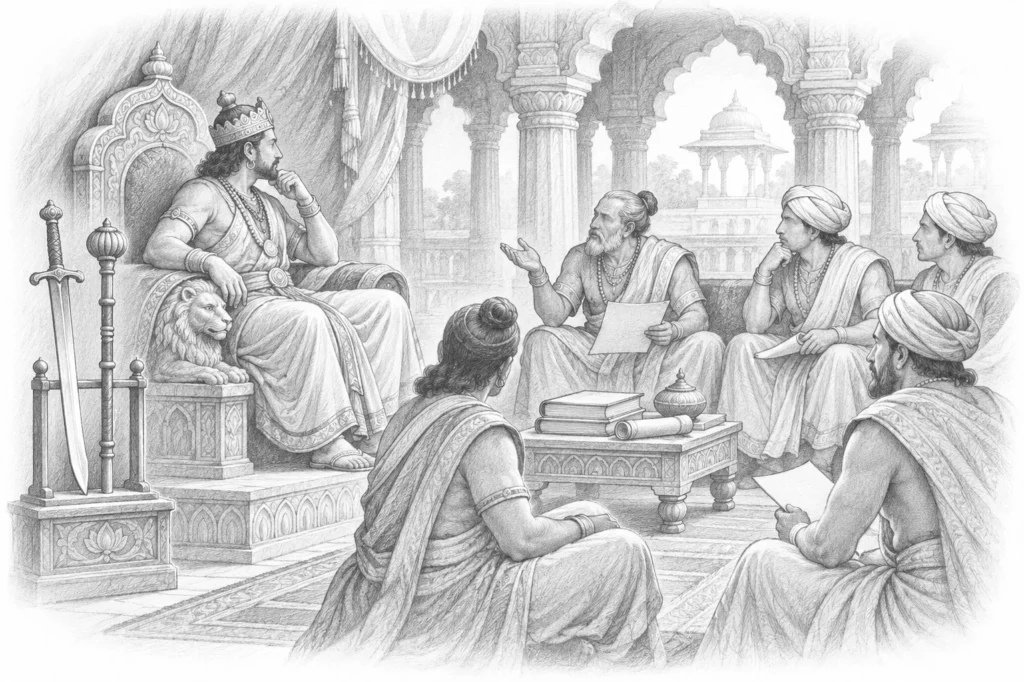
KKAUTILYA, also known as Chanakya and Vishnugupta, is the most famous political thinker of ancient India. His Arthashastra is a detailed treatise on how to acquire, protect and govern a kingdom. Two ideas run through it: dharma, the moral and social order that the king must uphold, and danda, the coercive power of punishment by which order is maintained. This chapter studies Kautilya and his work, his understanding of dharma and rajadharma, his theory of danda and dandaniti, and the debate on whether he was a ruthless realist or a thinker of welfare.
1.1 Kautilya and the Arthashastra
According to tradition, Kautilya was a Brahmin teacher from Taxila who helped Chandragupta Maurya overthrow the Nanda dynasty and establish the Mauryan empire around 321 BCE, and served as his chief minister. The Arthashastra is attributed to him. The word artha means wealth, but Kautilya also uses it to mean the earth inhabited by people, so the Arthashastra is the science of acquiring and protecting territory, i.e. the science of politics and government. Lost for centuries, the text was rediscovered by R. Shamasastry in Mysore in 1905. Scholars debate its date: Thomas Trautmann, in a statistical study of 1971, argued that it was compiled by several authors, and Patrick Olivelle, in his translation of 2013, dated its final form to around 50 to 300 CE, though its core may be older.
The Four Sciences
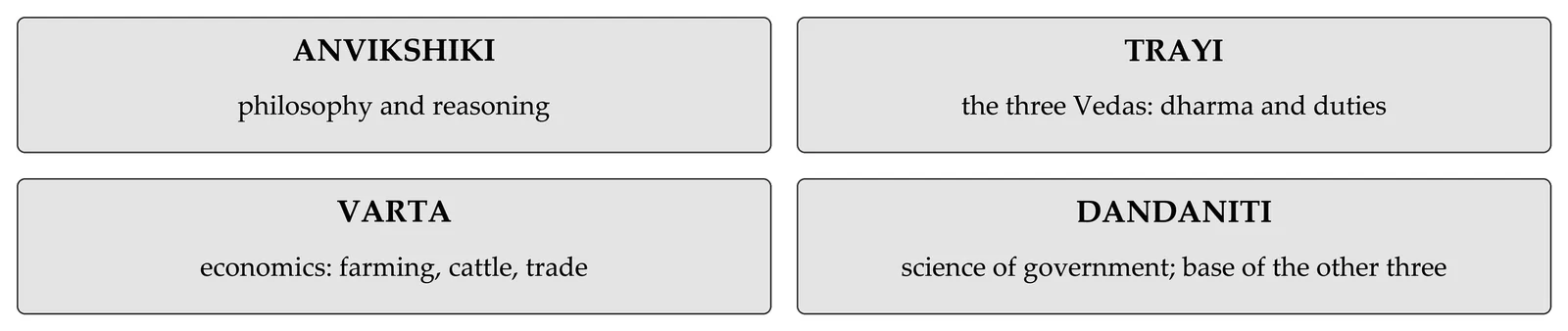
At the start of the Arthashastra, Kautilya lists four branches of knowledge (vidyas) that a king must learn:
- Anvikshiki, philosophy or the science of reasoning, including Samkhya, Yoga and Lokayata, which trains the mind to reason clearly.
- Trayi, the three Vedas, which teach dharma and the duties of the varnas and ashramas.
- Varta, economics, covering agriculture, cattle-rearing and trade, which provides wealth.
- Dandaniti, the science of government or of punishment, which secures the other three.
Kautilya argued that dandaniti is the foundation of the others, because without the coercive power of the state, philosophy, religion and economic life could not flourish. This shows his realism: moral and economic life depend on political order.
Features of Kautilya’s Political Thought
- Realism. He studies politics as it is practised, frankly discussing spies, intrigue and war.
- Primacy of artha. In Arthashastra 1.7, he says that material well-being is supreme, since dharma and kama depend on it.
- The saptanga state. The state has seven elements: king, ministers, territory and people, fort, treasury, army and ally.
- Welfare. The king’s happiness lies in the happiness of his subjects, so power must serve yogakshema, the security and welfare of the people.
- Centralised administration. He describes a large bureaucracy of superintendents, revenue officials, judges and spies.
- Foreign policy. His mandala theory of a circle of states and the six measures guide relations with other kingdoms.
The Saptanga Theory
Kautilya’s theory of the state lists seven elements (prakritis), each depending on the others like the limbs of a body: svami, the king; amatya, ministers and officials; janapada, the territory with its people; durga, the fortified capital; kosha, the treasury; danda, the army and coercive power; and mitra, the ally. Kautilya ranks them in order of importance, the king first, because a calamity affecting an earlier element is more serious than one affecting a later element. The theory shows his understanding that political power depends on economic resources, administration and alliances, not only on the ruler’s will.
1.2 Dharma in Kautilya’s Thought
The word dharma has many meanings: duty, righteousness, law, religion and the moral order that sustains the world. In ancient Indian thought, dharma included svadharma, the specific duties of each varna and ashrama, and sadharana dharma, universal duties such as truthfulness and non-violence. Kautilya accepted this framework but gave it a distinctly political interpretation.
Dharma as Social Order
For Kautilya, the king’s first task is to protect the social order based on varnashrama dharma, the duties of the four varnas and four stages of life. When people follow their own dharma, society is orderly and prosperous; when they abandon it, confusion results. The king therefore must ensure that subjects do not transgress their duties, using danda when necessary. Kautilya says that the world, when maintained in accordance with the Vedas, prospers and does not perish.
The Four Sources of Law
In Book III, Kautilya lists four sources of law, which he calls the four legs of law: dharma, sacred law based on truth; vyavahara, evidence or legal transactions based on witnesses; charitra, custom or the practice of the people; and rajashasana, the edict or command of the king. He holds that each later source prevails over the earlier one when they conflict, so the king’s edict has the highest authority, provided it is in accordance with dharma and reason. This places the king’s law at the centre, a striking assertion of royal authority compared with the Dharmashastras.

Rajadharma: The Duty of the King
- Protection. The king must protect his subjects from external enemies, internal disorder, natural calamities and exploitation by officials.
- Welfare. He must promote yogakshema, i.e. the acquisition of what is not possessed and the preservation of what is possessed.
- Self-control. He must conquer the six enemies of the senses, lust, anger, greed, conceit, arrogance and excessive joy, and be trained by learned elders.
- Justice. He must punish wrongdoers impartially and protect the weak, including widows, orphans and the aged.
- Diligence. Kautilya divides the king’s day and night into eight parts each and assigns duties to each, from hearing petitions to consulting spies.
Dharma and Artha
Kautilya gave priority to artha over dharma and kama because material prosperity is the basis of both religious life and enjoyment. Yet he also told the king to enjoy pleasures without violating dharma and artha and to pursue all three in balance. Scholars such as R.P. Kangle argue that Kautilya was not amoral: he accepted dharma as the goal of society, but believed that political power and wealth were necessary means to achieve and protect it.
Dharma in the Wider Indian Tradition
Kautilya’s view of dharma can be compared with that of the Dharmashastras, such as the Manusmriti, which also made the king the protector of varnashrama dharma but gave greater authority to Brahmins and sacred law. Kautilya placed the king’s edict above sacred law in cases of conflict, giving the state a more independent role. The Mahabharata’s Shanti Parva also discussed rajadharma, describing the king’s duty to protect and please the people. Kautilya stands within this tradition but with a sharper focus on the practical means of power.
1.3 Danda and Dandaniti
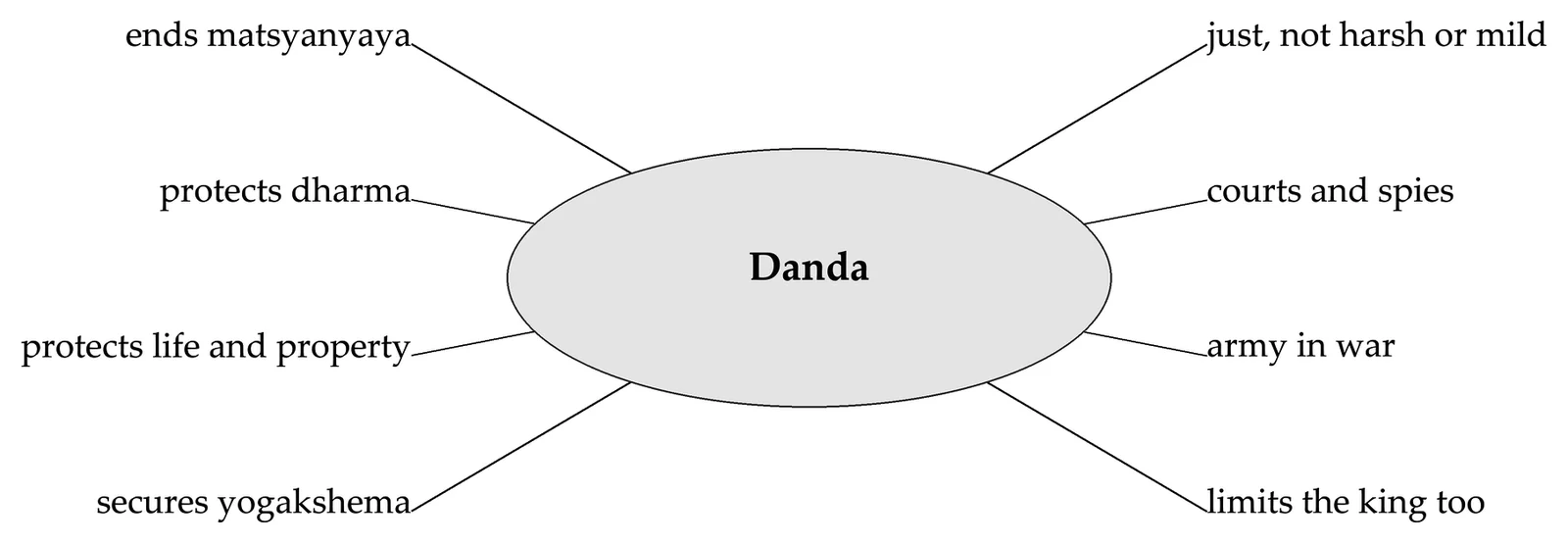
Danda literally means a rod or staff. In political thought it means punishment and, more broadly, the coercive power of the state, including the army. Dandaniti is the science of the proper use of danda, i.e. the science of government.
Why Danda Is Necessary
Kautilya explains the need for danda through the idea of matsyanyaya, the law of the fishes. If danda is not used, the stronger will swallow the weaker, as big fish eat small fish. When danda is used properly, the weak are protected and everyone follows their dharma. Danda thus maintains the social order, protects property and life and allows people to pursue dharma, artha and kama. Kautilya also says that people who were oppressed by matsyanyaya chose Manu as their king and agreed to pay him a share of their produce, an early idea of a contract for protection.
Features of Kautilya’s Theory of Danda
- Just punishment. Punishment must be neither too severe, which makes the king hated, nor too mild, which makes him despised, but deserved, which makes him respected.
- Based on knowledge. Danda must be used after full consideration and with knowledge, not out of anger, greed or ignorance.
- Protects dharma. Its purpose is to make people observe their duties and to maintain the varna order.
- Graded penalties. The Arthashastra prescribes fines, corporal punishment, imprisonment and death, graded according to the offence, though also according to caste, which shows inequality before law.
- Courts. Kautilya describes dharmasthiya courts for civil disputes and kantakashodhana courts, literally for removing thorns, for criminal matters and offences against the state.
- Intelligence. A network of spies helps detect crime, corruption and conspiracy, so danda depends on information.
- The king is not above danda. Kautilya warns that a king who misuses danda will be destroyed by his own subjects or by enemies.
Realist or Moralist
Kautilya has often been called the Indian Machiavelli. The sociologist Max Weber, in Politics as a Vocation (1919), remarked that compared with the Arthashastra, Machiavelli’s The Prince is harmless. Roger Boesche, in The First Great Political Realist (2002), places Kautilya among the great realists. Other scholars, such as R.P. Kangle and L.N. Rangarajan, stress that Kautilya’s realism served welfare and dharma, that he condemned the misuse of power and that he required the king to be disciplined and just. Most now see him as combining ruthless means with welfare ends, a thinker of statecraft whose ideas are still discussed in debates on Indian strategy.
Kautilya Today
- Strategic studies. Indian scholars and institutions, such as the Institute for Defence Studies and Analyses, have revived interest in Kautilya’s ideas on intelligence, alliances and the use of force.
- Economics and administration. Balbir Sihag, in Kautilya: The True Founder of Economics (2014), argues that the Arthashastra anticipated modern ideas of incentives and institutions.
- Governance. Kautilya’s concern with the accountability of officials, audits and anti-corruption measures is often cited in discussions of good governance.
- A caution. Scholars warn against reading modern ideas back into an ancient text written for a monarchy based on a hierarchical social order.
Key Terms in Kautilya
- Svami: the king, the first element of the state.
- Amatya: ministers and high officials.
- Kantakashodhana: courts for removing thorns, i.e. criminal matters and offences against the state.
- Mantriparishad: the council of ministers whom the king consults in important matters.
- Upayas: the four means of policy: sama (conciliation), dana (gifts), bheda (division) and danda (force).
Kautilya and Ashoka Compared
Students often compare Kautilya with the Mauryan emperor Ashoka. Both belonged to the same dynasty and both stressed the king’s duty to his subjects’ welfare; Ashoka declared in his edicts that all men are his children. But while Kautilya accepted war, intrigue and severe punishment as tools of statecraft, Ashoka, after the Kalinga war, preferred conquest by dhamma, non-violence and moral persuasion. Their contrast shows two traditions in Indian political thought: realist statecraft and ethical kingship.
1.4 Important Questions
- Question 1 Explain the significance of dharma and danda in Kautilya’s political thought.
- Question 2 Discuss Kautilya’s concept of danda and dandaniti.
- Question 3 Discuss Kautilya’s views on the king and rajadharma.
- Question 4 Kautilya is often called the Indian Machiavelli. Discuss.
DU asks the same idea in different words. So learn one broad answer for each question below; the same answer works for every question joined by OR.
Important Question 1
Explain the significance of dharma and danda in Kautilya’s political thought.
OR
How did Kautilya relate dharma to danda?
OR
Discuss Kautilya’s understanding of dharma and the sources of law.
Model Answer
“Sacred law, evidence, history and edicts of kings are the four legs of law.”
— Kautilya, Arthashastra 3.1 (trans. R. Shamasastry)
Introduction. Dharma and danda are two central ideas in Kautilya’s Arthashastra. Dharma is the moral and social order based on duties, and danda is the coercive power of punishment by which the king maintains that order. Kautilya treats them as closely linked: danda exists to protect dharma, and dharma gives danda its purpose. Their relationship shows how Kautilya combined political realism with a commitment to social order and welfare.
1. Meaning of Dharma
Dharma means duty, righteousness and the moral order. It includes svadharma, the specific duties of each varna and ashrama, and universal duties such as truthfulness and non-violence. For Kautilya, dharma is the foundation of an orderly and prosperous society.
2. Dharma as Social Order
Kautilya held that the king must protect varnashrama dharma, ensuring that each person performs the duties of his varna and stage of life. When duties are performed, society prospers; when they are abandoned, confusion and decline follow.
3. The Four Legs of Law
Kautilya identified four sources of law: dharma, vyavahara (evidence), charitra (custom) and rajashasana (the king’s edict). Each later source prevails over the earlier, so the king’s edict has the highest authority, provided it agrees with dharma and reason.
4. Rajadharma
The king’s own dharma is to protect his subjects, punish wrongdoers, promote welfare and maintain the social order. Kautilya says that the king’s happiness lies in the happiness of his subjects, making welfare the purpose of royal power.
5. Meaning of Danda
Danda means punishment and the coercive power of the state, including the army. Dandaniti, the science of government, is the knowledge of how to use danda properly to secure order and prosperity.
6. Why Danda Is Needed
Without danda, the law of the fishes, matsyanyaya, would prevail, and the strong would devour the weak. Danda protects the weak, maintains order and makes it possible for people to follow their dharma.
7. Danda Protects Dharma
For Kautilya, danda is the guardian of dharma. It ensures that people do not transgress their duties and that the varna order is preserved, so the coercive power of the state serves the moral and social order.
8. Just Use of Danda
Kautilya warned that severe punishment makes the king hated, mild punishment makes him despised and deserved punishment makes him respected. Danda must be used with knowledge and judgement, not out of anger or greed.
9. Dandaniti as the Foundation
Among the four sciences, Kautilya placed dandaniti at the base, since philosophy, the Vedas and economics can flourish only when the state maintains order through danda.
10. Primacy of Artha
Kautilya gave priority to artha, material well-being, because dharma and kama depend on it. This does not reject dharma but recognises that prosperity and security are necessary for moral life.
11. Limits on the King
The king is bound by dharma and by the need to keep his subjects content. Kautilya warns that a king who misuses danda will be destroyed by his subjects or enemies, so danda is not arbitrary power.
12. Courts and Justice
Kautilya describes courts for civil disputes (dharmasthiya) and for criminal matters (kantakashodhana), staffed by officials who apply law based on the four sources, showing an organised system of justice.
13. Criticisms
Critics note that Kautilya’s dharma defended the hierarchical varna order, that punishments varied with caste and that his use of spies and intrigue sometimes went beyond moral limits.
14. Dharma, Danda and Welfare
For Kautilya, the final purpose of both dharma and danda is yogakshema, the security and welfare of the people. Danda without dharma becomes tyranny, and dharma without danda remains a wish; together they create an order in which people can prosper and pursue their duties, which is why Kautilya made the king’s happiness depend on the happiness of his subjects.
15. Evaluation
Kautilya’s linking of dharma and danda reflects a realistic understanding that moral order needs political power, and that power needs moral purpose. This combination makes his thought relevant to debates on law, order and welfare today.
Conclusion. Thus, in Kautilya’s thought dharma is the moral and social order and danda the coercive power that protects it. Through the four legs of law, rajadharma and the just use of punishment, Kautilya sought to prevent matsyanyaya and secure the welfare of the people, combining realism with a commitment to order and dharma.
Important Question 2
Discuss Kautilya’s concept of danda and dandaniti.
OR
Examine Kautilya’s theory of punishment.
OR
‘Danda is the foundation of the state.’ Discuss with reference to Kautilya.
Model Answer
“Whoever imposes severe punishment becomes repulsive to the people; while he who awards mild punishment becomes contemptible. But whoever imposes punishment as deserved becomes respectable.”
— Kautilya, Arthashastra 1.4 (trans. R. Shamasastry)
Introduction. Danda, meaning punishment and the coercive power of the state, is the central concept of Kautilya’s political theory. Dandaniti, the science of government, teaches how danda should be used. For Kautilya, danda is the foundation on which order, prosperity and moral life rest, but it must be used justly and with knowledge.
1. Meaning of Danda
Literally a rod or staff, danda means punishment, the coercive power of the king and, more broadly, the army and the machinery of law enforcement. It is the means by which the state secures obedience.
2. Meaning of Dandaniti
Dandaniti is the science of the proper use of danda, i.e. the science of government. Kautilya regards it as the most important of the four sciences, since it secures the others.
3. Matsyanyaya
Kautilya explains the need for danda through matsyanyaya, the law of the fishes: without danda, the strong devour the weak. Danda ends this condition, protects the weak and creates order.
4. The Origin of Kingship
Kautilya says that people oppressed by matsyanyaya made Manu their king and agreed to give him a sixth of their grain and a tenth of their merchandise, in return for protection. Danda is thus tied to the king’s duty to protect.
5. Functions of Danda
Danda protects life and property, maintains the varna order, secures the acquisition and protection of wealth, defends the kingdom and allows people to pursue dharma, artha and kama. It is the guarantor of yogakshema.
6. Just Punishment
Kautilya warned that severe punishment makes the king hated and mild punishment makes him despised, while deserved punishment makes him respected. Punishment must be proportionate to the offence.
7. Danda and Knowledge
Danda must be used after full consideration and with knowledge. When used out of anger, greed or ignorance, it provokes even ascetics to anger, let alone householders, and leads to the ruin of the king.
8. Types of Punishment
The Arthashastra prescribes fines, confiscation, corporal punishment, imprisonment and death, graded according to the offence. However, punishments also varied by caste, reflecting the inequalities of the social order.
9. The Judicial System
Kautilya describes dharmasthiya courts for civil disputes such as contracts, debts and inheritance, and kantakashodhana courts for crimes, fraud by artisans and merchants and offences against the state.
10. Spies and Enforcement
Kautilya relied on an elaborate network of spies, disguised as ascetics, traders and householders, to detect crime, corruption and conspiracy, so that danda could be applied effectively.
11. Danda in Foreign Policy
Danda also refers to military force in foreign relations, the last of the four upayas after conciliation (sama), gifts (dana) and division (bheda). Kautilya preferred to achieve goals without war where possible.
12. Limits on Danda
Danda is limited by dharma and by the welfare of the people. A king who misuses it loses the loyalty of his subjects, and Kautilya warns that disaffected subjects destroy their own king.
13. Comparison with Western Ideas
Kautilya’s view resembles Hobbes’s argument in Leviathan (1651) that without a sovereign, life would be a war of all against all, and Weber’s definition of the state as a monopoly of legitimate force.
14. Danda and the Saptanga State
Danda is one of the seven elements of the state in Kautilya’s saptanga theory, standing for the army and coercive power. Without danda, the other elements, the king, ministers, territory, fort, treasury and ally, cannot be protected, so it is the force that holds the state together and makes its authority real.
15. Danda and Economic Life
Kautilya linked danda with varta, economic life. By punishing theft, fraud by traders and artisans and the embezzlement of officials, danda protects property and trade, which in turn fill the treasury that pays for the army. Order and prosperity thus support each other.
16. Evaluation
Kautilya’s theory of danda shows a clear understanding of the role of coercion in politics, while insisting that coercion must be just and directed to welfare, a balance relevant to modern debates on law and order.
Conclusion. Thus, for Kautilya danda is the coercive power that ends matsyanyaya, protects dharma and secures welfare, and dandaniti is the science of using it wisely. Just, proportionate and informed punishment, administered through courts and supported by intelligence, makes the king respected and the kingdom prosperous.
Important Question 3
Discuss Kautilya’s views on the king and rajadharma.
OR
‘The Kautilyan king was not an autocrat.’ Discuss.
OR
Examine the duties of the king according to Kautilya.
Model Answer
“That king who is well educated and disciplined in sciences, devoted to good Government of his subjects, and bent on doing good to all people will enjoy the earth unopposed.”
— Kautilya, Arthashastra 1.5 (trans. R. Shamasastry)
Introduction. In Kautilya’s Arthashastra, the king (svami) is the first and most important element of the state. He has wide powers, but he is also bound by rajadharma, the duty to protect and promote the welfare of his subjects. Kautilya’s ideal king is disciplined, educated, diligent and devoted to the good of the people, raising the question whether he was an autocrat or a constitutional ruler.
1. The King as the First Element
Among the seven elements of the state, the king comes first, since he unites and directs the others. Kautilya says that the king and his rule sum up all the elements of the state.
2. Qualities of the King
The ideal king should be of noble birth, intelligent, truthful, energetic, disciplined and devoted to learning, with qualities of leadership, wisdom and self-control.
3. Education and Self-Control
The king must be trained in the four sciences and conquer the six enemies of the senses. Kautilya says that a king without self-control soon perishes, however powerful his kingdom.
4. Protection
The king’s primary duty is protection: defending the kingdom from enemies, maintaining internal order, protecting subjects from officials’ oppression and providing relief in famine and disaster.
5. Welfare
Kautilya declared that in the happiness of his subjects lies the king’s happiness and in their welfare his welfare. The king must promote agriculture, trade, irrigation and relief for the weak.
6. Diligence
The king’s day and night are divided into sixteen periods, each with specific duties, such as hearing petitions, receiving reports, consulting ministers and reviewing the army, showing that kingship is hard work.
7. The King and Law
The king’s edict is the highest of the four sources of law, which suggests great power. Yet his edicts must agree with dharma and reason, so his law-making power is not unlimited.
8. Ministers and Council
The king must consult a council of ministers (mantriparishad) and follow the majority opinion in important matters, which limits arbitrary rule.
9. Arguments that He Was an Autocrat
Critics point to the king’s control over all departments, his use of spies, his power to make law and his ruthless methods against enemies as evidence of autocracy.
10. Arguments that He Was Not an Autocrat
Defenders argue that the king was bound by dharma, by the need to consult ministers, by custom and by the welfare of his subjects, and that Kautilya warned that disaffected subjects would overthrow an unjust king.
11. Popular Disaffection
Kautilya lists the causes of disaffection, such as neglecting the good, encouraging the wicked, unjust violence and failure to protect, and warns that impoverished, greedy and disaffected subjects destroy their king.
12. Paternal Kingship
The Kautilyan king is often described as paternal, caring for his subjects as a father cares for children, an idea later reflected in Ashoka’s edicts declaring that all men are his children.
13. Modern Interpretations
K.P. Jayaswal saw limits on the king as constitutional checks, while others see Kautilya’s king as a benevolent despot whose power was limited mainly by moral and practical considerations rather than by institutions.
14. The King and His Officials
The king governs through a large bureaucracy of superintendents (adhyakshas), the collector-general (samaharta) and the treasurer (sannidhata). Kautilya warns that officials are like fish in water, whose embezzlement is hard to detect, so the king must test their loyalty, audit accounts and transfer them regularly.
15. Protection of the Weak
Kautilya’s rajadharma includes care for those who cannot care for themselves. The king must maintain orphans, the aged, the sick, widows and women without support, and protect subjects in famine by distributing seeds and food, showing a concern for welfare.
16. The King in Foreign Affairs
The king is also responsible for the security of the kingdom in a world of rival states. Kautilya’s mandala theory and six measures guide him in choosing peace, war or neutrality, so rajadharma includes the wise conduct of foreign policy.
17. Evaluation
The Kautilyan king had great power but was not an arbitrary autocrat, since his authority was justified by and directed to the protection and welfare of the people.
Conclusion. Thus, Kautilya’s king is the first element of the state, educated, disciplined and diligent, with wide powers over law, administration and war. Yet his rajadharma of protection and welfare, the need to consult ministers and respect dharma, and the danger of popular disaffection made him a benevolent rather than arbitrary ruler.
Important Question 4
Kautilya is often called the Indian Machiavelli. Discuss.
OR
Compare the political ideas of Kautilya and Machiavelli.
OR
Was Kautilya a political realist? Discuss.
Model Answer
“Compared to it, Machiavelli’s The Prince is harmless.”
— Max Weber, Politics as a Vocation (1919), on the Arthashastra
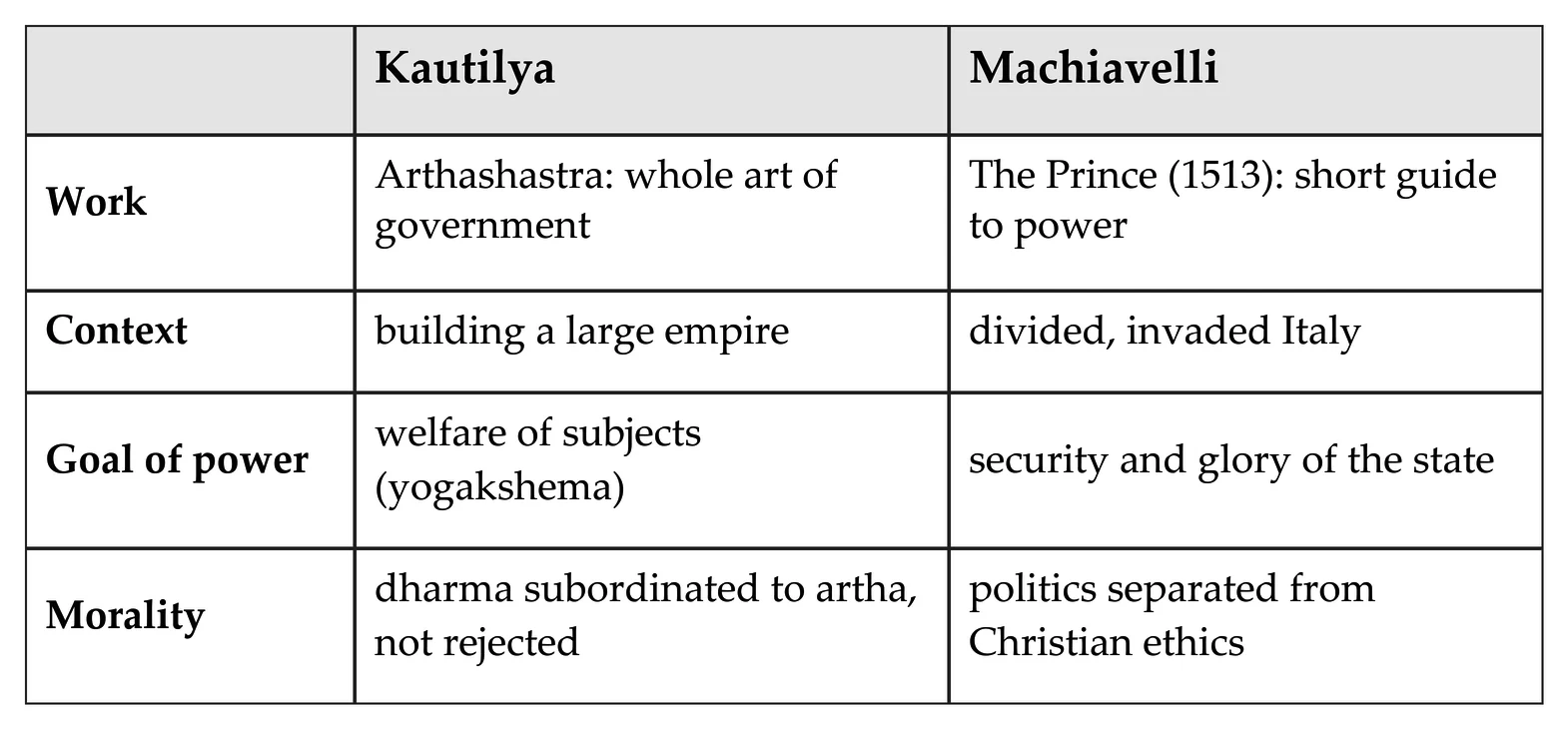
Introduction. Kautilya, who wrote the Arthashastra, and Niccolò Machiavelli, who wrote The Prince in 1513, are often compared because both studied politics realistically and advised rulers on how to gain and keep power by any effective means. The comparison has led scholars to call Kautilya the Indian Machiavelli. Yet there are important differences in their contexts, aims and views of morality.
1. Contexts
Kautilya wrote, according to tradition, in the time of Chandragupta Maurya’s rise to power, when a large empire was being built. Machiavelli wrote in sixteenth-century Italy, divided into small, weak states and invaded by foreign powers.
2. Realism
Both studied politics as it is, not as it ought to be. Machiavelli spoke of the effectual truth of things, and Kautilya frankly discussed spies, intrigue, deception and war as tools of statecraft.
3. Human Nature
Machiavelli saw people as ungrateful, fickle and self-interested. Kautilya also assumed that people and officials are prone to greed, which is why he relied on spies and punishment.
4. Ends and Means
Both accepted that the ruler may use deception and force when necessary. Machiavelli said a prince must learn how not to be good, and Kautilya advised secret methods against enemies and conspirators.
5. The Scope of Their Works
The Arthashastra is far broader than The Prince, covering administration, economics, law, taxation, foreign policy and war in great detail, while The Prince is a short work on acquiring and maintaining principalities.
6. Welfare as the Goal
Kautilya made the welfare of the subjects the purpose of power, saying the king’s happiness lies in theirs. Machiavelli focused on the security and glory of the state and the survival of the prince.
7. Morality and Dharma
Machiavelli separated politics from Christian morality. Kautilya did not reject dharma; he subordinated it to artha in practice but saw the protection of dharma as a goal of the state.
8. Religion
Machiavelli treated religion as a tool for social cohesion and criticised the Church. Kautilya accepted the Vedic order and used religious beliefs and festivals as tools of statecraft.
9. Foreign Policy
Kautilya developed systematic theories of foreign policy, the mandala, the six measures and the four upayas, while Machiavelli wrote on war and alliances in the context of Italian politics.
10. Weber’s Judgement
Max Weber remarked that compared with the Arthashastra, The Prince is harmless, emphasising the radical realism of Kautilya’s methods, such as the use of spies and assassination.
11. Scholarly Reassessment
Roger Boesche called Kautilya the first great political realist, while R.P. Kangle and L.N. Rangarajan stressed his concern for welfare, justice and good administration, warning against a one-sided comparison.
12. Differences Summarised
Kautilya wrote a comprehensive manual of government aimed at welfare within dharma, while Machiavelli wrote a short guide to power aimed at the security of the state, freed from Christian morality.
13. Relevance Today
Both thinkers are studied in international relations and strategic studies. Kautilya’s ideas are invoked in debates on Indian strategy, while Machiavelli remains central to Western political realism.
14. Kautilya’s Ethics of Means
Kautilya allowed secret methods, such as spies and assassination, mainly against enemies, traitors and conspirators, not against innocent subjects. Within the kingdom he insisted on just punishment and fair administration. This distinction between conduct towards enemies and towards subjects shows that his realism was not simple amorality.
15. Kautilya and Indian Strategic Thought
Indian strategists and scholars, such as those at the Institute for Defence Studies and Analyses, have revived Kautilya’s ideas on alliances, intelligence and the balance of power to understand India’s foreign policy, much as Western strategists study Machiavelli, Sun Tzu and Clausewitz.
16. Evaluation
Calling Kautilya the Indian Machiavelli captures his realism but misses his breadth and his commitment to welfare and dharma, so the comparison is useful but incomplete.
Conclusion. Thus, Kautilya and Machiavelli shared a realist view of politics and accepted deception and force as tools of power. But Kautilya’s Arthashastra is a far wider treatise on government directed to the welfare of the people within dharma, while Machiavelli’s The Prince focused on the survival and glory of the state. Kautilya is better seen as a realist of welfare than merely an Indian Machiavelli.
Short Notes
(a) Matsyanyaya
The law of the fishes, a condition without danda in which the strong devour the weak as big fish eat small fish; Kautilya used it to explain the need for the state.
(b) Dandaniti
The science of government or of the proper use of punishment, which Kautilya regarded as the foundation of the other three sciences: philosophy, the Vedas and economics.
(c) Yogakshema
The security and welfare of the people, i.e. acquiring what is not possessed and preserving what is possessed, which Kautilya saw as the purpose of the king’s rule.
(d) Saptanga
Kautilya’s theory of the seven elements of the state: the king, ministers, territory with people, fort, treasury, army and ally, which depend on one another like the limbs of a body.
More notes: GE-1 Ideas in Indian Political Thought
These notes are prepared by PADHO TO AISE for study help. They are not an official publication.