
Generic Electives (GE) GE-10 Digital Social Sciences
Unit I · 21 min read · Updated 27 Nov 2026
As per the University of Delhi (DU) Generic Elective (GE) syllabus offered by the Department of Political Science
Contents
- 1.1 Meaning and Dimensions of Digital Literacy
- Dimensions of Digital Literacy
- Digital Literacy in the Social Sciences
- The Digital Literacy Divide in India
- 1.2 Critical Digital Literacy and Democracy
- Polizzi: Why Critical Digital Literacy Matters
- Information Disorder
- Skills for Evaluating Information
- Digital Literacy and Citizenship
- 1.3 Public Access, Knowledge and Digital Social Science
- Perdue and Sbicca: Public Access
- The Open Access Movement
- Digital Methods and Computational Social Science
- Ethics and Limits
- 1.4 Important Questions
- What is digital literacy? Discuss its dimensions and importance for the social sciences.
- Why does critical digital literacy matter for democracy? Discuss with reference to Polizzi.
- Discuss the importance of public access to knowledge for a democratic cybersphere.
- How are digital technologies transforming the methods of the social sciences?
- Short Notes
प्रत्येक व्यक्ति को विचार और अभिव्यक्ति की स्वतंत्रता का अधिकार है; इस अधिकार में किसी भी माध्यम से और सीमाओं की परवाह किए बिना जानकारी और विचारों को खोजने, प्राप्त करने और देने की स्वतंत्रता शामिल है।
Everyone has the right to freedom of opinion and expression; this right includes freedom to hold opinions without interference and to seek, receive and impart information and ideas through any media and regardless of frontiers.
— United Nations, Universal Declaration of Human Rights (1948), Article 19
WWE now search, read, learn, argue and vote in a world shaped by screens and networks. A student researching a political question will meet scholarly articles, government data, news, opinion, propaganda and outright falsehood, all on the same screen. Digital literacy, the ability to find, evaluate, use and create information with digital tools, has therefore become essential for citizens and social scientists alike. This chapter explains the meaning of digital literacy, why critical digital literacy matters for democracy, how open access can make knowledge a public good, and how digital methods are changing the social sciences.

1.1 Meaning and Dimensions of Digital Literacy
Literacy once meant the ability to read and write. In the digital age, it has expanded to include the skills needed to use digital technologies and to make sense of the information they carry. Paul Gilster, in Digital Literacy (1997), defined it as the ability to understand and use information in multiple formats from a wide range of sources when it is presented via computers. Related ideas include information literacy, the ability to recognise when information is needed and to locate, evaluate and use it effectively, and media literacy, the ability to analyse and create media messages. UNESCO combines these as media and information literacy.
Dimensions of Digital Literacy
- Access and operation. Using devices, software and the internet, including searching, navigating and managing files.
- Finding information. Locating relevant information through search engines, databases and libraries.
- Evaluating information. Judging the reliability, accuracy, bias and purpose of sources, and distinguishing evidence from opinion and falsehood.
- Using and creating. Using information ethically, citing sources, and creating content such as reports, blogs, videos and data visualisations.
- Communicating and participating. Taking part in online discussion, collaboration and civic life responsibly.
- Safety and rights. Protecting privacy, data and security, and understanding one’s rights online.
Digital Literacy in the Social Sciences
For social scientists, digital literacy includes the ability to use online archives, databases and digital libraries, to find and evaluate official statistics and surveys, to use software for analysing data, texts and networks, and to communicate research to wider publics. It also includes understanding how digital technologies themselves shape society, politics and knowledge, which is the subject of this paper. Students of political science must learn to read government data portals, court judgments, legislative records and election data online, and to judge the credibility of think tank reports, news and social media claims.
The Digital Literacy Divide in India
Access to devices and the internet has grown rapidly in India, but digital skills remain unevenly distributed by region, class, caste, gender and age. National surveys show that a minority of Indians, and far fewer rural women, can use a computer or perform basic internet tasks. The Pradhan Mantri Gramin Digital Saksharta Abhiyan (PMGDISHA), launched in 2017, aimed to make one person in each of six crore rural households digitally literate. Bridging the literacy divide is essential if digital services and knowledge are to benefit all.
1.2 Critical Digital Literacy and Democracy
Polizzi: Why Critical Digital Literacy Matters
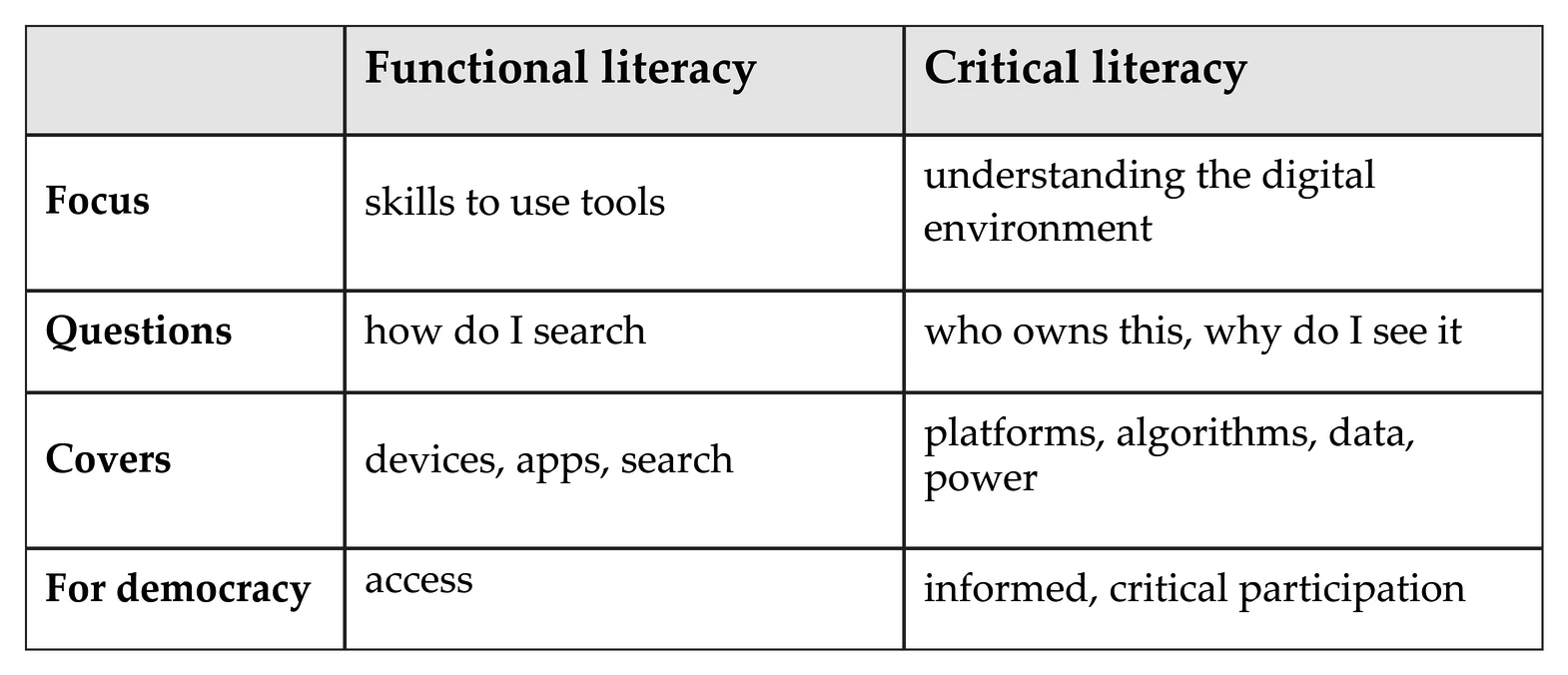
Gianfranco Polizzi, in Information Literacy in the Digital Age: Why Critical Digital Literacy Matters for Democracy (2020), distinguishes functional digital literacy, the skills to use technologies and find information, from critical digital literacy. Critical digital literacy involves understanding the digital environment itself: who owns and controls platforms, how their business models depend on advertising and data, how algorithms select what we see, how information is produced and circulated, and how this shapes power. It also involves the ability to evaluate information critically and to use digital media for civic and political participation. Polizzi argues that critical digital literacy is essential for democracy, because citizens who understand the digital environment are better able to resist manipulation, engage in informed debate and hold power to account.
Information Disorder
Claire Wardle and Hossein Derakhshan described information disorder (2017) in three forms: misinformation, false information shared without intent to harm; disinformation, false information deliberately created to harm or mislead; and malinformation, genuine information shared to cause harm, such as leaking private details. Social media allow such information to spread quickly, often through messaging apps in India, sometimes with tragic results, as when rumours of child kidnappers led to lynchings in 2018. Deepfakes created with artificial intelligence add new challenges.
Skills for Evaluating Information
- Check the source. Who produced the information, with what expertise and interest.
- Lateral reading. Leave the page and check what other reliable sources say about the claim and the source.
- Look for evidence. Distinguish claims backed by data and documents from opinion and rumour.
- Check dates and context. Old images and quotations are often shared out of context.
- Use fact-checking. Organisations such as fact-checking websites, and the International Fact-Checking Network, verify viral claims.
- Recognise bias and emotion. Content designed to provoke anger or fear spreads faster and deserves greater scrutiny.
Digital Literacy and Citizenship
Critical digital literacy supports digital citizenship: the ability to participate in public life online responsibly, to protect one’s rights, to respect others and to engage in reasoned debate. It helps citizens use tools such as the Right to Information online portal, government grievance systems and petitions, and to join social movements. Without it, citizens risk being manipulated by propaganda, trapped in filter bubbles and excluded from digital public life.
1.3 Public Access, Knowledge and Digital Social Science
Perdue and Sbicca: Public Access
Robert Todd Perdue and Joshua Sbicca, in Public Access: For Socially Relevant Knowledge Production and a Democratic Cybersphere (2013), argue that much academic knowledge, though often publicly funded, is locked behind paywalls of commercial publishers, making it inaccessible to the public, activists and scholars in poorer institutions and countries. Drawing on the idea of public sociology, promoted by Michael Burawoy in For Public Sociology (2004), they argue that social scientists should produce socially relevant knowledge and share it openly, engaging with publics beyond the academy. They call for open access publishing and a democratic cybersphere in which knowledge is a public good rather than a commodity.
The Open Access Movement
- arXiv (1991) allowed physicists to share papers freely before publication.
- The Budapest Open Access Initiative (2002) called for free online availability of research literature.
- Plan S (2018), backed by European research funders, required funded research to be published open access.
- In India, institutional repositories, the Shodhganga archive of doctoral theses (from 2011) and the One Nation One Subscription scheme, approved in 2024 to give institutions access to major journals, aim to widen access.
- Debates continue over article processing charges, which shift costs to authors, and over unauthorised sharing platforms.
Digital Methods and Computational Social Science
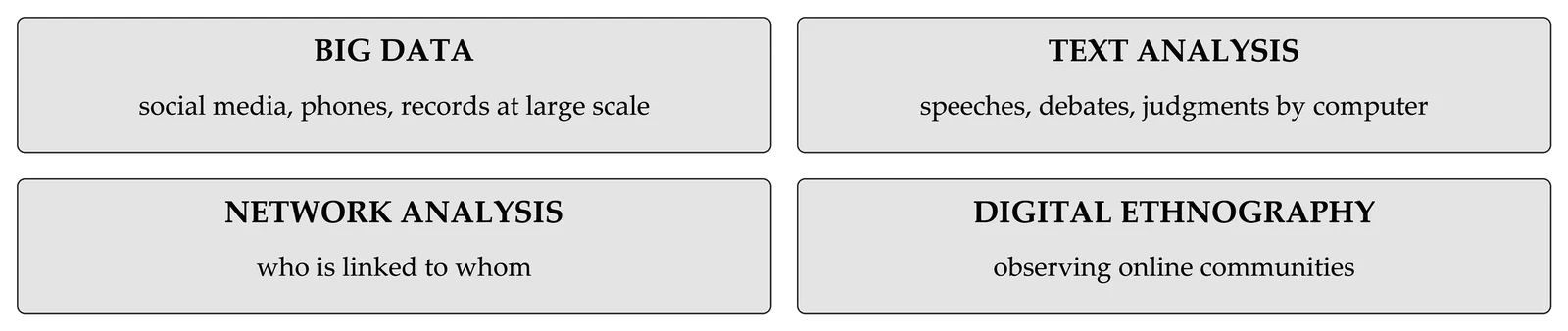
Digital technologies have also transformed how social scientists do research. David Lazer and colleagues, in Computational Social Science (2009), argued that the digital traces of everyday life, emails, phone records, social media posts and online transactions, offer new data for understanding society. New methods include big data analysis, text analysis of speeches and documents, network analysis of social connections, online surveys and experiments, and digital ethnography of online communities. Richard Rogers calls for digital methods that study the internet using its own tools, such as search engines and hyperlinks.
Ethics and Limits
Digital research raises ethical questions about privacy, consent and the use of personal data, as shown by the Cambridge Analytica scandal of 2018, in which data from millions of Facebook users were harvested for political profiling. Digital data may also be biased, representing those who are online more than those who are not, which in India often excludes the rural poor, women and older people. Social scientists must combine digital methods with critical reflection on whose voices the data capture and whose they leave out.

1.4 Important Questions
- Question 1 What is digital literacy? Discuss its dimensions and importance for the social sciences.
- Question 2 Why does critical digital literacy matter for democracy? Discuss with reference to Polizzi.
- Question 3 Discuss the importance of public access to knowledge for a democratic cybersphere.
- Question 4 How are digital technologies transforming the methods of the social sciences?
DU asks the same idea in different words. So learn one broad answer for each question below; the same answer works for every question joined by OR.
Important Question 1
What is digital literacy? Discuss its dimensions and importance for the social sciences.
OR
Distinguish between digital literacy, information literacy and media literacy.
OR
Discuss the digital literacy divide in India.
Model Answer
“The ability to understand and use information in multiple formats from a wide range of sources when it is presented via computers.”
— Paul Gilster, Digital Literacy (1997)
Introduction. In the digital age, literacy means more than reading and writing. Digital literacy, the ability to use digital technologies to find, evaluate, use and create information, has become essential for education, work and citizenship. For social scientists, it is the foundation of research and of understanding how technology shapes society.
1. Expanding Literacy
Literacy once meant the ability to read and write, but the spread of computers and the internet has expanded it to include digital skills and understanding.
2. Gilster’s Definition
Paul Gilster defined digital literacy in 1997 as the ability to understand and use information in multiple formats from many sources presented via computers.
3. Information Literacy
Information literacy is the ability to recognise when information is needed and to locate, evaluate and use it effectively, a skill central to research.
4. Media Literacy
Media literacy is the ability to analyse, evaluate and create media messages, understanding their purposes, audiences and techniques.
5. Access and Operation
The first dimension is the ability to use devices, software and the internet, including searching, navigating and managing files.
6. Finding and Evaluating Information
Digital literacy requires the ability to find relevant information and to judge its reliability, accuracy, bias and purpose.
7. Using and Creating
It includes using information ethically, citing sources and creating content such as reports, videos and data visualisations.
8. Communicating and Participating
It also involves taking part in online discussion, collaboration and civic life responsibly and respectfully.
9. Safety and Rights
Digital literacy includes protecting privacy, data and security, and understanding one’s rights and responsibilities online.
10. Importance for Social Sciences
Social scientists need digital literacy to use online archives, databases, official statistics and software for analysing data, texts and networks.
11. Understanding Digital Society
Digital literacy also means understanding how technologies shape politics, economy and culture, which is itself a key subject of social science.
12. Political Science Uses
Students of politics must read government data portals, court judgments, legislative records and election data, and judge think tank and media claims.
13. The Literacy Divide
In India, digital skills are unevenly distributed by region, class, caste, gender and age, with rural women most excluded.
14. PMGDISHA
The Pradhan Mantri Gramin Digital Saksharta Abhiyan, launched in 2017, aimed to make one person in each of six crore rural households digitally literate.
15. Beyond Skills
Digital literacy must go beyond technical skills to critical understanding, as discussed in the debate on critical digital literacy.
16. Digital Literacy and Language
Most online content is in English, while most Indians are more comfortable in Indian languages. Digital literacy in India therefore depends on content and interfaces in Indian languages, supported by initiatives such as the Bhashini language translation mission launched in 2022.
17. Digital Literacy and Employment
Digital skills are increasingly required for jobs, from using payment apps in small shops to data analysis in offices. Lack of digital literacy can exclude workers from opportunities, so digital skills are now part of national skill development programmes.
18. Evaluation
Digital literacy is now a basic capability for participation in education, work and democracy, and bridging the literacy divide is a matter of social justice.
Conclusion. Thus, digital literacy, defined by Gilster as the ability to understand and use information from many sources via computers, includes access, evaluation, creation, participation and safety. It is essential for social science research and for citizenship, and bridging India’s digital literacy divide is vital for inclusive development.
Important Question 2
Why does critical digital literacy matter for democracy? Discuss with reference to Polizzi.
OR
Distinguish between functional and critical digital literacy.
OR
Discuss the problem of misinformation and the role of digital literacy in addressing it.
Model Answer
“Whenever the people are well-informed, they can be trusted with their own government.”
— Thomas Jefferson, letter to Richard Price (1789)
Introduction. Democracy depends on informed citizens who can debate, judge claims and hold power to account. In the digital age, information reaches citizens through platforms controlled by corporations and shaped by algorithms, and misinformation spreads rapidly. Gianfranco Polizzi argues that critical digital literacy is essential for democracy in these conditions.
1. Democracy and Information
Democratic self-government requires citizens who can access reliable information and deliberate on public issues, as Jefferson observed.
2. Functional Digital Literacy
Functional digital literacy refers to the skills needed to use technologies, find information and perform tasks online.
3. Critical Digital Literacy
Critical digital literacy involves understanding the digital environment itself, its ownership, business models, algorithms and effects on power.
4. Platform Ownership
A few corporations own the main platforms, and understanding their interests helps citizens see why certain content is promoted or suppressed.
5. Business Models
Platforms earn money from advertising based on users’ data and attention, which encourages content that keeps people engaged, often sensational or divisive.
6. Algorithms
Algorithms select what users see, creating personalised feeds that may limit exposure to diverse views and produce filter bubbles.
7. Evaluating Information
Critical literacy enables citizens to check sources, read laterally, look for evidence and recognise bias and emotional manipulation.
8. Information Disorder
Wardle and Derakhshan distinguished misinformation, disinformation and malinformation, all of which threaten informed public debate.
9. Indian Examples
Rumours spread through messaging apps led to lynchings in 2018, and deepfakes and false claims have circulated during elections.
10. Resisting Manipulation
Polizzi argues that citizens who understand the digital environment are better able to resist manipulation and propaganda.
11. Civic Participation
Critical digital literacy also enables citizens to use digital media for participation, such as petitions, campaigns, RTI requests and online deliberation.
12. Holding Power to Account
Digitally literate citizens can use online data and investigative tools to scrutinise governments and corporations.
13. Fact-Checking
Fact-checking organisations verify viral claims, but their reach depends on citizens who value verification.
14. Education Policy
Polizzi argues that schools and universities should teach critical digital literacy, not only technical skills, as part of civic education.
15. Limits
Critical literacy cannot alone solve the problems of platform power and misinformation, which also require regulation and accountability of platforms.
16. Platform Regulation
Alongside literacy, governments have begun regulating platforms. India’s Information Technology Rules of 2021 require large platforms to appoint grievance officers and to trace the first originator of certain messages, a provision criticised by privacy advocates, while the European Union’s Digital Services Act of 2022 requires transparency about algorithms.
17. Elections and Digital Literacy
Election periods see intense circulation of political messages, paid content and misinformation. The Election Commission has asked platforms to follow a voluntary code of ethics since 2019, but informed and critical voters remain the strongest defence against manipulation.
18. Evaluation
Critical digital literacy is a foundation of democratic citizenship in the digital age, enabling citizens to be informed participants rather than manipulated users.
Conclusion. Thus, Polizzi shows that functional skills are not enough; critical digital literacy, understanding platforms, business models and algorithms and evaluating information, is essential for democracy. As Jefferson observed, a well-informed people can be trusted with self-government, and today being informed requires critical digital literacy.
Important Question 3
Discuss the importance of public access to knowledge for a democratic cybersphere.
OR
Examine the open access movement and its significance.
OR
Discuss Perdue and Sbicca’s argument for socially relevant knowledge production.
Model Answer
“An old tradition and a new technology have converged to make possible an unprecedented public good.”
— Budapest Open Access Initiative (2002)
Introduction. The internet makes it possible to share knowledge with anyone, anywhere, at almost no cost. Yet much academic research remains locked behind paywalls of commercial publishers. Perdue and Sbicca argue for public access to knowledge and socially relevant research as the basis of a democratic cybersphere, a vision advanced by the open access movement.
1. Knowledge as a Public Good
Knowledge is a public good: one person’s use does not reduce another’s, and its wide sharing benefits society as a whole.
2. The Paywall Problem
Much research, often publicly funded, is published in journals accessible only through expensive subscriptions, excluding the public and poorer institutions.
3. Perdue and Sbicca
Perdue and Sbicca argue that social scientists should produce socially relevant knowledge and make it publicly accessible.
4. Public Sociology
Michael Burawoy’s idea of public sociology calls on scholars to engage with publics beyond the academy, which open access makes possible.
5. A Democratic Cybersphere
Perdue and Sbicca envision a democratic cybersphere in which knowledge circulates freely and citizens can participate in producing and using it.
6. Beginnings of Open Access
arXiv, launched in 1991, allowed physicists to share papers freely before publication, showing the potential of online sharing.
7. The Budapest Initiative
The Budapest Open Access Initiative of 2002 called for free online availability of research literature, describing it as an unprecedented public good.
8. Plan S
Plan S, launched by European research funders in 2018, required research they funded to be published open access.
9. Indian Initiatives
Shodhganga provides open access to Indian doctoral theses, and the One Nation One Subscription scheme approved in 2024 gives institutions access to major journals.
10. Benefits for the Global South
Open access allows scholars, students and policymakers in poorer countries to use the latest research, reducing global knowledge inequality.
11. Benefits for Democracy
Public access allows citizens, journalists and activists to use research in public debate, strengthening evidence-based policy and accountability.
12. Article Processing Charges
Some open access models charge authors fees, which can exclude scholars from poorer institutions, shifting rather than removing inequality.
13. Unauthorised Sharing
Unauthorised platforms that share paywalled articles have raised legal and ethical debates, reflecting frustration with restricted access.
14. Quality Concerns
Predatory journals that charge fees without proper peer review threaten the credibility of open access, requiring careful evaluation by readers.
15. Open Data
Beyond articles, open government data portals such as India’s data.gov.in make public datasets available for research and accountability.
16. Wikipedia and Collaborative Knowledge
Wikipedia, launched in 2001, shows the possibilities of open, collaborative knowledge production, with volunteers writing articles in hundreds of languages, including many Indian languages. It also shows the need for critical reading, since quality varies and articles can be edited by anyone.
17. Open Educational Resources
Platforms such as SWAYAM, launched in 2017, and the National Digital Library of India offer free online courses and learning materials, extending public access to knowledge for students across the country.
18. Evaluation
Public access to knowledge is essential for a democratic cybersphere, though it requires fair funding models and attention to quality.
Conclusion. Thus, Perdue and Sbicca argue that publicly relevant knowledge must be publicly accessible to build a democratic cybersphere. The open access movement, from arXiv and the Budapest Initiative to Plan S and Indian initiatives, seeks to realise knowledge as an unprecedented public good, though challenges of cost and quality remain.
Important Question 4
How are digital technologies transforming the methods of the social sciences?
OR
Write a note on computational social science.
OR
Discuss the ethical issues in digital social research.
Model Answer
“We live life in the network.”
— David Lazer and others, Computational Social Science (2009)
Introduction. Digital technologies have transformed not only society but also the ways social scientists study it. The digital traces of everyday life provide vast new data, and new tools allow researchers to analyse texts, networks and behaviour at large scale. These changes open exciting possibilities but also raise ethical and methodological questions.
1. Digital Traces
Lazer and colleagues noted that we live life in the network, leaving digital traces through emails, phone calls, social media and online transactions.
2. Computational Social Science
Computational social science uses these data and computational methods to study social behaviour, networks and institutions at large scale.
3. Big Data Analysis
Researchers analyse large datasets from social media, mobile phones and administrative records to study patterns such as migration, opinion and mobility.
4. Text Analysis
Computer-assisted text analysis allows researchers to study thousands of speeches, debates, manifestos and judgments, identifying themes and changes over time.
5. Network Analysis
Network analysis maps connections among people, organisations and websites, revealing patterns of influence and communication.
6. Online Surveys and Experiments
The internet allows quick and inexpensive surveys and experiments, though samples may not represent the whole population.
7. Digital Ethnography
Digital ethnography studies online communities, practices and cultures through participant observation in digital spaces.
8. Digital Methods
Richard Rogers calls for digital methods that study the internet with its own tools, such as search engines, hyperlinks and platform data.
9. Digital Archives
Digitised archives, newspapers and parliamentary records allow historical and political research from anywhere, as with India’s digitised Constituent Assembly debates.
10. Indian Applications
Researchers use election data, satellite images of night lights and social media data to study politics, development and public opinion in India.
11. Privacy and Consent
Using personal data raises questions of privacy and consent, since users may not know their data are being studied.
12. Cambridge Analytica
The Cambridge Analytica scandal of 2018, in which data from millions of Facebook users were harvested for political profiling, showed the dangers of misuse.
13. Bias in Digital Data
Digital data represent those who are online more than those who are not, often excluding the rural poor, women and older people in India.
14. Access to Data
Much digital data is controlled by private platforms, which restrict researchers’ access and shape what can be studied.
15. Combining Methods
Many scholars argue for combining digital methods with traditional qualitative and quantitative research to understand context and meaning.
16. Artificial Intelligence in Research
Large language models and other AI tools can now summarise texts, code data and assist writing, raising questions about accuracy, plagiarism and the reliability of findings. Social scientists must learn to use such tools carefully, checking outputs against original sources.
17. Replication and Transparency
Digital tools allow researchers to share data and code, so that others can check and replicate findings. Open science practices improve the credibility of social science, though they must be balanced against the privacy of research participants.
18. Evaluation
Digital methods greatly expand the possibilities of social science, but they must be used critically and ethically, with attention to whose voices they capture.
Conclusion. Thus, as Lazer and colleagues observe, we live life in the network, and computational social science, text and network analysis, online surveys and digital ethnography are transforming research. Yet privacy, consent, bias and platform control require social scientists to use digital methods critically and ethically.
Short Notes
(a) Critical digital literacy
The ability not only to use digital tools but to understand how platforms, algorithms and business models shape information and power, and to participate critically in digital life.
(b) Information disorder
Wardle and Derakhshan’s term for misinformation, disinformation and malinformation that pollute the information environment.
(c) Open access
The free online availability of research publications, without subscription barriers, so that anyone can read and use them.
More notes: GE-10 Digital Social Sciences
These notes are prepared by PADHO TO AISE for study help. They are not an official publication.