

Semester VII MDSE-10 Issues in Contemporary Politics
Unit II · 20 min read · Updated 24 Nov 2026
As per the University of Delhi (DU) BA (Hons) Political Science syllabus
Contents
- 2.1 Social Exclusion and Inclusion
- 2.2 The Politics of Empowerment
- 2.3 Feminism and Emotions
- 2.4 Important Questions
- What is social exclusion? Discuss Amartya Sen’s analysis of social exclusion.
- Explain Amartya Sen’s capability approach to equality and development.
- What is empowerment? Discuss the politics of empowerment with reference to India.
- Discuss the feminist understanding of emotions in politics.
- Short Notes
विकास को लोगों की वास्तविक स्वतंत्रताओं के विस्तार की प्रक्रिया के रूप में देखा जा सकता है।
Development can be seen, it is argued here, as a process of expanding the real freedoms that people enjoy.
— Amartya Sen, Development as Freedom (1999)
SOCIAL exclusion means being shut out, fully or partly, from the economic, social and political life of a society. Inclusion means removing these barriers so that everyone can take part as an equal. Amartya Sen links exclusion with the deprivation of capabilities, the real freedoms people have to live the lives they value. The politics of empowerment asks how excluded groups can gain the power to shape their lives, and feminist thinkers show how emotions, long dismissed as private and irrational, are part of politics and knowledge. This chapter explains these ideas with examples from India.
2.1 Social Exclusion and Inclusion
Social exclusion describes how individuals and groups are kept out of the relationships, markets and institutions through which others live full lives. Amartya Sen argues that its value lies in focusing on these relational features of deprivation. Inclusion means not only removing barriers but enabling people to take part on fair terms. In India, caste, gender, tribe, religion, disability and poverty have been major sources of exclusion.
2.2 The Politics of Empowerment
Empowerment is the process by which people who have been denied power gain the ability to make choices about their lives. Naila Kabeer describes three dimensions: resources, agency and achievements. The politics of empowerment includes movements, laws and policies, such as reservations, that help excluded groups gain voice, resources and dignity.

2.3 Feminism and Emotions
Western thought often opposed reason, linked with men and public life, to emotion, linked with women and private life. Feminist thinkers such as Alison Jaggar, Martha Nussbaum, Arlie Hochschild and Sara Ahmed challenge this divide, arguing that emotions carry judgement and knowledge, that care is political, and that anger can drive struggles for justice.

2.4 Important Questions
- Question 1 What is social exclusion? Discuss Amartya Sen’s analysis of social exclusion.
- Question 2 Explain Amartya Sen’s capability approach to equality and development.
- Question 3 What is empowerment? Discuss the politics of empowerment with reference to India.
- Question 4 Discuss the feminist understanding of emotions in politics.
DU asks the same idea in different words. So learn one broad answer for each question below; the same answer works for every question joined by OR.
Important Question 1
What is social exclusion? Discuss Amartya Sen’s analysis of social exclusion.
OR
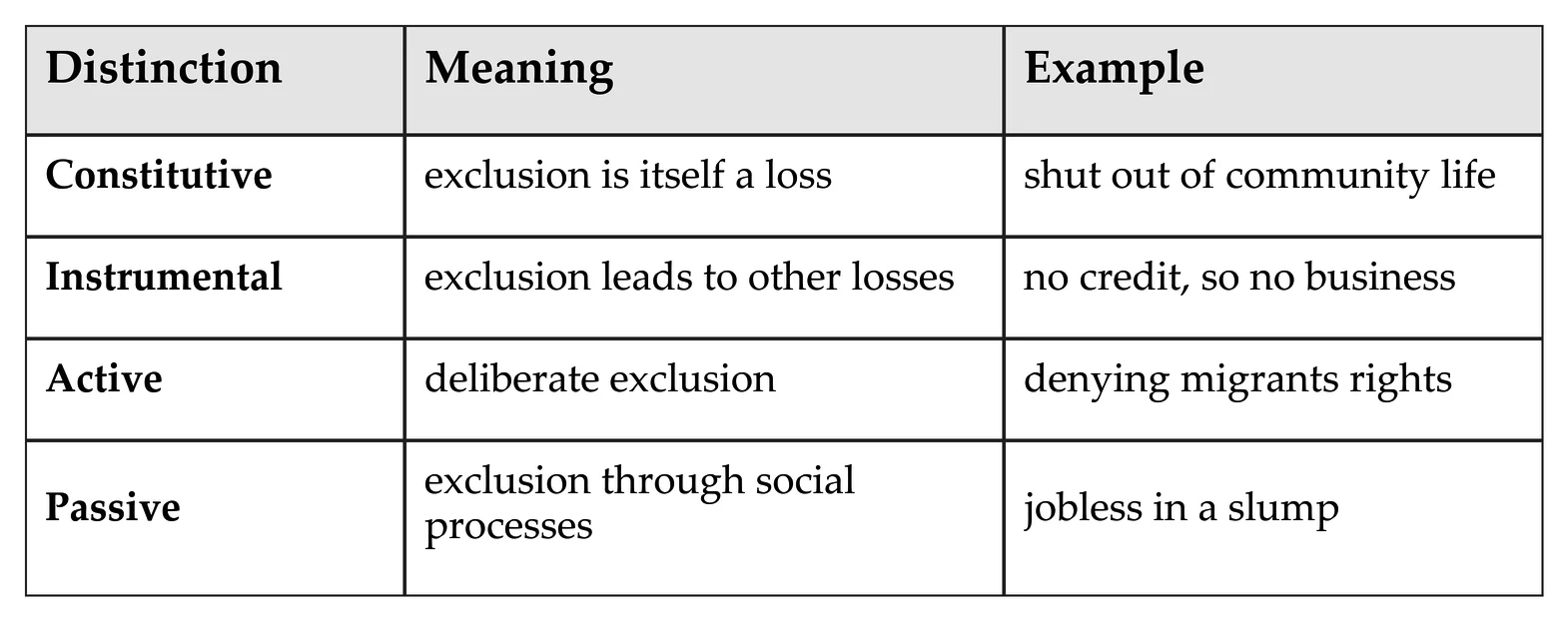
Distinguish between active and passive exclusion, and between constitutive and instrumental exclusion.
OR
Examine the problem of social exclusion and inclusion in India.
Model Answer
“A creditable day-labourer would be ashamed to appear in public without a linen shirt, the want of which would be supposed to denote that disgraceful degree of poverty.”
— Adam Smith, The Wealth of Nations (1776)
Introduction. Social exclusion refers to the processes by which individuals and groups are shut out from full participation in the economic, social and political life of their society. The idea became popular in Europe from the 1970s and was later applied to developing countries. Amartya Sen, in a 2000 paper for the Asian Development Bank, examined the concept carefully and linked it with his capability approach.
1. Meaning
Social exclusion means being kept out of the relationships, markets and institutions that others take for granted, such as jobs, credit, education, health care, housing and political participation. It focuses on how people are excluded and by whom, not only on what they lack.
2. Origin of the Term
The term was popularised by René Lenoir, a French official, whose book Les Exclus (1974) described groups such as the disabled, the elderly, abused children, single parents and other marginal people who were left out of the protection of the welfare state. The idea spread through European social policy.
3. Old Roots
Sen shows that the idea has old roots. Aristotle saw an impoverished life as one without the freedom to undertake important activities. Adam Smith argued that being unable to appear in public without shame, for lack of a linen shirt, was a real deprivation, since it excluded a person from social life.
4. Exclusion as Capability Deprivation
Sen connects social exclusion with his view of poverty as capability deprivation. Being excluded from social relations can itself be a deprivation, and it can also lead to other deprivations, such as loss of income, health or education, limiting what people can do and be.
5. Constitutive Relevance
Some exclusions have constitutive relevance: being excluded is itself a loss, whatever its further effects. For example, not being able to take part in the life of the community is in itself an impoverishment of a person’s life.
6. Instrumental Importance
Other exclusions have instrumental importance: they are not bad in themselves but lead to other deprivations. For example, exclusion from the credit market may prevent a person from starting a business, leading to poverty.
7. Active Exclusion
Active exclusion is deliberate, as when a government denies political rights or economic opportunities to immigrants or refugees, or when a dominant caste prevents Dalits from using a village well.
8. Passive Exclusion
Passive exclusion happens through social and economic processes without any deliberate attempt to exclude, as when a sluggish economy produces unemployment and poverty. Both forms need attention, but they require different policy responses.
9. Unfavourable Inclusion
Sen notes that the problem is sometimes not exclusion but unfavourable inclusion, where people are included on deeply unequal terms, such as bonded labourers or workers in exploitative jobs. Inclusion alone is not enough; its terms matter.
10. Areas of Exclusion
Sen examines exclusion from labour markets, credit markets, health care and food. He recalls that famines, such as the Bengal famine of 1943, resulted not from lack of food but from some groups losing their entitlement to buy it.
11. A Caution
Sen warns against using social exclusion as a label for every kind of deprivation. Its usefulness lies in drawing attention to the relational features of deprivation, the ways social relations and institutions cause people to be shut out.
12. Exclusion in India
In India, exclusion is rooted in caste, as untouchability denied Dalits access to temples, water and education; in tribe, as Adivasis were displaced from forests; in gender, religion and disability; and in poverty. These exclusions often overlap and reinforce each other.
13. Policies of Inclusion
The Constitution abolishes untouchability under Article 17 and permits reservations in education, jobs and legislatures. Laws such as the Scheduled Castes and Scheduled Tribes (Prevention of Atrocities) Act of 1989 and the Rights of Persons with Disabilities Act of 2016 aim at inclusion.
14. Inclusive Growth
India’s Eleventh Five Year Plan (2007–12) adopted the goal of faster and more inclusive growth, and schemes for financial inclusion, such as Jan Dhan accounts, aim to bring excluded people into the banking system.
15. Evaluation
Sen’s analysis gives social exclusion a precise meaning by linking it with capabilities and distinguishing its forms, helping policy target the causes of deprivation.
Conclusion. Thus, social exclusion means being shut out from the relationships and institutions of society. Sen links it with capability deprivation and distinguishes constitutive from instrumental exclusion, active from passive exclusion, and exclusion from unfavourable inclusion. In India, caste, gender, tribe and poverty make inclusion a central political task.
Important Question 2
Explain Amartya Sen’s capability approach to equality and development.
OR
Discuss Sen’s view of poverty as capability deprivation.
OR
Equality of what? Examine Sen’s answer in Inequality Reexamined.
Model Answer
“Poverty must be seen as the deprivation of basic capabilities rather than merely as lowness of incomes.”
— Amartya Sen, Development as Freedom (1999)
Introduction. Amartya Sen, winner of the Nobel Prize in Economics in 1998, developed the capability approach as a new way of thinking about equality, poverty and development. In Inequality Reexamined (1992), he asked what equality should be measured in, and in Development as Freedom (1999), he argued that development means expanding people’s real freedoms. His ideas inspired the Human Development Index.
1. Equality of What
Sen argues that every major theory of justice demands equality of something: utilitarians of utility, libertarians of liberties, Rawls of primary goods. The real question is not whether to be equal but equality of what, since equality in one space may mean inequality in another.
2. Human Diversity
Sen stresses that human beings differ in personal characteristics, such as age, gender, health and disability, and in external circumstances, such as climate and social environment. Because of this diversity, equal resources do not give people equal opportunities to live well.

3. Functionings
Functionings are the various things a person may value doing or being, from basic ones such as being well nourished and avoiding illness to complex ones such as taking part in community life and having self-respect.
4. Capabilities
A capability is a person’s real freedom to achieve various combinations of functionings. It reflects the alternative lives a person could choose to lead. Sen argues that justice should focus on capabilities, the freedom to achieve, rather than only on what is achieved.
5. Fasting and Starving
Sen gives the example of a rich person who fasts and a poor person who starves. Both are undernourished, so their functioning is the same, but the first has the capability to eat and chooses not to, while the second has no choice. Capability captures this difference in freedom.
6. Critique of Rawls
Sen argues that Rawls’s focus on primary goods, such as income and liberties, ignores differences in people’s ability to convert goods into freedoms. A disabled person may need more resources than others to achieve the same capabilities.
7. Poverty as Capability Deprivation
In Development as Freedom, Sen argues that poverty should be seen as deprivation of basic capabilities, not merely low income. Income matters as a means, but what matters in the end is what people can do and be.
8. Conversion Factors
The relationship between income and capability varies with age, gender, location and the health environment. An elderly or ill person needs more income to achieve the same functionings, and disadvantages often couple, making the poorest doubly deprived.
9. Evidence
Sen showed that people in Kerala and China had longer lives than many richer populations, and that African Americans in the United States had lower chances of surviving to old age than people in Kerala, despite higher incomes. Income alone does not measure well-being.
10. Missing Women
Sen drew attention to the millions of missing women in Asia and North Africa, women who would be alive if they received the same care as men. This shows how gender inequality deprives women of the most basic capability, survival.
11. Instrumental Freedoms
Sen identifies five instrumental freedoms that help expand capabilities: political freedoms, economic facilities, social opportunities such as education and health, transparency guarantees and protective security, such as social safety nets.
12. Human Development Index
Sen’s ideas influenced the Human Development Index, launched by the UNDP in 1990 with Mahbub ul Haq. It measures development by life expectancy, education and income, rather than income alone.
13. Nussbaum’s List
Martha Nussbaum developed the capability approach by proposing a list of ten central capabilities, such as life, health, bodily integrity, practical reason and affiliation. Sen refused to fix a list, preferring public reasoning to decide which capabilities matter.
14. Criticisms
Critics argue that capabilities are hard to measure, that Sen’s refusal to give a list makes the approach vague, and that it focuses on individuals rather than social structures and group power.
15. Capabilities and Democracy
Sen argues that political freedoms and democracy are part of development, not luxuries to be postponed. Democracy has intrinsic value, because participation is itself a valued capability; instrumental value, because it gives people a voice to demand attention to their needs; and constructive value, because public discussion helps societies decide which capabilities matter most and how to secure them.
16. Evaluation
The capability approach has transformed thinking about equality, poverty and development by putting human freedom and diversity at the centre.
Conclusion. Thus, Sen answers the question of equality of what by pointing to capabilities, people’s real freedoms to achieve valued functionings. He sees poverty as capability deprivation and development as the expansion of freedom. His approach shaped the Human Development Index, though critics question its measurement and vagueness.
Important Question 3
What is empowerment? Discuss the politics of empowerment with reference to India.
OR
Examine the meaning and dimensions of empowerment.
OR
How have marginalised groups in India sought empowerment through politics?
Model Answer
“On the 26th of January 1950, we are going to enter into a life of contradictions. In politics we will have equality and in social and economic life we will have inequality.”
— B.R. Ambedkar, Constituent Assembly (25 November 1949)
Introduction. Empowerment means the process by which people who have been denied power gain the ability to make choices and shape their lives. It is closely linked with inclusion, because excluded groups need not only access to resources but also voice and agency. In India, the politics of empowerment has involved movements of Dalits, Adivasis, backward classes and women, as well as laws and policies of the state.
1. Meaning
Naila Kabeer defines empowerment as the expansion in people’s ability to make strategic life choices in a context where this ability was previously denied to them. It is a process of change from a condition of disempowerment, not simply a state of having power.
2. Kabeer’s Three Dimensions
Kabeer identifies three interrelated dimensions: resources, including material, human and social resources; agency, the ability to define one’s goals and act on them; and achievements, the outcomes in well-being that result. Resources and agency together make up capabilities.
3. Forms of Power
Jo Rowlands distinguished power over others, power to act, power with others through collective action and power within, meaning self-confidence and dignity. Empowerment involves all these, not just gaining control over others.
4. Freire and Consciousness
Paulo Freire, in Pedagogy of the Oppressed, argued that the oppressed must become aware of the causes of their oppression through dialogue and critical education. This process of conscientisation is the beginning of empowerment.
5. Sen and Agency
Amartya Sen emphasises agency, the ability of people to act and bring about change. He argues that women’s agency, through literacy, employment and property rights, improves not only their own well-being but also child survival and social change.
6. Ambedkar’s Vision
B.R. Ambedkar warned that political equality without social and economic equality would be a life of contradictions. His call to educate, agitate and organise inspired Dalit movements to seek empowerment through education, struggle and political organisation.
7. Constitutional Measures
The Constitution provides for reservations for Scheduled Castes and Scheduled Tribes in legislatures, jobs and education, and permits special provisions for socially and educationally backward classes, women and children, as tools of empowerment.
8. Backward Class Politics
The implementation of the Mandal Commission report in 1990, giving reservation to Other Backward Classes in central jobs, transformed Indian politics. Parties representing backward classes and Dalits, such as the Bahujan Samaj Party founded by Kanshi Ram in 1984, gained power in several states.
9. Women’s Empowerment
The 73rd and 74th Amendments reserved one-third of seats in local bodies for women, raised to half in many states. The 106th Amendment of 2023 provides for one-third reservation for women in the Lok Sabha and state assemblies after the next delimitation.
10. Self-Help Groups
Self-help groups of women, supported by banks and programmes such as the National Rural Livelihoods Mission, provide savings, credit and collective strength, and have helped many women gain income and confidence.
11. Rights-Based Laws
Laws such as the Right to Information Act, the National Rural Employment Guarantee Act, the Forest Rights Act of 2006 and the Right to Education Act give marginalised people enforceable rights, shifting from charity to entitlement.
12. Recognition and Redistribution
Nancy Fraser argues that justice requires both redistribution of resources and recognition of identities that have been disrespected. Empowerment of Dalits, women and minorities involves both material gains and dignity.
13. Limits
Empowerment policies face limits: benefits may go to a better-off section, women representatives may be controlled by male relatives, and empowerment language may be used by states and NGOs without changing power structures.
14. Empowerment as Struggle
Empowerment cannot simply be given from above; it is won through struggle and organisation. Movements of Dalits, Adivasis, women and workers show that the excluded empower themselves by organising and demanding rights.
15. Adivasi Empowerment
Adivasi movements have sought control over land, forests and resources. The Panchayats (Extension to the Scheduled Areas) Act of 1996 gave gram sabhas in tribal areas powers over local resources, and in 2013 the gram sabhas of Niyamgiri in Odisha rejected bauxite mining on their sacred hill after the Supreme Court asked for their views, a notable example of community empowerment.
16. Evaluation
The politics of empowerment combines resources, agency and recognition, and in India it has changed the social base of power, though deep inequalities remain.
Conclusion. Thus, empowerment is the expansion of people’s ability to make strategic life choices, involving resources, agency and achievements, as Kabeer explains. In India, Ambedkar’s vision, reservations, backward class and Dalit politics, women’s reservation and rights-based laws have advanced empowerment, though elite capture and proxy control limit its reach.
Important Question 4
Discuss the feminist understanding of emotions in politics.
OR
How have feminists challenged the opposition between reason and emotion?
OR
Examine the role of care and anger in feminist politics.
Model Answer
“One is not born, but rather becomes, a woman.”
— Simone de Beauvoir, The Second Sex (1949)
Introduction. Western political thought has usually treated reason as the basis of politics and emotion as private, irrational and dangerous. Because reason was associated with men and emotion with women, this divide helped exclude women from public life. Feminist thinkers have challenged it, showing that emotions involve judgement, that care is a political value, and that emotions such as anger can drive struggles for justice.
1. The Reason–Emotion Divide
From Plato’s image of reason controlling the passions to Kant’s ethics of duty, Western philosophy placed reason above emotion. Genevieve Lloyd, in The Man of Reason (1984), showed how the ideal of reason was defined in masculine terms, by excluding qualities associated with women.
2. Public and Private
The divide was linked with the separation of public and private spheres. Men were seen as rational citizens fit for politics, while women were confined to the home, where emotions and care belonged. Feminists argue that this separation hid power relations within the family.
3. Wollstonecraft and Beauvoir
Mary Wollstonecraft argued in 1792 that women are as rational as men and should be educated accordingly. Simone de Beauvoir showed that women are made, not born, as society defines woman as the Other of man, including by labelling her emotional.
4. Jaggar on Emotion and Knowledge
Alison Jaggar, in ‘Love and Knowledge’ (1989), argued that emotions are not opposed to knowledge but are part of how we understand the world. She described outlaw emotions, such as anger at a sexist joke, which conflict with dominant values and can lead to feminist insight.
5. Nussbaum on Emotions
Martha Nussbaum, in Upheavals of Thought (2001), argued that emotions are evaluative judgements about what matters to us. In Political Emotions (2013), she argued that just societies need to cultivate emotions such as compassion and love to sustain commitment to justice.
6. The Ethic of Care
Carol Gilligan, in In a Different Voice (1982), argued that women often reason in terms of care and relationships rather than abstract rules. Nel Noddings and others developed an ethic of care that values attention, responsibility and responsiveness to others’ needs.
7. Care as Political
Joan Tronto, in Moral Boundaries (1993), argued that care is not only a private virtue but a political concern. Who does care work, who receives care and how it is valued are questions of justice, since care work is mostly done by women and poorly rewarded.
8. Emotional Labour
Arlie Hochschild, in The Managed Heart (1983), described emotional labour, the work of managing one’s feelings to produce a required emotional display, as flight attendants must smile. Such labour is often expected of women and is unrecognised.
9. Unpaid Care in India
In India, time use surveys show that women spend several times more time than men on unpaid domestic and care work. Feminists argue that recognising, reducing and redistributing this work is necessary for gender equality.
10. The Uses of Anger
Audre Lorde, in ‘The Uses of Anger’ (1981), argued that women’s anger at racism and sexism is a source of energy for change, not something to be suppressed. Anger has fuelled many feminist movements.
11. Ahmed on the Politics of Emotion
Sara Ahmed, in The Cultural Politics of Emotion (2004), argued that emotions are social and political, shaping how bodies and groups are seen. Emotions such as hate and fear stick to certain groups, while feminists who point out sexism are labelled killjoys.
12. Emotions in Movements
Emotions play a large role in feminist movements, as in the protests after the Delhi gang rape of 2012, the #MeToo movement from 2017 and the women-led sit-in at Shaheen Bagh in 2019–20, where grief, anger and solidarity mobilised people.
13. Risks
Some feminists warn that linking women with care and emotion may reinforce stereotypes. Emotions can also be manipulated by populist leaders to spread fear and hatred, so emotions need critical reflection.
14. Beyond the Divide
Feminists do not reject reason but argue for an understanding of politics in which reason and emotion work together, where compassion and anger inform judgement and care is valued as a public good.
15. Emotions and Citizenship
Feminists argue that good citizenship involves emotions such as empathy, solidarity and a sense of injustice, not only rational argument. Iris Marion Young criticised deliberative democracy for privileging calm, dispassionate speech, which can silence those who express their claims through testimony, storytelling or passion, often women and marginalised groups. Recognising these forms of speech makes democracy more inclusive.
16. Evaluation
Feminist thought has shown that emotions are part of politics and knowledge, making visible the care work and feelings that sustain social life.
Conclusion. Thus, feminists challenge the divide between male reason and female emotion. Jaggar shows that emotions carry knowledge, Nussbaum that they involve judgement, Tronto that care is political and Lorde that anger can drive change. From unpaid care to protest movements, emotions are central to feminist politics, though they must be critically examined.
Short Notes
(a) Unfavourable inclusion
Sen’s term for inclusion on deeply unequal terms, such as exploitative work, where the problem is not being shut out but being included unfairly.
(b) Capability
In Sen’s approach, a person’s real freedom to achieve valued functionings, the beings and doings that make up a good life.
(c) Outlaw emotions
Alison Jaggar’s term for emotions, such as anger at injustice, that conflict with dominant values and can lead to critical and feminist understanding.
(d) Emotional labour
Arlie Hochschild’s term (1983) for the work of managing one’s own feelings to display the emotions a job requires, often expected of women and rarely recognised or paid.
More notes: MDSE-10 Issues in Contemporary Politics
These notes are prepared by PADHO TO AISE for study help. They are not an official University of Delhi publication.