
Semester VII MDSE-8 Understanding Globalisation
Unit IV · 17 min read · Updated 24 Nov 2026
As per the University of Delhi (DU) BA (Hons) Political Science syllabus
Contents
- 4.1 Regionalism and Globalisation
- 4.2 ASEAN and the EU
- 4.3 BRICS and the G-21
- 4.4 Important Questions
- Discuss the evolution, structure and role of ASEAN.
- Discuss the evolution and working of the European Union.
- Discuss the origin, objectives and significance of BRICS.
- Discuss the G-21 and the role of developing-country coalitions in global trade negotiations.
- Short Notes
यूरोप न तो एक साथ बनेगा, न किसी एक योजना से। वह ठोस उपलब्धियों से बनेगा, जो पहले वास्तविक एकजुटता पैदा करेंगी।
Europe will not be made all at once, or according to a single plan. It will be built through concrete achievements which first create a de facto solidarity.
— Robert Schuman, Schuman Declaration (9 May 1950)
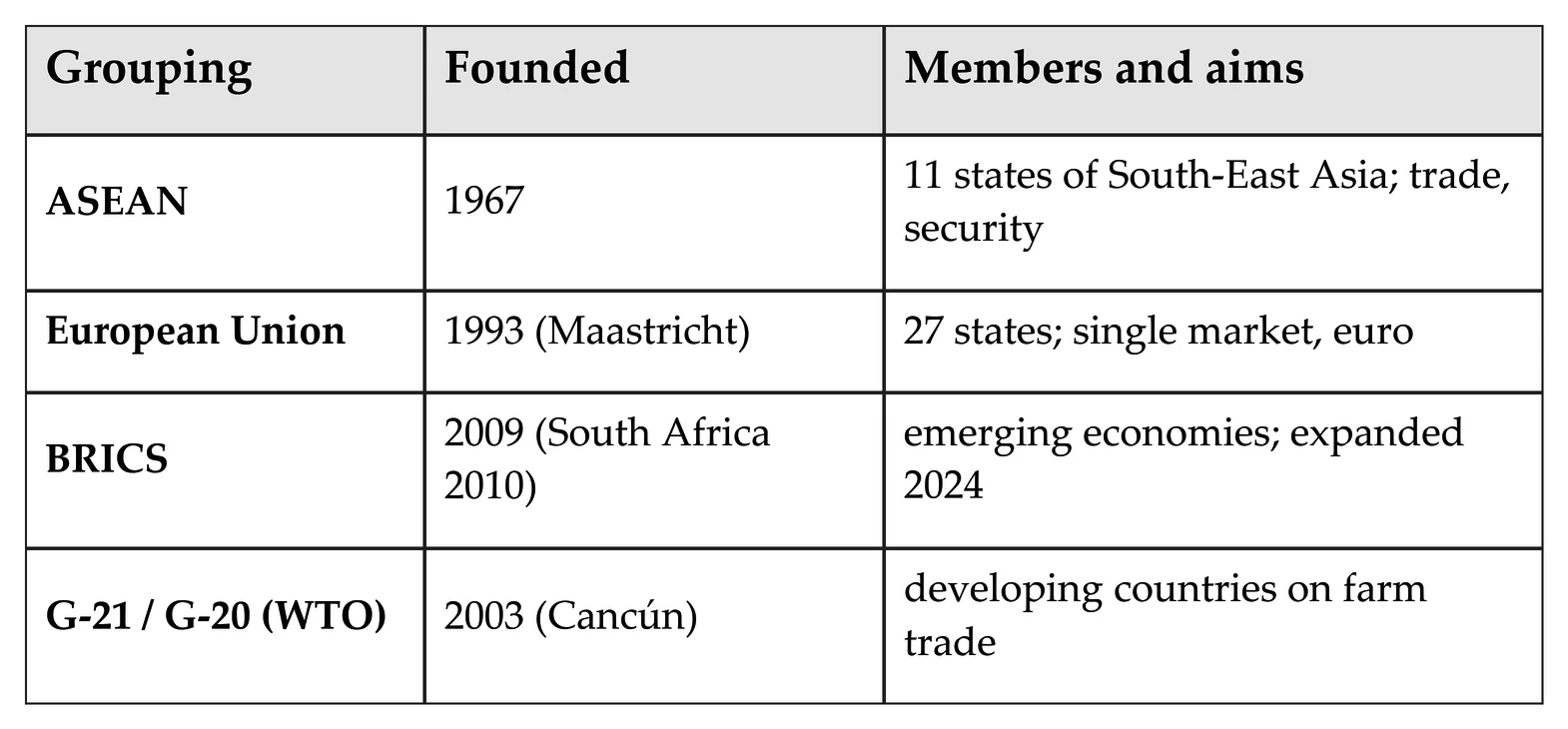
AALONGSIDE globalisation, the world has seen a rise of regionalism: groups of countries cooperating to promote trade, security and a stronger collective voice. This chapter studies four important groupings named in the syllabus. The Association of Southeast Asian Nations (ASEAN) has built cooperation among diverse countries of South-East Asia. The European Union (EU) is the most advanced example of regional integration. BRICS brings together major emerging economies. The G-21, a coalition of developing countries formed at the WTO in 2003, fought for fairer agricultural trade. India’s relationship with each is also examined.
4.1 Regionalism and Globalisation
Regionalism is cooperation among countries in a region, through trade agreements, common institutions and political coordination. It can be a building block of globalisation, preparing countries for wider integration, or a stumbling block, creating rival blocs. Some groupings, such as the EU and ASEAN, are regional; others, such as BRICS and the G-21, bring together countries from different continents with shared interests, and are better called plurilateral groupings.
4.2 ASEAN and the EU
ASEAN, founded in 1967, has grown to eleven members and built economic, political and socio-cultural cooperation through the ASEAN Way of consensus and non-interference. The European Union began with the European Coal and Steel Community of 1951 and developed into a union of twenty-seven states with a single market, a common currency for many members and supranational institutions. Both are important partners for India.
4.3 BRICS and the G-21
BRICS, originally Brazil, Russia, India and China, joined by South Africa and later by other countries, seeks a greater voice for emerging economies and created the New Development Bank. The G-21, formed at the WTO in 2003 under the leadership of Brazil, India, China and South Africa, challenged rich countries’ agricultural subsidies. It should not be confused with the G20 of major economies, which India chaired in 2023.
4.4 Important Questions
- Question 1 Discuss the evolution, structure and role of ASEAN.
- Question 2 Discuss the evolution and working of the European Union.
- Question 3 Discuss the origin, objectives and significance of BRICS.
- Question 4 Discuss the G-21 and the role of developing-country coalitions in global trade negotiations.
DU asks the same idea in different words. So learn one broad answer for each question below; the same answer works for every question joined by OR.
Important Question 1
Discuss the evolution, structure and role of ASEAN.
OR
Examine the ‘ASEAN Way’ of regional cooperation.
OR
Discuss India’s relations with ASEAN.
Model Answer
“To accelerate the economic growth, social progress and cultural development in the region through joint endeavours in the spirit of equality and partnership.”
— ASEAN Declaration (Bangkok, 1967)
Introduction. The Association of Southeast Asian Nations is one of the most successful regional organisations in the developing world. Founded in 1967 during the Cold War, it has brought together diverse countries of South-East Asia, helped keep peace among them and built economic integration. It is also central to the wider regional architecture of Asia and to India’s Act East policy.
1. Founding
ASEAN was founded on 8 August 1967 by the Bangkok Declaration, signed by Indonesia, Malaysia, the Philippines, Singapore and Thailand, amid the Vietnam War and fears of communism and regional conflict.
2. Expansion
Brunei joined in 1984, Vietnam in 1995, Laos and Myanmar in 1997 and Cambodia in 1999. Timor-Leste became the eleventh member in 2025, making ASEAN cover almost all of South-East Asia.
3. Aims
ASEAN aims to accelerate economic growth, social progress and cultural development, promote regional peace and stability and cooperate on common problems.
4. The ASEAN Way
ASEAN’s approach, called the ASEAN Way, emphasises consensus, informal consultation, non-interference in members’ internal affairs and the peaceful settlement of disputes, set out in the Treaty of Amity and Cooperation of 1976.
5. Economic Integration
The ASEAN Free Trade Area, agreed in 1992, reduced tariffs among members. The ASEAN Economic Community, launched in 2015, aims at a single market and production base.
6. The ASEAN Charter and Community
The ASEAN Charter, which came into force in 2008, gave ASEAN legal personality. The ASEAN Community rests on three pillars: political-security, economic and socio-cultural.
7. ASEAN Centrality
ASEAN convenes wider forums, such as the ASEAN Regional Forum (1994), ASEAN Plus Three and the East Asia Summit (2005), placing itself at the centre of Asian regional cooperation.
8. RCEP
ASEAN led the negotiation of the Regional Comprehensive Economic Partnership, signed in 2020 with China, Japan, South Korea, Australia and New Zealand. India withdrew in 2019.
9. India and ASEAN
India became a sectoral dialogue partner in 1992 and a full dialogue partner in 1995. Relations grew under the Look East and Act East policies, with an ASEAN–India trade agreement in goods signed in 2009 and a comprehensive strategic partnership in 2022.
10. Connectivity
India and ASEAN are building connectivity through the India–Myanmar–Thailand Trilateral Highway and the Kaladan project, linking India’s north-east with South-East Asia.
11. Challenges
ASEAN faces disputes in the South China Sea with China, divisions among members, and the crisis in Myanmar after the military coup of 2021, which tested its principle of non-interference.
12. Criticisms
Critics argue that the ASEAN Way makes the organisation slow and weak, unable to resolve disputes or protect human rights, while supporters credit it with keeping peace in a diverse region.
13. Significance
ASEAN has turned a region of conflict into one of cooperation and growth, showing that developing countries can build effective regional institutions.
14. Future
ASEAN’s future depends on maintaining unity amid rivalry between the United States and China and deepening economic integration.
15. Peace and Security
One of ASEAN’s greatest achievements is that no war has broken out between its founding members since 1967, despite earlier disputes such as the confrontation between Indonesia and Malaysia. Through regular meetings, confidence-building and norms of non-interference, ASEAN created a security community in which members expect to settle differences peacefully.
16. Evaluation
ASEAN is a successful example of regionalism in the developing world, built on consensus and gradual cooperation, and is a key partner for India.
Conclusion. Thus, ASEAN, founded in 1967 and now with eleven members, has built economic, political and socio-cultural cooperation through the ASEAN Way of consensus and non-interference. It is central to Asian regionalism and India’s Act East policy, though disputes, divisions and the Myanmar crisis test its unity.
Important Question 2
Discuss the evolution and working of the European Union.
OR
Examine the European Union as a model of regional integration.
OR
Discuss the challenges facing the European Union.
Model Answer
“The Union is founded on the values of respect for human dignity, freedom, democracy, equality, the rule of law and respect for human rights.”
— Treaty on European Union, Article 2
Introduction. The European Union is the most advanced example of regional integration in the world. Born from the desire to prevent another war after 1945, it has developed from a coal and steel community of six countries into a union of twenty-seven states with a single market, common institutions and, for many members, a common currency. It shows both the possibilities and the difficulties of pooling sovereignty.
1. Origins
After two world wars, European leaders sought to make war between France and Germany impossible. The Schuman Declaration of 1950 proposed pooling coal and steel production, leading to the European Coal and Steel Community in 1951.
2. The Treaty of Rome
In 1957, the Treaty of Rome created the European Economic Community, a common market among six countries: France, West Germany, Italy, Belgium, the Netherlands and Luxembourg.
3. The Single Market
The Single European Act of 1986 aimed to complete a single market with free movement of goods, services, capital and people, achieved by 1993.
4. Maastricht and the Euro
The Maastricht Treaty, in force from 1993, created the European Union and planned a common currency. The euro was introduced in 1999 and as notes and coins in 2002; twenty members now use it.
5. Enlargement
The EU expanded from six to twenty-eight members, notably with ten new members in 2004, many from Central and Eastern Europe, spreading democracy and markets after the Cold War.
6. Institutions
The EU’s main institutions are the European Commission, which proposes laws; the Council of the EU, representing governments; the European Parliament, directly elected since 1979; the Court of Justice; and the European Central Bank.
7. Pooled Sovereignty
Member states pool sovereignty in areas such as trade, competition and, for euro members, monetary policy. EU law takes precedence over national law in these areas, making the EU partly supranational.
8. Normative Power
The scholar Ian Manners described the EU as a normative power, which influences the world by promoting values such as democracy, human rights and the rule of law rather than by military force.
9. Brexit
In a referendum in 2016, Britain voted to leave the EU, and it left on 31 January 2020, the first member to do so, reflecting concerns about sovereignty and migration.
10. Crises
The EU faced the eurozone debt crisis from 2010, the migration crisis of 2015 and challenges from Russia’s invasion of Ukraine in 2022, testing its solidarity.
11. The Democratic Deficit
Critics argue that EU decision-making is distant from citizens and dominated by unelected officials, a problem called the democratic deficit, which fuels Euroscepticism.
12. India and the EU
The EU is one of India’s largest trading partners. India and the EU have held summits since 2000 and relaunched negotiations on a free trade agreement in 2022.
13. A Model for Others
The EU has inspired other regional organisations, though its deep integration depends on conditions, such as shared values and economic levels, that are not easily replicated.
14. Achievements
The EU has helped maintain peace among its members for decades, created the world’s largest single market and promoted democracy and human rights.
15. Evaluation
The EU is the most advanced regional organisation, pooling sovereignty successfully, though crises and Euroscepticism challenge its future.
Conclusion. Thus, the European Union developed from the Coal and Steel Community of 1951 through the Treaty of Rome and Maastricht into a union of twenty-seven states with a single market and, for many, a common currency. It pools sovereignty through supranational institutions and promotes democratic values, though Brexit, economic crises and the democratic deficit challenge it.
Important Question 3
Discuss the origin, objectives and significance of BRICS.
OR
Examine the role of BRICS in reforming global governance.
OR
Discuss India’s role in BRICS.
Model Answer
“We are committed to advance the reform of international financial institutions, so as to reflect changes in the world economy.”
— Joint Statement of the BRIC Leaders, Yekaterinburg (2009)
Introduction. BRICS is a grouping of major emerging economies. The acronym BRIC was coined in 2001 by the economist Jim O’Neill for Brazil, Russia, India and China, which he expected to become major economies. The four countries began holding summits in 2009, South Africa joined in 2010, and the group expanded further in 2024 and 2025. BRICS seeks a greater voice for emerging economies in global governance.
1. Origins of the Term
In 2001, Jim O’Neill of Goldman Sachs grouped Brazil, Russia, India and China as fast-growing economies that would reshape the world economy, coining the term BRIC.
2. From Idea to Grouping
Foreign ministers of the four countries began meeting in 2006, and the first leaders’ summit was held in Yekaterinburg, Russia, in 2009. South Africa joined in 2010, making the group BRICS.
3. Objectives
BRICS aims to reform international institutions such as the IMF and World Bank to reflect the rise of emerging economies, promote economic cooperation among members and strengthen the voice of the global South.
4. The New Development Bank
In 2014, BRICS agreed to create the New Development Bank, headquartered in Shanghai, to finance infrastructure and sustainable development. Its first president was K.V. Kamath of India.
5. The Contingent Reserve Arrangement
BRICS also set up a Contingent Reserve Arrangement of 100 billion dollars to help members facing balance-of-payments pressures, as a supplement to the IMF.
6. Expansion
In 2024, Egypt, Ethiopia, Iran and the United Arab Emirates joined BRICS, and Indonesia joined in 2025. A category of partner countries was also created, expanding the group’s reach.
7. Cooperation Areas
BRICS cooperates on trade, finance, health, science, counter-terrorism and people-to-people exchanges, and its members coordinate positions in forums such as the G20 and the UN.
8. India’s Role
India is a founding member and has hosted BRICS summits. It values BRICS as a platform for reforming global governance and promoting the interests of developing countries, while resisting attempts to make it an anti-Western bloc.
9. Internal Differences
BRICS members differ greatly in political systems, economic interests and foreign policies. Tensions between India and China and differences over relations with the West limit the group’s unity.
10. Debates on De-dollarisation
Some members have promoted trade in national currencies to reduce dependence on the US dollar, but proposals for a common BRICS currency have not been agreed, and India has been cautious.
11. Criticisms
Critics argue that BRICS is too diverse to act coherently, that China dominates it and that its achievements, apart from the New Development Bank, are limited.
12. Significance
BRICS reflects the shift of economic power towards emerging economies and the demand for a more multipolar world order.
13. BRICS and the Global South
BRICS presents itself as a voice of the global South, though its members are major economies whose interests do not always match those of poorer countries.
14. Future
BRICS’s future depends on whether its expanded membership can agree on common goals and whether it can build effective institutions.
15. BRICS and the G20
BRICS members also act within the G20, where they press for reforms of global institutions, such as larger quotas for emerging economies at the IMF. India, Brazil and South Africa held successive G20 presidencies from 2023 to 2025, using them to highlight the concerns of developing countries, including debt relief, climate finance and inclusive growth.
16. Evaluation
BRICS is an important platform for emerging economies to seek reform of global governance, though its diversity limits its coherence.
Conclusion. Thus, BRICS grew from an economist’s acronym of 2001 into a grouping of major emerging economies that held its first summit in 2009 and expanded in 2024–25. It seeks reform of global institutions and created the New Development Bank, and India values it as a voice for the global South, though internal differences limit its unity.
Important Question 4
Discuss the G-21 and the role of developing-country coalitions in global trade negotiations.
OR
Examine the role of the G-21 at the WTO.
OR
Distinguish between the G-21 of developing countries and the G20 of major economies.
Model Answer
“The majority of WTO Members are developing countries. We seek to place their needs and interests at the heart of the Work Programme adopted in this Declaration.”
— WTO Doha Ministerial Declaration (2001)
Introduction. In global trade negotiations, developing countries have often been weaker than rich countries. To increase their bargaining power, they have formed coalitions. The most important was the G-21, a group of developing countries formed in 2003 before the WTO ministerial conference at Cancún, led by Brazil, India, China and South Africa. It challenged the agricultural subsidies of rich countries and changed the dynamics of WTO negotiations.
1. The Doha Round
The Doha Round, launched in 2001, promised to place developing countries’ needs at the centre of trade negotiations, especially on agriculture, where rich countries’ subsidies hurt farmers in poor countries.
2. The US–EU Proposal
Before the Cancún meeting of 2003, the United States and the European Union put forward a joint proposal on agriculture that developing countries felt protected rich countries’ subsidies while demanding market opening from the poor.
3. Formation of the G-21
In response, developing countries led by Brazil, India, China and South Africa formed a coalition. Its membership varied, so it was called the G-20, G-21 or G-22 at different times, but it represented a large share of the world’s population and farmers.
4. Demands
The G-21 demanded substantial cuts in rich countries’ trade-distorting farm subsidies, the elimination of export subsidies and greater market access for developing countries’ agricultural products, while protecting their own vulnerable farmers.
5. Cancún
At Cancún, the G-21’s refusal to accept the US–EU proposal, together with disputes over new issues such as investment and competition, led to the collapse of the conference, showing developing countries’ new collective power.
6. Significance
The G-21 transformed WTO negotiations, which could no longer be decided by the United States and Europe alone. Brazil and India became central participants in later negotiations.
7. Other Coalitions
Other developing-country coalitions include the G-33, which defends developing countries’ right to protect food security and rural livelihoods, and in which India plays a leading role, and the African Group.
8. India’s Role
India used coalitions such as the G-21 and G-33 to defend its farmers, its public stockholding of food grains and its policy space, becoming a leading voice of developing countries at the WTO.
9. The G20 of Major Economies
The G-21 should not be confused with the G20 of major economies, formed in 1999 as a forum of finance ministers and raised to leaders’ level in 2008 to respond to the global financial crisis. It includes both developed and emerging economies.
10. India’s G20 Presidency
India held the presidency of the G20 in 2023, with the theme ‘One Earth, One Family, One Future’. At the New Delhi summit, the African Union was admitted as a permanent member, strengthening the voice of the global South.
11. Limits of Coalitions
Developing-country coalitions face internal differences, for example between agricultural exporters such as Brazil and countries protecting small farmers such as India, which can weaken their unity.
12. Stalemate at the WTO
Although coalitions increased developing countries’ power, the Doha Round has remained stalled, and many countries have turned to regional and bilateral trade agreements.
13. South–South Cooperation
Coalitions such as the G-21 reflect growing South–South cooperation, in which developing countries work together to change rules made by rich countries.
14. Lessons
The experience of the G-21 shows that collective action can increase the bargaining power of weaker countries in global governance.
15. Evaluation
The G-21 was a turning point in global trade politics, giving developing countries a stronger collective voice, though it could not by itself deliver a fair outcome to the Doha Round.
Conclusion. Thus, the G-21, formed at the WTO in 2003 under the leadership of Brazil, India, China and South Africa, challenged rich countries’ farm subsidies and helped cause the collapse of the Cancún meeting, transforming trade negotiations. It is distinct from the G20 of major economies, which India chaired in 2023, and shows the power of developing-country coalitions.
Short Notes
(a) ASEAN Way
ASEAN’s style of cooperation based on consensus, informal consultation, non-interference in members’ internal affairs and peaceful settlement of disputes.
(b) Pooled sovereignty
The sharing of decision-making authority among states in common institutions, as in the European Union, where members accept common rules in areas such as trade and currency.
(c) New Development Bank
A multilateral development bank set up by BRICS in 2014, headquartered in Shanghai, to finance infrastructure and sustainable development in emerging and developing countries.
(d) G20
A forum of nineteen major economies, the European Union and, since 2023, the African Union, formed in 1999 and raised to leaders’ level in 2008. India held its presidency in 2023. It is distinct from the G-21 coalition of developing countries at the WTO.
More notes: MDSE-8 Understanding Globalisation
These notes are prepared by PADHO TO AISE for study help. They are not an official University of Delhi publication.