
Semester VII DSE-6 The Idea of the Political: Perspectives from the Indian Intellectual Tradition
Unit I · 21 min read · Updated 24 Nov 2026
As per the University of Delhi (DU) BA (Hons) Political Science syllabus
Contents
- 1.1 Gyan: Knowledge and Its Sources
- 1.2 Listening and Learning
- 1.3 Chetna: Consciousness
- 1.4 Maitri: Friendship and Inter-State Relations
- 1.5 Important Questions
- Discuss the idea of knowledge (gyan) in the Indian intellectual tradition.
- Discuss the significance of listening and the methods of learning in the ancient Indian tradition.
- Discuss the concept of consciousness (chetna) in Indian philosophy.
- Discuss the idea of maitri and its implications for inter-state relations in ancient India.
- Short Notes
विद्या ददाति विनयम्।
Knowledge gives humility.
— Narayana, Hitopadesha
HOW do we know what we know, and what kind of knowledge should guide a ruler and a society? Indian thinkers asked these questions for more than two thousand years, developing rich theories of gyan (knowledge), chetna (consciousness) and maitri (friendship). Modern political science, shaped largely by European thought, has often ignored this tradition. This unit shows how Indian ideas of knowing, of the knowing self and of friendship towards others offer resources for understanding the political. It draws on Bimal Krishna Matilal, J.N. Mohanty, A.S. Altekar, Bina Gupta, Kisor Chakrabarti, Paul Griffiths, U.N. Ghoshal and D.B. Mathur.
1.1 Gyan: Knowledge and Its Sources
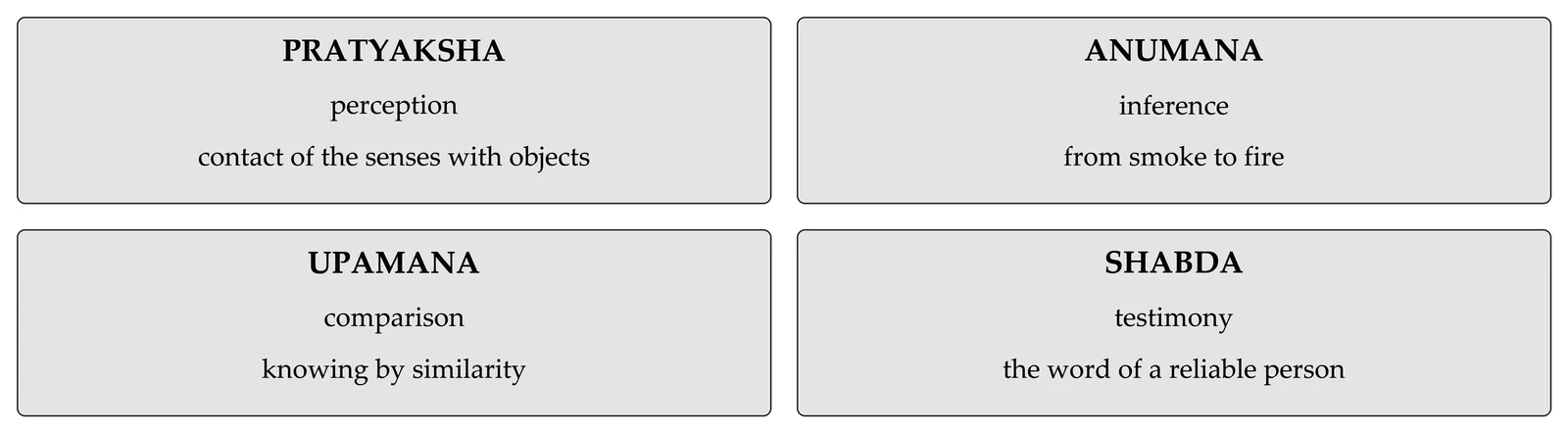
In Indian philosophy, gyan (jnana) means knowledge or cognition. Valid knowledge is called prama, and its sources are called pramanas, the means of knowing. Schools differed on how many pramanas exist: the materialist Charvakas accepted only perception, Buddhists accepted perception and inference, and the Nyaya school accepted four, adding comparison and the testimony of a reliable person. Bimal Krishna Matilal shows that the Nyaya thinkers treated knowledge as a mental episode, a particular event of cognition in the self, and asked how we can know that we know.
J.N. Mohanty shows that these theories of knowledge rest on different views of what exists: the realism of Nyaya-Vaisheshika, the momentariness of Buddhism and the single reality of Advaita Vedanta. Knowledge also had a political meaning. Kautilya called anvikshiki, the science of reasoning, a lamp for all other sciences, and insisted that a ruler must be trained in knowledge and self-discipline.
1.2 Listening and Learning
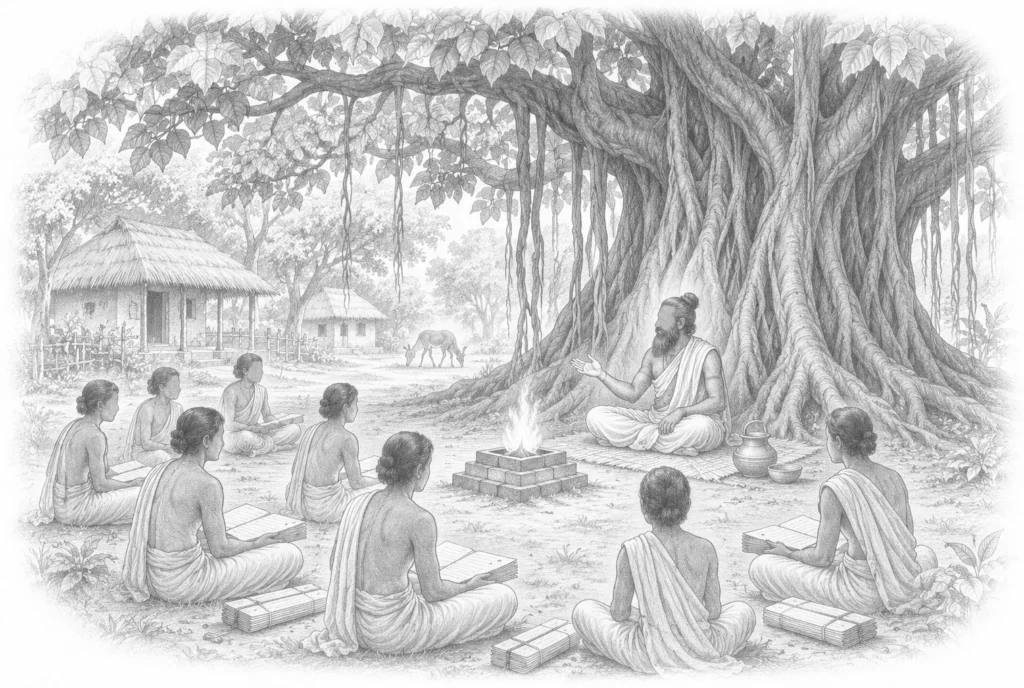
Indian learning was for centuries oral. The Vedas are called shruti, that which is heard, and were preserved by careful recitation from teacher to student. The Upanishads describe three steps: shravana (listening), manana (reflection) and nididhyasana [निदिध्यासन] (deep contemplation). A.S. Altekar describes how education in the gurukula combined memorisation with explanation, questioning and debate. Being a good listener was the first condition of gaining knowledge, and debate, or shastrartha, tested ideas in public.

1.3 Chetna: Consciousness
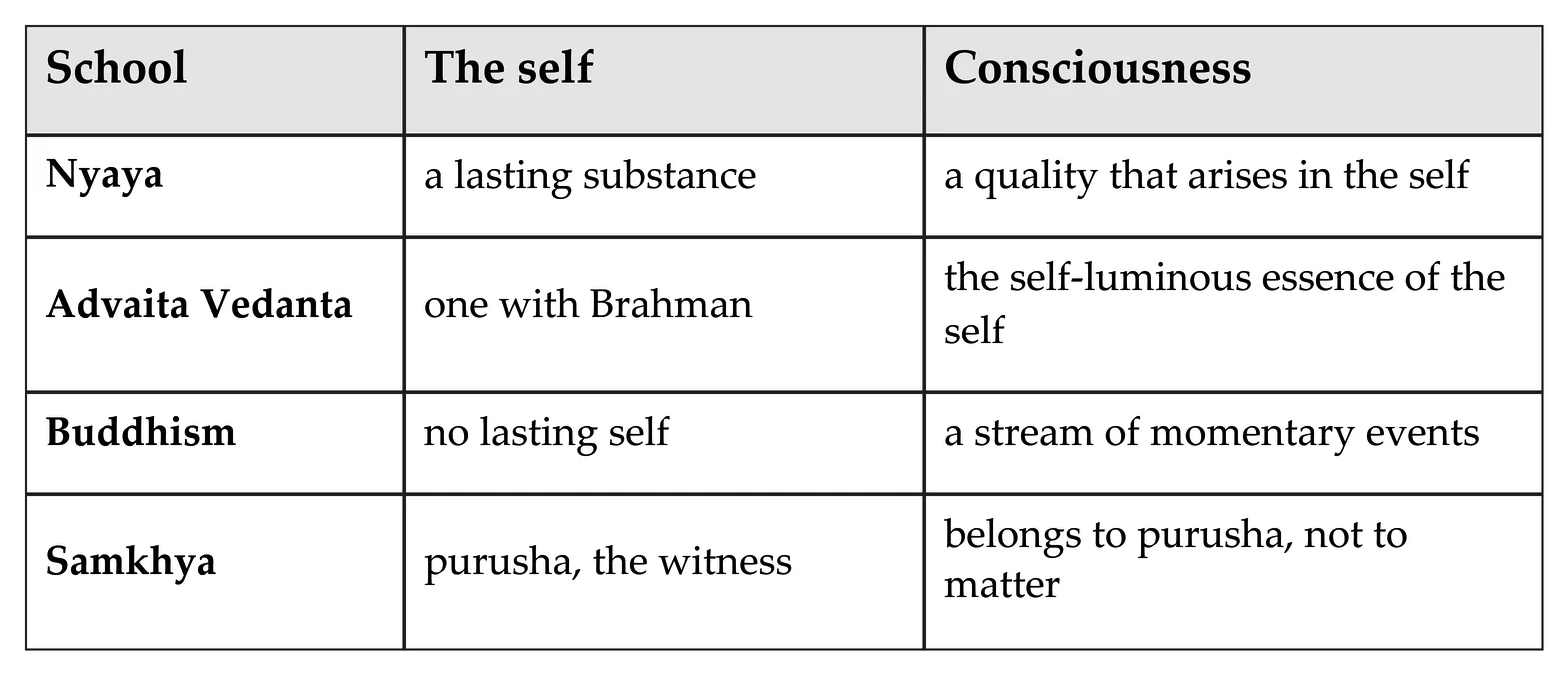
Chetna, or chit, means consciousness. Indian schools disagreed sharply about it. For Advaita Vedanta, consciousness is the self-luminous essence of the self, identical with Brahman, as Bina Gupta explains. For the Nyaya school, studied by Kisor Chakrabarti, the self is a substance and consciousness is a quality that arises in it when it is connected with the mind and senses. Samkhya places consciousness in purusha alone, while Buddhism denies a lasting self and treats consciousness as a stream of momentary events. Paul Griffiths examines Buddhist debates on whether consciousness can exist without any object.
1.4 Maitri: Friendship and Inter-State Relations
Maitri means friendship and goodwill. In Buddhism it is the first of four sublime attitudes, the brahmaviharas, and Jain ethics asks for maitri towards all living beings. After the Kalinga war, Emperor Ashoka proclaimed conquest by dhamma rather than by force. Kautilya took a realist view: in his mandala theory, the neighbouring king is a natural enemy and the neighbour’s neighbour a natural friend, or mitra. U.N. Ghoshal and D.B. Mathur describe the alliances, envoys and treaties of ancient Indian inter-state relations.

1.5 Important Questions
- Question 1 Discuss the idea of knowledge (gyan) in the Indian intellectual tradition.
- Question 2 Discuss the significance of listening and the methods of learning in the ancient Indian tradition.
- Question 3 Discuss the concept of consciousness (chetna) in Indian philosophy.
- Question 4 Discuss the idea of maitri and its implications for inter-state relations in ancient India.
DU asks the same idea in different words. So learn one broad answer for each question below; the same answer works for every question joined by OR.
Important Question 1
Discuss the idea of knowledge (gyan) in the Indian intellectual tradition.
OR
Examine the theory of pramanas in Indian philosophy.
OR
Discuss Bimal Krishna Matilal’s analysis of knowledge as a mental episode.
Model Answer
“Perception, inference, comparison and word (verbal testimony), these are the means of right knowledge.”
— Nyaya Sutra 1.1.3 (trans. S.C. Vidyabhusana)
Introduction. Gyan, or jnana, means knowledge or cognition. Indian philosophers developed a detailed theory of knowledge, called pramana-shastra, which asked what valid knowledge is, how it is obtained and how errors arise. These debates, carried on across Nyaya, Buddhist, Mimamsa and Vedanta schools, form one of the richest epistemological traditions in the world and also shaped ideas about the knowledge needed for good rule.
1. Meaning of Gyan
Indian philosophy distinguishes valid knowledge, prama, from invalid cognition, such as doubt and error. Every act of knowing involves a knower (pramata), an object known (prameya) and a means of knowing (pramana). The central question is which means of knowing are reliable and why.
2. The Number of Pramanas
Schools differed on the number of pramanas. The Charvakas accepted only perception. Buddhists such as Dignaga and Dharmakirti accepted perception and inference. Samkhya added testimony, Nyaya accepted four, and the Bhatta school of Mimamsa and Advaita Vedanta accepted six, adding postulation and non-cognition.
3. Perception
For Nyaya, perception (pratyaksha) is knowledge produced by the contact of a sense organ with its object, which is not erroneous. It has two stages: an indeterminate awareness of the object, and a determinate cognition in which the object is recognised as a particular kind of thing with a name and qualities.
4. Inference
Inference (anumana) moves from a mark to what has the mark. The classic example is: the hill has fire, because it has smoke, and wherever there is smoke there is fire, as in a kitchen. Inference depends on vyapti, the invariable relation between smoke and fire. Nyaya set it out in a five-step argument.
5. Comparison and Testimony
Comparison (upamana) gives knowledge of a thing through its similarity to something known, as when one recognises an unfamiliar animal from a description. Testimony (shabda) is knowledge from the word of a reliable person, an apta. For orthodox schools, the Vedas were the highest testimony.
6. Matilal: Knowledge as a Mental Episode
Bimal Krishna Matilal shows that Nyaya thinkers treated knowledge as an episode, a particular event of cognition occurring in the self at a time, rather than as a lasting state of belief. A cognition counts as knowledge when it arises from a pramana and correctly presents its object.
7. Knowing that One Knows
Matilal discusses how we know our own cognitions. Nyaya held that a cognition is known through a later introspective cognition. The Prabhakara school of Mimamsa and Advaita held that cognition reveals itself, like a lamp that shows both other things and itself.
8. The Validity of Knowledge
Mimamsa thinkers held that cognitions are valid by their own nature unless contradicted. Nyaya held that validity is established from outside, for example when acting on a cognition leads to success, as when water seen at a distance actually quenches thirst.
9. Theories of Error
Indian philosophers debated how errors happen, as when a rope is mistaken for a snake. Nyaya said a snake seen elsewhere is wrongly attributed to the rope. Advaita said the illusory snake is neither real nor unreal, and Prabhakara said error is a failure to distinguish two cognitions. Matilal analyses these theories in detail.
10. Mohanty: Ontological Differences
J.N. Mohanty shows that these debates rest on different ontologies, or views of what exists. Nyaya-Vaisheshika is realist, accepting many categories of real things. Buddhism holds that everything is momentary, and Advaita that only Brahman is ultimately real. Each view of knowledge fits its view of reality.
11. Higher and Lower Knowledge
The Mundaka Upanishad distinguishes lower knowledge, which includes the Vedas, grammar and the sciences, from higher knowledge, by which the imperishable reality is known. Knowledge thus had both a practical and a spiritual dimension.
12. Knowledge and Rule
Kautilya named four sciences: anvikshiki, or reasoning; trayi, the Vedas; varta, economics; and dandaniti, the science of government. He described anvikshiki as a lamp of all sciences and held that a king must acquire knowledge and self-discipline before he can rule well.
13. An Argumentative Tradition
Amartya Sen describes India’s long argumentative tradition, in which knowledge advanced through debate between schools. Such debates, with rules for fair argument, show that reasoned disagreement is part of the Indian heritage.
14. Evaluation
The Indian theory of knowledge is rigorous and challenges the idea that philosophy is only Western. Its emphasis on reliable sources, reasoning and debate offers resources for thinking about public knowledge and good government.
Conclusion. Thus, the Indian idea of gyan centres on the pramanas, the means of valid knowledge, which schools such as Nyaya analysed with great rigour. As Matilal shows, knowledge was understood as a mental episode whose validity and errors could be examined. Linked to reasoning and good rule, this tradition enriches our understanding of the political.
Important Question 2
Discuss the significance of listening and the methods of learning in the ancient Indian tradition.
OR
Examine A.S. Altekar’s account of educational and intellectual methods in ancient India.
OR
Why is being a good listener important for gaining knowledge in the Indian tradition?
Model Answer
“The Self, my dear Maitreyi, should be realised, should be heard of, reflected on and meditated upon.”
— Brihadaranyaka Upanishad 2.4.5 (trans. Swami Madhavananda)
Introduction. In the Indian tradition, knowledge was passed down orally from teacher to student for many centuries. Learning therefore began with listening. The Upanishads describe a path of listening, reflection and contemplation, and A.S. Altekar describes educational methods that combined memorisation with discussion and debate. These ideas show that knowledge was seen as a relationship of humility, attention and dialogue.
1. An Oral Tradition
The Vedas are called shruti, that which is heard, while later texts are called smriti, that which is remembered. For centuries they were transmitted orally rather than in writing. Students learned by listening to the teacher and repeating the texts until they knew them by heart.
2. Guru and Shishya
Education took place in the gurukula, where the student lived in the teacher’s household, served the teacher and learned through close personal guidance. The relationship between guru and shishya was based on respect, discipline and trust.
3. Altekar on Educational Methods
A.S. Altekar describes how ancient Indian education used several methods: memorisation and recitation, explanation of meaning, questioning, discussion and debate. Special recitation patterns were developed to preserve the Vedic texts exactly. Education also aimed at building character and self-discipline, not just learning.
4. Shravana: Listening
The first step was shravana, attentive listening to the teacher. The Upanishads are themselves dialogues, and the word upanishad is often explained as sitting down near a teacher. A good listener is humble, attentive and open, ready to receive what is taught rather than to judge it immediately.
5. Manana: Reflection
The second step was manana, reflection on what was heard. The student reasons about the teaching, raises questions and removes doubts through argument. Listening is therefore not passive acceptance but the start of active thinking.
6. Nididhyasana: Contemplation
The third step was nididhyasana, deep and sustained contemplation, through which the student absorbs the truth until it transforms understanding and conduct. Knowledge in this sense is not only information but realisation.
7. Learning through Dialogue
The Upanishads present knowledge as dialogue: Yajnavalkya teaches Maitreyi about the self, Uddalaka teaches his son Svetaketu that ‘you are that’, and the boy Nachiketa questions Yama about death. Teaching proceeds through questions and answers.
8. Questioning and Debate
Public debate, or shastrartha, was an important method of testing knowledge. In the Brihadaranyaka Upanishad, the woman philosopher Gargi questions Yajnavalkya in the court of King Janaka. Buddhist and Jain traditions also developed rules of debate.
9. Centres of Learning
Takshashila was an early centre of learning, and Nalanda, founded under the Guptas in the fifth century, attracted students from across Asia, including the Chinese pilgrim Xuanzang in the seventh century. Vikramashila flourished under the Pala kings.
10. Listening and Public Life
Listening has political meaning. Ashoka urged people to respect and learn from the teachings of other sects rather than to praise their own and condemn others. A culture of listening supports tolerance, deliberation and the search for common ground.
11. Limits of the Tradition
Access to Vedic learning was restricted by caste and gender: Shudras and most women were excluded, though women such as Gargi and Maitreyi appear in the texts. The story of Ekalavya, denied instruction by Drona, symbolises this exclusion, which reformers such as Ambedkar criticised.
12. Relevance Today
Today, there is renewed interest in Indian knowledge systems, and the National Education Policy of 2020 encourages their study. The emphasis on listening, reflection and dialogue can enrich modern education and democratic discussion if it is made inclusive.
13. Memory and Recitation
To preserve the Vedas without writing, teachers developed recitation patterns in which words were repeated in different orders, such as the padapatha, kramapatha and ghanapatha. Any error would be noticed at once. These techniques preserved the texts with astonishing accuracy for centuries, and UNESCO recognised the tradition of Vedic chanting as part of the intangible cultural heritage of humanity in 2003.
14. Women as Learners
Early texts mention women scholars, called brahmavadinis, such as Gargi and Maitreyi in the Upanishads, and women such as Lopamudra who composed Vedic hymns. Over time, however, women’s access to formal learning declined, and later law books confined most women to domestic roles, narrowing the circle of those allowed to listen and learn.
15. Evaluation
The Indian tradition treated listening as the foundation of knowledge, followed by reflection and contemplation. Its methods produced remarkable learning, though its exclusions must be recognised.
Conclusion. Thus, ancient Indian learning began with shravana, attentive listening, followed by manana and nididhyasana. As Altekar shows, it combined memorisation with questioning and debate in a close relationship between teacher and student. Being a good listener was the first condition of gaining knowledge and remains valuable for democratic life.
Important Question 3
Discuss the concept of consciousness (chetna) in Indian philosophy.
OR
Compare the Advaita and Nyaya views of the self and consciousness.
OR
Examine Bina Gupta’s account of consciousness (cit) in Indian philosophy.
Model Answer
“Satyam jnanam anantam brahma: Brahman is truth, knowledge and infinity.”
— Taittiriya Upanishad 2.1.1
Introduction. Chetna, or chit, means consciousness, the awareness through which anything is known. Because Indian philosophy aimed at liberation through self-knowledge, the nature of consciousness and the self became central questions. Different schools gave very different answers, from the Advaita view that consciousness is the ultimate reality to the Buddhist view that there is no lasting self at all.
1. Consciousness in the Upanishads
The Upanishads identify the deepest self, atman, with consciousness. The Mandukya Upanishad describes four states: waking, dreaming, deep sleep, and a fourth state, turiya, of pure consciousness that underlies the other three.
2. Advaita Vedanta
For Advaita Vedanta, systematised by Shankara, Brahman alone is ultimately real, and the individual self, atman, is identical with Brahman. Consciousness is the very nature of the self. The world of many things is an appearance produced by maya, or ignorance.
3. Gupta: Cit as Pure Consciousness
Bina Gupta explains that for Advaita, cit is pure, self-luminous consciousness, a witness (sakshi) that illuminates all mental states without being one of them. Unlike Western phenomenology, which holds that consciousness is always of an object, Advaita holds that pure consciousness need not have an object.
4. Nyaya Dualism
Kisor Chakrabarti explains that the Nyaya school is dualist. The self is a lasting substance distinct from the body. Consciousness is not its essence but a quality that arises when the self is connected with the mind and the senses. In liberation, the self exists without consciousness and therefore without suffering.
5. Arguments for the Self
Nyaya thinkers argued that memory, desire and the unity of experience prove a lasting self: the one who sees an object today must be the same one who remembers it tomorrow. Without a lasting self, memory and moral responsibility would be impossible.
6. Samkhya
Samkhya distinguishes purusha, pure consciousness, from prakriti, the material principle. The mind and intellect are products of prakriti and are not conscious in themselves; they seem conscious because they reflect the light of purusha. Liberation is the realisation that purusha is distinct from prakriti.
7. Buddhist Views
Buddhism denies a lasting self, teaching anatta, no-self. A person is made of five aggregates: form, feeling, perception, mental formations and consciousness. Consciousness itself is a stream of momentary events, each arising from causes and passing away.
8. Yogacara
The Yogacara school of Buddhism, associated with Asanga and Vasubandhu, held that what we experience is consciousness alone. It described a storehouse consciousness, alaya-vijnana, which holds the seeds of past actions and experiences.
9. Griffiths on Pure Consciousness
Paul Griffiths examines whether Indian Buddhist traditions recognise a pure consciousness, empty of any object. Such questions arose from meditative experiences in which ordinary mental activity ceases, and they connect Buddhist thought to wider debates on mysticism.
10. Mohanty: Differences in Ontology
J.N. Mohanty shows that these disagreements reflect deeper differences about what exists. A realist ontology like Nyaya’s makes the self a substance with qualities, while Advaita’s monism makes consciousness the one reality.
11. Consciousness and Conduct
Indian thought links awareness to ethics. The Bhagavad Gita describes the person of steady wisdom, who acts without selfish attachment. Self-knowledge was seen as the basis of right action and compassion towards others.
12. Chetna and Politics
In modern India, chetna gained a political meaning: awakening of consciousness. Thinkers such as Vivekananda and Aurobindo spoke of national awakening, Gandhi of conscience, and Ambedkar of awakening the consciousness of the oppressed through education and organisation.
13. Jain and Charvaka Views
Jain philosophy holds that every living being has a soul, jiva, whose defining mark is consciousness, and that each soul can attain infinite knowledge when freed from karma. At the opposite extreme, the materialist Charvakas argued that consciousness arises from the combination of material elements, just as the power to intoxicate arises when certain ingredients are fermented together, so it ends with the body.
14. Evaluation
Indian theories of consciousness are sophisticated philosophies of mind. They show how views of the self shape ideas of freedom, ethics and political awakening.
Conclusion. Thus, Indian philosophy offers contrasting views of chetna: for Advaita, as Bina Gupta explains, consciousness is the self-luminous essence of the self; for Nyaya it is a quality of a substantial self; for Samkhya it belongs to purusha; and for Buddhism it is a stream of momentary events. These ideas link self-knowledge to ethics and politics.
Important Question 4
Discuss the idea of maitri and its implications for inter-state relations in ancient India.
OR
Examine the mandala theory and the place of the mitra in Kautilya’s thought.
OR
Discuss the principles of ancient Indian diplomacy.
Model Answer
“But it is conquest by Dhamma that Beloved-of-the-Gods considers to be the best conquest.”
— Ashoka, Rock Edict XIII (trans. S. Dhammika)
Introduction. Maitri means friendship, goodwill and loving-kindness. It is a central ethical value in Buddhist and Jain thought, and it also shaped ideas about relations between states. Ancient Indian thought contains two strands: an ethical strand, seen in Ashoka’s conquest by dhamma, and a realist strand, seen in Kautilya’s mandala theory, where friendship depends on interest and geography.
1. Meaning of Maitri
Maitri, from mitra, a friend, means friendliness and goodwill towards others. In Pali it is called metta. It is not merely personal affection but a wish for the well-being of all beings, without exception.
2. Maitri in Buddhism
Buddhism lists four sublime attitudes, the brahmaviharas: maitri (loving-kindness), karuna (compassion), mudita (sympathetic joy) and upeksha (equanimity). The Metta Sutta asks the follower to wish happiness and safety to all beings, as a mother protects her only child.
3. Maitri in Jainism
Jain ethics also calls for maitri towards all living beings, along with joy in the virtues of others, compassion for those who suffer and equanimity towards the hostile. This is linked to the Jain principle of ahimsa, non-violence.
4. Ashoka’s Conquest by Dhamma
After the bloody conquest of Kalinga, Ashoka expressed remorse in his Rock Edict XIII and declared conquest by dhamma, moral persuasion and welfare, to be the best conquest. He sent envoys to Hellenistic kings and neighbouring lands and promoted welfare, showing an ethical approach to relations with other states.
5. Kautilya’s Mandala
Kautilya saw relations among states realistically. In his mandala, or circle of states, the vijigishu, the would-be conqueror, is at the centre; the neighbouring king is a natural enemy (ari), and the king beyond the enemy is a natural friend (mitra). Friendship here rests on shared interests against a common enemy.
6. The Six-fold Policy
Kautilya’s six-fold policy, shadgunya, gave the king six options: sandhi (treaty or peace), vigraha (war), asana (remaining neutral), yana (marching or preparing for war), samshraya (seeking shelter with a stronger king) and dvaidhibhava (a dual policy of peace with one and war with another).
7. The Four Means
Indian political texts list four means, upayas, of dealing with others: sama (conciliation), dana (gifts), bheda (sowing division) and danda (force). Force was to be used only when the gentler means failed.
8. Ghoshal: Inter-State Relations
U.N. Ghoshal describes inter-state relations in the period before the Mauryas, when kingdoms and republics such as Magadha, Kosala and the Vajji confederacy formed alliances, fought wars and made marriage alliances. These relations led to the gradual rise of Magadha.
9. Mathur: Ancient Indian Diplomacy
D.B. Mathur examines ancient Indian diplomacy. Kautilya described three kinds of envoys: those with full powers, those with limited missions and those who merely carried messages. Envoys were not to be killed, since they spoke for their kings, an early form of diplomatic immunity.
10. Rules of War
Texts such as the Mahabharata and the Dharmashastras describe dharma-yuddha, righteous war, with rules forbidding attacks on the unarmed, the fleeing and those who surrender. These ideas limited the violence of war in principle.
11. Maitri and Fraternity
Friendship is also the basis of political community. Ambedkar said he took the ideals of liberty, equality and fraternity from the teachings of the Buddha, and fraternity in the Preamble expresses the ideal of civic friendship among citizens.
12. Modern Echoes
Modern Indian foreign policy has drawn on these traditions: the Panchsheel principles of peaceful coexistence agreed with China in 1954, non-alignment and the motto of India’s G20 presidency in 2023, ‘One Earth, One Family, One Future’, inspired by vasudhaiva kutumbakam.
13. Treaties and Alliances
Kautilya discussed many kinds of treaties, made with or without conditions, secured by oaths, hostages or the exchange of territory, and he warned that a treaty lasts only as long as it serves the interests of both sides. Alliances, including marriage alliances among ruling families, were common ways of turning neighbours into friends or neutralising enemies.
14. Spies and Intelligence
Ancient Indian statecraft relied heavily on intelligence. Kautilya described an elaborate network of spies in disguise, as ascetics, merchants and students, to gather information on enemies, friends and even the king’s own officials. Friendship between states was therefore always watchful, combining goodwill with careful knowledge of the other side’s intentions.
15. Evaluation
Ancient Indian thought combines Kautilya’s realism with the ethical ideal of maitri. Together they show that statecraft can balance interests with goodwill.
Conclusion. Thus, maitri, the ideal of friendship and goodwill, shaped Buddhist and Jain ethics and Ashoka’s conquest by dhamma, while Kautilya’s mandala treated friendship among states as a matter of interest. As Ghoshal and Mathur show, ancient India developed a rich practice of diplomacy that still echoes in Indian foreign policy.
Short Notes
(a) Pramana
A means of valid knowledge in Indian philosophy. The Nyaya school accepted four: perception, inference, comparison and testimony, while other schools accepted between one and six. The theory of pramanas is the core of Indian epistemology.
(b) Anvikshiki
The science of reasoning and philosophy in Kautilya’s Arthashastra, one of four sciences along with the Vedas, economics and the science of government. Kautilya praised it as a lamp of all sciences, essential for a ruler’s judgement.
(c) Shadgunya
Kautilya’s six-fold foreign policy: treaty, war, neutrality, preparing to march, seeking shelter with a stronger power and a dual policy. The king was to choose among them according to his relative strength.
More notes: DSE-6 The Idea of the Political: Perspectives from the Indian Intellectual Tradition
These notes are prepared by PADHO TO AISE for study help. They are not an official University of Delhi publication.