

Semester IV MDSC-4B Public Institutions in India
Unit VI · 19 min read · Updated 24 Nov 2026
As per the University of Delhi (DU) BA (Hons) Political Science syllabus
Contents
- 6.1 Regulatory Institutions and Central Banks
- 6.2 History and Organisation of the RBI
- 6.3 Functions of the RBI
- 6.4 Autonomy, Accountability and Challenges
- 6.5 Important Questions
- Discuss the role and functions of the Reserve Bank of India.
- Examine the autonomy of the Reserve Bank of India and its relationship with the government.
- Discuss the monetary policy framework of the RBI and the challenges it faces as a regulator.
- Short Notes
भारत में मौद्रिक स्थिरता सुनिश्चित करने और सामान्यतः देश के लाभ के लिए मुद्रा और ऋण प्रणाली का संचालन करने हेतु।
To regulate the issue of Bank notes and the keeping of reserves with a view to securing monetary stability in India and generally to operate the currency and credit system of the country to its advantage.
— Preamble, Reserve Bank of India Act, 1934
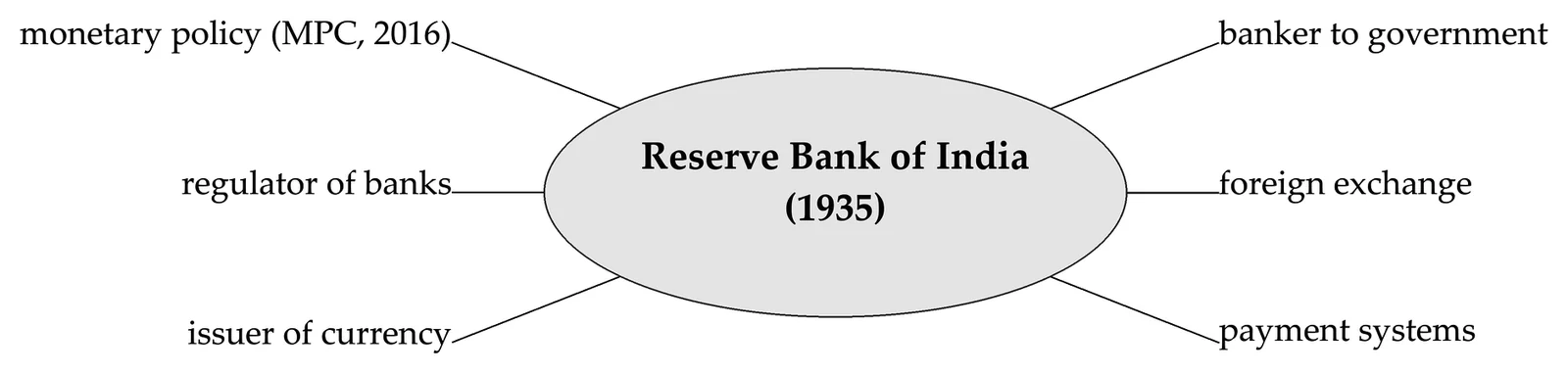
EVERY rupee note in an Indian’s pocket carries the promise of the Reserve Bank of India (RBI). As India’s central bank, the RBI issues currency, sets interest rates to control inflation, regulates banks, manages foreign exchange, acts as banker to the government and oversees payment systems such as UPI. It is one of the most important regulatory institutions in the country, and its credibility affects savers, borrowers, businesses and investors alike. This unit studies the meaning of regulatory institutions, the history and functions of the RBI, its autonomy and relationship with the government, analysed by Deena Khatkhate and Errol D’Souza, and its monetary policy framework and challenges.
6.1 Regulatory Institutions and Central Banks
A regulatory institution is a public body that sets and enforces rules for a sector of the economy, such as banking, securities, telecommunications or electricity, in order to protect consumers, ensure stability and promote competition. After the economic reforms of 1991, India created many regulators, such as SEBI (1992), TRAI (1997) and the Competition Commission (2003), reflecting a shift from direct state ownership to a regulatory state. The RBI is the oldest and most powerful of these institutions.
A central bank is the monetary authority of a country. It issues currency, conducts monetary policy, acts as banker to the government and to banks and safeguards the financial system. Since the 1990s, many countries have given central banks independence in monetary policy, on the argument that elected governments are tempted to print money or keep interest rates low before elections, causing inflation, while an independent central bank can maintain price stability and credibility.
6.2 History and Organisation of the RBI
The Royal Commission on Indian Currency and Finance (Hilton Young Commission, 1926) recommended a central bank for India. The RBI Act, 1934 created the Reserve Bank, which began operations on 1 April 1935 as a shareholders’ bank; it was nationalised in 1949. After independence the RBI supported planned development, directed credit to priority sectors, and oversaw the nationalisation of banks in 1969 and 1980. The reforms of the 1990s, following the Narasimham Committee (1991), liberalised banking and interest rates and strengthened prudential regulation.
The RBI is governed by a Central Board of Directors consisting of the Governor, up to four Deputy Governors, and directors nominated by the government. The Governor is appointed by the Union government. Monetary policy is decided by the six-member Monetary Policy Committee, while specialised departments handle banking regulation, supervision, currency management, foreign exchange and payment systems.
6.3 Functions of the RBI
- Monetary authority: formulates and implements monetary policy, mainly through the repo rate at which it lends to banks, to maintain price stability while keeping growth in mind.
- Issuer of currency: has the sole right to issue banknotes (except one-rupee notes and coins, which are issued by the government) and manages the supply of currency.
- Banker to the government: manages the accounts and public debt of the Union and state governments and provides them temporary loans called Ways and Means Advances.
- Banker’s bank and lender of last resort: holds banks’ reserves, provides liquidity and supports the system in a crisis.
- Regulator and supervisor: licenses and regulates banks under the Banking Regulation Act, 1949, and non-banking financial companies, setting capital and prudential norms.
- Manager of foreign exchange: manages India’s foreign exchange reserves and the rupee’s exchange rate under the Foreign Exchange Management Act, 1999.
- Payment systems: regulates payment and settlement systems under the Payment and Settlement Systems Act, 2007, and promoted the National Payments Corporation of India, which runs UPI.
- Developmental role: promotes financial inclusion, priority sector lending to agriculture and small enterprises, and financial literacy.
6.4 Autonomy, Accountability and Challenges
Deena Khatkhate, in ‘Reserve Bank of India: A Study in the Separation and Attrition of Powers’ (2005), argued that the RBI’s autonomy was historically limited. The government controlled key decisions, the RBI automatically financed budget deficits through ad hoc treasury bills until this practice was phased out by 1997, and the Finance Ministry shared control over public sector banks, creating dual regulation. Over time, some functions were separated and others eroded, so the RBI’s powers suffered attrition. Errol D’Souza, discussing the way forward, argued that the RBI should focus on monetary stability with a clear mandate, that public debt management should be separated from monetary policy, and that autonomy must be combined with transparency and accountability.
The 2016 amendment to the RBI Act created a statutory framework of flexible inflation targeting: the government sets an inflation target, currently 4 per cent with a band of 2 to 6 per cent, and the Monetary Policy Committee decides interest rates; if inflation stays outside the band for three consecutive quarters, the RBI must explain the failure to the government, as it did for the first time in 2022. Tensions with the government surfaced in 2018, when the government initiated consultations under Section 7 of the RBI Act, and Governor Urjit Patel resigned; the Bimal Jalan Committee (2019) later fixed a framework for transferring the RBI’s surplus reserves. Other challenges include bad loans in banks, failures of non-banking companies and cooperative banks, the 2016 demonetisation, digital payments and fraud, and the launch of the digital rupee (2022).
6.5 Important Questions
- Question 1 Discuss the role and functions of the Reserve Bank of India.
- Question 2 Examine the autonomy of the Reserve Bank of India and its relationship with the government.
- Question 3 Discuss the monetary policy framework of the RBI and the challenges it faces as a regulator.
DU asks the same idea in different words. So learn one broad answer for each question below; the same answer works for every question joined by OR.
Important Question 1
Discuss the role and functions of the Reserve Bank of India.
OR
Examine the RBI as India’s central bank and financial regulator.
OR
Explain the evolution of the Reserve Bank of India since 1935.
Model Answer
“The primary objective of the monetary policy is to maintain price stability while keeping in mind the objective of growth.”
— Preamble, Reserve Bank of India Act, 1934, as amended in 2016
Introduction. The Reserve Bank of India is the country’s central bank and one of its most important public institutions. It manages money and credit, regulates banks and financial institutions, manages foreign exchange and acts as banker to the government. Its decisions affect inflation, interest rates, growth and the stability of the financial system, and its credibility is crucial for public confidence.
1. Establishment
The Hilton Young Commission of 1926 recommended a central bank for India, and the RBI Act, 1934 established the Reserve Bank, which began operations on 1 April 1935 in Calcutta and moved its headquarters to Bombay in 1937. Originally a private shareholders’ bank, it was nationalised on 1 January 1949, becoming fully owned by the government. It was modelled partly on the Bank of England and was expected to keep the rupee stable at a time of economic depression and colonial financial control.
2. Role in Planned Development
After independence the RBI supported planned development by financing government programmes, directing credit to agriculture, small industry and other priority sectors, and building institutions such as the Industrial Development Bank of India and NABARD. After the nationalisation of major banks in 1969 and 1980, it oversaw a large public sector banking system.
3. Monetary Policy
The RBI formulates and implements monetary policy. Its main tool is the repo rate, the rate at which it lends to banks; raising it makes borrowing more expensive and reduces inflation, while cutting it encourages lending and growth. Other tools include the cash reserve ratio, open market operations and liquidity management. Since 2016, the six-member Monetary Policy Committee sets the policy rate to achieve the inflation target.
4. Issue of Currency
The RBI has the sole right to issue banknotes in India, except one-rupee notes and coins, which are issued by the government and distributed through the RBI. It manages currency printing and distribution, replaces soiled notes and works to prevent counterfeiting. Since 2022 it has also piloted a central bank digital currency, the e-rupee.
5. Banker to the Government
The RBI manages the banking transactions of the Union and state governments, manages their public debt by issuing and servicing government securities, and provides temporary loans called Ways and Means Advances to cover short-term mismatches between receipts and payments.
6. Banker’s Bank and Lender of Last Resort
Banks keep part of their reserves with the RBI, which provides them liquidity through various facilities. In a crisis, the RBI acts as lender of last resort, providing funds to prevent the collapse of the financial system, as it did during the global financial crisis of 2008 and the COVID-19 pandemic in 2020.
7. Regulation and Supervision
Under the Banking Regulation Act, 1949, the RBI licenses banks, sets capital adequacy and prudential norms, inspects banks and can supersede their boards. It also regulates non-banking financial companies and, since 2020, has stronger powers over cooperative banks. Regulation aims to protect depositors and maintain financial stability. It also runs the Deposit Insurance and Credit Guarantee Corporation, which insures bank deposits up to ₹5 lakh per depositor per bank.
8. Foreign Exchange Management
The RBI manages India’s foreign exchange reserves, among the largest in the world, and intervenes in the currency market to limit excessive volatility of the rupee. Under the Foreign Exchange Management Act, 1999, it regulates foreign exchange transactions.
9. Payment Systems
The RBI regulates payment and settlement systems under the Payment and Settlement Systems Act, 2007. It promoted the National Payments Corporation of India (2008), which runs the Unified Payments Interface launched in 2016. UPI has made India a world leader in real-time digital payments.
10. Organisation and Governance
The RBI is governed by a Central Board of Directors comprising the Governor, up to four Deputy Governors, and directors nominated by the government from different fields and regions, along with government officials. The Governor, appointed by the Union government, leads the institution and chairs the Monetary Policy Committee. Specialised departments deal with monetary policy, banking regulation and supervision, currency management, foreign exchange, government debt and payment systems, and the RBI has regional offices across the country.
11. Developmental Functions
The RBI promotes financial inclusion through no-frills accounts, banking correspondents, priority sector lending and financial literacy campaigns. Its developmental role reflects the needs of a developing economy where many people lacked access to formal finance.
Conclusion. Thus, the RBI performs a wide range of functions as monetary authority, issuer of currency, banker to the government and banks, regulator, manager of foreign exchange and payment systems, and promoter of development. Its effectiveness is central to India’s economic stability and growth.
Important Question 2
Examine the autonomy of the Reserve Bank of India and its relationship with the government.
OR
Discuss the separation and attrition of the RBI’s powers.
OR
‘Central bank independence is essential for price stability.’ Discuss with reference to the RBI.
Model Answer
“The Central Government may from time to time give such directions to the Bank as it may, after consultation with the Governor of the Bank, consider necessary in the public interest.”
— Section 7(1), Reserve Bank of India Act, 1934
Introduction. Central banks around the world have been given greater independence since the 1990s, on the argument that monetary policy should be insulated from short-term political pressure. In India, the relationship between the RBI and the government has always been close and sometimes tense. Deena Khatkhate and Errol D’Souza examine how the RBI’s powers have been shaped by this relationship.
1. Why Central Bank Independence
Economists argue that elected governments may be tempted to finance deficits by printing money or to lower interest rates before elections, causing inflation. An independent central bank with a clear mandate for price stability can resist such pressures and build credibility, which helps keep inflation expectations low. Examples include the German Bundesbank and, later, the European Central Bank.
2. The Legal Position of the RBI
The RBI is a statutory body owned by the government. The government appoints the Governor, Deputy Governors and directors, and Section 7 of the RBI Act allows it to give directions to the RBI after consulting the Governor. Legally, therefore, the RBI is not fully independent; its autonomy depends on conventions and the relationship between the Governor and the Finance Ministry.
3. Khatkhate’s Analysis
Deena Khatkhate argued that the RBI’s history shows a separation and attrition of powers. In the planning era, its functions were subordinated to government priorities: it financed deficits, directed credit and had limited control over interest rates. Some powers were separated from it, and others were eroded by government control, so the RBI often acted as an arm of the Finance Ministry rather than an independent authority.
4. Monetisation of Deficits
Until the 1990s, the government financed deficits by issuing ad hoc treasury bills that the RBI automatically bought, which effectively meant printing money and fuelled inflation. Agreements between the government and the RBI in 1994 and 1997 ended this practice, and the FRBM Act of 2003 later barred the RBI from buying government securities in primary auctions, strengthening its autonomy.
5. Dual Regulation of Banks
Public sector banks are owned by the government, which appoints their boards and influences their lending. The RBI regulates them but has limited powers to remove their management or merge them, unlike private banks. This dual control has been blamed for the accumulation of bad loans, and RBI governors have publicly called for stronger powers over public sector banks.
6. D’Souza’s Way Forward
Errol D’Souza argued that the RBI should have a clear primary mandate of price stability, that the management of public debt should be separated from monetary policy to avoid conflicts of interest, and that greater autonomy must be matched by transparency, publication of decisions and accountability to Parliament.
7. The 2016 Framework
The 2016 amendment to the RBI Act strengthened the RBI’s autonomy in monetary policy by creating a statutory inflation target and a Monetary Policy Committee of three RBI members and three external members, with the Governor holding a casting vote. At the same time, accountability was built in: the government sets the target, and the RBI must explain to the government if it fails to meet it for three consecutive quarters.
8. The 2018 Conflict
In 2018, disagreements arose between the government and the RBI over the RBI’s surplus reserves, lending restrictions on weak banks, credit to small businesses and the regulation of payment systems. The government initiated consultations under Section 7 for the first time, and Governor Urjit Patel resigned in December 2018. The episode showed the fragility of the RBI’s autonomy.
9. Surplus Transfers
The question of how much of the RBI’s reserves should be transferred to the government was settled by the Bimal Jalan Committee (2019), which recommended an economic capital framework. Following it, the RBI transferred about ₹1.76 lakh crore to the government in 2019. Critics worried that large transfers could weaken the RBI’s balance sheet, while supporters argued that excess reserves belonged to the public.
10. Evaluation
The RBI enjoys considerable functional autonomy in monetary policy under the 2016 framework, but its legal subordination to the government, dual regulation of public sector banks and disputes over reserves show its limits. Balancing autonomy with democratic accountability remains a central issue for the RBI.
Conclusion. Thus, the RBI’s autonomy has grown since the 1990s, especially with the end of automatic monetisation and the 2016 inflation targeting framework. Yet, as Khatkhate and D’Souza show, its powers remain shaped by the government, and a clear mandate with transparency and accountability is essential.
Important Question 3
Discuss the monetary policy framework of the RBI and the challenges it faces as a regulator.
OR
What is inflation targeting? Examine the role of the Monetary Policy Committee.
OR
Examine the challenges before the RBI in regulating the banking and financial system.
Model Answer
“There is no subtler, no surer means of overturning the existing basis of society than to debauch the currency.”
— John Maynard Keynes, The Economic Consequences of the Peace (1919)
Introduction. Maintaining the value of money and the stability of the financial system are the RBI’s two most important tasks. Since 2016, India has followed a framework of flexible inflation targeting, in which the RBI uses interest rates to keep inflation within a target band. At the same time, the RBI faces serious challenges in regulating banks, non-banking companies and new digital forms of finance.
1. Inflation and its Effects
High inflation reduces the purchasing power of the poor, who have few ways to protect their savings, discourages investment and creates uncertainty. Keynes warned that debauching the currency undermines the foundations of society. Very low inflation or deflation can also harm growth, so central banks aim for moderate, stable inflation.
2. Earlier Approaches
Before 2016, the RBI followed a multiple-indicator approach, considering inflation, growth, credit, exchange rates and financial stability together. Critics argued that this lacked a clear anchor and that inflation remained high, especially between 2009 and 2013, reducing the RBI’s credibility.
3. The Patel Committee and Inflation Targeting
The Expert Committee chaired by Urjit Patel (2014) recommended flexible inflation targeting using consumer price inflation. The 2016 amendment to the RBI Act made this statutory: the government, in consultation with the RBI, sets an inflation target every five years, fixed at 4 per cent with a band of 2 to 6 per cent and retained in 2021.
4. The Monetary Policy Committee
The MPC has six members: the Governor, a Deputy Governor and another RBI officer, and three external experts appointed by the government for four years. Decisions are taken by majority vote, with the Governor having a casting vote, and the minutes are published. The MPC first met in October 2016. Its collective decision-making and transparency are meant to improve credibility.
5. Accountability for the Target
If average inflation is above 6 per cent or below 2 per cent for three consecutive quarters, the RBI must report to the government explaining the reasons and the remedial actions it proposes. This happened for the first time in 2022, when inflation rose after the war in Ukraine and supply disruptions, and the RBI raised the repo rate sharply between May 2022 and February 2023.
6. Bad Loans in Banks
From around 2015, Indian banks, especially public sector banks, faced a large stock of non-performing assets, partly due to loans to infrastructure and industry during the boom years. The RBI’s Asset Quality Review (2015), the Insolvency and Bankruptcy Code (2016) and the Prompt Corrective Action framework aimed to recognise and resolve bad loans, and the problem has eased since.
7. Failures in Non-banks and Cooperative Banks
The default of IL&FS in 2018, the crisis at Punjab and Maharashtra Co-operative Bank in 2019 and the reconstruction of Yes Bank in 2020 exposed gaps in regulation. In response, the RBI strengthened supervision of non-banking financial companies with a scale-based framework, and the Banking Regulation (Amendment) Act, 2020 gave it greater powers over cooperative banks.
8. Digital Finance
The rapid growth of UPI, digital lending apps and fintech companies has brought financial inclusion but also new risks, such as fraud, data misuse and predatory lending. The RBI has issued guidelines on digital lending and payment security and launched the digital rupee pilot in 2022.
9. Demonetisation and Credibility
The withdrawal of ₹500 and ₹1000 notes in November 2016, about 86 per cent of currency by value, raised questions about the RBI’s independence, since the decision was announced by the government and the RBI board approved it at short notice. Most of the withdrawn notes returned to banks, and the episode remains debated.
10. Limits of Monetary Policy
Monetary policy works with long lags and has limited effect on supply-side shocks, such as poor monsoons, which raise food prices, or global oil price increases. Food and fuel have large weights in India’s consumer price index, so inflation can rise even when demand is weak. Critics argue that raising interest rates in response to supply shocks may hurt growth without controlling prices, while supporters reply that the RBI must prevent such shocks from becoming persistent inflation by anchoring expectations.
11. Evaluation
The inflation targeting framework has made monetary policy more transparent and helped anchor expectations, though food price shocks remain beyond the RBI’s control. As a regulator, the RBI has strengthened banking supervision, but new risks in non-banks, cooperative banks and digital finance require constant vigilance and adequate powers.
Conclusion. Thus, the RBI’s flexible inflation targeting framework and the Monetary Policy Committee have improved the credibility of monetary policy, while its regulatory role faces challenges from bad loans, institutional failures and digital finance. A capable and autonomous RBI is essential for India’s financial stability.
Short Notes
(a) Repo rate
The interest rate at which the RBI lends short-term funds to commercial banks against government securities. It is the main instrument of monetary policy: raising it makes borrowing costlier and helps reduce inflation, while lowering it encourages lending and growth. It is decided by the Monetary Policy Committee.
(b) Monetary Policy Committee
A six-member committee created by the 2016 amendment to the RBI Act to set the policy repo rate in order to achieve the inflation target. It consists of the Governor, a Deputy Governor, another RBI officer and three external members appointed by the government. Decisions are by majority, with the Governor’s casting vote, and the minutes are published.
(c) Lender of last resort
The role of a central bank in providing emergency liquidity to banks that are solvent but temporarily unable to obtain funds, in order to prevent panic and the collapse of the financial system. The RBI performed this role during the 2008 global financial crisis and the COVID-19 pandemic.
More notes: MDSC-4B Public Institutions in India
- Studying Public Institutions
- Framing Public Policy: Niti Aayog
- Conducting Elections: Election Commission of India (ECI)
- Securing Citizens: The Police
- Ensuring Rights: National Human Rights Commission of India (NHRC)
- Transparency and Accountability: Comptroller and Auditor General (CAG) and Central Vigilance Commissioner (CVC)
These notes are prepared by PADHO TO AISE for study help. They are not an official University of Delhi publication.