

Semester IV MDSC-4B Public Institutions in India
Unit I · 19 min read · Updated 24 Nov 2026
As per the University of Delhi (DU) BA (Hons) Political Science syllabus
Contents
- 1.1 Meaning and Types of Public Institutions
- 1.2 Why Public Institutions Matter
- 1.3 Studying Institutions: Performance and Design
- 1.4 Rethinking Public Institutions in India
- 1.5 Important Questions
- What are public institutions? Why is it important to study them?
- Discuss the main issues in the performance and design of public institutions in India.
- Examine the challenges of state capacity and accountability in Indian public institutions.
- Short Notes
संस्थाएँ समाज में खेल के नियम हैं, या अधिक औपचारिक रूप से, मनुष्यों द्वारा बनाई गई वे बाध्यताएँ हैं जो मानवीय संपर्क को आकार देती हैं।
Institutions are the rules of the game in a society or, more formally, are the humanly devised constraints that shape human interaction.
— Douglass North, Institutions, Institutional Change and Economic Performance (1990)
WHY does the Election Commission of India command such trust, while the police are often feared? Why has the Reserve Bank been able to keep inflation in check, while many government departments struggle to deliver basic services? The answers lie in the design and working of public institutions, the organisations through which the state makes rules, delivers services, settles disputes and holds power to account. Devesh Kapur, Pratap Bhanu Mehta and Milan Vaishnav have led the study of India’s public institutions in two influential volumes. This unit introduces the meaning of public institutions, why they matter, how they can be studied and the main debates about their performance and design in India.
1.1 Meaning and Types of Public Institutions
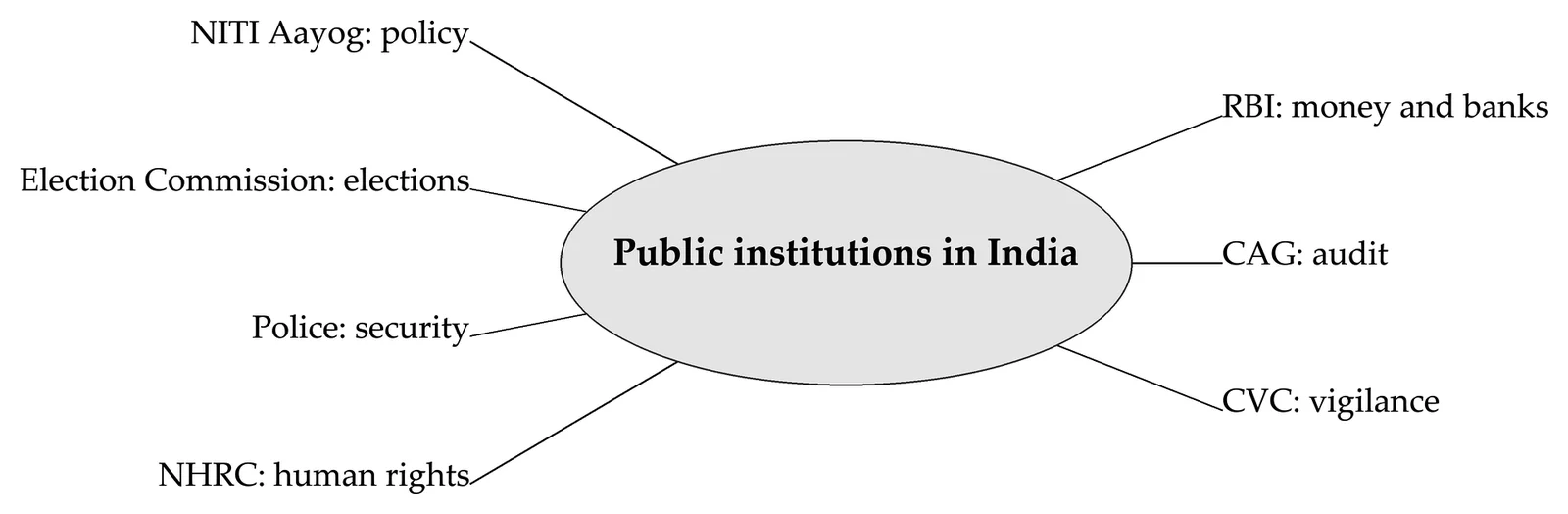
An institution is a stable set of rules, norms and organisations that structures behaviour. Douglass North called institutions the rules of the game in a society. Public institutions are the organisations of the state that make and implement rules and deliver public goods: legislatures, executives, courts, the bureaucracy, the police, regulatory bodies and constitutional authorities. They can be classified as:
- Constitutional bodies, created by the Constitution itself, such as the Election Commission (Article 324), the Comptroller and Auditor General (Article 148), the Finance Commission (Article 280) and the Union Public Service Commission (Article 315).
- Statutory bodies, created by laws of Parliament, such as the National Human Rights Commission (1993), the Central Vigilance Commission (2003 Act) and the Reserve Bank of India (1934 Act).
- Executive bodies, created by government resolution, such as the former Planning Commission (1950) and NITI Aayog (2015).
- Regulatory bodies, which oversee sectors of the economy, such as SEBI, TRAI and the Competition Commission.
- Accountability institutions, which check the use of power, such as the CAG, CVC, Lokpal and information commissions.
1.2 Why Public Institutions Matter
Institutions shape how well a democracy works. They translate the will of the people into policies, provide services such as security, education and health, protect rights, manage the economy, and hold rulers accountable. New institutionalism in political science, associated with James March and Johan Olsen, argues that institutions are not neutral arenas but shape the preferences and behaviour of actors. In economics, North and later Daron Acemoglu and James Robinson (Why Nations Fail, 2012) argued that inclusive institutions explain why some countries prosper while others remain poor.
In India, public institutions have been central to the survival of democracy in a poor, diverse society. The Election Commission has conducted free and fair elections for the world’s largest electorate; the Supreme Court has expanded rights; and the RBI has maintained macroeconomic stability. Yet other institutions, such as the police, lower bureaucracy and many regulatory bodies, have struggled with capacity, politicisation and corruption. Understanding this uneven performance is the central task of studying public institutions in India.
1.3 Studying Institutions: Performance and Design
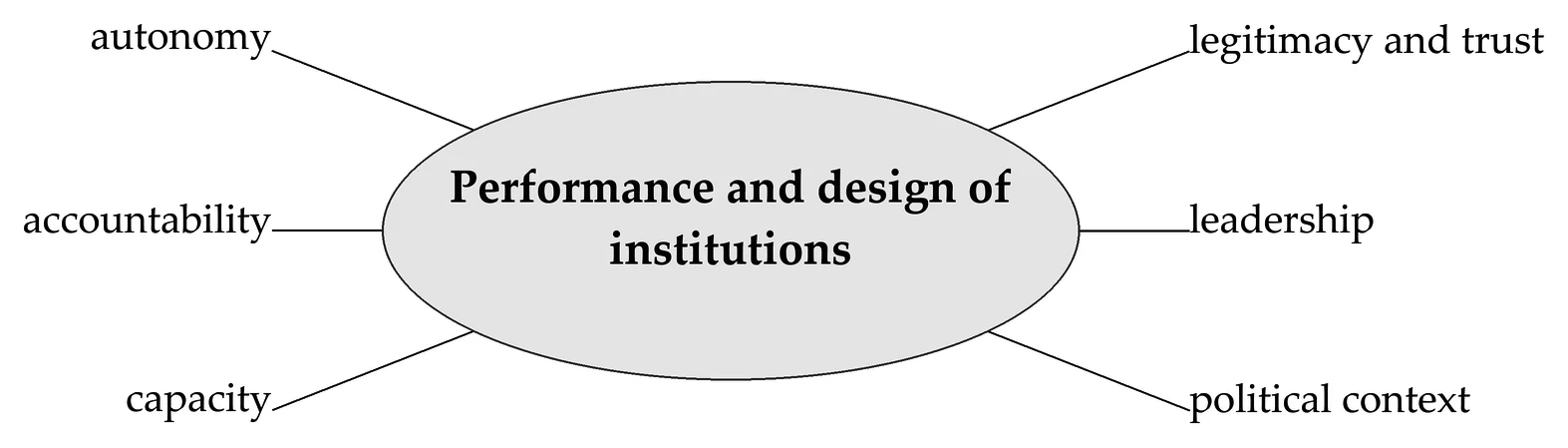
In their introduction to Public Institutions in India (2005), Kapur and Mehta observed that public discussion in India often spoke of institutional decline, especially after the Emergency and the politicisation of the 1970s and 1980s. They argued that the picture was more complex. Some institutions, such as the Election Commission and the Supreme Court, had become more assertive from the 1990s, while others weakened. They examined institutions through their design, the formal rules, powers, appointments and resources, and their performance, how effectively and fairly they carry out their tasks.
- Autonomy: institutions need insulation from short-term political pressure to act impartially, as with security of tenure for the CAG and the Chief Election Commissioner.
- Accountability: autonomous institutions must still answer to Parliament, courts and citizens, so that autonomy does not become arbitrariness.
- Capacity: institutions need skilled personnel, money, information and technology.
- Legitimacy: public trust depends on fairness, transparency and visible results.
- Leadership and context: individual leaders, such as T.N. Seshan at the Election Commission, and political circumstances, such as coalition governments, influence how institutions use their powers.
- Interaction: institutions work within a system; the assertiveness of one, such as the judiciary, affects others.
1.4 Rethinking Public Institutions in India
In Rethinking Public Institutions in India (2017), Kapur, Mehta and Vaishnav returned to these questions in a period of rapid economic growth and new challenges. They highlight the problem of state capacity: India’s state is often unable to implement its own policies. Lant Pritchett (2009) called India a flailing state, in which the head, elite institutions in Delhi, is sound but is not reliably connected to its limbs, the field-level agencies that deliver services. India also has relatively few public employees per head of population compared with many other countries, so its state is in some respects too small for the tasks it has taken on.
The editors also note the growth of regulatory and accountability institutions, such as the RBI’s Monetary Policy Committee, sectoral regulators, information commissions and the Lokpal, and the increasing role of courts and civil society in demanding accountability. They identify tensions between autonomy and democratic control, as when governments and independent institutions clash, and they emphasise that the design of appointment processes, tenure and funding is crucial to institutional independence. Debates over appointments to the Election Commission (2023) and the relationship between the government and the RBI (2018) illustrate these tensions.
1.5 Important Questions
- Question 1 What are public institutions? Why is it important to study them?
- Question 2 Discuss the main issues in the performance and design of public institutions in India.
- Question 3 Examine the challenges of state capacity and accountability in Indian public institutions.
DU asks the same idea in different words. So learn one broad answer for each question below; the same answer works for every question joined by OR.
Important Question 1
What are public institutions? Why is it important to study them?
OR
Explain the meaning, types and significance of public institutions in India.
OR
‘Institutions are the rules of the game.’ Discuss with reference to Indian democracy.
Model Answer
“Institutions are the rules of the game in a society or, more formally, are the humanly devised constraints that shape human interaction.”
— Douglass North, Institutions, Institutional Change and Economic Performance (1990)
Introduction. Public institutions are the organisations through which the state exercises its authority and serves its citizens. In a democracy they turn the will of the people into laws and policies, deliver services, protect rights and keep power accountable. The study of public institutions examines how they are designed, how they actually work and why some perform better than others.
1. Meaning of Institutions
Institutions are stable, recurring patterns of behaviour structured by rules and norms. Douglass North described them as the humanly devised constraints that shape human interaction, both formal rules such as constitutions and laws and informal ones such as customs. Organisations are the players, and institutions are the rules of the game, though in everyday language we also call organisations like the Election Commission institutions.
2. Public Institutions
Public institutions are the organisations of the state: legislatures, executives, courts, the civil service, the police, regulatory bodies and constitutional authorities. They differ from private institutions such as firms or families because they exercise public authority, are financed by public money and are expected to serve the public interest.
3. Types of Public Institutions
In India, some institutions are constitutional bodies, such as the Election Commission, the CAG, the Finance Commission and the UPSC; others are statutory bodies created by Parliament, such as the NHRC, the CVC and the RBI; others are executive bodies created by government resolution, such as NITI Aayog; and there are many regulatory bodies, such as SEBI and TRAI. Their legal basis affects their independence and powers.
4. Functions of Public Institutions
Public institutions perform several functions. They make policy, as NITI Aayog advises; conduct elections, as the Election Commission does; maintain order and security, the task of the police; protect rights, as the NHRC and courts do; regulate the economy, as the RBI does; and ensure accountability, the role of the CAG and the CVC. Together they make the state capable and legitimate.
5. Institutions and Democracy
Democracy is not only about elections; it depends on institutions that limit power and protect rights between elections. Independent courts, election bodies, auditors and human rights commissions provide what Guillermo O’Donnell called horizontal accountability, checks by one state institution on another. Without them, elected governments can become unaccountable.
6. Institutions and Development
Institutions also shape economic development. North and later Acemoglu and Robinson argued that inclusive institutions, which secure property rights, the rule of law and broad participation, promote growth, while extractive institutions serve narrow elites. Efficient regulatory institutions, a stable central bank and honest administration encourage investment and welfare.
7. New Institutionalism
From the 1980s, political scientists such as James March and Johan Olsen developed new institutionalism, which argues that institutions shape the preferences, strategies and identities of actors, not just the arena in which they compete. Historical institutionalism stresses path dependence, how choices made at one time shape later possibilities, which helps explain the colonial legacy of Indian institutions such as the police.
8. Why Study Indian Institutions
Kapur and Mehta argue that India’s institutions show a puzzling mix of success and failure. India has sustained democracy and conducted remarkable elections, yet many institutions struggle to deliver basic services. Studying institutions helps explain these differences and points to reforms in design, autonomy, accountability and capacity.
9. Indian Examples
The Election Commission, the Supreme Court and the RBI are often cited as relatively successful institutions, while the police, the lower bureaucracy and some regulators face criticism for politicisation, corruption and inefficiency. The difference often lies in their insulation from political pressure, their professional culture and their visibility to the public.
10. Colonial Legacy and Constitutional Design
Many Indian institutions, such as the civil services, the police and the courts, were built by the colonial state for control and revenue collection. The Constitution adapted them to democratic purposes and created new ones, such as the Election Commission, to serve a sovereign people. The tension between this colonial inheritance and democratic expectations, visible especially in the police, is a recurring theme in the study of Indian institutions.
11. Significance for Citizens
For citizens, institutions determine whether they receive justice, security, services and fair treatment. Understanding them helps citizens use them, for example through the Right to Information Act, and demand reform. As Kapur and Mehta suggest, the quality of democracy in India depends greatly on the quality of its institutions.
Conclusion. Thus, public institutions are the organised rules and bodies through which the state governs. Studying them is important because they shape democracy, development and the daily lives of citizens, and because India’s uneven institutional performance calls for careful analysis and reform.
Important Question 2
Discuss the main issues in the performance and design of public institutions in India.
OR
Examine Kapur and Mehta’s argument on institutional decline and resilience in India.
OR
What factors explain the uneven performance of public institutions in India?
Model Answer
“Constitutional morality is not a natural sentiment. It has to be cultivated.”
— B.R. Ambedkar, Constituent Assembly (4 November 1948)
Introduction. India inherited a set of institutions from colonial rule and built others under the Constitution. Their performance has been uneven: some have earned high public trust, while others are seen as corrupt or ineffective. In Public Institutions in India (2005), Devesh Kapur and Pratap Bhanu Mehta examined why, focusing on the design of institutions and their actual performance.
1. The Decline Debate
From the 1970s, many observers spoke of institutional decline in India. The Emergency (1975–77), the demand for a committed bureaucracy and judiciary, the misuse of President’s Rule and the politicisation of the police seemed to show that institutions were being weakened by political leaders seeking personal control.
2. Kapur and Mehta’s Argument
Kapur and Mehta argued that the picture was more complex than simple decline. Some institutions, notably the Election Commission and the Supreme Court, became more assertive from the 1990s, helped by coalition politics, economic reform and public pressure. Others, such as the police and parts of the bureaucracy, continued to decline. The task is to explain this variation.
3. Design
Design refers to the formal rules that govern institutions: their legal basis, powers, methods of appointment and removal, tenure, funding and relationship with the government. Constitutional status and security of tenure, as for the Chief Election Commissioner and the CAG, protect independence, while bodies dependent on government for appointments and budgets are more vulnerable.
4. Autonomy and Accountability
Institutions need autonomy to resist short-term political pressure, but they must also be accountable to Parliament, courts and the public. Too little autonomy leads to politicisation; too much without accountability can lead to arbitrariness or self-serving behaviour. Kapur and Mehta emphasise finding the right balance.
5. Capacity
Many Indian institutions lack capacity: too few trained personnel, outdated procedures, inadequate technology and limited budgets. Courts have huge backlogs, police stations are understaffed and regulators lack expertise. Lant Pritchett’s idea of a flailing state captures the gap between elite policy-making and weak implementation on the ground. Vacancies in sanctioned posts, from judges to teachers and police constables, are a persistent problem.
6. Politicisation and Patronage
Political interference in appointments, transfers and decisions weakens institutions. The police and the lower bureaucracy are particularly affected, as transfers are used to reward loyalty or punish independence. Patronage politics, in which jobs and benefits are distributed to supporters, undermines professional norms.
7. Leadership and Culture
Individual leaders can transform institutions. T.N. Seshan, Chief Election Commissioner from 1990 to 1996, enforced the Model Code of Conduct strictly and made the Commission a powerful guardian of elections. Professional culture, internal norms and esprit de corps also matter, as in the RBI’s tradition of technical expertise.
8. Political Context
The political context shapes institutional performance. Coalition governments in the 1990s and 2000s were weaker, giving more room to independent institutions. Strong single-party governments may be more willing to challenge institutional autonomy, as debates on appointments and the independence of regulators have shown.
9. Public Trust and Legitimacy
Institutions that act visibly and fairly, such as the Election Commission during elections, earn public trust, which in turn strengthens them against political pressure. Opinion surveys have consistently shown higher trust in the army, the judiciary and the Election Commission than in the police or politicians.
10. Examples of Contrasting Performance
The contrast between institutions is striking. The Election Commission conducts elections for nearly a billion voters with high credibility, and the RBI has generally maintained financial stability. By contrast, courts face a backlog of tens of millions of cases, many police stations lack staff and resources, and public trust in the police remains low. Kapur and Mehta argue that such differences arise from differences in insulation, professional norms, the clarity of mandates and the visibility of outcomes.
11. Reform
Reform requires better design of appointment processes, secure tenure, adequate funding and personnel, transparency, use of technology and accountability to citizens. Commissions such as the Second Administrative Reforms Commission (2005–09) made many recommendations, though implementation has been limited.
Conclusion. Thus, the performance of public institutions in India varies with their design, autonomy, capacity, leadership and political context. Kapur and Mehta show that the story is not one of simple decline but of uneven resilience, and that careful institutional design is crucial for democratic governance.
Important Question 3
Examine the challenges of state capacity and accountability in Indian public institutions.
OR
‘India is a flailing state.’ Discuss.
OR
Discuss the arguments of Kapur, Mehta and Vaishnav in Rethinking Public Institutions in India.
Model Answer
“The State shall not deny to any person equality before the law or the equal protection of the laws within the territory of India.”
— Article 14, Constitution of India
Introduction. In Rethinking Public Institutions in India (2017), Devesh Kapur, Pratap Bhanu Mehta and Milan Vaishnav re-examined India’s institutions after two decades of economic reform and political change. They argued that India’s central challenge is the capacity of the state to implement policies and deliver services, along with the need to balance the autonomy of institutions with democratic accountability.
1. Meaning of State Capacity
State capacity is the ability of the state to achieve its goals: to collect taxes, maintain order, enforce laws, regulate markets and deliver services such as education and health. It depends on personnel, organisation, information, finances and the legitimacy of the state. Scholars distinguish fiscal capacity, the ability to raise revenue, legal capacity, the ability to enforce laws and contracts, and administrative capacity, the ability to deliver services.
2. The Flailing State
Lant Pritchett described India as a flailing state: its head, the elite institutions in Delhi such as the RBI, the Election Commission and top policy bodies, is capable and sophisticated, but it is not reliably connected to its limbs, the field-level agencies such as schools, health centres, police stations and local offices, which often fail to implement policies. Pritchett pointed to examples such as high absenteeism among teachers and health workers, which showed that rules made at the top were not enforced at the bottom.
3. A Small State
Kapur and his co-authors note that, contrary to popular belief, India’s state is in some respects small. India has relatively few public employees per head of population, a low tax-to-GDP ratio and understaffed courts, police and regulatory bodies. Vacancies in key positions further weaken capacity.
4. Implementation Gaps
Ambitious laws and schemes, such as the Right to Education or health programmes, often fail at the implementation stage because of weak administrative capacity, poor coordination between levels of government and corruption. Studies of teacher absenteeism and leakages in welfare programmes illustrate the gap.
5. Regulatory Institutions
Economic liberalisation after 1991 led to the creation of regulatory bodies such as SEBI, TRAI and the Competition Commission. The editors note that these bodies often lack clear mandates, adequate expertise and independence, and that regulatory capture, by industry or government, is a risk. Frequent appointment of retired civil servants to head regulators has raised questions about their independence from the government.
6. Accountability Institutions
Institutions of accountability, such as the CAG, the CVC, information commissions and the Lokpal, have become more prominent, partly due to public anger at corruption scandals around 2010–11. Yet many face vacancies, limited powers and dependence on government, which reduce their effectiveness.

7. Autonomy versus Democratic Control
A key tension is between the autonomy of institutions and the control of elected governments. Clashes between the government and the RBI in 2018 over reserves and lending, and debates over the appointment of election commissioners after the Supreme Court’s Anoop Baranwal judgment (2023) and the law that followed, illustrate how difficult it is to balance independence with democratic legitimacy.
8. The Role of Courts and Civil Society
Courts, the media and civil society have increasingly demanded accountability, through public interest litigation, the RTI Act (2005) and social audits. While this has strengthened accountability, judicial intervention in executive functions also raises concerns about the separation of powers.
9. Technology and Reform
Technology, such as digital payments, direct benefit transfers and e-governance, has improved some forms of state capacity by reducing leakages and intermediaries. But technology cannot substitute for trained personnel, institutional coordination and accountability. The JAM trinity of Jan Dhan bank accounts, Aadhaar and mobile phones is often cited as an example of technology-led capacity.
10. Centre, States and Local Bodies
Capacity problems are compounded by India’s federal structure. Most services, such as policing, health and school education, are delivered by state governments and local bodies, which often lack funds and staff, while revenues are concentrated with the Union. The 73rd and 74th Amendments created local governments, but without adequate funds, functions and functionaries they cannot deliver effectively, so strengthening state capacity requires attention to every level of government.
11. Evaluation
Kapur, Mehta and Vaishnav conclude that strengthening India’s institutions requires investment in capacity, better design of appointment and accountability mechanisms, and a political culture that respects institutional independence. India’s democracy depends on institutions that are both capable and accountable.
Conclusion. Thus, India’s public institutions face challenges of limited capacity, implementation gaps and tensions between autonomy and accountability. Rethinking them, as Kapur, Mehta and Vaishnav suggest, means building a state that is both effective and answerable to its citizens.
Short Notes
(a) Flailing state
Lant Pritchett’s description (2009) of India as a state whose head, the elite central institutions, remains sound and capable, but whose head is not reliably connected to its own limbs, the field-level agencies that implement policies. The result is a gap between ambitious policies and poor delivery of services such as education, health and policing.
(b) Horizontal accountability
Guillermo O’Donnell’s term (1998) for the checks exercised by state institutions on one another, such as courts reviewing executive actions, auditors examining government spending or election commissions supervising elections. It complements vertical accountability, in which citizens hold rulers to account through elections.
(c) Constitutional and statutory bodies
Constitutional bodies, such as the Election Commission, the CAG and the Finance Commission, are created by the Constitution and can be changed only by constitutional amendment, which gives them greater security. Statutory bodies, such as the NHRC and the CVC, are created by Acts of Parliament, which can alter their powers through ordinary legislation.
(d) New institutionalism
An approach in political science, launched by James March and Johan Olsen in 1984, which argues that institutions are not just arenas for competition but shape the goals, strategies and identities of actors. Peter Hall and Rosemary Taylor (1996) distinguished three strands: rational choice institutionalism, which sees institutions as rules that structure incentives; historical institutionalism, which stresses path dependence; and sociological institutionalism, which stresses norms and culture.
More notes: MDSC-4B Public Institutions in India
- Framing Public Policy: Niti Aayog
- Conducting Elections: Election Commission of India (ECI)
- Securing Citizens: The Police
- Ensuring Rights: National Human Rights Commission of India (NHRC)
- Regulatory Institutions: Reserve Bank of India (RBI)
- Transparency and Accountability: Comptroller and Auditor General (CAG) and Central Vigilance Commissioner (CVC)
These notes are prepared by PADHO TO AISE for study help. They are not an official University of Delhi publication.