
Semester VI DSC-16 Public Policy
Unit IV · 21 min read · Updated 24 Nov 2026
As per the University of Delhi (DU) BA (Hons) Political Science syllabus
Contents
- 4.1 Normative Analysis of Policy Issues
- 4.2 Business and Government Policy; Corporate Social Responsibility
- 4.3 NGOs and Government Policy
- 4.4 Bureaucracy and the Politics of Policy
- 4.5 Important Questions
- What is normative analysis of public policy? Discuss the values and ethical frameworks used to judge policy issues.
- Discuss the relationship between business and government policy in India. Examine the concept of corporate social responsibility.
- Discuss the relationship between non-governmental organisations and government policy.
- Examine the role of the bureaucracy in the politics of public policy.
- Short Notes
न्याय सामाजिक संस्थाओं का प्रथम गुण है, जैसे सत्य विचार-प्रणालियों का प्रथम गुण है।
Justice is the first virtue of social institutions, as truth is of systems of thought.
— John Rawls, A Theory of Justice (1971)
POLICY is never only technical. It involves values, such as justice, efficiency and liberty, and power, as businesses, non-governmental organisations and bureaucrats try to shape what governments do. This unit studies the politics of policy: the normative analysis of policy issues; the relationship between business and government, including corporate social responsibility; the relationship between NGOs and government; and the role of the bureaucracy, from senior officials to street-level workers, in making and remaking policy. The readings include B. Guy Peters, Michael Lipsky, Kuldeep Mathur and James Bjorkman, Stanley Kochanek, Aseema Sinha, and Jonathan Doh and Hildy Teegen.

4.1 Normative Analysis of Policy Issues
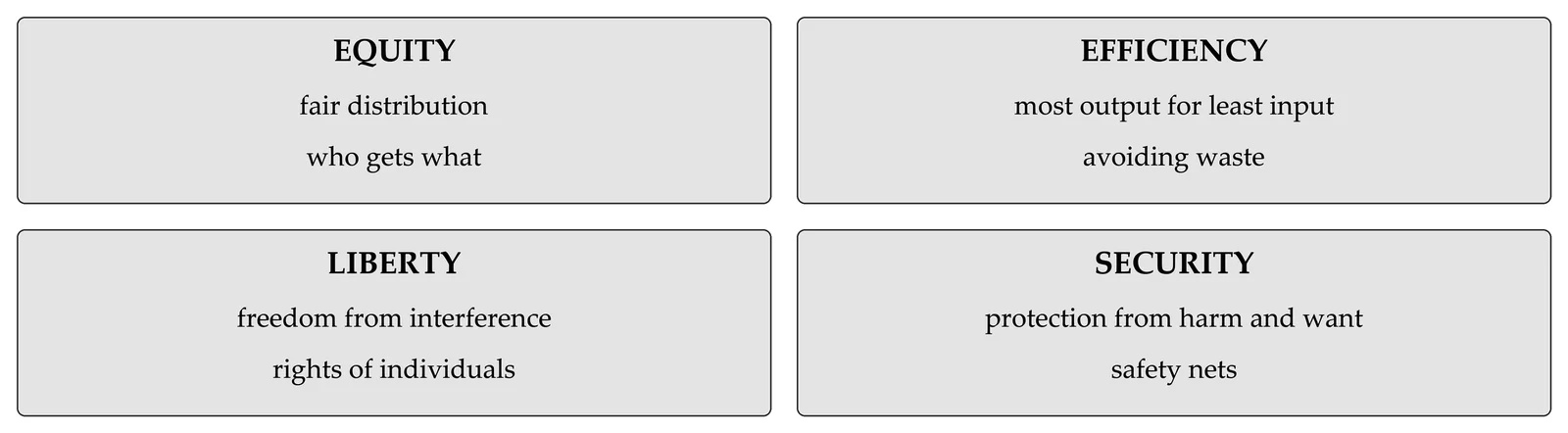
Normative analysis asks what policy ought to be, not only what it is. Every policy choice involves values. Deborah Stone, in Policy Paradox, identifies four goals that policies pursue and that often conflict: equity, efficiency, security and liberty. Ethical theories offer different standards: utilitarianism, from Jeremy Bentham, judges policies by the greatest happiness and underlies cost-benefit analysis; John Rawls asks whether inequalities benefit the least advantaged; libertarians such as Robert Nozick defend liberty and a minimal state; and Amartya Sen judges policies by how they expand people’s capabilities.
Normative issues arise everywhere in Indian policy: reservation (equality of opportunity and representation), land acquisition (development and displacement), environmental regulation (present needs and future generations), and digital identity (welfare delivery and privacy, recognised as a fundamental right in Puttaswamy in 2017). Scholars of the argumentative turn, such as Frank Fischer and John Forester, argue that policy analysis is a form of practical argument about values, not neutral calculation.
4.2 Business and Government Policy; Corporate Social Responsibility
Business influences policy through lobbying, associations, campaign finance, expertise and the threat of moving investment. Stanley Kochanek (1996) shows that liberalisation transformed business lobbying in India: before 1991, individual firms sought licences and favours from officials; afterwards, associations such as the Confederation of Indian Industry engaged in open policy advocacy. Aseema Sinha describes India’s porous state, in which the boundaries between business and government are blurred through advisory committees, think tanks and the movement of people between them. Christophe Jaffrelot, Atul Kohli and Kanta Murali trace the growing power of business in Indian politics.

Corporate social responsibility (CSR) means that companies should contribute to society beyond making profits. Archie Carroll’s pyramid lists economic, legal, ethical and philanthropic responsibilities. Milton Friedman argued that business’s only responsibility is to increase profits within the rules, while Michael Porter and Mark Kramer argued for creating shared value. India’s Companies Act, 2013 requires companies above certain thresholds to spend 2 per cent of their average net profit on activities in Schedule VII, such as education, health and environment.
4.3 NGOs and Government Policy
Non-governmental organisations (NGOs) are voluntary, non-profit bodies that pursue public purposes. Jonathan Doh and Hildy Teegen, in Globalization and NGOs (2003), describe NGOs as agents of change that influence business, government and society through advocacy, as watchdogs and campaigners, and through service delivery. Adil Najam identified four relations between government and NGOs: cooperation, confrontation, complementarity and co-optation. In India, NGOs and movements such as the Mazdoor Kisan Shakti Sangathan, SEWA and Pratham shaped laws on information, employment and education.
Governments partner with NGOs in delivering midday meals, health services and skill training, but also regulate them. The Foreign Contribution (Regulation) Act, amended in 2020, restricts foreign funding and its transfer between NGOs, which critics say limits civil society. The balance between partnership and control remains contested.
4.4 Bureaucracy and the Politics of Policy
B. Guy Peters, in The Politics of Bureaucracy, shows that bureaucracies are political actors: they advise ministers, draft laws, control information and implement policy with discretion. Kuldeep Mathur and James Bjorkman, in Policy Making in India: Who Speaks? Who Listens? (2009), find that Indian policy-making is dominated by senior bureaucrats and the political executive, with experts and civil society heard only selectively. Michael Lipsky showed that street-level bureaucrats, such as teachers, police and welfare workers, use discretion in dealing with citizens, so that their routines effectively become the policies they carry out.

4.5 Important Questions
- Question 1 What is normative analysis of public policy? Discuss the values and ethical frameworks used to judge policy issues.
- Question 2 Discuss the relationship between business and government policy in India. Examine the concept of corporate social responsibility.
- Question 3 Discuss the relationship between non-governmental organisations and government policy.
- Question 4 Examine the role of the bureaucracy in the politics of public policy.
DU asks the same idea in different words. So learn one broad answer for each question below; the same answer works for every question joined by OR.
Important Question 1
What is normative analysis of public policy? Discuss the values and ethical frameworks used to judge policy issues.
OR
‘Public policy is about values as much as facts.’ Discuss.
OR
Examine the role of equity, efficiency, liberty and security in policy analysis.
Model Answer
“It is the greatest happiness of the greatest number that is the measure of right and wrong.”
— Jeremy Bentham, A Fragment on Government (1776)
Introduction. Public policy is often presented as a technical matter of finding the most efficient solution. But every policy choice involves values: who should benefit, who should bear costs, which rights matter most. Normative analysis examines these value questions explicitly, using ethical theories and principles to judge what policy ought to be.
1. Empirical and Normative Analysis
Empirical analysis asks what a policy is and what effects it has. Normative analysis asks whether a policy is good, just or right. Both are needed: facts alone cannot tell us what to do without values, and values without facts can lead to impractical choices.
2. Stone’s Four Values
Deborah Stone, in Policy Paradox, shows that policy debates revolve around values that are themselves contested: equity, efficiency, security and liberty. Each can be defined in different ways, and policies often trade one off against another.
3. Equity
Equity concerns fair distribution. But fairness may mean equal shares, shares according to need, or according to merit. Debates on reservation, taxation and subsidies in India are largely debates about the meaning of equity.
4. Efficiency
Efficiency means getting the most output for given inputs. Economists use Pareto efficiency, where no one can be made better off without making someone worse off. Efficiency is important, but an efficient policy may still be unfair.
5. Liberty and Security
Liberty means freedom from interference; security means protection from harm and want. Policies on surveillance, public health and welfare often involve trade-offs between them, as seen in debates on Aadhaar and privacy and on lockdowns during the pandemic.
6. Utilitarianism
Utilitarianism, from Jeremy Bentham and J.S. Mill, judges policies by their consequences for total welfare, the greatest happiness of the greatest number. It underlies cost-benefit analysis, but critics argue that it can sacrifice minorities for the majority.
7. Rawls’s Justice
John Rawls argued that just institutions guarantee equal basic liberties and fair equality of opportunity, and permit inequalities only if they benefit the least advantaged, the difference principle. Rawlsian analysis asks how a policy affects the worst-off.
8. Libertarianism
Libertarians such as Robert Nozick, in Anarchy, State, and Utopia (1974), argue that individuals have strong rights to liberty and property, and that the state should be minimal. They criticise redistributive and paternalistic policies.
9. Capabilities Approach
Amartya Sen and Martha Nussbaum argue that policies should expand people’s capabilities, their real freedom to achieve valuable functionings such as health, education and participation. This approach shaped the Human Development Index (1990).
10. Rights as Trumps
Ronald Dworkin argued that rights act as trumps over policies that pursue collective goals. Certain things may not be done to individuals even if they would increase total welfare, which limits purely utilitarian policy.
11. Normative Issues in India
Indian policy faces many normative dilemmas: reservation and merit, land acquisition and displacement, environmental protection and growth, privacy and welfare delivery, and the rights of present and future generations. The Constitution’s Preamble and Directive Principles provide guiding values of justice, liberty, equality and fraternity.
12. The Argumentative Turn
Frank Fischer and John Forester argued that policy analysis is a form of argument, in which analysts persuade audiences using both evidence and values. This view encourages deliberation and public participation in policy-making.
13. Evaluation
Normative analysis makes the values behind policy explicit, helping citizens and decision-makers understand trade-offs. Good policy analysis combines empirical evidence with clear ethical reasoning.
Conclusion. Thus, normative analysis asks what policy ought to be, examining values such as equity, efficiency, liberty and security through frameworks such as utilitarianism, Rawlsian justice, libertarianism, capabilities and rights. It shows that public policy is about values as much as facts.
Important Question 2
Discuss the relationship between business and government policy in India. Examine the concept of corporate social responsibility.
OR
How has business lobbying in India changed since liberalisation? Discuss.
OR
Critically examine the mandatory CSR provisions of the Companies Act, 2013.
Model Answer
“There is one and only one social responsibility of business—to use its resources and engage in activities designed to increase its profits so long as it stays within the rules of the game.”
— Milton Friedman, Capitalism and Freedom (1962)
Introduction. Business and government are closely linked. Governments regulate, tax, license and subsidise business, while business invests, employs and lobbies to shape policy. In India, this relationship changed greatly after liberalisation in 1991. At the same time, society increasingly expects companies to act responsibly, and India has made corporate social responsibility a legal requirement.
1. Channels of Business Influence
Business influences policy through associations, lobbying, expert advice, funding of parties and think tanks, media and the structural power that comes from investment and employment, since governments depend on growth.
2. Business Associations in India
India’s main business associations include ASSOCHAM (1920), FICCI (1927) and the Confederation of Indian Industry, which took its present name in 1992. They represent business views to government through submissions, meetings and participation in committees.
3. Kochanek on Lobbying
Stanley Kochanek argues that before 1991, under the licence-permit raj, firms lobbied individually and often privately for licences and favours. After liberalisation, lobbying became more open and policy-oriented, with associations such as CII advocating for reforms and engaging in public debate.
4. Sinha’s Porous State
Aseema Sinha describes India’s porous state, in which boundaries between business and government are blurred. Business leaders sit on official committees, former officials join companies, and think tanks and consultancies link the two. This porousness brings expertise but also risks of capture.
5. Pro-business Policy
Jaffrelot, Kohli and Murali trace the growing power of business in Indian politics since the 1980s. Atul Kohli described a shift towards a pro-business state that favours established firms. Critics warn of crony capitalism, in which policy favours well-connected businesses.
6. Government Regulation of Business
Government shapes business through regulation of competition, environment, labour and finance, taxation, public procurement and public-private partnerships. Independent regulators such as SEBI and the Competition Commission oversee markets.
7. Meaning of CSR
Corporate social responsibility means that companies have responsibilities to society beyond profit-making, towards employees, communities, the environment and the public.
8. Carroll’s Pyramid
Archie Carroll (1991) described a pyramid of responsibilities: economic, being profitable; legal, obeying the law; ethical, doing what is right beyond the law; and philanthropic, contributing to the community.
9. Friedman and Shared Value
Milton Friedman argued that business’s only social responsibility is to increase profits within the rules of the game; social goals are for governments. Michael Porter and Mark Kramer (2011) argued instead that firms can create shared value by addressing social problems in ways that also benefit business.
10. CSR Law in India
Section 135 of the Companies Act, 2013, effective from April 2014, requires companies with a net worth of 500 crore rupees, turnover of 1,000 crore rupees or net profit of 5 crore rupees to form a CSR committee and spend 2 per cent of their average net profit of the past three years on activities listed in Schedule VII. A 2019 amendment made unspent amounts subject to transfer and penalties.
11. Achievements
Mandatory CSR has channelled large sums into education, health, sanitation, rural development and disaster relief, and encouraged partnerships between companies, NGOs and government.
12. Criticisms
Critics argue that CSR spending is concentrated in industrialised states, often aligned with company interests or government priorities, sometimes used for publicity, and that it may substitute for the state’s own responsibilities. Some see it as a disguised tax.
13. Business and Election Finance
Business influence also flows through political funding. The Finance Act of 2017 removed the earlier cap on corporate donations to parties, and the electoral bond scheme of 2018 allowed anonymous donations. In February 2024 the Supreme Court struck down the bonds, and the data later released showed large donations by companies, renewing debate on the links between business funding and policy decisions.
14. Evaluation
The business–government relationship is essential for development but must be transparent and accountable to avoid capture. CSR can contribute to social goals, but it cannot replace effective public policy and regulation.
Conclusion. Thus, business shapes policy through associations, lobbying and a porous state, as Kochanek and Sinha show, while government regulates business. India’s mandatory CSR law reflects a view of business responsibility beyond profit, though its effectiveness and fairness remain debated.
Important Question 3
Discuss the relationship between non-governmental organisations and government policy.
OR
Examine the role of NGOs as agents of change in public policy.
OR
Discuss the cooperation and conflict between NGOs and the state in India.
Model Answer
“All citizens shall have the right … to form associations or unions or co-operative societies.”
— Constitution of India, Article 19(1)(c)
Introduction. Non-governmental organisations have become important actors in public policy across the world. They campaign for change, deliver services, monitor governments and represent marginalised groups. Doh and Teegen describe NGOs as agents of change that transform business, government and society. In India, NGOs have shaped major laws, but their relationship with the state is complex.
1. Meaning of NGOs
NGOs are voluntary, non-profit organisations, independent of government, that pursue public purposes such as development, rights, environment or relief. Together with community groups and associations, they form part of civil society, sometimes called the third sector.
2. Doh and Teegen
Doh and Teegen argue that in a globalised world, NGOs act as agents of change. They influence corporate strategy, government policy and public opinion, especially on issues such as environment, labour standards and human rights, where states and markets fall short.
3. Advocacy Role
As advocates, NGOs raise issues, mobilise public opinion, conduct research, lobby legislators and litigate in courts. Public interest litigation by NGOs has led to important judgements in India on environment, food and labour.
4. Service Delivery Role
As operational organisations, NGOs deliver services such as education, health care, microfinance and disaster relief, often reaching people the state cannot. The Akshaya Patra Foundation, for example, provides midday meals in partnership with governments.
5. Watchdog Role
NGOs monitor government performance, expose corruption and demand accountability. Organisations such as the Association for Democratic Reforms track candidates and party funding, contributing to electoral reforms.
6. Najam’s Four Cs
Adil Najam described four relationships between government and NGOs: cooperation, when they share goals and means; confrontation, when both differ; complementarity, when goals are shared but means differ; and co-optation, when means are shared but goals differ.
7. NGOs and Indian Policy
NGOs and movements shaped many Indian laws: the Mazdoor Kisan Shakti Sangathan campaigned for the Right to Information Act (2005); the Right to Food campaign influenced the rural employment and food security laws; and Pratham’s ASER reports shifted education policy towards learning outcomes.
8. National Advisory Council
From 2004 to 2014, the National Advisory Council, which included civil society activists, drafted several rights-based laws. It showed how NGOs and activists could influence policy from within, though critics questioned its accountability.
9. SEWA and Empowerment
The Self-Employed Women’s Association, founded by Ela Bhatt in 1972, organised informal women workers and influenced policies on social security and street vendors. It shows how membership-based organisations can give voice to the marginalised.
10. Regulation of NGOs
Governments regulate NGOs through registration, tax rules and the Foreign Contribution (Regulation) Act. The 2020 amendment banned the transfer of foreign funds to other NGOs and capped administrative expenses, and many organisations lost their licences. Critics see this as shrinking civic space; the government cites accountability and security.
11. Problems with NGOs
NGOs face criticisms too: dependence on donors, lack of accountability to the people they serve, corruption in some cases, and the risk of depoliticising issues by turning rights into projects.
12. Partnership and Accountability
Effective relations require mutual respect, transparency and accountability on both sides. Platforms such as NITI Aayog’s NGO Darpan portal for registration aim to improve transparency in partnerships.
13. Transnational NGOs
International NGOs and networks, such as Amnesty International, Greenpeace and global campaigns on climate and trade, also seek to influence Indian policy, often in alliance with local groups. Margaret Keck and Kathryn Sikkink describe such transnational advocacy networks. Their activities have sometimes led to conflict with the Indian state; Amnesty International India halted its operations in 2020 after its bank accounts were frozen.
14. Evaluation
NGOs enrich democracy and policy by representing the marginalised, innovating and holding governments accountable. Their relationship with the state ranges from partnership to confrontation, and a healthy democracy needs space for both.
Conclusion. Thus, NGOs influence policy as advocates, service providers and watchdogs, acting as agents of change, as Doh and Teegen argue. In India they have shaped major rights-based laws, though their relationship with government involves cooperation, conflict and increasing regulation.
Important Question 4
Examine the role of the bureaucracy in the politics of public policy.
OR
‘Street-level bureaucrats are policy makers.’ Discuss with reference to Michael Lipsky.
OR
Discuss Mathur and Bjorkman’s view of policy-making in India.
Model Answer
“The decisions of street-level bureaucrats, the routines they establish, and the devices they invent to cope with uncertainties and work pressures, effectively become the public policies they carry out.”
— Michael Lipsky, Street-Level Bureaucracy (1980)
Introduction. In theory, elected politicians make policy and bureaucrats implement it. In practice, bureaucrats shape policy at every stage, from advising ministers to deciding how rules apply to individual citizens. B. Guy Peters, Michael Lipsky, and Kuldeep Mathur and James Bjorkman show the political role of bureaucracy in policy.
1. The Politics–Administration Dichotomy
Woodrow Wilson (1887) and others argued that politics and administration should be separate: politicians decide, administrators execute. Later scholars showed that this separation does not hold in practice.
2. Peters on the Politics of Bureaucracy
B. Guy Peters argues that bureaucracies are political actors in their own right. They possess expertise, information and continuity, which give them influence over ministers who come and go. They advise on policy, draft legislation and regulations, and shape how laws are implemented.
3. Sources of Bureaucratic Power
Bureaucratic power comes from expertise, control of information, permanence, links with interest groups and the discretion involved in implementation. Rufus Miles’s law, where you stand depends on where you sit, suggests that officials defend the interests of their departments.
4. Bureaucracy in India
India’s bureaucracy, especially the IAS, inherited the colonial steel frame. It plays a central role in policy, staffing ministries, district administration and regulatory bodies. Its generalist character and frequent transfers have been criticised for limiting expertise.
5. Mathur and Bjorkman
Mathur and Bjorkman find that policy-making in India is concentrated among senior bureaucrats and the political executive. Experts, think tanks, NGOs and Parliament are heard selectively, depending on access and the issue. Their question, who speaks and who listens, highlights unequal access to policy-makers.
6. Lipsky’s Street-Level Bureaucrats
Michael Lipsky defined street-level bureaucrats as public workers who interact directly with citizens and have substantial discretion: teachers, police officers, social workers, health workers and welfare officials.
7. Discretion
Rules cannot cover every situation, so street-level bureaucrats must decide how to apply them to individuals. They decide who gets a benefit, how much attention a case receives and whether to enforce a rule strictly or leniently.
8. Coping Mechanisms
Faced with heavy workloads, limited resources and ambiguous goals, street-level bureaucrats develop routines to cope: rationing services, simplifying cases, favouring some clients and processing people rather than serving them. These routines become policy in practice.
9. Policy-making from Below
Lipsky argues that street-level bureaucrats are effectively policy-makers, because the policy citizens experience is what these workers do. This explains why policies often look different on the ground from what was intended.
10. Examples in India
Anganwadi workers, ASHA health workers, schoolteachers, patwaris and police constables in India exercise wide discretion. Their behaviour, absenteeism, commitment or corruption largely determines whether welfare schemes reach the poor.
11. Controlling Discretion
Governments try to control discretion through rules, supervision, technology such as biometric attendance, and performance targets. But too much control can reduce flexibility and motivation, while too little invites abuse.
12. Accountability
Bureaucratic accountability can be strengthened through citizens’ charters, right to services laws in several states, grievance redressal, RTI, social audits and training that builds public service values.
13. Committed Bureaucracy
In the early 1970s some leaders called for a committed bureaucracy, loyal to the government’s policy goals rather than neutral. Critics saw this as a step towards politicisation. Frequent transfers of officials by state governments have since been used to reward loyalty and punish independence, weakening the professional neutrality that Weber considered essential.
14. Lateral Entry and Reform
The Second Administrative Reforms Commission (2005–09) recommended opening senior posts to specialists. From 2019 the Union government appointed experts from outside the civil service at the level of joint secretary through lateral entry, though a 2024 round was withdrawn after objections that it bypassed reservation. Such reforms aim to bring expertise into policy-making.
15. Evaluation
Bureaucrats are not neutral implementers but political actors shaping policy at the top and at the street level. Understanding their role is essential to understanding why policies succeed or fail.
Conclusion. Thus, as Peters shows, bureaucracies are political actors in policy-making; as Mathur and Bjorkman show, Indian policy is dominated by senior officials; and as Lipsky shows, street-level bureaucrats effectively make the policies they carry out through their discretion and coping routines.
Short Notes
(a) Corporate social responsibility
The idea that companies have responsibilities to society beyond profit, towards employees, communities and the environment. Archie Carroll described economic, legal, ethical and philanthropic responsibilities. India’s Companies Act, 2013 made CSR spending of 2 per cent of average net profit mandatory for large companies.
(b) Street-level bureaucracy
Michael Lipsky’s term (1980) for public service workers who interact directly with citizens and exercise discretion, such as teachers, police and welfare workers. Their decisions and coping routines effectively become public policy as experienced by citizens.
(c) Porous state
Aseema Sinha’s description of the Indian state after liberalisation, in which the boundaries between business and government are blurred through committees, consultancies, think tanks and movement of personnel. It allows business expertise into policy but risks capture by business interests.
(d) Najam’s four Cs
Adil Najam’s model (2000) of government–NGO relations based on whether their goals and means are similar: cooperation (similar goals and means), confrontation (different goals and means), complementarity (similar goals, different means) and co-optation (different goals, similar means).
More notes: DSC-16 Public Policy
These notes are prepared by PADHO TO AISE for study help. They are not an official University of Delhi publication.