
Semester V DSC-13 Western Political Philosophy - I
Unit II · 26 min read · Updated 24 Nov 2026
As per the University of Delhi (DU) BA (Hons) Political Science syllabus
Contents
- 3.1 Man as Zoon Politikon and the Nature of the Polis
- 3.2 State and Household: Family, Property and Slavery
- 3.3 Citizenship
- 3.4 Justice and Virtue
- 3.5 Regimes and the Best Practicable State
- 3.6 Important Questions
- Describe Aristotle’s classification of constitutions. What according to him is the best practicable state?
- Examine Aristotle’s theory of citizenship. What is the position of women within the polis?
- ‘Man is by nature a political animal.’ Discuss Aristotle’s view of the state and the household, including his theory of slavery.
- Discuss Aristotle’s theory of justice and virtue.
- Short Notes
मनुष्य स्वभाव से एक राजनीतिक प्राणी है।
Man is by nature a political animal.
— Aristotle, Politics, Book I (1253a)
ARISTOTLE (384–322 BCE) was Plato’s student for twenty years, but he became his master’s most searching critic. Where Plato looked upward to the eternal Forms, Aristotle looked outward at the world as it is. He studied the constitutions of 158 Greek cities and built his political philosophy on observation as well as reason, which is why he is often called the father of political science. In the Politics and the Nicomachean Ethics he argued that human beings are political animals who can achieve the good life only in the polis. This chapter studies his ideas on the polis and the household, slavery, citizenship, justice, virtue and the classification of regimes, including his search for the best practicable state.
3.1 Man as Zoon Politikon and the Nature of the Polis
Aristotle declared that man is by nature a political animal (zoon politikon). Human beings alone possess speech (logos), which allows them not only to express pleasure and pain, as animals do, but to declare what is useful and harmful, just and unjust. Living together in a political community is therefore natural to humans. One who cannot live in a community, or needs none because he is self-sufficient, must be either a beast or a god.
The polis develops naturally. The household (oikos) arises to satisfy daily needs; several households form a village; and several villages unite to form the polis, the self-sufficient community. The polis comes into being for the sake of life but exists for the sake of the good life. Aristotle argued that the polis is prior to the individual, as the whole is prior to its parts: a hand cut off from the body is a hand only in name. Politics is therefore the master science, since it aims at the highest human good, happiness (eudaimonia), understood as a life of virtuous activity.

3.2 State and Household: Family, Property and Slavery
Book I of the Politics distinguishes the polis from the household. The household contains three relationships, each with its own kind of rule: the master rules the slave despotically; the husband rules the wife with a kind of political rule, but permanently; and the father rules children with royal rule, based on love and seniority. Political rule, by contrast, is rule over free and equal citizens who take turns ruling and being ruled. Aristotle criticised Plato for confusing the rule of a household with the rule of a city.

Aristotle defended the household and private property against Plato’s communism. What belongs to everyone is cared for by no one; private ownership encourages responsibility, allows generosity and gives pleasure, while use can be made common through friendship. He distinguished household management (oikonomia), the natural acquisition of what is needed, from unlimited money-making (chrematistike), which he considered unnatural, especially lending at interest.
Most controversially, Aristotle defended natural slavery. A slave is a living possession, an animate instrument of action. Some people, he argued, lack the capacity for deliberation and are fit by nature to be ruled, so slavery benefits both master and slave. But he admitted that conventional slavery, such as enslaving prisoners of war, may be unjust when those enslaved are not natural slaves. On women, he said that they possess the deliberative faculty but without authority, so they should be ruled by men. These views reflected the hierarchies of Greek society and have been rejected by modern thought.
3.3 Citizenship
In Book III Aristotle asked who is a citizen. Citizenship is not residence, since resident aliens (metics) and slaves also live in the city, nor merely the right to sue in courts. A citizen in the strict sense is one who shares in deliberative and judicial office, who takes part in the assembly and the courts. This definition, he admitted, fits democracy best, since in other regimes fewer people share in office. Citizenship is thus participation in ruling, not merely a legal status.
Excluded from citizenship were slaves, women, children, resident aliens and, in the best state, manual workers and artisans (banausoi), whose occupations left no leisure for virtue and politics. Citizens rule and are ruled in turn. Aristotle also asked whether the good man and the good citizen are the same: the good citizen is one who serves the constitution well, and since constitutions differ, the virtue of the citizen is relative to the regime. Only in the best state do the virtue of the good citizen and the good man coincide.
3.4 Justice and Virtue
In Book V of the Nicomachean Ethics, Aristotle distinguished general justice, which is lawfulness and complete virtue in relation to others, from particular justice, which concerns fair shares. Particular justice is of two kinds. Distributive justice gives honours, offices and goods in proportion to merit, a geometrical equality, so equals receive equal shares and unequals unequal shares. Corrective or rectificatory justice restores equality in transactions, such as contracts and injuries, treating the parties as equals, an arithmetical equality.

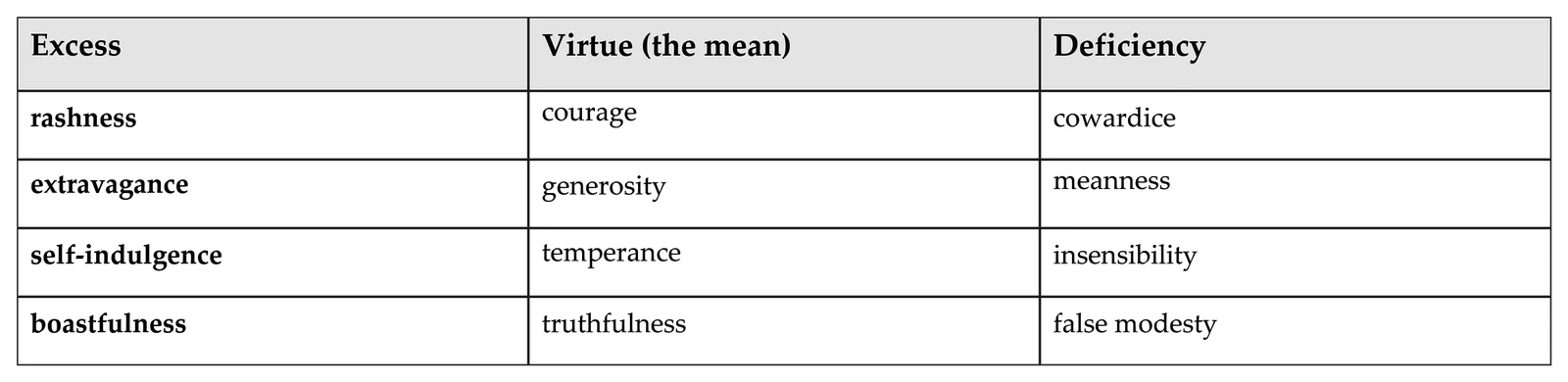
Disputes about justice in politics are disputes about merit: democrats think free birth is the standard, oligarchs wealth, aristocrats virtue. Aristotle argued that political offices should go to those who contribute most to the purpose of the polis, the good life, which favours virtue but also recognises the claims of the wealthy and the many. Virtue (arete) is a settled disposition to act well. Moral virtues, such as courage and temperance, are formed by habit and consist in a mean between excess and deficiency, determined by practical wisdom (phronesis). Since virtue is formed by habit, laws and education are central to politics.
3.5 Regimes and the Best Practicable State
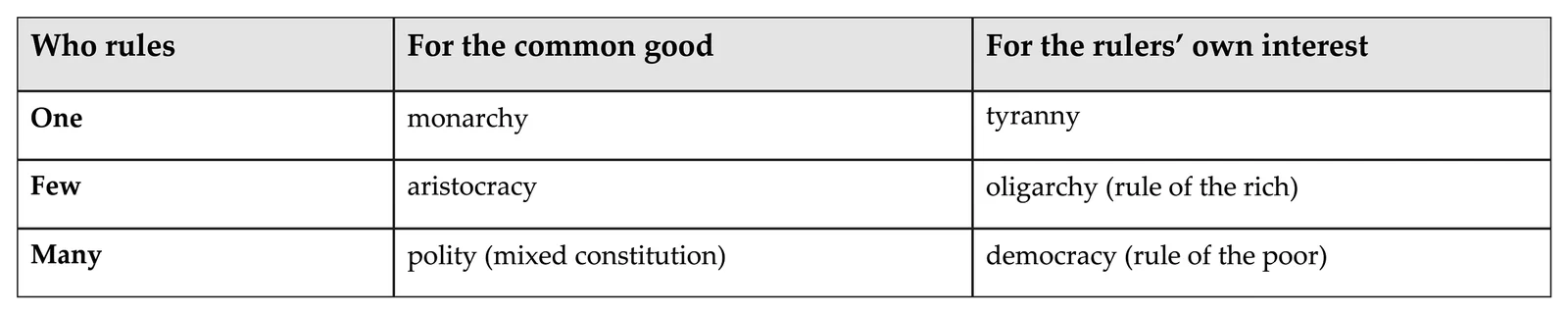
Aristotle classified constitutions (politeiai) by two criteria: the number of rulers, one, few or many, and whether they rule for the common good or their own interest. The correct forms are monarchy, aristocracy and polity; the deviant forms are tyranny, oligarchy and democracy. He added that the real difference between oligarchy and democracy is wealth: oligarchy is rule of the rich and democracy rule of the poor, whatever their numbers.
Aristotle distinguished the ideal state, described in Books VII and VIII, from the best practicable state for most cities. The latter is the polity, a mixture of oligarchy and democracy, in which power rests with a large middle class. The middle class is neither arrogant like the rich nor envious like the poor; it obeys reason, provides stability and prevents faction. Aristotle also defended the rule of law, describing law as reason free from passion, and argued that the many, deliberating together, may judge better than a few experts. In Book V he analysed the causes of revolution, chiefly inequality and the sense of injustice, and the means of preserving constitutions.
3.6 Important Questions
- Question 1 Describe Aristotle’s classification of constitutions. What according to him is the best practicable state?
- Question 2 Examine Aristotle’s theory of citizenship. What is the position of women within the polis?
- Question 3 ‘Man is by nature a political animal.’ Discuss Aristotle’s view of the state and the household, including his theory of slavery.
- Question 4 Discuss Aristotle’s theory of justice and virtue.
DU asks the same idea in different words. So learn one broad answer for each question below; the same answer works for every question joined by OR.
Important Question 1
Describe Aristotle’s classification of constitutions. What according to him is the best practicable state?
OR
Examine Aristotle’s theory of the polity as a mixed constitution.
OR
Why did Aristotle regard the middle class as the basis of a stable state?
Model Answer
“The best political community is formed by citizens of the middle class.”
— Aristotle, Politics, Book IV (trans. Jowett)
Introduction. Aristotle was the first thinker to compare constitutions systematically. With his students he collected studies of 158 Greek constitutions, and in the Politics he classified them, analysed their strengths and weaknesses and asked which is best. He distinguished the ideal state, which requires ideal conditions, from the best practicable state, which most cities can realistically achieve, and found the answer in the polity based on a strong middle class.
1. Meaning of Constitution
For Aristotle, a constitution (politeia) is the arrangement of offices in a city, especially the sovereign office that decides who rules. But it is also the way of life of the city, expressing what the community values. To change the constitution is to change the city itself, even if the people and territory remain the same.
2. Two Criteria
Aristotle classified constitutions by two criteria. The first is the number of those who hold sovereign power: one, few or many. The second, more important, is the purpose of rule: whether rulers govern for the common good of all citizens or for their own private interest. Constitutions that serve the common good are correct; those that serve the rulers are deviant.
3. The Six Forms
Rule by one for the common good is monarchy; its deviant form is tyranny, rule by one for himself. Rule by the few best for the common good is aristocracy; its deviant form is oligarchy, rule by the few rich for themselves. Rule by the many for the common good is polity; its deviant form is democracy, rule by the many poor for themselves.
4. Wealth as the Real Basis
Aristotle observed that the real difference between oligarchy and democracy is not numbers but wealth. Oligarchy is rule by the rich, who are usually few, and democracy rule by the free poor, who are usually many. Since every city contains rich and poor, these two regimes are the most common, and much political conflict is a struggle between them.
5. Ranking of Constitutions
Among the correct forms, Aristotle ranked monarchy and aristocracy highest in theory, since they are rule by the most virtuous. Among the deviant forms, tyranny is the worst, being the corruption of the best, oligarchy next and democracy the least bad. This ranking shows his realism: the rule of many, even when self-interested, does less harm than the rule of one tyrant.
6. Ideal State and Best Practicable State
In Books VII and VIII, Aristotle described an ideal state in which citizens of complete virtue rule, supported by a well-ordered territory, population and education. But he recognised that most cities cannot achieve such conditions. Political science must therefore also ask what is the best constitution for most cities and for people as they actually are.
7. The Polity as a Mixed Constitution
The best practicable state is the polity, a mixture of oligarchy and democracy. It combines elements of both: for example, using election from oligarchy and paying citizens to attend courts from democracy, or setting a moderate property qualification for office. By balancing the claims of the rich and the poor, the polity avoids the extremes of each.
8. The Role of the Middle Class
Aristotle argued that the best political community is formed by citizens of the middle class. The very rich tend to be arrogant and unwilling to obey, the very poor envious and servile. The middle class is most ready to follow reason, least likely to covet others’ property or be envied, and able to hold the balance between rich and poor. Where the middle class is large, the city is stable and free from faction.
9. Rule of Law and the Wisdom of the Many
In the polity, laws rather than individuals should be sovereign, since law is reason free from passion. Aristotle also argued that the many, though individually not excellent, may collectively judge better than a few, just as a feast to which many contribute is better than one provided by a single person. This gives the polity a basis for including ordinary citizens.
10. Stability and Revolution
In Book V, Aristotle analysed revolutions, finding their main cause in inequality and the sense of injustice, as when the poor feel excluded or the rich feel equality is unjust. Mixed constitutions with a strong middle class, moderation, the rule of law and education in the spirit of the constitution are the best safeguards of stability.
11. Influence
Aristotle’s classification influenced political thought for over two thousand years, from Polybius’s theory of the mixed constitution of Rome to Montesquieu’s separation of powers and the American founders’ checks and balances. His emphasis on the middle class anticipates modern theories linking democracy to a broad middle class.
12. Evaluation
Aristotle’s classification combines empirical observation with normative judgement. Critics note that it was designed for small Greek city-states and excluded slaves and women from political life. Yet his insights that regimes should be judged by whether they serve the common good, and that a strong middle class and mixed institutions promote stability, remain valuable.
Conclusion. Thus, Aristotle classified constitutions by the number of rulers and the purpose of rule into six forms, and found the best practicable state in the polity, a mixed constitution based on a large middle class and the rule of law, which offers stability and justice for most cities.
Important Question 2
Examine Aristotle’s theory of citizenship. What is the position of women within the polis?
OR
Who is a citizen according to Aristotle? Is the good man the same as the good citizen?
OR
Critically examine Aristotle’s views on women and the household.
Model Answer
“He who has the power to take part in the deliberative or judicial administration of any state is said by us to be a citizen of that state.”
— Aristotle, Politics, Book III (trans. Jowett)
Introduction. Citizenship was central to Greek political life, and Aristotle gave the first systematic theory of it in Book III of the Politics. For him, citizenship is not merely living in a city or having legal rights but actively sharing in ruling. His theory is participatory and demanding, but also exclusive, leaving out slaves, women, resident aliens and manual workers. His views on women reveal both his realism and the limits of his thought.
1. The Question
Aristotle began by asking who is a citizen, since the city is a community of citizens and constitutions differ in how they define citizenship. A person who is a citizen in a democracy may not be one in an oligarchy, so the question is both practical and theoretical.
2. What Citizenship Is Not
Citizenship is not simply residence, since slaves and resident aliens also live in the city. It is not merely the right to sue and be sued, which foreigners may have through treaties. Nor is it descent from citizen parents, which only pushes the question back. Children and old people past service are citizens only in an incomplete sense.
3. The Definition
A citizen in the strict sense is one who shares in the administration of justice and in offices, especially the deliberative and judicial functions, that is, who participates in the assembly and the courts. Aristotle admitted that this definition fits democracy best, since there the citizens as a whole sit in the assembly and the courts.
4. Ruling and Being Ruled
Political rule is rule over free and equal persons, so citizens take turns ruling and being ruled. A good citizen must know both how to rule and how to obey, which requires education and experience. Citizenship is therefore an activity and a form of virtue, not a passive status.
5. Good Man and Good Citizen
Aristotle asked whether the virtue of the good man is the same as that of the good citizen. The good citizen is one who preserves the constitution, and since constitutions differ, the virtue of the citizen is relative to the regime. A good man in a bad regime may be a bad citizen. Only in the best state, where the constitution aims at virtue, do the two coincide fully, especially in those who rule.
6. Exclusion of Workers
In the best state, Aristotle excluded manual workers, artisans and traders from citizenship, because their work leaves no leisure for virtue and politics and their occupations degrade body and mind. Citizenship requires leisure, which depended on the labour of slaves and others. This shows the aristocratic character of his ideal.
7. Women in the Household
In Book I, Aristotle described the household as containing three relationships. The husband rules the wife with political rule, as among citizens, but unlike political rule it is permanent, since the male is by nature fitter to command. Women’s role was to manage the household under the husband’s authority.
8. Women’s Deliberative Faculty
Aristotle claimed that the slave lacks the deliberative faculty entirely, the woman has it but without authority, and the child has it in an undeveloped form. Women’s virtue, such as courage or temperance, differed from men’s: a man’s courage is shown in commanding, a woman’s in obeying. Women were therefore excluded from citizenship and confined to the private sphere.
9. Women and the Polis
Although excluded from political life, women were important to the polis as wives and mothers of citizens, and Aristotle recommended attention to their education and to marriage laws. He also criticised Sparta for giving women too much freedom and wealth, which he thought harmful to the city.
10. Feminist Critique
Feminist thinkers such as Susan Okin and Jean Bethke Elshtain criticised Aristotle for naturalising women’s subordination and for building the public–private distinction that excluded women from politics for centuries. His functionalist reasoning, defining women by their role in reproduction and the household, became a model for later justifications of inequality.
11. Influence of His Theory
Aristotle’s participatory idea of citizenship inspired republican thinkers from Cicero to Machiavelli, Rousseau and Hannah Arendt, who saw citizenship as active involvement in public life. Modern democracies have extended citizenship to all adults, but his emphasis on participation and civic virtue remains influential.
12. Evaluation
Aristotle’s theory combines an inspiring ideal of active citizenship with exclusions based on class, gender and status. His recognition that citizenship varies by constitution was insightful, but his justification of women’s and workers’ exclusion reflected the prejudices of his society rather than reasoned necessity.
Conclusion. Thus, for Aristotle a citizen is one who shares in deliberative and judicial office, ruling and being ruled in turn. Women, though members of the polis, were excluded from citizenship and subordinated in the household because he believed their deliberative capacity lacked authority, a view modern thought has decisively rejected.
Important Question 3
‘Man is by nature a political animal.’ Discuss Aristotle’s view of the state and the household, including his theory of slavery.
OR
Explain Aristotle’s theory of the origin and nature of the state.
OR
Critically examine Aristotle’s justification of natural slavery.
Model Answer
“He who is unable to live in society, or who has no need because he is sufficient for himself, must be either a beast or a god.”
— Aristotle, Politics, Book I (trans. Jowett)
Introduction. Book I of Aristotle’s Politics explains the origin and nature of the polis and its relationship with the household. Against the sophists, who saw the state as a mere convention or contract, Aristotle argued that the polis exists by nature and that human beings are political animals who fulfil their nature only in a political community. In the same book he discussed property and defended slavery, one of the most criticised parts of his thought.
1. The State Exists by Nature
Aristotle argued that the polis is natural because it is the end towards which human associations naturally develop. Just as the nature of a thing is what it is when fully developed, the nature of human association is fully realised in the polis. The polis is therefore not artificial but the natural home of human beings.
2. Man as a Political Animal
Human beings are political animals in a higher sense than bees or herd animals, because they possess speech. Speech allows them to discuss what is advantageous and harmful, just and unjust, and it is sharing in these perceptions that makes a household and a city. A person without a city is either a beast or a god.
3. From Household to Polis
The first association is the household, formed by the unions of man and woman for reproduction and of master and slave for preservation. Several households form a village, and several villages form the polis, which is self-sufficient. The polis arises for the sake of life but continues for the sake of the good life.
4. The Priority of the Polis
Aristotle argued that the polis is prior to the household and the individual, as the whole is prior to its parts. A hand separated from the body is no longer really a hand. Individuals are not self-sufficient and depend on the community for the virtues and goods that make a human life complete.
5. Household and Polis Distinguished
Aristotle criticised those, like Plato, who thought that the rule of a household and the rule of a city differ only in size. The household involves unequal relationships of master and slave, husband and wife, and father and children, while the polis is a community of free and equal citizens who rule and are ruled in turn.
6. Property and Wealth
Property is part of the household and necessary for life. Aristotle distinguished natural acquisition of what the household needs from unlimited money-making for its own sake, which he called unnatural. He condemned usury, money breeding money, as the most unnatural form. He defended private property against Plato’s communism, arguing that it encourages care, generosity and pleasure.
7. The Theory of Natural Slavery
Aristotle called the slave a living possession and an animate instrument. He argued that some people are slaves by nature: they lack the deliberative faculty and can understand reason without possessing it fully. For them, being ruled by a master is both natural and beneficial, as the body is ruled by the soul.
8. Natural and Conventional Slavery
Aristotle recognised that not all slavery is natural. Slavery by convention, such as enslaving prisoners of war, may be unjust if the captives are by nature free, for example Greeks enslaved by Greeks. He also said that masters and natural slaves can have a kind of friendship and common interest.
9. Criticisms of Slavery
Critics point out that Aristotle offered no reliable way to identify natural slaves, and that his theory justified the slave economy on which Greek leisure and citizenship depended. Later thinkers used it to defend the enslavement of Africans and indigenous peoples. Modern thought rejects the idea that any human being is naturally fit to be another’s property.
10. Women and Children
The household also contains the rule of husband over wife and father over children. Aristotle believed women had deliberative capacity without authority and children in an undeveloped form, so both should be ruled, though differently from slaves. These hierarchies, he thought, were natural.
11. Significance
Aristotle’s idea that humans are political animals and that the community is necessary for a good life influenced natural law thinkers, Aquinas, and modern communitarians such as Alasdair MacIntyre and Michael Sandel. It challenges individualist theories, like those of Hobbes and Locke, which treat the state as an artificial contract.
12. Evaluation
Aristotle’s organic view of the polis offers a rich account of human sociability and the political nature of the good life. But his defence of slavery and women’s subordination shows how ideas of nature can be used to justify existing hierarchies, a warning for later political thought.
Conclusion. Thus, Aristotle saw the polis as a natural community that grows from the household and exists for the good life, making humans political animals by nature. His distinction between political and household rule is insightful, but his theory of natural slavery and women’s subordination reflected the injustices of his society.
Important Question 4
Discuss Aristotle’s theory of justice and virtue.
OR
Distinguish between distributive and corrective justice according to Aristotle.
OR
Explain Aristotle’s doctrine of virtue as a mean and its relation to politics.
Model Answer
“Virtue, then, is a state of character concerned with choice, lying in a mean, the mean relative to us.”
— Aristotle, Nicomachean Ethics, Book II (trans. W.D. Ross)
Introduction. For Aristotle, ethics and politics are inseparable. The Nicomachean Ethics asks what the good life is, and the Politics asks how the community should be organised to make that life possible. His theories of virtue and justice therefore form the moral foundation of his political thought. Justice concerns how goods and honours are distributed and how wrongs are corrected; virtue concerns the character that enables people to live and act well.
1. Happiness as the Highest Good
Aristotle argued that every action aims at some good, and the highest good is happiness (eudaimonia), understood not as pleasure but as flourishing: an activity of the soul in accordance with virtue over a complete life. Since the polis aims at the good life, politics is the master science that directs all other activities towards this end.
2. Meaning of Virtue
Virtue (arete) is excellence of character or intellect. Intellectual virtues, such as wisdom and practical wisdom, are acquired through teaching. Moral virtues, such as courage, temperance and generosity, are acquired through habit: we become just by doing just acts and brave by doing brave acts. Laws and education are therefore central to forming virtuous citizens.
3. Virtue as a Mean
Moral virtue is a settled disposition to choose the mean between two vices, one of excess and one of deficiency. Courage lies between rashness and cowardice, generosity between extravagance and meanness, temperance between self-indulgence and insensibility. The mean is not a mathematical midpoint but what is appropriate to the person and situation.
4. Practical Wisdom
Identifying the mean requires practical wisdom (phronesis), the ability to deliberate well about what is good in particular circumstances. The practically wise person, rather than a fixed rule, is the standard of right action. Practical wisdom is especially important for statesmen, who must judge what is good for the city.
5. General Justice
In Book V of the Ethics, Aristotle distinguished general justice, which is lawfulness and complete virtue exercised towards others, from particular justice, which concerns fairness in the distribution of goods and in transactions. General justice makes justice the virtue that sums up all others in relation to the community.
6. Distributive Justice
Distributive justice concerns the distribution of honours, offices and wealth among members of the community. It follows geometrical proportion: shares should be proportional to merit, so equals receive equal shares and unequals unequal shares. Injustice arises when equals receive unequal shares or unequals equal shares.
7. Corrective Justice
Corrective or rectificatory justice applies to transactions between individuals, voluntary, like sales and loans, or involuntary, like theft and assault. It follows arithmetical proportion: the judge treats the parties as equals and restores the balance by taking from the one who gained and giving to the one who lost, regardless of their merit.
8. Justice and Constitutions
In the Politics, Aristotle showed that political conflict arises from different ideas of merit. Democrats think all free-born persons are equal and should share equally; oligarchs think the wealthy deserve more. Aristotle argued that offices should go to those who contribute most to the purpose of the city, the good life, which gives weight to virtue while recognising other claims.
9. Political and Natural Justice
Aristotle distinguished natural justice, which has the same force everywhere, from legal or conventional justice, which depends on what a community decides. This distinction influenced the later natural law tradition of the Stoics, Cicero and Aquinas.
10. Equity
Because laws are general, they may produce injustice in particular cases. Aristotle argued that equity corrects the law where it fails because of its generality, by doing what the lawgiver would have done had he foreseen the case. Equity is a higher form of justice.
11. Friendship and the Polis
Aristotle also argued that friendship (philia) holds cities together, and that lawgivers care more about friendship than justice, since friends have no need of justice. Civic friendship, based on shared commitment to the common good, is the bond of a well-ordered polis.
12. Evaluation
Aristotle’s theories of virtue and justice remain influential in virtue ethics and theories of distributive justice. Critics argue that his idea of merit justified hierarchy and exclusion, but his distinction between distributive and corrective justice, and his insight that justice is tied to the purposes of a community, are still central to political philosophy.
Conclusion. Thus, Aristotle defined virtue as a disposition to choose the mean, guided by practical wisdom, and justice as both lawfulness and fairness in distribution and correction. These ideas connect ethics with politics, since the polis exists to make citizens virtuous and to secure a just order for the good life.
Short Notes
(a) Slavery (Aristotle)
Aristotle defended natural slavery in Book I of the Politics. A slave is a living possession and an animate instrument; some people, lacking the deliberative faculty, are slaves by nature and benefit from being ruled by a master, as the body by the soul. He admitted that conventional slavery, such as enslaving prisoners of war, may be unjust when the enslaved are naturally free. The theory justified the slave economy of Greece and was later used to defend modern slavery.
(b) Polity
Aristotle’s name for the correct form of rule by the many, and for the best practicable state: a mixed constitution combining features of oligarchy and democracy, such as elected offices and paid participation, and resting on a large middle class. The middle class is moderate, obeys reason and holds the balance between rich and poor, making the polity stable and free from faction.
(c) Eudaimonia
The Greek word usually translated as happiness or flourishing. For Aristotle it is the highest good, sought for its own sake: an activity of the soul in accordance with virtue over a complete life. Since the polis exists for the good life, politics aims at enabling citizens to achieve eudaimonia through virtue, education and law.
More notes: DSC-13 Western Political Philosophy - I
These notes are prepared by PADHO TO AISE for study help. They are not an official University of Delhi publication.