
Semester V DSC-13 Western Political Philosophy - I
Unit I · 22 min read · Updated 24 Nov 2026
As per the University of Delhi (DU) BA (Hons) Political Science syllabus
Contents
- 1.1 Meaning of a Text
- 1.2 Why Read the Classics
- 1.3 Approaches to Interpretation
- 1.4 Terence Ball on the Challenges of Interpretation
- 1.5 Skinner and Rawls on Reading the Past
- 1.6 Important Questions
- What is a text? Discuss the challenges of interpreting a text according to Terence Ball.
- Discuss Quentin Skinner’s contextual approach to the history of political ideas.
- Why should we study the classics of Western political philosophy today? Discuss with reference to Rawls.
- Short Notes
क्लासिक वह पुस्तक है जिसने जो कुछ कहना है उसे कहना कभी समाप्त नहीं किया।
A classic is a book that has never finished saying what it has to say.
— Italo Calvino, Why Read the Classics? (1981)
WHY should students in the twenty-first century read Plato, Aristotle, Machiavelli, Hobbes and Locke? These thinkers wrote in societies very different from ours, about city-states, monarchies and religious wars. Yet their questions, what is justice, why should we obey the state, what makes a ruler legitimate, are still our questions. Before we study them, we must ask how a text should be read. Do we read it as a timeless conversation with great minds, or as a document of its own time? Can we ever know what an author meant? This unit studies the meaning of a text and the main approaches to interpretation, drawing on Terence Ball, John Rawls and Quentin Skinner.
1.1 Meaning of a Text
The word text comes from the Latin texere, to weave: a text is a woven fabric of words. In the simplest sense it is a written work, such as a book, essay, speech or letter, whose meaning can be read and interpreted. In political philosophy, the term usually refers to the classic texts of the tradition, such as Plato’s Republic, Aristotle’s Politics, Machiavelli’s The Prince, Hobbes’s Leviathan and Locke’s Two Treatises of Government. A text is different from a mere record of facts because it makes arguments, uses concepts and seeks to persuade.
Thinkers disagree about what a text is. Textualists treat a classic text as a self-contained whole whose meaning lies in its words. Contextualists such as Quentin Skinner treat it as a speech act, an action performed by an author in a particular historical and linguistic situation. Hermeneutic thinkers such as Hans-Georg Gadamer see the meaning of a text as emerging from a dialogue between the text and its readers across time. Postmodern thinkers such as Jacques Derrida went further, arguing that meaning is never fixed and that there is nothing outside the text. Each view leads to a different method of interpretation.
1.2 Why Read the Classics
Political philosophers give several reasons for studying classic texts. First, they pose the perennial questions of politics, about justice, power, authority, liberty and the good life, with exceptional depth. Second, they shaped the concepts we still use, such as the state, sovereignty, rights and consent, so reading them helps us understand our own vocabulary. Third, they offer alternatives to present assumptions; Plato’s critique of democracy, for example, forces democrats to defend their views. Fourth, they show how political ideas responded to crises, such as the defeat of Athens, the civil war in England or the instability of Italian city-states.
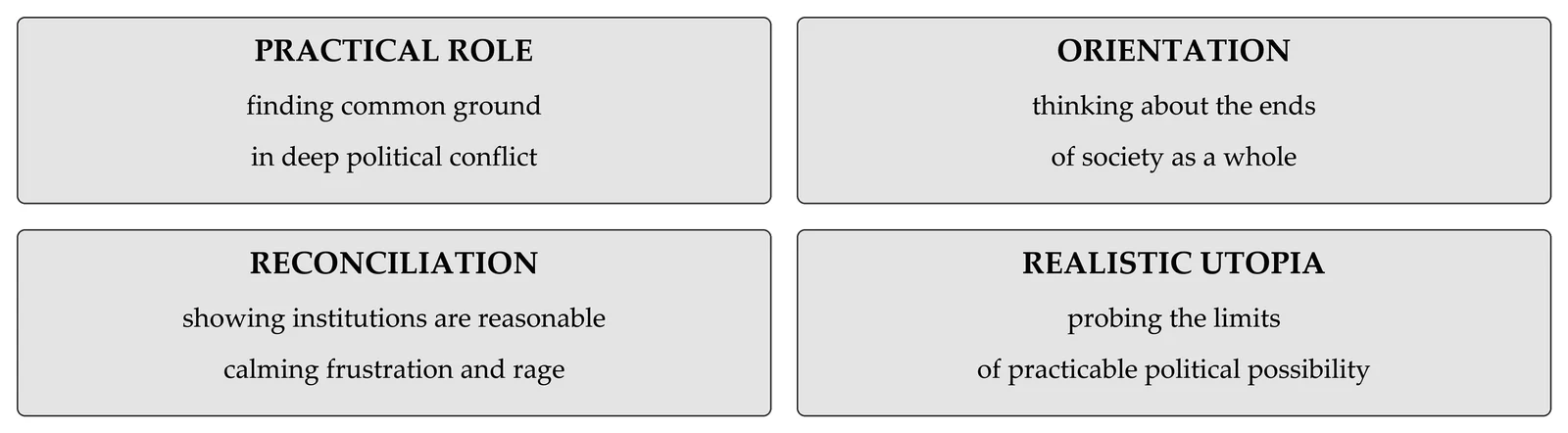
John Rawls, who taught the history of political philosophy at Harvard for decades, believed that we should read each author at his strongest, trying to understand the problem he faced and the answer he gave, before criticising him. Political philosophy, he argued, has practical roles: it can help societies find common ground when they are divided, orient citizens to the ends of their society, reconcile them to institutions that are reasonable, and explore the limits of what is politically possible, which he called a realistic utopia.
1.3 Approaches to Interpretation
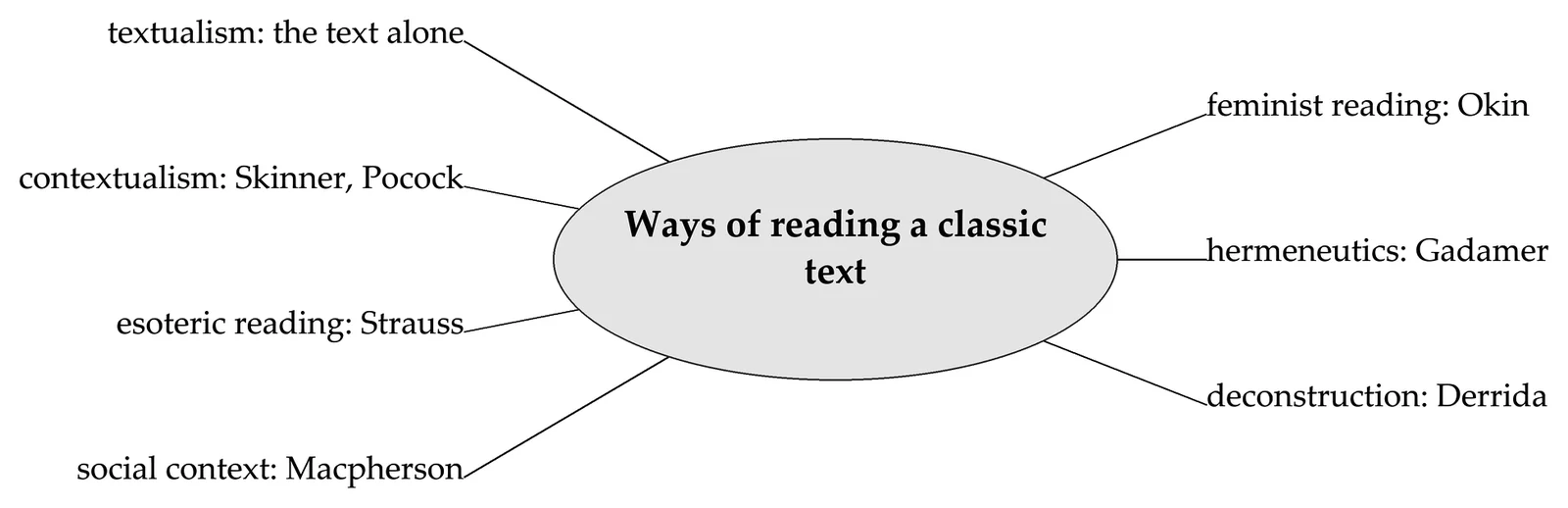
- Textualism: the text contains its own meaning and should be read closely and repeatedly; classic texts address timeless questions and can be studied without reference to their context. Critics say this leads to anachronism, reading modern ideas into old texts.
- Contextualism: associated with the Cambridge School of Quentin Skinner, J.G.A. Pocock and John Dunn, it holds that a text must be read in its historical and linguistic context to recover what the author was doing in writing it.
- Esoteric reading: Leo Strauss, in Persecution and the Art of Writing (1952), argued that philosophers living under persecution often hid their true teaching between the lines, writing an exoteric surface message for the many and an esoteric message for careful readers.
- Social and economic context: Marxist readers such as C.B. Macpherson, in The Political Theory of Possessive Individualism (1962), interpreted Hobbes and Locke as expressing the assumptions of an emerging market society.
- Feminist reading: Susan Moller Okin, in Women in Western Political Thought (1979), showed how the canon excluded or subordinated women, and read texts for their assumptions about gender and the family.
- Hermeneutics: Hans-Georg Gadamer, in Truth and Method (1960), argued that understanding is a fusion of horizons between the text’s world and the reader’s, so every age reads the classics anew.
- Deconstruction: Jacques Derrida argued that texts contain tensions and hidden hierarchies that undermine their apparent meaning, so no reading is final.
1.4 Terence Ball on the Challenges of Interpretation
Terence Ball, in ‘History and Interpretation’ (2004), surveys these approaches and the difficulties every interpreter faces. Texts are written in particular languages and times; their words change meaning over centuries; authors may write ambiguously, inconsistently or cautiously; translations alter nuances; and readers bring their own concerns and prejudices. Rival schools disagree about whether the author’s intention, the historical context, the text itself or the reader’s situation should govern interpretation. Ball also notes the debate about the canon itself: who decides which texts are classics, and why so few women and non-Western thinkers have been included.
Ball rejects the idea that there is one correct method. He favours a pluralist and problem-driven approach: interpreters should take historical context seriously to avoid anachronism, but they read the classics because those texts help illuminate present political problems. Interpretation is therefore an ongoing conversation in which each generation reappraises the classics in the light of its own questions, while respecting the evidence of the texts. No interpretation is final, but some are better supported than others.
1.5 Skinner and Rawls on Reading the Past
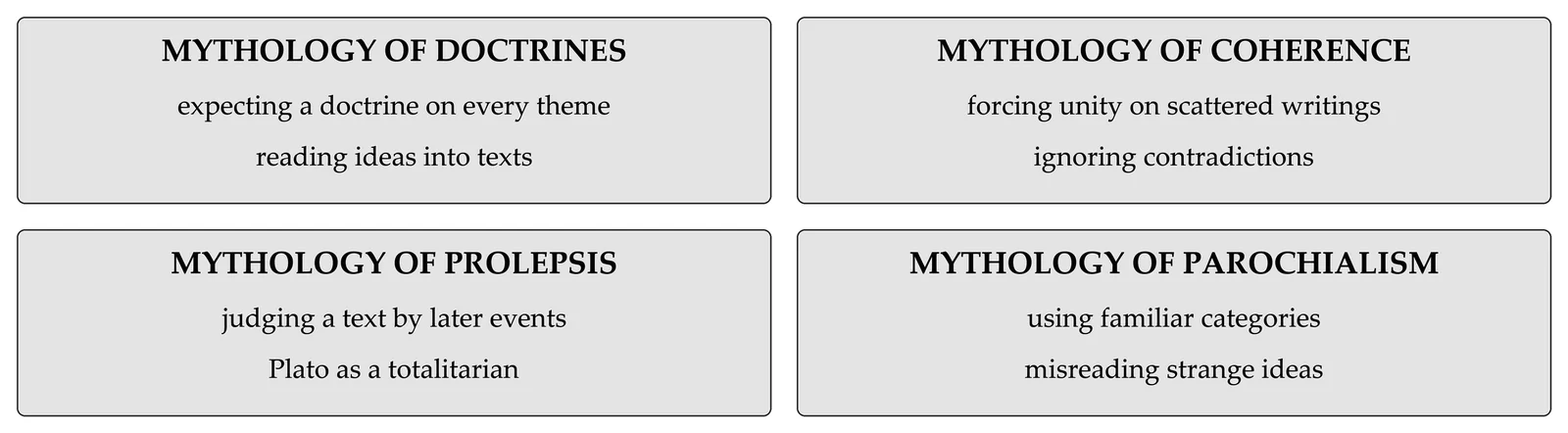
Quentin Skinner, in ‘Meaning and Understanding in the History of Ideas’ (1969, revised in Visions of Politics, 2002), attacked both textualism and crude contextualism. Textualists, he argued, fall into mythologies: the mythology of doctrines, expecting each classic author to have a doctrine on every standard theme; the mythology of coherence, forcing scattered writings into a consistent system; the mythology of prolepsis, judging a text by its later significance, as when Plato is called a totalitarian; and the mythology of parochialism, describing unfamiliar ideas in familiar categories. Drawing on J.L. Austin’s theory of speech acts, Skinner argued that to understand a text we must recover its illocutionary force, what the author was doing in writing it, by studying the conventions and debates of the time.
Rawls, by contrast, read the classics as a philosopher seeking to learn from them. In his lectures he tried to present each author’s views in their most defensible form, assuming that the authors were wise and that their apparent errors often reflected problems they were wrestling with. He focused on texts that shaped the liberal tradition, such as those of Hobbes, Locke, Hume, Rousseau and Mill, and asked how they could help us think about justice and legitimacy today. Rawls and Skinner thus represent two complementary ways of reading the past: philosophical reconstruction and historical recovery.
1.6 Important Questions
- Question 1 What is a text? Discuss the challenges of interpreting a text according to Terence Ball.
- Question 2 Discuss Quentin Skinner’s contextual approach to the history of political ideas.
- Question 3 Why should we study the classics of Western political philosophy today? Discuss with reference to Rawls.
DU asks the same idea in different words. So learn one broad answer for each question below; the same answer works for every question joined by OR.
Important Question 1
What is a text? Discuss the challenges of interpreting a text according to Terence Ball.
OR
Discuss the various approaches to interpreting texts in the history of political thought.
OR
‘There is no single correct way of reading a classic text.’ Discuss.
Model Answer
“A classic is a book that has never finished saying what it has to say.”
— Italo Calvino, Why Read the Classics? (1981)
Introduction. The study of Western political philosophy is largely the study of a small number of classic texts, from Plato’s Republic to Locke’s Two Treatises. But reading such texts is not straightforward. They were written long ago, in other languages and for other audiences, and scholars disagree about how they should be understood. Terence Ball, in ‘History and Interpretation’, examines what a text is, the main approaches to interpreting it and the challenges every interpreter faces.
1. Meaning of a Text
A text, from the Latin texere, to weave, is a written work whose words are woven into arguments, images and meanings. In political philosophy, texts are works such as the Republic, the Politics, The Prince and Leviathan. They are not mere records but attempts to persuade, to justify or to criticise political arrangements, so understanding them requires interpretation, not just reading.
2. Different Views of a Text
Textualists see a classic as a self-contained work whose meaning lies in its words and arguments. Contextualists, like Skinner, see it as a speech act performed in a particular historical and linguistic setting. Hermeneutic thinkers, like Gadamer, see meaning as arising from a dialogue between text and reader, and postmodernists, like Derrida, argue that meaning is never fixed. How we define a text shapes how we interpret it.
3. The Challenge of Historical Distance
Ball emphasises that classic texts come from worlds very different from ours. Words such as state, liberty, democracy or property have changed their meaning over centuries. When we read Plato’s dikaiosune as justice or Machiavelli’s virtù as virtue, we risk misunderstanding them. Reading modern meanings into old texts produces anachronism, one of the most common errors of interpretation.
4. Author’s Intention
Another challenge is whether the meaning of a text is what its author intended. Contextualists argue that we should recover the author’s intentions by studying the debates and conventions of the time. Critics reply that intentions are often unknowable, that authors may not fully understand their own work, and that texts can have meanings beyond what their authors intended. Some literary theorists, such as Roland Barthes, even proclaimed the death of the author, arguing that meaning is produced by readers.
5. Ambiguity and Inconsistency
Classic texts are often ambiguous or apparently inconsistent. Machiavelli seems to praise republics in the Discourses and princes in The Prince; Locke seems to defend both equal rights and unlimited accumulation of property. Interpreters must decide whether to resolve such tensions, explain them by context or accept them, without imposing what Skinner called the mythology of coherence.
6. Hidden Meanings and Translation
Leo Strauss argued that philosophers writing under persecution concealed their true teachings between the lines, so careful readers must look for esoteric meanings. Most of us also read classics in translation, and translators make choices that shape meaning. Ball notes that these factors make interpretation an uncertain and contestable task.
7. The Reader’s Situation
Readers bring their own concerns, values and prejudices. Gadamer argued that this is not simply a problem but a condition of understanding: every reading is a fusion of the horizon of the text with the horizon of the reader. Marxist, feminist and postcolonial readers have shown how different standpoints reveal different aspects of the same text.
8. The Problem of the Canon
Ball also raises the question of which texts count as classics. The canon of Western political philosophy has been almost entirely male and European. Feminist scholars such as Susan Okin and postcolonial scholars ask why women and non-Western thinkers were excluded, and whether the canon reflects intellectual merit or the power of particular traditions.
9. Ball’s Pluralist Approach
Ball rejects the claim that any one method is the only correct one. He favours a pluralist and problem-driven approach: historical context must be respected to avoid anachronism, but we read the classics because they help us think about present political problems. Each generation reappraises the classics in the light of its own concerns, and interpretations compete through argument and evidence.
10. Interpretation as Conversation
Ball compares the history of political thought to a long conversation in which later thinkers respond to earlier ones and readers today join in. Hobbes wrote against Aristotle, Locke against Filmer and Hobbes, and Rousseau against Locke. Interpreters who understand these exchanges can see what was at stake in each text, while also asking what the conversation means for present debates on justice, rights and democracy.
11. Evaluation
Ball’s approach steers between the antiquarian view that texts belong only to their past and the timeless view that ignores history. It reminds students that interpretation is never final, but that some readings are better supported by the text and its context than others, and that reading the classics carefully is itself a political and intellectual education.
Conclusion. Thus, a text is a woven fabric of arguments that must be interpreted, and Ball shows that historical distance, intention, ambiguity, hidden meanings, translation, the reader’s standpoint and the canon all make interpretation difficult. A pluralist, problem-driven approach allows the classics to keep speaking to us without distorting them.
Important Question 2
Discuss Quentin Skinner’s contextual approach to the history of political ideas.
OR
Explain Skinner’s critique of the mythologies in the history of ideas.
OR
‘To understand a text we must understand what its author was doing in writing it.’ Discuss.
Model Answer
“No agent can eventually be said to have meant or done something which he could never be brought to accept as a correct description of what he had meant or done.”
— Quentin Skinner, ‘Meaning and Understanding in the History of Ideas’ (1969)
Introduction. Quentin Skinner, one of the leading figures of the Cambridge School, transformed the study of the history of political thought. In his essay ‘Meaning and Understanding in the History of Ideas’ (1969), later revised in Visions of Politics (2002), he criticised the ways in which classic texts were usually read and proposed a contextual method focused on what authors were doing in writing their texts.
1. The Problem
Before Skinner, historians of political thought often treated classic texts as contributions to a timeless debate on perennial questions. Scholars asked what Plato, Hobbes or Locke said about the state, liberty or sovereignty, as if all of them were answering the same questions. Skinner argued that this approach produced serious historical errors. This produced histories of ideas that read like conversations among great thinkers across the centuries, detached from the particular quarrels in which they actually wrote.
2. Critique of Textualism
Skinner rejected the textualist view that a text should be read on its own, repeatedly and closely, to discover its timeless meaning. Without knowledge of context, readers inevitably fill gaps with their own assumptions and expectations, so they end up writing mythologies rather than history.
3. The Mythology of Doctrines
The first mythology is the expectation that every classic author must have a doctrine on each of the standard themes of political theory. Historians then construct doctrines from scattered remarks or criticise authors for failing to discuss topics they never intended to address, attributing to them ideas they could not have held.
4. The Mythology of Coherence
The second mythology is the assumption that an author’s writings form a coherent system. Interpreters then explain away contradictions or invent hidden unities, instead of recognising that authors change their minds, write for different purposes and sometimes contradict themselves.
5. Prolepsis and Parochialism
The mythology of prolepsis judges a text by its significance for later events, for example calling Plato a forerunner of totalitarianism or Locke the father of liberalism, as if they intended these outcomes. The mythology of parochialism occurs when interpreters describe unfamiliar ideas in familiar terms, misidentifying what an alien text is really about.
6. Critique of Social Contextualism
Skinner also rejected the view that texts can be explained simply by their social or economic context, as some Marxist readings suggested. Knowing the social background may explain why an author wrote, but it does not tell us what the text means or what the author was doing.
7. Speech Acts and Intentions
Drawing on J.L. Austin’s theory of speech acts, Skinner argued that writing is a form of action. To understand a text we must grasp its illocutionary force: what the author was doing in saying what he said, whether attacking, defending, satirising or reformulating an existing position. This requires recovering the author’s intentions in writing. For example, Machiavelli’s advice that a prince must learn how not to be good is best understood as a deliberate challenge to the mirror-for-princes literature of his time, which urged rulers to cultivate the conventional virtues.
8. Linguistic Context
Intentions can be recovered by studying the linguistic context: the conventions, vocabularies and debates of the period. For example, to understand Hobbes’s Leviathan we must know the arguments of the royalists, parliamentarians and radicals of the English Civil War to which he was responding. J.G.A. Pocock similarly studied the political languages, such as republicanism, in which texts were written.
9. Skinner’s Own Studies
Skinner applied his method in The Foundations of Modern Political Thought (1978), which traced how the modern concept of the state emerged from Renaissance and Reformation debates, and in studies of Machiavelli and Hobbes. In Liberty before Liberalism (1998) he recovered a neo-Roman or republican idea of freedom as not being dependent on the arbitrary will of another, showing how historical recovery can enrich present political thought.
10. Criticisms
Critics argue that Skinner’s method reduces texts to their context, making them antiquarian documents with little relevance today, and that intentions are often unrecoverable. Others note that great texts transcend their contexts and continue to speak to new readers. Skinner replied that historical understanding liberates us by showing that our concepts are not inevitable.
11. Significance
Skinner’s approach revolutionised the history of political thought, inspiring studies of Machiavelli, Hobbes and republican liberty. It taught students to read texts historically, avoid anachronism and see political theory as a series of arguments in specific situations. His method also encouraged attention to minor writers, pamphlets and debates, not only the great texts, because these form the context that gives the classics their meaning.
Conclusion. Thus, Skinner argued that to understand a classic text we must recover what its author was doing in writing it by studying its linguistic context. His critique of the mythologies of doctrines, coherence, prolepsis and parochialism made the history of political thought more historical and more rigorous.
Important Question 3
Why should we study the classics of Western political philosophy today? Discuss with reference to Rawls.
OR
Distinguish between textualist and contextualist approaches to the classics.
OR
Examine John Rawls’s approach to the history of political philosophy.
Model Answer
“Understanding is not to be thought of so much as an action of one’s subjectivity, but as the placing of oneself within a process of tradition.”
— Hans-Georg Gadamer, Truth and Method (1960)
Introduction. Many students ask why they should read philosophers who lived centuries ago. The classics of Western political philosophy were written for city-states, monarchies and societies without democracy or modern technology. Yet they continue to be studied, debated and reinterpreted. Philosophers such as John Rawls and historians such as Quentin Skinner offer different but complementary answers to the question of why and how we should read them.
1. Perennial Questions
The classics address enduring questions: what is justice, who should rule, why should we obey, what are the limits of authority and what is the good life. Plato, Aristotle, Hobbes and Locke offered profound answers that remain points of reference. Textualists argue that this is why the classics can be read as a timeless conversation. Leo Strauss went further, arguing that the classics contain a wisdom that modern thought has forgotten, especially about virtue and the best regime.
2. Origins of Our Concepts
Our political vocabulary of the state, sovereignty, rights, consent, property and citizenship was shaped by these texts. Reading Hobbes explains the modern idea of sovereignty, and reading Locke explains natural rights and limited government. Understanding the classics therefore helps us understand ourselves.
3. Critical Alternatives
The classics also challenge our assumptions. Plato’s critique of democracy, Aristotle’s idea that humans are political animals, and Machiavelli’s separation of politics from conventional morality force us to rethink positions we take for granted and to defend them with better arguments.
4. Rawls’s Philosophical Reading
John Rawls taught the history of political philosophy by trying to present each author’s arguments in their strongest and most coherent form. He assumed that the authors were thinking hard about real problems, so apparent errors should first be understood as responses to those problems before being criticised. His aim was to learn from them for contemporary questions of justice. He told his students that when they found an apparent mistake in a great writer, they should first ask whether the mistake might be their own, and look for the reasons that could have led the author to that view.
5. The Liberal Tradition
Rawls focused on authors who shaped the liberal and democratic tradition, such as Hobbes, Locke, Hume, Rousseau, Mill and Marx. He traced how ideas of the social contract, legitimacy and equal citizenship developed, and he presented his own theory of justice as fairness as continuing the contract tradition of Locke, Rousseau and Kant.
6. Roles of Political Philosophy
Rawls identified practical roles for political philosophy: helping divided societies find a basis for agreement, orienting citizens to the ends of their society, reconciling them to institutions that are reasonable, and exploring a realistic utopia, the best that is politically possible. The classics are resources for each of these tasks.
7. The Contextualist Answer
Skinner argued that the classics should be read historically, as interventions in the debates of their time. Their value for us is not that they answer our questions but that they show us how differently political concepts can be understood, freeing us from assuming that our own ways of thinking are inevitable.
8. Hermeneutic and Critical Readings
Gadamer argued that understanding the classics is a fusion of horizons between past and present, so each age reads them anew. Feminist, Marxist and postcolonial readers have used the classics critically, exposing their exclusions of women, workers and colonised peoples, which is another reason to study them carefully.
9. Textualism versus Contextualism
Textualists emphasise the timeless relevance of the classics but risk anachronism; contextualists emphasise historical accuracy but risk antiquarianism. Terence Ball suggests combining both: respecting context while asking how the classics illuminate present problems. Students preparing for examinations can use both: explaining the historical setting of a thinker before assessing the strengths and weaknesses of the argument.
10. Critical Uses of the Classics
Reading the classics critically also matters. Feminists such as Susan Okin and Carole Pateman showed how social contract theories assumed a male head of household, while postcolonial scholars showed how Locke’s ideas of property were used to justify taking land from indigenous peoples. These critical readings do not reject the classics but show that understanding their limits is as important as admiring their insights.
11. Relevance for Indian Students
For students in India, the Western classics shaped the constitutional ideas of rights, sovereignty and democracy adopted in 1950, and they can be read alongside Indian traditions such as Kautilya and Gandhi, enriching comparative understanding.
Conclusion. Thus, we study the classics because they pose enduring questions, shaped our concepts and challenge our assumptions. Rawls read them philosophically to learn from them, and Skinner historically to understand them in context; together these approaches make the classics living resources for political thought.
Short Notes
(a) Fusion of horizons
Hans-Georg Gadamer’s idea, in Truth and Method (1960), that understanding a text involves a meeting of two horizons: the historical world of the text and the present world of the reader. Readers cannot escape their own prejudices, but through dialogue with the text their horizon is enlarged, so every age understands the classics in a new way.
(b) Esoteric writing
Leo Strauss’s claim, in Persecution and the Art of Writing (1952), that philosophers living under persecution wrote in two layers: an exoteric teaching acceptable to the authorities and the public, and an esoteric teaching hidden between the lines for careful readers. Critics argue that this method allows interpreters to find almost any meaning they wish.
(c) Speech act
A concept from J.L. Austin’s How to Do Things with Words (1962), used by Quentin Skinner. Saying something is also doing something, such as promising, warning or attacking. Skinner argued that political texts are speech acts, so understanding them requires grasping their illocutionary force: what the author was doing in writing them.
(d) The canon
The set of texts regarded as the classics of political philosophy, usually running from Plato and Aristotle through Machiavelli, Hobbes, Locke and Rousseau to Mill and Marx. Critics argue that the canon was formed by universities and publishers in particular times and places, and that it excludes women, such as Mary Wollstonecraft, and non-Western thinkers, such as Kautilya or Ibn Khaldun. Debates about the canon ask whether its texts are chosen for their quality or because of the power of the traditions that preserved them.
More notes: DSC-13 Western Political Philosophy - I
These notes are prepared by PADHO TO AISE for study help. They are not an official University of Delhi publication.