
Semester II DSC-5 Methods and Approaches in Comparative Political Analysis
Unit VI · 23 min read · Updated 24 Nov 2026
As per the University of Delhi (DU) BA (Hons) Political Science syllabus
Contents
- 6.1 Why Gender Matters for Comparative Politics
- 6.2 The Gender Lacuna in Comparative Politics
- 6.3 Gendering Comparative Politics: Achievements and Challenges
- 6.4 Political Representation: Women in Government and Politics
- 6.5 Increasing Women’s Representation: Electoral Systems and Quotas
- 6.6 Important Questions
- What is the ‘gender lacuna’ in comparative politics? How can comparative politics be gendered?
- Discuss the political representation of women in government and politics.
- Examine gender quotas as a means of increasing women’s political representation.
- Short Notes
जो व्यक्तिगत है, वही राजनीतिक है।
The personal is political.
— Carol Hanisch, essay of that title (1970)
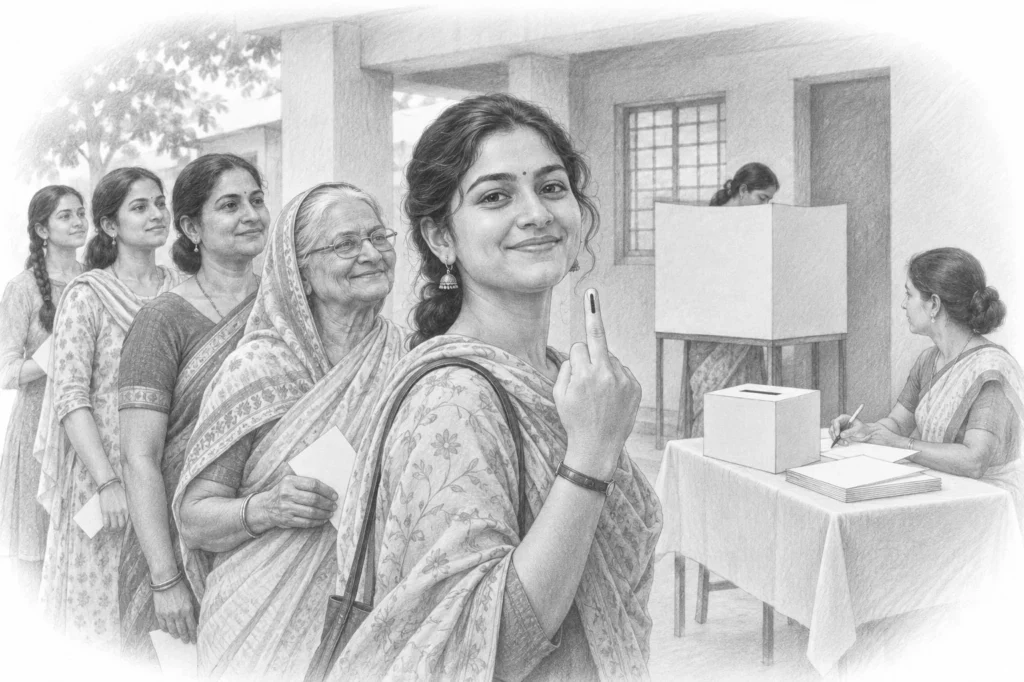
FOR MOST OF ITS HISTORY comparative politics studied states, parties, elections, revolutions and wars as if gender did not matter. Yet in almost every country women were denied the vote until the twentieth century, they remain a minority in parliaments and cabinets, and the policies of states, on welfare, family, work and violence, affect women and men very differently. Feminist scholars have shown that gender is not a side issue but a basic structure of political life. In this chapter we study why comparative politics long neglected gender, which Lisa Baldez called the gender lacuna, how scholars such as Karen Beckwith and Mona Lena Krook have tried to gender the discipline, and the central question of the political representation of women in government and politics, including the role of electoral systems and gender quotas.
6.1 Why Gender Matters for Comparative Politics
As we saw in DSC-4, sex refers to biological differences and gender to the social roles and expectations attached to them. A gender perspective in comparative politics asks how these roles shape political life and how politics in turn shapes gender relations. It matters for three reasons. First, participation and power are unequally distributed between women and men in every country, though to very different degrees. Second, institutions are gendered: constitutions, electoral systems, parties, welfare states and armies were designed largely by men and embody assumptions about men’s and women’s roles, such as the ‘male breadwinner’. Third, the boundary between public and private is itself political: issues such as domestic violence, child care and reproductive rights were once considered private matters and became political only through women’s movements, as the slogan ‘the personal is political’ insists.
6.2 The Gender Lacuna in Comparative Politics
A lacuna is a gap. Lisa Baldez [बाल्डेज़], in ‘The Gender Lacuna in Comparative Politics’ (2010), observed a striking paradox. On the one hand, there is a large and growing body of research on gender and politics around the world, much of it comparative. On the other hand, this research had very little place in the mainstream of comparative politics: few articles on gender appeared in the leading comparative journals, gender was rarely included in general textbooks and theories, and it was treated as a specialised topic for women scholars rather than a central variable.
A. Reasons for the lacuna
- A male-dominated discipline: for most of its history political science was written by men about men.
- A narrow definition of politics: comparative politics focused on the formal public sphere, states, parties, elections and wars, where women were few, and ignored the private sphere of family and household, where gender power is exercised.
- Gender seen as a women’s issue: gender was equated with women and treated as a separate subject rather than a dimension of all politics.
- Separate subfields: gender and politics developed its own journals and networks, so the two communities rarely spoke to each other.
- Methodological prejudice: mainstream scholars sometimes regarded feminist research as normative or activist rather than scientific.
B. Why the gap is costly
Baldez argued that ignoring gender produces incomplete and sometimes wrong explanations. Studies of democratisation that ignored women’s movements missed an important actor in transitions from military rule in Latin America, as in Chile, where women’s protests helped bring down the Pinochet regime; studies of welfare states that ignored gender missed how policies assume and reinforce unpaid care work by women; and studies of conflict that ignored gender missed the use of sexual violence as a weapon of war. Bringing gender in does not require a separate theory; it requires that gender be treated as a variable and a structure in the mainstream questions of comparative politics.
6.3 Gendering Comparative Politics: Achievements and Challenges
A. Beckwith: gender as category and as process
Karen Beckwith, in ‘Comparative Politics and the Logics of a Comparative Politics of Gender’ (2010), clarified what it means to study gender comparatively. Gender can be used as a category: comparing women and men as groups, for example their voting turnout, party preferences or numbers in parliament. Gender can also be studied as a process: the ways in which institutions, policies and political practices create and reproduce differences between women and men, for example how electoral rules, party recruitment or welfare policies favour one sex. A comparative politics of gender uses the logic of comparison, comparing across countries and over time, to explain why gender relations and their political effects vary. Gender, she stresses, is relational and changing, not a fixed attribute.
B. Krook: achievements
Mona Lena Krook [क्रूक], in ‘Gendering Comparative Politics: Achievements and Challenges’ (2011), lists what this research has achieved:
- Women’s representation: a large body of comparative research on why women’s presence in parliaments varies and on the effects of electoral systems and quotas.
- Gender quotas: the study of quotas, now used in more than a hundred countries, has become one of the most dynamic areas of comparative politics.
- Women’s movements: research on how women’s movements shape democratisation, policy and the state.
- State feminism: the comparative study of women’s policy agencies, such as ministries and commissions for women, and of how they advance gender equality.
- Gendered welfare states: scholars such as Ann Orloff and Diane Sainsbury showed how welfare regimes differ in the degree to which they support women’s independence.
- Feminist institutionalism: applying the new institutionalisms of Chapter 3 to gender, showing that formal and informal institutional rules are gendered and that gender equality reforms are often resisted by ‘old’ informal norms.
C. Krook: challenges
The challenges remain: integrating gender research into the mainstream of the discipline; developing concepts that travel across very different societies, especially in the Global South; combining large-N and case-study methods; and taking intersectionality seriously, since gender interacts with race, class, caste, religion and sexuality. Gendering comparative politics also means going beyond the binary of men and women to include gender minorities.
6.4 Political Representation: Women in Government and Politics
A. Participation
Rod Hague, Martin Harrop and John McCormick note that women have largely closed the gender gap in voting: in many democracies women now vote as often as men or more. In India, in the 2019 Lok Sabha election, women’s turnout slightly exceeded that of men for the first time. A modern gender gap has appeared in party preferences: in many Western democracies women have become more likely than men to vote for parties of the left, a change that Inglehart and Pippa Norris linked to post-materialist values. But the higher one goes in politics, the fewer women there are: in party leadership, parliaments, cabinets and heads of government, women remain a minority almost everywhere.
B. Women in parliaments and executives
Women hold only a little over a quarter of seats in national parliaments worldwide, with great variation: Rwanda, where women hold more than half the seats in the lower house, and the Nordic countries are at the top, while some countries have very few women legislators. In India women won about 14 per cent of Lok Sabha seats in 2024. In executives, Sirimavo Bandaranaike [भंडारनायके] (Sri Lanka, 1960) was the world’s first woman Prime Minister, followed by Indira Gandhi (1966), Golda Meir (1969) and Margaret Thatcher (1979). In South Asia several women leaders came to power through family connections, which shows that dynastic politics can open doors for individual women without changing the position of women in general.
C. Reasons for women’s under-representation
Pippa Norris and Joni Lovenduski [लवेन्डुस्की] (1995) explained women’s under-representation through supply and demand. On the supply side, fewer women come forward as candidates because of fewer resources of time, money and networks, the burden of care work, and socialisation that discourages political ambition. On the demand side, party gatekeepers select fewer women, assuming that they are less ‘winnable’, and voters may be biased. Institutional factors, especially the electoral system and quotas, and cultural factors, such as attitudes towards women’s roles, shape both supply and demand.
D. Why representation matters: meanings of representation
Hanna Pitkin’s The Concept of Representation (1967) helps us see what is at stake (Figure 6.2). Descriptive representation means that representatives resemble those they represent, so that women are present in proportion to their numbers. Substantive representation means that representatives act for the interests of the represented, for example by advancing policies on violence against women, child care or equal pay. Symbolic representation concerns how the represented feel about their representatives, for example whether women see parliament as legitimate and open to them.

Anne Phillips, in The Politics of Presence (1995), argued that a politics of ideas, in which it does not matter who represents us as long as our ideas are represented, is not enough; the presence of women matters, because experiences shape priorities and because the exclusion of women from decision-making is itself an injustice. Jane Mansbridge (1999) gave a ‘contingent yes’ to the question whether women should represent women: descriptive representation is especially valuable when there is distrust and when interests are not yet fully formed. Rosabeth Moss Kanter and Drude Dahlerup argued that a critical mass of about 30 per cent may be needed before women can change institutions; Sarah Childs and Krook (2008) suggested that critical actors, individuals who initiate change, may matter more than numbers. Research on Indian panchayats by Chattopadhyay and Duflo (2004) found that women leaders invested more in drinking water, a priority of women voters, which supports the link between presence and policy.
6.5 Increasing Women’s Representation: Electoral Systems and Quotas
A. Electoral systems
Women are generally better represented under proportional representation with party lists than under single-member plurality (first-past-the-post) systems. Under list PR, parties present several candidates in each district and can balance their lists, while under plurality each party chooses one candidate per constituency and tends to choose the ‘safest’, usually a man. This helps explain the high numbers of women in the Nordic countries and the lower numbers in Britain, the United States and India.
B. Gender quotas
Gender quotas require that women make up a minimum share of candidates or members of political bodies. Krook and Drude Dahlerup distinguish three types:
| Type | Meaning | Examples |
|---|---|---|
| Reserved seats | A number of seats is set aside for women, filled by women only | India’s panchayats and municipalities (1992); Rwanda; India’s 106th Amendment (2023) |
| Legal candidate quotas | The law requires parties to nominate a minimum share of women candidates | Argentina (1991); France’s parity law (2000) |
| Voluntary party quotas | Parties adopt their own rules for women candidates | Sweden’s Social Democrats; the ANC in South Africa |
Dahlerup and Lenita Freidenvall (2005) contrasted the incremental track of the Nordic countries, where women’s representation rose slowly over decades with social change, with the fast track of countries that used quotas to achieve a sudden jump. Arguments for quotas are that they compensate for barriers women face, achieve justice and presence quickly, and change attitudes. Arguments against are that they conflict with merit and voter choice, may produce token or ‘proxy’ women, and may benefit elite women more than others. Research shows that the effect of quotas depends on their design: placement rules on party lists, sanctions for non-compliance and the electoral system.
C. India
India illustrates both the promise and the limits of quotas. The 73rd and 74th Amendments (1992) reserved one-third of seats in local bodies for women, raised to one-half in many states, bringing lakhs of women into local politics. The Women’s Reservation Bill to extend reservation to Parliament and state assemblies was first introduced in 1996 and finally passed as the Constitution (106th Amendment) Act, 2023, reserving one-third of seats, to take effect after the next census and delimitation. The problems of proxy representation and the absence of a sub-quota for OBC women have been debated.
6.6 Important Questions
- Question 1 What is the ‘gender lacuna’ in comparative politics? How can comparative politics be gendered?
- Question 2 Discuss the political representation of women in government and politics.
- Question 3 Examine gender quotas as a means of increasing women’s political representation.
DU asks the same idea in different words. So learn one broad answer for each question below; the same answer works for every question joined by OR.
Important Question 1
What is the ‘gender lacuna’ in comparative politics? How can comparative politics be gendered?
OR
Discuss the achievements and challenges of gendering comparative politics.
OR
Explain gender as a category and as a process in comparative politics.
Model Answer
“Sex is a status category with political implications.”
— Kate Millett, Sexual Politics (1970)
Introduction. Comparative politics long neglected gender, though gender shapes participation, institutions and policies everywhere. Lisa Baldez (2010) called this neglect the gender lacuna. Scholars such as Karen Beckwith and Mona Lena Krook have shown how the discipline can be gendered.
1. Meaning of Gender
Gender refers to socially constructed roles and expectations attached to being a man or a woman. It is relational and changing, and it structures power in both public and private life. Gender is relational: it concerns power between women and men.
2. The Gender Lacuna
Baldez observed that despite a large body of comparative research on gender and politics, mainstream comparative politics journals, textbooks and theories rarely included gender, treating it as a niche topic. Surveys of leading journals found relatively few articles on gender.
3. Reasons for the Lacuna
The discipline was male-dominated; it defined politics narrowly as the formal public sphere; it equated gender with women; gender research developed in a separate subfield; and feminist research was dismissed as normative. Its focus on the state, war and elections excluded the household and informal politics.
4. Costs of the Lacuna
Ignoring gender leads to incomplete explanations: of democratisation without women’s movements (as in Chile), of welfare states without unpaid care, of conflict without sexual violence. Studies of democratisation, for example, ignored the women’s movements that helped end dictatorships in Latin America.
5. Beckwith: Category and Process
Gender as a category compares women and men, for example in turnout or representation. Gender as a process studies how institutions and policies create and reproduce gender differences. A comparative politics of gender compares these across countries and over time. Gender as a process examines how institutions themselves are gendered.
6. Gender and the Welfare State
Feminist scholars such as Ann Orloff showed that welfare states differ in how they treat women as mothers, workers and citizens, adding gender to Esping-Andersen’s typology.
7. Achievements (Krook)
Research has advanced understanding of women’s representation, gender quotas in over a hundred countries, women’s movements, state feminism and women’s policy agencies, gendered welfare states, and feminist institutionalism, which shows how formal and informal institutional rules are gendered.
8. Women’s Movements Compared
Comparative studies show how women’s movements shaped policies on violence, reproductive rights and quotas in different countries, from Latin America to South Asia.
9. Challenges
Integrating gender into the mainstream, building concepts that travel to the Global South, combining methods, applying intersectionality and moving beyond the binary of men and women remain challenges. Data on gender are often missing in many countries.
10. Gender in Indian Research
Research on women’s reservation in panchayats, such as Chattopadhyay and Duflo’s study, shows how gender can be built into comparative and policy research.
11. Masculinities
Gendering also means studying men and masculinities, for example how ideas of strong leadership and militarism shape politics.
12. Evaluation
Gendering comparative politics has made the discipline more complete and realistic. Critics within feminism warn against treating women as a single group, and mainstream scholars still sometimes see gender as optional; but its central claim, that gender is a basic structure of politics, is increasingly accepted. It shows that politics cannot be fully understood without gender.
13. Feminist Institutionalism
Fiona Mackay, Meryl Kenny and Louise Chappell (2010) applied the new institutionalism to gender. They showed that institutions are gendered both formally and informally: candidate selection, for example, may follow informal norms that favour men even when formal rules are neutral, and new gender-equality rules are often resisted or undermined by older informal practices.
14. Intersectionality
Women are not a single category. Kimberlé Crenshaw showed how race and gender combine, and in India Gopal Guru argued in ‘Dalit Women Talk Differently’ (1995) that Dalit women face oppression by caste as well as gender, which mainstream feminism and Dalit politics both overlooked. Comparative research must therefore study how gender interacts with other identities.
Conclusion. Thus, filling the gender lacuna means treating gender as a central variable and process in all comparative questions, not as a separate subject for women alone.
Important Question 2
Discuss the political representation of women in government and politics.
OR
Why are women under-represented in legislatures? Discuss.
OR
Distinguish between descriptive and substantive representation of women.
Model Answer
“Should blacks represent blacks and women represent women? A contingent ‘yes’.”
— Jane Mansbridge, title of her article (1999)
Introduction. Women form half of every population, yet they remain a minority in parliaments, cabinets and party leaderships almost everywhere. The political representation of women is therefore a central issue of democracy and of comparative politics.
1. Participation
Women have largely closed the gender gap in voting; in India their turnout slightly exceeded men’s in 2019. A modern gender gap in party preference has emerged in many democracies, with women leaning more to the left. In recent Indian general elections women’s turnout has equalled or exceeded men’s.
2. Representation in Legislatures and Executives
Women hold only a little over a quarter of parliamentary seats worldwide, with wide variation from Rwanda and the Nordic countries to countries with very few women. In India about 14 per cent of Lok Sabha members elected in 2024 were women. Women heads of government, from Bandaranaike (1960) and Indira Gandhi (1966) onwards, remain exceptions. Rwanda, with over sixty per cent women in its lower house, leads the world.
3. Supply-Side Explanations
Norris and Lovenduski point to fewer resources of time, money and networks, the burden of care work and socialisation that discourages ambition. Women’s lower political ambition is itself shaped by socialisation and expectations.
4. Demand-Side Explanations
Party gatekeepers select fewer women as ‘winnable’ candidates, and voter bias may persist. Parties often give women tickets in seats they cannot win.
5. Institutional and Cultural Explanations
List proportional representation favours women more than plurality systems; quotas raise numbers rapidly; and cultural attitudes and levels of development shape both supply and demand. The Nordic countries combine PR, voluntary party quotas and an egalitarian culture.
6. Meanings of Representation
Pitkin distinguished descriptive representation (women present), substantive representation (women’s interests acted upon) and symbolic representation (women’s sense that institutions are theirs).
7. Why Presence Matters
Phillips argued for a politics of presence, not only of ideas; Mansbridge gave a contingent yes to descriptive representation. Critical mass (Kanter, Dahlerup) and critical actors (Childs and Krook) explain when presence translates into policy. Indian evidence shows women leaders changing local priorities.
8. The Critical Mass Debate
Drude Dahlerup questioned whether a ‘critical mass’ of about thirty per cent automatically changes politics, arguing that critical acts by committed individuals matter more.
9. Violence against Women in Politics
Women politicians face harassment and violence, online and offline, which discourages participation; scholars now study this as a distinct barrier.
10. Limits
Women representatives do not always act for women, because of party discipline, class and caste differences, or proxy control; descriptive representation is necessary but not sufficient. Elite women may not represent poor or minority women.
11. Women in Cabinets
Women ministers are often concentrated in ‘soft’ portfolios such as family, education and social welfare rather than finance, defence or home affairs, as Krook and Diana O’Brien (2012) found across the world. Research also speaks of a ‘glass cliff’: women are sometimes appointed to leadership in times of crisis, when the risk of failure is high. Women heads of government such as Indira Gandhi, Margaret Thatcher and Golda Meir did not necessarily advance women’s causes.
12. Women’s Representation in India
Women formed under 5 per cent of the first Lok Sabha (1952) and about 14 per cent in 2024. Parties nominate few women, and many women MPs come from political families. Local bodies, with reservation, have become a pipeline that may increase the supply of experienced women politicians.
13. Substantive Outcomes
Women legislators and women’s movements have pushed laws on violence against women in many countries; in India, after the Justice Verma Committee (2013), the Criminal Law (Amendment) Act, 2013 strengthened laws on sexual violence.
14. Evaluation
Women’s representation has risen but remains far from equal; presence matters for justice and legitimacy, but substantive change also needs women’s movements, party reform and supportive institutions.
Conclusion. Thus, women’s representation in government and politics remains unequal. Increasing it is a matter of justice, legitimacy and better policy, and requires institutional as well as cultural change.
Important Question 3
Examine gender quotas as a means of increasing women’s political representation.
OR
Discuss the role of electoral systems and quotas in women’s representation.
OR
Examine women’s reservation in India in comparative perspective.
Model Answer
“Take measures to ensure women’s equal access to and full participation in power structures and decision-making.”
— Beijing Platform for Action (1995), Strategic Objective G.1
Introduction. Gender quotas are rules that require women to make up a minimum share of candidates or members of political bodies. Since the 1990s they have spread to more than a hundred countries and have become, as Krook shows, one of the most important subjects of comparative research on gender and politics.
1. The Case for Quotas
Women face barriers of resources, care work, party gatekeeping and prejudice. Quotas aim to compensate for these barriers and to achieve presence quickly rather than waiting for slow social change. Quotas are a ‘fast track’ remedy for these barriers.
2. Reserved Seats
Seats are set aside for women only, as in India’s panchayats and municipalities (1992), Rwanda and India’s 106th Amendment (2023). Rwanda, Uganda and several Arab countries also use reserved seats. In India’s panchayats, seats reserved for women rotate across constituencies.
3. Legal Candidate Quotas
The law requires parties to nominate a minimum share of women, as in Argentina’s pioneering law of 1991 and France’s parity law of 2000. France’s parity law (2000) requires equal numbers of male and female candidates.
4. Voluntary Party Quotas
Parties adopt their own rules, as Sweden’s Social Democrats and South Africa’s ANC did. Germany’s Social Democrats and Greens also use them.
5. Fast Track and Incremental Track
Dahlerup and Freidenvall contrasted the slow incremental track of the Nordic countries with the fast track of countries that used quotas to achieve sudden increases. The Scandinavian countries took the incremental track; many Latin American and African countries the fast track.
6. Electoral Systems and Design
Quotas work best with list PR, placement rules (for example alternating men and women on lists) and sanctions for non-compliance. Under plurality systems reserved seats are often needed. ‘Zipper’ lists that alternate men and women ensure that women are placed in winnable positions.
7. Sanctions and Enforcement
Quotas work only if enforced: legal quotas with sanctions, such as rejecting non-compliant lists, are more effective than those without penalties.

8. Arguments For and Against
Supporters say quotas promote justice, presence, role models and policy change. Critics say they conflict with merit and voter choice, may produce token or proxy women, and may benefit elite women. Opponents argue that quotas violate merit and equal treatment and may create token representatives.
9. Quotas and Intersectionality
Critics in India argue for sub-quotas for OBC and minority women so that reservation does not benefit only elite women.
10. The Indian Experience
Local reservation brought lakhs of women into politics and changed priorities, though proxy representation by male relatives remains a problem. The 106th Amendment will reserve one-third of seats in Parliament and assemblies after the next census and delimitation; the absence of an OBC sub-quota was debated. The 106th Amendment (2023) extends reservation to the Lok Sabha and state assemblies after the next delimitation.
11. The Global Spread of Quotas
From Argentina’s law of 1991, quotas spread across Latin America and, after the Beijing Conference of 1995, across the world. Rwanda’s constitution of 2003 reserved 30 per cent of seats for women, and Nepal’s constitution of 2015 requires that a third of members of Parliament be women. More than half the countries of the world now use some form of gender quota.
12. Quotas Beyond Legislatures
Some countries also use quotas for company boards, as Norway did from 2003, and for cabinets and public bodies.
13. Effects of Quotas
Quotas have rapidly raised the number of women in many legislatures. Research has challenged the claim that they lower quality: a study of Sweden by Timothy Besley and colleagues (2017) found that a party quota increased the competence of politicians by displacing mediocre men. But numbers do not automatically translate into influence if party leaders control women representatives. But numbers do not always translate into influence. Studies in India show that reservation increased women’s participation in gram sabhas.
14. Evaluation
Gender quotas are the most effective tool for rapidly increasing women’s representation, but their impact depends on design, enforcement and political culture; they are a means to equality, not an end in themselves.
Conclusion. Thus, gender quotas are a powerful tool for increasing women’s representation. Their success depends on their design and on wider changes in parties and society.
Short Notes
(a) The politics of presence
Anne Phillips’s argument (1995) that democracy requires not only the representation of ideas but also the presence of excluded groups, such as women, in decision-making bodies, because experience shapes priorities and exclusion is itself unjust.
(b) Critical mass and critical actors
Critical mass is the idea, from Kanter and Dahlerup, that women can change institutions only once they reach a substantial share, often put at about 30 per cent. Childs and Krook argued that critical actors, individuals who initiate change, may matter more than numbers.
(c) State feminism
The activities of women’s policy agencies within the state, such as ministries, commissions and units for women, to advance gender equality. Comparative research studies when such agencies succeed in bringing women’s movement demands into policy.
More notes: DSC-5 Methods and Approaches in Comparative Political Analysis
- Understanding Comparative Politics
- Approaches to Studying Comparative Politics: Political System, Structural functional analysis
- Approaches to Studying Comparative Politics: Traditional and Neo-Institutionalisms
- Approaches to Studying Comparative Politics: Political Culture
- Approaches to Studying Comparative Politics: Political Economy
These notes are prepared by PADHO TO AISE for study help. They are not an official University of Delhi publication.