
Semester II DSC-5 Methods and Approaches in Comparative Political Analysis
Unit IV · 31 min read · Updated 24 Nov 2026
As per the University of Delhi (DU) BA (Hons) Political Science syllabus
Contents
- 4.1 Meaning of Political Culture
- 4.2 Civic Culture (Sidney Verba)
- 4.3 Subculture (Dennis Kavanagh)
- 4.4 Hegemony (Antonio Gramsci)
- 4.5 Post-materialism (Ronald Inglehart)
- 4.6 Social Capital (R. Putnam)
- 4.7 Evaluating the Political Culture Approach
- 4.8 Important Questions
- What is political culture? Discuss the major approaches to its study.
- Critically examine Almond and Verba’s concept of civic culture.
- Explain Gramsci’s concept of hegemony and its significance for the study of political culture.
- Discuss Ronald Inglehart’s theory of post-materialism.
- Explain Robert Putnam’s concept of social capital.
- Short Notes
किसी राष्ट्र की राजनीतिक संस्कृति उसके सदस्यों में राजनीतिक वस्तुओं के प्रति अभिमुखताओं के प्रतिरूपों का विशिष्ट वितरण है।
The political culture of a nation is the particular distribution of patterns of orientation toward political objects among the members of the nation.
— Gabriel Almond and Sidney Verba, The Civic Culture (1963)
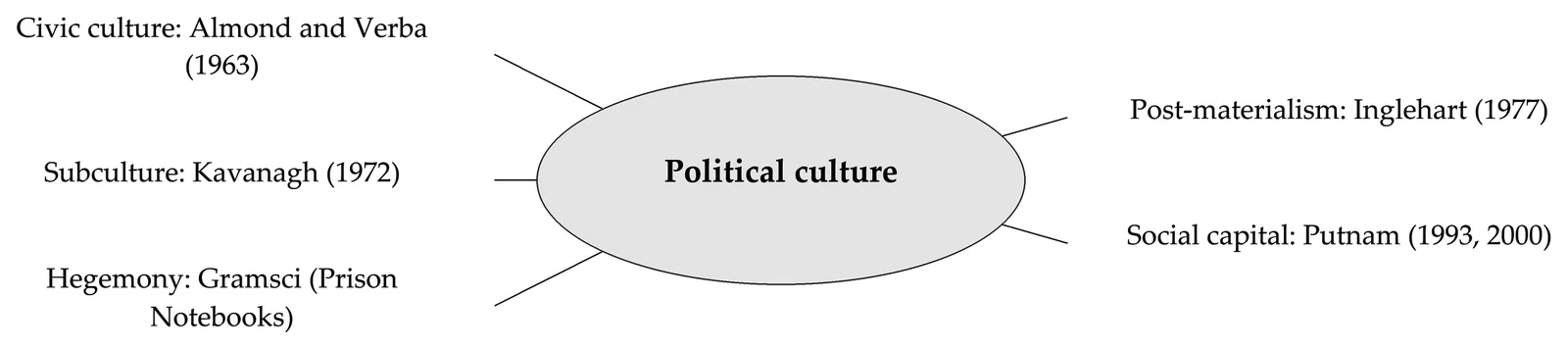
TWO COUNTRIES may adopt almost identical constitutions, yet democracy may flourish in one and collapse in the other. Institutions alone cannot explain this. What also matters is how citizens think and feel about politics: whether they trust one another and their government, whether they believe they can influence decisions, whether they value order or freedom, obedience or participation. These attitudes, values and beliefs make up a country’s political culture. In this chapter we study the political culture approach through five influential ideas: the civic culture of Almond and Verba, the subcultures described by Dennis Kavanagh, Antonio Gramsci’s Marxist concept of hegemony, Ronald Inglehart’s theory of post-materialism, and Robert Putnam’s concept of social capital. Each of them answers the same question, how does culture shape politics, in a different way.
4.1 Meaning of Political Culture
The idea that a people’s character shapes its government is old: Montesquieu wrote of the ‘spirit’ of nations and Tocqueville of the ‘habits of the heart’ that sustained American democracy. As a concept of political science, political culture was introduced by Gabriel Almond in 1956 and developed in The Civic Culture (1963), which defined it as the pattern of orientations of citizens towards political objects. Dennis Kavanagh [कैवनॉ] called it a shorthand expression for the emotional and attitudinal environment within which the political system operates.
Almond and Verba distinguished three kinds of orientation: cognitive (knowledge and beliefs about the political system), affective (feelings of attachment, involvement or rejection) and evaluative (judgements and opinions about it). These orientations are directed towards four objects: the political system as a whole; the input side (parties, interest groups, elections); the output side (the bureaucracy, courts and policies); and the self as a political actor. Political culture is acquired through political socialisation by the family, school, religion, peers, media and political experience. The main approaches to it are summarised in Figure 4.2.
4.2 Civic Culture (Sidney Verba)
Gabriel Almond and Sidney Verba’s The Civic Culture: Political Attitudes and Democracy in Five Nations (1963) was the first large comparative survey of political attitudes. About a thousand citizens were interviewed in each of five countries, the United States, Britain, West Germany, Italy and Mexico, in 1959–60. The authors asked what kind of political culture best supports a stable democracy.
A. Three pure types
They identified three pure types of political culture (Figure 4.3):
- Parochial political culture: citizens have little awareness of the national political system and no expectations from it; their loyalties are to the village, tribe or clan. It is found in traditional societies.
- Subject political culture: citizens are aware of the political system and of its outputs, but see themselves as passive subjects who obey rather than participate. It was associated with authoritarian or bureaucratic states.
- Participant political culture: citizens are aware of both inputs and outputs and see themselves as active participants who can influence decisions.

Real societies have mixed cultures: parochial-subject, subject-participant or parochial-participant.
B. The civic culture
The civic culture is a particular mixture that Almond and Verba considered most favourable to stable democracy. It is a participant culture in which participant orientations are balanced by subject and parochial ones. Citizens believe they can influence government and participate when necessary, but most of the time they trust the authorities, accept their decisions and get on with private life. This creates balanced disparities between activity and passivity, involvement and non-involvement, consensus and cleavage, so that government is both responsive and able to govern. Political culture and political structure are congruent. Britain and the United States came closest to the civic culture; West Germany had a subject culture with low participation; Italy showed alienation and distrust; and Mexico combined aspirations to participate with distrust of government.
C. Criticism
Critics accused the study of an Anglo-American bias, treating Britain and America as the model; of being static, unable to explain cultural change (in later surveys West German attitudes became strongly democratic); and of confusing cause and effect, since democratic institutions may produce civic attitudes rather than the other way round. Carole Pateman (1980) argued that praising citizen passivity was elitist and conservative. Others criticised the reliance on surveys and the neglect of class, subcultures and power. Almond and Verba responded with The Civic Culture Revisited (1980).
4.3 Subculture (Dennis Kavanagh)
Dennis Kavanagh, in Political Culture (1972), stressed that no nation has a single, uniform political culture. Within the national culture there are subcultures, groups whose orientations differ from those of the majority. Subcultures may be based on region, class, religion, ethnicity or language, generation, or occupation. Kavanagh paid particular attention to the difference between the elite political culture of leaders and the mass political culture of ordinary citizens: the elite usually has more information, more interest and stronger commitment to the rules of the political game.
Subcultures matter because a country with deep and reinforcing subcultures has a fragmented political culture, which can make government difficult, while a country whose subcultures overlap and accept common rules has a homogeneous culture. In the Netherlands, Catholic, Protestant, socialist and liberal ‘pillars’ formed separate subcultures, and Arend Lijphart showed how elite co-operation (consociational democracy) kept the system stable. India is an outstanding example of a country with many regional, linguistic, religious and caste subcultures held together by a shared commitment to democratic institutions. Ben Rosamond notes that the idea of subculture weakens the assumption of a single ‘national character’ and opens the door to studying conflict and diversity within political culture.
4.4 Hegemony (Antonio Gramsci)
Antonio Gramsci [ग्राम्शी] (1891–1937), the Italian Marxist imprisoned by Mussolini’s fascist regime, wrote the Prison Notebooks between 1929 and 1935. He asked why workers in the West had not made revolutions as Marx predicted. His answer was hegemony: the ruling class rules not only by force but by winning the consent of the ruled to its values and world view.
A. Main ideas
- Hegemony: the intellectual and moral leadership of a dominant class, which makes its own interests appear to be the common interest and its view of the world appear to be ‘common sense’.
- Political society and civil society: the state, in its broad sense, has two parts: political society, which rules by coercion through the army, police, courts and government, and civil society, which rules by consent through schools, churches, the media, families, trade unions and cultural institutions. Gramsci summed this up in the formula: State = political society + civil society, that is, hegemony protected by the armour of coercion.
- Intellectuals: traditional intellectuals (priests, teachers, lawyers) appear independent but often support the existing order, while organic intellectuals arise from a class and articulate its interests.
- War of position and war of manoeuvre: in Russia, where civil society was weak, revolution could be a frontal assault on the state (war of manoeuvre); in the West, with its strong civil society, the working class must first win a long cultural struggle within civil society (war of position) to build a counter-hegemony.
- Historic bloc: a durable alliance of classes held together by a shared hegemonic ideology.
B. Hegemony and political culture
Gramsci’s idea offers a radical alternative to Almond and Verba. For them political culture is a neutral set of attitudes that supports stable democracy; for Gramsci the dominant political culture is the product of class power, and the consent it produces conceals domination. The ‘civic’ deference that Almond and Verba praised appears, from a Gramscian perspective, as the success of ruling-class hegemony. In India, scholars have used Gramsci to study the Congress’s nationalist hegemony and the subaltern classes whose voices were excluded; the Subaltern Studies historians took the word ‘subaltern’ itself from Gramsci. Criticism: the concept can be stretched to explain everything, it may underestimate people’s own agency and capacity for resistance, and it is difficult to test empirically.
4.5 Post-materialism (Ronald Inglehart)
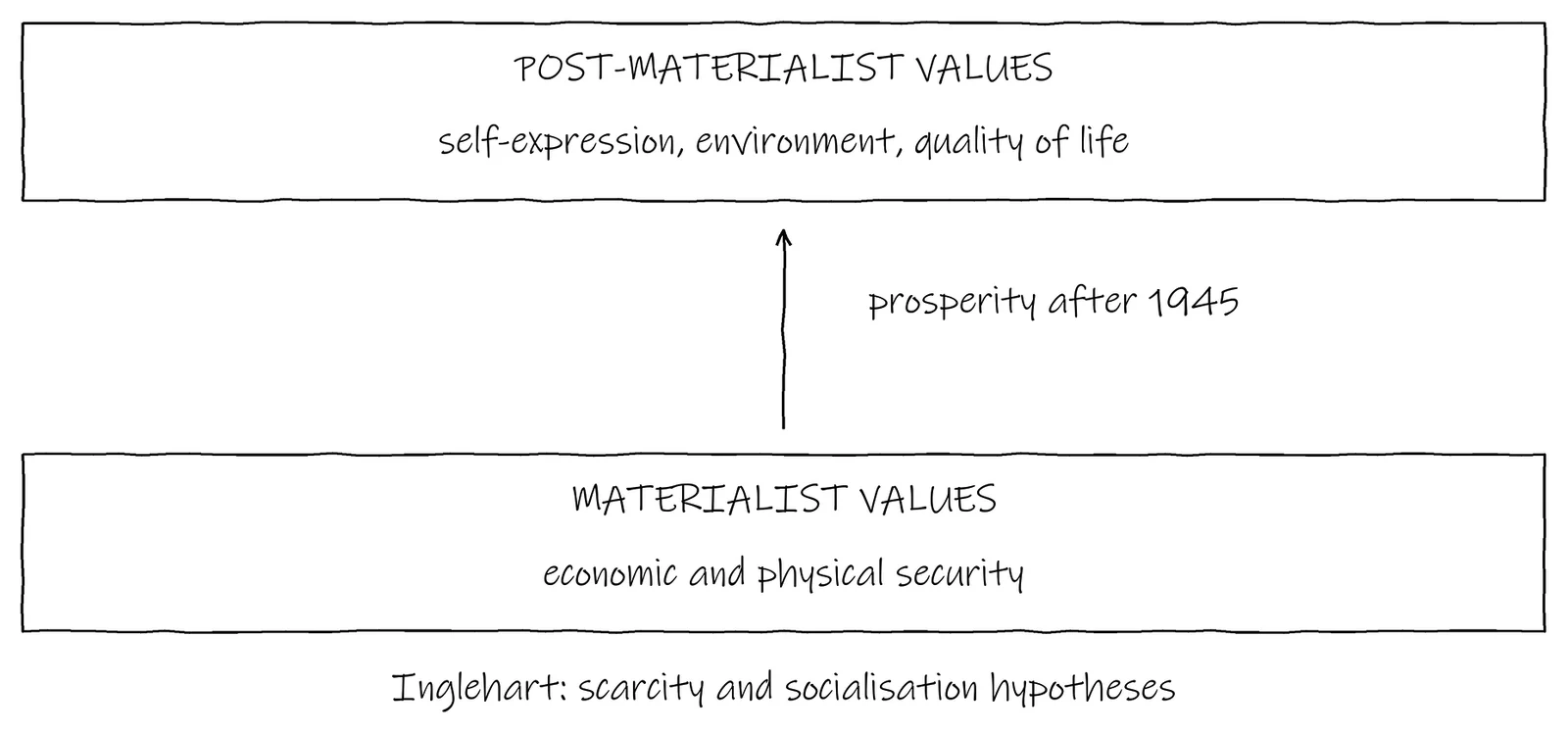
Ronald Inglehart [इंगलहार्ट] (1934–2021), in The Silent Revolution (1977) and Culture Shift (1990), argued that the values of Western publics were shifting from materialist concerns with economic and physical security towards post-materialist concerns with self-expression and the quality of life. His theory rested on two hypotheses:
- The scarcity hypothesis: people give the highest value to what is in short supply, following Maslow’s hierarchy of needs. Once physical and economic security are assured, people turn to higher needs such as belonging, esteem and self-expression.
- The socialisation hypothesis: basic values are formed in childhood and youth and remain largely stable in adulthood. So value change occurs mainly through generational replacement, as younger cohorts raised in security replace older ones raised in scarcity.
The generations that grew up in the unprecedented peace and prosperity of Western Europe and North America after 1945 therefore gave greater priority to freedom of speech, participation in decisions, environmental protection, gender equality and tolerance (Figure 4.4). Inglehart measured this with a simple index asking people to choose their top priorities among maintaining order, giving people more say in government, fighting rising prices and protecting freedom of speech.
The political consequences included new social movements (environmental, feminist, peace and gay rights movements), Green parties, a decline in class-based voting, and more elite-challenging forms of participation, such as petitions and demonstrations, alongside lower trust in hierarchical institutions. Through the World Values Survey, which Inglehart founded in 1981, Christian Welzel [वेल्त्सेल] and Inglehart later mapped cultures across the world on two dimensions: traditional versus secular-rational values, and survival versus self-expression values, arguing that economic development, by increasing human resources and security, promotes emancipative values that support democracy. Criticism: the four-item index is crude; economic crises can reverse the trend; it is unclear whether value change reflects generations or periods; and the theory may describe Western societies better than others. The rise of right-wing populism has been explained, by Pippa Norris and Inglehart themselves in Cultural Backlash (2019), as a reaction of older, materialist groups against post-materialist change.
4.6 Social Capital (R. Putnam)
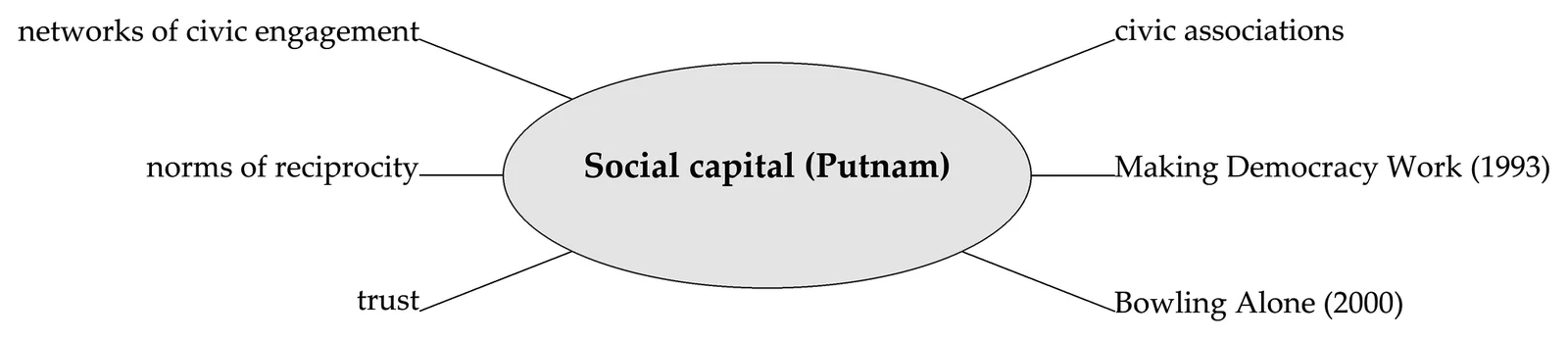
Robert Putnam defined social capital as features of social organisation, such as networks, norms of reciprocity and social trust, that facilitate co-ordination and co-operation for mutual benefit. Just as physical capital (machines) and human capital (skills) increase productivity, social capital increases the ability of people to act together.
A. Making Democracy Work (1993)
In 1970 Italy created twenty new regional governments with identical constitutions. Studying them over twenty years, Putnam found that some, mostly in the north, such as Emilia-Romagna, performed well, while others, mostly in the south, such as Calabria, performed badly. The difference was explained not by wealth alone but by the strength of the civic community: in the north, citizens were active in choral societies, football clubs, co-operatives and cultural associations, trusted one another and expected others to obey the law; in the south, life was organised around vertical patron–client ties, distrust and family loyalty. Putnam traced these differences back to the medieval period, when the north developed self-governing communal republics while the south was ruled by a centralised Norman monarchy.
B. Bowling Alone (2000)
In Bowling Alone Putnam argued that social capital had been declining in America since the 1960s. Americans were joining fewer associations, attending fewer meetings, entertaining friends less and voting less; more people went bowling, but fewer bowled in leagues. He blamed generational change, television and electronic entertainment, suburban sprawl and commuting, and pressures of time and money. He distinguished bonding social capital, which ties together people who are alike (such as members of the same ethnic group), from bridging social capital, which connects people across social divides. Bridging capital is especially valuable for democracy.
C. Applications and criticism
Ashutosh Varshney, in Ethnic Conflict and Civic Life (2002), applied the idea to India: cities with strong inter-communal civic networks, such as business associations and trade unions that brought Hindus and Muslims together, avoided riots, while cities lacking them were riot-prone. Criticism: Putnam’s historical argument seems to make culture a destiny; the concept is vague and may confuse causes and effects; it neglects the role of the state, which can create or destroy trust; social capital can have a dark side, as in mafias or exclusive groups; Pierre Bourdieu [बूर्दियो] (1986) had used the term to show how social connections reproduce class privilege; and critics questioned whether civic engagement in America had declined or merely changed form.
4.7 Evaluating the Political Culture Approach
The political culture approach reminds us that institutions work through people, whose values and beliefs shape how rules are used. It has produced rich comparative surveys and explains why similar institutions perform differently. Marc Howard notes that culture can be studied in two ways: as a set of measurable attitudes (Almond and Verba, Inglehart) or as shared meanings and practices interpreted in context (the anthropological view); the first allows comparison but may miss meaning, the second captures meaning but makes comparison harder.
The approach also faces serious criticisms. Culture is hard to define and measure; it is often used as a residual explanation for whatever institutions and economics cannot explain; it risks essentialism, treating cultures as fixed and homogeneous; the direction of causation between culture and institutions is unclear; and it can carry a Western bias. Samuel Huntington’s ‘The Clash of Civilizations’ (1993), which argued that future conflicts would be between civilisations defined by culture and religion, shows both the appeal and the danger of cultural explanation: critics such as Edward Said replied that civilisations are not monolithic blocs but internally diverse and constantly interacting. Today most scholars treat culture and institutions as shaping each other.
4.8 Important Questions
- Question 1 What is political culture? Discuss the major approaches to its study.
- Question 2 Critically examine Almond and Verba’s concept of civic culture.
- Question 3 Explain Gramsci’s concept of hegemony and its significance for the study of political culture.
- Question 4 Discuss Ronald Inglehart’s theory of post-materialism.
- Question 5 Explain Robert Putnam’s concept of social capital.
DU asks the same idea in different words. So learn one broad answer for each question below; the same answer works for every question joined by OR.
Important Question 1
What is political culture? Discuss the major approaches to its study.
OR
Examine the political culture approach to comparative politics.
OR
Discuss the concept of political subculture with reference to Dennis Kavanagh.
Model Answer
“Political culture is a shorthand expression to denote the emotional and attitudinal environment within which the political system operates.”
— Dennis Kavanagh, Political Culture (1972)
Introduction. Political culture refers to the attitudes, beliefs, values and feelings that citizens hold towards politics. The political culture approach argues that these orientations shape how political systems work, and it explains why similar institutions perform differently in different countries.
1. Meaning
Almond and Verba defined political culture as the distribution of patterns of orientation towards political objects among citizens. Orientations are cognitive, affective and evaluative; objects are the system, its inputs, its outputs and the self as participant. Culture is transmitted through political socialisation. Lucian Pye described it as the attitudes, beliefs and sentiments that give order and meaning to the political process.
2. Civic Culture
Almond and Verba (1963) distinguished parochial, subject and participant cultures, and argued that a balanced mixture, the civic culture, best supports stable democracy, as in Britain and the USA. The study rested on surveys in five countries.
3. Subculture
Kavanagh (1972) showed that national cultures contain subcultures based on region, class, religion, ethnicity, generation and especially the elite–mass divide. Reinforcing subcultures produce fragmented cultures; overlapping ones produce homogeneous cultures. Lijphart’s consociational democracy explains how elites manage fragmented cultures. Elite and mass cultures may also differ.
4. Hegemony
Gramsci argued that the ruling class dominates through consent organised in civil society, so the dominant political culture reflects class power. This challenges the liberal view of culture as neutral. This explains why subordinate classes often accept their position.
5. Post-materialism
Inglehart argued that post-war prosperity produced a generational shift from materialist to post-materialist values, explaining new social movements, Green parties and elite-challenging participation.
6. Social Capital
Putnam explained the performance of Italian regional governments by networks, norms and trust, and traced the decline of social capital in America in Bowling Alone. Trust and civic engagement make institutions work better.
7. Political Socialisation
Political culture is passed on through socialisation by the family, school, media, religion and peer groups, which explains both continuity and change in attitudes across generations.
8. Contributions
The approach brought citizens’ attitudes into comparative politics, produced large comparative surveys, and showed why identical institutions work differently in different societies.
9. The Cultural Turn
Interpretive approaches influenced by Clifford Geertz study culture as shared meanings and symbols to be interpreted rather than attitudes to be measured.
10. Criticism
Culture is hard to measure and is often used as a residual explanation; it risks essentialism and Western bias; the direction of causation between culture and institutions is unclear; and liberal versions ignore power, which Gramsci highlights.
11. Attitudes and Meanings
Marc Howard distinguishes two ways of studying culture. The behavioural tradition measures attitudes through surveys, which allows comparison across countries. The interpretive tradition, inspired by Clifford Geertz’s ‘thick description’ (1973), studies shared meanings and practices in their context. The first risks missing meaning; the second makes comparison harder.
12. Culture and Civilisations
Huntington’s ‘The Clash of Civilizations’ (1993) argued that after the Cold War the main source of conflict would be cultural. Edward Said replied that civilisations are internally diverse and interacting, not monolithic blocs, showing the danger of treating culture as fixed.
13. Political Culture in India
India combines deep regional, religious and caste subcultures with strong attachment to elections. Yogendra Yadav described a ‘second democratic upsurge’ in the 1990s, when the poor, lower castes and rural voters participated more than the privileged, which contradicts the expectation that participation rises with education and wealth.
14. Evaluation
Political culture is an important but contested concept: it explains why similar institutions work differently in different societies, but it must be combined with institutional and economic explanations.
Conclusion. Thus, political culture is the attitudinal foundation of politics. Its different approaches show that culture can support stable democracy, conceal domination, change across generations and build co-operation.
Important Question 2
Critically examine Almond and Verba’s concept of civic culture.
OR
Discuss the types of political culture identified by Almond and Verba.
OR
Is civic culture necessary for a stable democracy? Discuss.
Model Answer
“The civic culture is a participant political culture in which the political culture and political structure are congruent.”
— Gabriel Almond and Sidney Verba, The Civic Culture (1963)
Introduction. The Civic Culture (1963) by Gabriel Almond and Sidney Verba was the first major comparative study of political attitudes. Based on surveys in five countries, it asked what kind of political culture sustains a stable democracy and answered: a civic culture.
1. The Study
About a thousand people were interviewed in each of the USA, Britain, West Germany, Italy and Mexico in 1959–60 about their knowledge, feelings and judgements regarding politics. The five countries were the United States, Britain, West Germany, Italy and Mexico, surveyed in 1959–60.
2. Orientations and Objects
Political culture consists of cognitive, affective and evaluative orientations towards the political system, its input and output sides, and the self as a political actor. The objects include the system as a whole, input objects, output objects and the self as a participant.
3. Parochial Culture
Citizens have little awareness of or expectations from the national system; loyalties are local, as in traditional societies.
4. Subject Culture
Citizens are aware of the system and its outputs but are passive; they obey but do not expect to influence decisions. Germany and Italy were described as having strong subject elements.
5. Participant Culture
Citizens are aware of inputs and outputs and see themselves as active participants who can influence government. Real cultures are mixtures, such as parochial-subject or subject-participant.
6. Political Competence
A key finding was that citizens who feel able to influence government, subjective political competence, are more supportive of democracy, and education was the strongest predictor of such competence.
7. The Civic Culture
The civic culture combines participant orientations with subject and parochial ones. Citizens can participate but usually trust and defer to authorities, producing balanced disparities between activity and passivity, consensus and cleavage. This allows government to be both responsive and effective. Britain and the USA approached it; Germany was subject, Italy alienated and Mexico aspirational. Britain and the United States came closest to it.
8. Balanced Disparities
Almond and Verba argued that democracy needs a balance between activity and passivity, involvement and indifference, so that governments can both respond and govern.
9. Contributions
The study pioneered comparative survey research, made culture a central variable, and influenced decades of research on democracy, trust and participation.
10. Criticism
It was Anglo-American and ethnocentric; static, unable to explain change in Germany or Italy; unclear about causation, since democracy may create civic culture; elitist in praising passivity (Pateman); dependent on surveys; and neglectful of class, subcultures and power, as Kavanagh and Gramscians pointed out. Carole Pateman criticised its acceptance of political inequality and passivity.
11. Culture Can Change
Later research showed that cultures change, as West Germany developed a strong participant culture after the 1960s, which challenged the original study’s static picture.
12. Relevance
Despite these criticisms, research continues to show that trust, tolerance and a sense of political efficacy help democracies survive. India’s democracy, with high participation among the poor, shows that civic culture may take forms different from the Anglo-American model.
13. The Civic Culture Revisited and After
The Civic Culture Revisited (1980) found declining trust in Britain and the United States and strengthening democratic attitudes in West Germany, showing that political culture changes with experience. Later research by Pippa Norris (Critical Citizens, 1999) found ‘critical citizens’ who strongly support democracy as an ideal but distrust governments and politicians.
14. Civic Culture and India
Almond and Verba’s model would have predicted instability for a poor, largely illiterate country like India. Yet India sustained democracy, suggesting that democratic institutions and practice can themselves create democratic culture, and that civic culture may take forms different from the Anglo-American model.
15. Evaluation
The Civic Culture was a landmark that made culture central to the study of democracy, but its assumptions were rooted in Anglo-American experience and must be used with care in other societies.
Conclusion. Thus, the civic culture thesis linked attitudes to democratic stability. It was a landmark study, though its model of a good citizen was too closely tied to Britain and America.
Important Question 3
Explain Gramsci’s concept of hegemony and its significance for the study of political culture.
OR
Discuss the relationship between hegemony and civil society in Gramsci.
OR
How does Gramsci’s idea of hegemony differ from the liberal concept of political culture?
Model Answer
“The State = political society + civil society, in other words hegemony protected by the armour of coercion.”
— Antonio Gramsci, Prison Notebooks (1929–35)
Introduction. Antonio Gramsci, the Italian Marxist, developed the concept of hegemony in his Prison Notebooks to explain why capitalist rule in the West was stable and why workers did not revolt. Hegemony means rule through the consent of the dominated, won by the intellectual and moral leadership of the ruling class.
1. Context
Marx predicted proletarian revolution in advanced capitalist countries, but it occurred in backward Russia while Western workers accepted capitalism and even fascism. Gramsci sought the reason in culture and consent. Gramsci wrote his Prison Notebooks (1929–35) while imprisoned by Mussolini’s fascist regime.
2. Meaning of Hegemony
Hegemony is the ability of a class to make its own interests and world view appear to be the common interest and common sense of the whole society, so that the dominated consent to their domination. It is moral and intellectual leadership, not merely domination.
3. Political Society and Civil Society
Political society rules through coercion (army, police, courts); civil society rules through consent (schools, churches, media, family, associations). The state in its full sense is hegemony protected by the armour of coercion. Civil society includes schools, churches, the media, trade unions and associations. In the West, Gramsci wrote, the state is only an outer ditch behind which stands a powerful system of fortresses: civil society.
4. Role of Intellectuals
Traditional intellectuals appear independent but usually support the existing order; organic intellectuals arise from a class and articulate its interests. Every class needs its own organic intellectuals to build hegemony. Organic intellectuals arise from a class and articulate its worldview.
5. The Historic Bloc
Gramsci used the term historic bloc for an alliance of classes and social groups held together by a shared worldview, which gives a hegemonic order its stability.
6. War of Position and Counter-Hegemony
In the West, revolution requires a long war of position within civil society to build a counter-hegemony, rather than a direct war of manoeuvre against the state. A historic bloc of classes united by a common ideology is necessary. A war of manoeuvre, a direct assault on the state as in Russia in 1917, was unlikely to succeed in the West.
7. Hegemony and Political Culture
For Almond and Verba, political culture is a neutral pattern of attitudes; for Gramsci it is shaped by class power, and consent conceals domination. The deference that liberals praise as civic culture may be the product of hegemony. Culture is thus a field of struggle, not a neutral background.

8. Hegemony Today
The concept is used to analyse how neoliberal ideas came to seem ‘common sense’ after the 1980s and how populist movements seek counter-hegemony.
9. Influence
Gramsci influenced cultural studies, critical theory, and Indian scholarship: the Subaltern Studies historians took the term ‘subaltern’ from him, and scholars have analysed the Congress’s nationalist hegemony and its limits. Partha Chatterjee and the Subaltern Studies historians drew on him.
10. Criticism
The concept can be stretched to explain everything; it may underestimate people’s ability to resist and think independently; it is hard to test empirically; and its link with Marxist class analysis may neglect other identities. Some argue that it neglects the weight of coercion and economic interest.
11. Common Sense and Good Sense
Gramsci distinguished common sense, the uncritical, fragmentary beliefs of everyday life in which ruling ideas are absorbed, from good sense, critical and coherent thinking. Education and organic intellectuals can transform common sense into good sense, which is the basis of counter-hegemony. Education and critical reflection turn common sense into good sense.
12. Hegemony and Passive Revolution in India
Indian scholars have used Gramsci widely. Ranajit Guha argued in Dominance without Hegemony (1997) that colonial rule rested on coercion rather than genuine consent. Partha Chatterjee and Sudipta Kaviraj described post-colonial India as a passive revolution, a transformation led from above in which the new bourgeoisie shared power with landlords and the bureaucracy rather than overthrowing them.
13. Evaluation
Gramsci’s concept of hegemony transformed the study of political culture by linking culture with power, and it remains one of the most influential ideas in critical political theory.
Conclusion. Thus, hegemony shows that political culture is a field of power and struggle. Gramsci transformed the study of culture by asking whose values become common sense, and why.
Important Question 4
Discuss Ronald Inglehart’s theory of post-materialism.
OR
Explain the ‘silent revolution’ in the values of Western publics.
OR
Examine the scarcity and socialisation hypotheses of Inglehart.
Model Answer
“The values of Western publics have been shifting from an overwhelming emphasis on material well-being and physical security toward greater emphasis on the quality of life.”
— Ronald Inglehart, The Silent Revolution (1977)
Introduction. Ronald Inglehart argued that a ‘silent revolution’ was taking place in the values of advanced industrial societies: younger generations raised in security were moving from materialist to post-materialist values, with profound consequences for politics.
1. Materialist and Post-materialist Values
Materialist values emphasise economic growth, stable prices, order and security. Post-materialist values emphasise self-expression, participation, freedom of speech, the environment, gender equality and the quality of life. Post-materialist values emphasise self-expression, participation, freedom of speech and the quality of life.
2. The Scarcity Hypothesis
Following Maslow, people value most what is scarce. When basic needs are met, they turn to higher needs of belonging, esteem and self-expression. Maslow’s hierarchy of needs places physiological and safety needs below belonging, esteem and self-actualisation.
3. The Socialisation Hypothesis
Values are formed in pre-adult years and remain stable. So change occurs mainly through generational replacement as cohorts raised in post-war prosperity replace those raised in war and depression. This implies change by generational replacement rather than individual conversion.
4. Measuring Value Change
Inglehart asked people to choose priorities among maintaining order, giving people more say, fighting rising prices and protecting freedom of speech. Choosing the second and fourth indicated post-materialism. The World Values Survey, from 1981, extended this to many countries. Younger, educated and affluent cohorts in Western Europe proved far more post-materialist.
5. Political Consequences
Post-materialism produced new social movements, Green parties, the decline of class-based voting, new issues such as environment and gender, and elite-challenging participation through protests and petitions, along with declining trust in hierarchical authority.
6. Welzel and Inglehart’s Cultural Map
Later work mapped societies on traditional versus secular-rational and survival versus self-expression values, arguing that development spreads emancipative values that support democracy.
7. The World Values Survey
Inglehart founded the World Values Survey, which since 1981 has surveyed values in about a hundred countries and provides data for comparative research.
8. Cultural Backlash
Inglehart and Pippa Norris argued in Cultural Backlash (2019) that the rise of populism reflects a reaction by older, less educated groups against post-materialist value change.
9. Criticism
The four-item index is crude; economic crises can reverse value change; it is unclear whether changes reflect generations or periods; the theory is Western-centric; and the rise of right-wing populism suggests a ‘cultural backlash’, as Norris and Inglehart themselves later argued (2019). Others argue that post-materialism reflects education more than early security.
10. Relevance
The theory helps explain the rise of environmentalism, demands for participation and changing gender attitudes, and invites study of whether rapidly developing countries such as India will follow similar paths.
11. The New Politics
Post-materialism produced a ‘new politics’ cleavage alongside the old class cleavage: Green parties, such as the German Greens founded in 1980, environmental movements, and campaigns for gender equality and gay rights mobilised educated young voters across traditional class lines.
12. Persistence of Cultural Zones
Inglehart and Wayne Baker (2000) found that modernisation changes values but that historical cultural heritages persist: Protestant Europe, Catholic Europe, the Confucian, Islamic and South Asian zones retain distinctive values. Development moves societies in similar directions but not to the same destination.
13. Developing Countries and India
World Values Survey data show that societies such as India remain largely traditional and survival-oriented, though younger, urban and educated groups show growing self-expression values. This fits the scarcity hypothesis: value change follows security.
14. Evaluation
Inglehart showed how economic development can change values and politics, though value change does not follow a single path and can be reversed.
Conclusion. Thus, Inglehart showed that economic security changes values and that changing values transform politics, though the shift is neither uniform nor irreversible.
Important Question 5
Explain Robert Putnam’s concept of social capital.
OR
Discuss Putnam’s explanation of institutional performance in Making Democracy Work.
OR
Examine the decline of social capital as described in Bowling Alone.
Model Answer
“Social capital refers to features of social organization such as networks, norms, and social trust that facilitate coordination and cooperation for mutual benefit.”
— Robert Putnam, ‘Bowling Alone: America’s Declining Social Capital’ (1995)
Introduction. Social capital is the stock of networks, norms of reciprocity and trust that enable people to act together. Robert Putnam made the concept central to comparative politics by using it to explain why democratic institutions work well in some places and badly in others.
1. Meaning
Like physical and human capital, social capital increases productivity, here the productivity of collective action. It consists of networks of civic engagement, norms of reciprocity and generalised trust. Putnam defined it as features of social organisation, such as networks, norms and trust, that facilitate coordination and cooperation for mutual benefit.
2. Bourdieu and Coleman
Pierre Bourdieu saw social capital as a resource that privileged groups use to keep their advantage, while James Coleman stressed its role in education and community; Putnam focused on its benefits for democracy.
3. Making Democracy Work (1993)
Italy’s twenty regional governments, created in 1970 with identical structures, performed very differently. Northern regions such as Emilia-Romagna were efficient and responsive; southern regions such as Calabria were not. Putnam and his colleagues studied them for about twenty years.
4. The Civic Community
The difference lay in civic engagement: the north had dense horizontal associations such as choral societies, sports clubs and co-operatives, high trust and law-abidingness; the south was dominated by vertical patron–client ties and distrust. Choral societies, football clubs and cooperatives mattered more than formal politics.
5. Historical Roots
Putnam traced these patterns to medieval history: the communal republics of the north versus the centralised Norman monarchy of the south, showing path dependence in culture. The south had a history of hierarchical rule, patronage and distrust.
6. Bowling Alone (2000)
Putnam argued that American social capital had declined since the 1960s, with falling membership, participation and trust, owing to generational change, television, suburbanisation and time pressures. Television, suburbanisation, work pressures and generational change were the main causes.
7. Bonding and Bridging
Bonding social capital ties similar people together; bridging social capital links different groups. Bridging capital is especially important in diverse democracies. Varshney showed that inter-communal civic networks prevented Hindu–Muslim riots in some Indian cities. Bridging capital matters more for democracy in diverse societies.
8. Social Capital in India
Varshney showed that inter-communal civic associations, such as business and trade organisations linking Hindus and Muslims, prevented riots in some Indian cities, a form of bridging social capital.
9. The Dark Side
Social capital can also exclude outsiders or support harmful groups; strong caste networks may help their members but shut out others.
10. Criticism
Putnam’s historical argument seems deterministic; the concept is vague and causation is unclear; he neglects the state and power; social capital has a dark side in mafias and exclusive groups; Bourdieu showed how social connections reproduce class privilege; and engagement may have changed form rather than declined.
11. Significance
Social capital has influenced research and policy on democracy, development, health and community, and the World Bank adopted it in development thinking. It highlights the social foundations of good governance.
12. Measuring Social Capital
Putnam measured the civic community in Italian regions by four indicators: membership in associations, newspaper readership, turnout in referendums and the use of preference votes (a sign of patronage politics). In America he used membership, attendance at meetings, volunteering, informal socialising and survey measures of trust.
13. Social Capital and Development
In the 1990s the World Bank treated social capital as a resource for development. Self-help groups and microfinance, such as the Grameen Bank in Bangladesh and Kudumbashree in Kerala, show how networks of trust among poor women can support credit, livelihoods and participation; Elinor Ostrom showed how communities manage common resources through such trust.
14. Evaluation
Social capital has become one of the most influential ideas in social science, linking culture, institutions and democracy, though its causes and effects remain debated.
Conclusion. Thus, Putnam showed that democracy works better where citizens trust one another and participate together, though social capital must be studied alongside institutions, power and inequality.
Short Notes
(a) Political socialisation
The process through which individuals acquire their political attitudes, values and knowledge, through agents such as the family, school, religion, peer groups, media and political experience. It transmits political culture from one generation to the next and may also change it.
(b) Elite and mass political culture
Kavanagh’s distinction between the political culture of leaders, who are better informed, more interested and more committed to democratic rules, and that of ordinary citizens. Stability often depends on the elite culture, especially in societies with divided mass subcultures.
More notes: DSC-5 Methods and Approaches in Comparative Political Analysis
- Understanding Comparative Politics
- Approaches to Studying Comparative Politics: Political System, Structural functional analysis
- Approaches to Studying Comparative Politics: Traditional and Neo-Institutionalisms
- Approaches to Studying Comparative Politics: Political Economy
- Gendering Comparative Politics
These notes are prepared by PADHO TO AISE for study help. They are not an official University of Delhi publication.