
Semester I DSC-2 Ideas and Institutions in Indian Political Thought
Unit IV · 22 min read · Updated 24 Nov 2026
As per the University of Delhi (DU) BA (Hons) Political Science syllabus
Contents
- 4.1 The Vedic Assemblies
- 4.2 The Sabha
- 4.3 The Samiti
- Decline of the Sabha and Samiti
- 4.4 Republics and Later Assemblies
- The Ganas and Sanghas
- Village Assemblies under the Cholas
- 4.5 Continuity and Break
- 4.6 Important Questions
- Discuss the functions and relevance of ‘Sabha’ and ‘Samiti’ as political institutions in India.
- Examine ‘Sabha’ and ‘Samiti’ as Vedic representative institutions in India. Do you agree that the present-day political institutions have evolved from these?
- Discuss the nature and working of republics (ganas and sanghas) in ancient India.
- Short Notes
समानो मन्त्रः समितिः समानी समानं मनः सह चित्तमेषाम्।
Common be your counsel, common your assembly, common your mind, united your thoughts.
— Rigveda, X.191.3
WHEN WE THINK of kingship in ancient India, we often imagine a king ruling alone. But the earliest Vedic texts show that kings ruled together with assemblies of the people. The two most important were the sabha and the samiti; others were the vidatha and the gana. Later, in the sixth century BCE, several republics (ganas and sanghas) were governed entirely by assemblies, and in the tenth century CE the Chola villages of South India elected their committees by lot. This chapter studies these institutions, their functions and their decline, and asks a question DU often sets: did India’s modern representative institutions evolve from them?
4.1 The Vedic Assemblies
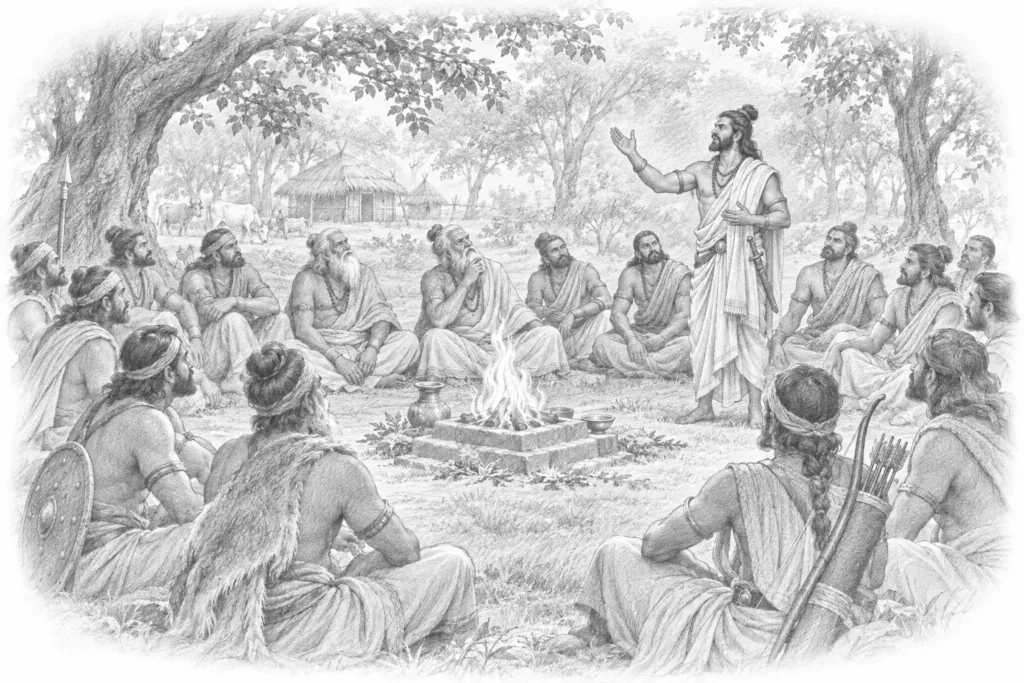
In the early Vedic period (c. 1500–1000 BCE) the Aryan tribes (janas) were small, pastoral and constantly at war. The chief, or rajan, was a war leader and protector of cattle, but he did not rule alone. Important matters were discussed in tribal assemblies. As R.S. Sharma showed in Aspects of Political Ideas and Institutions in Ancient India, these assemblies performed military, religious, judicial and distributive functions all at once, because early tribal society had not yet separated these spheres. Four assemblies are mentioned (Figure 4.2).

- Vidatha: the oldest and most frequently mentioned assembly. It distributed the spoils of war, performed rituals and took military decisions; women took part in it.
- Gana: a body of people; the word is later used for tribal groups and for republics ruled by many.
- Sabha: a select council of elders and nobles, also used as a court.
- Samiti: the general assembly of the whole tribe, which chose and advised the king.
Of these, the sabha and the samiti were the most important for political life, and they are the subject of this unit.
4.2 The Sabha
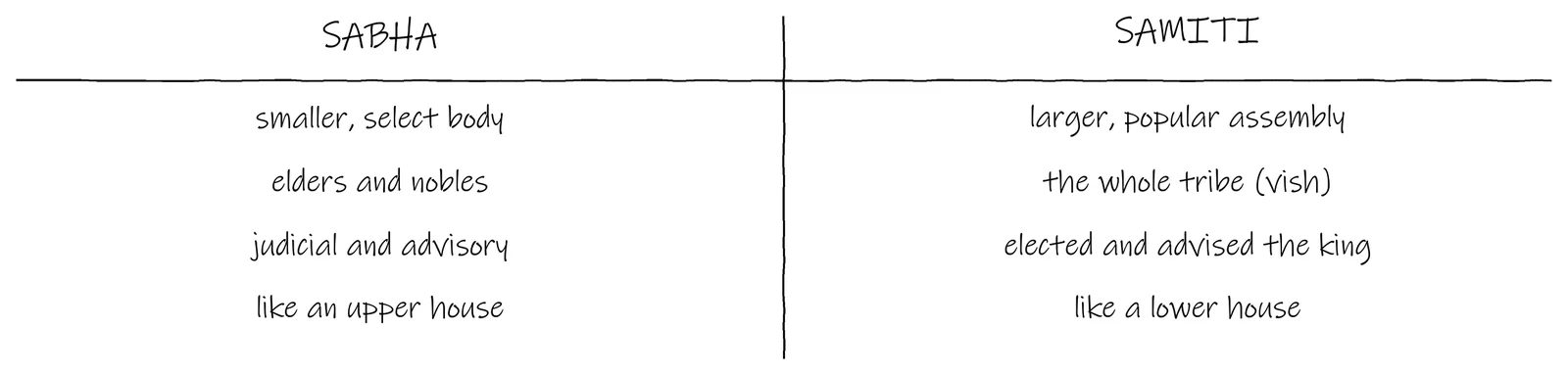
The sabha was a smaller and more select body than the samiti, made up of elders, nobles and the wealthy. Its members were called sabhasad or sabheya, and a respected member was praised as sabheya, i.e. ‘worthy of the sabha’. Its features and functions were these:
- Council of elders. It advised the king on important matters; the Atharvaveda says that the words spoken in the sabha should be pleasing and in agreement.
- Judicial body. The sabha decided disputes; in later texts the word sabha came to mean a court of justice, and a judge’s assessors were called sabhyas. The Mahabharata says: ‘That is not a sabha where there are no elders; they are not elders who do not speak of dharma.’
- Social gathering. It was also a place for social life, discussion and even gambling, as the Rigveda’s ‘gambler’s hymn’ (X.34) shows.
- Participation of women. In the early Vedic period women seem to have attended; the word sabhavati is used for a woman fit for the sabha. In the later Vedic period women were excluded.
- Survival as royal court. Unlike the samiti, the sabha survived into later periods as the king’s council or court (rajasabha), though it lost its popular character.
4.3 The Samiti
The samiti was the general assembly of the people (vish). It was larger and more popular than the sabha, and the king himself attended its meetings. Its features and functions were these:
- Election of the king. Several hymns suggest that the samiti chose or confirmed the king; the Atharvaveda prays, ‘May the people choose you for kingship’, and the Rigveda (X.173) prays that all the people may want the king.
- Deliberation on policy. Matters of war, peace and tribal welfare were discussed, and the king sought its agreement.
- Unity of the tribe. The final hymn of the Rigveda (X.191) prays for a common counsel, a common assembly and a common mind, showing the ideal of consensus.
- Check on the king. The samiti could restore or expel a king; the Atharvaveda contains prayers for the support of the samiti, which a king needed to rule securely.
- Religious functions. Like other early assemblies, it was linked with rituals and prayers.
Decline of the Sabha and Samiti
In the later Vedic period (c. 1000–600 BCE), the tribes settled into territorial kingdoms (janapadas), agriculture expanded, the varna order hardened and kingship became hereditary and was surrounded by grand rituals. The samiti gradually disappeared, and the sabha turned into a royal council of nobles and Brahmins. R.S. Sharma explains the decline by the rise of territorial states, the growing power of the king and the priestly class, and the end of the tribal equality on which the assemblies rested.
4.4 Republics and Later Assemblies
The Ganas and Sanghas
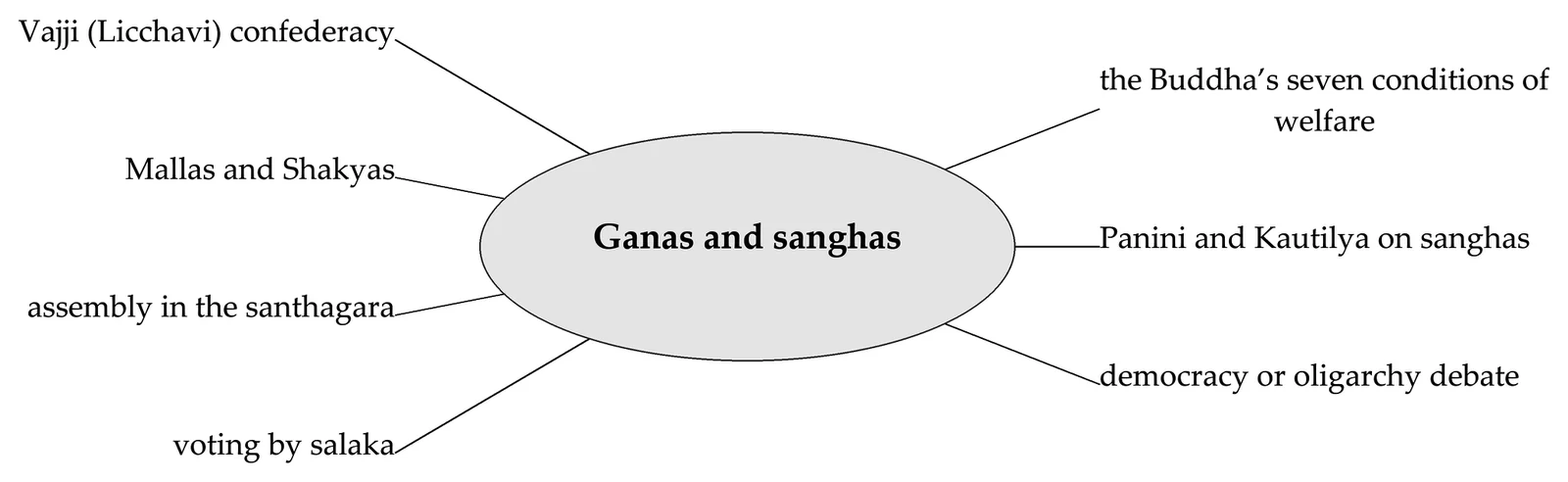
While monarchy grew stronger in the Gangetic plain, a number of republics flourished in the sixth and fifth centuries BCE, especially in the foothills of the Himalayas: the Licchavis of the Vajji confederacy with their capital at Vaishali, the Shakyas of Kapilavastu (the Buddha’s clan) and the Mallas of Kushinagara. J.P. Sharma, in Republics in Ancient India (1968), studied these non-monarchical governments in detail. Their features were these:
- Rule by an assembly. Power lay with an assembly of the heads of ruling (mostly Kshatriya) families, who met in a hall called the santhagara; the Licchavis are said to have had 7,707 rajas.
- Elected chief. The assembly chose a chief or president, sometimes called raja or ganapati.
- Procedure. Buddhist texts, especially the Vinaya Pitaka, which modelled the Buddhist sangha on these assemblies, describe a quorum, motions, voting by wooden tokens (shalaka) collected by an official, and committees.
- Collective decision-making. In the Mahaparinibbana Sutta, the Buddha said that the Vajjis would prosper as long as they met often, met and acted in concord, respected their laws and honoured their elders.
- Recognition in other texts. The grammarian Panini mentions sanghas, and Kautilya advised kings to win over or divide them, which shows their strength.
These republics were not democracies in the modern sense: power belonged to a narrow aristocracy of clan heads, and slaves and labourers had no voice. Most of them were absorbed by the expanding kingdom of Magadha.
Village Assemblies under the Cholas
The tradition of assemblies survived at the local level. Under the Chola kings of South India, villages had their own assemblies: the ur (of ordinary villagers), the sabha or mahasabha (of Brahmin villages) and the nagaram (of merchants). The famous Uttaramerur inscriptions of Parantaka I (919 and 921 CE) describe how the sabha of Uttaramerur chose its committees (variyams) by the kudavolai system: names were written on palm-leaf tickets, put in a pot and drawn by a young boy. Candidates had to own land and a house, be between thirty-five and seventy years old and know the Vedas, and those who had failed to render accounts were disqualified.
4.5 Continuity and Break
Did India’s modern Parliament and panchayats evolve from these ancient assemblies? Two views exist.
A. The view of continuity
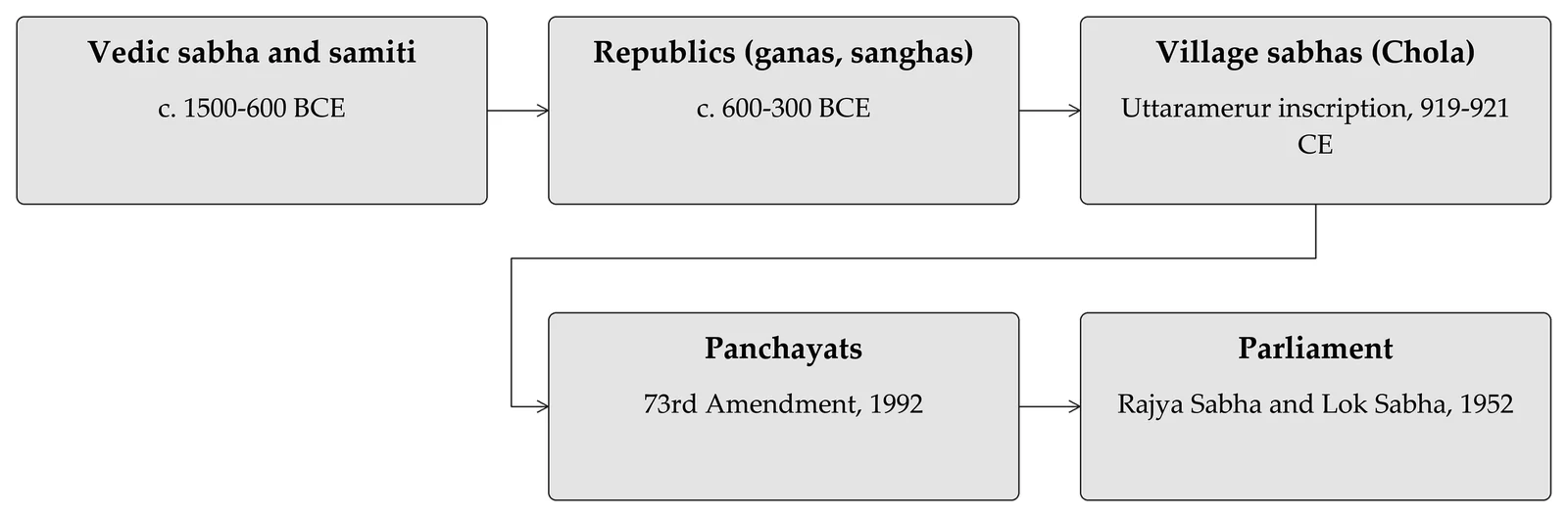
Nationalist historians, above all K.P. Jayaswal in Hindu Polity (1924), argued that ancient India had representative assemblies and republics comparable to those of Greece and Rome, so that democracy was not foreign to India. Gandhi’s idea of gram swaraj, Article 40 of the Constitution, which directs the state to organise village panchayats, the 73rd Amendment of 1992, and even the names Lok Sabha and Rajya Sabha express this sense of continuity.
B. The view of a break
Historians such as R.S. Sharma and U.N. Ghoshal argued that the Vedic assemblies were tribal bodies of a small pastoral society, and that the republics were oligarchies of clan heads. They disappeared long before modern times. India’s present institutions grew out of the British parliamentary model and colonial constitutional reforms, from the Indian Councils Acts of 1861 and 1892 to the Government of India Act of 1935, and out of the national movement’s demand for self-government based on universal adult franchise.
The balanced view is that modern Indian democracy is institutionally a product of modern history, but it draws inspiration and legitimacy from an older tradition of assemblies, consultation and local self-government. The past provides ideals; it did not directly produce the modern Parliament.
4.6 Important Questions
- Question 1 Discuss the functions and relevance of ‘Sabha’ and ‘Samiti’ as political institutions in India.
- Question 2 Examine ‘Sabha’ and ‘Samiti’ as Vedic representative institutions in India. Do you agree that the present-day political institutions have evolved from these?
- Question 3 Discuss the nature and working of republics (ganas and sanghas) in ancient India.
DU asks the same idea in different words. So learn one broad answer for each question below; the same answer works for every question joined by OR.
Important Question 1
Discuss the functions and relevance of ‘Sabha’ and ‘Samiti’ as political institutions in India.
OR
Distinguish between the sabha and the samiti.
OR
Write a note on the popular assemblies of the Vedic period.
Model Answer
“Common be your counsel, common your assembly, common your mind.”
— Rigveda X.191.3
Introduction. The sabha and the samiti were the most important popular assemblies of the Vedic age. The Atharvaveda calls them the two daughters of Prajapati. They show that early Indian kingship was not absolute but shared with the people.
1. Background
In the early Vedic period (c. 1500–1000 BCE) the tribes were small, pastoral and frequently at war, and the rajan was a war leader and protector of cattle rather than an absolute ruler. Important matters were settled in assemblies: the vidatha, the oldest and most frequently mentioned (122 times in the Rigveda, according to R.S. Sharma), which distributed booty and performed rituals; the gana; the sabha and the samiti. R.S. Sharma noted that these combined military, religious, judicial and distributive functions, because tribal society had not yet separated these spheres. The Rigveda mentions several assemblies, the vidatha, sabha, samiti and gana, which show that the tribal chief did not rule alone.
2. The Sabha: Nature and Functions
The sabha was a select council of elders and nobles, whose respected members were called sabheya. Its functions were: advising the king on important matters; acting as a court of justice, so that the word sabha later came to mean a court and its members sabhyas; serving as a place of social discussion, and even gambling, as the Rigveda’s gambler’s hymn (X.34) shows; and, in early times, including women (sabhavati). The Mahabharata later declared that ‘that is not a sabha where there are no elders’. Unlike the samiti, the sabha survived as the king’s council (rajasabha). The Atharvaveda calls the sabha and samiti the two daughters of Prajapati, and a member prays to speak well in the sabha, which shows the importance of persuasion.
3. The Samiti: Nature and Functions
The samiti was the general assembly of the people (vish), attended by the king himself. Its functions were: choosing or confirming the king, as the Atharvaveda’s prayer ‘may the people choose you for kingship’ suggests; deliberating on policy, especially war and peace; expressing the unity of the tribe, as in the last hymn of the Rigveda (X.191), which prays for a common counsel and a common mind; and checking the king, since a king needed its support to rule securely and could be restored or removed by it. It also had religious functions, with prayers offered at its meetings. The last hymn of the Rigveda prays that the members of the assembly be of one mind, one purpose and one heart, an early ideal of consensus.
4. Other Vedic Assemblies
The vidatha, perhaps the oldest assembly, combined religious, military and distributive functions, including the sharing of booty, and women may have taken part in it, while the gana was a tribal unit with its own leader.
5. The Assemblies and the King
The king was expected to attend the samiti and win its support; a king who lost the confidence of the assembly was weakened, which made early kingship consultative.
6. Sabha and Samiti Compared
The sabha was smaller, aristocratic, judicial and advisory, somewhat like an upper house; the samiti was larger, popular and political, somewhat like a lower house. In early times the samiti may even have elected or re-elected the king.
7. Women and the Assemblies
Some Vedic passages suggest that women attended the sabha and vidatha in early times, but their participation disappeared as society became more patriarchal.
8. Decline
In the later Vedic period, territorial kingdoms, hereditary kingship, rituals such as the rajasuya and the power of priests weakened the assemblies. The samiti vanished; the sabha became a royal court. By the age of the Brahmanas, councils of royal officials (ratnins) and priests had taken the place of the popular assemblies.
9. Relevance
The assemblies show an early tradition of consultation, consent and limited kingship. Their ideal survived in several forms: in the republics (ganas and sanghas) of the sixth century BCE, governed by assemblies in the santhagara; in the Buddhist sangha, whose rules of quorum and voting by tokens were modelled on them; in the Chola village assemblies, which, according to the Uttaramerur inscriptions (919 and 921 CE), elected committees by lot; and in modern institutions such as panchayats (Article 40, 73rd Amendment, 1992). The very names Lok Sabha and Rajya Sabha recall the ancient sabha. Nationalists cited these assemblies to show that self-government was not foreign to India, and the name ‘Lok Sabha’ echoes the ancient sabha.
10. Lessons for Democracy
The sabha and samiti remind us that deliberation, consent and the accountability of rulers are old values, though modern democracy requires the equal citizenship and representation that they lacked.
11. Limitations
They were tribal and later aristocratic bodies; women and lower groups were excluded in later times; their procedures are known only vaguely from hymns; and they were not representative in the modern sense of elections and universal franchise. R.S. Sharma therefore warns against reading modern democracy into them, as K.P. Jayaswal’s Hindu Polity (1924) tended to do. Our knowledge comes from religious texts composed by priests, so the actual working of the assemblies remains uncertain.
Conclusion. Thus, the sabha and samiti were the earliest institutions of collective decision-making in India. Their functions declined with the rise of monarchy, but their ideal of shared counsel remains relevant to Indian democracy.
Important Question 2
Examine ‘Sabha’ and ‘Samiti’ as Vedic representative institutions in India. Do you agree that the present-day political institutions have evolved from these?
OR
Did ancient India have democratic institutions? Discuss.
OR
“Democracy is not alien to India.” Examine with reference to ancient Indian assemblies.
Model Answer
“That is not a sabha where there are no elders; they are not elders who do not speak of dharma.”
— Mahabharata
Introduction. The Vedic sabha and samiti were assemblies through which the people took part in tribal government. Whether they were truly representative and whether modern institutions evolved from them are important debates in Indian political thought.
1. The Vedic Assemblies
The vidatha, gana, sabha and samiti were tribal assemblies. The sabha was a council of elders and a court; the samiti was the assembly of the whole people that chose and advised the king. They show that early Vedic polity combined chieftainship with collective decision-making.
2. The Question of Representation
In a small tribe, the samiti allowed the free men of the tribe to take part directly; it was closer to direct participation than to representation. The sabha represented elders and nobles, an early form of aristocratic counsel. Neither involved elections in the modern sense, fixed terms or universal franchise. Yet they embodied the principle that rule requires the consent and counsel of the ruled, which is the moral core of representative government. Representation in the modern sense, through elected deputies acting for constituents, did not exist; participation was direct but limited to adult male members of the tribe. As the assemblies became aristocratic, even this direct participation narrowed.
3. The Republics
The ganas and sanghas of the sixth century BCE, such as the Licchavis and Shakyas, were governed by assemblies of clan heads in the santhagara, with quorum, motions and voting by tokens, as the Vinaya Pitaka describes. They were aristocratic republics. Their rules of debate and voting were later adopted by the Buddhist sangha.
4. Local Assemblies
The Uttaramerur inscriptions of the Chola king Parantaka I (919 and 921 CE) show the sabha of a Brahmin village choosing its committees (variyams) by the kudavolai system, i.e. drawing names written on palm leaves from a pot. Candidates had to own land and a house, be between thirty-five and seventy and know the Vedas, while those who had failed to submit accounts, and their relatives, were disqualified. This shows a remarkable concern for accountability. Members were chosen by lot (kudavolai) from qualified candidates, who had to own property, be learned and be of good character, and were barred if they or their relatives had committed offences.
5. Councils under the Monarchies
Even in monarchies, councils of ministers (mantriparishad), guild assemblies and the paura and janapada bodies mentioned in some texts had a consultative role; Jayaswal saw the paura-janapada as popular assemblies, but most historians doubt this.
6. The Argument for Evolution
K.P. Jayaswal’s Hindu Polity (1924) argued that India had a democratic and republican heritage. Gandhi’s gram swaraj, Article 40 and the 73rd Amendment draw on the tradition of village self-government, and the names Lok Sabha and Rajya Sabha echo the ancient sabha. Ambedkar, too, told the Constituent Assembly that India had once known parliamentary procedure through the Buddhist sanghas.
7. The Argument against Evolution
R.S. Sharma and U.N. Ghoshal showed that the Vedic assemblies were tribal and disappeared by the end of the Vedic age, and that the republics were oligarchies. Modern institutions grew from British parliamentary practice, colonial reforms (1861, 1892, 1909, 1919, 1935) and the national movement’s demand for universal franchise. Modern representative institutions in India grew instead from the colonial legislative councils created by the Acts of 1861, 1892, 1909, 1919 and 1935, and from the national movement’s demand for self-government. The name of the Lok Sabha was chosen for its symbolic value, not because of any institutional continuity.
8. Democracy as Public Reasoning
Amartya Sen argues in The Argumentative Indian (2005) that public reasoning, not elections alone, lies at the heart of democracy, and that India has a long tradition of public discussion, from Buddhist councils to Akbar’s debates.
9. Representation in Modern India
Modern representation rests on universal adult franchise, territorial constituencies and political parties, with reserved seats for disadvantaged groups, features unknown to the ancient assemblies.
10. Evaluation
There is no direct institutional line from the samiti to the Lok Sabha; the modern Parliament, with its universal adult franchise, parties, cabinet responsibility and written constitution, is a product of modern history. But the ancient assemblies supply an ideal of consultation and consent that gives modern Indian democracy cultural roots and legitimacy. Ambedkar himself, in his speech of 25 November 1949, recalled that India once had parliaments and Buddhist sanghas with rules of debate and voting, but warned that democracy had been lost once and could be lost again. The ancient assemblies are better seen as a cultural memory that legitimised democracy than as its institutional ancestor.
Conclusion. Thus, the sabha and samiti were early participatory institutions rather than modern representative ones. Present-day institutions did not evolve directly from them, but they draw inspiration from this long tradition of collective decision-making.
Important Question 3
Discuss the nature and working of republics (ganas and sanghas) in ancient India.
OR
Write a note on the Licchavi republic.
OR
Examine the non-monarchical governments of ancient India.
Model Answer
“So long as the Vajjis meet frequently and in concord, they may be expected to prosper, not decline.”
— The Buddha, Mahaparinibbana Sutta
Introduction. Alongside monarchies, ancient India had republics, called ganas or sanghas, governed by assemblies rather than by a single king. They flourished especially in the sixth and fifth centuries BCE.
1. Examples
The Licchavis of the Vajji confederacy (Vaishali), the Shakyas (Kapilavastu) and the Mallas (Kushinagara) are the best known; Panini and Kautilya also mention sanghas. Others included the Mallas of Pava, the Moriyas, the Koliyas and the Bulis, as listed in Buddhist texts.
2. Structure
Power lay with an assembly of the heads of ruling families meeting in the santhagara. The Licchavis are said to have had 7,707 rajas. An elected chief presided, assisted by officials. The Licchavis are said to have had 7,707 rajas, heads of families who met in the assembly, with an executive of a chief, a deputy and a treasurer.
3. Procedure
The Vinaya Pitaka describes a quorum, the formal moving of resolutions, voting by wooden tokens (shalaka), and committees for difficult matters. Difficult matters could be referred to a committee (ubbahika), and a teller (salakagahapaka) collected the voting tokens. Decisions were ideally unanimous, but voting resolved disagreements.
4. The Buddha’s Advice
In the Mahaparinibbana Sutta the Buddha said the Vajjis would prosper as long as they met often and in concord, followed their laws and honoured their elders. He listed seven conditions of welfare: meeting often, meeting and acting in concord, following established laws, respecting elders, protecting women, honouring shrines and supporting holy men.
5. Justice in the Republics
According to a later Buddhist commentary, an accused Licchavi passed through several levels of judicial officers before reaching the chief, and could be punished only if each of them found him guilty, an early safeguard of liberty.
6. Economy of the Republics
The republics rested on agriculture and trade; their ruling clans owned land worked by slaves and labourers, and towns such as Vaishali were wealthy commercial centres.
7. Nature: Between Democracy and Oligarchy
K.P. Jayaswal saw them as democracies; J.P. Sharma and R.S. Sharma showed that they were aristocratic republics of Kshatriya clans, excluding slaves, labourers and women. Only members of the ruling Kshatriya clans had political rights; slaves, labourers and other groups were excluded.
8. Republics and Kingdoms Compared
Kingdoms concentrated power in one ruler who claimed divine sanction, while republics shared power among clan heads who debated and voted. Brahmanical texts generally favoured monarchy, while Buddhist and Jain texts were more sympathetic to the ganas.
9. The Jain Connection
Mahavira was born into the Jnatrika clan of the Vajji confederacy near Vaishali, and both Buddhism and Jainism grew in the republican world of eastern India.
10. Decline
Internal divisions and the expansion of Magadha, which conquered the Vajjis under Ajatashatru, led to their decline; Kautilya advised kings to divide and win over sanghas. Ajatashatru’s minister Vassakara is said to have sown dissension among the Vajjis before Magadha conquered them, which shows that unity was their strength.
11. Republics in Panini and Kautilya
The grammarian Panini (c. 5th–4th century BCE) mentions many sanghas, some of them ayudhajivi (living by arms), which shows how common republics were in north-western India. Kautilya classified sanghas into those living by agriculture and arms and those using the title raja, and advised the king to win them over or break their unity through spies, since a united sangha was hard to defeat. Greek writers who accompanied Alexander (326 BCE) also described self-governing peoples in the Punjab. Kautilya advised kings to win over or divide the sanghas, since united they were hard to conquer.
12. Republics after the Buddha
Republican communities such as the Yaudheyas, Malavas and Arjunayanas survived in north-western and western India into the Gupta period, issuing their own coins, until Samudragupta brought them under his overlordship.
13. Comparison with Greek Republics
Like Greek city-states, the Indian republics were governed by assemblies of citizens, but citizenship was limited to the members of ruling Kshatriya clans, and there was nothing like the large popular assembly of Athenian democracy. They resembled aristocratic republics more than democracies. Like Athens, the Indian republics excluded large parts of the population from citizenship.
14. Significance
The republics show that government by discussion, voting and collective decision existed in India alongside monarchy, and their procedures survived in the Buddhist sangha. K.P. Jayaswal used them to argue that democracy had Indian roots; R.S. Sharma and J.P. Sharma reminded readers of their oligarchic character. They also show that the Buddha’s sangha drew on republican practice, and that Indian history includes collective as well as monarchical government.
15. Evaluation
The ganas and sanghas show that government by discussion, voting and collective leadership has deep roots in India. They were not democracies in the modern sense, but they enriched the Indian political tradition and remain a source of inspiration.
Conclusion. Thus, the ancient Indian republics show that government by assembly and discussion existed in India alongside monarchy, though in an aristocratic rather than a modern democratic form.
Short Notes
(a) Vidatha
Probably the earliest assembly mentioned in the Rigveda, where the word appears many times. Scholars such as R.S. Sharma regard it as an assembly with religious, military and distributive functions, in which women also took part. It disappeared in later Vedic times, while the sabha and samiti continued.
(b) Jayaswal’s Hindu Polity
K.P. Jayaswal’s Hindu Polity (1924) argued that ancient India had popular assemblies, republics and constitutional monarchy, presenting a democratic past against colonial claims of oriental despotism. Later historians accepted the existence of assemblies and republics but criticised Jayaswal for reading modern democratic institutions into ancient sources.
More notes: DSC-2 Ideas and Institutions in Indian Political Thought
These notes are prepared by PADHO TO AISE for study help. They are not an official University of Delhi publication.