
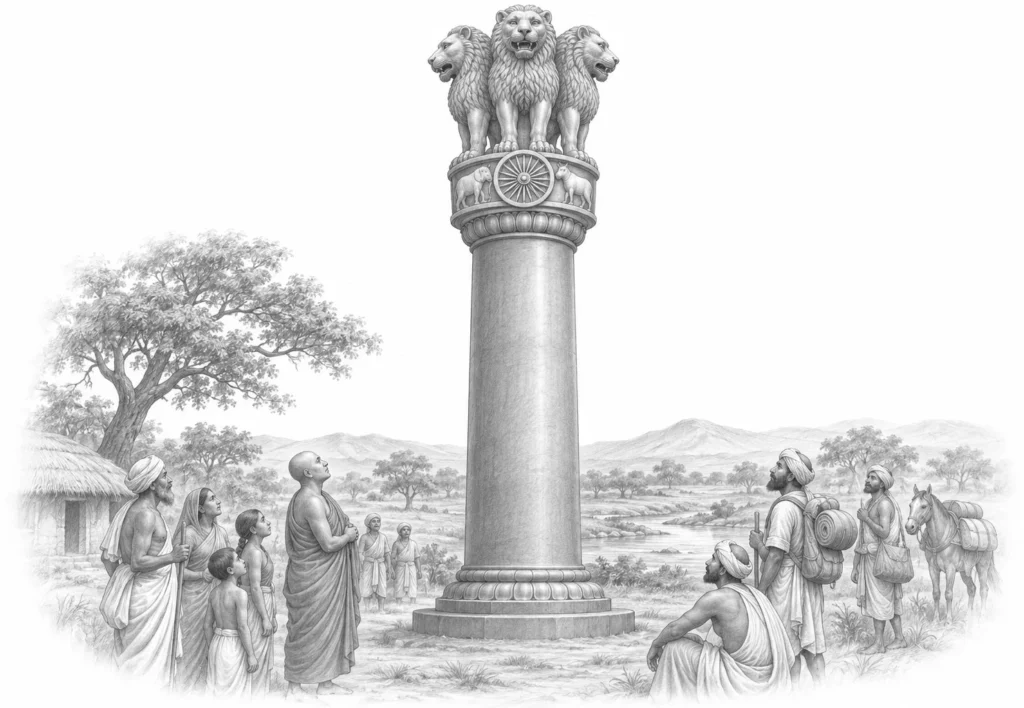
Semester I DSC-2 Ideas and Institutions in Indian Political Thought
Unit II · 26 min read · Updated 24 Nov 2026
As per the University of Delhi (DU) BA (Hons) Political Science syllabus
Contents
- 2.1 Dharma
- Meanings of Dharma
- Sources and Types of Dharma
- Dharma and the State
- 2.2 Dhamma
- Dhamma and Kingship
- 2.3 Ashoka’s Dhamma
- Interpretations of Ashoka’s Dhamma
- 2.4 Danda
- Danda in the Texts
- Kinds and Aims of Punishment
- 2.5 Dharma, Dhamma and Danda Together
- 2.6 Important Questions
- Explain the significance of ‘Dharma’ and ‘Danda’ in ancient Indian political thought.
- Analyse the concept of ‘Dhamma’ in ancient India with special reference to Ashoka’s Dhamma.
- Discuss the ancient Indian theory of punishment (Danda).
- Short Notes
धर्मो रक्षति रक्षितः।
Dharma protects those who protect it.
— Manusmriti, VIII.15
IN CHAPTER 1 we saw that ancient Indian statecraft placed the king between two forces. Above him stood dharma, the moral order he had to protect; in his hand was danda, the power of punishment through which he protected it. The Buddhist tradition gave a third idea, dhamma, which the emperor Ashoka turned into a policy of government. These three words are among the most important concepts of Indian political thought. They answer three questions: What is the moral order of society? How should a ruler govern ethically? And how is order enforced? In this chapter we study each concept, its meanings, the thinkers and texts behind it, and how the three are connected.
2.1 Dharma
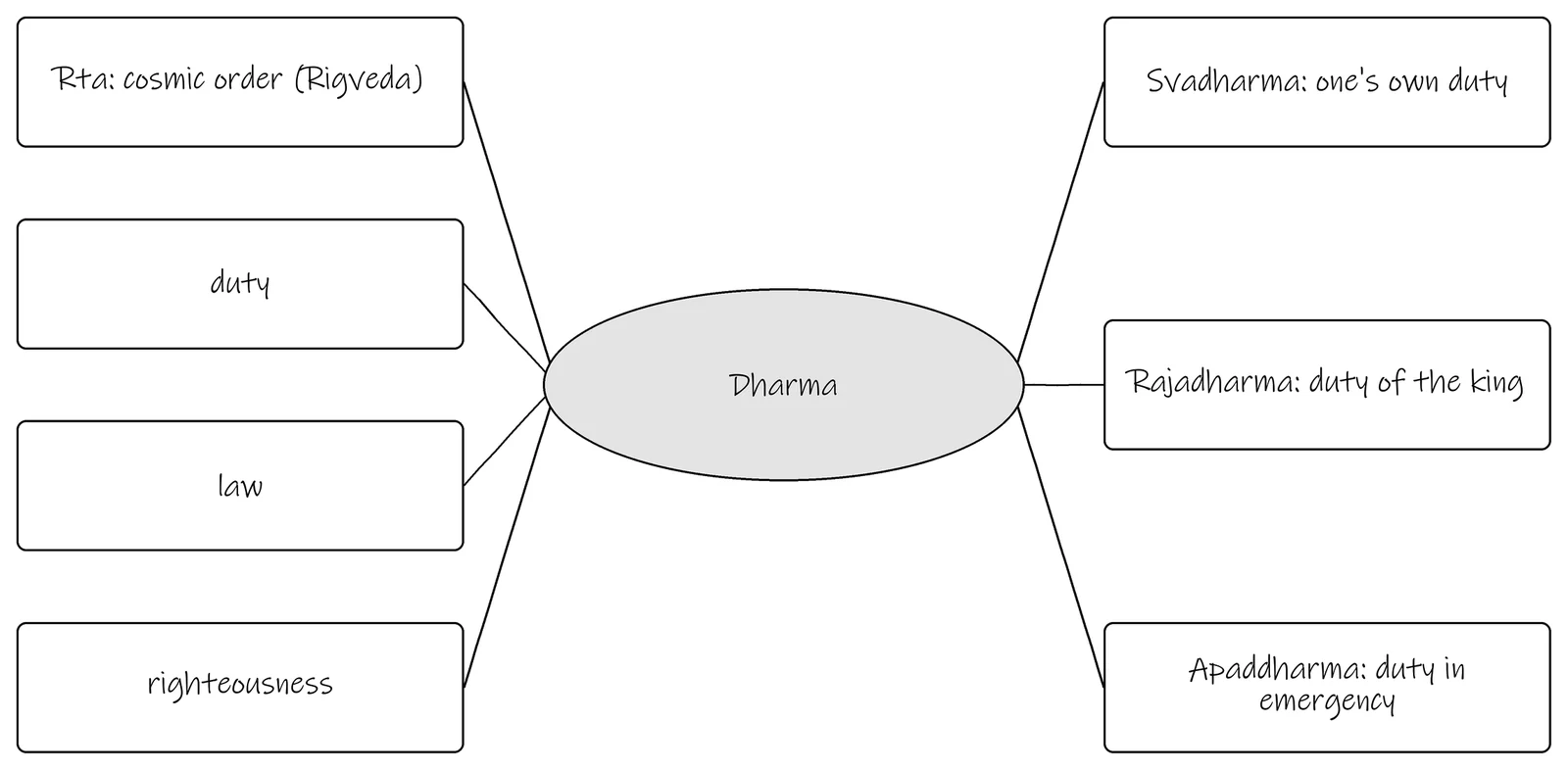
The word dharma comes from the root dhṛ, meaning to hold, support or sustain. In its widest sense, dharma is that which holds the world, society and the individual together. Its earliest form is the Rigvedic idea of rta, the cosmic order by which the sun rises, the seasons change and the gods themselves act. Over time the idea moved from the cosmic to the social and moral sphere. Dharma came to mean the order of society, the duties of each person, law, justice and righteousness all at once.
This is why the philosopher Margaret Chatterjee, in ‘The Concept of Dharma’ (1986), warned against translating dharma as ‘religion’. Religion in the Western sense is a set of beliefs about God; dharma is a set of duties and norms that govern how one should live in a particular position and situation. It is contextual and relational: what is right for a king may be wrong for a teacher, and what is right in normal times may change in an emergency.
Meanings of Dharma
Dharma is used in several related senses (Figure 2.2). It means the cosmic order (rta); duty, i.e. what one ought to do; law, i.e. the rules of the Dharmashastras enforced by the king; righteousness or virtue; and, in modern usage, religion. Ancient texts also speak of particular forms of dharma: svadharma, one’s own duty according to one’s station; rajadharma, the duty of the king; and apaddharma, the rules that apply in times of distress.
Sources and Types of Dharma
According to Manu, dharma is known from four sources, in order of authority: shruti (the Vedas), smriti (the Dharmashastras), sadachara (the conduct of the virtuous) and atmatushti (what satisfies one’s own conscience). The Mimamsa philosopher Jaimini defined dharma as that good which is known through the injunctions of the Veda. Within this framework, the texts distinguish several types of dharma:
- Sadharana dharma (common duties). Duties binding on all human beings. Manu (X.63) lists non-violence, truthfulness, not stealing, purity and control of the senses; this universal ethic shows that dharma was not only about caste.
- Varnashrama dharma. Duties according to one’s varna (social order) and ashrama (stage of life: student, householder, forest-dweller, renunciant). The Dharmashastras, compiled as the Brahmanical order consolidated itself, made this the core of social organisation.
- Svadharma. One’s own particular duty. In the Bhagavad Gita (3.35), spoken to Arjuna on the battlefield of Kurukshetra, Krishna says that it is better to perform one’s own dharma imperfectly than another’s dharma well.
- Rajadharma. The duty of the king to protect the people, uphold the varna order and administer danda justly. Bhishma in the Shanti Parva declares that all dharmas are rooted in rajadharma, because without the king’s protection no one can follow his own dharma.
- Apaddharma. Rules for times of distress. The Shanti Parva allows departures from normal duties when survival is at stake, which shows the flexibility of dharma.
- Yugadharma. The dharma appropriate to each age (yuga), which recognises that norms change with time.
Dharma and the State
In ancient Indian political thought, dharma is above the king. The king does not create dharma; he protects and enforces it. This is why the ancient state is often described as dharma-bound. Kautilya, however, gave the king more room: in his list of four sources of law (dharma, vyavahara, charitra and rajashasana), the king’s edict prevails when the others conflict. Critics such as B.R. Ambedkar, in Annihilation of Caste (1936), argued that the Dharmashastras used dharma to sanctify caste inequality, so that the idea of dharma cannot be studied without its social consequences.
2.2 Dhamma
Dhamma is the Pali form of dharma, used in the Buddhist tradition. Its meaning overlaps with dharma but has its own emphasis. In ‘Traditional Definitions of the Term Dhamma’ (1976), John Ross Carter showed that Buddhist commentators used it in several senses: the teaching of the Buddha; the truth or natural law that the Buddha discovered; righteousness or good conduct; and the elements of existence. Rupert Gethin, in ‘He who sees Dhamma sees Dhammas’ (2004), explained that early Buddhism linked the single Dhamma, the truth, with the many dhammas, the passing elements of experience: to understand how these elements arise and pass away is to see the truth.
The core of the Buddha’s Dhamma lies in the Four Noble Truths (suffering, its cause in craving, its cessation, and the path to cessation), the Noble Eightfold Path, and the doctrine of dependent origination, i.e. that everything arises from conditions. Unlike Brahmanical dharma, Buddhist dhamma rejected the authority of the Vedas, animal sacrifice and birth-based hierarchy; it was a universal ethic open to all.
Dhamma and Kingship
Buddhist texts gave dhamma a political meaning. In the Cakkavatti Sihanada Sutta of the Digha Nikaya, the ideal ruler is the chakravartin [चक्रवर्ती], the wheel-turning king, who conquers ‘without rod and without sword’, by dhamma alone, and who protects all, including animals and the poor. When later kings neglected the poor, the sutta says, poverty led to theft, violence and the decline of society. The Jataka tales list ten royal virtues (dasa raja dhamma): generosity, morality, self-sacrifice, honesty, gentleness, self-control, non-anger, non-violence, patience and not opposing the will of the people. This ideal found its most famous expression in Ashoka.
| Basis | Dharma (Brahmanical) | Dhamma (Buddhist) |
|---|---|---|
| Source of authority | The Vedas and the Dharmashastras | The teaching of the Buddha and reason |
| Social order | Varnashrama: duties differ by varna and stage of life | A universal ethic open to all, rejecting birth-based hierarchy |
| Rituals | Accepts Vedic sacrifice and ritual | Rejects animal sacrifice and empty ritual |
| Ideal ruler | The king who protects dharma through danda | The chakravartin who rules by dhamma, not by the rod |
| Key texts | Manusmriti, Shanti Parva, Bhagavad Gita | Digha Nikaya, Jatakas, Ashoka’s edicts |
2.3 Ashoka’s Dhamma
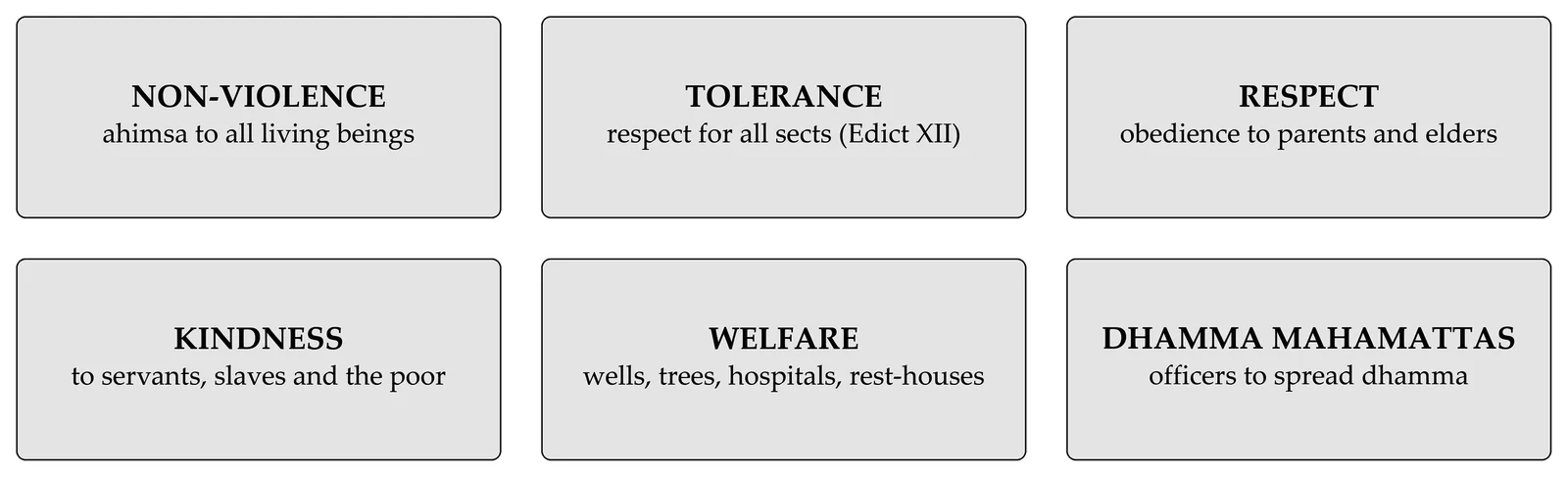
Ashoka’s Dhamma was born out of the Kalinga war. In Rock Edict XIII Ashoka expressed deep remorse for the slaughter and suffering it had caused, and declared that the only true conquest is dhamma-vijaya, conquest by righteousness. From then on he devoted his reign to spreading Dhamma through edicts carved on rocks and pillars across the subcontinent. Although Ashoka was personally a Buddhist lay follower, his Dhamma was not a sectarian creed. It was a moral code for all his subjects, whatever their faith. Its main features were these (Figure 2.3):
- Non-violence (ahimsa). Rock Edict I banned animal sacrifice and reduced the killing of animals in the royal kitchen.
- Religious tolerance. Rock Edict XII asks people to honour other sects and to restrain their speech, because whoever praises his own sect while condemning others harms his own.
- Respect and obedience. Subjects should obey parents, respect elders and teachers, and show courtesy to Brahmins and shramanas.
- Kindness to the weak. Rock Edict IX urges proper treatment of slaves and servants and generosity to friends and the needy.
- Public welfare. Rock Edict II records medical treatment for humans and animals, and the planting of trees and digging of wells along the roads.
- Paternal kingship. In the Separate Kalinga Edict Ashoka declared, “All men are my children,” and promised that he was always available to hear the affairs of the people.
- Administration of Dhamma. In Rock Edict V he appointed dhamma mahamattas, special officers to spread Dhamma and look after the welfare of all sects; and, as Rock Edict VIII records, he replaced royal pleasure tours with dhamma-yatras.
- Moderation in punishment. Pillar Edict IV grants three days’ respite to prisoners sentenced to death, so that they can prepare themselves or appeal.
Interpretations of Ashoka’s Dhamma
Historians have interpreted Ashoka’s Dhamma in different ways. D.R. Bhandarkar (Asoka, 1925) saw it as Buddhism for lay people. Romila Thapar, in Asoka and the Decline of the Mauryas (1961), argued that it was above all a policy: a set of shared ethical values designed to hold together a vast and diverse empire of many peoples, faiths and languages, and to reduce social tensions. The historian H.C. Raychaudhuri blamed Ashoka’s pacifism for weakening the empire, but Thapar rejected this, pointing to the size of the empire and its weak economic base. In simple words, Ashoka’s Dhamma was both a personal moral conviction and an instrument of government.
2.4 Danda
Danda literally means a rod or staff, the symbol of authority. In political thought it means punishment and, more broadly, the coercive power of the state. The science of government was therefore called Dandaniti [दण्डनीति], the science of the right use of danda. Without danda, the texts agree, society would fall back into matsya nyaya.
Danda in the Texts
A. Manu: danda is the real king
The Manusmriti (VII.17–18) declares that danda is the real king, the leader and the ruler; danda alone governs all beings, protects them and watches over them while they sleep. But Manu also insists that danda must be just: inflicted with due consideration, it makes people happy; inflicted without consideration, it destroys everything, including the king himself.
B. Kautilya: danda in due measure
Kautilya (Arthashastra 1.4) argued that a king who punishes too severely becomes hated, one who punishes too mildly is despised, but one who punishes justly is respected. Properly used, danda secures the people’s dharma, artha and kama; without it, the strong devour the weak. Kautilya also used danda in a wider sense, as one of the seven limbs of the state (the army) and as the last of the four upayas (force).
C. The Shanti Parva: danda as the guardian of all
Bhishma tells Yudhishthira that when danda is properly applied, people follow their duties without fear, and that the king who administers danda well is the maker of the age.
Kinds and Aims of Punishment
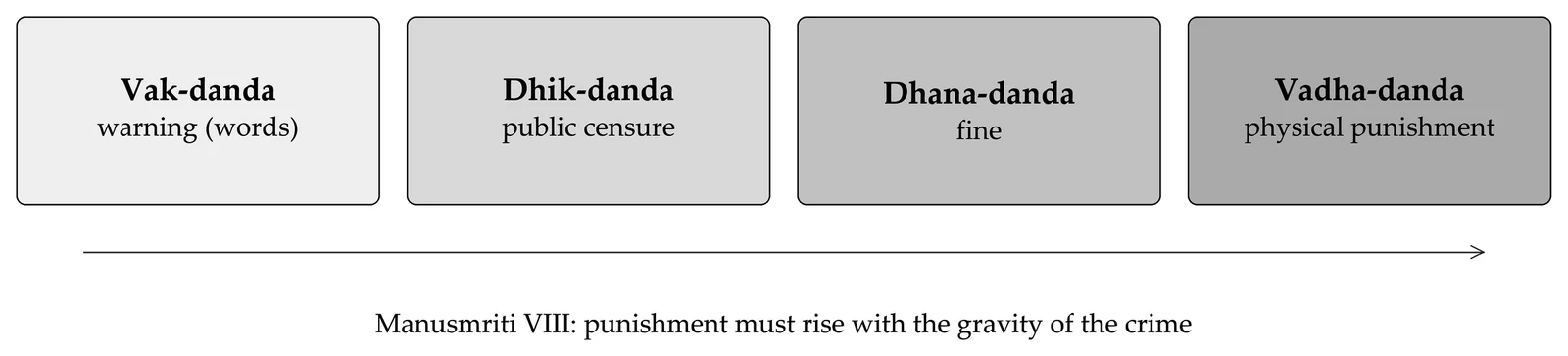
Manu (VIII.129) describes four kinds of danda, to be used in rising order of severity (Figure 2.4): vak-danda, a gentle warning; dhik-danda, public censure; dhana-danda, a fine; and vadha-danda, physical punishment, including death in the gravest cases.
In ‘Theory of Punishment in Ancient India’ (1947), Radha Krishna Choudhry showed that ancient Indian punishment served several aims at once: deterrence, to frighten others; retribution, to give the offender what he deserves; prevention, to protect society; and reformation and expiation through prayashchitta, i.e. penance that purifies the offender. Donald Davis, in The Spirit of Hindu Law (2010), described danda as aiming at ‘rectitude and rehabilitation’, i.e. restoring the offender to right conduct, not merely hurting him.
Punishment also varied with the status of the offender. For some offences, such as insult, the Dharmashastras prescribed harsher punishment for lower varnas; for theft, Manu (VIII.337–338) made the fine rise with the offender’s varna, on the ground that those who know more deserve heavier punishment; and he declared that where a common man is fined one coin, the king should be fined a thousand. Danda was therefore unequal by caste, yet it held the powerful to a higher standard in some respects.
2.5 Dharma, Dhamma and Danda Together
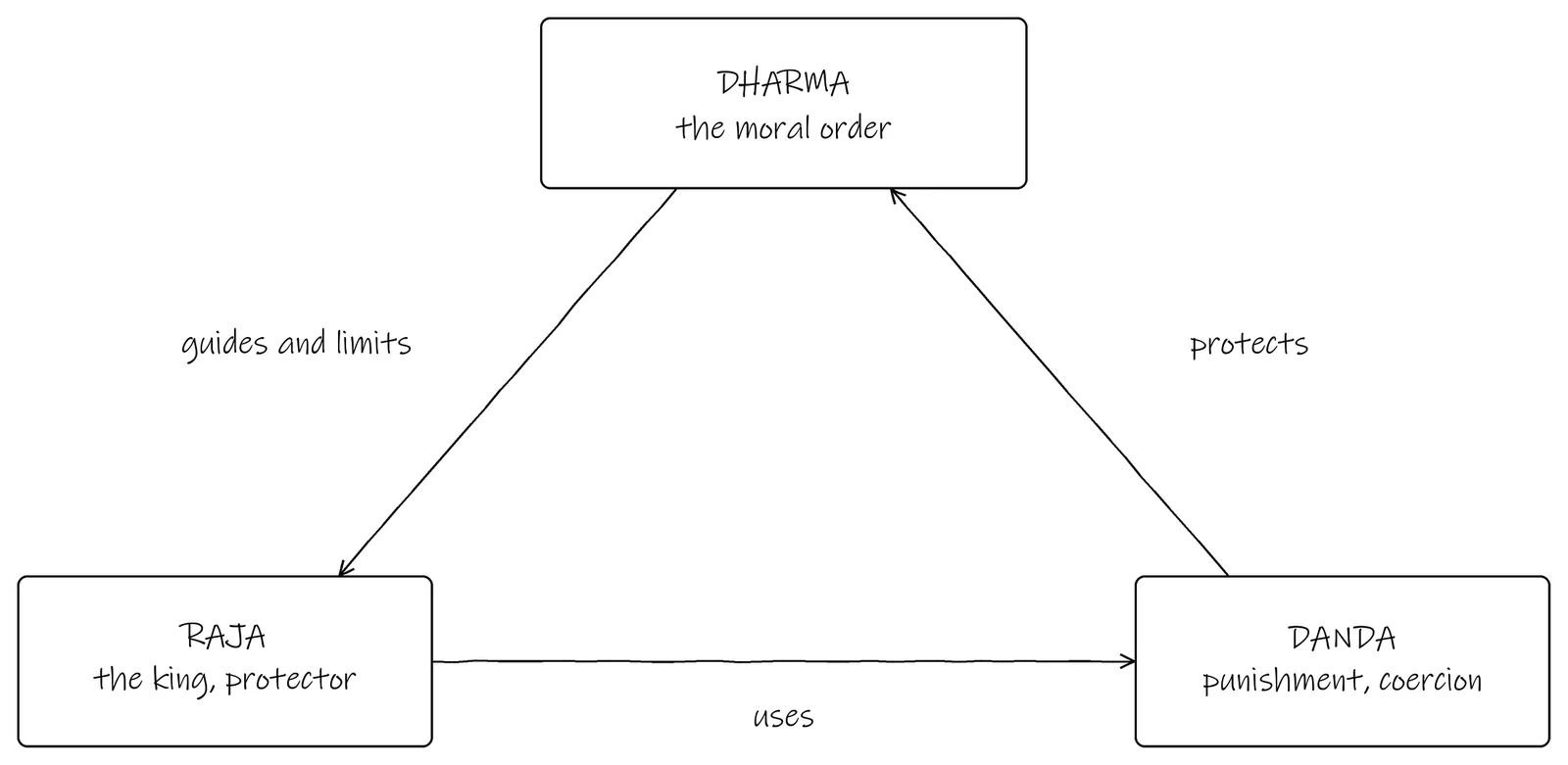
The three concepts form a single framework of political thought (Figure 2.5). Dharma is the moral and social order; danda is the power that protects it; and the king links the two, using danda to uphold dharma while being bound by dharma himself. Danda without dharma becomes tyranny, and dharma without danda becomes helpless before the strong. The Buddhist idea of dhamma shifted the emphasis: the ideal ruler should govern by moral example and welfare rather than by the rod. Ashoka did not abolish punishment, but he tried to make dhamma rather than danda the main foundation of his rule.
2.6 Important Questions
- Question 1 Explain the significance of ‘Dharma’ and ‘Danda’ in ancient Indian political thought.
- Question 2 Analyse the concept of ‘Dhamma’ in ancient India with special reference to Ashoka’s Dhamma.
- Question 3 Discuss the ancient Indian theory of punishment (Danda).
DU asks the same idea in different words. So learn one broad answer for each question below; the same answer works for every question joined by OR.
Important Question 1
Explain the significance of ‘Dharma’ and ‘Danda’ in ancient Indian political thought.
OR
Discuss the relationship between dharma and danda.
OR
Explain the concept of dharma in the Indian tradition.
Model Answer
“Dharma protects those who protect it.”
— Manusmriti VIII.15
Introduction. Dharma and danda are the two pillars of ancient Indian political thought. Dharma is the moral and social order that holds society together; danda is the coercive power of the state that protects it. The king stands between the two, using danda to uphold dharma while himself remaining bound by it.
1. Meaning of Dharma
From the root dhṛ (to sustain), dharma means that which holds the world and society together. Its forerunner is the Rigvedic rta, the cosmic order. It means duty, law, righteousness and the social order; as Margaret Chatterjee (1986) stressed, it is contextual and relational and should not be reduced to ‘religion’.
2. Sources and Types of Dharma
Manu names four sources: shruti, smriti, the conduct of the virtuous and conscience. The types include sadharana dharma (universal duties such as non-violence and truth), varnashrama dharma, svadharma (the Gita’s ‘one’s own duty’), rajadharma (the king’s duty) and apaddharma (duties in distress). Sadharana dharma, such as truthfulness and non-violence, applies to everyone, while varnashrama dharma differs by group and stage of life.
3. Significance of Dharma
Dharma was above the king: he protected it but did not create it. It gave legitimacy to rule, set limits on royal power, provided the basis of law and organised social life. Bhishma declared that all dharmas depend on rajadharma, since only the king’s protection allows others to follow their duties. The Brihadaranyaka Upanishad says that there is nothing higher than dharma, and that through dharma even the weak can prevail over the strong.
4. Meaning of Danda
Danda, literally the rod, means punishment and the coercive power of the state. The science of government was called Dandaniti. Without danda, society falls into matsya nyaya, the law of the fishes. It also means the army and the coercive apparatus of the state.
5. Significance of Danda
For Manu (VII.17–18), danda is the real king, protecting all beings and watching over them while they sleep. Kautilya (Arthashastra 1.4) held that just danda secures dharma, artha and kama, while excessive danda makes the king hated and weak danda makes him despised. Manu’s four kinds of danda, warning, censure, fine and physical punishment, were to be applied in rising order of severity. Kautilya made dandaniti the science that secures the other three sciences.
6. Rajadharma
Rajadharma, the duty of the king, joined dharma and danda: the king must protect the people, uphold the social order, administer justice and ensure prosperity. The Shantiparva calls rajadharma the highest of all dharmas, because all other duties depend on it.
7. The Relationship between Dharma and Danda
Danda exists to protect dharma, and dharma limits danda. Danda without dharma becomes tyranny; dharma without danda is helpless. The king is the link between them: he must apply danda justly and remain bound by dharma himself, and a king who fails in this duty may, according to the Shanti Parva, be removed by his people.
8. The Buddhist Alternative
Buddhist thought shifted the emphasis from danda to dhamma: the ideal chakravartin rules ‘without rod and without sword’. Ashoka tried to make dhamma the foundation of rule, though he retained punishment. Ashoka’s Dhamma applied this ideal to an empire.
9. Dharma and Danda Today
Modern India replaced varna-based dharma with constitutional morality and the king’s danda with the rule of law, but the idea that state power must serve a moral order and be used justly remains central.
10. Criticism
Dharma in the Dharmashastras sanctified the varna hierarchy, and danda varied with caste, as Ambedkar strongly criticised. Yet the idea that power must serve a moral order remains significant. Modern constitutional values of equality and rights therefore replaced varna-based dharma, though the ideal of righteous rule survives.
11. Dharma and Danda in the Shanti Parva
The Shanti Parva gives the fullest account of the relationship. Bhishma tells Yudhishthira that in the golden age people followed dharma without a king, but when greed and delusion arose, dharma was lost and matsya nyaya prevailed; the king and danda were created to restore it. The king who wields danda according to dharma is said to make the age itself, so that the Krita (golden) age exists when the king is righteous.
12. Danda in Kautilya’s Scheme
Kautilya used danda in three senses: as punishment, which must be neither too severe nor too mild; as the army, the sixth limb of the Saptanga; and as force, the last of the four upayas in foreign policy. For him, the science of government itself is Dandaniti, and danda secures the acquisition and protection of what the state needs. His approach is more secular than Manu’s, but he too declares that danda used justly makes the people devoted to dharma and wealth.
Conclusion. Thus, dharma gave the ancient Indian state its moral purpose and danda its coercive strength. Their relationship expresses a lasting principle: power is legitimate only when it serves a just order.
Important Question 2
Analyse the concept of ‘Dhamma’ in ancient India with special reference to Ashoka’s Dhamma.
OR
Was Ashoka’s Dhamma a religion or a state policy? Discuss.
OR
Distinguish between dharma and dhamma.
Model Answer
“All men are my children.”
— Ashoka, Separate Kalinga Edict
Introduction. Dhamma is the Pali form of dharma, used in the Buddhist tradition. It means the Buddha’s teaching, the truth he discovered and a universal ethic of righteous living. Under the Mauryan emperor Ashoka, dhamma became a moral policy of government.
1. Meaning of Dhamma
John Ross Carter (1976) showed that Buddhist commentators used dhamma for the teaching, the truth, righteousness and the elements of existence. Rupert Gethin (2004) explained that to see the passing dhammas of experience is to see the one Dhamma, the truth. In Pali, dhamma refers both to the Buddha’s teaching and to the moral order underlying existence.
2. Buddhist Dhamma
Its core lies in the Four Noble Truths, the Noble Eightfold Path and dependent origination. Unlike Brahmanical dharma, it rejected Vedic authority, animal sacrifice and birth-based hierarchy, offering an ethic open to all. The Eightfold Path of right view, intention, speech, action, livelihood, effort, mindfulness and concentration links personal ethics with social conduct.
3. Dhamma and Kingship
The Cakkavatti Sihanada Sutta describes the chakravartin who rules by dhamma, not by force, and the Jatakas list ten royal virtues, including generosity, non-violence and not opposing the will of the people.
4. Background of Ashoka’s Dhamma
After the Kalinga war (c. 261 BCE), in which, according to Rock Edict XIII, 150,000 were deported and 100,000 killed, Ashoka renounced conquest by war in favour of dhamma-vijaya, conquest by righteousness. Rock Edict XIII records his remorse and declares that conquest by dhamma is the best conquest.
5. Features of Ashoka’s Dhamma
Ashoka’s Dhamma included ahimsa (Rock Edict I banned animal sacrifice), tolerance (Rock Edict XII asked people to honour all sects), respect for parents, elders and teachers, kindness to slaves and servants, public welfare (Rock Edict II records medical care, wells and trees), paternal kingship (“All men are my children”), dhamma mahamattas (Rock Edict V) and moderation in punishment (Pillar Edict IV). Pillar Edict II defines dhamma as few sins, many good deeds, kindness, generosity, truthfulness and purity. Rock Edict IX criticised meaningless rituals and praised the ceremony of dhamma.
6. Ashoka and the Sangha
Ashoka supported the Buddhist sangha, convened, according to tradition, the Third Buddhist Council at Pataliputra and sent missions to Sri Lanka and other lands, though his edicts also urged respect for Brahmins and all sects.
7. Religion or State Policy
D.R. Bhandarkar saw Ashoka’s Dhamma as Buddhism for lay people. Romila Thapar (1961) argued that it was a policy to unite a vast, diverse empire through shared ethical values. Its non-sectarian content, its stress on tolerance and its use of officials support Thapar’s view, though Ashoka’s personal Buddhist faith clearly inspired it. Thapar argued that it sought to unite a diverse empire through an ethic acceptable to all communities.
8. Dharma and Dhamma Compared
Dharma rests on the Vedas and the varna order and protects society through danda; dhamma rests on the Buddha’s teaching, rejects birth-based hierarchy and stresses moral example and welfare. Ashoka’s dhamma did not speak of varna, which made it more inclusive.
9. Ashoka’s Dhamma and Indian Secularism
Scholars often see in Rock Edict XII, which asks people to honour other sects and restrain their speech about them, an early model of religious tolerance that Nehru and others invoked when building Indian secularism.
10. Evaluation
Raychaudhuri blamed Ashoka’s pacifism for the decline of the Mauryas, but Thapar points to economic and administrative causes. Ashoka’s Dhamma remains an early example of an ethical, tolerant and welfare-oriented state; independent India adopted his lion capital as its national emblem. His edicts, written in Prakrit, Greek and Aramaic and spread across the empire, show a moral message reaching across languages and regions.
11. Administration of Dhamma
Ashoka built an administrative machinery for Dhamma. Dhamma mahamattas (Rock Edict V) looked after the welfare of all sects, prisoners and the poor; rajukas and pradeshikas toured their areas every five years to teach Dhamma (Rock Edict III); and dhamma-yatras replaced royal hunting trips (Rock Edict VIII). The edicts themselves, written in Prakrit in the Brahmi script (and in Greek and Aramaic in the north-west), were a means of communicating directly with the people. Officials also undertook tours every five years (anusamyana) to instruct the people and check the administration.
12. Relevance Today
Ashoka’s Dhamma offers an early model of an ethical state that rules by persuasion rather than force, respects all religions and cares for the weak. Independent India adopted his lion capital as the national emblem and the Dhamma Chakra on the national flag, and Ambedkar’s turn to Buddhism (1956) revived the ideal of Dhamma as a basis for a just society. The Ashokan lion capital and the dhamma chakra on India’s national flag show the continuing symbolic power of his ideal.
Conclusion. Thus, dhamma gave Indian political thought an ideal of rule by righteousness rather than by force, and Ashoka turned it into a practical policy of tolerance and welfare that still inspires the idea of an ethical state.
Important Question 3
Discuss the ancient Indian theory of punishment (Danda).
OR
Write a note on Dandaniti.
OR
“Danda is the king.” Examine this statement.
Model Answer
“Danda is the king, danda is the leader, danda is the ruler.”
— Manusmriti VII.17
Introduction. Danda, literally the rod, is the coercive power of the state and the punishment through which it keeps order. Ancient Indian thinkers regarded it as essential to government, calling the science of government Dandaniti, but insisted that it be applied justly and in service of dharma.
1. Meaning of Danda
Danda means the rod of authority, punishment, the army and, broadly, the power of the state to compel obedience. Without it, society falls into matsya nyaya. The science of government was called dandaniti because it governs through the rod.
2. Danda in Manu
Manu called danda the real king, protector and ruler, watching over all beings while they sleep. Just danda makes people happy; unjust danda destroys the king himself. Manu warns that if the king did not punish, the strong would roast the weak like fish on a spit.
3. Danda in Kautilya
Kautilya warned against severe and mild punishment alike and favoured just punishment, which wins respect. Danda secures dharma, artha and kama, and it is also the sixth limb of the state and the last of the four upayas. Danda, he said, secures what is not yet possessed, protects what is possessed, increases it and distributes it among the worthy.
4. Danda in the Shanti Parva
Bhishma taught that when danda is rightly used, people follow their duties without fear, and that the king who administers it well shapes the character of the whole age. Bhishma also says that in the golden age people protected one another by dharma, and danda became necessary only when moral decline set in.
5. Danda and Welfare
Danda was not only punishment: as the coercive power of the state it protected property, enforced contracts and made economic life possible, so order, prosperity and dharma all depended on it.
6. Kinds of Punishment
Manu (VIII.129) prescribed four kinds in rising order: vak-danda (warning), dhik-danda (censure), dhana-danda (fine) and vadha-danda (physical punishment). Fines were graded into three levels, the lowest, middle and highest, and Kautilya lists many offences with precise penalties. Capital punishment and mutilation were reserved for grave offences such as treason and murder.
7. Aims of Punishment
Radha Krishna Choudhry (1947) identified deterrent, retributive, preventive and reformative aims, with prayashchitta (penance) providing expiation. Donald Davis (2010) described danda as seeking ‘rectitude and rehabilitation’. Penances (prayashchitta) were meant to purify the offender, while royal punishment protected society. Modern scholars see in these aims a balance between protecting society and reforming the individual.
8. Principles of Just Punishment
Punishment should fit the crime, take account of the offender’s motive, place and time, and apply even to the king’s own son; Manu even declared that the king should be fined a thousand times more than a common man for the same offence. Manu says that the king should consider the time, the place, the offender’s strength and his knowledge before inflicting punishment.
9. Danda and Modern Theories of Punishment
Ancient ideas anticipate modern debates: the deterrent theory of Bentham, the retributive theory of Kant and the reformative approach of modern penology all have parallels in the aims of danda.
10. Danda in Buddhist and Jain Thought
Buddhist and Jain traditions, with their stress on non-violence, sought to limit danda: the ideal king rules by dhamma rather than the rod, and Ashoka urged his officials to avoid unjust imprisonment and torture.
11. Proportionality and Amends
The texts also show concern for proportionality: punishment was to match the offence, repeated offences invited heavier penalties, and penance and fines allowed offenders to make amends and return to society.
12. Criticism
Danda varied with caste, punishing lower varnas more harshly for many offences, and its severe forms were often cruel. Buddhist thought and Ashoka’s edicts sought to soften it. Ambedkar argued that such graded punishment was the legal expression of graded inequality.
13. Danda and the Origin of the State
The theory of danda is closely tied to the theory of the origin of the state. Without danda, every text agrees, society falls into matsya nyaya, the law of the fishes, in which the strong devour the weak. The king is created to end this condition, and danda is his chief instrument. Danda is therefore not merely punishment but the foundation of political order. Hence the king is called dandadhara, the bearer of the rod.
14. Danda and the Rule of Law
The principle that danda must be applied according to law, after inquiry, and even to the king suggests an early form of the rule of law, though it remained limited by inequality between varnas.
15. Danda for the King Himself
Danda was not meant to place the king above the law. Manu declared that where a common man is fined one coin, the king should be fined a thousand; the Shanti Parva allowed the people to resist a king who failed to protect them; and Kautilya warned that a king who misuses danda is destroyed by his own subjects. Danda thus bound the ruler as well as the ruled. This idea, that the ruler is not above the law, anticipates the modern rule of law, though it was weakened by the privileges of the higher varnas.
Conclusion. Thus, the ancient Indian theory of danda combined a realistic recognition that order needs coercion with the principle that punishment must be just, proportionate and in the service of dharma.
Short Notes
(a) Rajadharma
The duty of the king according to the dharmashastras and the epics, especially the Shanti Parva of the Mahabharata. The king must protect his subjects, punish wrongdoers, maintain the social order, collect taxes justly and promote welfare. Rajadharma was believed to be the highest of all duties, since without a righteous king the strong would devour the weak.
(b) The Kalinga war
The conquest of Kalinga by Ashoka around 261 BCE, which, according to his Rock Edict XIII, caused the death and deportation of hundreds of thousands of people. Ashoka expressed deep remorse and turned to dhamma, replacing conquest by force with conquest by dhamma (dhamma vijaya), and appointing dhamma mahamattas to spread moral conduct and welfare.
More notes: DSC-2 Ideas and Institutions in Indian Political Thought
These notes are prepared by PADHO TO AISE for study help. They are not an official University of Delhi publication.