
Semester I DSC-2 Ideas and Institutions in Indian Political Thought
Unit I · 27 min read · Updated 24 Nov 2026
As per the University of Delhi (DU) BA (Hons) Political Science syllabus
Contents
- 1.1 Statecraft and Its Sources
- 1.2 Theories of the Origin of the State
- 1.3 Kautilya’s Arthashastra
- Features of Kautilya’s Statecraft
- The Saptanga Theory of the State
- The Mandala Theory of Foreign Policy
- 1.4 Other Traditions of Statecraft
- 1.5 Features of the Ancient Indian State
- 1.6 Important Questions
- Examine the theory of statecraft in ancient India. Discuss Kautilya’s theory of statecraft.
- Critically analyse the origin and growth of the institution of ‘Monarchy’ in ancient and medieval India.
- Discuss the nature of the state in ancient India.
- Short Notes
प्रजासुखे सुखं राज्ञः प्रजानां च हिते हितम्।
In the happiness of his subjects lies the happiness of the king; in their welfare, his welfare.
— Kautilya, Arthashastra 1.19
FOR A LONG TIME many European writers believed that ancient Indians were a spiritual, other-worldly people who had little interest in the state and no real political theory. Hegel thought that India had no proper history of the state, and the idea of ‘oriental despotism’ pictured Asian kings as unlimited tyrants. Indian scholars of the early twentieth century answered this view. Benoy Kumar Sarkar, in ‘The Hindu Theory of the State’ (1921), and Beni Prasad, in The State in Ancient India (1928), showed that ancient India produced a rich, practical and largely secular science of government. In simple words, statecraft means the art and science of running a state: how a ruler gains, keeps and uses power, governs the people, collects revenue, keeps order and deals with other states. This chapter studies that tradition and its most famous text, Kautilya’s Arthashastra.
1.1 Statecraft and Its Sources
Ancient Indian thinkers did not use the word ‘political science’, but they had several names for it. Dandaniti means the science of danda, i.e. of government through punishment and coercion; Rajadharma means the duties of the king; and Arthashastra means the science of artha, i.e. material well-being and the acquisition and protection of land. Kautilya defined it simply: Arthashastra is the science that deals with the acquisition and protection of the earth. Notice that from the very beginning Indian thought linked the state with two things: protection of the people and their material welfare.
Where do we learn about ancient Indian statecraft? The sources are of several kinds, and each reflects the age in which it was written (Table 1.1). Together they show a long tradition stretching over more than a thousand years.
| Source | Period (approx.) | Contribution to statecraft |
|---|---|---|
| Vedic texts (Rigveda, Atharvaveda, Brahmanas) | c. 1500–600 BCE | Tribal kingship, the sabha and samiti, coronation rituals, early theories of the origin of kingship |
| Dharmasutras and Dharmashastras (e.g. Manusmriti) | c. 600 BCE–200 CE | Rajadharma: the duties of the king, law, punishment and the varna order |
| Buddhist and Jain texts (e.g. Digha Nikaya) | c. 5th–1st century BCE | The Mahasammata theory of an elected king; accounts of republics (ganas) |
| Kautilya’s Arthashastra | c. 4th century BCE (final form disputed) | A complete, realist manual of government, administration, law, economy and foreign policy |
| The Mahabharata, Shanti Parva | c. 400 BCE–400 CE | Bhishma’s teaching to Yudhishthira on Rajadharma, Dandaniti and the origin of the state |
| Kamandaka’s Nitisara; Shukranitisara | c. 4th–8th century CE; later | Verse summaries of Kautilyan statecraft; the organic theory of the state |
| Inscriptions (Ashoka’s edicts, Kharavela’s Hathigumpha) | 3rd–1st century BCE | Evidence of how rulers actually governed |
Among all these sources, the Arthashastra is the most complete. But before we study it, we must ask the first question of every theory of the state: how did the state come into being?
1.2 Theories of the Origin of the State
Almost every ancient Indian text begins its theory of the state with a picture of life before the state. In this condition there was no king, and society fell into Matsya Nyaya [मत्स्य न्याय], i.e. the ‘law of the fishes’, in which the big fish swallow the small ones. In simple words, it was a situation of ‘might is right’. Benoy Kumar Sarkar compared this idea with Thomas Hobbes’s state of nature, in which life is ‘nasty, brutish and short’. From this common starting point, different texts give different explanations of how kingship arose (Figure 1.2).
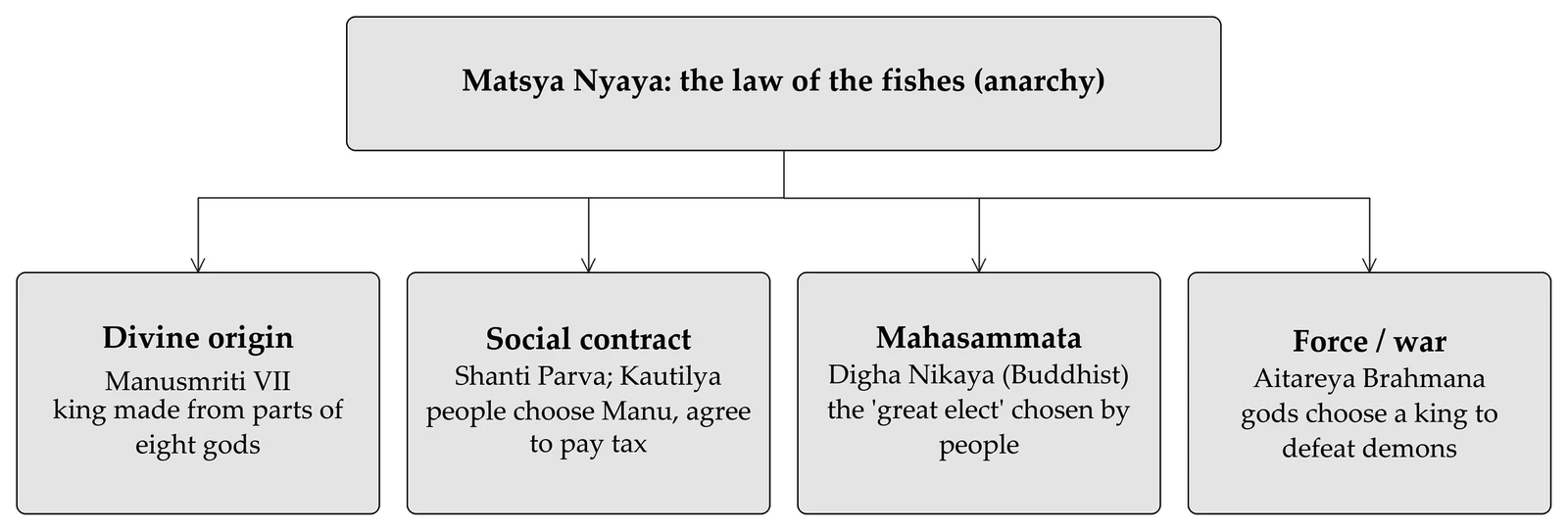
- The divine origin theory. The king is created by God. The Manusmriti (Chapter VII) says that when the world was without a king and people scattered in fear, the Lord created the king for the protection of all, taking eternal particles of eight gods: Indra, Vayu, Yama, Surya, Agni, Varuna, Chandra and Kubera. This theory, written when the Brahmanical order sought to strengthen royal authority, made the king a great deity in human form. Yet it also bound him to protect the people and uphold dharma.
- The social contract (elective) theory. People choose a king by agreement. In the Shanti Parva of the Mahabharata (Chapter 67), Bhishma tells Yudhishthira that people suffering under anarchy went to Brahma, who asked Manu to become king. Manu hesitated, fearing the sins of the people, until they promised to obey him and to pay him one-fiftieth of their cattle and gold and one-tenth of their grain. Kautilya (Arthashastra 1.13) tells a similar story: oppressed by matsya nyaya, the people made Manu Vaivasvata king and allotted him one-sixth of their grain and one-tenth of their merchandise and gold. Here kingship rests on consent and on an exchange of protection for taxes.
- The Mahasammata theory. The Buddhist Digha Nikaya (the Agganna Sutta) describes how, after greed and private property appeared, people assembled and chose the most handsome, gracious and capable among them to punish wrongdoers, paying him a share of their rice. He was called Mahasammata, i.e. ‘the great elect’, chosen by the whole people. This theory reflects the Buddhist rejection of divine kingship and the republican traditions of the sanghas.
- The force or war theory. Kingship arises from the needs of war. The Aitareya Brahmana relates that the gods, defeated by the demons, realised that they lost because they had no king, and so made Soma their king. The story suggests that early kingship grew out of military leadership in conflicts between tribes.
- The organic theory. The state is like a living body whose limbs depend on one another. This idea underlies Kautilya’s Saptanga theory, studied below, and the Shukranitisara compares the king to the head and the other elements to the eyes, ears, mouth, mind and limbs of the body.
Notice how these theories prepare the ground for statecraft. Whether the king is divine or elected, his first duty everywhere is the same: to end matsya nyaya through danda and to protect the people. How he should do this is the subject of Kautilya’s Arthashastra.
1.3 Kautilya’s Arthashastra
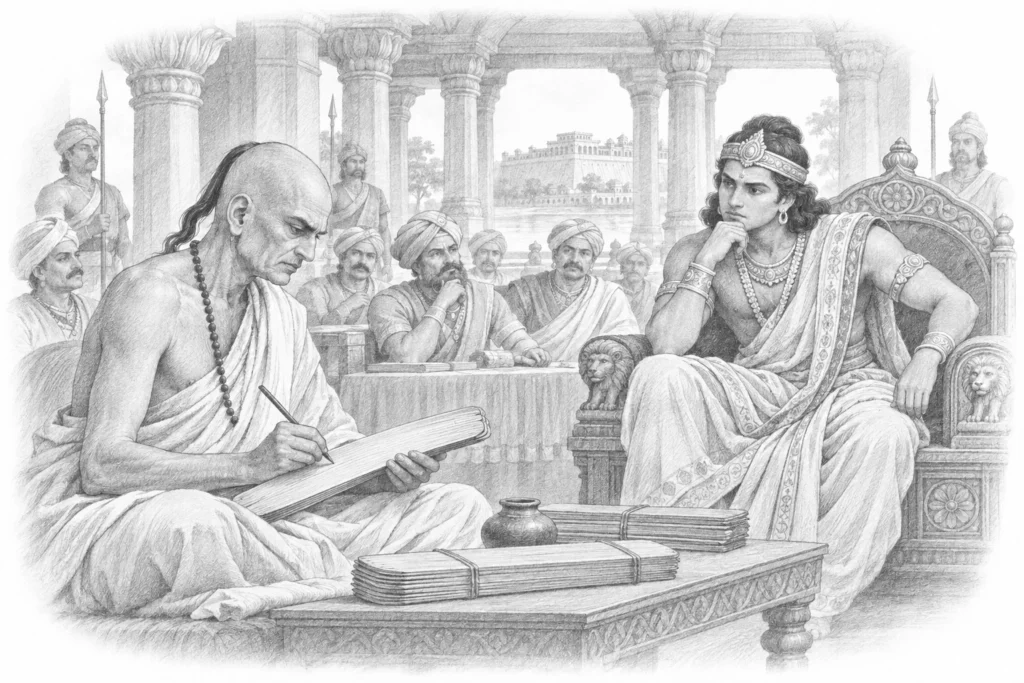
Kautilya, also known as Chanakya or Vishnugupta, is traditionally regarded as the Brahmin minister who helped Chandragupta Maurya overthrow the Nanda dynasty and found the Mauryan empire around 321 BCE. Scholars debate the date of the text: many, such as Thomas Trautmann (1971) and Patrick Olivelle (2013), argue that it was revised and reached its final form in the first centuries CE. Whatever its date, the Arthashastra is the most systematic work of statecraft in ancient India. Its aim is yogakshema [योगक्षेम], i.e. yoga, the acquisition of what one does not have, and kshema, the protection of what one has.
Features of Kautilya’s Statecraft
- Primacy of artha. Material well-being is the foundation of the other goals of life. “Artha alone is supreme,” Kautilya declared, because dharma and kama depend on it.
- Realism. The state must be guided by what actually works in a world of rival kings, not by idealism. This is why Weber, in ‘Politics as a Vocation’ (1919), called the Arthashastra an example of truly radical ‘Machiavellianism’.
- Welfare of the subjects. The king’s happiness lies in the happiness of his subjects (Arthashastra 1.19), so the state must protect the weak, support orphans and the aged, and promote agriculture and trade.
- Centralised bureaucracy. Government works through a large staff of superintendents (adhyakshas) in charge of the treasury, mines, trade, agriculture and other departments.
- Espionage. A vast network of spies (gudhapurushas) in many disguises keeps the king informed about officials, citizens and enemies.
- Rule of law. Justice is administered according to four sources of law: dharma (sacred law), vyavahara (evidence and contracts), charitra (custom) and rajashasana (royal edicts), with royal edicts prevailing in case of conflict.
- Trained kingship. The king must master four sciences: anvikshiki (philosophy and logic), trayi (the three Vedas), varta (economics) and dandaniti (the science of government), and must control his senses.
The Saptanga Theory of the State
Kautilya’s most famous idea is that the state has seven angas, i.e. limbs or elements (Arthashastra Book 6). Together they form an organic whole, so that the weakness of one limb harms the whole state (Figure 1.3).
- Swami (the king). The head of the state. He should be of noble birth, wise, energetic, truthful, self-controlled and devoted to the welfare of his people.
- Amatya (the ministers and officials). The king cannot rule alone; “a single wheel can never move”. Ministers must be tested for loyalty and ability.
- Janapada (territory and population). A good territory is fertile, rich in resources and easy to defend, and its people are loyal and hard-working.
- Durga (the fort). Fortified cities protect the state against attack; Kautilya describes forts in water, on hills, in deserts and in forests.
- Kosha (the treasury). All undertakings depend on finance; the treasury must be filled by just taxation.
- Danda (the army and the power of punishment). A loyal and disciplined army protects the state and enforces the law.
- Mitra (the ally). A reliable ally, preferably hereditary, strengthens the state in war and peace.
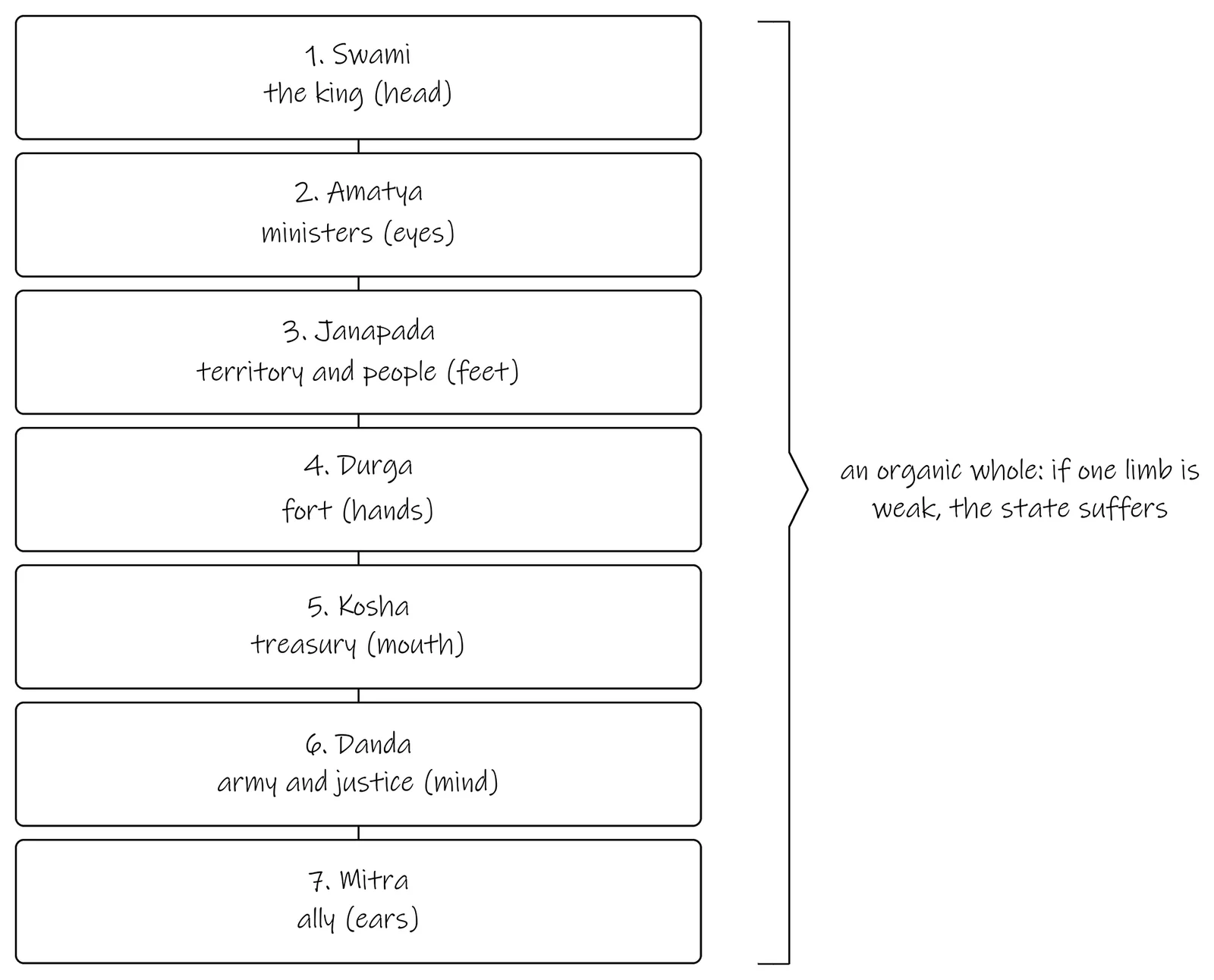
Kautilya listed the elements in order of importance: a calamity affecting an earlier element is more serious than one affecting a later element. The king therefore comes first, but he is only one part of a larger whole that includes officials, people, economy and defence.
The Mandala Theory of Foreign Policy
For foreign policy Kautilya imagined a mandala, i.e. a circle of states, around the king who seeks to conquer, the vijigishu [विजिगीषु]. The basic rule is that a neighbour is a natural enemy and the neighbour’s neighbour a natural friend. In front of the vijigishu lie the enemy (ari), the friend (mitra), the enemy’s friend, the friend’s friend and the enemy’s friend’s friend; behind him lie the rear enemy (parshnigraha) and the rear friend (akranda) with their allies; and beyond them are the middle king (madhyama) and the neutral king (udasina). In all there are twelve kings (Figure 1.4).
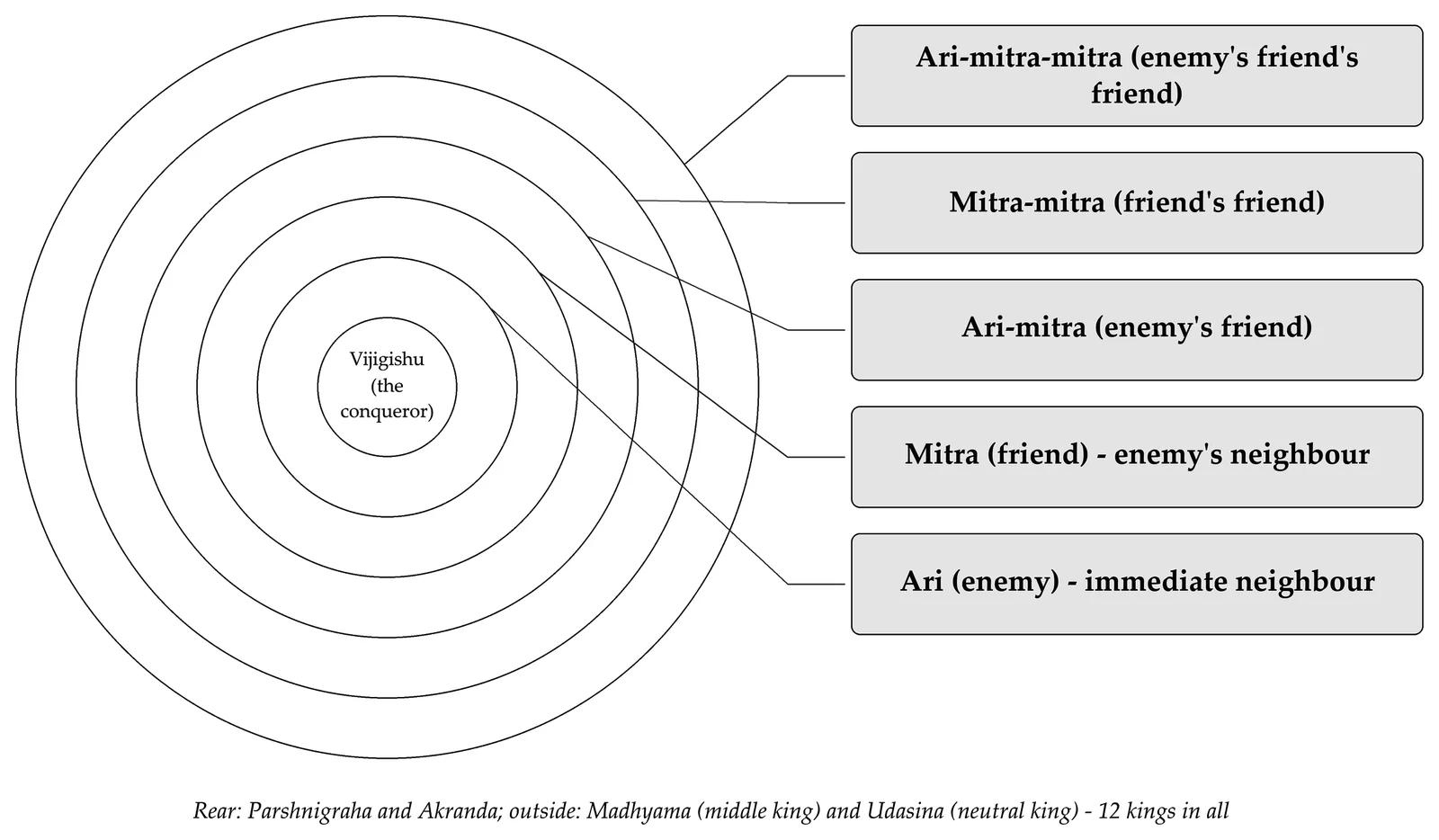
To deal with this circle, Kautilya proposed shadgunya, a six-fold policy: sandhi (peace by treaty), vigraha (war), asana (remaining quiet), yana (marching against the enemy), samshraya (seeking the protection of a stronger king) and dvaidhibhava [द्वैधीभाव] (making peace with one and war with another). The choice depends on whether the state is growing stronger, stagnating or declining. He also listed four upayas, i.e. means of dealing with others: sama (conciliation), dana (gifts), bheda (dividing the enemy) and danda (force), recommending force only when the other means fail.

1.4 Other Traditions of Statecraft
A. The Shanti Parva: Rajadharma
The Shanti Parva, the twelfth book of the Mahabharata, records the teaching of Bhishma, lying on a bed of arrows, to Yudhishthira after the Kurukshetra war. Its section on Rajadharma describes the duties of the king: to protect the people, to uphold dharma, to administer danda with balance, to appoint able ministers and to tax justly. Bhishma declares that all dharmas depend on rajadharma, and compares the good king to a pregnant mother who gives up her own desires for the welfare of the child. The text also allows people to resist a king who fails to protect them: the Anushasana Parva says that such a king should be killed by his subjects like a mad dog.
B. The Manusmriti
The Manusmriti (c. 200 BCE–200 CE) presents the king as a divine creation whose chief duty is to protect the varna order and to administer danda. Danda, says Manu, is the real king: it governs all creatures and protects them, and it is awake when others sleep. But danda must be applied justly; a king who punishes unjustly destroys himself. The king is to rule with the help of seven or eight ministers and to follow the counsel of learned Brahmins.
C. Kamandaka’s Nitisara
Kamandaka’s Nitisara (c. 4th–8th century CE) summarises Kautilya’s statecraft in verse, accepting the Saptanga and Mandala theories but placing greater stress on the moral discipline of the king. It shows how Kautilyan statecraft continued to be studied for centuries. (The Nitisara is examined further in the chapter on Nyaya and Niti.)
1.5 Features of the Ancient Indian State
From these texts we can identify the main features of the ancient Indian state. Each was stressed by particular thinkers in particular contexts:
- Monarchy as the dominant form, with republics alongside. Most texts assume rule by a king, but Buddhist sources and the grammarian Panini describe ganas and sanghas, such as the Licchavis of the Vajji confederacy and the Shakyas, governed by assemblies.
- Kingship limited by dharma. The king was not above the moral law. The Dharmashastras and the Shanti Parva bind him to rajadharma, and ministers, Brahmin counsellors and custom limited his power.
- Protection as the first duty. Every theory of origin presents the king as the protector who ends matsya nyaya.
- Welfare orientation. Kautilya’s yogakshema and Ashoka’s edicts show a state concerned with irrigation, roads, famine relief and the care of the weak.
- Centralised administration. The Mauryan state described in the Arthashastra and by Megasthenes had a large bureaucracy, a standing army and a system of spies.
- Realism in foreign policy. The Mandala and Shadgunya theories treat interstate relations as a struggle for power and security.
- Danda as the basis of order. Punishment, applied justly, keeps every group within its dharma.
Was the ancient Indian state secular or religious? Benoy Kumar Sarkar argued that the Arthashastra tradition was secular and positive, concerned with power and welfare rather than religion. Others point out that the state was expected to protect the varna order and to follow dharma. The most balanced view is that ancient Indian statecraft combined a practical, worldly science of government with a strong ethical framework of dharma.
1.6 Important Questions
- Question 1 Examine the theory of statecraft in ancient India. Discuss Kautilya’s theory of statecraft.
- Question 2 Critically analyse the origin and growth of the institution of ‘Monarchy’ in ancient and medieval India.
- Question 3 Discuss the nature of the state in ancient India.
DU asks the same idea in different words. So learn one broad answer for each question below; the same answer works for every question joined by OR.
Important Question 1
Examine the theory of statecraft in ancient India. Discuss Kautilya’s theory of statecraft.
OR
Explain Kautilya’s Saptanga theory of the state.
OR
Discuss Kautilya’s Mandala theory of foreign policy.
Model Answer
“In the happiness of his subjects lies the happiness of the king; in their welfare, his welfare.”
— Kautilya, Arthashastra 1.19
Introduction. Statecraft is the art and science of governing a state: gaining and keeping power, administering the people, raising revenue, keeping order and dealing with other states. Contrary to the colonial view that ancient Indians had no political theory, ancient India produced a rich tradition of statecraft, known as Dandaniti, Rajadharma or Arthashastra, whose greatest work is Kautilya’s Arthashastra.
1. Sources of Statecraft
The Vedic texts describe tribal kingship and the sabha and samiti; the Dharmashastras, especially the Manusmriti, set out rajadharma; the Shanti Parva of the Mahabharata records Bhishma’s teaching to Yudhishthira; Buddhist texts describe the Mahasammata and the republics; and Kamandaka’s Nitisara summarised Kautilya. Benoy Kumar Sarkar (1921) and Beni Prasad (1928) showed that this tradition was practical and largely secular. The Shantiparva of the Mahabharata, Kamandaka’s Nitisara and the Buddhist Jatakas add to this literature, while inscriptions and the account of Megasthenes show how statecraft worked in practice.
2. Origin of the State
All these texts begin with matsya nyaya, the law of the fishes. The king arose either by divine creation (Manusmriti VII), by agreement of the people (Shanti Parva 67; Arthashastra 1.13), by popular election (the Buddhist Mahasammata) or from the needs of war (Aitareya Brahmana). In every case his first duty is protection. Kautilya combines both ideas: the people chose Manu as king and agreed to pay a sixth of their grain, yet the king also holds the office of Indra and Yama, rewarding and punishing.
3. Kautilya and the Arthashastra
Kautilya, the minister of Chandragupta Maurya, defined Arthashastra as the science of acquiring and protecting the earth. Its aim is yogakshema: acquisition and security. He held that artha is supreme, since dharma and kama depend on it. Rediscovered in 1905 and published by R. Shamasastry in 1909, the text has fifteen books, from the training of the prince to foreign policy and secret warfare.
4. The Saptanga Theory
The state has seven limbs: swami (king), amatya (ministers), janapada (territory and people), durga (fort), kosha (treasury), danda (army and justice) and mitra (ally). They form an organic whole, listed in order of importance, so that the weakness of any limb endangers the state. The elements are ranked, and a calamity to the king is the most serious because he directs all the others.
5. Administration and Law
Kautilya described a centralised bureaucracy of superintendents (adhyakshas), a vast system of spies (gudhapurushas), just taxation and two kinds of courts. Law rests on four sources: dharma, vyavahara, charitra and rajashasana, with the king’s edict prevailing in case of conflict. Law had four sources, dharma, vyavahara, charitra and rajashasana, and in conflict the later prevailed, which gave the king’s edict great weight.
6. Foreign Policy: Mandala, Shadgunya and Upayas
In the Mandala theory, the conqueror (vijigishu) stands at the centre of a circle of twelve kings, in which the neighbour is the natural enemy and the neighbour’s neighbour the natural friend. Shadgunya, the six-fold policy of sandhi, vigraha, asana, yana, samshraya and dvaidhibhava, guides relations with them, and the four upayas of sama, dana, bheda and danda are the means, force being the last resort. The choice among the six policies depended on relative strength: peace when weaker, war when stronger, neutrality when equal.
7. The Welfare Dimension
Kautilya’s realism is joined to welfare: the king must support the helpless, promote agriculture and trade and find his happiness in the happiness of his subjects. He must master the four sciences and control his senses, since an undisciplined king destroys himself. In the happiness of his subjects lies the king’s happiness, Kautilya wrote, and in their welfare his welfare.
8. Evaluation
Max Weber called the Arthashastra more radical than Machiavelli’s The Prince, and Kautilya is often compared with Machiavelli for his realism, espionage and use of deceit in foreign affairs. But unlike Machiavelli, Kautilya placed the king within a framework of dharma and public welfare. Critics note his acceptance of the varna order and of harsh methods, while others value him as one of the world’s earliest theorists of the state and of international relations.
Conclusion. Thus, ancient Indian statecraft, and Kautilya above all, combined a hard-headed science of power with a concern for welfare and dharma. It shows that the Indian tradition was not other-worldly but deeply political.
Important Question 2
Critically analyse the origin and growth of the institution of ‘Monarchy’ in ancient and medieval India.
OR
Discuss the theories of kingship in ancient India.
OR
Was kingship in ancient India absolute or limited? Discuss.
Model Answer
“Danda alone governs all created beings, danda alone protects them, danda watches over them while they sleep.”
— Manusmriti VII.18
Introduction. Monarchy was the most common form of government in ancient and medieval India. Over nearly three thousand years it grew from the elected chief of a Vedic tribe into the divinely sanctioned emperors of the Mauryas, Guptas, Sultans and Mughals, while remaining bound in theory by dharma or religious law.
1. Theories of Origin
Ancient texts explain the rise of monarchy from the anarchy of matsya nyaya. The Manusmriti gives a divine theory, the Shanti Parva and Kautilya a contract theory, the Buddhist Agganna Sutta the election of the Mahasammata, and the Aitareya Brahmana a theory of war leadership. The Shantiparva gives both divine and contractual accounts, the Aggañña Sutta describes the election of Mahasammata, and Kautilya tells of people choosing Manu as king in return for a share of their produce. These theories served to justify kingship and its claim to taxes.
2. Vedic Monarchy
In the early Vedic period the rajan was a tribal chief, a leader in war and protector of cattle, often chosen or approved by the people; hymns of the Atharvaveda pray that ‘all the people may want’ the king. The sabha and samiti limited his power. In the later Vedic period kingship became hereditary and was strengthened by grand rituals such as the rajasuya, vajapeya and ashvamedha. The sabha and samiti limited the early rajan, while sacrifices such as the Rajasuya and Vajapeya gradually raised his status. The Aitareya Brahmana tells that the gods chose Indra as their king because they were losing to the demons, an early suggestion that kingship arose from the need for leadership in war.
3. Monarchy in the Age of Empires
With the Mauryas, monarchy became a centralised imperial institution with a bureaucracy, army and spies, as described in the Arthashastra. Ashoka presented himself as a father to his people: “All men are my children.” Later dynasties enlarged the king’s divine status; the Kushanas took the title devaputra (son of god) and the Guptas called themselves maharajadhiraja (great king of kings). Ashoka’s edicts show a monarch who called his subjects his children and governed through officers of dhamma, while the Guptas adopted grand titles such as maharajadhiraja.
4. Limits on Ancient Monarchy
Ancient monarchy was not unlimited. The king was bound by dharma and custom, advised by ministers (mantriparishad) and Brahmin counsellors, and expected to follow rajadharma. The Shanti Parva and Anushasana Parva even allow the people to remove a king who fails to protect them. Republics (ganas) such as the Licchavis and Shakyas also show that monarchy was not the only form of government. The Mahabharata even says that a king who fails to protect his people may be killed by them like a mad dog.
5. Regional Monarchies and Feudalisation
After the Guptas, power fragmented among regional kingdoms such as the Pratiharas, Palas, Rashtrakutas and Cholas. Land grants to Brahmins and officials created what R.S. Sharma called Indian feudalism, in which the king shared power with landed intermediaries.
6. The Chola Model
The Cholas combined strong monarchy with lively local self-government: tenth-century inscriptions at Uttaramerur describe village assemblies selecting committee members by lot.
7. Monarchy in the Delhi Sultanate
Under the Sultanate, kingship rested on Islamic theory. Balban (1266–1287) called the Sultan niyabat-i-khudai, the deputy of God, and zil-i-ilahi, the shadow of God, and introduced elaborate court ceremonies. Ziauddin Barani, in Fatawa-i-Jahandari, described the ideal Sultan: he should follow the sharia, but could frame zawabit, i.e. state laws, where the sharia was silent. The Sultan’s sovereignty was temporal, and the ulema claimed authority in religious matters. Iltutmish obtained an investiture from the Abbasid Caliph in 1229 to strengthen his legitimacy, and Alauddin Khalji, according to Barani, declared that he made laws according to the needs of the state rather than the views of the ulema.
8. Rajput and Vijayanagara Kingship
Rajput kingdoms rested on clan loyalty, while the Vijayanagara empire used the nayaka system, granting military chiefs land in return for service, and presented its kings as defenders of dharma.
9. Mughal Monarchy
Under Akbar, Abul Fazl in the Ain-i-Akbari and Akbarnama presented the emperor as farr-i-izadi, i.e. divine light received directly from God, which raised him above the ulema. Akbar’s policy of sulh-i-kul, i.e. peace with all, and the mahzar of 1579, which made him the final authority in religious disputes, gave Mughal kingship a universal and tolerant character. Rituals such as the jharokha darshan and the mansabdari system bound subjects and nobles to the emperor’s person. Aurangzeb’s reign marked a return to a more orthodox Islamic idea of kingship.
10. Kingship and Legitimacy
Across these periods legitimacy rested on three supports: religion (divine origin or sanction), performance (protection, justice and prosperity) and acceptance by nobles and subjects. When these failed, rebellions and changes of dynasty followed.
11. Evaluation
Monarchy in India grew steadily more centralised and more sacred, from tribal chieftainship to divine emperorship. Yet in both periods the king was expected to rule justly and to protect his subjects, and religious law, counsellors and custom set limits on his power. The idea of ‘oriental despotism’ therefore exaggerates the absolutism of Indian kingship. Yet throughout, kingship was justified by protection and justice, and rulers who failed in these could lose legitimacy and face rebellion.
Conclusion. Thus, Indian monarchy combined claims of divine sanction with an ideal of protective and welfare-oriented rule. Its long history shows both the concentration of power and the persistent belief that power must serve dharma and the people.
Important Question 3
Discuss the nature of the state in ancient India.
OR
Was the ancient Indian state a welfare state?
OR
Explain the main features of the ancient Indian theory of the state.
Model Answer
“The king is the maker of the age.”
— Mahabharata, Shanti Parva (raja kalasya karanam)
Introduction. The ancient Indian state has been described in very different ways: as an oriental despotism by some European writers, as a secular and positive state by Benoy Kumar Sarkar, and as a dharma-bound and welfare-oriented polity by most modern historians. A careful study of the texts shows a complex picture.
1. Monarchy and Republics
Monarchy was the dominant form, but republics (ganas and sanghas) such as the Licchavis and Shakyas were governed by assemblies, as Buddhist texts and Panini describe. Greek writers such as Arrian also mention self-governing communities in north-western India.
2. Dharma-bound Authority
The king was the protector of dharma, not its author. The Dharmashastras and the Shanti Parva bound him to rajadharma, and custom and counsel restrained him. The king was thus the guardian of a moral and social order that existed before him, unlike the modern sovereign who makes law.
3. Protection and Danda
Every theory of origin presents the king as the protector who ends matsya nyaya. Danda, applied justly, was the instrument of order. Taxes were justified as the king’s wage for protection, as both the Shantiparva and Kautilya say.
4. The Welfare State
Kautilya’s aim of yogakshema made the state responsible for agriculture, irrigation, trade, famine relief and the care of orphans, widows and the aged. Ashoka’s edicts record wells, rest-houses, shade trees and medical care for humans and animals. In this sense the ancient Indian state was a welfare state, though welfare was understood within the hierarchical varna order. Ashoka’s edicts record medical care for humans and animals, wells and shade trees along roads, showing welfare in practice.
5. Centralised Administration
The Mauryan state had a large bureaucracy of superintendents, a standing army, a system of revenue and a network of spies, which shows a highly developed administration. Romila Thapar, however, argues that the Mauryan empire was less centralised in practice: a metropolitan core was ruled directly, while peripheral regions were governed through local elites.
6. Secular or Religious
Sarkar emphasised the secular, power-centred character of the Arthashastra, while other scholars stress the religious foundation of kingship and the duty to protect the varna order. The state was neither a theocracy nor fully secular; it combined practical statecraft with a moral order of dharma. The truth lies between: the state served dharma but also pursued power and wealth through rational means.
7. Realism in Foreign Relations
The Mandala and Shadgunya theories show a realistic understanding of interstate politics as a balance of power. The ideal of the vijigishu, the would-be conqueror, made expansion a normal aim of the state.
8. The Oriental Despotism Debate
Colonial writers such as James Mill, and later Karl Wittfogel, described Asian states as ‘oriental despotisms’ with no limits on rulers. Indian historians such as K.P. Jayaswal, in Hindu Polity (1924), replied by stressing assemblies, republics and dharma; modern scholars reject both exaggerations.
9. Layers of Authority
Villages, guilds (shrenis) and caste councils governed much of everyday life, settling disputes and collecting dues, so the state was layered rather than monolithic.
10. Evaluation
The ancient Indian state was neither the arbitrary despotism imagined by colonial writers nor a modern democracy. Its welfare was shaped by the varna hierarchy, which excluded and subordinated many. Yet its ideals of protection, welfare and rule bound by law show a mature political tradition. It was a moral, protective and welfare-oriented monarchy with considerable centralisation, limited more by custom and dharma than by popular institutions.
11. The Theories of Origin as Evidence
The theories of the origin of the state reveal its nature. The contract theory of the Shanti Parva and Kautilya shows that kingship rested on an exchange of protection for taxes, so the king was bound to serve the people; the Mahasammata theory of the Buddhists shows a belief in kingship by popular choice; and even the divine theory of Manu binds the king to dharma. None of them presents the king as an owner of the state with unlimited rights.
12. Comparison with the Western State
Unlike the modern Western state, the ancient Indian state did not claim to make all law: much law came from dharma, custom and the rules of guilds, castes and villages, which the king enforced rather than created. Society was organised largely through these self-governing groups, so the state was strong at the centre but left wide autonomy to local bodies. This is why some scholars describe it as a ‘segmentary’ rather than a fully centralised state, though the Mauryan empire was a notable exception. Nor did it develop the idea of a territorial nation-state with fixed borders; the chakravartin ideal imagined overlordship rather than direct rule.
Conclusion. Thus, the ancient Indian state was a protective, welfare-oriented and dharma-bound monarchy, supported by a strong administration and a realist foreign policy. It challenges the old belief that India had no tradition of political thought.
Short Notes
(a) Saptanga theory
Kautilya’s theory, in Book 6 of the Arthashastra, that the state has seven limbs or elements: the swamin (king), amatya (ministers), janapada (territory and people), durga (fort), kosha (treasury), danda (army and coercive power) and mitra (ally). Like the organs of a body, the elements are interdependent, and the weakness of one affects the whole. The theory is an early organic conception of the state.
(b) Mandala theory
Kautilya’s theory of inter-state relations, which places the ambitious king, the vijigishu, at the centre of a circle of states. His immediate neighbour is a natural enemy (ari), the state beyond is a natural friend (mitra), and the circle includes a middle king (madhyama) and a neutral king (udasina). Foreign policy must be guided by this geometry of power through six measures of policy.
More notes: DSC-2 Ideas and Institutions in Indian Political Thought
These notes are prepared by PADHO TO AISE for study help. They are not an official University of Delhi publication.