
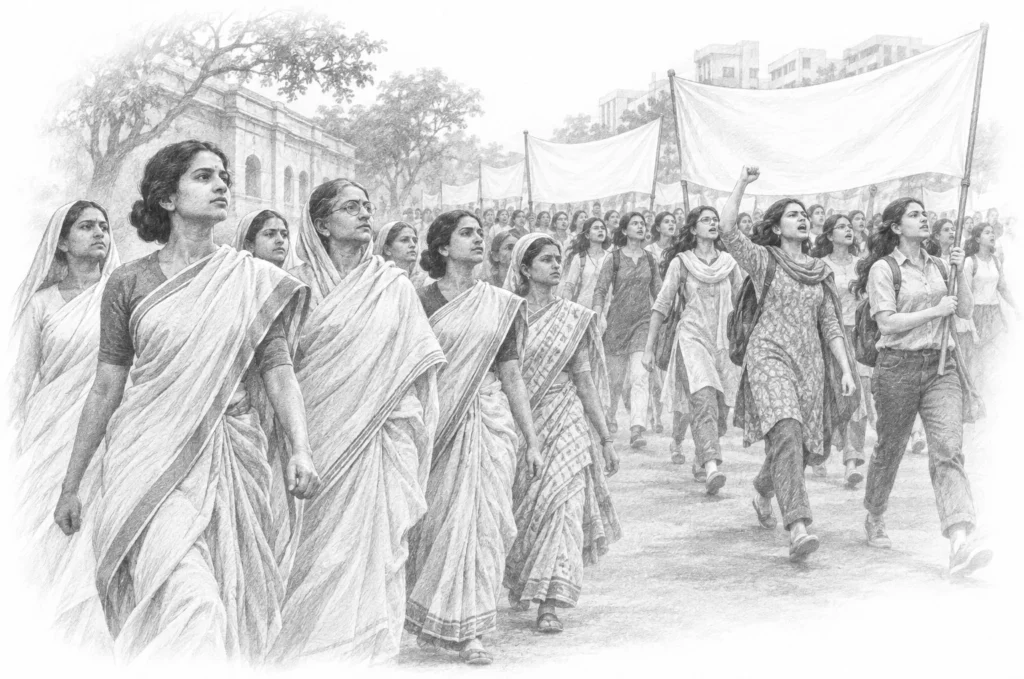
Semester VII DSE-8 Feminism: Theory and Practice
Unit III · 19 min read · Updated 24 Nov 2026
As per the University of Delhi (DU) BA (Hons) Political Science syllabus
Contents
- 3.1 Social Reform and Women’s Struggle
- 3.2 Women and the National Movement
- 3.3 The Contemporary Women’s Movement
- 3.4 Important Questions
- Discuss the role of social reform movements in addressing the women’s question in colonial India.
- Examine the relationship between nationalism and the women’s question in India.
- Discuss the issues taken up by the contemporary women’s movement in India since the 1970s.
- Discuss the debates within the contemporary women’s movement in India.
- Short Notes
इस अनुच्छेद की कोई बात राज्य को स्त्रियों और बालकों के लिए कोई विशेष उपबंध करने से निवारित नहीं करेगी।
Nothing in this article shall prevent the State from making any special provision for women and children.
— Constitution of India, Article 15(3)
THE women’s movement in India has a long history. In the nineteenth century, social reformers campaigned against sati and child marriage and for widow remarriage and education. In the early twentieth century, women formed their own organisations and joined the national movement in large numbers. After a lull following Independence, a new autonomous women’s movement emerged in the 1970s, campaigning against rape, dowry and violence and for equality in law, work and politics. This chapter traces this history and its debates, drawing on Mrinalini Sinha, Partha Chatterjee, Nandita Gandhi and Nandita Shah, and Maitrayee Chaudhuri.

3.1 Social Reform and Women’s Struggle
In the nineteenth century, the women’s question became central to debates about Indian society. Colonial writers judged Indian civilisation by the status of its women, and reformers such as Raja Ram Mohan Roy and Ishwar Chandra Vidyasagar campaigned against sati and for widow remarriage. Anti-caste reformers such as the Phules and women writers such as Tarabai Shinde and Pandita Ramabai went further, criticising patriarchy itself. By the early twentieth century, women formed their own organisations, such as the Women’s Indian Association (1917) and the All India Women’s Conference (1927).
3.2 Women and the National Movement
Partha Chatterjee argues that nationalism resolved the women’s question by dividing life into an outer, material world, where the West was superior, and an inner, spiritual home, where Indian culture had to be preserved by women. Mrinalini Sinha shows how the controversy over Katherine Mayo’s Mother India (1927) turned women into political subjects. Under Gandhi, women joined the freedom struggle in large numbers, and fifteen women sat in the Constituent Assembly.

3.3 The Contemporary Women’s Movement
The report Towards Equality (1974) revealed the poor status of women and sparked a new autonomous women’s movement. From the late 1970s, it campaigned against custodial rape, dowry deaths and domestic violence, and for equality in work, health and politics. Nandita Gandhi and Nandita Shah document its issues and debates, including its relationship with the state, political parties, religion and caste. Recent decades have seen new forms of activism, from protests after the Delhi gang rape of 2012 to #MeToo.

3.4 Important Questions
- Question 1 Discuss the role of social reform movements in addressing the women’s question in colonial India.
- Question 2 Examine the relationship between nationalism and the women’s question in India.
- Question 3 Discuss the issues taken up by the contemporary women’s movement in India since the 1970s.
- Question 4 Discuss the debates within the contemporary women’s movement in India.
DU asks the same idea in different words. So learn one broad answer for each question below; the same answer works for every question joined by OR.
Important Question 1
Discuss the role of social reform movements in addressing the women’s question in colonial India.
OR
Examine the history of women’s struggle in nineteenth and early twentieth-century India.
OR
‘In the reform movement, women were objects rather than subjects.’ Discuss.
Model Answer
“The practice of suttee, or of burning or burying alive the widows of Hindoos, is hereby declared illegal, and punishable by the criminal courts.”
— Bengal Sati Regulation XVII (1829)
Introduction. In nineteenth-century India, the condition of women became a central issue in debates about society, religion and colonialism. Social reformers campaigned against sati, child marriage and the treatment of widows, and for women’s education. These movements were mostly led by men, but they opened the way for women themselves to speak and organise in the early twentieth century.
1. The Women’s Question
Colonial writers such as James Mill, in his History of British India (1817), used the status of women to portray Indian civilisation as backward and to justify British rule. Indian reformers responded by seeking to improve women’s condition while defending Indian culture.
2. Ram Mohan Roy and Sati
Raja Ram Mohan Roy campaigned against sati, the burning of widows, arguing that it was not required by the scriptures. Governor-General William Bentinck banned it in Bengal in 1829. Roy also argued for women’s property rights.
3. Vidyasagar and Widow Remarriage
Ishwar Chandra Vidyasagar campaigned for the remarriage of Hindu widows, using scriptural arguments, which led to the Hindu Widows’ Remarriage Act of 1856. He also promoted girls’ education in Bengal.
4. Female Education
Girls’ schools were opened by missionaries and reformers, including the Phules’ school in Pune (1848) and the Bethune School in Calcutta (1849). Education allowed women to read, write and eventually speak for themselves.
5. Child Marriage and the Age of Consent
The Rukhmabai case of the 1880s, in which a young woman refused to live with the husband she had been married to as a child, and the death of the child bride Phulmoni in 1890, led to the Age of Consent Act of 1891, which Tilak and others opposed.
6. Reform Organisations
Organisations such as the Brahmo Samaj, the Prarthana Samaj and the Arya Samaj supported women’s education and opposed child marriage. Reformers such as Behramji Malabari campaigned for legal changes.
7. Women Reformers
Women increasingly spoke for themselves. Tarabai Shinde’s Stri Purush Tulana (1882) criticised male hypocrisy, Pandita Ramabai worked for widows, Rukhmabai became a doctor, and Anandibai Joshi became one of the first Indian women to qualify in Western medicine in 1886.
8. Women as Objects of Debate
The historian Lata Mani argued that in the debate on sati, women were neither subjects nor objects but the ground on which colonial officials and Indian men debated tradition. Women’s own voices were largely absent.
9. Sinha: Refashioning Mother India
Mrinalini Sinha shows that the controversy over Katherine Mayo’s Mother India (1927), which blamed India’s problems on its treatment of women, led Indian women’s organisations to campaign for the Child Marriage Restraint Act of 1929, making women political actors in their own right.
10. Women’s Organisations
Women founded the Women’s Indian Association in 1917, the National Council of Women in India in 1925 and the All India Women’s Conference in 1927. These organisations campaigned for education, legal reform and the vote.
11. The Demand for the Vote
In 1917, a women’s deputation led by Sarojini Naidu demanded the vote. Limited franchise was granted in provinces in the 1920s and extended by the Government of India Act of 1935, before the Constitution granted universal adult franchise in 1950.
12. Limitations
Reform movements were led mainly by upper-caste men, focused on upper-caste women and sought to reform rather than overturn patriarchy. Lower-caste and poor women’s concerns were often neglected.
13. Legacy
The reform movements put women’s issues on the public agenda, created the first legal reforms and opened education to women, laying the foundation for women’s own organisations and later movements.
14. Evaluation
Social reform began the struggle for women’s rights in India, though women were at first objects of reform. By the early twentieth century, they had become agents of change.
Conclusion. Thus, nineteenth-century social reform movements, led by figures such as Ram Mohan Roy, Vidyasagar and the Phules, campaigned against sati and child marriage and for education and widow remarriage. Though women were initially the objects of debate, as Lata Mani shows, by the 1920s women’s organisations had made them subjects of their own struggle, as Mrinalini Sinha shows.
Important Question 2
Examine the relationship between nationalism and the women’s question in India.
OR
Discuss Partha Chatterjee’s argument about the nationalist resolution of the women’s question.
OR
Discuss the participation of women in the Indian national movement.
Model Answer
“To call woman the weaker sex is a libel; it is man’s injustice to woman.”
— M.K. Gandhi, Young India (10 April 1930)
Introduction. The rise of nationalism transformed the women’s question in India. Nationalists sought to defend Indian culture against colonial criticism while also modernising society. Partha Chatterjee argues that nationalism resolved this tension by assigning women the role of guardians of a spiritual inner domain. At the same time, women participated in the freedom struggle in large numbers, and Maitrayee Chaudhuri shows how gender shaped the making of the nation-state.
1. Reform and Nationalism
By the late nineteenth century, many nationalists opposed colonial interference in social matters, arguing that reform should come from Indians themselves. Tilak opposed the Age of Consent Act of 1891 for this reason, showing tension between nationalism and reform.
2. Chatterjee: Two Domains
Partha Chatterjee argues that nationalism divided culture into two domains: the outer, material world of science, economy and statecraft, where the West was superior and must be imitated, and the inner, spiritual domain of the home, where Indian identity must be preserved.
3. Woman as Guardian of the Home
In this scheme, the home was the space of Indian spirituality, and women were its guardians. Women could be educated and modern, but they must remain modest, spiritual and different from both Western women and lower-class women.
4. The Disappearance of the Women’s Question
Chatterjee argues that this resolution explains why the women’s question disappeared from public debate by the end of the nineteenth century. It was not solved but moved into the inner domain, where nationalism refused to allow colonial intervention.
5. Sinha on Mother India
Mrinalini Sinha shows that the controversy over Katherine Mayo’s Mother India in 1927 brought the women’s question back. Indian women’s organisations responded by demanding reform, presenting themselves as citizens and linking women’s rights to national self-respect.
6. Gandhi and Women
Gandhi brought women into mass politics on an unprecedented scale. In the Salt Satyagraha of 1930, women made salt, picketed liquor and foreign cloth shops and courted arrest. He valued qualities he associated with women, such as non-violence and self-sacrifice, as sources of strength.
7. Women Leaders
Sarojini Naidu became president of the Congress in 1925. Kamaladevi Chattopadhyay, Aruna Asaf Ali, who hoisted the flag in Bombay in 1942, and Usha Mehta, who ran a secret radio during the Quit India movement, were prominent leaders.
8. Revolutionary Women
Women also joined revolutionary movements. Pritilata Waddedar led an attack on a European club in Chittagong in 1932, Bina Das fired at the Governor of Bengal the same year, and Lakshmi Sahgal commanded the Rani of Jhansi Regiment of the Indian National Army.
9. Chaudhuri: Gender and the Nation-State
Maitrayee Chaudhuri shows how gender was built into the making of the Indian nation-state. Women were represented as symbols of the nation, such as Bharat Mata, and as mothers of the nation, while their claims as equal citizens were debated.
10. Women in the Constituent Assembly
Fifteen women were members of the Constituent Assembly, including Hansa Mehta, Durgabai Deshmukh and Rajkumari Amrit Kaur. Hansa Mehta also helped change the Universal Declaration of Human Rights to say ‘all human beings’ rather than ‘all men’.
11. The Hindu Code Bill
Ambedkar’s Hindu Code Bill, giving women rights in marriage, divorce and inheritance, faced strong opposition and was passed only in parts in 1955–56. The debate showed the limits of nationalist commitment to gender equality.
12. Limits of Nationalist Feminism
Nationalism mobilised women but often subordinated their issues to the cause of independence. Women’s participation was valued as service to the nation rather than as a claim to equality.
13. Legacy
The national movement gave women political experience, leadership and the vote, and its constitutional legacy of equality became the basis for later feminist struggles.
14. Evaluation
Nationalism both empowered and constrained women. As Chatterjee shows, it confined them to the inner domain even as it drew them into public politics.
Conclusion. Thus, nationalism resolved the women’s question, according to Partha Chatterjee, by making women guardians of a spiritual inner domain. Yet, as Sinha and Chaudhuri show, women became political subjects through organisations and mass participation under Gandhi, winning equal citizenship in the Constitution, though their issues were often subordinated to the nation.
Important Question 3
Discuss the issues taken up by the contemporary women’s movement in India since the 1970s.
OR
Examine Nandita Gandhi and Nandita Shah’s analysis of the issues at stake in the women’s movement.
OR
Discuss the major campaigns of the women’s movement in India.
Model Answer
“Gender equality includes protection from sexual harassment and right to work with dignity, which is a universally recognised basic human right.”
— Supreme Court of India, Vishaka v State of Rajasthan (1997)
Introduction. After a lull following Independence, a new women’s movement emerged in India in the 1970s. Autonomous women’s groups, independent of political parties, campaigned against violence and discrimination and for legal reform. Nandita Gandhi and Nandita Shah, in The Issues at Stake (1991), documented the theory and practice of this movement, which continues to shape Indian politics and law.
1. Towards Equality
The report of the Committee on the Status of Women in India, Towards Equality (1974), showed a declining sex ratio, high maternal mortality, low literacy and low political participation of women. It shattered the belief that independence had brought equality.
2. Autonomous Groups
From the mid-1970s, autonomous women’s groups such as the Progressive Organisation of Women in Hyderabad, Saheli in Delhi and Stree Mukti Sanghatana in Bombay emerged. Magazines such as Manushi, founded in 1978, spread feminist ideas.
3. Gandhi and Shah: The Issues at Stake
Nandita Gandhi and Nandita Shah document the movement’s campaigns on violence, work, health, law, media and the environment, and its debates about organisation, strategy and its relationship with the state, parties and other movements.
4. The Campaign against Rape
In 1979, the Supreme Court acquitted policemen accused of raping Mathura, a young tribal woman. An open letter by four law teachers sparked a national campaign, leading to the Criminal Law Amendment of 1983 on custodial rape and the burden of proof.
5. Dowry
Women’s groups protested dowry deaths, in which young brides were killed or driven to suicide. Campaigns led to amendments to the Dowry Prohibition Act and the creation of the offence of cruelty by husbands and relatives in 1983.
6. Domestic Violence
After long campaigns, the Protection of Women from Domestic Violence Act of 2005 provided civil remedies, protection orders and the right to reside in the shared household.
7. Sexual Harassment at Work
The gang rape of Bhanwari Devi, a government worker in Rajasthan, led women’s groups to petition the Supreme Court, which issued the Vishaka guidelines in 1997. These became the Sexual Harassment of Women at Workplace Act of 2013.
8. Personal Law
The Shah Bano case of 1985 and the Muslim Women Act of 1986 raised the question of personal law and a uniform civil code. The movement struggled to support Muslim women without strengthening communal politics.
9. Sati and Religion
The sati of Roop Kanwar in Deorala, Rajasthan, in 1987 led to protests and the Commission of Sati (Prevention) Act of 1987, highlighting the use of religion to justify violence against women.
10. Health and Reproduction
Feminists criticised coercive population control, especially forced sterilisation during the Emergency, and campaigned against sex-selective abortion, which led to the Pre-Natal Diagnostic Techniques Act of 1994.
11. Political Representation
The movement campaigned for women’s representation, achieving one-third reservation in local bodies through the 73rd and 74th Amendments of 1992 and, after decades, the Women’s Reservation Act of 2023 for Parliament and assemblies.
12. Nirbhaya and After
The Delhi gang rape of December 2012 led to mass protests, the Justice Verma Committee and the Criminal Law Amendment Act of 2013. The #MeToo campaign of 2018 exposed harassment in workplaces.
13. Land and Livelihood
Rural women’s struggles linked gender with land and livelihood. In the Bodhgaya land movement in Bihar from 1978, landless labourers fought a powerful monastery for land, and women insisted that titles be given in their own names, winning some of the first land titles for women in such a struggle. Such campaigns showed that economic independence is central to women’s freedom.
14. Achievements
The movement transformed laws on rape, dowry, domestic violence and harassment, made violence against women a public issue and increased women’s political representation.
15. Evaluation
The contemporary women’s movement has been one of India’s most influential social movements, though implementation of laws and social change lag behind legal reform.
Conclusion. Thus, the contemporary women’s movement, sparked by Towards Equality in 1974, campaigned against rape, dowry, domestic violence and harassment, and for reproductive rights and representation. As Gandhi and Shah show, its campaigns transformed Indian law and public debate, though the struggle for real equality continues.
Important Question 4
Discuss the debates within the contemporary women’s movement in India.
OR
Examine the relationship between the women’s movement and the state in India.
OR
How have caste and religion challenged the Indian women’s movement?
Model Answer
“A common civil code will help the cause of national integration by removing disparate loyalties to laws which have conflicting ideologies.”
— Supreme Court of India, Mohd. Ahmed Khan v Shah Bano Begum (1985)
Introduction. The Indian women’s movement is not a single organisation but a diverse field of groups, parties and individuals. It has been marked by vigorous debates about autonomy, the state, religion, caste, class and sexuality. These debates, documented by Nandita Gandhi and Nandita Shah and others, have shaped the movement’s strategies and made it more inclusive over time.
1. A Plural Movement
The movement includes autonomous groups, women’s wings of political parties, trade unions, non-governmental organisations, Dalit and Muslim women’s organisations and individual activists, each with different priorities and methods.
2. Autonomy or Affiliation
Autonomous groups insisted on independence from political parties, which they saw as patriarchal. Party-affiliated organisations, such as the National Federation of Indian Women (1954) and the All India Democratic Women’s Association (1981), argued that linking women’s issues to broader politics was essential.
3. The State
Feminists debated whether the state is an ally or an oppressor. They demanded new laws and institutions, yet the state’s police and courts were also sources of violence and bias, as custodial rape cases showed. Relying on law alone proved insufficient.
4. The Uniform Civil Code
After the Shah Bano case, feminists debated whether to demand a uniform civil code. Many feared that the demand had been taken over by Hindu nationalists to target Muslims, and some proposed gender-just reform of each personal law instead.
5. Communalism
The rise of communal politics, including the participation of women in Hindu nationalist movements and sexual violence in riots such as Gujarat in 2002, challenged the idea that women naturally unite across religious lines.
6. Caste
Dalit women argued that the mainstream movement, led largely by upper-caste women, ignored caste violence and the specific oppression of Dalit women. Cases such as Bhanwari Devi and the Khairlanji massacre of 2006 highlighted caste and gender together.
7. Class
Socialist feminists and women in trade unions argued that the movement should focus more on poor and rural women’s issues of work, wages, land and food, not only on violence and law.
8. Sexuality
Lesbian and queer activists challenged the movement to address sexuality and heteronormativity. Some groups hesitated at first, but many later supported the campaign against Section 377.
9. NGO-isation
From the 1990s, many groups became funded non-governmental organisations. Critics argue that this professionalised the movement, made it dependent on donors and turned political struggles into projects.
10. Women’s Reservation
The demand for one-third reservation for women in legislatures led to the debate on a quota within the quota for backward-class and minority women, which delayed the bill for many years before it was passed in 2023.
11. A New Generation
Young women have created new forms of activism, such as Pinjra Tod, which challenged hostel curfews for women students from 2015, the #MeToo campaign of 2018 and the leadership of women in the Shaheen Bagh protest of 2019–20.
12. Women in Conflict Zones
Women in Kashmir and the North-East raised issues of militarisation and state violence. In 2004, after the killing of Thangjam Manorama in custody, a group of women in Manipur protested naked outside an army headquarters, and Irom Sharmila fasted for sixteen years, from 2000 to 2016, against the Armed Forces (Special Powers) Act. These struggles challenged the movement to confront the security state.
13. Women and Ecology
Women’s participation in the Chipko movement and in struggles against displacement, such as the Narmada Bachao Andolan, raised the question of how development affects women who depend on forests, water and land. Ecofeminists argued that women’s knowledge of nature should guide development, while critics warned against assuming that women are naturally closer to nature.
14. Gains from Debate
These debates made the movement more aware of difference and more inclusive, leading to alliances with Dalit, Muslim, Adivasi and queer movements.
15. Continuing Challenges
The movement faces backlash, the persistence of violence, the gap between law and practice and the difficulty of reaching women in rural areas and the informal economy.
16. Evaluation
Debates within the women’s movement reflect India’s diversity. They have made Indian feminism more plural and self-critical.
Conclusion. Thus, the Indian women’s movement has debated autonomy versus party affiliation, the role of the state, the uniform civil code, communalism, caste, class, sexuality and NGO-isation. These debates, documented by Gandhi and Shah, have made the movement more plural and inclusive, though major challenges remain.
Short Notes
(a) Towards Equality
The 1974 report of the Committee on the Status of Women in India, which showed declining sex ratios and women’s poor health, education and political participation, and became the catalyst for the contemporary women’s movement.
(b) Mathura case
A case in which the Supreme Court in 1979 acquitted policemen accused of raping a young tribal woman in custody. Protests against the judgment launched a national campaign that led to the Criminal Law Amendment of 1983.
(c) Inner and outer domains
Partha Chatterjee’s idea that nationalism divided culture into an outer material domain, where the West was imitated, and an inner spiritual domain of the home, where women preserved Indian identity.
More notes: DSE-8 Feminism: Theory and Practice
These notes are prepared by PADHO TO AISE for study help. They are not an official University of Delhi publication.