
Semester VII DSE-8 Feminism: Theory and Practice
Unit II · 21 min read · Updated 24 Nov 2026
As per the University of Delhi (DU) BA (Hons) Political Science syllabus
Contents
- 2.1 Waves and Strands of Feminism
- 2.2 Liberal and Socialist Feminism
- 2.3 Radical, Postmodern and Postcolonial Feminism
- 2.4 Indian Perspectives on Feminism
- 2.5 Important Questions
- Discuss the main ideas of liberal feminism.
- Discuss socialist and Marxist perspectives on feminism.
- Discuss the main ideas of radical feminism.
- Discuss postmodern and postcolonial perspectives on feminism.
- Discuss Indian perspectives on feminism.
- Short Notes
मैं नहीं चाहती कि स्त्रियों का पुरुषों पर अधिकार हो, बल्कि अपने आप पर हो।
I do not wish them to have power over men; but over themselves.
— Mary Wollstonecraft, A Vindication of the Rights of Woman (1792)
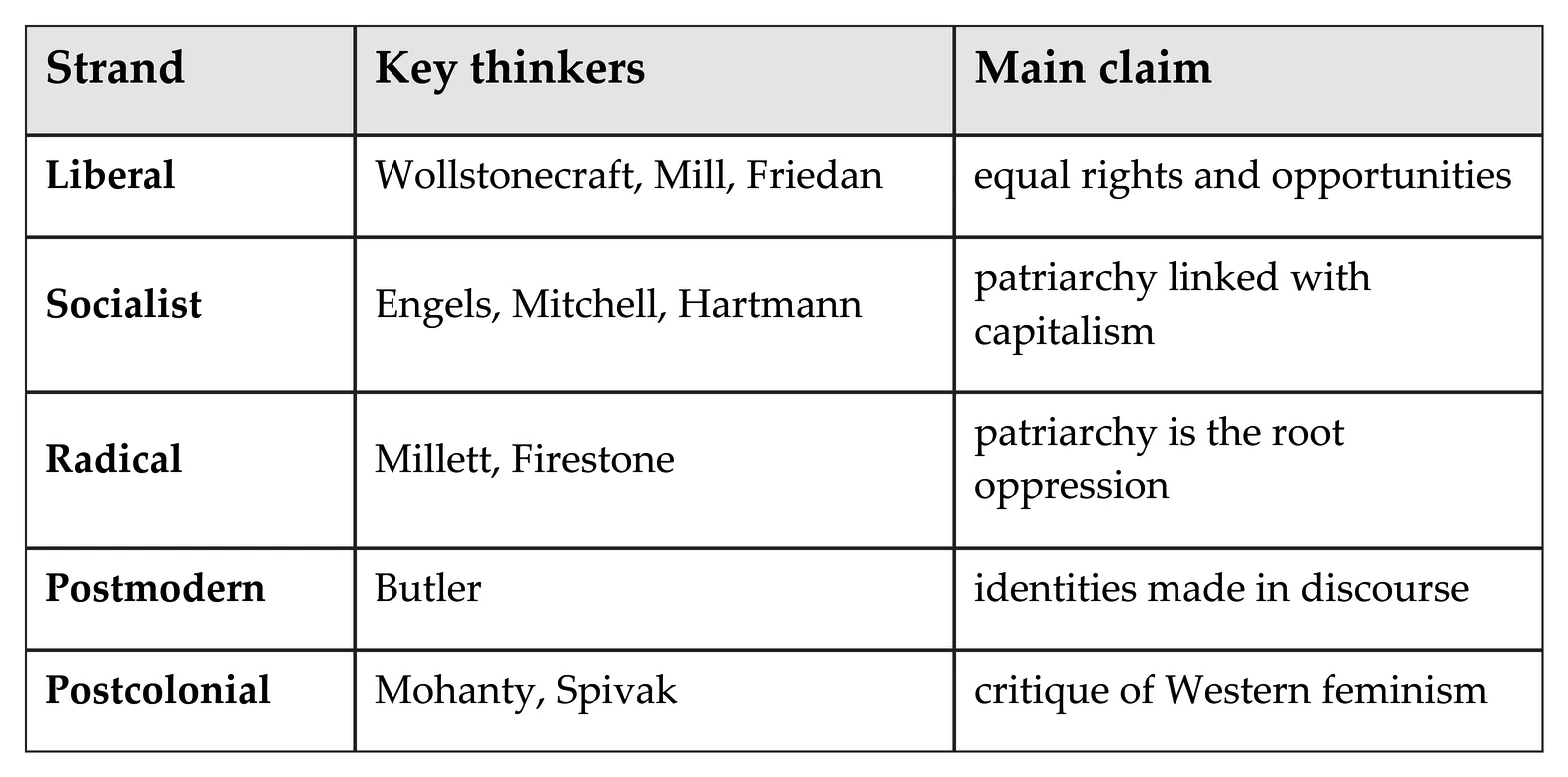
FEMINISM is not a single doctrine but a family of perspectives that share a commitment to ending women’s subordination while disagreeing about its causes and remedies. Liberal feminists seek equal rights, socialist feminists link patriarchy to capitalism, radical feminists see patriarchy as the root of oppression, postmodern feminists question the very category of woman, and postcolonial feminists criticise the assumptions of Western feminism. Indian thinkers have also developed their own Indian perspectives on feminism, shaped by caste, religion and colonialism. This chapter draws on Alison Jaggar, Stevi Jackson and Jackie Jones, Sheila Rowbotham, Kumari Jayawardena, Geraldine Forbes and Mary E. John.
2.1 Waves and Strands of Feminism
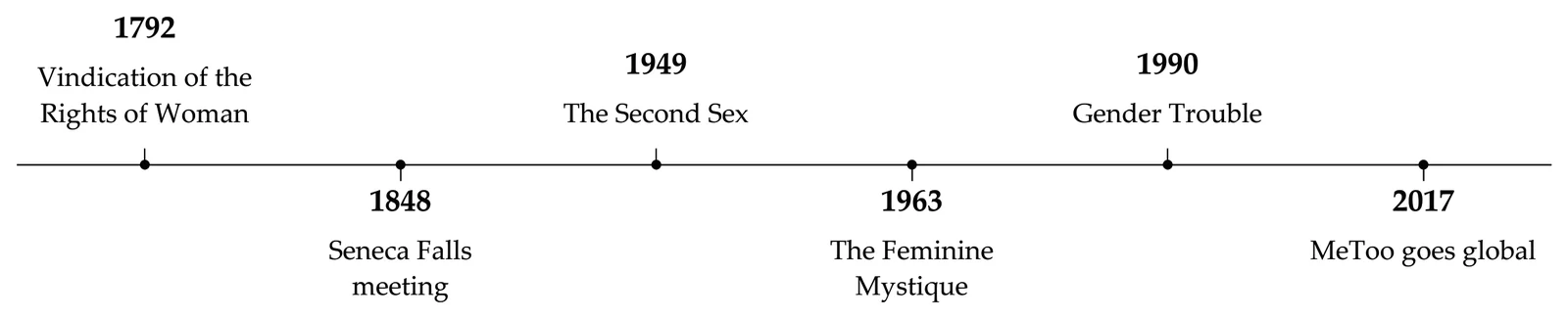
Feminism is often described in waves. The first wave, from the mid-nineteenth century, campaigned for the vote, education and property rights. The second wave, from the 1960s, addressed the family, work, sexuality and violence. A third wave from the 1990s stressed diversity among women, and some speak of a fourth wave of online activism such as #MeToo. Alison Jaggar distinguished feminist theories by their underlying views of human nature, a classification widely used in teaching.
2.2 Liberal and Socialist Feminism
Liberal feminism, from Mary Wollstonecraft and J.S. Mill to Betty Friedan, argues that women are rational individuals entitled to the same rights and opportunities as men, and seeks reform through law and education. Socialist feminism argues that women’s oppression is rooted in both patriarchy and capitalism, which together exploit women’s paid and unpaid labour. Sheila Rowbotham studied how women organised in movements linking class and gender.
2.3 Radical, Postmodern and Postcolonial Feminism
Radical feminism holds that patriarchy is the most basic form of oppression and that the personal is political. Postmodern feminism, influenced by Judith Butler, questions the idea of a single female identity. Postcolonial feminism, represented by Chandra Talpade Mohanty and Gayatri Spivak, criticises Western feminists for portraying Third World women as passive victims, while Kumari Jayawardena shows that feminism grew within anti-colonial movements in Asia.
2.4 Indian Perspectives on Feminism
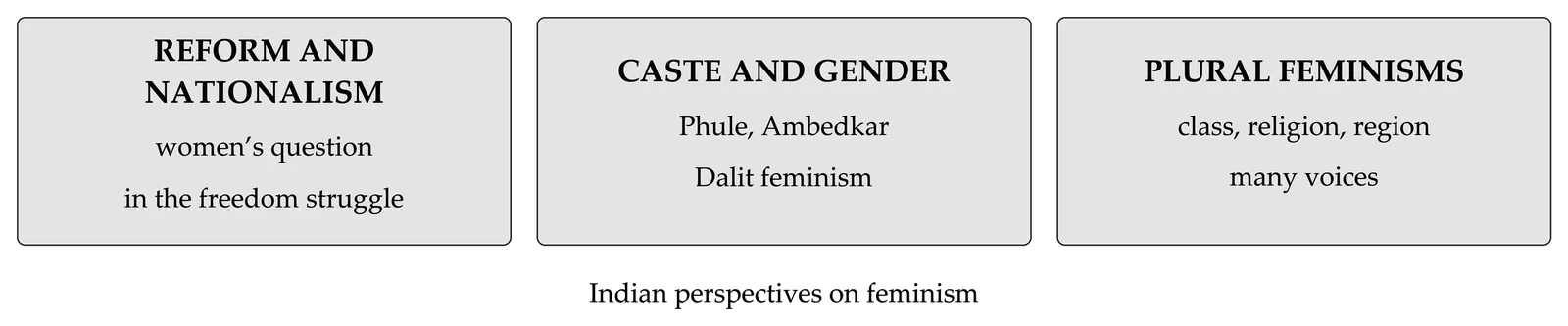
Indian perspectives on feminism emerged from social reform, nationalism and anti-caste movements. Thinkers such as Jotirao and Savitribai Phule, Tarabai Shinde, Pandita Ramabai and B.R. Ambedkar linked women’s oppression to caste and religion. Since the 1970s, women’s studies and the autonomous women’s movement have developed Indian feminist theory, while Dalit, Muslim and tribal women have insisted on their distinct experiences.
2.5 Important Questions
- Question 1 Discuss the main ideas of liberal feminism.
- Question 2 Discuss socialist and Marxist perspectives on feminism.
- Question 3 Discuss the main ideas of radical feminism.
- Question 4 Discuss postmodern and postcolonial perspectives on feminism.
- Question 5 Discuss Indian perspectives on feminism.
DU asks the same idea in different words. So learn one broad answer for each question below; the same answer works for every question joined by OR.
Important Question 1
Discuss the main ideas of liberal feminism.
OR
Examine the contribution of Mary Wollstonecraft and J.S. Mill to liberal feminism.
OR
Critically evaluate liberal feminism.
Model Answer
“The principle which regulates the existing social relations between the two sexes, the legal subordination of one sex to the other, is wrong in itself, and now one of the chief hindrances to human improvement.”
— J.S. Mill, The Subjection of Women (1869)
Introduction. Liberal feminism is the oldest strand of modern feminism. Rooted in the liberal ideas of reason, individual rights and equality, it argues that women are as rational as men and should enjoy equal rights and opportunities. From Mary Wollstonecraft and J.S. Mill to Betty Friedan, liberal feminists have sought to end discrimination through education, law and political reform.
1. Liberal Foundations
Liberalism holds that all individuals are free and equal, possess reason and have natural rights. Liberal feminists argued that these principles must apply to women, who had been excluded from the rights proclaimed by liberal revolutions.
2. Wollstonecraft
Mary Wollstonecraft, in A Vindication of the Rights of Woman (1792), argued that women appear inferior only because they are denied education and trained to please men. Given equal education, women would become rational citizens, better mothers and companions.
3. Mill and Taylor
J.S. Mill, influenced by Harriet Taylor, argued in The Subjection of Women (1869) that the legal subordination of women is wrong and hinders human progress. He compared marriage to slavery and called for equal rights in law, property, education, employment and voting.
4. The Suffrage Struggle
The Seneca Falls convention of 1848 demanded women’s rights, including the vote. New Zealand gave women the vote in 1893, Britain in 1918 and fully in 1928, and the United States in 1920. Suffrage was the central goal of first-wave liberal feminism.
5. Friedan and the Second Wave
Betty Friedan’s The Feminine Mystique (1963) described the problem that has no name: the frustration of educated American housewives confined to domestic life. She co-founded the National Organization for Women in 1966 to campaign for equal opportunities.
6. Equal Rights Reforms
Liberal feminists campaigned for laws on equal pay, equal access to education and employment, and against discrimination. They seek to change institutions from within through legislation, courts and political participation.
7. Jaggar’s Analysis
Alison Jaggar argues that liberal feminism rests on a view of human nature that values reason over the body and treats individuals as abstract, separate beings. This leads it to neglect the body, care and social relations, which are central to women’s lives.
8. Okin on Justice in the Family
Susan Moller Okin, in Justice, Gender, and the Family (1989), criticised liberal theories of justice, including Rawls, for ignoring the family. She argued that justice must extend to the household, where unequal division of labour disadvantages women.
9. Liberal Feminism in India
The Indian Constitution’s guarantee of equality and many legal reforms, on property, dowry, workplace harassment and political representation, reflect liberal feminist goals of equal rights through law.
10. Achievements
Liberal feminism won the vote, access to education and professions, property rights and laws against discrimination, transforming women’s legal status across the world.
11. The Public and the Private
Critics argue that liberal feminism focuses on the public sphere and leaves the private sphere of family and sexuality untouched, where much of women’s oppression occurs.
12. Class and Race
Liberal feminism has been criticised as reflecting the concerns of white, middle-class women, ignoring how class, race and caste shape women’s lives differently.
13. Accepting Male Norms
Radical and difference feminists argue that liberal feminism asks women to become like men, accepting male standards of success rather than questioning them.
14. Evaluation
Liberal feminism laid the foundation of women’s rights and remains influential, but it needs to address the private sphere and differences among women.
Conclusion. Thus, liberal feminism, from Wollstonecraft and Mill to Friedan, argues that women are rational individuals entitled to equal rights and opportunities. It achieved major legal reforms, but critics such as Jaggar and Okin show that it neglects the body, the family and differences of class, race and caste.
Important Question 2
Discuss socialist and Marxist perspectives on feminism.
OR
Examine the relationship between patriarchy and capitalism in socialist feminism.
OR
Discuss Sheila Rowbotham’s contribution to feminist thought.
Model Answer
“The first class opposition that appears in history coincides with the development of the antagonism between man and woman in monogamous marriage, and the first class oppression coincides with that of the female sex by the male.”
— Friedrich Engels, The Origin of the Family, Private Property and the State (1884)
Introduction. Marxist and socialist feminists argue that women’s oppression cannot be understood apart from the economic system. Marxist feminists, following Engels, traced it to private property and class society. Socialist feminists argued that patriarchy and capitalism are two interlinked systems that together exploit women’s paid and unpaid labour. They sought women’s liberation through both economic and social transformation.
1. Engels
Friedrich Engels, in The Origin of the Family, Private Property and the State (1884), argued that the rise of private property led men to control women in order to pass property to their own children. He called this the world-historic defeat of the female sex.
2. Marxist Feminism
Marxist feminists such as August Bebel and Alexandra Kollontai argued that women would be liberated by entering paid work and by the overthrow of capitalism. Socialism would socialise housework and child care.
3. The Unhappy Marriage
Heidi Hartmann argued in 1979 that the marriage of Marxism and feminism was unhappy, because Marxism subordinated gender to class. She argued that patriarchy is a separate system with its own material basis in men’s control of women’s labour.
4. Dual Systems
Socialist feminists developed dual-systems theory, which sees capitalism and patriarchy as two systems that support each other, and unified-systems theory, which sees them as one combined system of capitalist patriarchy.
5. Mitchell’s Longest Revolution
Juliet Mitchell, in ‘Women: The Longest Revolution’ (1966), argued that women’s position is shaped by four structures: production, reproduction, sexuality and the socialisation of children. Liberation requires change in all four.
6. Domestic Labour
Socialist feminists showed that women’s unpaid housework and care reproduce the labour force and benefit capitalism. The Wages for Housework campaign of the 1970s, associated with Selma James, Mariarosa Dalla Costa and Silvia Federici, demanded recognition of this labour.
7. Rowbotham: Women in Movements
Sheila Rowbotham, in Women in Movements (1993), studied how women organised in workplaces, communities and political movements across the world. She showed that women’s struggles combined issues of class, work, family and everyday life, linking feminism with socialism.
8. Jaggar on Socialist Feminism
Alison Jaggar saw socialist feminism as the most promising theory, because it combines the Marxist analysis of labour with the radical feminist focus on sexuality and reproduction, and views human nature as shaped by social relations.
9. Mies and the Global Economy
Maria Mies, in Patriarchy and Accumulation on a World Scale (1986), drew on her study of lace makers in Narsapur, Andhra Pradesh, to show how capitalism profits from women defined as housewives, whose work is treated as leisure rather than labour.
10. Women and Labour in India
In India, women work mostly in informal, low-paid and unpaid jobs. Organisations such as SEWA and women’s participation in trade unions and peasant movements reflect socialist feminist concerns with work and class.
11. Feminisation of Labour
Globalisation has drawn many women into low-paid, flexible jobs in export industries and services, a process called the feminisation of labour, which socialist feminists see as capitalism exploiting gender inequality.
12. Achievements
Socialist feminism made unpaid labour visible, linked gender to class and global capitalism and inspired policies on maternity benefits, child care and equal pay.
13. Criticisms
Critics argue that socialist feminism can reduce gender to economics, neglecting culture, sexuality and identity, and that socialist states did not end patriarchy.
14. Evaluation
Socialist feminism offers a powerful analysis of how gender and class combine to exploit women’s labour, though it must also address culture and diversity.
Conclusion. Thus, Marxist feminism traced women’s oppression to private property, while socialist feminists such as Hartmann, Mitchell and Rowbotham argued that patriarchy and capitalism are interlinked systems. By making women’s paid and unpaid labour visible, they linked women’s liberation to economic as well as social transformation.
Important Question 3
Discuss the main ideas of radical feminism.
OR
‘The personal is political.’ Discuss with reference to radical feminism.
OR
Examine the radical feminist view of patriarchy and sexuality.
Model Answer
“Unlike economic class, sex class sprang directly from a biological reality: men and women were created different, and not equally privileged.”
— Shulamith Firestone, The Dialectic of Sex (1970)
Introduction. Radical feminism emerged in the United States and Britain in the late 1960s from the women’s liberation movement. It argues that patriarchy is the oldest and most basic form of oppression, rooted in men’s control over women’s bodies, sexuality and reproduction. Its slogan, the personal is political, transformed feminist politics by bringing private life into political analysis.
1. Origins
Many radical feminists came from the civil rights and student movements, where they experienced sexism from male activists. They formed women-only groups and practised consciousness raising, sharing personal experiences to reveal their political roots.
2. The Personal Is Political
Radical feminists argued that problems women experience in private, such as domestic violence, unequal housework and sexual coercion, are not personal failings but products of power relations. Politics exists wherever there is power, including in the family and bedroom.
3. Patriarchy as the Root
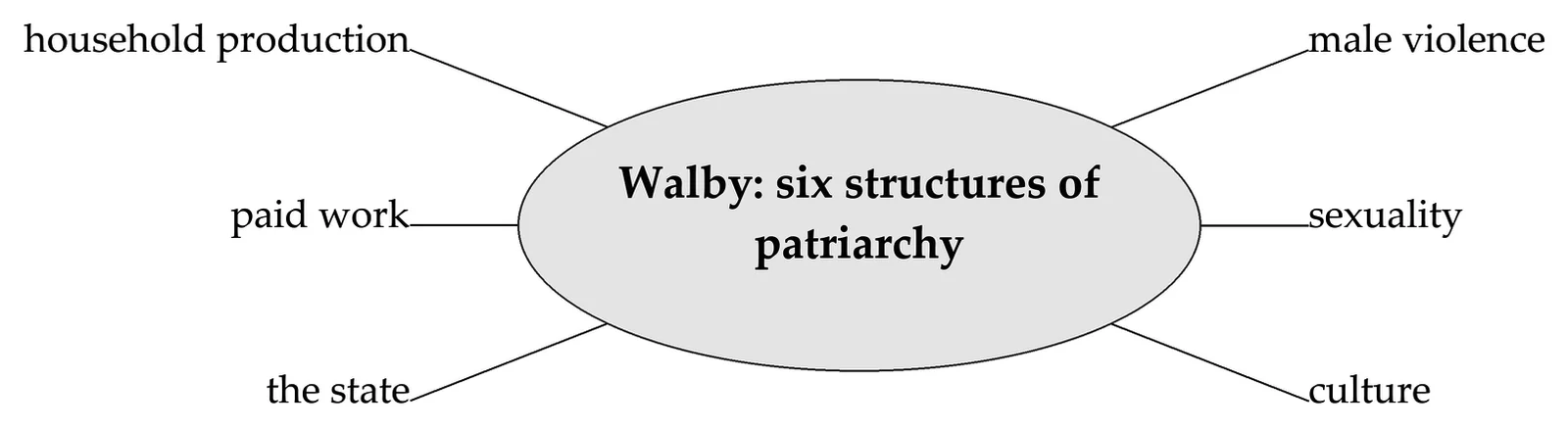
Kate Millett, in Sexual Politics (1970), argued that patriarchy is a universal system of male domination maintained through the family, ideology, economics, education and force, and that sex is a political category.
4. Firestone and Reproduction
Shulamith Firestone, in The Dialectic of Sex (1970), argued that women’s oppression arises from their role in reproduction. She believed that technology, such as artificial reproduction, could free women from biological burdens.
5. Sexual Violence
Susan Brownmiller, in Against Our Will (1975), argued that rape is a means by which men keep women in fear. Radical feminists made violence against women a central political issue.
6. Pornography
Andrea Dworkin and Catharine MacKinnon argued that pornography subordinates women and promotes violence, and campaigned for laws against it. Other feminists opposed censorship, leading to the feminist sex wars of the 1980s.
7. Cultural Feminism
Some radical feminists, such as Mary Daly, celebrated women’s distinct values of care and connection and sought to build a separate women’s culture, an approach called cultural feminism.
8. Separatism
Some radical feminists advocated separatism, building women-only communities and relationships, including lesbian feminism, as a way of escaping patriarchal control.
9. Jackson and Jones on Radical Feminism
Stevi Jackson and Jackie Jones note that radical feminism made patriarchy, sexuality and violence central to feminist theory and established that women form a social group with common interests in ending male domination.
10. Achievements
Radical feminists created rape crisis centres and shelters for women facing domestic violence, and brought issues such as sexual harassment, marital rape and reproductive rights onto the political agenda.
11. Indian Resonance
In India, campaigns against rape, dowry deaths and domestic violence from the late 1970s reflected similar concerns, though Indian feminists linked them to caste, class and community.
12. Essentialism
Critics argue that radical feminism treats women as a single group with shared experiences, ignoring differences of race, class, caste and sexuality, and sometimes implies that men are naturally oppressive.
13. Other Criticisms
Liberal and socialist feminists argue that radical feminism neglects economic structures and legal reform, and that its universal view of patriarchy is ahistorical.
14. Evaluation
Radical feminism transformed politics by showing that the personal is political and by making violence and sexuality central issues, despite its essentialist tendencies.
Conclusion. Thus, radical feminism sees patriarchy as the root of oppression, maintained through control of women’s bodies, sexuality and reproduction. Thinkers such as Millett, Firestone and Brownmiller showed that the personal is political, bringing violence and sexuality into politics, though critics fault radical feminism for essentialism.
Important Question 4
Discuss postmodern and postcolonial perspectives on feminism.
OR
Examine Chandra Talpade Mohanty’s critique of Western feminism.
OR
How do postcolonial feminists challenge the idea of a universal sisterhood?
Model Answer
“The production of the ‘Third World Woman’ as a singular monolithic subject in some recent (Western) feminist texts.”
— Chandra Talpade Mohanty, ‘Under Western Eyes’ (1984)
Introduction. From the 1980s, postmodern and postcolonial feminists challenged the idea that women share a single identity and a common experience of oppression. Postmodern feminists questioned the category of woman itself, while postcolonial feminists criticised Western feminists for speaking for women of the Global South and ignoring colonialism, race and culture.
1. Postmodernism
Postmodern thinkers such as Jean-François Lyotard rejected grand narratives that claim universal truth. They emphasised difference, plurality and the role of language and discourse in shaping identities.
2. Postmodern Feminism
Postmodern feminists argued that the category woman is not natural or unified. Women differ by race, class, sexuality and culture, and claims about all women often universalise the experience of privileged women.
3. Butler
Judith Butler argued in Gender Trouble (1990) that gender is performative and that feminism need not rest on a fixed identity of women. Instead, it can subvert gender norms through parody and the disruption of categories.
4. French Feminists
French feminists such as Luce Irigaray, Hélène Cixous and Julia Kristeva examined how language and psychoanalysis construct femininity. Cixous called for écriture féminine, women’s writing that expresses women’s experiences in new forms.
5. Criticism of Postmodern Feminism
Critics argue that if there is no stable category of women, feminism loses the political subject in whose name it acts. Some feminists defend strategic essentialism, using the category for political purposes while recognising its limits.
6. Postcolonial Feminism
Postcolonial feminism examines how colonialism and its legacies shape gender relations, and how Western feminism has reproduced colonial attitudes towards women in Asia, Africa and Latin America.
7. Mohanty: Under Western Eyes
Chandra Talpade Mohanty argued that Western feminist writing often portrays the Third World woman as a single, monolithic victim of tradition, ignorant and passive, in contrast to the liberated Western woman. This erases the diversity, agency and struggles of women in the Global South.
8. Spivak: Can the Subaltern Speak
Gayatri Chakravorty Spivak, in ‘Can the Subaltern Speak?’ (1988), examined the colonial abolition of sati, which she described as white men saving brown women from brown men. Both colonialists and nationalists spoke for women, while the women themselves were silenced.
9. Jayawardena: Feminism and Nationalism
Kumari Jayawardena showed that feminism was not a Western import. In countries such as India, Sri Lanka, Egypt and China, feminist movements arose alongside nationalist and anti-imperialist struggles in the late nineteenth and early twentieth centuries.
10. Black Feminism and Intersectionality
Black feminists such as bell hooks, in Ain’t I a Woman (1981), criticised white feminism for ignoring race. Kimberlé Crenshaw’s concept of intersectionality showed how race, gender and class combine in oppression.
11. Transnational Feminism
Transnational feminists seek solidarity among women across borders based on shared struggles against global capitalism, militarism and patriarchy, while respecting differences in context.
12. Relevance to India
Postcolonial perspectives help Indian feminists analyse how colonial law, nationalism and religious communities shaped women’s lives, and how Dalit, Adivasi and Muslim women experience distinct forms of oppression.
13. Criticisms
Critics warn that cultural relativism can be used to defend oppressive traditions, and that emphasis on difference may weaken feminist solidarity.
14. Evaluation
Postmodern and postcolonial feminisms made feminism more aware of difference, power among women and the legacies of colonialism, enriching its theory and practice.
Conclusion. Thus, postmodern feminists questioned the unified category of woman, while postcolonial feminists such as Mohanty, Spivak and Jayawardena criticised Western feminism’s portrayal of Third World women and showed that feminism grew within anti-colonial struggles. Together they made feminism attentive to difference and power.
Important Question 5
Discuss Indian perspectives on feminism.
OR
Is there a distinct Indian feminism? Discuss.
OR
Examine the contribution of anti-caste thinkers to Indian feminism.
Model Answer
“I measure the progress of a community by the degree of progress which women have achieved.”
— B.R. Ambedkar
Introduction. Indian feminism developed from social reform movements, the freedom struggle, anti-caste movements and the autonomous women’s movement since the 1970s. While it shares much with Western feminism, it has been shaped by distinct issues of caste, religion, community, colonialism and family. Scholars such as Geraldine Forbes and Mary E. John have traced its history and debates.
1. Is There an Indian Feminism
Some Indian activists hesitated to use the word feminism, seeing it as Western. Madhu Kishwar wrote ‘Why I Do Not Call Myself a Feminist’ in 1990. Others argued that Indian women had long struggled against patriarchy in their own terms.
2. Social Reform
Nineteenth-century reformers, mostly men such as Raja Ram Mohan Roy and Ishwar Chandra Vidyasagar, campaigned against sati and child marriage and for widow remarriage and female education, raising the women’s question in Indian public life.
3. Anti-Caste Feminism
Jotirao and Savitribai Phule opened a school for girls in Pune in 1848 and linked women’s oppression to Brahmanical caste. Tarabai Shinde’s Stri Purush Tulana (1882) boldly compared women and men, criticising male hypocrisy.
4. Pandita Ramabai
Pandita Ramabai founded the Arya Mahila Samaj in 1882 and wrote The High-Caste Hindu Woman (1887), criticising the treatment of widows and child brides. She set up homes and schools for widows.
5. Ambedkar
B.R. Ambedkar linked caste and gender, arguing that caste depends on controlling women. As Law Minister, he drafted the Hindu Code Bill to give women rights in marriage, divorce and inheritance, and resigned in 1951 when it was stalled.
6. Forbes: Women in Modern India
Geraldine Forbes, in Women in Modern India (1996), traces how women moved from being objects of reform to agents in education, organisations such as the All India Women’s Conference and the freedom struggle.
7. Women’s Studies
From the 1970s, women’s studies emerged in Indian universities, and the Indian Association for Women’s Studies was founded in 1982. Mary E. John’s reader Women’s Studies in India (2008) collects key debates in Indian feminist scholarship.
8. Dalit Feminism
From the 1990s, Dalit women argued that mainstream feminism ignored caste. Gopal Guru (1995) and Sharmila Rege (1998) argued that Dalit women talk differently, facing caste, class and gender oppression together, and called for a Dalit feminist standpoint.
9. Muslim Women’s Perspectives
Muslim women’s organisations, such as the Bharatiya Muslim Mahila Andolan founded in 2007, have campaigned for reform of personal law from within, including against instant triple talaq, while resisting communal politics.
10. Ecofeminism
Vandana Shiva developed an ecofeminist perspective linking the exploitation of women and nature, drawing on the Chipko movement and the idea of prakriti as a living feminine principle.
11. Feminism and the State
Nivedita Menon, in Seeing like a Feminist (2012), examines how Indian feminists have used and questioned the law and the state, recognising both the gains of legal reform and the dangers of relying on state power.
12. Distinct Features
Indian feminism engages with family, community and religion rather than simply rejecting them, addresses caste alongside gender and often works with the state through law while also challenging it.
13. Criticisms
Indian feminism has been criticised for being dominated by urban, upper-caste women, for neglecting rural and marginalised women and for its uneasy relationship with religious and community identities.
14. Evaluation
Indian feminism is plural, shaped by reform, anti-caste thought, nationalism and contemporary movements, and has developed perspectives that enrich global feminist theory.
Conclusion. Thus, Indian perspectives on feminism grew from social reform, anti-caste thought and the freedom struggle, through figures such as the Phules, Tarabai Shinde, Pandita Ramabai and Ambedkar, to women’s studies and Dalit, Muslim and ecofeminist voices. Indian feminism is plural and links gender with caste, religion and community.
Short Notes
(a) The personal is political
A slogan of radical feminism from the late 1960s, meaning that problems women experience in private life, such as domestic violence and unequal housework, are products of power relations and therefore political.
(b) Dual-systems theory
A socialist feminist view, associated with Heidi Hartmann, that capitalism and patriarchy are two distinct but interlinked systems that together shape women’s oppression.
(c) Under Western Eyes
Chandra Talpade Mohanty’s essay (1984) criticising Western feminist writing for portraying Third World women as a single, passive victim group, ignoring their diversity and agency.
More notes: DSE-8 Feminism: Theory and Practice
These notes are prepared by PADHO TO AISE for study help. They are not an official University of Delhi publication.