
Semester VIII DSE-12 Comparative Constitutionalism
Unit I · 28 min read · Updated 24 Nov 2026
As per the University of Delhi (DU) BA (Hons) Political Science syllabus
Contents
- 1.1 Constitution and Constitutionalism
- Meaning of a Constitution
- Features of Constitutionalism
- Why the Difference Matters
- Criticisms of Constitutionalism
- 1.2 The Evolution of Constitutionalism
- Ancient and Medieval Roots
- Milestones of Modern Constitutionalism
- The Indian Path to Constitutionalism
- Constitutionalism beyond the West
- 1.3 Comparing Constitutions
- Approaches to Comparative Constitutional Study
- Legal Transplants and Borrowing
- What Comparison Teaches
- Constitutionalism in India Today
- 1.4 Important Questions
- Distinguish between constitution and constitutionalism.
- Trace the evolution of constitutionalism.
- Discuss the different types of constitutions.
- What is comparative constitutionalism? Why do we compare constitutions?
- Short Notes
जिस समाज में अधिकारों की गारंटी सुनिश्चित नहीं है और शक्तियों का पृथक्करण निर्धारित नहीं है, उसका कोई संविधान नहीं है।
Any society in which the guarantee of rights is not assured, nor the separation of powers determined, has no constitution.
— Declaration of the Rights of Man and of the Citizen, Article 16 (1789)
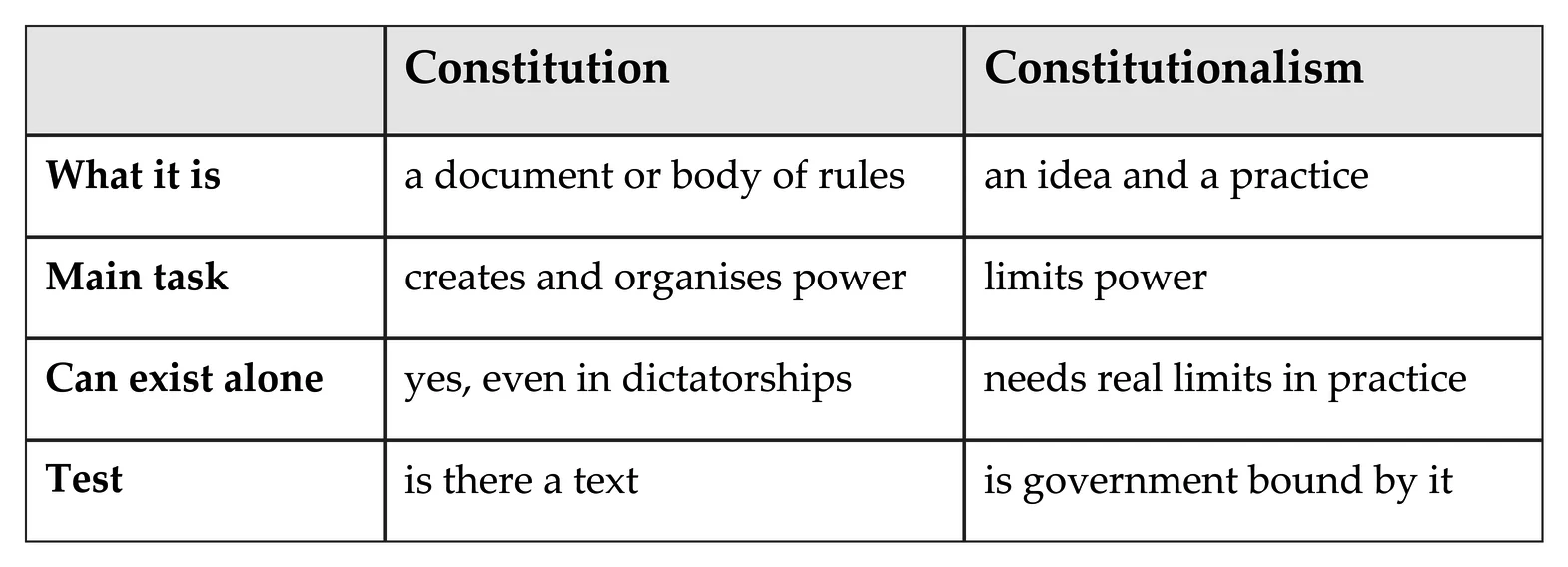
CONSTITUTIONALISM is the idea that government must be limited by law. Almost every state today has a constitution, but not every state practises constitutionalism. A constitution may create and organise power, while constitutionalism insists that this power be limited, that rights be protected and that rulers be bound by higher law. This chapter explains the difference between the two, traces the evolution of constitutionalism from Magna Carta to the post-colonial constitutions, and introduces the comparative study of constitutions, drawing on Gerhard Casper, Dieter Grimm, Stephen Holmes, Larry Alexander and Kim Lane Scheppele.
1.1 Constitution and Constitutionalism
A constitution is the body of fundamental rules that sets up the organs of government, distributes power among them and defines their relationship with citizens. Constitutionalism is the doctrine and practice that government must be limited by these rules. A dictatorship can have a written constitution without constitutionalism, while Britain practises constitutionalism without a single written constitution. The real test is whether rulers are actually bound.
Meaning of a Constitution
The word constitution comes from the Latin constitutio, i.e. an arrangement or settled order. Aristotle used the Greek word politeia for the arrangement of offices in a city, especially the supreme office, and studied 158 constitutions of Greek cities to see how they worked. In the eighteenth century, Lord Bolingbroke described the British constitution in A Dissertation upon Parties (1733–34) as the assemblage of laws, institutions and customs according to which a community has agreed to be governed. Thomas Paine, defending the French Revolution in Rights of Man (1791), gave the modern view that a constitution is not the act of a government but of a people constituting a government. In simple words, a constitution is the basic law that creates the organs of the state, gives them powers and sets the relationship between rulers and citizens.
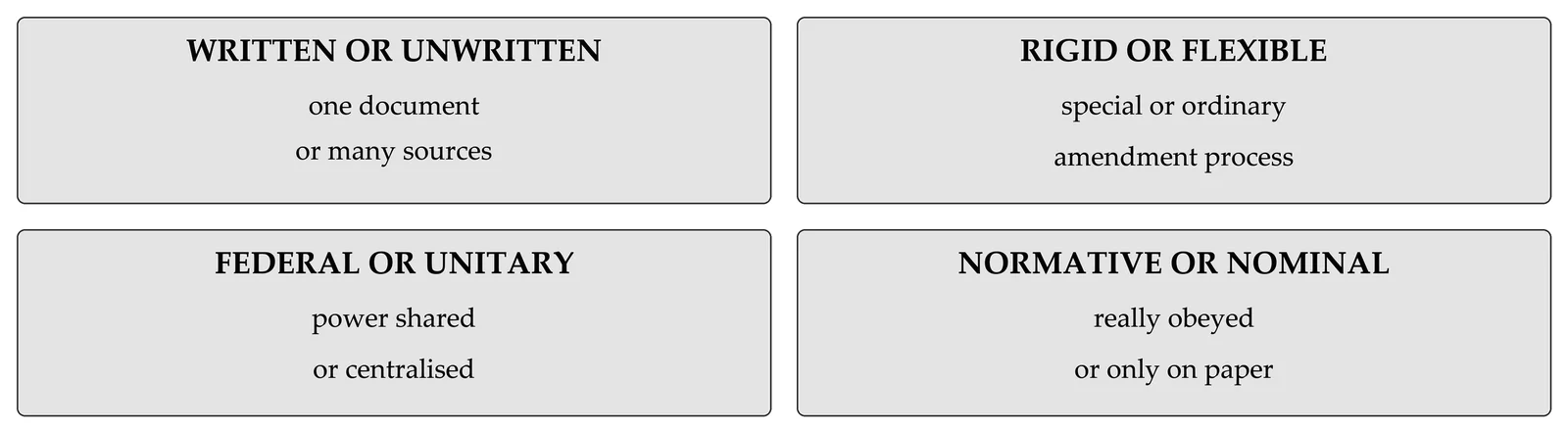
Constitutions can be written, i.e. collected in one document adopted at a particular moment, as in the United States (1787) and India (1950), or unwritten, i.e. spread across statutes, court judgments, conventions and customs, as in Britain. They can be rigid, needing special procedures to change, or flexible, changeable by ordinary law. But whatever its form, a constitution answers three questions: who holds power, how that power is exercised, and what the limits of that power are.
Features of Constitutionalism
Constitutionalism is the doctrine that government must be limited by law and that its authority depends on respecting those limits. Its main features developed over centuries, each in response to a particular political struggle:
- Limited government. John Locke, in Two Treatises of Government (1690), written to justify the Glorious Revolution of 1688 against James II, argued that government holds only a trust from the people to protect life, liberty and property, and that it loses its authority when it breaks this trust.
- Separation of powers. Montesquieu, in The Spirit of the Laws (1748), writing under the absolute monarchy of France and admiring the English system, argued that liberty is safe only when legislative, executive and judicial powers are held by different hands.
- Rule of law. A.V. Dicey, in Introduction to the Study of the Law of the Constitution (1885), described the rule of law as the supremacy of regular law over arbitrary power, equality of all before the ordinary courts, and the protection of rights by judges.
- Guaranteed rights. The American Bill of Rights (1791), added because the Anti-Federalists feared a strong central government, and the French Declaration of 1789 made written guarantees of rights a central part of constitutional government.
- Judicial review. In Marbury v. Madison (1803), Chief Justice John Marshall held that courts can strike down laws that conflict with the Constitution, making the constitution enforceable higher law.
- Popular sovereignty and constituent power. Emmanuel Sieyès, in What is the Third Estate? (1789), distinguished the constituent power of the nation, which makes the constitution, from the constituted powers of government, which must obey it.
- Entrenchment. Special procedures for amendment, such as Article V of the US Constitution and Article 368 of the Indian Constitution, protect basic rules from being changed by temporary majorities.
Why the Difference Matters
Carl J. Friedrich, in Constitutional Government and Democracy (first published in 1941), explained constitutionalism as a system of effective and regular restraints on government action. The word effective is important: a document that lists rights but is ignored by rulers does not create constitutionalism. This is why the Soviet Constitution of 1936, which promised many rights, existed alongside the purges under Stalin, while Britain, without a single written document, developed strong constitutional government through Parliament, courts and conventions. Thus the study of constitutionalism looks beyond texts to the practice of power.
Criticisms of Constitutionalism
Constitutionalism is widely admired, but it has also been criticised from several directions. These criticisms help students write a balanced evaluation:
- Marxist criticism. Karl Marx, in On the Jewish Question (1843), argued that the rights proclaimed in liberal constitutions are the rights of the egoistic, property-owning individual, so constitutional government protects the interests of the bourgeoisie rather than freeing all people.
- Feminist criticism. Carole Pateman, in The Sexual Contract (1988), argued that the social contract behind liberal constitutions hid a sexual contract that kept women subordinate in the family, so formal equality in the constitution left private domination untouched.
- Postcolonial criticism. Upendra Baxi and others argue that many post-colonial constitutions continued colonial laws and state structures, so constitutionalism in the global South must be judged by whether it actually serves the poor and marginalised.
- Democratic criticism. Jeremy Waldron argues that strong judicial review takes decisions about rights away from elected citizens, which is undemocratic when people reasonably disagree about what rights require.
- Schmitt’s criticism. Carl Schmitt, in Constitutional Theory (1928), argued that liberal constitutionalism tries to neutralise politics through rules, but cannot answer who decides in a real crisis.
Defenders reply that these criticisms show the need to improve constitutionalism, by adding social rights, gender equality and democratic participation, rather than to abandon the idea of limited government.
1.2 The Evolution of Constitutionalism
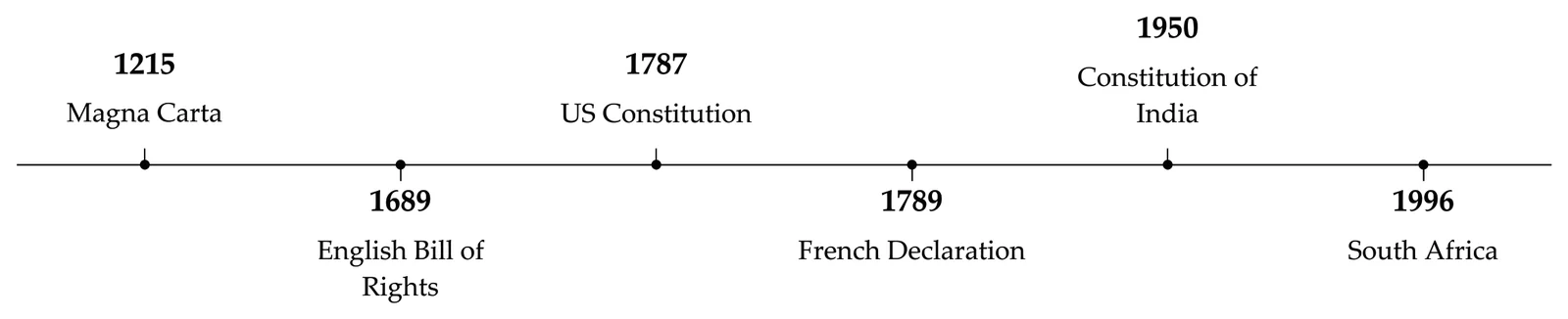
The idea of limited government is old, but modern constitutionalism took shape through the Magna Carta (1215), the English Bill of Rights (1689), the American (1787) and French (1789) revolutions, and the wave of constitutions after the Second World War and decolonisation. Charles McIlwain described constitutionalism as a legal limitation on government, the opposite of arbitrary rule.
Ancient and Medieval Roots
The idea that rulers should be bound by law is very old. In Athens, the reforms of Solon in 594 BCE set out laws that applied to rich and poor alike. Aristotle, in his Politics, distinguished good constitutions, in which rulers govern for the common good under law, from perverted ones, in which they govern for themselves. The Greek historian Polybius, writing in the second century BCE, praised the Roman Republic for its mixed constitution, which balanced consuls (monarchy), the Senate (aristocracy) and the assemblies (democracy). In medieval England, the jurist Henry de Bracton wrote around 1250 that the king is under God and the law, and the Magna Carta of 1215 forced King John to accept that no free man could be punished except by lawful judgement.
Charles McIlwain, in Constitutionalism: Ancient and Modern (1947), explained that medieval thinkers distinguished gubernaculum, the sphere of government in which the king’s will was supreme, from jurisdictio, the sphere of law and rights in which even the king was bound. Modern constitutionalism, he argued, widened jurisdictio and made legal limits enforceable against all public power.
Milestones of Modern Constitutionalism
- 1628 → The Petition of Right forced Charles I to accept that he could not tax without Parliament or imprison people without cause.
- 1689 → After the Glorious Revolution, the Bill of Rights established the supremacy of Parliament over the Crown in Britain.
- 1776 → The Virginia Declaration of Rights and the American Declaration of Independence proclaimed natural rights and government by consent.
- 1787 → The Philadelphia Convention wrote the US Constitution, with federalism, separation of powers and checks and balances.
- 1789 and 1791 → The French Declaration of the Rights of Man and Poland’s Constitution of 3 May 1791, the first modern written constitution in Europe, spread constitutional ideas.
- 1919 and 1949 → Germany’s Weimar Constitution failed to stop dictatorship, so the Basic Law of 1949 made human dignity inviolable and created a strong constitutional court.
- 1950 and 1996 → India’s Constitution and South Africa’s post-apartheid Constitution joined limits on power with a commitment to social transformation.
The Indian Path to Constitutionalism
India’s constitutional history began under colonial rule. The Government of India Acts of 1858, 1909, 1919 and 1935 gradually introduced legislatures, elections and provincial autonomy, but always under British supremacy. Indian leaders demanded a constitution made by Indians: the Nehru Report of 1928 proposed fundamental rights and dominion status, and the Constituent Assembly, formed in 1946 under the Cabinet Mission Plan, debated for nearly three years before adopting the Constitution on 26 November 1949. Granville Austin called it a seamless web of three strands: national unity, democracy and social revolution.
Constitutionalism beyond the West
Ideas of limited rule are not only Western. In ancient India, the king was bound by rajadharma, the duty to rule by dharma and for the welfare of the people, and assemblies such as the sabha and samiti advised rulers. In Islamic political thought, the ruler was expected to govern under the sharia and through shura, i.e. consultation. In China, the doctrine of the Mandate of Heaven held that an unjust ruler could lose his right to rule, and Mencius in the fourth century BCE justified the removal of a tyrant. These traditions did not create modern constitutions, but they show that the demand for restraints on power is found across civilisations.
James Tully, in Strange Multiplicity (1995), criticised modern constitutionalism for assuming one uniform nation. Writing about the claims of indigenous peoples in Canada, he argued for a constitutionalism of diversity based on mutual recognition, consent and continuity, in which different cultures negotiate the terms of their association. Such ideas are relevant to India, with its federal and cultural diversity and special provisions for the North-east under Article 371 and the Sixth Schedule.
1.3 Comparing Constitutions
Comparative constitutionalism studies how constitutions in different countries limit power, protect rights and change over time. Scholars such as Kim Lane Scheppele and Mark Tushnet show that comparison helps us understand our own constitution, learn from others and judge which designs work. India’s Constitution itself borrowed from many models.
Approaches to Comparative Constitutional Study
Scholars compare constitutions in different ways, and each approach asks a different question. Mark Tushnet, in The Possibilities of Comparative Constitutional Law (1999) and his later Advanced Introduction (2014), identified the main approaches:
- Functionalism asks how different constitutions perform similar functions, such as protecting rights or dividing power, and which designs work better.
- Expressivism treats a constitution as an expression of a nation’s identity and history, so that India’s directive principles express its commitment to social justice.
- Universalism looks for principles common to all constitutional democracies, such as dignity, equality and proportionality.
- Bricolage describes how framers piece together elements borrowed from many sources, as India’s Constituent Assembly did.
- Contextualism insists that institutions must be understood in their social and political setting, since a borrowed institution may work very differently in a new country.
Legal Transplants and Borrowing
Alan Watson, in Legal Transplants (1974), argued that the borrowing of law from one society by another is common and often successful. Others, such as Otto Kahn-Freund, warned that institutions closely tied to politics are hard to transplant. India’s experience shows both sides: parliamentary government borrowed from Britain worked, but emergency provisions borrowed partly from the Weimar Constitution were misused in 1975. India also became an exporter: the basic structure doctrine has influenced courts in Bangladesh, Kenya and Belize, and public interest litigation has inspired courts across South Asia.
What Comparison Teaches
Comparison teaches three lessons. First, constitutions with similar texts can produce very different results, because political culture and institutions matter. Second, constitutional design involves trade-offs, such as between strong courts and democratic majorities. Third, constitutions are living documents that change through amendment, interpretation and practice. For students, comparison makes the Indian Constitution easier to understand by showing what is distinctive in it, such as the combination of fundamental rights, directive principles and the basic structure doctrine.
Constitutionalism in India Today
In India, constitutionalism is protected mainly through the basic structure doctrine and independent institutions. In Kesavananda Bharati (1973), Chief Justice S.M. Sikri listed features such as the supremacy of the Constitution, the republican and democratic form of government, secularism, separation of powers and federalism as part of the basic structure, and later cases added judicial review, free and fair elections and the rule of law.
- Independent institutions. The Election Commission (Article 324), the Comptroller and Auditor General (Article 148), the Union Public Service Commission and an independent judiciary are meant to check the government of the day.
- Federal limits. In S.R. Bommai (1994), the Supreme Court held federalism to be a basic feature and limited the misuse of President’s Rule.
- Continuing debates. Controversies over the appointment of election commissioners, decided in Anoop Baranwal (2023) and followed by a new law in the same year, over the powers of Governors and over the independence of tribunals show that constitutionalism must be defended continuously.
Thus constitutionalism in India is not a finished achievement but an ongoing practice, depending on courts, institutions, a free press and alert citizens.
1.4 Important Questions
- Question 1 Distinguish between constitution and constitutionalism.
- Question 2 Trace the evolution of constitutionalism.
- Question 3 Discuss the different types of constitutions.
- Question 4 What is comparative constitutionalism? Why do we compare constitutions?
DU asks the same idea in different words. So learn one broad answer for each question below; the same answer works for every question joined by OR.
Important Question 1
Distinguish between constitution and constitutionalism.
OR
What is constitutionalism? Can a state have a constitution without constitutionalism?
OR
Explain the meaning and essential features of constitutionalism.
Model Answer
“Any society in which the guarantee of rights is not assured, nor the separation of powers determined, has no constitution.”
— Declaration of the Rights of Man and of the Citizen, Article 16 (1789)
Introduction. The words constitution and constitutionalism are often used together, but they mean different things. A constitution is a set of rules that creates and organises political power, while constitutionalism is the principle that this power must be limited and that rulers must be bound by law. The difference matters because many states have constitutions on paper while their rulers act without real limits.
1. Meaning of Constitution
A constitution is the body of fundamental rules, written or unwritten, that establishes the organs of government, distributes powers among them and regulates their relations with one another and with citizens. It answers the questions of who rules, how they are chosen and what they may do.
2. Meaning of Constitutionalism
Constitutionalism is the idea that government should be limited in its powers and that its authority depends on respecting those limits. It is not merely having a constitution but living by one, so that rulers cannot act arbitrarily and citizens enjoy protected rights.
3. Grimm on Two Senses
Dieter Grimm distinguishes the empirical sense of constitution, the actual condition of a political community, from the normative sense, the legal rules that regulate the establishment and exercise of public power. Modern constitutionalism refers to the second sense, in which law stands above politics.
4. Constitution Creates Power
A constitution constitutes power: it creates offices such as parliament, president and courts and gives them authority. Stephen Holmes stresses that constitutions are enabling as well as limiting, because organised and predictable government is more effective than arbitrary rule.
5. Constitutionalism Limits Power
Constitutionalism limits power through devices such as separation of powers, checks and balances, federalism, a bill of rights, judicial review, regular elections and difficult procedures for amendment. These prevent any single person or body from becoming all-powerful.
6. Higher Law
Constitutionalism treats the constitution as higher law that ordinary laws must obey. In India, Article 13 declares laws inconsistent with fundamental rights void, and courts can strike down such laws, making the Constitution supreme.
7. Rule of Law
Constitutionalism is closely linked with the rule of law, which A.V. Dicey described as the supremacy of regular law over arbitrary power, equality before the law and the protection of rights by ordinary courts. Rulers, like citizens, must obey the law.
8. Casper on Constitutionalism
Gerhard Casper traces constitutionalism to the effort to subject government to rules, especially through written constitutions, separation of powers and judicial protection of rights, and notes that its meaning has developed with the experience of different countries.
9. Constitution without Constitutionalism
Many authoritarian states have written constitutions that list rights and institutions, but rulers ignore them. Karl Loewenstein called such constitutions nominal, when they are not fully applied, or semantic, when they simply dress up the power of those who rule.
10. Constitutionalism without a Written Constitution
Britain has no single written constitution, yet it practises constitutionalism through conventions, the rule of law, an independent judiciary and parliamentary accountability. This shows that constitutionalism depends on political culture as well as texts.
11. Alexander on Entrenchment
Larry Alexander explains that constitutionalism involves entrenching certain rules so that they cannot easily be changed by ordinary majorities. Entrenchment gives settlement and stability, but it raises the question of why later generations should be bound by earlier decisions.
12. Holmes on Precommitment
Stephen Holmes compares constitutions to Ulysses tying himself to the mast to resist the Sirens. A people binds itself in advance against passions and temptations, so that limits on power serve long-term democratic self-government.
13. Indian Example
In Kesavananda Bharati (1973), the Supreme Court held that Parliament cannot amend the basic structure of the Constitution, such as democracy, secularism, federalism and judicial review. The basic structure doctrine is a strong expression of constitutionalism.
14. Ambedkar’s Warning
B.R. Ambedkar warned that however good a constitution may be, it will turn out bad if those who work it are bad. Constitutionalism thus requires not only good rules but also leaders and citizens committed to them.
15. Evaluation
A constitution is a document; constitutionalism is a practice of limited government. The second is what makes the first meaningful.
Conclusion. Thus, a constitution establishes and organises power, while constitutionalism limits it through higher law, separation of powers, rights and judicial review. A state may have a constitution without constitutionalism, as Loewenstein’s nominal and semantic constitutions show, while Britain shows constitutionalism without a written text. India’s basic structure doctrine expresses this idea strongly.
Important Question 2
Trace the evolution of constitutionalism.
OR
Discuss the historical development of the idea of limited government.
OR
Distinguish between ancient and modern constitutionalism.
Model Answer
“Constitutionalism has one essential quality: it is a legal limitation on government; it is the antithesis of arbitrary rule.”
— Charles Howard McIlwain, Constitutionalism: Ancient and Modern (1947)
Introduction. The idea that government should be limited has developed over more than two thousand years. It began in ancient ideas of law and good government, grew through medieval charters and the struggle against absolute monarchy, and took its modern form in the American and French revolutions. In the twentieth century, it spread across the world through post-war and post-colonial constitutions.
1. Ancient Ideas
Aristotle classified constitutions and preferred a mixed constitution under the rule of law to the rule of one person’s will. Charles McIlwain called this ancient constitutionalism, in which the constitution described the whole order of the state rather than a set of legal limits.
2. Rome and Natural Law
The Roman Republic divided power among consuls, the Senate and assemblies, and Roman and Stoic thinkers spoke of a natural law above human rulers. This idea of law above the ruler shaped later constitutionalism.
3. Medieval Constitutionalism
In medieval Europe, kings were thought to be under God and the law. The Magna Carta of 1215 forced King John to accept that no free man should be imprisoned except by lawful judgement, establishing the principle that the ruler is bound by law.
4. The English Revolution
The struggles of the seventeenth century between Crown and Parliament ended in the Glorious Revolution of 1688 and the Bill of Rights of 1689, which limited the monarch’s power to tax, suspend laws or keep an army without Parliament’s consent.
5. Locke and Montesquieu
John Locke argued that government rests on consent and exists to protect life, liberty and property, and that people may resist a ruler who breaks this trust. Montesquieu argued that liberty requires separating legislative, executive and judicial power.
6. The American Constitution
The US Constitution of 1787 created the first modern written constitution, based on popular sovereignty, separation of powers, checks and balances and federalism. The Bill of Rights of 1791 added protections, and Marbury v. Madison (1803) established judicial review.
7. The French Revolution
The Declaration of the Rights of Man and of the Citizen of 1789 proclaimed natural rights and declared that a society without guaranteed rights and separation of powers has no constitution. It spread constitutional ideas across Europe.
8. Grimm on Modern Constitutions
Dieter Grimm argues that the modern constitution, born in America and France, was new because it founded political power on the people and regulated it comprehensively by law. Earlier documents had only limited an existing ruler’s power in particular respects.
9. Nineteenth-Century Constitutionalism
In the nineteenth century, many European monarchies adopted constitutions that limited royal power and created parliaments, though often with narrow franchises. Constitutionalism was linked with liberalism and the rising middle classes.
10. Post-War Constitutionalism
After the Second World War, countries such as Germany (1949) and Italy (1948) adopted constitutions with strong bills of rights, constitutional courts and human dignity at their centre, to prevent a return of dictatorship.
11. Post-Colonial Constitutionalism
Decolonisation produced new constitutions in Asia and Africa. India’s Constitution of 1950 combined parliamentary government, federalism, fundamental rights, directive principles and judicial review, aiming at social transformation as well as limited government.
12. After 1989
After the fall of communism in 1989 and the end of apartheid, new constitutions were written in Eastern Europe and South Africa (1996), with constitutional courts, extensive rights and commitments to democracy.
13. Global Constitutionalism
Some scholars speak of global constitutionalism, as international human rights law, regional courts and bodies such as the European Union create rules that limit states. Others doubt that constitutionalism can work beyond the state.
14. Critical Views
Critics such as Upendra Baxi and Julian Go note that constitutionalism spread through colonialism and Western influence, and argue that post-colonial societies have developed their own forms of constitutionalism suited to their histories.
15. Evaluation
Constitutionalism has evolved from limiting kings to founding democratic states on rights, and from the West to the whole world, adapting to new contexts.
Conclusion. Thus, constitutionalism evolved from Aristotle’s rule of law and Roman natural law through Magna Carta and the English Bill of Rights to the American and French revolutions, which created the modern written constitution. Post-war and post-colonial constitutions, including India’s, extended it worldwide, making legal limitation of power, as McIlwain said, its essential quality.
Important Question 3
Discuss the different types of constitutions.
OR
Examine Dieter Grimm’s and Karl Loewenstein’s classifications of constitutions.
OR
How do constitutions both enable and limit political power?
Model Answer
“You must first enable the government to control the governed; and in the next place oblige it to control itself.”
— James Madison, The Federalist No. 51 (1788)
Introduction. Constitutions differ widely in form, content and function. Some are written in a single document, others are spread across many sources; some are hard to amend, others easy; some divide power between levels of government, others concentrate it. Scholars such as Dieter Grimm and Karl Loewenstein have classified constitutions to understand how they shape political power.
1. Written and Unwritten
A written constitution is set out in a single document, as in India and the United States. An unwritten constitution, as in Britain, is found in statutes, court decisions, conventions and customs. In practice, every constitution has both written and unwritten elements.
2. Rigid and Flexible
A rigid constitution requires a special procedure for amendment, such as a two-thirds majority or approval by states, as in the United States. A flexible constitution can be changed by ordinary law, as in Britain. India’s Constitution combines both, with different procedures under Article 368.
3. Federal and Unitary
A federal constitution divides power between a central government and regional units, each with its own sphere, as in the United States and India. A unitary constitution concentrates power at the centre, which may delegate it to local bodies, as in France or Britain.
4. Presidential and Parliamentary
Constitutions also differ in executive form. Presidential systems separate a directly elected president from the legislature, while parliamentary systems make the executive responsible to the legislature, as in India and Britain.
5. Grimm on Constitutions that Found and Limit
Dieter Grimm distinguishes revolutionary constitutions, which found political power anew on the basis of popular sovereignty, as in America and France, from constitutions that merely limit a ruler who already holds power, as in the monarchical constitutions of nineteenth-century Germany.
6. Grimm on Achievements
Grimm argues that the full achievement of constitutionalism requires a constitution that is supreme law, regulates all public power, rests on the people and is enforced, often by a constitutional court. Not all documents called constitutions meet these standards.
7. Loewenstein’s Classification
Karl Loewenstein classified constitutions by how far they match reality: normative constitutions are actually observed; nominal constitutions are not yet fully applied but express aspirations; and semantic constitutions only formalise the power of the rulers.
8. Enabling Power
Stephen Holmes argues that constitutions do not only restrain power; they also create it. By establishing institutions, procedures and rules for decision-making, constitutions make collective action possible and allow governments to act effectively.
9. Limiting Power
Constitutions limit power through rights, separation of powers, federalism and judicial review. James Madison argued that government must first be able to control the governed and then be obliged to control itself.
10. Transformative Constitutions
Some constitutions, such as those of India and South Africa, aim not only to limit power but to transform society, by abolishing untouchability or apartheid and committing the state to social justice.
11. Codified Values
Constitutions also differ in the values they express. Some, like the German Basic Law, put human dignity first; others stress liberty, equality, secularism, socialism or religious identity, reflecting each nation’s history.
12. Long and Short
The US Constitution is short, leaving much to interpretation, while India’s is one of the longest in the world, with detailed provisions on federalism, services, elections and emergencies.
13. Living Constitutions
All constitutions change through amendment, judicial interpretation and convention. Courts often treat constitutions as living documents whose meaning develops with society.
14. Limits of Classification
Classifications simplify reality. A constitution’s real character depends on how it works in practice, which is why comparative constitutionalism studies practice as well as texts.
15. Evaluation
Classifying constitutions helps us compare how they organise and limit power, but their real nature appears only in political practice.
Conclusion. Thus, constitutions may be written or unwritten, rigid or flexible, federal or unitary, presidential or parliamentary. Grimm distinguishes constitutions that found power from those that merely limit it, and Loewenstein separates normative, nominal and semantic constitutions. As Holmes and Madison show, constitutions both enable and limit power.
Important Question 4
What is comparative constitutionalism? Why do we compare constitutions?
OR
Discuss the agendas and methods of comparative constitutional study.
OR
Examine constitutional borrowing with reference to the Indian Constitution.
Model Answer
“However good a Constitution may be, it is sure to turn out bad because those who are called to work it, happen to be a bad lot.”
— B.R. Ambedkar, Constituent Assembly (25 November 1949)
Introduction. Comparative constitutionalism studies the constitutions of different countries to understand how they create and limit power, protect rights and change over time. It has grown rapidly since the 1990s, as new constitutions were written across the world and courts began to cite each other’s decisions. Scholars such as Kim Lane Scheppele and Mark Tushnet have examined its agendas and methods.
1. Meaning
Comparative constitutionalism compares constitutional texts, institutions, judicial decisions and practices across countries. It asks why constitutions take different forms, how they work in practice and what can be learned from one country’s experience for another.
2. Why Compare
We compare constitutions to understand our own better, to learn from the successes and failures of others, to design new constitutions, to guide judges and to discover general patterns in how constitutions limit power.

3. Scheppele’s Agendas
Kim Lane Scheppele observes that scholars compare constitutions for different purposes, such as designing new constitutions, guiding judges who borrow from foreign courts, and understanding how constitutional ideas travel and work in different social contexts.
4. Tushnet’s Approaches
Mark Tushnet identifies different approaches: functionalism, which asks how institutions perform similar functions in different countries; expressivism, which sees constitutions as expressing a nation’s identity; and bricolage, in which constitution-makers piece together borrowed elements.
5. Constitutional Borrowing
Constitution-makers often borrow from other constitutions. India’s Constituent Assembly studied many models and adapted them to Indian conditions, which Ambedkar defended as sensible, since there is nothing new in the basic principles of a constitution.
6. India’s Borrowings
India borrowed parliamentary government and the rule of law from Britain, fundamental rights and judicial review from the United States, directive principles from Ireland, a quasi-federal structure from Canada, emergency provisions from the Weimar constitution and the concurrent list from Australia.
7. Judicial Dialogue
Courts increasingly cite foreign judgments. The Indian Supreme Court has drawn on American, British, South African and European cases in areas such as privacy, equality and the basic structure, while adapting them to Indian conditions.
8. Constitutional Migration
Ideas such as the basic structure doctrine have migrated from India to Bangladesh, Kenya and other countries, showing that comparative constitutionalism is not a one-way flow from the West.
9. South Asian Comparisons
Sunil Khilnani, Vikram Raghavan and Arun Thiruvengadam’s volume on comparative constitutionalism in South Asia compares India, Pakistan, Bangladesh, Sri Lanka and Nepal, showing how similar colonial legacies produced different constitutional paths.
10. Texts and Practice
Comparison must look beyond texts to practice. Two constitutions with similar texts may work very differently because of political culture, parties, courts and social conditions, as Loewenstein’s idea of nominal constitutions suggests.
11. Risks of Comparison
Critics warn that comparison can be superficial, treating institutions as transplantable machines while ignoring context. Borrowed institutions may fail if they do not fit local history and society.
12. Waldron’s Scepticism
Jeremy Waldron questions whether strong judicial review and entrenched bills of rights are necessary, arguing that legislatures can protect rights, and comparison with countries like Britain and New Zealand supports this debate.
13. Post-Colonial Perspectives
Upendra Baxi and others argue that comparative constitutionalism must take seriously the experiences of the global South, where constitutions are tools of social transformation and not only limits on government.
14. Uses for India
Comparative study helps Indian students understand debates on federalism, judicial appointments, emergency powers and rights by placing India alongside other democracies.
15. Constitution-Making
Comparison is especially useful at moments of constitution-making. Jon Elster shows that constitution-makers work under pressures of crisis, bargaining and self-interest, and studying earlier processes helps new framers avoid known mistakes. South Africa’s framers in the 1990s, for example, studied India, Germany and Canada before designing their own bill of rights and constitutional court.
16. Evaluation
Comparative constitutionalism widens our understanding of constitutions, but it must be sensitive to context and to the experiences of the global South.
Conclusion. Thus, comparative constitutionalism studies constitutions across countries to understand, learn, design and judge. Scheppele shows its different agendas and Tushnet its approaches, while India’s borrowings and the migration of the basic structure doctrine show how ideas travel. As Ambedkar warned, any constitution depends on those who work it.
Short Notes
(a) Semantic constitution
Karl Loewenstein’s term for a constitution that merely formalises the power of those who rule, without really limiting them.
(b) Basic structure doctrine
The principle laid down in Kesavananda Bharati (1973) that Parliament can amend the Constitution but cannot destroy its basic features, such as democracy, federalism and judicial review.
(c) Precommitment
The idea, used by Stephen Holmes and Jon Elster, that a people binds itself in advance through a constitution, like Ulysses tied to the mast, to resist future passions.
(d) Nominal constitution
Loewenstein’s term for a constitution whose rules are not yet fully applied in practice, though it expresses aims the society hopes to realise.
More notes: DSE-12 Comparative Constitutionalism
These notes are prepared by PADHO TO AISE for study help. They are not an official University of Delhi publication.