

Semester VIII DSE-12 Comparative Constitutionalism
Unit IV · 25 min read · Updated 24 Nov 2026
As per the University of Delhi (DU) BA (Hons) Political Science syllabus
Contents
- 4.1 Gender and Constitutions
- Why Gender Matters in Constitutional Design
- Approaches to Gender Equality in Constitutions
- Women in Constitution-Making
- Gender in Constitutional Interpretation
- 4.2 Feminist Constitutionalism in Practice
- Indian Milestones in Gender Justice
- Debates in Feminist Constitutionalism
- 4.3 Environmental Constitutionalism
- Features of Environmental Constitutionalism
- Global Trends
- Indian Environmental Jurisprudence
- Rights of Rivers and Nature
- Linking Gender and Environment
- 4.4 Important Questions
- What is meant by gendering constitutionalism? Discuss.
- What is feminist constitutionalism? Discuss with reference to India.
- What is environmental constitutionalism? Discuss its main features.
- Discuss environmental constitutionalism in India with reference to the role of the judiciary.
- Short Notes
राज्य देश के पर्यावरण के संरक्षण और संवर्धन का तथा वनों और वन्य जीवों की रक्षा करने का प्रयास करेगा।
The State shall endeavour to protect and improve the environment and to safeguard the forests and wild life of the country.
— Constitution of India, Article 48A (added in 1976)
CONSTITUTIONS were long written by men and for a world in which nature seemed limitless. Two new movements are changing this. Gendering constitutionalism asks how constitutions can secure equality and agency for women, as Helen Irving, Catharine MacKinnon and Beverley Baines explain. Environmental constitutionalism asks how constitutions can protect the environment through rights, duties and courts, as Erin Daly, Louis Kotzé, James May and the UN Environment Programme describe. This chapter explains both, with special attention to India.
4.1 Gender and Constitutions
Most constitutions were drafted by men and assumed a public world of male citizens and a private world of women. Gendering constitutionalism means examining how constitutional design affects women and redesigning it to secure equity and agency, in Helen Irving’s words. It covers equality rights, political representation, family law, reproductive rights and protection from violence.
Why Gender Matters in Constitutional Design
Constitutions affect men and women differently even when they use neutral words. Historically, many constitutions denied women the vote, made their citizenship depend on their husbands’ and left family law outside constitutional scrutiny. Women in the United States won the vote only through the Nineteenth Amendment in 1920, and the Equal Rights Amendment, first proposed in 1923 and passed by Congress in 1972, was never ratified by enough states. Helen Irving argues that constitution-makers must therefore consciously design for equity, fair treatment and outcomes, and agency, women’s capacity to act and shape decisions.
Approaches to Gender Equality in Constitutions
- Formal equality treats men and women alike, following the Aristotelian principle of treating likes alike; it removes open discrimination but ignores existing disadvantage.
- Substantive equality, defended by Catharine MacKinnon and adopted by the Supreme Court of Canada in Andrews (1989), looks at the effects of laws on disadvantaged groups and seeks to end their subordination.
- Special measures allow positive action for women, as India’s Article 15(3) and Article 4 of CEDAW (1979), which permits temporary special measures to speed up equality.
- Quotas in representation guarantee women seats, as in Rwanda’s Constitution of 2003 (thirty per cent), Kenya’s two-thirds gender rule of 2010 and Nepal’s one-third requirement of 2015.
- Protection from violence brings domestic and sexual violence within constitutional rights, as Indian courts did in the Vishaka guidelines of 1997.
- Family and personal law raises the hardest questions, because equality must be balanced with religious freedom and community autonomy.
Women in Constitution-Making
India’s Constituent Assembly had fifteen women members, among them Hansa Mehta, Ammu Swaminathan, Durgabai Deshmukh, Rajkumari Amrit Kaur, Sucheta Kriplani and Dakshayani Velayudhan, the only Dalit woman member. Hansa Mehta also helped change the wording of the Universal Declaration of Human Rights from all men to all human beings are born free and equal. In South Africa, the Women’s National Coalition drafted a Women’s Charter for Effective Equality in 1994, and women’s groups in Kenya and Nepal shaped the gender provisions of their constitutions, showing that participation affects outcomes.
Gender in Constitutional Interpretation
Equality guarantees mean little unless courts interpret them with an understanding of gender. Early Indian judgments often accepted sex-based rules as natural. In Anuj Garg (2008), however, the Supreme Court struck down a rule that barred women from working in bars and warned against protective discrimination based on stereotypes. In NALSA (2014) the Court recognised transgender persons as a third gender with constitutional rights, and in Navtej Singh Johar (2018) it held that discrimination on the basis of sexual orientation is discrimination on the basis of sex under Article 15. These decisions show a shift from formal to substantive and intersectional reading of the equality clauses.
- Anti-stereotyping. Judges increasingly ask whether a law rests on fixed ideas about the proper roles of men and women.
- Dignity and autonomy. The privacy judgment in Puttaswamy (2017) recognised decisional autonomy, including choices about the body, family and reproduction.
- Indirect discrimination. In Nitisha (2021), the Court accepted that rules neutral on their face can discriminate against women because of their effects.
4.2 Feminist Constitutionalism in Practice
Feminist constitutionalism, as Beverley Baines explains, is the effort to make constitutions and their interpretation reflect women’s experiences and advance gender equality. Countries such as South Africa, Rwanda, Kenya and Nepal have adopted strong equality clauses and quotas, and Indian courts have advanced women’s rights from the Vishaka guidelines to permanent commission for women officers.

Indian Milestones in Gender Justice
- 1979 → In C.B. Muthamma, the Supreme Court struck down rules requiring women in the Indian Foreign Service to resign on marriage.
- 1981 → Air India v. Nergesh Meerza struck down the rule ending air hostesses’ service on first pregnancy.
- 1986 → Mary Roy gave Syrian Christian women in Kerala equal inheritance rights; the same period saw the Shah Bano controversy over maintenance for divorced Muslim women.
- 1997 → Vishaka laid down guidelines against sexual harassment at the workplace.
- 2017 to 2020 → Shayara Bano (instant triple talaq), Joseph Shine (adultery), Babita Puniya (permanent commission) and Vineeta Sharma (daughters as coparceners) expanded equality.
- 2022 and 2023 → The Court recognised unmarried women’s right to abortion, and the 106th Amendment provided for women’s reservation in legislatures.
Debates in Feminist Constitutionalism
Feminist constitutionalism faces difficult debates in India. The first concerns personal laws: in Narasu Appa Mali (1952), the Bombay High Court held that personal laws are not laws under Article 13, which protected them from equality challenges, and the debate on a uniform civil code under Article 44 continues. The second concerns intersectionality: Sharmila Rege, in Writing Caste/Writing Gender (2006), showed that Dalit women face caste and gender oppression together, so feminist constitutionalism must address both. The third concerns the gap between rights and reality, since judgments do not automatically change practices such as dowry or unequal wages.
4.3 Environmental Constitutionalism
Environmental constitutionalism is the recognition of environmental rights, duties and principles in constitutions and their enforcement by courts. More than a hundred constitutions now contain environmental provisions. In India, Articles 48A and 51A(g) and the courts’ reading of the right to life in Article 21 have made the environment a constitutional value.
Features of Environmental Constitutionalism
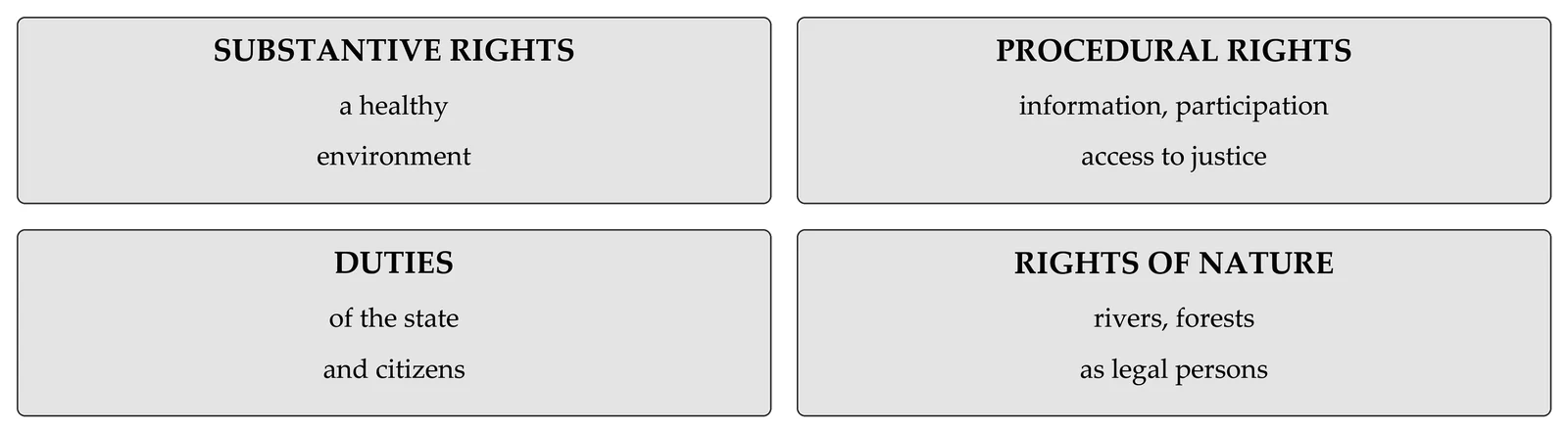
- A substantive right to a healthy environment, first recognised in Portugal’s Constitution of 1976 (Article 66) and in South Africa’s Section 24 of 1996.
- Procedural rights to information, participation and justice, based on Principle 10 of the Rio Declaration (1992) and the Aarhus Convention (1998).
- Duties of state and citizens, as in India’s Articles 48A and 51A(g), added by the 42nd Amendment of 1976 after the Stockholm Conference.
- Rights of nature, recognised in Ecuador’s Constitution of 2008 (Articles 71 to 74), which give nature itself a right to exist and regenerate.
- Intergenerational equity, developed by Edith Brown Weiss in In Fairness to Future Generations (1989), which treats the present generation as trustee of the planet for those yet to come.
- The precautionary principle, which allows action against serious environmental threats even without full scientific certainty.
Global Trends
Erin Daly, Louis Kotzé and James May show that environmental provisions spread rapidly after the 1970s and now appear in most of the world’s constitutions. The UN Environment Programme’s report on the environmental rule of law (2019) warned, however, of a large implementation gap between laws on paper and practice. Climate litigation has opened a new frontier: in Leghari (2015) a Pakistani court ordered climate action, in Urgenda (2019) the Dutch Supreme Court required deeper emission cuts, and in 2021 Germany’s Federal Constitutional Court held that weak climate targets unfairly burdened future generations. The UN General Assembly recognised the right to a clean, healthy and sustainable environment in 2022.
Indian Environmental Jurisprudence
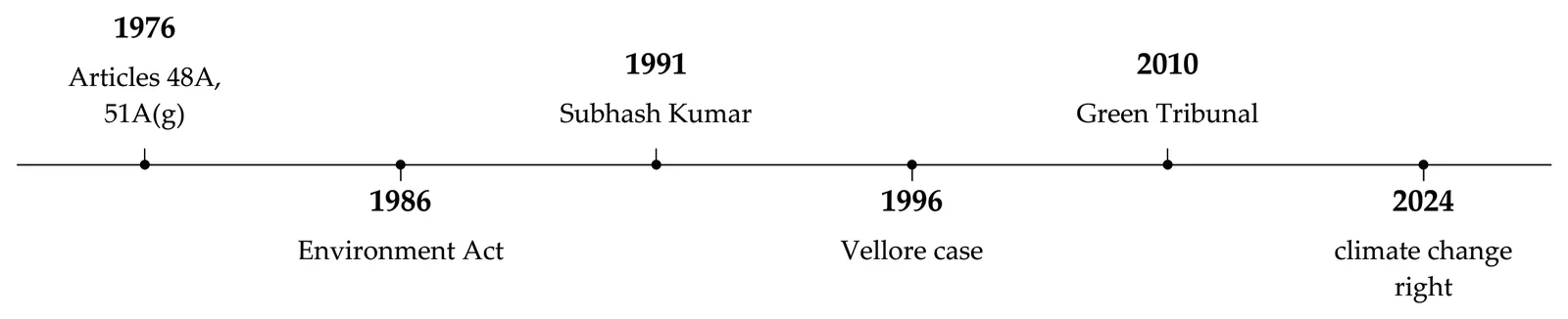
India’s Supreme Court built environmental constitutionalism largely through public interest litigation. Key steps include the Dehradun quarrying case (1985), M.C. Mehta on the oleum gas leak (1987), which created absolute liability, Subhash Kumar (1991), which read clean water and air into Article 21, Vellore Citizens (1996), which adopted precaution and polluter pays, Godavarman (from 1995) on forests, M.C. Mehta v. Kamal Nath (1997) on public trust, and M.K. Ranjitsinh (2024) on climate change. Critics such as Amita Baviskar describe some of this as bourgeois environmentalism, since orders to relocate industries and slums in Delhi in the late 1990s harmed workers and the poor, which shows the need to join environmental and social justice.
Rights of Rivers and Nature
A striking recent development is the recognition of natural entities as legal persons. New Zealand’s Te Awa Tupua Act of 2017 recognised the Whanganui River as a legal person, reflecting the Maori view of the river as an ancestor. In 2016, Colombia’s Constitutional Court declared the Atrato River a subject of rights in decision T-622. In March 2017, the Uttarakhand High Court declared the Ganga and Yamuna living entities with the rights of a legal person, but the Supreme Court stayed the order in July 2017 because of practical difficulties, such as who would be liable for floods. Supporters see such rulings as a shift from a human-centred to an ecocentric constitutionalism, while critics doubt whether they change anything on the ground.
Linking Gender and Environment
The two themes of this chapter meet in movements in which women defended forests, water and land. In the Chipko movement, which began in 1973 in the Garhwal Himalaya, village women led by Gaura Devi of Reni village hugged trees in 1974 to stop commercial felling. Vandana Shiva, in Staying Alive (1988), developed an ecofeminist argument that the domination of women and the domination of nature are linked. Bina Agarwal, in an essay of 1992, offered feminist environmentalism instead, arguing that women’s concern for the environment arises from their material dependence on forests and commons, not from any special female nature. Both views suggest that environmental constitutionalism must include women’s participation and rights over natural resources.
4.4 Important Questions
- Question 1 What is meant by gendering constitutionalism? Discuss.
- Question 2 What is feminist constitutionalism? Discuss with reference to India.
- Question 3 What is environmental constitutionalism? Discuss its main features.
- Question 4 Discuss environmental constitutionalism in India with reference to the role of the judiciary.
DU asks the same idea in different words. So learn one broad answer for each question below; the same answer works for every question joined by OR.
Important Question 1
What is meant by gendering constitutionalism? Discuss.
OR
Examine the views of Helen Irving and Catharine MacKinnon on gender and constitutions.
OR
How can constitutional design advance gender equality?
Model Answer
“One is not born, but rather becomes, a woman.”
— Simone de Beauvoir, The Second Sex (1949)
Introduction. Constitutions claim to treat all citizens equally, yet most were drafted by men and reflected a world in which women were excluded from public life. Gendering constitutionalism means examining constitutions through the lens of gender and redesigning them to secure women’s equality and participation. Helen Irving and Catharine MacKinnon are leading scholars of this field.
1. Meaning
Gendering constitutionalism means recognising that constitutional rules, institutions and interpretations affect men and women differently, and using constitutional design to correct the disadvantages women face in law, politics, the family and the economy.
2. Male-Made Constitutions
Most early constitutions were written by men, and many excluded women from citizenship and voting. The US Constitution did not guarantee women the vote until the Nineteenth Amendment of 1920, and its Equal Rights Amendment was never ratified.
3. Irving on Equity and Agency
Helen Irving, in Gender and the Constitution (2008), argues for gender-sensitive constitutional design guided by two values: equity, meaning fair treatment and outcomes for women, and agency, meaning women’s capacity to act, participate and shape decisions.
4. Design Beyond Rights
Irving shows that gender is affected not only by rights clauses but also by rules on citizenship, federalism, electoral systems and the division of powers. For example, if family law is left to sub-national units or religious communities, women’s rights may vary widely.
5. MacKinnon on Gender in Constitutions
Catharine MacKinnon examines how constitutions around the world address sex equality. She argues that equality should be understood as ending the subordination of women, not merely treating women the same as men, and that constitutions should address sexual violence and exploitation.
6. Formal and Substantive Equality
Formal equality treats men and women identically, which may ignore real differences in power and circumstances. Substantive equality looks at outcomes and allows special measures, such as quotas and maternity protection, to overcome disadvantage.
7. The Public–Private Divide
Feminists criticise the divide between public and private life, because constitutions often protected the family from state interference, leaving domestic violence and unequal family laws untouched. Gendering constitutionalism brings these issues into constitutional view.
8. Women in Constitution-Making
Women’s participation in constitution-making matters. India’s Constituent Assembly had fifteen women members, such as Hansa Mehta and Dakshayani Velayudhan, who pressed for equality, while women’s groups shaped the constitutions of South Africa and Kenya.
9. Equality Clauses
Modern constitutions contain stronger equality clauses. South Africa’s Constitution of 1996 bars discrimination on grounds including sex, gender, pregnancy, marital status and sexual orientation, and Canada’s Charter of Rights guarantees rights equally to male and female persons.
10. Political Quotas
Many constitutions provide quotas for women. Rwanda’s Constitution of 2003 requires at least 30 per cent women in decision-making bodies, and Kenya’s Constitution of 2010 provides that no more than two-thirds of an elective body shall be of the same gender.
11. The Indian Constitution
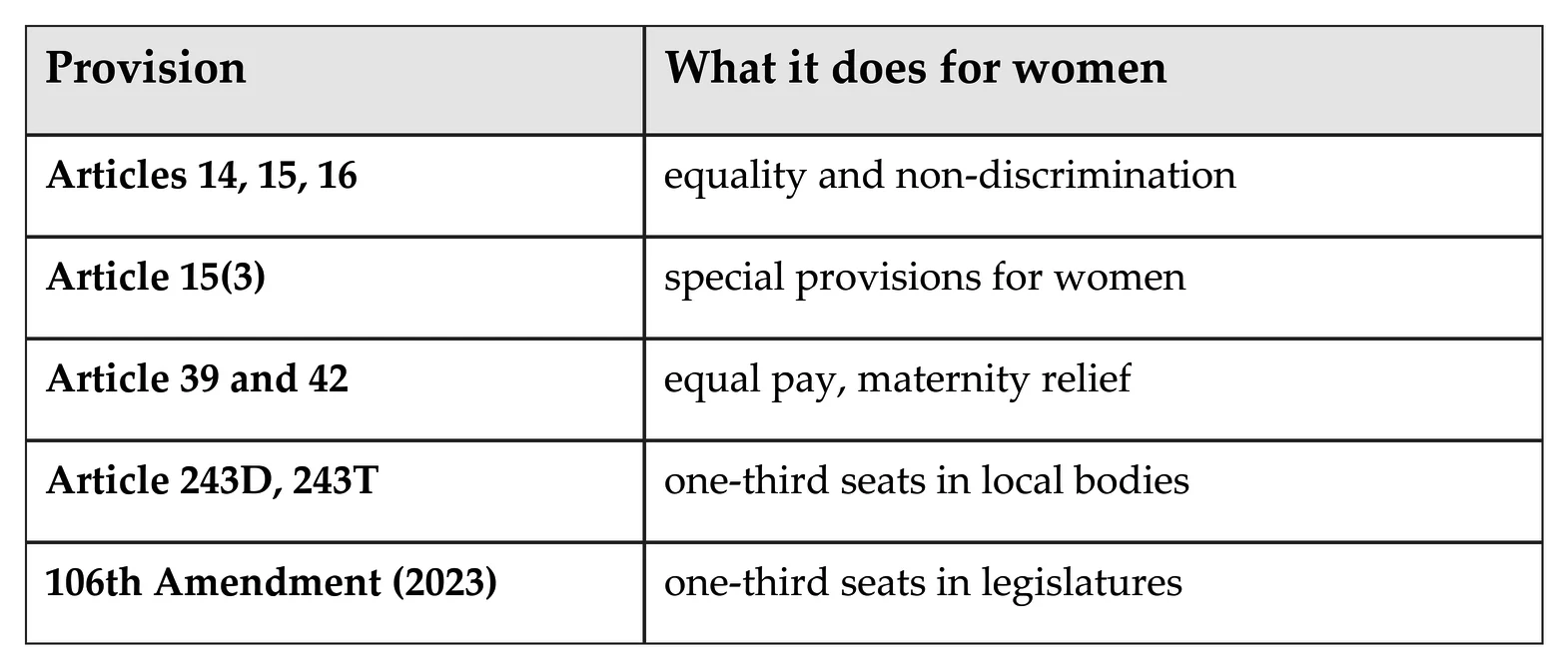
India’s Constitution guarantees equality and non-discrimination (Articles 14, 15 and 16), permits special provisions for women (Article 15(3)), directs equal pay and maternity relief (Articles 39 and 42) and reserves one-third of seats in local bodies (Articles 243D and 243T).
12. The 106th Amendment
The 106th Amendment of 2023 provides for one-third reservation for women in the Lok Sabha and state assemblies, to take effect after the next census and delimitation.
13. CEDAW
The Convention on the Elimination of All Forms of Discrimination against Women (1979), ratified by India in 1993, has influenced constitutional interpretation, as courts use it to fill gaps in domestic law.
14. Criticisms
Some argue that constitutional rights alone cannot change patriarchal social practices, and that quotas may benefit elite women. Others warn against treating women as a single group, ignoring caste, class and religion.
15. Evaluation
Gendering constitutionalism shows that equality must be designed into constitutions through rights, institutions and participation, not assumed.
Conclusion. Thus, gendering constitutionalism examines how constitutions affect women and redesigns them for equity and agency, as Irving argues. MacKinnon calls for substantive equality that ends subordination. Equality clauses, quotas and women’s participation in constitution-making, as in South Africa, Rwanda, Kenya and India’s 106th Amendment, show how constitutions can advance gender equality.
Important Question 2
What is feminist constitutionalism? Discuss with reference to India.
OR
How have Indian courts advanced gender equality through constitutional interpretation?
OR
Examine Beverley Baines’s idea of feminist constitutionalism.
Model Answer
“Political democracy cannot last unless there lies at the base of it social democracy.”
— B.R. Ambedkar, Constituent Assembly (25 November 1949)
Introduction. Feminist constitutionalism is the engagement of feminist thought and activism with constitutions, their making and their interpretation. Beverley Baines, in the introduction to Feminist Constitutionalism: Global Perspectives (2012), explains how feminists seek to make constitutional law reflect women’s experiences. In India, women’s movements and courts have used the Constitution to advance gender justice.
1. Baines on Feminist Constitutionalism
Beverley Baines describes feminist constitutionalism as a project that examines constitutions from women’s perspectives and seeks to use them to advance equality. It includes women’s participation in drafting, feminist interpretation of rights and attention to issues such as religion, culture and family.
2. Main Themes
Feminist constitutionalism addresses equality and non-discrimination, political representation, reproductive rights, sexual violence, family and personal laws, and the tension between women’s rights and claims of religion and culture.
3. Nergesh Meerza, 1981
In Air India v. Nergesh Meerza (1981), the Supreme Court struck down a rule ending air hostesses’ service on their first pregnancy as unreasonable and arbitrary, though it upheld other discriminatory rules, showing the early limits of judicial reasoning.
4. Vishaka, 1997
In Vishaka v. State of Rajasthan (1997), the Court laid down guidelines against sexual harassment at the workplace, drawing on CEDAW. These led to the Sexual Harassment of Women at Workplace Act of 2013.
5. Shayara Bano, 2017
In Shayara Bano v. Union of India (2017), the Court held instant triple talaq unconstitutional, a case brought by a Muslim woman, which raised the question of how equality applies to personal laws.
6. Joseph Shine, 2018
In Joseph Shine v. Union of India (2018), the Court struck down the adultery provision of the Indian Penal Code, holding that it treated a wife as her husband’s property and violated equality and dignity.
7. Babita Puniya, 2020
In Secretary, Ministry of Defence v. Babita Puniya (2020), the Court directed that women officers in the Army be granted permanent commission, rejecting stereotypes about women’s physical and social roles.
8. Reproductive Autonomy
In X v. Principal Secretary, Health and Family Welfare (2022), the Court held that unmarried women are entitled to safe and legal abortion on the same basis as married women, recognising reproductive autonomy.
9. Women’s Movements
The Indian women’s movement has campaigned against dowry, custodial rape and sexual harassment, and for reservation in legislatures, using constitutional language to press for legal reform.
10. Personal Laws and Equality
Feminist constitutionalism in India faces the question of personal laws, which govern marriage, divorce and inheritance by religion. Debates on a uniform civil code reflect tensions between gender equality and religious freedom.
11. Intersectionality
Indian feminists stress that women’s experiences differ by caste, class, religion and region. Dalit and Adivasi women face multiple disadvantages that a single focus on gender may miss.
12. Representation
The reservation of seats in panchayats since 1992 brought more than a million women into local government, and the 106th Amendment of 2023 extends reservation to legislatures.
13. Comparative Examples
Elsewhere, South Africa’s Constitutional Court has advanced women’s rights in cases on customary law and inheritance, and Colombia’s Court has protected reproductive rights, showing feminist constitutionalism across the global South.
14. Limits
Court judgments do not automatically change social practice. Implementation, awareness and social change are needed for constitutional rights to reach women in everyday life.
15. Domestic Violence and Rights
The Protection of Women from Domestic Violence Act of 2005 recognised that violence within the home violates women’s constitutional rights to equality, dignity and life. It covered physical, sexual, verbal, emotional and economic abuse and gave women a right to reside in the shared household, bringing the private sphere of the family within the reach of constitutional values.
16. Women in the Armed Forces and Workplaces
Beyond Babita Puniya, the Supreme Court in 2021 allowed women to sit for the National Defence Academy examination, and laws on maternity benefit, amended in 2017 to give twenty-six weeks of paid leave, and on equal remuneration have extended constitutional equality into employment, though gaps in pay and participation remain wide.
17. Evaluation
Feminist constitutionalism has made constitutions more responsive to women, and in India courts and movements have together advanced gender justice.
Conclusion. Thus, feminist constitutionalism, as Baines explains, examines and uses constitutions to advance women’s equality. In India, cases from Nergesh Meerza and Vishaka to Joseph Shine, Babita Puniya and the 2022 abortion ruling, along with women’s movements and reservation, show its progress, though social change and personal laws remain challenges.
Important Question 3
What is environmental constitutionalism? Discuss its main features.
OR
Examine the new frontiers of environmental constitutionalism.
OR
How do constitutions protect the environment?
Model Answer
“The State shall endeavour to protect and improve the environment and to safeguard the forests and wild life of the country.”
— Constitution of India, Article 48A
Introduction. Environmental constitutionalism is the inclusion of environmental rights, duties and principles in constitutions and their enforcement by courts. It has grown rapidly since the 1970s, and today most constitutions contain some environmental provision. Erin Daly, Louis Kotzé and James May, writing for the UN Environment Programme, describe its features and new frontiers.
1. Meaning
Environmental constitutionalism refers to the use of constitutional law to protect the environment, through substantive rights to a healthy environment, procedural rights, duties of the state and citizens, and principles such as sustainable development.
2. Why Constitutionalise the Environment
Placing environmental protection in the constitution gives it the status of higher law, protects it from short-term political pressures, allows courts to enforce it and signals that the environment is a fundamental value of the nation.
3. Growth
Portugal’s Constitution of 1976 was among the first to recognise a right to a healthy environment. Since then, more than a hundred constitutions have added environmental rights or duties, especially in Latin America, Africa and Europe.
4. Substantive Rights
Many constitutions guarantee a right to a healthy, clean or ecologically balanced environment, which courts can use to stop pollution, deforestation and harmful projects.
5. Procedural Rights
Procedural environmental rights include access to information, public participation in decisions and access to justice. They follow the principles of the Rio Declaration of 1992 and the Aarhus Convention of 1998.
6. Duties
Constitutions also impose environmental duties on the state, such as India’s Article 48A, and on citizens, such as Article 51A(g), which requires every citizen to protect and improve the natural environment.
7. Daly, Kotzé and May
Erin Daly, Louis Kotzé and James May explain that environmental constitutionalism links environmental protection with human rights, the rule of law and democracy, and that its success depends on courts willing to enforce it.
8. New Frontiers
Arnold Kreilhuber of the UN Environment Programme identifies new frontiers, such as the rights of nature, climate change litigation, the rights of future generations and the environmental rule of law.
9. Rights of Nature
Ecuador’s Constitution of 2008 recognised the rights of nature to exist and regenerate. Courts in Colombia have treated the Amazon and rivers as subjects of rights, and New Zealand granted legal personhood to the Whanganui River in 2017.
10. Climate Litigation
Courts have begun to use constitutional and human rights to require climate action, as in Leghari v. Pakistan (2015) and the Urgenda case in the Netherlands (2019), where courts ordered governments to act on emissions.
11. International Recognition
The UN Human Rights Council in 2021 and the General Assembly in July 2022 recognised the human right to a clean, healthy and sustainable environment, strengthening environmental constitutionalism worldwide.
12. Role of Judges
James May and Erin Daly’s Judicial Handbook on Environmental Constitutionalism (2017) guides judges on interpreting environmental provisions, showing that enforcement depends on an informed and active judiciary.
13. Challenges
Challenges include vague provisions, conflicts with development and property rights, weak enforcement and the difficulty of proving environmental harm.
14. Global South
Many of the strongest examples of environmental constitutionalism come from the global South, where communities depend directly on natural resources and courts have been active.
15. Intergenerational Equity
Environmental constitutionalism often protects the interests of future generations. Some constitutions, such as those of Norway and Kenya, refer to the rights of future generations, and courts in the Philippines, Colombia and India have recognised intergenerational equity, holding that the present generation must not use up or degrade natural resources that belong to those yet to be born.
16. Evaluation
Environmental constitutionalism raises environmental protection to the highest legal level, but its value depends on enforcement by courts and governments.
Conclusion. Thus, environmental constitutionalism protects the environment through constitutional rights, procedural guarantees and duties. As Daly, Kotzé and May show, it has spread widely since Portugal’s 1976 Constitution, and new frontiers include the rights of nature, climate litigation and the UN’s recognition of a right to a healthy environment in 2022.
Important Question 4
Discuss environmental constitutionalism in India with reference to the role of the judiciary.
OR
How has the Supreme Court of India expanded the right to life to protect the environment?
OR
Examine the constitutional and judicial principles of environmental protection in India.
Model Answer
“It shall be the duty of every citizen of India to protect and improve the natural environment including forests, lakes, rivers and wild life, and to have compassion for living creatures.”
— Constitution of India, Article 51A(g)
Introduction. India’s original Constitution said little about the environment. After the Stockholm Conference of 1972, the 42nd Amendment of 1976 added environmental duties for the state and citizens. Since the 1980s, the Supreme Court has made India one of the leading examples of environmental constitutionalism, reading a right to a healthy environment into the right to life.
1. The 42nd Amendment
The 42nd Amendment of 1976 added Article 48A, directing the state to protect and improve the environment and safeguard forests and wildlife, and Article 51A(g), making it a duty of citizens to protect the natural environment.
2. Environmental Laws
Parliament passed the Water Act (1974), the Air Act (1981), the Forest (Conservation) Act (1980) and, after the Bhopal gas tragedy, the Environment (Protection) Act of 1986, which gave the Union wide powers to protect the environment.
3. Right to Life
In Subhash Kumar v. State of Bihar (1991), the Supreme Court held that the right to life under Article 21 includes the right to enjoy pollution-free water and air. Earlier, in the Dehradun quarrying case of 1985, it had closed limestone quarries to protect the environment.
4. Absolute Liability
In M.C. Mehta v. Union of India (1987), after a gas leak in Delhi, the Court laid down the principle of absolute liability for hazardous industries, stricter than the old rule of strict liability.
5. The Vellore Case
In Vellore Citizens Welfare Forum v. Union of India (1996), the Court accepted the precautionary principle and the polluter pays principle as part of Indian law, and treated sustainable development as a balancing concept.
6. Public Trust Doctrine
In M.C. Mehta v. Kamal Nath (1997), the Court held that the state holds natural resources such as rivers, forests and the seashore in trust for the public and cannot transfer them for private use against the public interest.
7. Forest Cases
In T.N. Godavarman Thirumulpad v. Union of India, begun in 1995, the Court took over the supervision of forest protection across India through a continuing mandamus, issuing orders on felling, mining and compensatory afforestation.
8. Public Interest Litigation
Most environmental cases came through public interest litigation filed by citizens such as M.C. Mehta, which allowed courts to address pollution of the Ganga, vehicular pollution in Delhi and damage to the Taj Mahal.
9. The National Green Tribunal
The National Green Tribunal, set up in 2010, hears environmental cases quickly with judicial and expert members. It applies the principles of sustainable development, precaution and polluter pays.
10. Climate Change
In M.K. Ranjitsinh v. Union of India (2024), a case about the Great Indian Bustard, the Supreme Court recognised a right against the adverse effects of climate change under Articles 14 and 21.
11. Rights of Nature
In 2017, the Uttarakhand High Court declared the Ganga and Yamuna rivers legal persons, though the Supreme Court stayed the order. The case shows the influence of the rights of nature movement.
12. Environment and Livelihoods
Environmental orders have sometimes harmed the poor, as when slums or small industries were closed without adequate rehabilitation. Critics urge balancing environmental protection with the rights of forest dwellers and workers.
13. Criticisms of Judicial Activism
Some argue that courts have taken over executive functions in environmental governance, issuing detailed orders they cannot monitor, and that this may weaken accountability of the executive.
14. Guidance for Judges
The Judicial Handbook on Environmental Constitutionalism by May and Daly cites Indian cases as leading examples, showing India’s influence on environmental constitutionalism worldwide.
15. Environmental Impact Assessment
The Environment Impact Assessment Notification of 2006 requires public hearings and expert appraisal before large projects are approved. Courts and the Green Tribunal have cancelled clearances granted without proper hearings or studies, linking environmental constitutionalism with procedural rights of information and participation, though critics say later amendments have weakened the process.
16. Evaluation
India’s courts have built strong environmental constitutionalism through Article 21 and judicial principles, though balance with livelihoods and executive accountability remains necessary.
Conclusion. Thus, India’s environmental constitutionalism rests on Articles 48A and 51A(g) and the courts’ reading of Article 21. From Subhash Kumar and M.C. Mehta to Vellore, Kamal Nath, Godavarman and the 2024 climate ruling, the judiciary has developed principles of precaution, polluter pays and public trust, while the Green Tribunal provides specialised justice.
Short Notes
(a) Equity and agency
Helen Irving’s two values for gender-sensitive constitutional design: fair treatment of women and women’s capacity to act and shape decisions.
(b) Polluter pays principle
The principle, accepted in the Vellore case (1996), that those who cause pollution must bear the cost of repairing the damage.
(c) Public trust doctrine
The principle, applied in M.C. Mehta v. Kamal Nath (1997), that the state holds natural resources in trust for the public.
More notes: DSE-12 Comparative Constitutionalism
These notes are prepared by PADHO TO AISE for study help. They are not an official University of Delhi publication.