
Semester IV DSE-2b India's National Security
Unit I · 23 min read · Updated 24 Nov 2026
As per the University of Delhi (DU) BA (Hons) Political Science syllabus
Contents
- 1.1 India’s Security Policy: A Historical Perspective
- The Colonial Inheritance
- The Nehru Years
- Wars, Nuclearisation and New Threats
- Lessons of History
- Milestones in India’s Security Policy
- 1.2 Contemporary Dimensions of India’s National Security Framework
- Bajpai: Modified Structuralism
- Institutions of National Security
- Non-Traditional Security
- Challenges in the Framework
- Reports that Shaped the Framework
- 1.3 Conceptualizing India’s National Security
- Behera and Moazzam: India’s National Security Discourse
- Raghavan: Security and Foreign Policy
- Indian Approaches
- Security in the Constitution and Law
- 1.4 Important Questions
- Trace the evolution of India’s security policy since independence.
- Discuss the contemporary dimensions of India’s national security framework.
- Discuss how the concept of national security has been understood in India.
- Examine Kanti Bajpai’s argument that India’s security practice reflects modified structuralism.
- Short Notes
संघ का यह कर्तव्य होगा कि वह बाह्य आक्रमण और आंतरिक अशांति से प्रत्येक राज्य की संरक्षा करे।
It shall be the duty of the Union to protect every State against external aggression and internal disturbance.
— Constitution of India, Article 355
NNATIONAL security is the protection of a nation’s territory, people, institutions and values from threats, external and internal. For India, with long and disputed land borders, a vast coastline, hostile neighbours armed with nuclear weapons, internal insurgencies and new threats such as terrorism and cyber attacks, security has been a constant concern since independence. This chapter examines India’s security policy in historical perspective, the contemporary dimensions of its national security framework, and the ways in which India’s national security has been conceptualised, from a narrow military view to a comprehensive and human-centred one.

1.1 India’s Security Policy: A Historical Perspective
The Colonial Inheritance
India’s security thinking was shaped by the experience of invasions through the north-west and by the strategy of the British Raj. Raju G.C. Thomas, in The Strategic Environment and Defence Policies (1986), shows that British India defended a large security perimeter, using buffer states such as Afghanistan, Tibet and Nepal, controlling the Indian Ocean through naval supremacy and maintaining a large Indian Army. Independent India inherited this geography and much of this outlook. Sanjay Chaturvedi, in Indian Geopolitics: Nation-State and the Colonial Legacy (2005), shows that colonial cartography drew boundaries such as the Durand Line (1893) and the McMahon Line (1914), and that Partition left India with disputed borders that still shape its security.
The Nehru Years
Under Jawaharlal Nehru, India gave priority to economic development and non-alignment, kept defence spending modest and hoped that friendship with China, expressed in the Panchsheel agreement of 1954, would secure its northern border. India fought Pakistan over Kashmir in 1947–48 and took the dispute to the UN. The 1962 war with China ended in a humiliating defeat, revealing weaknesses in military preparation, intelligence and political judgement, and leading to a major expansion of the armed forces.
Wars, Nuclearisation and New Threats
- 1965 war. India and Pakistan fought over Kashmir; the Tashkent Agreement (1966) restored the status quo.
- 1971 war. After signing the Indo-Soviet Treaty of August 1971, India intervened in East Pakistan, leading to the creation of Bangladesh and establishing India as the dominant power in South Asia.
- Nuclear tests. India conducted a peaceful nuclear explosion at Pokhran in 1974 and nuclear weapon tests in May 1998 (Pokhran-II), followed by Pakistan’s tests; both became nuclear-armed states.
- IPKF. The Indian Peace Keeping Force in Sri Lanka (1987–90) became entangled in conflict with the LTTE, a costly lesson in regional intervention.
- Kargil (1999). Pakistani forces occupied heights in Kargil; India expelled them, and the Kargil Review Committee led to reforms in intelligence and higher defence management.
- Terrorism. Attacks on Parliament (2001) and Mumbai (26 November 2008) highlighted cross-border terrorism; India responded with surgical strikes (2016) and the Balakot air strike (2019).
- China. Standoffs at Doklam (2017) and the clash in Galwan (June 2020), the first deadly clash on the border since 1975, renewed focus on the northern frontier.
Lessons of History
Scholars such as L.P. Singh and Sumit Ganguly note recurring lessons: India was often surprised by threats (1962, Kargil, Mumbai) because of weak intelligence and coordination; civil-military relations kept the armed forces away from policy-making; and strategic planning was often reactive. David Malone and Shyam Saran show that history, from Kautilya to colonial rule, shapes India’s world view and its preference for strategic autonomy.
Milestones in India’s Security Policy
- 1947–49. The first war over Kashmir ended with a UN-brokered ceasefire on 1 January 1949, leaving the state divided along a ceasefire line.
- 1954. The Panchsheel agreement with China expressed Nehru’s hope that peaceful coexistence would secure the northern frontier.
- 1962. Defeat in the war with China led to a sharp rise in defence spending and the raising of new mountain divisions.
- 1965–66. The war with Pakistan ended with the Tashkent Declaration of January 1966, mediated by the Soviet Union.
- 1971–72. The Indo-Soviet Treaty of Peace, Friendship and Cooperation (August 1971) preceded the Bangladesh war; the Simla Agreement of 1972 turned the ceasefire line in Kashmir into the Line of Control.
- 1974 and 1998. India conducted a peaceful nuclear explosion at Pokhran in 1974 and declared itself a nuclear weapon state after the Pokhran-II tests of May 1998.
1.2 Contemporary Dimensions of India’s National Security Framework
Bajpai: Modified Structuralism
Kanti Bajpai, in India: Modified Structuralism (in Muthiah Alagappa, ed., Asian Security Practice, 1998), argues that India’s security practice is best explained by structural realism modified by other factors. The structure of the international and regional system, anarchy and the distribution of power, especially rivalry with Pakistan and China, pushes India to seek military strength, nuclear deterrence and regional primacy. But ideas, such as Nehruvian internationalism and the commitment to non-alignment, and domestic factors, such as democratic politics, economic constraints and internal diversity, modify how India responds. Hence India combines realist policies with restraint, preference for negotiation and reluctance to form alliances.
Institutions of National Security
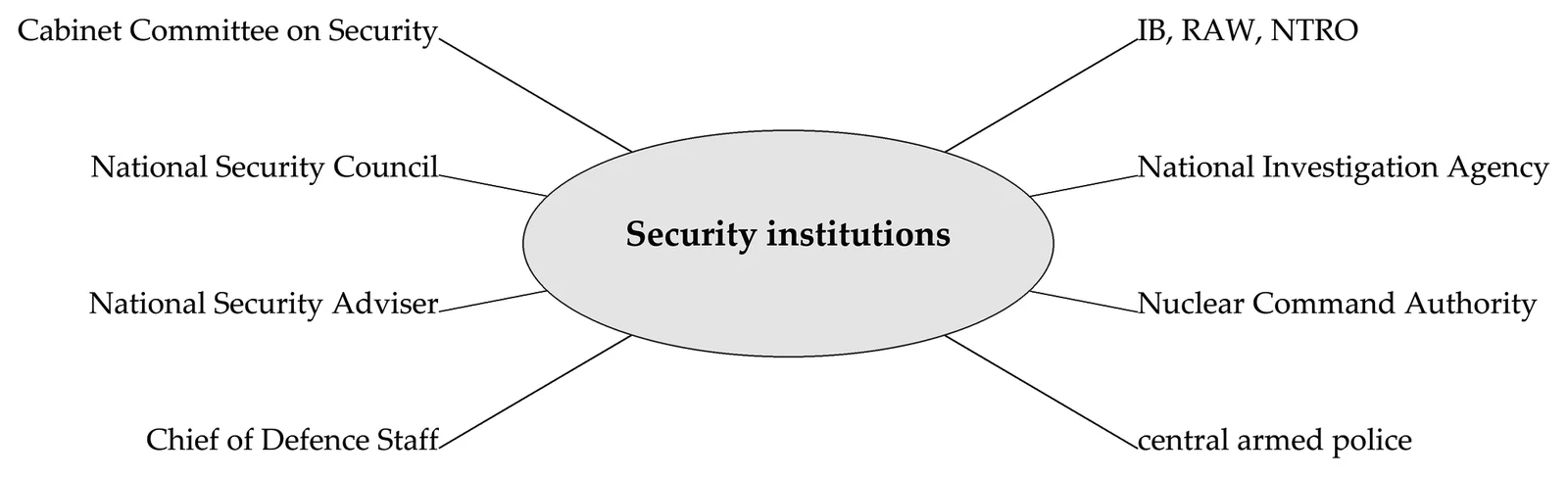
- Cabinet Committee on Security. Chaired by the Prime Minister, it takes the main decisions on defence and security.
- National Security Council (1998). Headed by the Prime Minister, with the National Security Adviser as its key official, supported by the Strategic Policy Group, the National Security Advisory Board and the National Security Council Secretariat.
- Chief of Defence Staff (2020). Created to promote jointness among the Army, Navy and Air Force; General Bipin Rawat was the first CDS, heading a new Department of Military Affairs.
- Intelligence agencies. The Intelligence Bureau (internal), the Research and Analysis Wing (1968, external), the National Technical Research Organisation and the National Investigation Agency (2009, after the Mumbai attacks).
- Nuclear Command Authority (2003). It manages India’s nuclear arsenal under a doctrine of no first use and credible minimum deterrence.
- Central Armed Police Forces. Forces such as the BSF, CRPF, ITBP and Assam Rifles guard borders and deal with internal security.
Non-Traditional Security
Arvind Gupta, a former Deputy National Security Adviser, in How India Manages its National Security (2018), stresses that India’s security environment now includes non-traditional issues: energy security, since India imports most of its oil; food and water security; health security, as the Covid-19 pandemic showed; climate change and disasters; cyber security; and economic security. Rohan Mukherjee and David Malone argue that India’s contemporary security challenges are increasingly linked with globalisation, technology and internal governance.
Challenges in the Framework
Analysts point to continuing weaknesses: the absence of a published national security strategy, limited coordination between ministries and agencies, slow defence procurement, dependence on imported weapons, and inadequate integration of the armed forces. Recent reforms include the Defence Planning Committee (2018), the creation of the CDS, the push for Atmanirbharta in defence production and the Agnipath recruitment scheme (2022).
Reports that Shaped the Framework
Much of India’s present security framework came from official reviews after crises. The Kargil Review Committee, chaired by K. Subrahmanyam, reported in 1999 that intelligence, coordination and higher defence management had failed. A Group of Ministers (2001) then recommended reforms that created the Integrated Defence Staff and the Defence Intelligence Agency in 2002. The Naresh Chandra Task Force (2012) proposed a permanent chairman of the Chiefs of Staff Committee, and the Shekatkar Committee (2016) suggested ways to improve combat capability and cut wasteful spending. The long-debated post of Chief of Defence Staff was finally created in December 2019, with General Bipin Rawat taking charge on 1 January 2020, along with a new Department of Military Affairs.
1.3 Conceptualizing India’s National Security
Behera and Moazzam: India’s National Security Discourse
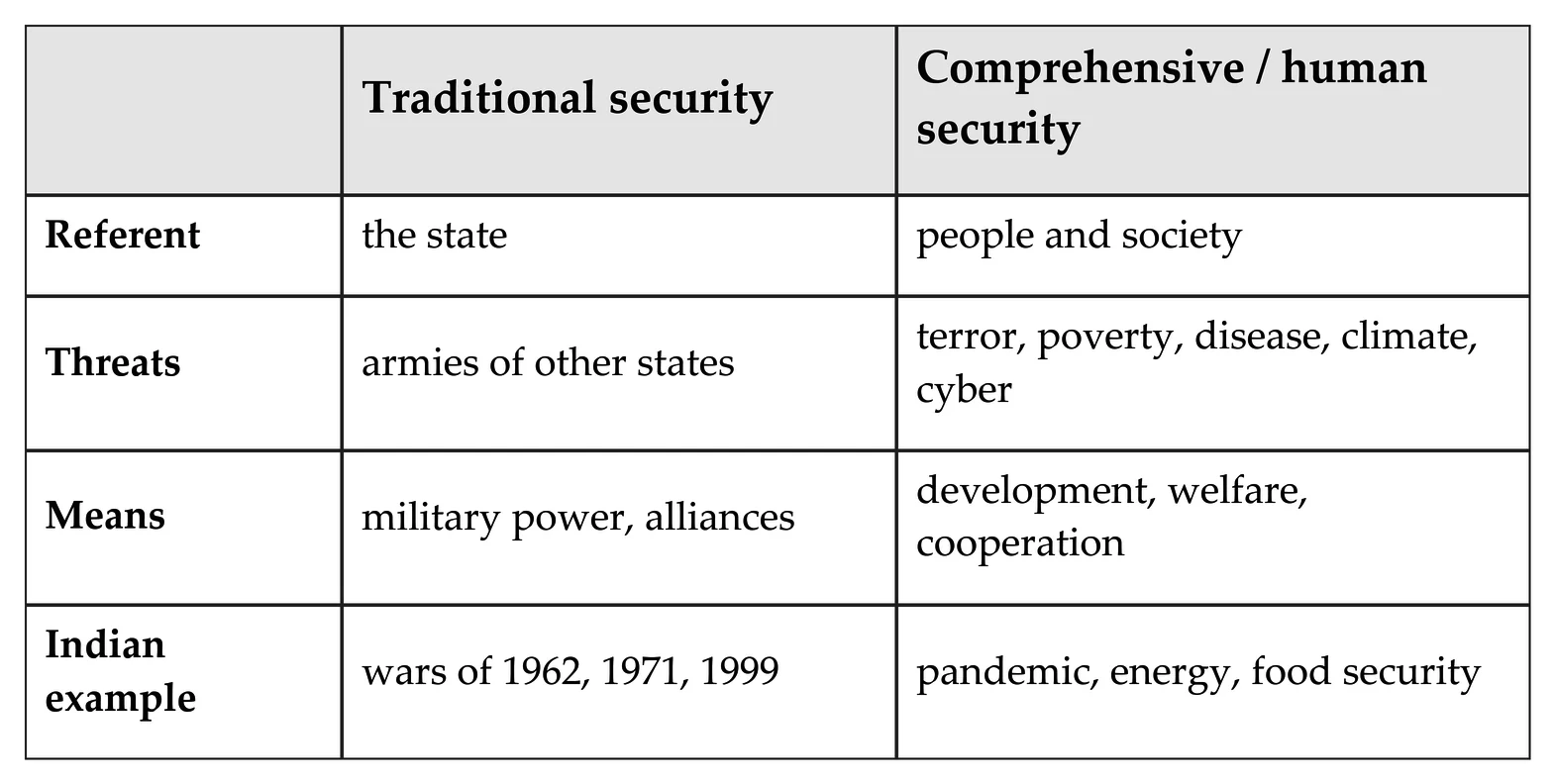
Anshuman Behera and Areeba Ahsanat Moazzam, in India’s National Security Discourse: A Conceptual Introduction (2022), trace how the concept of national security in India has evolved. The traditional concept focused on the state, territorial integrity and military threats from neighbours. Over time, the discourse widened to include internal security (insurgency, terrorism, communal violence), economic and energy security, environmental security and human security, centred on the safety and well-being of people. They note that Indian discourse combines realist concerns with a long-standing emphasis on development and the welfare of people as foundations of security.
Raghavan: Security and Foreign Policy
P.S. Raghavan, a former Convenor of the National Security Advisory Board, in National Security Determinants of Foreign Policy (2020), argues that national security considerations, such as the threats from Pakistan and China, the need for energy, technology and defence partnerships, and the protection of the diaspora and sea lanes, shape India’s foreign policy choices. Foreign policy is therefore a key instrument of national security, through partnerships, multilateral diplomacy and economic engagement.
Indian Approaches
- Development as security. Nehru argued that economic strength is the basis of security; in 1947 he said that foreign policy is ultimately the outcome of economic policy.
- Comprehensive national security. Security includes military, economic, technological, social and environmental dimensions, all linked.
- Strategic autonomy. India seeks to preserve independence of decision-making, avoiding dependence on any single power.
- Restraint. India has generally preferred defensive postures, no first use of nuclear weapons and negotiated settlements, though it has also used force when it judged necessary.
- Human security. The UNDP’s Human Development Report of 1994 defined human security as freedom from fear and want, a concept increasingly used in Indian debates on internal security and development.
Harsh Pant and Kartik Bommakanti, in India’s National Security: Challenges and Dilemmas (2019), argue that India faces a growing gap between its ambitions as a rising power and its capacities, and must manage the two-front threat from China and Pakistan, internal conflicts and new technological threats, while balancing strategic autonomy with deeper partnerships.
Security in the Constitution and Law
The Constitution places defence, armed forces, atomic energy and foreign affairs in the Union List, while police and public order are state subjects. Article 352 allows a national emergency in case of war, external aggression or armed rebellion; the 44th Amendment (1978) replaced the vague words internal disturbance with armed rebellion after the misuse of 1975. Article 355 makes it the duty of the Union to protect every state against external aggression and internal disturbance. Laws such as the Unlawful Activities (Prevention) Act, 1967 and the National Investigation Agency Act, 2008 give the state powers against terrorism, though critics argue that their wide definitions can threaten civil liberties.
1.4 Important Questions
- Question 1 Trace the evolution of India’s security policy since independence.
- Question 2 Discuss the contemporary dimensions of India’s national security framework.
- Question 3 Discuss how the concept of national security has been understood in India.
- Question 4 Examine Kanti Bajpai’s argument that India’s security practice reflects modified structuralism.
DU asks the same idea in different words. So learn one broad answer for each question below; the same answer works for every question joined by OR.
Important Question 1
Trace the evolution of India’s security policy since independence.
OR
Examine India’s security policy in historical perspective.
OR
Discuss the colonial legacy in India’s national security.
Model Answer
“Talk as we may of foreign policy, ultimately foreign policy is the outcome of economic policy.”
— Jawaharlal Nehru, speech in the Constituent Assembly (Legislative) (4 December 1947)
Introduction. India’s security policy has evolved through wars, crises and changing global conditions since 1947. It began with the colonial inheritance of borders and strategic outlook, was shaped by Nehru’s emphasis on development and non-alignment, transformed by the shock of 1962, and later by nuclearisation, terrorism and the rise of China. Each phase left lessons that continue to influence India’s security thinking.
1. Ancient and Medieval Experience
India’s history of invasions through the north-west passes and the strategic thought of Kautilya shaped a long-standing concern with frontiers, alliances and the balance of power among neighbours.
2. The British Security Perimeter
Raju Thomas shows that British India defended a wide perimeter using buffer states such as Afghanistan, Tibet and Nepal, naval control of the Indian Ocean and a large army, an outlook independent India partly inherited.
3. Colonial Boundaries
Chaturvedi shows that colonial cartography drew lines such as the Durand Line (1893) and McMahon Line (1914), and Partition left disputed borders with Pakistan and China.
4. Nehru’s Priorities
Nehru gave priority to development and non-alignment, kept defence spending modest and argued that foreign policy is ultimately the outcome of economic policy.
5. Kashmir, 1947–48
The first war with Pakistan over Kashmir and the referral of the dispute to the UN made Kashmir the central issue in India-Pakistan relations.
6. Panchsheel and 1962
India hoped that the Panchsheel agreement with China (1954) would secure its border, but the 1962 war ended in defeat, exposing weaknesses in preparation and intelligence.
7. Military Expansion
After 1962, India expanded its armed forces, modernised equipment and gave greater attention to defence planning and the northern frontier.
8. 1965 and 1971
The 1965 war ended in stalemate, but the 1971 war, backed by the Indo-Soviet Treaty, created Bangladesh and established India as the dominant regional power.
9. Nuclear Path
India conducted a peaceful nuclear explosion in 1974 and nuclear weapon tests in 1998, becoming a nuclear-armed state with a doctrine of no first use.
10. Regional Intervention
The IPKF in Sri Lanka (1987–90) showed the costs of intervention in neighbours’ conflicts, making India more cautious.
11. Kargil, 1999
The Kargil conflict exposed intelligence failures; the Kargil Review Committee chaired by K. Subrahmanyam led to reforms such as the National Security Council and intelligence restructuring.
12. Terrorism
The attacks on Parliament (2001) and Mumbai (2008) made cross-border terrorism central, leading to the NIA (2009) and later the surgical strikes (2016) and Balakot (2019).
13. China Challenge
The Doklam standoff (2017) and the Galwan clash (2020) renewed focus on the northern border and the two-front threat.
14. Lessons
Scholars note recurring surprise due to weak intelligence, limited civil-military integration and reactive planning, lessons stressed by L.P. Singh and Sumit Ganguly.
15. Strategic Autonomy
Throughout, India has sought strategic autonomy, preferring independent decision-making to alliances, a preference rooted in its history.
16. Security and Democracy
India has kept civilian control over the armed forces since independence, unlike several neighbours where the military seized power. This democratic tradition shaped security policy, keeping the military away from political decisions but sometimes limiting its role in strategic planning.
17. Extended Neighbourhood
Since the 1990s, India’s security horizon has expanded to the extended neighbourhood, from the Gulf to South-East Asia, through the Look East and Act East policies, maritime cooperation and energy diplomacy, reflecting its growing economic interests.
18. Evaluation
India’s security policy has moved from idealism and restraint towards greater realism and capability, while retaining commitments to autonomy and restraint.
Conclusion. Thus, India’s security policy evolved from the colonial inheritance and Nehru’s development-first approach, through the shocks of 1962, the victory of 1971 and nuclearisation, to the challenges of terrorism and China. Nehru’s link between foreign and economic policy remains a reminder that security rests on national strength.
Important Question 2
Discuss the contemporary dimensions of India’s national security framework.
OR
Examine the institutions of national security management in India.
OR
Discuss the role of the National Security Council and the Chief of Defence Staff.
Model Answer
“A posture of No First Use: nuclear weapons will only be used in retaliation against a nuclear attack on Indian territory or on Indian forces anywhere.”
— Cabinet Committee on Security, India’s nuclear doctrine (4 January 2003)
Introduction. India’s national security framework includes the institutions, doctrines and policies through which the state manages threats. It has evolved through reforms after crises such as Kargil and Mumbai. Today it covers not only military threats but also non-traditional issues such as energy, cyber and health security, though analysts point to continuing gaps.
1. The Cabinet Committee on Security
The Cabinet Committee on Security, chaired by the Prime Minister, takes the main decisions on defence, nuclear policy and internal security.
2. The National Security Council
Set up in November 1998, the NSC is headed by the Prime Minister. It is supported by the Strategic Policy Group, the National Security Advisory Board and a secretariat.
3. The National Security Adviser
The NSA, first Brajesh Mishra, coordinates security policy, advises the Prime Minister and handles sensitive negotiations, such as border talks with China.
4. Chief of Defence Staff
Created in January 2020, the CDS heads the Department of Military Affairs and promotes jointness among the three services; General Bipin Rawat was the first CDS.
5. Theatre Commands
Reforms aim to create integrated theatre commands combining the Army, Navy and Air Force for particular regions, a change still under discussion.
6. Intelligence Agencies
The Intelligence Bureau, the Research and Analysis Wing (1968), the NTRO and the NIA (2009) gather intelligence and investigate threats such as terrorism.
7. Nuclear Doctrine
India’s nuclear doctrine of 2003 declared no first use and credible minimum deterrence, with the Nuclear Command Authority controlling the arsenal.
8. Internal Security Forces
Central Armed Police Forces such as the BSF, CRPF and ITBP guard borders and handle insurgencies, while states maintain police forces.
9. Bajpai’s Modified Structuralism
Kanti Bajpai argues that India’s security practice reflects structural realism modified by ideas and domestic factors, explaining its mix of strength and restraint.
10. Non-Traditional Security
Arvind Gupta stresses energy, food, water, health, climate and cyber security as parts of India’s security environment.
11. Energy Security
India imports most of its crude oil, so secure supplies, strategic petroleum reserves and diversified sources are security priorities.
12. Cyber and Technology
Cyber attacks on infrastructure and data, and competition in emerging technologies, require new institutions such as the National Cyber Security Coordinator.
13. Defence Production
Dependence on imported weapons is a vulnerability; the push for Atmanirbharta seeks to build domestic defence production and exports.
14. Gaps
Analysts note the absence of a published national security strategy, slow procurement and limited coordination among ministries and agencies.
15. Recent Reforms
The Defence Planning Committee (2018), the CDS (2020) and the Agnipath scheme (2022) are among recent attempts to modernise the framework.
16. Maritime and Space Security
India’s framework increasingly covers the seas and space: the Navy’s role in the Indian Ocean, coastal security reforms after the 2008 Mumbai attack, and the Defence Space Agency (2019), set up after India’s anti-satellite test, Mission Shakti, in March 2019.
17. Parliament and Oversight
Parliamentary committees on defence and home affairs examine budgets and policies, but critics argue that parliamentary debate on national security is limited and that greater oversight of intelligence agencies is needed.
18. Evaluation
India’s security framework has grown more institutionalised and comprehensive, but coordination and strategic planning remain works in progress.
Conclusion. Thus, India’s security framework includes the CCS, NSC, NSA, CDS, intelligence agencies and a nuclear doctrine of no first use, and now covers non-traditional threats. Bajpai’s modified structuralism explains its mix of realism and restraint, while gaps in strategy and coordination remain.
Important Question 3
Discuss how the concept of national security has been understood in India.
OR
Distinguish between traditional and comprehensive conceptions of national security.
OR
Discuss the idea of human security with reference to India.
Model Answer
“Human security is not a concern with weapons. It is a concern with human life and dignity.”
— UNDP, Human Development Report 1994
Introduction. National security was traditionally understood as the protection of the state’s territory and sovereignty against military threats. In India, as elsewhere, the concept has widened to include internal, economic, environmental and human dimensions. Anshuman Behera and Areeba Moazzam trace this evolution in India’s national security discourse.
1. The Traditional Concept
The traditional concept focuses on the state, territorial integrity and military threats from other states, requiring armed forces and alliances for protection.
2. India’s Traditional Concerns
For India, traditional concerns centred on Pakistan and China, disputed borders and wars in 1947–48, 1962, 1965, 1971 and 1999.
3. Behera and Moazzam
Behera and Moazzam show that India’s security discourse widened from state-centric military security to include internal, economic, environmental and human security.
4. Internal Security
Insurgencies in Kashmir and the North-East, Maoist violence, terrorism and communal violence made internal security a central part of national security.
5. Economic Security
Economic strength, secure supplies of energy and resources, and resilience to economic shocks are now seen as essential to national security.
6. Nehru’s View
Nehru linked security with development, arguing that economic strength is the basis of national power, an idea that runs through Indian thinking.
7. Comprehensive National Security
Comprehensive national security integrates military, economic, technological, social and environmental dimensions, recognising their interdependence.
8. Environmental Security
Climate change, water scarcity and disasters threaten livelihoods and stability, especially in a country as vulnerable as India.
9. Human Security
The UNDP’s 1994 report defined human security as freedom from fear and want, focusing on people’s safety and dignity rather than only the state.
10. Human Security in India
Poverty, hunger, disease and displacement affect millions, so development and welfare policies contribute to human security.
11. Health Security
The Covid-19 pandemic showed that health crises can threaten the economy and social stability as seriously as military threats.
12. Cyber Security
Cyber attacks on critical infrastructure and data are a new dimension of security, requiring technical capacity and international cooperation.
13. Raghavan on Foreign Policy
P.S. Raghavan argues that national security considerations shape India’s foreign policy, making diplomacy a key instrument of security.
14. Tensions
Widening the concept risks securitising every issue and justifying excessive state power, while narrow views neglect people’s real insecurities.
15. Indian Synthesis
Indian thinking combines realist concern with military strength and a long tradition linking security with development and welfare.
16. Security and Federalism
Since police and public order are state subjects, internal security depends on cooperation between the Union and the states. Disputes over the deployment of central forces and the powers of agencies such as the NIA show how federalism shapes national security.
17. Societal Security
Scholars of the Copenhagen School speak of societal security, the protection of collective identities. In India, threats to communal harmony and social cohesion are increasingly seen as security issues, though this carries the risk of treating minorities as threats.
18. Evaluation
India’s understanding of national security has become comprehensive, but policy and institutions still focus mainly on traditional threats.
Conclusion. Thus, India’s concept of national security has widened from a traditional, state-centric military view to include internal, economic, environmental and human security, as Behera and Moazzam show. The UNDP’s reminder that human security concerns human life and dignity has entered Indian debates, though traditional threats still dominate.
Important Question 4
Examine Kanti Bajpai’s argument that India’s security practice reflects modified structuralism.
OR
Discuss the role of structure, ideas and domestic factors in India’s security policy.
OR
Discuss how realism and restraint combine in India’s security practice.
Model Answer
“In anarchy, security is the highest end.”
— Kenneth N. Waltz, Theory of International Politics (1979)
Introduction. Why does India behave as it does in matters of security? Kanti Bajpai argues that India’s security practice is best explained by structural realism, which emphasises the anarchic international system and the distribution of power, modified by ideas and domestic factors. This modified structuralism explains why India seeks strength and deterrence while also showing restraint and preferring negotiation.
1. Structural Realism
Structural realists such as Kenneth Waltz argue that the anarchic international system forces states to seek security and power, since there is no world government to protect them.
2. India’s Structural Position
India faces two nuclear-armed neighbours with whom it has fought wars and has border disputes, and a powerful extra-regional presence in Asia, pressures that push it towards military strength.

3. Bajpai’s Argument
Bajpai argues that structure explains much of India’s security behaviour, such as its nuclear weapons, military modernisation and quest for regional primacy.
4. Modification by Ideas
Ideas such as Nehruvian internationalism, non-alignment and a preference for peaceful settlement modify India’s response, encouraging restraint and diplomacy.
5. Modification by Domestic Factors
Democratic politics, economic constraints, federalism and internal diversity shape how India responds to threats, limiting aggressive options.
6. Nuclear Policy
India built nuclear weapons in response to China and Pakistan, a structural pressure, but adopted no first use and credible minimum deterrence, reflecting restraint.
7. Relations with Pakistan
India has responded firmly to Pakistani aggression and terrorism but has generally avoided escalation to full-scale war, reflecting calculated restraint.
8. Relations with China
India balances China through military preparation and partnerships while maintaining dialogue and trade, showing a mix of realism and engagement.
9. Non-Alignment and Autonomy
India’s reluctance to form formal alliances, despite structural incentives, reflects the idea of strategic autonomy rooted in its history.
10. Regional Primacy
India has sought primacy in South Asia, as in 1971 and the IPKF intervention, consistent with structural realist expectations of a dominant regional power.
11. Economic Constraints
Limited resources and development priorities have constrained defence spending, showing how domestic factors modify structural pressures.
12. Other Explanations
Other scholars stress strategic culture, the influence of leaders or bureaucratic politics, offering alternative explanations of India’s security behaviour.
13. Bajpai’s Strategic Schools
Elsewhere, Bajpai identified Nehruvian, neoliberal and hyperrealist schools of Indian strategic thought, showing the diversity of ideas that modify structural pressures.
14. Changes after 1998
Since the 1998 tests and India’s economic rise, structural pressures and capabilities have grown, and India’s policy has become more assertive.
15. Criticism
Critics argue that modified structuralism is too flexible, since almost any behaviour can be explained by combining structure with other factors.
16. Bajpai and Grand Strategy
Bajpai and his colleagues, in India’s Grand Strategy (2014), argue that India’s grand strategy combines elements of these schools, seeking power and security while preserving autonomy and a commitment to a rules-based order, a balance consistent with modified structuralism.
17. The Two-Front Problem
The possibility of simultaneous threats from China and Pakistan, highlighted by their close partnership, is a structural pressure that shapes Indian defence planning and its search for partners such as the United States, France and Russia.
18. Evaluation
Bajpai’s framework usefully explains India’s blend of realism and restraint, linking international pressures with ideas and domestic politics.
Conclusion. Thus, Bajpai argues that India’s security practice is driven by the structural pressures that Waltz saw as making security the highest end in anarchy, but modified by ideas such as non-alignment and by domestic constraints. This explains India’s combination of military strength, nuclear restraint and preference for autonomy.
Short Notes
(a) National Security Council
The body set up in November 1998, headed by the Prime Minister and coordinated by the National Security Adviser, to integrate India’s security policy.
(b) No first use
India’s nuclear doctrine (2003) that it will use nuclear weapons only in retaliation against a nuclear attack on its territory or forces.
(c) Kargil Review Committee
The committee chaired by K. Subrahmanyam that examined the Kargil conflict and, in its report From Surprise to Reckoning (2000), recommended security reforms.
More notes: DSE-2b India's National Security
These notes are prepared by PADHO TO AISE for study help. They are not an official University of Delhi publication.