
Semester IV DSE-2b India's National Security
Unit V · 24 min read · Updated 24 Nov 2026
As per the University of Delhi (DU) BA (Hons) Political Science syllabus
Contents
- 6.1 Non-Alignment
- Meaning of Non-Alignment
- Harshe: A Conceptual Reconstruction
- Critiques and Tests
- Beyond Non-Alignment
- 6.2 Strategic Partnerships
- Meaning
- The United States
- Russia, France, Japan and Others
- Debates
- 6.3 Military Responses
- Strategic Restraint
- Uses of Force
- Doctrine Debates
- The Military as an Instrument of Foreign Policy
- Reforms
- 6.4 Multilateral Alliances and Groupings
- Evolution of Indian Multilateralism
- India’s Groupings Today
- 6.5 Important Questions
- Discuss non-alignment as India’s strategic response and its relevance today.
- Discuss strategic partnerships as a response to India’s security challenges.
- Discuss India’s military responses to its security challenges.
- Discuss India’s approach to multilateralism as a strategic response.
- Short Notes
एक-दूसरे की क्षेत्रीय अखंडता और संप्रभुता का परस्पर सम्मान, परस्पर अनाक्रमण, एक-दूसरे के आंतरिक मामलों में अहस्तक्षेप, समानता और परस्पर लाभ, तथा शांतिपूर्ण सह-अस्तित्व।
Mutual respect for each other’s territorial integrity and sovereignty, mutual non-aggression, mutual non-interference in each other’s internal affairs, equality and mutual benefit, and peaceful co-existence.
— The Five Principles (Panchsheel), India-China Agreement on Tibet, 29 April 1954
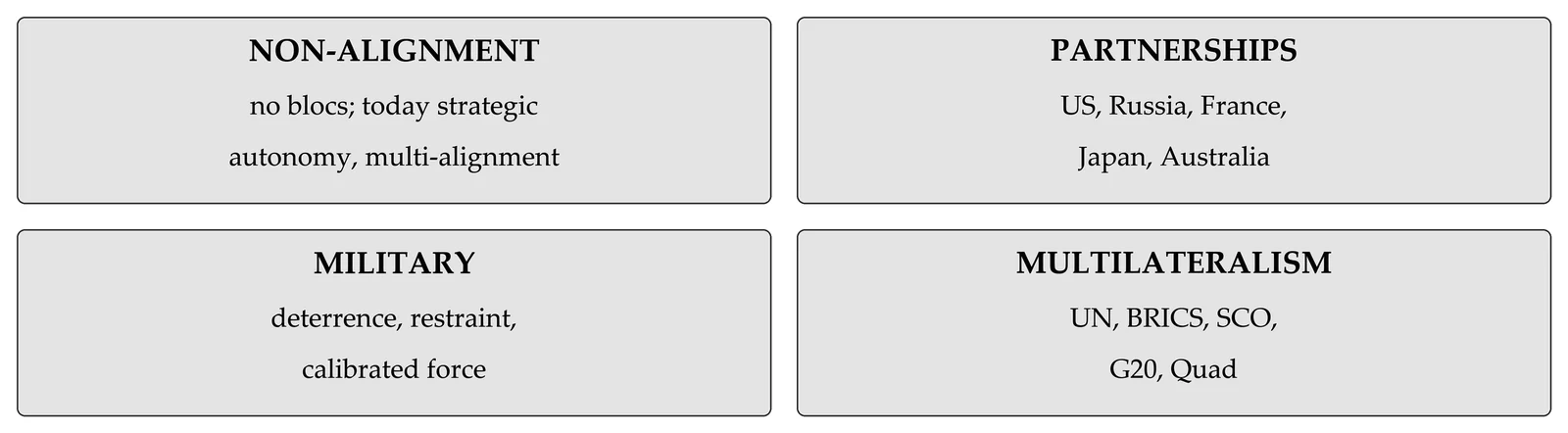
HHOW has India responded to the challenges studied in the last two chapters? Its strategic responses have taken four broad forms, which Unit V of the syllabus asks us to study: non-alignment, the policy of keeping away from rival power blocs that defined India’s foreign policy after 1947; strategic partnerships with major powers, which have multiplied since the end of the Cold War; military responses, from deterrence and restraint to the calibrated use of force; and multilateral engagement through the United Nations and a growing number of groupings. Throughout, one goal remains constant: strategic autonomy, i.e. India’s freedom to make its own choices.
6.1 Non-Alignment
Meaning of Non-Alignment
Non-alignment meant that India would not join either of the Cold War military blocs led by the United States and the Soviet Union, but would judge each issue on its merits and keep its freedom of action. It was not neutrality: Nehru insisted that India would take positions on questions of war, peace, colonialism and justice. Non-alignment grew from the national movement’s anti-colonialism, India’s civilisational self-image and its practical needs as a poor, newly independent country. It allowed India to receive aid and technology from both blocs, to avoid being dragged into wars that were not its own, and to lead the newly independent nations of Asia and Africa. With Tito of Yugoslavia, Nasser of Egypt, Sukarno of Indonesia and Nkrumah of Ghana, Nehru helped found the Non-Aligned Movement at Belgrade in 1961.
Harshe: A Conceptual Reconstruction
Rajen Harshe, in India’s Non-Alignment: An Attempt at Conceptual Reconstruction (1990), argues that non-alignment should not be seen as a moral posture or a fixed doctrine. He reconstructs it as a dynamic strategy rooted in India’s position as a post-colonial state: it was a way to protect sovereignty, pursue planned development and resist neo-colonial pressures in a bipolar world. Its content changed with circumstances, from Nehru’s idealism to Indira Gandhi’s more realist practice, including the Indo-Soviet Treaty of 1971, which critics saw as a tilt but which India presented as consistent with non-alignment.
Critiques and Tests
- 1962. Defeat by China exposed the limits of non-alignment without military strength, and India sought arms from both the United States and the Soviet Union.
- 1971. The treaty with the Soviet Union during the Bangladesh crisis led critics to call India’s policy a pro-Soviet tilt.
- Moralism. Western critics often saw India’s positions as preachy and selective, for example on Hungary in 1956.
- Economic cost. Some argue that the policy, combined with a closed economy, kept India away from Western capital and technology.
Beyond Non-Alignment
The end of the Cold War in 1991 removed the two blocs that non-alignment had responded to. C. Raja Mohan, in Crossing the Rubicon (2003), argues that India moved beyond non-alignment through a series of shifts: from a socialist to a market economy, from politics to economics, from Third World leadership to the pursuit of national interest, from anti-Westernism to engagement with the United States, and from idealism to realism. The nuclear tests of 1998 and the opening to America marked this crossing. Harsh V. Pant and Julie Super (2015) argue that India’s continued attachment to the language of non-alignment is a twentieth-century policy that sits uneasily with a changing world, especially China’s rise, and limits the partnerships India needs.
Others defend its core. Nonalignment 2.0 (2012), written by Sunil Khilnani, Rajiv Kumar, Pratap Bhanu Mehta, Prakash Menon, Nandan Nilekani, Srinath Raghavan, Shyam Saran and Siddharth Varadarajan, argues that the essence of non-alignment, i.e. strategic autonomy, remains valid: India should maximise its options, avoid becoming dependent on any single power, give priority to economic growth and internal strength, and manage China’s rise through a mix of engagement and balancing. Today the government speaks of strategic autonomy and multi-alignment, engaging many powers at once on different issues.

6.2 Strategic Partnerships
Meaning
A strategic partnership is a long-term cooperative relationship covering defence, economy, technology and diplomacy, without the binding obligations of a military alliance. India signed its first strategic partnership with France in 1998 and now has such partnerships with more than thirty countries and groupings. P. Srivastava (2001) describes this as a shift from non-alignment to strategic partnerships, through which India seeks support for its interests while keeping its autonomy.
The United States
India-US relations, distant during much of the Cold War, were transformed after 2000. The Next Steps in Strategic Partnership (2004), the New Framework for the Defence Relationship and the global partnership announced in July 2005 led to the civil nuclear agreement of 2008, which ended India’s nuclear isolation. The United States named India a Major Defence Partner in 2016, and the two signed the foundational agreements LEMOA (2016), COMCASA (2018) and BECA (2020), followed by the Initiative on Critical and Emerging Technology (2023). Speaking to the US Congress in June 2016, Prime Minister Modi said the relationship had overcome the hesitations of history.
Ashley Tellis, in US-India Relations: The Struggle for an Enduring Partnership (2015), argues that the transformation rested on a shared interest in balancing China and in India’s rise, but that the relationship faces obstacles: India’s attachment to autonomy, disputes over trade and technology, and bureaucratic caution on both sides. He argues that the United States should support India’s rise even without expecting strict reciprocity, because a strong India serves American interests. C. Raja Mohan, in Modi’s World (2015), describes Modi’s decision to embrace America more openly than earlier governments.
Russia, France, Japan and Others
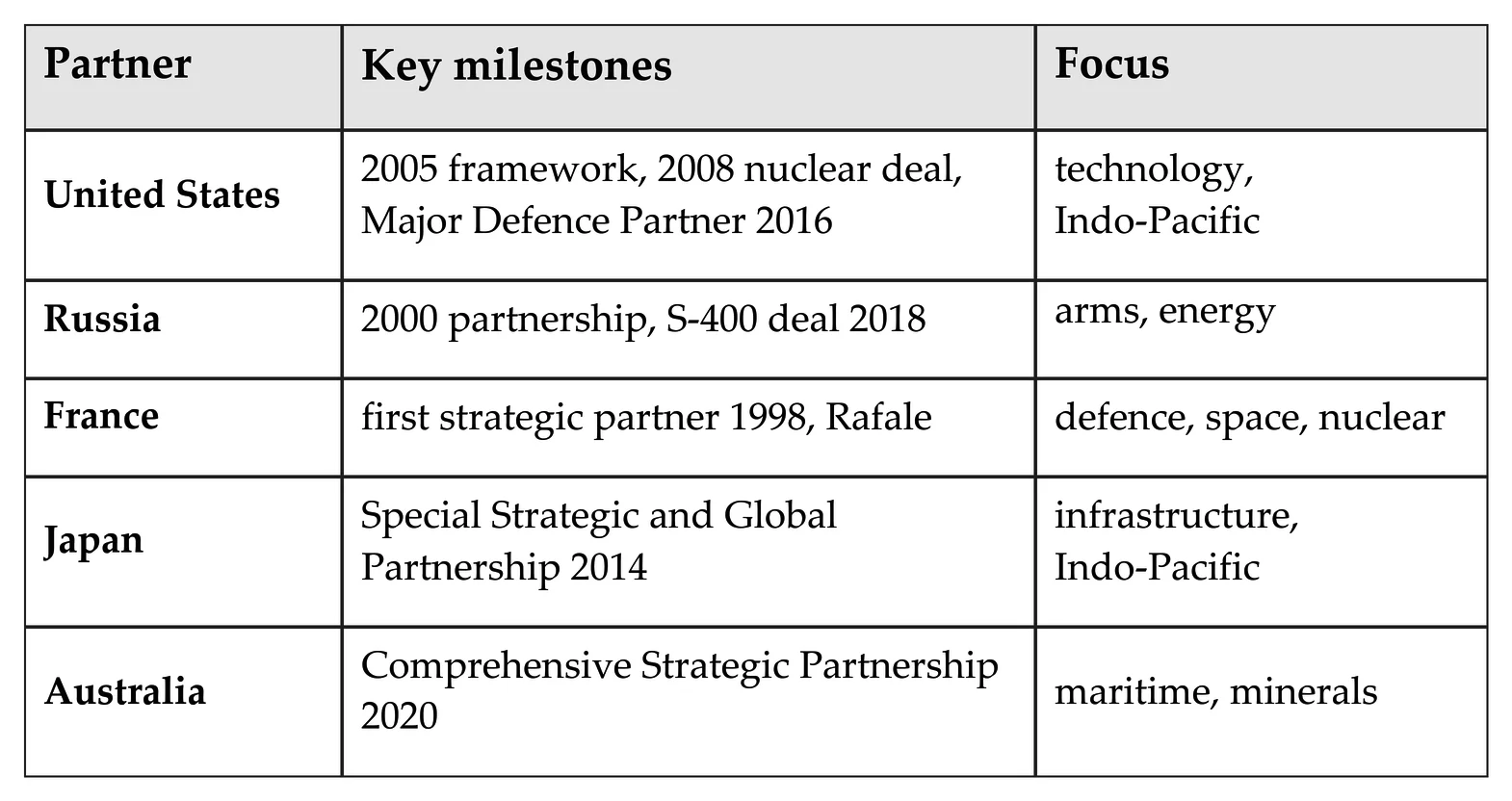
- Russia. The Declaration on Strategic Partnership (2000) was raised to a Special and Privileged Strategic Partnership in 2010; Russia remains a major arms supplier, as in the S-400 air defence deal of 2018, and India increased oil imports from Russia after 2022.
- France. India’s first strategic partner, a supplier of Rafale fighters and Scorpene submarines, and a partner in space, nuclear energy and the Indian Ocean.
- Japan. A Special Strategic and Global Partnership (2014), with Japanese investment in infrastructure such as the Mumbai-Ahmedabad high-speed rail.
- Australia. A Comprehensive Strategic Partnership (2020) focused on maritime security and critical minerals.
- Others. Partnerships with the EU, the UK, Germany, Israel, the UAE, Saudi Arabia, Indonesia and Vietnam extend India’s reach.
Debates
Rajiv Sikri, a former diplomat, in Challenge and Strategy: Rethinking India’s Foreign Policy (2009), argues that India’s strategic choices should keep its autonomy, give priority to its neighbourhood and Asia, and avoid becoming a junior partner of the United States; India should balance relations with all major powers, including Russia and China. Teresita and Howard Schaffer, in India at the Global High Table (2016), identify two constant goals in Indian strategic visions: primacy in South Asia and strategic autonomy in the wider world. Critics warn that too many partnerships may become shallow, while supporters see them as the best way for a rising power to gain support without alliances.
6.3 Military Responses
Strategic Restraint
India has historically used military force sparingly and mainly in defence. Sunil Dasgupta and Stephen P. Cohen, in Is India Ending its Strategic Restraint Doctrine? (2011), describe strategic restraint as India’s long practice of avoiding the use of force as an instrument of policy and preferring defensive postures, even after attacks such as those of 2001 and 2008. They examined whether military modernisation and new doctrines would end this restraint, and concluded that restraint was likely to continue because of nuclear deterrence, India’s focus on economic growth, limited civil-military integration and the political leadership’s caution.
Uses of Force
- Wars of 1947–48, 1962, 1965, 1971 and 1999, of which 1971 was the most decisive, creating Bangladesh.
- Interventions in the neighbourhood. The Indian Peace Keeping Force in Sri Lanka (1987–90) and Operation Cactus in the Maldives (1988).
- Coercive mobilisation. Operation Parakram (2001–02) after the attack on Parliament.
- Calibrated strikes. The surgical strikes of 2016, the Balakot air strike of 2019 and Operation Sindoor of May 2025.
- Holding ground against China. At Doklam (2017) and in eastern Ladakh (2020), including the occupation of heights on the Kailash range in August 2020.
Doctrine Debates
After Operation Parakram exposed the slowness of India’s mobilisation, the Army discussed a Cold Start or proactive strategy in 2004, using quick, limited offensives by integrated battle groups to punish Pakistan below its nuclear threshold. Arzan Tarapore, in The Army in Indian Military Strategy: Rethink Doctrine or Risk Irrelevance (2020), argues that the Army’s emphasis on large punitive offensives has limited value under nuclear conditions and against China. He recommends a shift towards deterrence by denial, i.e. preventing an adversary from gaining ground, and a greater role for air, naval and special forces in limited conflicts.
The Military as an Instrument of Foreign Policy
Sushant Singh (2020) shows that the Indian military has an expanding footprint in foreign policy, through defence diplomacy, joint exercises, training of foreign officers, defence exports, humanitarian assistance and disaster relief, and UN peacekeeping, to which India has been one of the largest contributors since the 1950s. Sumit Ganguly (2011) notes that India’s defence policy has been marked by firm civilian control but weak institutional planning and heavy dependence on imported weapons. Rajpal Budania (2001) shows how India’s threat perception of Pakistan shaped its military response, from conventional superiority to nuclear deterrence.
Reforms
- Higher defence management. The Chief of Defence Staff and the Department of Military Affairs (2019–20), and plans for integrated theatre commands.
- Self-reliance. Positive indigenisation lists from 2020 and rising defence exports, with products such as the BrahMos missile sold abroad.
- Manpower. The Agnipath scheme (2022) introduced short-term recruitment to make the forces younger.

6.4 Multilateral Alliances and Groupings
Evolution of Indian Multilateralism
India was a founding member of the United Nations in 1945 and used multilateral forums to oppose colonialism and apartheid, promote disarmament and defend the interests of developing countries through the G-77 and UNCTAD. David Malone, in Does the Elephant Dance? (2011), traces the evolution of Indian multilateralism from Nehru’s idealistic leadership, through a defensive phase in which India often blocked agreements it saw as unfair, such as the NPT (1968) and the CTBT (1996), to a more pragmatic engagement as India’s power grew. He describes India as a skilled but often defensive negotiator.
Shyam Saran, in India and Multilateralism: A Practitioner’s Perspective (2013), explains that India values multilateralism because rules and institutions can restrain powerful states and protect the development space of poorer ones. He argues that India must move from being a rule-taker to a rule-shaper, as it tried to do in climate negotiations by defending common but differentiated responsibilities. The Schaffers note that India’s style in multilateral negotiations is tough, principled and slow to compromise, which wins respect from developing countries but frustrates Western partners.
India’s Groupings Today
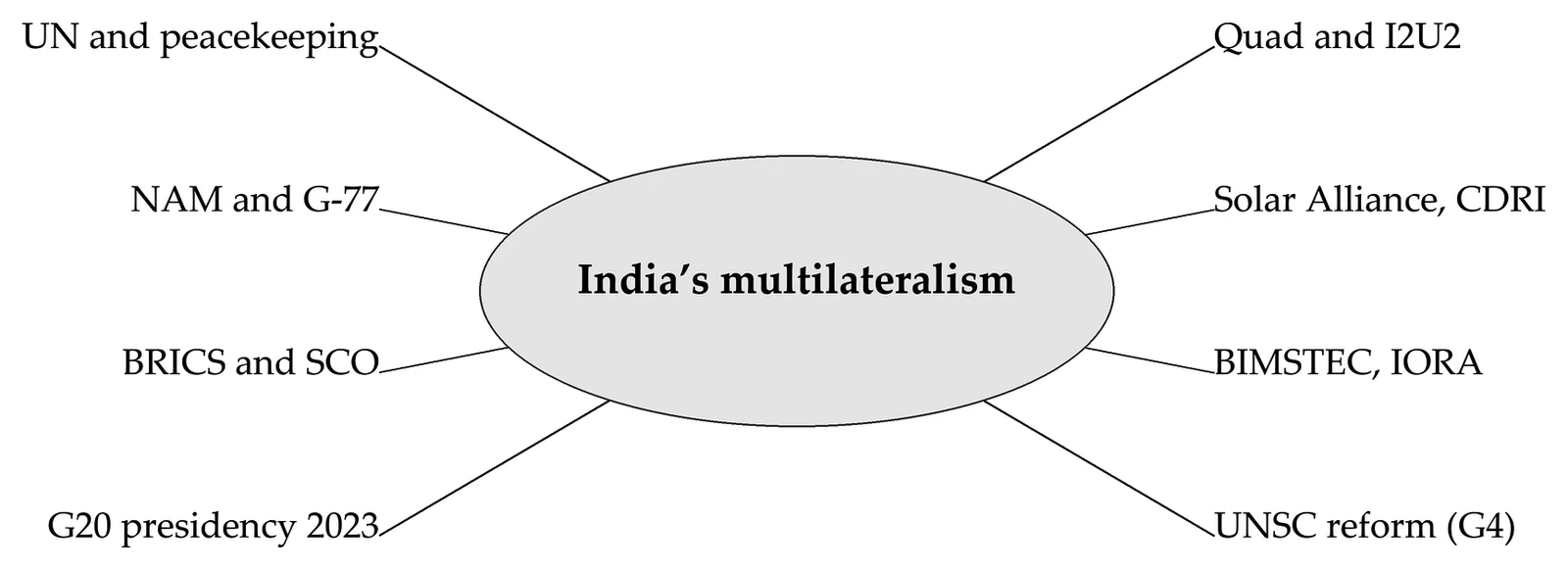
- United Nations. Peacekeeping, eight terms as a non-permanent member of the Security Council (most recently 2021–22) and the G4 campaign for a permanent seat.
- BRICS and SCO. India joined BRICS at its first summit in 2009 and became a full member of the Shanghai Cooperation Organisation in 2017.
- G20. India’s presidency in 2023 adopted the theme One Earth, One Family, One Future and secured permanent membership for the African Union.
- Quad and I2U2. The Quad with the United States, Japan and Australia, revived in 2017 and raised to leaders’ level in 2021; I2U2 with Israel, the UAE and the United States.
- Regional groupings. BIMSTEC, the Indian Ocean Rim Association and IBSA (2003).
- India-led initiatives. The International Solar Alliance (2015) and the Coalition for Disaster Resilient Infrastructure (2019).
India does not join military alliances. Its preference is for issue-based coalitions and minilateral groupings, often with partners that do not agree with each other, such as the Quad and the SCO at the same time. This reflects the enduring goal of strategic autonomy.
6.5 Important Questions
- Question 1 Discuss non-alignment as India’s strategic response and its relevance today.
- Question 2 Discuss strategic partnerships as a response to India’s security challenges.
- Question 3 Discuss India’s military responses to its security challenges.
- Question 4 Discuss India’s approach to multilateralism as a strategic response.
DU asks the same idea in different words. So learn one broad answer for each question below; the same answer works for every question joined by OR.
Important Question 1
Discuss non-alignment as India’s strategic response and its relevance today.
OR
Examine the debate on the relevance of non-alignment in the contemporary world.
OR
Discuss the shift from non-alignment to strategic autonomy and multi-alignment.
Model Answer
“We propose, as far as possible, to keep away from the power politics of groups, aligned against one another, which have led in the past to world wars and which may again lead to disasters on an even vaster scale.”
— Jawaharlal Nehru, radio broadcast (7 September 1946)
Introduction. Non-alignment was India’s main strategic response in the Cold War. It meant staying out of the rival military blocs while taking independent positions on world issues. Since the end of the Cold War, scholars have debated whether non-alignment is still relevant or whether India has moved beyond it. Most agree that its core, strategic autonomy, remains central to Indian strategy.
1. Nehru’s Vision
Nehru announced in 1946 that India would keep away from the power politics of rival groups that had led to world wars.
2. Not Neutrality
Non-alignment was not neutrality; India would judge each issue on its merits and speak on war, peace and colonialism.
3. Sources
The policy grew from the anti-colonial national movement, India’s civilisational identity and its needs as a poor new state.
4. Strategic Benefits
It allowed India to receive aid from both blocs, avoid others’ wars and lead the newly independent nations.
5. The Non-Aligned Movement
With Tito, Nasser, Sukarno and Nkrumah, Nehru helped found the Non-Aligned Movement at Belgrade in 1961.
6. Harshe’s Reconstruction
Rajen Harshe argues that non-alignment was a dynamic strategy of a post-colonial state to protect sovereignty and pursue development.
7. The Test of 1962
Defeat by China exposed the limits of non-alignment without military strength, and India sought help from both superpowers.
8. The 1971 Treaty
The Indo-Soviet Treaty during the Bangladesh crisis was called a tilt, but India saw it as a realistic use of non-alignment.
9. End of the Cold War
The collapse of the Soviet Union removed the bipolar system, forcing India to rethink its foreign and economic policy.
10. Raja Mohan’s Crossing the Rubicon
C. Raja Mohan argues that India moved beyond non-alignment towards realism, economics and engagement with the United States.
11. Pant and Super’s Critique
Pant and Super call non-alignment a twentieth-century policy whose language limits the partnerships India needs in a changing world.
12. Nonalignment 2.0
Nonalignment 2.0 (2012) argues that the core of non-alignment, strategic autonomy and maximum options, remains valid today.
13. Strategic Autonomy
Strategic autonomy means freedom to make independent choices, which India preserves by avoiding formal alliances.
14. Multi-Alignment
India today engages many powers at once, joining the Quad and the SCO and buying both American and Russian weapons.
15. Continuities
India’s refusal to join sanctions or blocs, as during the Ukraine war after 2022, shows the continuing spirit of non-alignment.
16. Non-Alignment and Development
Non-alignment also served India’s economic strategy: aid, loans and technology came from both blocs, such as the Bhilai steel plant built with Soviet help and the Green Revolution supported by American institutions.
17. The Global South
India’s recent emphasis on the Global South, seen in the Voice of the Global South summits from 2023, shows how the solidarity of the non-aligned era has been renewed in new forms.
18. Evaluation
Non-alignment as a Cold War policy has ended, but its essence, strategic autonomy, continues to guide India’s strategy.
Conclusion. Thus, non-alignment, announced by Nehru in 1946 as keeping away from rival power blocs, served India well in the Cold War. Though scholars like Raja Mohan and Pant argue that India has moved beyond it, Nonalignment 2.0 and today’s multi-alignment show that its core value, strategic autonomy, endures.
Important Question 2
Discuss strategic partnerships as a response to India’s security challenges.
OR
Examine the evolution of the India-US strategic partnership.
OR
Discuss the debate on India’s strategic choices with reference to Rajiv Sikri.
Model Answer
“Prime Minister Manmohan Singh and President George W. Bush today declare their resolve to transform the relationship between their countries and establish a global partnership.”
— India-US Joint Statement (18 July 2005)
Introduction. After the Cold War, India replaced the bloc-free language of non-alignment with a web of strategic partnerships. These are long-term cooperative relationships covering defence, economy and technology without the obligations of an alliance. The most important is with the United States, transformed since 2000, while older ties with Russia and France and newer ones with Japan and Australia also matter.
1. Meaning
A strategic partnership is long-term cooperation in defence, economy and technology without binding alliance commitments.
2. From Non-Alignment to Partnerships
P. Srivastava describes the post-Cold War shift from non-alignment to strategic partnerships as a way to gain support while keeping autonomy.
3. The First Partnership
France became India’s first strategic partner in 1998, standing by India after the nuclear tests when others imposed sanctions.
4. Transformation with the United States
The 2005 global partnership and the 2008 civil nuclear agreement ended decades of distance and India’s nuclear isolation.
5. Defence Cooperation
India became a Major Defence Partner in 2016 and signed LEMOA, COMCASA and BECA, deepening military interoperability.
6. Tellis on the Enduring Partnership
Ashley Tellis argues that the partnership rests on balancing China and supporting India’s rise, but faces obstacles of autonomy and trade.
7. Embracing America
Raja Mohan shows how Modi embraced America openly, saying in 2016 that the relationship had overcome the hesitations of history.
8. Russia
The 2000 strategic partnership with Russia, raised to special and privileged in 2010, rests on arms, energy and diplomatic trust.
9. Japan and Australia
Partnerships with Japan (2014) and Australia (2020) focus on the Indo-Pacific, infrastructure, maritime security and critical minerals.
10. Europe and the Gulf
Partnerships with the EU, France, Germany, the UAE and Saudi Arabia support trade, energy security and technology.
11. Sikri’s Strategic Choices
Rajiv Sikri argues that India should keep its autonomy, prioritise Asia and its neighbourhood, and avoid becoming a junior partner of the US.
12. The Schaffers’ Strategic Visions
The Schaffers find that India seeks primacy in South Asia and autonomy in the wider world, which shapes how it uses partnerships.
13. Balancing China
Many partnerships, especially with the US, Japan and Australia, help India balance China without forming a formal alliance.
14. Limits
Partnerships can be shallow, and differences, such as US objections to India’s Russian ties, test their strength.
15. Autonomy Preserved
India’s partnerships with rivals, such as the US and Russia, show that it uses them to widen options rather than choose sides.
16. Technology Partnerships
Many partnerships now focus on critical technologies, such as semiconductors, artificial intelligence and jet engines, reflecting the view that technology is central to national security.
17. Defence Industrial Cooperation
Partners such as France, the United States and Russia increasingly co-develop or co-produce equipment in India, from BrahMos missiles to jet engines, supporting India’s goal of self-reliance.
18. Evaluation
Strategic partnerships give India technology, arms and diplomatic support while preserving the autonomy that alliances would limit.
Conclusion. Thus, strategic partnerships have become India’s main way of engaging major powers. The 2005 resolve to transform India-US relations into a global partnership marked a turning point, but as Sikri and the Schaffers show, India uses partnerships to serve its primacy in South Asia and its strategic autonomy.
Important Question 3
Discuss India’s military responses to its security challenges.
OR
Discuss whether India has moved away from its doctrine of strategic restraint.
OR
Examine the role of the military as an instrument of India’s foreign policy.
Model Answer
“Nothing in the present Charter shall impair the inherent right of individual or collective self-defence if an armed attack occurs against a Member of the United Nations.”
— Charter of the United Nations, Article 51
Introduction. India has generally used military force sparingly and defensively, a pattern Sunil Dasgupta and Stephen Cohen call strategic restraint. Yet it has fought several wars, intervened in its neighbourhood and, since 2016, carried out calibrated strikes against terrorist targets. The debate is whether India is ending restraint or adapting it, and whether its military doctrine suits the threats it faces.
1. Military Power and Strategy
Military power deters threats, defends territory and supports diplomacy, making it one of India’s key strategic responses.
2. Strategic Restraint
Dasgupta and Cohen describe India’s long practice of avoiding force as an instrument of policy and preferring defensive postures.
3. Sources of Restraint
Nuclear deterrence, focus on economic growth, civilian caution and weak civil-military integration all encourage restraint.
4. Wars of Necessity
India fought wars in 1947–48, 1962, 1965, 1971 and 1999, mostly in response to attacks; 1971 was the most decisive.
5. Neighbourhood Interventions
The IPKF in Sri Lanka (1987–90) and Operation Cactus in the Maldives (1988) showed India’s willingness to act in its region.
6. Restraint after Attacks
After the 2001 Parliament attack and 2008 Mumbai attack, India mobilised or relied on diplomacy rather than going to war.
7. Cold Start
The proactive strategy discussed in 2004 sought quick, limited offensives to punish Pakistan below its nuclear threshold.
8. Calibrated Strikes
The surgical strikes of 2016, Balakot in 2019 and Operation Sindoor in 2025 marked a shift towards calibrated punishment.
9. Holding Ground against China
At Doklam in 2017 and in Ladakh in 2020, India held its ground and occupied heights on the Kailash range, signalling resolve.
10. Tarapore’s Critique
Arzan Tarapore argues that the Army should move from large punitive offensives to deterrence by denial and support air and naval power.
11. Ganguly on Defence Policy
Sumit Ganguly notes firm civilian control but weak institutional planning and heavy dependence on imported weapons.
12. Military Diplomacy
Sushant Singh shows the military’s expanding footprint through exercises, training, defence exports and humanitarian missions.
13. UN Peacekeeping
India has been one of the largest contributors of troops to UN peacekeeping since the 1950s, supporting its global image.
14. Reforms
The CDS, plans for theatre commands, Agnipath and defence indigenisation aim to make the forces more integrated and self-reliant.
15. Restraint Adapted
Calibrated strikes remain limited in scope, so restraint has been adjusted rather than abandoned, balancing deterrence and escalation risks.
16. Air and Naval Power
The Balakot strike of 2019 and the strikes of 2025 relied mainly on air power and precision weapons, showing that limited conflicts may increasingly be fought from the air and sea rather than by large land offensives.
17. Nuclear Overhang
Every Indian military response against Pakistan takes place under the shadow of nuclear weapons, so India must calibrate force carefully to punish without triggering escalation to the nuclear level.
18. Evaluation
India’s military responses show a move from passive restraint to calibrated force, while doctrine and capability still need reform.
Conclusion. Thus, India’s military responses rest on the right of self-defence recognised in Article 51 of the UN Charter. From strategic restraint, India has moved towards calibrated strikes, but as Dasgupta, Cohen and Tarapore suggest, restraint has been adapted rather than abandoned, and doctrine must keep pace with threats.
Important Question 4
Discuss India’s approach to multilateralism as a strategic response.
OR
Examine the evolution of Indian multilateralism.
OR
Discuss India’s role in multilateral groupings such as the UN, BRICS, SCO, G20 and the Quad.
Model Answer
“We the peoples of the United Nations determined to save succeeding generations from the scourge of war.”
— Charter of the United Nations, Preamble (1945)
Introduction. Multilateralism means managing international problems through rules, institutions and groups of states rather than by power alone. India has long valued the UN and forums of developing countries, and today it belongs to a wide range of groupings, from BRICS and the SCO to the Quad. David Malone and Shyam Saran trace how Indian multilateralism evolved from idealism and defensiveness to pragmatic rule-shaping.
1. Meaning of Multilateralism
Multilateralism means cooperation among many states through rules and institutions, which can restrain the powerful and give voice to the weak.
2. Founding Member of the UN
India joined the UN in 1945 and used it to oppose colonialism and apartheid and to promote disarmament.
3. Voice of the Developing World
Through NAM, the G-77 and UNCTAD, India championed a fairer world economic order for developing countries.
4. Malone’s Evolution
David Malone traces Indian multilateralism from Nehru’s idealism, through a defensive phase, to pragmatic engagement as India’s power grew.
5. Defensive Positions
India rejected the NPT and CTBT as discriminatory, showing that it would block agreements it considered unfair.
6. Saran’s Practitioner’s View
Shyam Saran explains that India values multilateralism to protect its development space and argues it must move from rule-taker to rule-shaper.
7. Climate Diplomacy
In climate talks, India defended common but differentiated responsibilities and later launched the International Solar Alliance.
8. UN Peacekeeping and the Security Council
India is a leading peacekeeping contributor, has served eight terms on the Security Council and seeks a permanent seat with the G4.
9. BRICS and SCO
BRICS (2009) and the SCO (full member 2017) give India a voice among non-Western powers, though China’s presence limits them.
10. The G20 Presidency
India’s 2023 G20 presidency, with the theme One Earth, One Family, One Future, secured permanent membership for the African Union.
11. The Quad
The Quad with the US, Japan and Australia, revived in 2017, cooperates on maritime security, vaccines and technology, but is not a military alliance.
12. Regional Groupings
With SAARC stalled, India has turned to BIMSTEC and the Indian Ocean Rim Association for regional cooperation.
13. India-Led Initiatives
The International Solar Alliance (2015) and the Coalition for Disaster Resilient Infrastructure (2019) show India shaping new institutions.
14. Negotiating Style
The Schaffers note that India’s tough, principled style wins respect from developing countries but frustrates Western partners.
15. No Military Alliances
India prefers issue-based coalitions and minilaterals over military alliances, preserving its strategic autonomy.
16. Reformed Multilateralism
India calls for reformed multilateralism, arguing that institutions such as the UN Security Council, the World Bank and the IMF still reflect the world of 1945 and must give greater voice to Asia, Africa and Latin America.
17. Multilateralism and Autonomy
Membership of rival groupings, such as the Quad and the SCO, allows India to work with different powers on different issues without being bound to any single camp.
18. Evaluation
Multilateralism allows India to amplify its voice, shape rules and balance powers without sacrificing autonomy.
Conclusion. Thus, India’s multilateralism, rooted in the UN Charter’s promise to save succeeding generations from the scourge of war, has evolved from idealism and defensiveness to pragmatic rule-shaping. As Malone and Saran show, India now uses many groupings to advance its interests while avoiding military alliances.
Short Notes
(a) Strategic autonomy
India’s goal of keeping the freedom to make independent choices in foreign and security policy, by avoiding formal alliances and maintaining relations with many powers at once.
(b) Strategic restraint
India’s long practice, described by Dasgupta and Cohen, of avoiding the use of force as an instrument of policy and preferring defensive postures, adjusted since 2016 by calibrated strikes.
(c) Quad
The Quadrilateral Security Dialogue of India, the United States, Japan and Australia, revived in 2017 and raised to leaders’ level in 2021, focused on a free and open Indo-Pacific.
More notes: DSE-2b India's National Security
These notes are prepared by PADHO TO AISE for study help. They are not an official University of Delhi publication.