
Semester IV DSE-2a Gandhi and the Contemporary World
Unit I · 26 min read · Updated 24 Nov 2026
As per the University of Delhi (DU) BA (Hons) Political Science syllabus
Contents
- 1.1 Gandhi’s Idea of Truth
- Satya: Truth as Being
- Absolute and Relative Truth
- Truth in Practice
- Sources of Gandhi’s Thought
- 1.2 Ahimsa: Meaning, Forms and the Link with Truth
- Meaning of Ahimsa
- Forms of Non-violence
- Truth and Ahimsa Together
- Means and Ends
- Self-Suffering and Conversion
- 1.3 Interpretations and Contemporary Relevance
- Bilgrami: Gandhi, the Philosopher
- Veeravalli: Truth, Law and Experiment
- Godrej: A Method of Moral and Political Arbitration
- Allen: Violence and Peace Education
- Contemporary Relevance
- 1.4 Important Questions
- Discuss Gandhi’s concept of truth.
- Explain Gandhi’s concept of ahimsa. Distinguish between the non-violence of the brave and the non-violence of the weak.
- Examine the relationship between truth and non-violence in Gandhi’s thought.
- Discuss the relevance of Gandhian non-violence in the contemporary world.
- Short Notes
अहिंसा हमारी प्रजाति का नियम है, जैसे हिंसा पशु का नियम है।
Non-violence is the law of our species as violence is the law of the brute.
— M.K. Gandhi, The Doctrine of the Sword, Young India (1920)
FFOR Gandhi, politics was not a separate world of power but a field for practising moral values. Two values stood at the centre of his life and thought: Satya (truth) and Ahimsa (non-violence). He called his autobiography The Story of My Experiments with Truth (serialised 1925–29), and he built his method of political struggle, satyagraha, on non-violence. This chapter explains what Gandhi meant by truth and non-violence, how the two are related, the sources that shaped them, and how scholars such as Akeel Bilgrami, Anuradha Veeravalli, Farah Godrej and Douglas Allen interpret their meaning for the contemporary world.

1.1 Gandhi’s Idea of Truth
Mohandas Karamchand Gandhi (1869–1948) trained as a lawyer in London, spent over twenty years in South Africa (1893–1914), where he first developed satyagraha against racial discrimination, and returned to India to lead the national movement through campaigns such as Champaran (1917), Non-Cooperation (1920–22), the Salt Satyagraha (1930) and Quit India (1942). Throughout, he insisted that his politics was an expression of his search for truth.
Satya: Truth as Being
The word satya comes from sat, meaning being or that which exists. For Gandhi, truth was therefore not just a correct statement but the very nature of reality. Nothing exists in reality except truth. He first held that God is Truth, but later reversed the phrase: speaking at Lausanne in 1931, he said that he had come to see that Truth is God. The reversal allowed even atheists and people of all religions to join the search for truth, since anyone can be devoted to truth even if they do not believe in a personal God.
Absolute and Relative Truth
- Absolute Truth. Truth in its full sense is eternal and perfect, identical with God; no human being can fully know it.
- Relative truth. Human beings can grasp only partial, relative truth, shaped by their experience, conscience and situation.
- Humility. Since each person sees only part of the truth, no one has the right to impose their truth on others by force; this makes truth inseparable from tolerance and non-violence.
- Experiment. Truth is discovered through experiments in one’s own life, through self-examination, discipline and practice, which is why Gandhi called his autobiography a story of experiments with truth.
- Inner voice. Gandhi often spoke of following his inner voice or conscience, which he believed could be heard only after moral discipline and self-purification.
Truth in Practice
For Gandhi, truth meant truthfulness in thought, speech and action; honesty in politics; and the refusal to use falsehood even against opponents. He believed that public life must be governed by the same moral standards as private life. His vows at the ashram, such as truth, non-violence, celibacy, non-stealing, non-possession, fearlessness and equal respect for all religions, were meant to prepare individuals to pursue truth. Truth, in this sense, was not an abstract theory but a way of life.
Sources of Gandhi’s Thought
- Indian traditions. The Jain ideas of ahimsa and many-sidedness of truth (anekantavada), the Vaishnava devotion of his mother, and the Bhagavad Gita, which he read as a guide to selfless action.
- Christian teaching. The Sermon on the Mount, with its message of loving one’s enemies and turning the other cheek.
- Leo Tolstoy. The Kingdom of God Is Within You (1894) convinced Gandhi of the power of non-resistance to evil by force; he named his South African commune Tolstoy Farm (1910).
- John Ruskin. Unto This Last (1860) taught him the dignity of labour and the idea that the good of the individual lies in the good of all; Gandhi paraphrased it as Sarvodaya.
- Henry David Thoreau. Civil Disobedience (1849) supported the idea of refusing to obey unjust laws.
- Raychandbhai. The Jain thinker Shrimad Rajchandra guided Gandhi’s spiritual search in his early years.
1.2 Ahimsa: Meaning, Forms and the Link with Truth
Meaning of Ahimsa
Ahimsa literally means non-injury, the absence of desire to harm any living being. Gandhi gave it a much wider meaning. In its negative sense, ahimsa means not hurting anyone in thought, word or deed, not even harbouring ill will or anger. In its positive sense, it means love, active goodwill towards all, including one’s opponents, and the willingness to suffer for others. Gandhi wrote in 1920 that non-violence is the law of our species as violence is the law of the brute, meaning that what is distinctively human is the capacity to overcome violence through love.
Forms of Non-violence
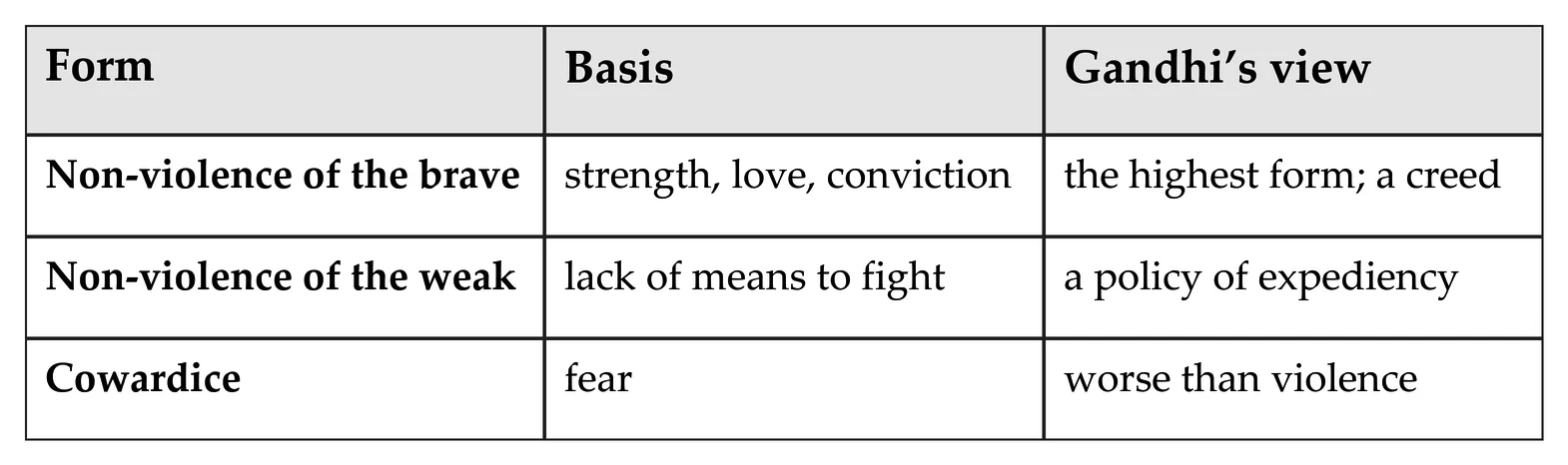
- Non-violence of the brave. The highest form, practised by those who have the strength to retaliate but choose not to, out of love and conviction; it requires courage and readiness to die rather than kill.
- Non-violence of the weak. Passive resistance adopted only because one lacks the means to use force; Gandhi saw it as a policy of expediency rather than a creed.
- Non-violence of the coward. Gandhi rejected cowardice disguised as non-violence. In The Doctrine of the Sword (1920) he wrote that where there is only a choice between cowardice and violence, he would advise violence.
- Creed and policy. For Gandhi, non-violence was a creed, a principle of life; for many of his followers in the Congress, it was a policy, a method suited to the circumstances of the freedom struggle.
Truth and Ahimsa Together
Gandhi saw truth and non-violence as inseparable. In From Yeravda Mandir (1932), written in prison, he said that they are so intertwined that it is practically impossible to separate them, like two sides of a coin; nevertheless, ahimsa is the means and truth is the end. Since no human being possesses the whole truth, using violence to impose one’s view would mean risking harm in the name of what may be error. Non-violence keeps the search for truth open, allowing opponents to be persuaded and converted rather than destroyed.
Means and Ends
Gandhi rejected the idea that good ends can justify bad means. In Hind Swaraj (1909), he compared the means to a seed and the end to a tree, insisting that there is the same inviolable connection between them. Violent means produce violent results; only non-violent means can produce a just and peaceful society. This made him critical of revolutionary violence, of the colonial state’s coercion, and of any politics that sacrificed people for future goals.
Self-Suffering and Conversion
Non-violent resistance relies on self-suffering (tapasya) rather than inflicting suffering on the opponent. By accepting suffering, such as imprisonment, beatings or fasting, the satyagrahi appeals to the conscience of the opponent and of the public. The aim is not to defeat or humiliate the opponent but to convert them, so that both sides arrive at a truer and more just relationship.
1.3 Interpretations and Contemporary Relevance
Bilgrami: Gandhi, the Philosopher
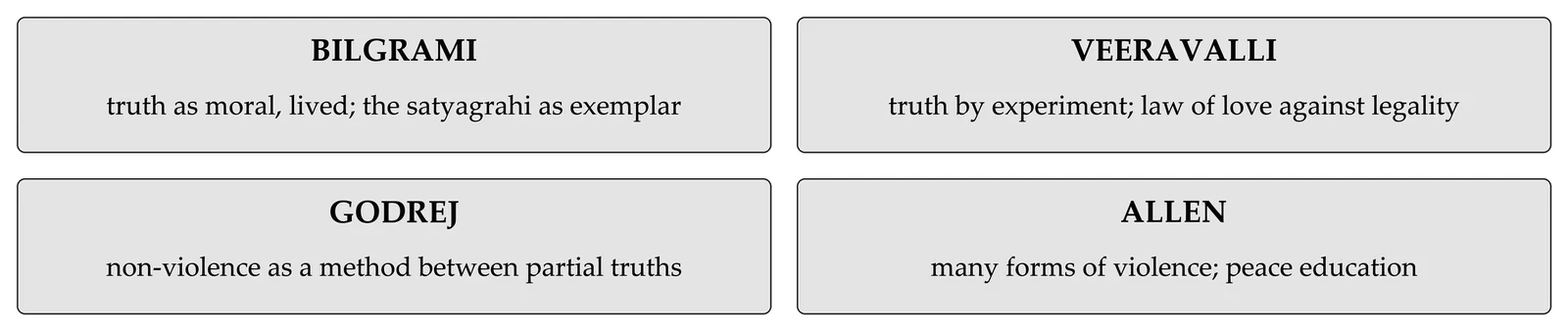
Akeel Bilgrami, in Gandhi, the Philosopher (2003), argues that Gandhi’s ideas form an integrated philosophy, in which views on truth, non-violence, politics and modernity hang together. Bilgrami suggests that Gandhi’s idea of truth was not the cognitive idea of truth as correspondence between statements and facts, which he associated with modern science, but a moral idea of truth as something experienced and lived. Gandhi’s non-violence, Bilgrami argues, involved not only refraining from physical harm but refraining even from criticising others in a judgemental way. The satyagrahi acts as an exemplar, showing by his or her own conduct what is right, rather than laying down universal principles and condemning those who fail them. In this way, Gandhi avoided the moral superiority that, he believed, breeds resentment and violence.
Veeravalli: Truth, Law and Experiment
Anuradha Veeravalli, in Gandhi in Political Theory: Truth, Law and Experiment (2014), places Gandhi in dialogue with Western political theory. She argues that Gandhi saw truth as discovered through experiment in the conduct of life, and contrasted the law of love, grounded in truth and non-violence, with modern legality, which relies on the coercive power of the state. For Gandhi, the modern state and its law rested on violence, while true order could emerge only from self-rule and moral discipline. Veeravalli shows that Gandhi offers a distinct political theory, not merely a set of moral teachings.
Godrej: A Method of Moral and Political Arbitration
Farah Godrej, in Nonviolence and Gandhi’s Truth: A Method for Moral and Political Arbitration (2006), argues that Gandhi’s view of truth as partial and relative makes non-violence a method for dealing with disagreement in plural societies. Since each party sees only part of the truth, conflicts should be resolved through a process in which each side is open to learning from the other, tests its claims through self-suffering rather than coercion, and remains willing to revise its views. Non-violence thus becomes a way of arbitrating between competing moral and political claims without imposing one view by force, relevant for democratic deliberation today.
Allen: Violence and Peace Education
Douglas Allen, in Mahatma Gandhi on Violence and Peace Education (2007), stresses that Gandhi had a multidimensional understanding of violence: not only physical violence but also economic, psychological, cultural, religious, linguistic and environmental violence built into everyday structures, close to what Johan Galtung later called structural violence. Allen argues that Gandhian peace education must therefore address the root causes of violence, such as exploitation, greed and domination, and must cultivate values of truth, tolerance and simple living. He sees Gandhi as highly relevant to a world of war, terrorism, inequality and ecological crisis.
Contemporary Relevance
- Civil rights and liberation movements. Martin Luther King Jr. drew on Gandhi in the American civil rights movement, and movements in South Africa, the Philippines, Eastern Europe and elsewhere used non-violent methods.
- International recognition. In 2007, the UN declared 2 October, Gandhi’s birthday, the International Day of Non-Violence.
- Research on non-violence. Studies by Erica Chenoweth and Maria Stephan found that non-violent campaigns between 1900 and 2006 succeeded more often than violent ones.
- Criticisms. Critics argue that non-violence may not work against ruthless regimes, that Gandhi’s demands on individuals were too severe, and that his ideas could be used to discourage legitimate resistance; others question whether truth can be relative and absolute at the same time.
1.4 Important Questions
- Question 1 Discuss Gandhi’s concept of truth.
- Question 2 Explain Gandhi’s concept of ahimsa. Distinguish between the non-violence of the brave and the non-violence of the weak.
- Question 3 Examine the relationship between truth and non-violence in Gandhi’s thought.
- Question 4 Discuss the relevance of Gandhian non-violence in the contemporary world.
DU asks the same idea in different words. So learn one broad answer for each question below; the same answer works for every question joined by OR.
Important Question 1
Discuss Gandhi’s concept of truth.
OR
Truth is God. Explain Gandhi’s view.
OR
Examine Akeel Bilgrami’s interpretation of Gandhi as a philosopher.
Model Answer
“I came to the conclusion that for myself God is Truth. But two years ago I went a step further and said that Truth is God.”
— M.K. Gandhi, speech at Lausanne (1931)
Introduction. Truth was the central value of Gandhi’s life and thought. He called his autobiography The Story of My Experiments with Truth and described all his activities, including politics, as part of his search for truth. For Gandhi, truth was not only a correct statement about facts but the very nature of reality, a moral ideal to be lived and discovered through experiment and self-discipline.
1. Meaning of Satya
The word satya comes from sat, meaning being. For Gandhi, truth was therefore the very nature of reality: nothing exists except truth. Truth was not just a quality of statements but the ground of existence itself, which is why he could identify it with God and treat its pursuit as the purpose of human life.
2. From God Is Truth to Truth Is God
Gandhi first said that God is Truth, but at Lausanne in 1931 he said that Truth is God. The change allowed people of all faiths, and even atheists, to join the search for truth, since devotion to truth does not require belief in a personal God. It made his idea more universal and inclusive.
3. Absolute and Relative Truth
Gandhi distinguished absolute Truth, perfect and eternal, from relative truth, the partial truth that human beings can grasp. Every person sees only a part of the truth, shaped by experience and conscience. This distinction is the key to understanding why he linked truth so closely with humility, tolerance and non-violence.
4. Truth and Humility
Since no one possesses the whole truth, no one has the right to impose their view on others by force. Gandhi therefore combined firm commitment to one’s own truth with humility and openness to the truth seen by others, including opponents. This is why the search for truth requires non-violence.
5. Experiments with Truth
Truth is discovered through experiments in one’s own life, through self-examination, discipline and practice. Gandhi treated his diet, dress, sexuality, ashram life and political campaigns as experiments, revising his views when experience showed him to be wrong, as when he called the premature launch of mass civil disobedience a Himalayan miscalculation.
6. The Inner Voice
Gandhi spoke of following his inner voice or conscience, which he believed could be heard only after moral discipline and self-purification. Critics saw this as arbitrary, but for Gandhi conscience disciplined by vows was the best guide available to a fallible human being.
7. Truth in Public Life
Gandhi insisted that politics must be governed by truth. He refused to use deception even against opponents, publicly admitted his mistakes and believed that public and private morality must be the same. This set him apart from politicians who treat politics as the art of the possible.
8. Ashram Vows
At his ashrams, Gandhi asked residents to take vows of truth, non-violence, celibacy, non-stealing, non-possession, fearlessness, bread labour and equal respect for all religions. These vows were meant to discipline the self so that it could pursue truth.
9. Indian Sources
The Jain idea of anekantavada, that truth has many sides, the Vaishnava devotion of his mother and the Bhagavad Gita’s teaching of selfless action shaped Gandhi’s idea of truth as both ultimate and approached through many paths.
10. Western Sources
Tolstoy, Ruskin, Thoreau and the Sermon on the Mount reinforced Gandhi’s conviction that truth must be lived in daily conduct and that unjust power must be resisted without hatred.
11. Bilgrami’s Interpretation
Akeel Bilgrami argues that Gandhi’s idea of truth was moral rather than cognitive. Gandhi rejected the scientific idea of truth as correspondence with facts and saw truth as something experienced and lived in conduct.
12. Exemplary Action
Bilgrami suggests that the satyagrahi acts as an exemplar, showing by conduct what is right, rather than condemning others for failing universal principles. This avoids moral superiority and the resentment it breeds, linking truth with non-violence even in judgement.
13. Veeravalli on Truth and Experiment
Anuradha Veeravalli argues that Gandhi saw truth as discovered through experiment and contrasted the law of love, grounded in truth, with modern legality based on the coercive power of the state.
14. Criticisms
Critics ask how truth can be both absolute and relative, and whether reliance on the inner voice allowed Gandhi to justify inconsistent decisions. Others found his moral demands too severe for ordinary people.
15. Relevance
Gandhi’s idea of truth as partial and open to revision encourages dialogue, tolerance and honesty in public life, values badly needed in an age of polarisation and misinformation.
16. Evaluation
Gandhi’s concept of truth was not a theory of knowledge but a moral and spiritual ideal that united his personal life and politics and grounded his commitment to non-violence.
Conclusion. Thus, for Gandhi truth was the nature of reality itself, identified with God, known only partially by human beings and discovered through experiments in living. As he said at Lausanne, Truth is God; this belief made humility and non-violence essential, and Bilgrami and Veeravalli show its depth as a moral and political philosophy.
Important Question 2
Explain Gandhi’s concept of ahimsa. Distinguish between the non-violence of the brave and the non-violence of the weak.
OR
Non-violence is the law of our species. Discuss.
OR
Examine the positive and negative dimensions of Gandhian non-violence.
Model Answer
“Non-violence is the greatest force at the disposal of mankind. It is mightier than the mightiest weapon of destruction devised by the ingenuity of man.”
— M.K. Gandhi, Harijan
Introduction. Ahimsa, or non-violence, was the means through which Gandhi sought truth and the basis of his method of satyagraha. He gave the ancient idea of non-injury a new, active meaning as love and courageous resistance to injustice, and he made it a principle of mass political action. He distinguished carefully between non-violence rooted in strength and passive submission rooted in weakness or fear.
1. Meaning of Ahimsa
Ahimsa literally means non-injury, the absence of the desire to harm any living being. It has deep roots in Indian traditions, especially Jainism and Buddhism, and in Hindu ethical teachings.
2. The Negative Dimension
In its negative sense, ahimsa means not hurting anyone in thought, word or deed, and not harbouring anger, hatred or ill will. Gandhi extended it beyond physical violence to harsh words and hostile thoughts.
3. The Positive Dimension
In its positive sense, ahimsa means love, active goodwill towards all, including opponents. It involves readiness to serve others and to suffer for them, which makes non-violence a dynamic force rather than mere abstention.
4. The Law of the Species
Gandhi wrote in 1920 that non-violence is the law of our species as violence is the law of the brute. What is distinctively human is the capacity to rise above violence through reason, conscience and love.
5. Non-violence of the Brave
The highest form is the non-violence of the brave, practised by those who have the strength to retaliate but choose not to. It requires great courage, including readiness to die rather than kill, and is rooted in conviction.
6. Non-violence of the Weak
The non-violence of the weak is passive resistance adopted only because one lacks the means to use force. Gandhi saw it as expedient policy, not a creed, and considered it inferior to the non-violence of the brave.
7. Rejecting Cowardice
Gandhi rejected cowardice disguised as non-violence. In The Doctrine of the Sword he wrote that where the only choice is between cowardice and violence, he would advise violence, showing that non-violence demands courage.
8. Creed and Policy
For Gandhi, non-violence was a creed, a principle of life. For many Congress leaders, including Nehru, it was a policy suited to the freedom struggle, a difference that became visible when independence was achieved.
9. Self-Suffering
Non-violent resistance relies on self-suffering rather than inflicting suffering. By accepting imprisonment, beatings or fasting, the satyagrahi appeals to the conscience of the opponent and the public.
10. Conversion, Not Defeat
The aim of non-violence is to convert the opponent, not to defeat or humiliate him, so that both sides reach a more just and truthful relationship.
11. Non-violence and Truth
Since no one possesses the whole truth, violence risks harming others in the name of error. Non-violence keeps the search for truth open and allows persuasion.
12. Non-violence and the State
Gandhi saw the modern state as based on organised violence and imagined an ideal society of self-governing villages with minimal coercion, though he accepted that some police force might be needed.
13. Non-violence in Action
Campaigns such as the Salt Satyagraha of 1930, in which volunteers at Dharasana accepted blows without retaliating, demonstrated the non-violence of the brave to the world.
14. Criticisms
Critics argue that non-violence may fail against ruthless regimes such as Nazi Germany, and Gandhi’s advice to Jews and to Britain in the Second World War has been widely criticised as unrealistic.
15. Relevance
Movements from the American civil rights movement to peaceful protests in many countries show the continuing power of non-violent resistance, which research finds often more successful than violence.
16. Evaluation
Gandhi transformed ahimsa from a personal virtue into a force for social and political change, demanding courage and love rather than passivity.
Conclusion. Thus, Gandhi’s ahimsa combined non-injury with active love and self-suffering, and he valued the non-violence of the brave above the non-violence of the weak and rejected cowardice. As he said, non-violence is the greatest force at the disposal of mankind, a force he made central to mass politics.
Important Question 3
Examine the relationship between truth and non-violence in Gandhi’s thought.
OR
Ahimsa is the means; Truth is the end. Discuss.
OR
Discuss Gandhi’s views on the relationship between means and ends.
Model Answer
“Ahimsa and Truth are so intertwined that it is practically impossible to disentangle and separate them… Nevertheless ahimsa is the means; Truth is the end.”
— M.K. Gandhi, From Yeravda Mandir (1932)
Introduction. Truth and non-violence are the twin pillars of Gandhi’s philosophy. He treated them as inseparable, like two sides of a coin, while describing truth as the end and non-violence as the means. This relationship underlies his insistence on the purity of means, his method of satyagraha and his vision of politics as a moral activity.
1. Two Sides of a Coin
In From Yeravda Mandir, written in prison in 1932, Gandhi said that truth and ahimsa are so intertwined that it is practically impossible to separate them, like two sides of a smooth unstamped disc.
2. Means and End
Nevertheless, he described ahimsa as the means and truth as the end. Truth is the goal of human life, and non-violence is the only way to approach it.
3. Partial Truth Requires Non-violence
Since human beings know only relative truth, using violence to impose one’s view risks harming others in the name of error. Non-violence keeps open the possibility of discovering that one was wrong.
4. Non-violence Requires Truth
Non-violence without truth could become deception or manipulation. Gandhi insisted that the satyagrahi must be truthful, never using secrecy or lies even against opponents.
5. The Seed and the Tree
In Hind Swaraj (1909), Gandhi compared means to a seed and ends to a tree, insisting on an inviolable connection between them. Bad means cannot produce good ends.
6. Against Ends Justifying Means
Gandhi rejected the idea, associated with Machiavelli and revolutionary politics, that good ends justify any means. Violent revolution, he argued, would produce a violent society.
7. Purity of Means in Politics
Gandhi applied this principle to the freedom struggle, suspending the Non-Cooperation Movement after the violence at Chauri Chaura in 1922 rather than allowing it to continue.
8. Satyagraha as Truth-Force
Satyagraha, literally holding firmly to truth, brings truth and non-violence together: it resists injustice firmly but only by non-violent means and self-suffering.
9. Godrej’s Interpretation
Farah Godrej argues that because truth is partial, non-violence becomes a method of arbitrating between competing truths, in which each side tests its claims through self-suffering and remains open to learning.
10. Truth and Dialogue
This method encourages dialogue and mutual learning rather than domination, making Gandhian non-violence relevant to democratic deliberation in plural societies.
11. Bilgrami’s Interpretation
Akeel Bilgrami argues that Gandhi’s non-violence extended to refraining from judgemental criticism; the satyagrahi exemplifies truth in conduct rather than condemning others.
12. Self-Suffering as Proof
Willingness to suffer for one’s truth shows sincerity and appeals to the opponent’s conscience, so self-suffering connects truth with non-violent action.
13. Consistency in Personal and Public Life
Gandhi practised truth and non-violence in personal life, through diet, vows and simple living, and in public life, refusing to separate private and political morality.
14. Criticisms
Critics argue that insisting on purity of means can paralyse action against urgent injustice, and that Gandhi himself made compromises in politics.
15. Relevance
The principle that means shape ends remains relevant for movements and governments tempted to justify repression or violence by appeal to good goals.
16. Truth, Non-violence and Fearlessness
Gandhi linked truth and non-violence with fearlessness (abhaya). Only a person free from fear of punishment, loss or death can hold firmly to truth without resorting to violence. Fearlessness, cultivated through discipline and faith, was therefore the bridge between commitment to truth and the practice of non-violent resistance.
17. Truth, Non-violence and Religion
Gandhi drew on many religions to support the unity of truth and non-violence: the Jain doctrine of ahimsa, the Gita’s teaching of selfless action, Christ’s Sermon on the Mount and the Islamic idea of submission to God. He believed that all religions, rightly understood, teach the same fundamental values.
18. Evaluation
The unity of truth and non-violence gives Gandhi’s thought its moral coherence and distinguishes his politics from both power politics and revolutionary violence.
Conclusion. Thus, Gandhi saw truth and non-violence as inseparable, with ahimsa as the means and truth as the end, and insisted, through the image of the seed and the tree, that means determine ends. Godrej and Bilgrami show how this relationship makes non-violence a method of dialogue among partial truths.
Important Question 4
Discuss the relevance of Gandhian non-violence in the contemporary world.
OR
Examine Douglas Allen’s views on Gandhi, violence and peace education.
OR
Discuss the relevance of Gandhi today with reference to truth and non-violence.
Model Answer
“Reaffirming the universal relevance of the principle of non-violence, and desiring to secure a culture of peace, tolerance, understanding and non-violence.”
— UN General Assembly Resolution 61/271 (2007), declaring the International Day of Non-Violence
Introduction. Gandhi’s ideas of truth and non-violence were developed in the struggles of South Africa and colonial India, but they have inspired movements across the world. In a world of wars, terrorism, inequality, communal conflict and ecological crisis, scholars such as Douglas Allen argue that Gandhian non-violence and peace education remain deeply relevant.
1. A World of Violence
The contemporary world faces wars, terrorism, communal and caste violence, gender violence and environmental destruction, which make the question of non-violence urgent.
2. Allen’s Argument
Douglas Allen argues that Gandhi had a multidimensional understanding of violence, including economic, psychological, cultural, religious and environmental violence built into everyday structures.
3. Structural Violence
Allen’s reading connects Gandhi with Johan Galtung’s idea of structural violence, the harm caused by unjust economic and social structures such as poverty and discrimination.
4. Peace Education
Allen argues that Gandhian peace education must address the root causes of violence, such as greed, exploitation and domination, and cultivate truth, tolerance and simple living.
5. The Civil Rights Movement
Martin Luther King Jr. drew on Gandhi to lead the American civil rights movement through boycotts, marches and civil disobedience in the 1950s and 1960s.
6. Global Movements
Non-violent movements in the Philippines (1986), Eastern Europe (1989) and elsewhere showed that unarmed mass action could bring down authoritarian regimes.
7. Evidence of Effectiveness
Erica Chenoweth and Maria Stephan found that non-violent campaigns between 1900 and 2006 succeeded more often than violent ones, partly because they attract wider participation.
8. International Recognition
In 2007, the UN declared 2 October the International Day of Non-Violence, reaffirming the universal relevance of the principle.
9. Indian Movements
Movements such as Chipko, the Narmada Bachao Andolan and many farmers’ and civil rights campaigns in India have used Gandhian methods of non-violent protest.
10. Ecology
Gandhi’s emphasis on simple living and limited wants speaks to the ecological crisis, as unlimited consumption threatens the planet.
11. Communal Harmony
Gandhi’s commitment to truth as many-sided and to equal respect for all religions offers resources against religious intolerance and communal violence.
12. Truth in Public Life
In an age of misinformation and polarisation, Gandhi’s insistence on truthfulness and on acknowledging one’s own errors offers a demanding standard for public life.
13. Godrej and Deliberation
Farah Godrej’s reading of non-violence as a method of arbitrating between partial truths makes Gandhi relevant to democratic deliberation in plural societies.
14. Limits
Critics argue that non-violence may not work against ruthless regimes or terrorists, and that it can be used to discourage legitimate resistance by the oppressed.
15. Ambedkar’s Critique
Ambedkar and others criticised Gandhi’s approach to caste and the use of fasting as a form of moral pressure, reminding us to read Gandhi critically.
16. Non-violence and the Environment
Allen and others note that Gandhi’s ahimsa extended to all living beings and to nature. In an age of climate change and species extinction, the idea that non-violence includes care for the earth gives Gandhian thought new relevance for ecological ethics and sustainable living.
17. Non-violence in Conflict Resolution
Practitioners of conflict resolution and peace-building draw on Gandhian ideas of dialogue, respect for opponents and the search for solutions acceptable to all sides. Organisations working in post-conflict societies use these principles to rebuild trust after violence.
18. Evaluation
Gandhian non-violence is not a simple formula but a demanding ethic that remains relevant as a method of resistance, a guide to peace education and a critique of violence.
Conclusion. Thus, Gandhian non-violence, understood with Allen as a response to physical and structural violence, remains relevant through movements for civil rights and democracy, peace education and ecological ethics. The UN’s recognition of its universal relevance shows its continuing appeal, though it must be applied critically.
Short Notes
(a) Anekantavada
The Jain doctrine of the many-sidedness of truth, which holds that reality can be seen from many perspectives; it influenced Gandhi’s view that human beings know only relative truth.
(b) Non-violence of the brave
Gandhi’s highest form of non-violence, practised by those who have the strength to retaliate but choose not to, out of love and conviction, with readiness to suffer.
(c) Peace education
Education that addresses the root causes of violence and cultivates values of non-violence, tolerance and justice, which Douglas Allen links with Gandhi’s thought.
More notes: DSE-2a Gandhi and the Contemporary World
These notes are prepared by PADHO TO AISE for study help. They are not an official University of Delhi publication.