
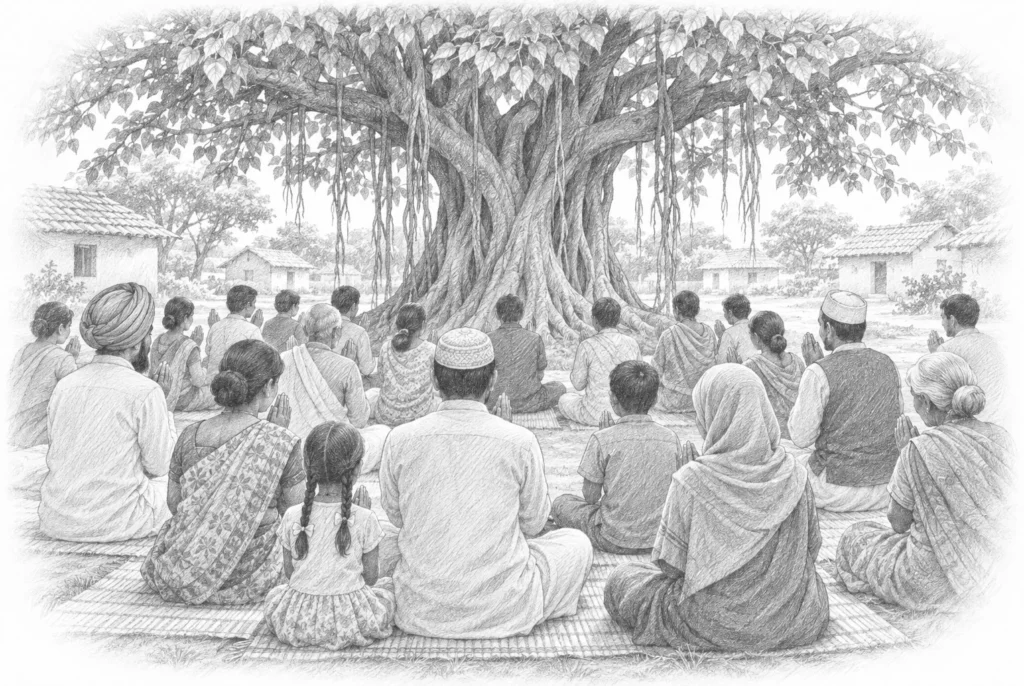
Semester IV DSE-2a Gandhi and the Contemporary World
Unit V · 22 min read · Updated 24 Nov 2026
As per the University of Delhi (DU) BA (Hons) Political Science syllabus
Contents
- 5.1 Gandhi on Hinduism
- Features of Gandhi’s Hinduism
- Religion and Politics
- Hardiman: Fighting Religious Hatreds
- 5.2 Religious Conversion and Cow Protection
- Gandhi on Religious Conversion
- Gandhi on Cow Protection
- 5.3 The Language Question
- Gandhi’s Views
- After Gandhi
- Gandhi’s Positions at a Glance
- 5.4 Important Questions
- Explain Gandhi’s understanding of Hinduism.
- Discuss Gandhi’s views on religious conversion.
- Examine Gandhi’s views on cow protection.
- Discuss Gandhi’s views on the language question.
- Short Notes
यदि मुझसे हिंदू धर्म की परिभाषा पूछी जाए, तो मैं केवल इतना कहूँगा: अहिंसक साधनों से सत्य की खोज।
If I were asked to define the Hindu creed, I should simply say: Search after truth through non-violent means.
— M.K. Gandhi, Young India (24 April 1924)
GGANDHI called himself a sanatani Hindu, yet he was killed by a Hindu extremist who accused him of betraying Hindus. His views on religion were deeply held and often controversial. He understood Hinduism as a search for truth through non-violence, opposed religious conversion through proselytisation, supported cow protection while rejecting coercion, and took strong positions on the language question, favouring the mother tongue and Hindustani. This chapter examines these four themes, drawing on Gandhi’s own writings and on interpretations by Akeel Bilgrami, S. Radhakrishnan, David Hardiman and Sangit Ragi.
5.1 Gandhi on Hinduism
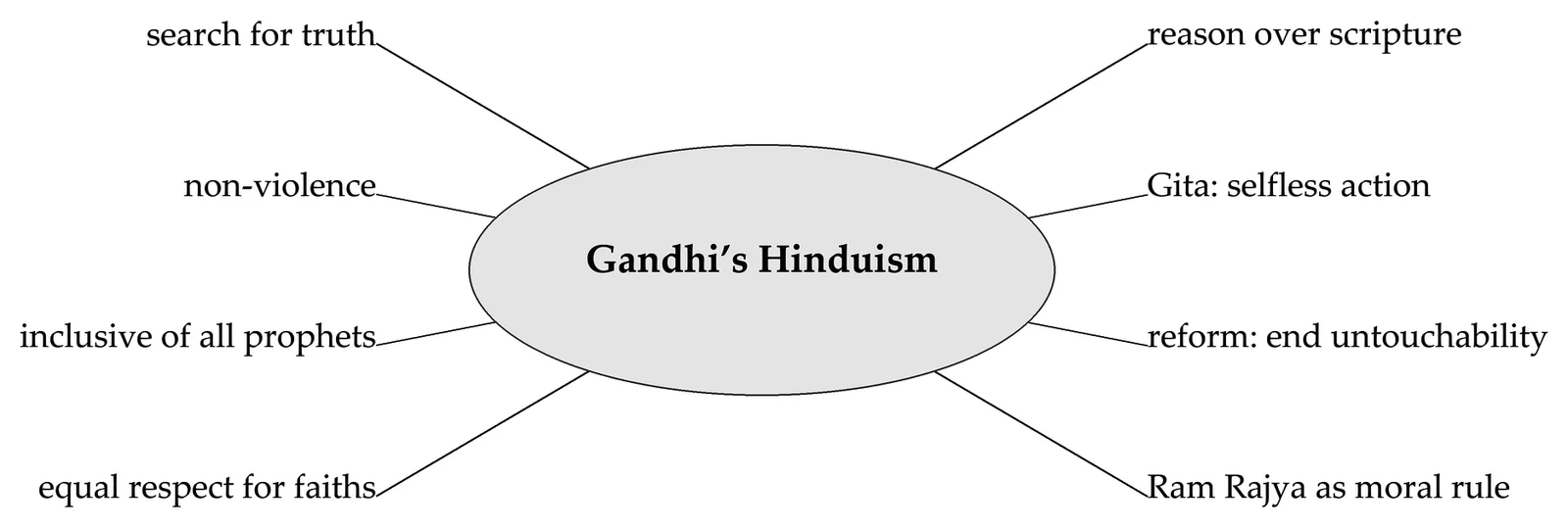
Gandhi described himself as a sanatani Hindu, a follower of the eternal religion. He believed in the Vedas, Upanishads, Puranas and the idea of rebirth, in varnashrama dharma understood without hierarchy, in cow protection, and in image worship as one form of devotion. But his Hinduism was ethical rather than ritualistic. Asked to define it, he said in 1924 that the Hindu creed was simply the search after truth through non-violent means. His writings were later compiled as What is Hinduism (National Book Trust, 1994).
Features of Gandhi’s Hinduism
- Truth and non-violence. Hinduism was, for him, the search for truth through ahimsa; whatever contradicted truth and non-violence could not be true religion.
- Inclusiveness. In Young India (1921) he wrote that Hinduism is not an exclusive religion and has room for the worship of all the prophets of the world.
- Tolerance and equal respect. He practised sarva dharma samabhava, equal respect for all religions, seeing them as different paths to the same truth.
- Reason and conscience. He rejected any scriptural injunction contrary to reason and morality, such as those used to justify untouchability.
- The Gita. He called the Gita his spiritual mother and read it as an allegory of the inner struggle, teaching selfless action (anasakti).
- Reform from within. He sought to purify Hinduism of untouchability, child marriage and the oppression of women.
- Ram Rajya. He used Ram Rajya as an ideal of just, moral rule; in 1929 he explained that it meant Divine Raj, the Kingdom of God, not Hindu Raj.
Religion and Politics
Akeel Bilgrami, in Gandhi’s Religion and Its Relation to His Politics (2011), argues that Gandhi’s religion was not a set of dogmas but a source of ethical values that resisted the disenchanted, scientific worldview of modernity. Gandhi brought religion into politics to make politics moral, not to make the state religious. S. Radhakrishnan, in Gandhi’s Religion and Politics, stressed that for Gandhi religion meant devotion to truth and service of humanity, which made his politics universal rather than sectarian. Sangit Ragi, in RSS and Gandhi (2022), compares Gandhi’s Hinduism with that of the RSS, showing that both claimed a civilisational idea of India but differed sharply on non-violence, minorities and the relationship between religion and nationhood.
Hardiman: Fighting Religious Hatreds
David Hardiman, in Fighting Religious Hatreds (2003), shows that Gandhi used a religious idiom to fight communal hatred, appealing to the best in each tradition and insisting that each community protect its minorities. Hardiman notes the risks of this approach: religious language could be appropriated by communal forces, and Gandhi’s Hindu symbols could alienate some Muslims. Yet Gandhi’s religion was ultimately universal, and he gave his life for communal harmony.
5.2 Religious Conversion and Cow Protection
Gandhi on Religious Conversion
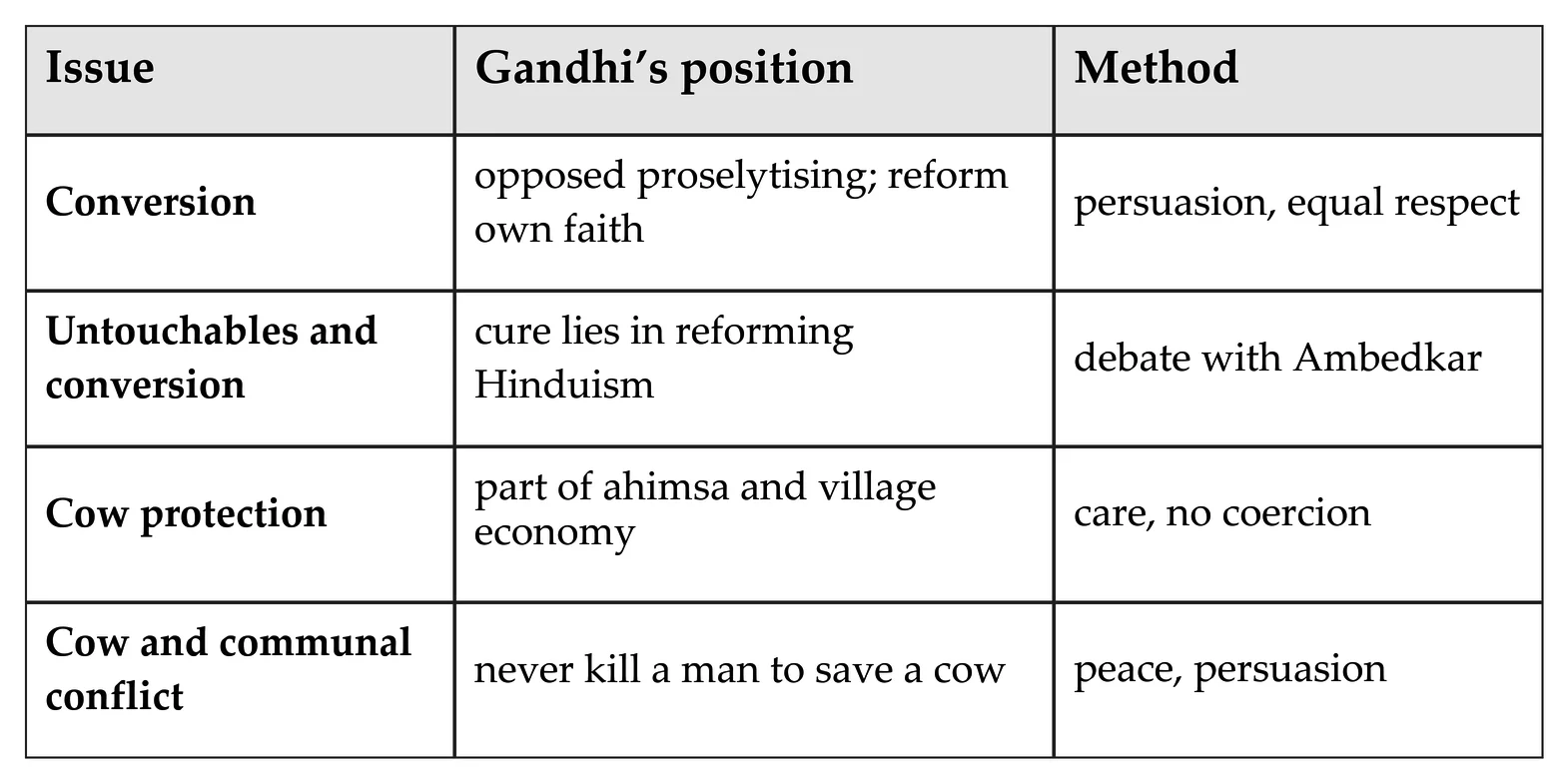
Gandhi opposed proselytisation, the effort to convert people from one religion to another. He believed that all religions are true, though imperfect, and that each person should seek truth within his or her own ancestral religion. In Harijan in 1935, he said that if he had the power to legislate he would stop all proselytising. Sandhya Mehta, in Gandhiji on Religious Conversion (2002), compiles his writings on the subject.
- Equal respect. Since all religions are paths to truth, there is no need to convert; one should help others to be better followers of their own faith.
- Swadeshi in religion. Gandhi applied swadeshi to religion, arguing that one should remain in and reform one’s ancestral faith.
- Service without conversion. He admired missionaries’ service in education and health, but objected when service was used as a means of conversion.
- Conversion of untouchables. When B.R. Ambedkar declared at Yeola in 1935 that though born a Hindu he would not die a Hindu, Gandhi opposed the idea of mass conversion of untouchables, arguing that the cure for untouchability lay in reforming Hinduism. Ambedkar converted to Buddhism in 1956, eight years after Gandhi’s death.
- Freedom of conscience. Gandhi did not deny individuals the right to change religion out of genuine conviction, but opposed organised conversion campaigns.
Gandhi on Cow Protection
Gandhi regarded cow protection as a central feature of Hinduism. In Young India (1921), he wrote that cow protection was to him one of the most wonderful phenomena in human evolution, because it takes human beings beyond their own species and expresses kinship with all life. The cow symbolised for him the whole sub-human world and the duty of compassion towards animals.
- Ethical meaning. Cow protection meant protection of all helpless creatures, an expression of ahimsa.
- Economic meaning. Cattle were essential to India’s village economy for ploughing, milk and manure, so care for cattle served agriculture.
- Against coercion. Gandhi rejected the use of force to stop cow slaughter. In July 1947 he asked how he could force anyone not to slaughter cows unless he was himself so disposed, since India was not only for Hindus.
- Against communal conflict. He criticised Hindus who attacked Muslims over cow slaughter, saying that killing a human being to save a cow was a denial of the very principle of cow protection.
- Constructive approach. He founded the Goseva Sangh (1941) to promote better breeding, dairying, tanning of hides of dead cattle and care of cattle.
The Constituent Assembly placed cow protection in Article 48, a Directive Principle directing the state to organise agriculture and animal husbandry on modern lines and to prohibit the slaughter of cows and calves. Ragi’s chapter on cow protection compares Gandhi’s ethical and non-coercive approach with later political campaigns for laws against cow slaughter.
5.3 The Language Question
Language was a major question for the national movement, since India has many languages and English was the language of colonial rule. Gandhi held strong views on the medium of education, a national language and the place of English.
Gandhi’s Views
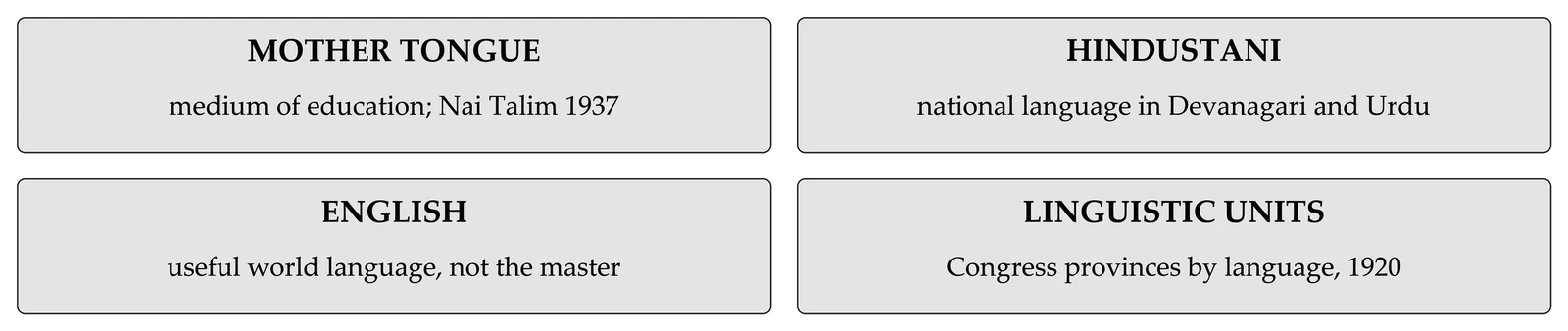
- Mother tongue. Education should be in the mother tongue. Learning through a foreign language, Gandhi argued, cut students off from their families and communities and wasted years. His Nai Talim (basic education) scheme of 1937 made the mother tongue the medium and linked learning with productive work.
- Against English domination. In Hind Swaraj (1909), he wrote that to give millions a knowledge of English is to enslave them. He respected English as a language of international communication and science, but opposed its dominance in Indian education, administration and public life.
- Hindustani as national language. Gandhi favoured Hindustani, the common spoken language of north India, written in both the Devanagari and Urdu scripts, as the national language, since it could unite Hindus and Muslims. He presided over the Hindi Sahitya Sammelan at Indore in 1918 and promoted Hindi in the south through the Dakshin Bharat Hindi Prachar Sabha (1918).
- Linguistic provinces. Gandhi supported organising the Congress on linguistic lines, adopted at the Nagpur session of 1920, believing that people should be governed and educated in their own languages.
- Respect for all languages. He wanted provincial languages to flourish while a common language served communication across India.
After Gandhi
Gandhi’s preference for Hindustani in both scripts lost ground after Partition. The Constituent Assembly, through the Munshi-Ayyangar formula (1949), adopted Hindi in Devanagari as the official language under Article 343, with English continuing for fifteen years. Opposition in the south, especially in Tamil Nadu in 1965, led to the continuation of English through the Official Languages Act. States were reorganised on linguistic lines in 1956. Ragi’s chapter on language questions compares Gandhi’s Hindustani with later emphasis on Hindi and shows the continuing relevance of his concern for the mother tongue, echoed in the National Education Policy 2020.
Gandhi’s Positions at a Glance
- Hinduism: a sanatani Hindu who rejected untouchability and taught equal respect for all religions (sarva dharma samabhava).
- Conversion: opposed organised proselytising by all faiths, believing each person should deepen their own religion.
- Cow protection: valued the cow as a symbol of compassion, but opposed forcing Muslims or legislating against them on this issue.
- Language: favoured Hindustani in both Devanagari and Urdu scripts as a link language, and mother-tongue education through Nai Talim (1937).
These positions show Gandhi’s attempt to combine a deep personal faith with tolerance and Hindu-Muslim unity, a combination that both Hindu nationalists and secular critics questioned.
5.4 Important Questions
- Question 1 Explain Gandhi’s understanding of Hinduism.
- Question 2 Discuss Gandhi’s views on religious conversion.
- Question 3 Examine Gandhi’s views on cow protection.
- Question 4 Discuss Gandhi’s views on the language question.
DU asks the same idea in different words. So learn one broad answer for each question below; the same answer works for every question joined by OR.
Important Question 1
Explain Gandhi’s understanding of Hinduism.
OR
Discuss the relationship between religion and politics in Gandhi’s thought.
OR
Examine Akeel Bilgrami’s interpretation of Gandhi’s religion.
Model Answer
“Hinduism is not an exclusive religion. In it there is room for the worship of all the prophets of the world.”
— M.K. Gandhi, Young India (6 October 1921)
Introduction. Gandhi called himself a sanatani Hindu and drew deeply on Hindu traditions, yet his understanding of Hinduism was ethical, inclusive and reformist. He defined the Hindu creed as the search for truth through non-violent means, rejected practices contrary to morality, and insisted on equal respect for all religions. His religion shaped his politics, but in a universal rather than sectarian way.
1. A Sanatani Hindu
Gandhi described himself as a sanatani Hindu, believing in the Vedas, Upanishads and Puranas, in rebirth, in varnashrama without hierarchy, in cow protection and in image worship as one form of devotion.
2. Search for Truth
In 1924, he defined the Hindu creed simply as the search after truth through non-violent means, making ethics rather than ritual the core of religion.
3. An Inclusive Religion
Gandhi wrote that Hinduism is not an exclusive religion and has room for the worship of all the prophets, reflecting its tolerance and openness.
4. Equal Respect for Religions
He practised sarva dharma samabhava, equal respect for all religions, seeing them as different paths to the same truth, each imperfect yet valuable.
5. Reason and Conscience
Gandhi rejected any scriptural teaching contrary to reason and morality, refusing to accept texts used to justify untouchability.
6. The Gita
He called the Gita his spiritual mother and read it as an allegory of the inner struggle, teaching selfless action, in his commentary Anasaktiyoga (1929).
7. Reform from Within
Gandhi sought to purify Hinduism of untouchability, child marriage and the oppression of widows, believing that reform from within would strengthen it.
8. Ram Rajya
He used Ram Rajya as an ideal of just and moral rule, explaining in 1929 that it meant Divine Raj, the Kingdom of God, not Hindu Raj.
9. Religion and Politics
Gandhi insisted that politics must be guided by religion, by which he meant the ethics of truth and non-violence, not the rule of one community.
10. Bilgrami’s View
Akeel Bilgrami argues that Gandhi’s religion was a source of ethical values resisting the disenchanted worldview of modernity, used to make politics moral rather than the state religious.
11. Radhakrishnan’s View
S. Radhakrishnan stressed that for Gandhi religion meant devotion to truth and service of humanity, giving his politics a universal character.
12. Ragi’s Comparison
Sangit Ragi compares Gandhi’s Hinduism with that of the RSS, showing a shared civilisational idea of India but sharp differences on non-violence and minorities.
13. Hardiman on Religious Hatred
David Hardiman shows that Gandhi used religious idiom to fight communal hatred, though this carried the risk of being appropriated by communal forces.
14. Criticism
Critics, including Ambedkar, argued that Gandhi’s defence of varna and reliance on Hindu symbols limited his challenge to caste and alienated some minorities.
15. Relevance
Gandhi’s inclusive, ethical Hinduism offers a counterpoint to exclusive religious nationalism and a resource for interfaith harmony.
16. Gandhi and the Bhagavad Gita
Gandhi called the Gita his mother and interpreted it as an allegory of the inner struggle between good and evil, teaching selfless action (anasakti) rather than literal war. His translation and commentary, Anasaktiyoga (1929), shows how he read Hindu texts ethically.
17. Gandhi’s Reform of Hinduism
Gandhi sought to reform Hinduism by rejecting untouchability, child marriage and the oppression of widows, arguing that practices contrary to truth and non-violence could not be part of true religion, whatever the scriptures said.
18. Evaluation
Gandhi’s Hinduism was an ethical and inclusive faith that he used to moralise politics, though it was contested from both secular and religious nationalist positions.
Conclusion. Thus, Gandhi understood Hinduism as the search for truth through non-violence, inclusive and reformist, with room, as he wrote, for the worship of all prophets. Bilgrami, Radhakrishnan, Ragi and Hardiman show how this faith shaped his moral politics and his fight against communal hatred.
Important Question 2
Discuss Gandhi’s views on religious conversion.
OR
Discuss why Gandhi opposed proselytisation.
OR
Examine the debate between Gandhi and Ambedkar on conversion.
Model Answer
“If I had the power and could legislate, I should certainly stop all proselytising.”
— M.K. Gandhi, Harijan (1935)
Introduction. Religious conversion was a contentious issue in colonial India, involving Christian missions, Hindu reform movements such as the Arya Samaj’s shuddhi, and debates on the future of untouchables. Gandhi opposed proselytisation, believing that all religions are true and that each person should seek truth within his or her own faith. His views led to a significant debate with B.R. Ambedkar.
1. The Colonial Context
Christian missions, Islamic tabligh and Hindu shuddhi movements competed for converts in colonial India, raising communal tensions and anxieties about numbers.
2. Equality of Religions
Gandhi believed that all religions are true, though imperfect, and that no religion is superior, so there is no need to convert others.
3. Stopping Proselytisation
In 1935, Gandhi said that if he had the power to legislate he would stop all proselytising, showing the strength of his opposition.
4. Swadeshi in Religion
Applying swadeshi to religion, Gandhi argued that one should remain in one’s ancestral faith and reform it from within rather than convert.
5. Making Better Believers
He urged followers of every faith to help others become better Hindus, Muslims or Christians, rather than seeking to change their religion.
6. Missionaries and Service
Gandhi admired missionaries’ service in education and health but objected when service was used as a means to conversion.
7. Conversion and Untouchability
Many conversions in colonial India were by untouchables seeking escape from caste oppression, which made the question deeply political.
8. Ambedkar’s Yeola Declaration
In 1935, Ambedkar declared at Yeola that though born a Hindu he would not die a Hindu, signalling his intention to leave Hinduism.
9. Gandhi’s Response
Gandhi opposed mass conversion of untouchables, arguing that the remedy for untouchability lay in reforming Hinduism and changing the hearts of caste Hindus.
10. Ambedkar’s Conversion
Ambedkar converted to Buddhism with lakhs of followers at Nagpur in 1956, choosing a religion of equality and reason over reform within Hinduism.
11. Freedom of Conscience
Gandhi did not deny individuals the right to change religion out of genuine conviction, but opposed organised conversion campaigns.
12. Mehta’s Compilation
Sandhya Mehta’s Gandhiji on Religious Conversion (2002) compiles his writings, showing consistency in his opposition to proselytisation.
13. Ragi’s Analysis
Sangit Ragi compares Gandhi’s views on conversion with those of the RSS, noting shared opposition to conversion but differences in method and tone.
14. Criticism
Critics argue that Gandhi’s opposition to conversion denied untouchables an exit from caste oppression and favoured the majority religion.
15. Contemporary Debates
Anti-conversion laws in several states and debates over freedom of religion under Article 25 show that the questions Gandhi raised remain contested.
16. Conversion and Service
Gandhi admired missionaries’ service in education and health, but objected when service was used as a means of conversion. He argued that service should be offered for its own sake, without the motive of changing the religion of those served.
17. Conversion and the Constitution
The Constitution guarantees the freedom to profess, practise and propagate religion under Article 25. In Rev. Stainislaus (1977), the Supreme Court held that propagation does not include a right to convert others, upholding state laws against conversion by force or inducement.
18. Evaluation
Gandhi’s opposition to conversion flowed from his belief in the equality of religions, but it conflicted with the claims of the oppressed to choose their faith.
Conclusion. Thus, Gandhi opposed proselytisation because he believed all religions are true and one should reform one’s own faith, saying he would stop all proselytising if he could. His debate with Ambedkar, who converted to Buddhism in 1956, shows the tension between equal respect for religions and the freedom of the oppressed to choose.
Important Question 3
Examine Gandhi’s views on cow protection.
OR
Cow protection is one of the most wonderful phenomena in human evolution. Discuss Gandhi’s view.
OR
Discuss Gandhi’s non-coercive approach to cow protection.
Model Answer
“Cow protection to me is one of the most wonderful phenomena in human evolution. It takes the human being beyond his species.”
— M.K. Gandhi, Young India (6 October 1921)
Introduction. Cow protection was a central and emotive issue in colonial India, often leading to communal conflict. Gandhi regarded it as a central feature of Hinduism and an expression of ahimsa, but he rejected the use of force and opposed violence against Muslims in its name. His approach was ethical, economic and non-coercive.
1. Cow Protection and Hinduism
Gandhi regarded cow protection as a central feature of Hinduism, calling it the gift of Hinduism to the world.
2. Beyond the Species
He wrote in 1921 that cow protection takes human beings beyond their species, expressing kinship with all life and compassion for helpless creatures.
3. Symbol of Ahimsa
The cow symbolised for Gandhi the whole sub-human world, so protecting it was an expression of ahimsa towards all creatures.
4. Economic Importance
He stressed the importance of cattle for ploughing, milk and manure in India’s village economy, linking cow protection with agriculture.
5. Rejecting Coercion
Gandhi rejected the use of force to stop cow slaughter. In July 1947 he asked how he could force anyone not to slaughter cows unless he was himself so disposed.
6. India Not Only for Hindus
He reminded Hindus that India was not only for Hindus, so the beliefs of one community could not be imposed by law on others.
7. Against Communal Violence
Gandhi criticised Hindus who attacked Muslims over cow slaughter, saying that killing a human being to save a cow denied the principle of cow protection.
8. Persuasion and Example
He believed Hindus should protect cows by caring for them and by persuading others through love, not by violence or legal compulsion.
9. The Goseva Sangh
Gandhi founded the Goseva Sangh in 1941 to promote better breeding, dairying and the use of hides of dead cattle, a constructive approach.
10. Cruelty by Hindus
He criticised Hindus for neglecting and ill-treating cattle, starving them and overworking bullocks, while claiming to revere the cow.
11. Article 48
The Constitution placed cow protection in Article 48 as a Directive Principle, combining modern animal husbandry with prohibition of cow slaughter.
12. Ragi’s Comparison
Sangit Ragi compares Gandhi’s non-coercive approach with later political campaigns for laws against cow slaughter and stricter enforcement.
13. Laws on Cow Slaughter
Many states have enacted laws against cow slaughter, upheld by the Supreme Court in Mirzapur Moti Kureshi (2005), showing the shift from persuasion to law.
14. Criticism
Critics argue that Gandhi’s emphasis on cow protection gave a Hindu colour to his politics, which communal forces later exploited.
15. Relevance
Gandhi’s insistence that cow protection cannot justify violence against human beings is highly relevant to incidents of vigilante violence today.
16. Cow Protection and Economics
Gandhi also gave economic reasons for cow protection, stressing the importance of cattle for agriculture, milk and manure in India’s village economy, and called for better breeding, dairying and care of cattle rather than mere prohibition.
17. Evaluation
Gandhi’s approach combined reverence for the cow with a firm rejection of coercion and violence, making it an ethic of compassion rather than a communal demand.
Conclusion. Thus, Gandhi saw cow protection as one of the most wonderful phenomena in human evolution, an expression of ahimsa and of economic value, but he rejected coercion and violence against Muslims in its name. His non-coercive approach contrasts with later legal and political campaigns.
Important Question 4
Discuss Gandhi’s views on the language question.
OR
Examine Gandhi’s views on the mother tongue, Hindustani and English.
OR
Discuss Gandhi’s contribution to the debate on a national language.
Model Answer
“To give millions a knowledge of English is to enslave them.”
— M.K. Gandhi, Hind Swaraj (1909)
Introduction. India’s linguistic diversity and the dominance of English under colonial rule made language a major question for the national movement. Gandhi held that education must be in the mother tongue, opposed the domination of English, and promoted Hindustani as a national language uniting Hindus and Muslims. His views shaped the debates that led to the language provisions of the Constitution.
1. Language and Colonialism
English was the language of colonial administration, higher education and the courts, giving the English-educated elite power and separating them from the masses.
2. The Mother Tongue
Gandhi insisted that education should be in the mother tongue, since learning through a foreign language cut students off from their families and wasted years.
3. Nai Talim
His basic education scheme of 1937, Nai Talim, made the mother tongue the medium and linked learning with productive work and village life.
4. Against English Domination
In Hind Swaraj, Gandhi wrote that giving millions a knowledge of English would enslave them, since it would tie India to the culture of its rulers.
5. English as a World Language
Gandhi respected English as a language of international communication and science, opposing only its dominance in Indian education and public life.
6. Hindustani
He favoured Hindustani, the common spoken language of north India, as the national language, written in both Devanagari and Urdu scripts.
7. Uniting Hindus and Muslims
Hindustani in both scripts could unite Hindus and Muslims, avoiding the communal division between Sanskritised Hindi and Persianised Urdu.
8. Promoting Hindi in the South
Gandhi presided over the Hindi Sahitya Sammelan at Indore in 1918 and promoted Hindi in the south through the Dakshin Bharat Hindi Prachar Sabha.
9. Linguistic Provinces
He supported organising the Congress on linguistic lines, adopted at Nagpur in 1920, so that people could be governed in their own languages.
10. Respect for All Languages
Gandhi wanted provincial languages to flourish, with a common language for communication across India rather than replacing regional languages.
11. The Constituent Assembly
After Partition, the Munshi-Ayyangar formula of 1949 adopted Hindi in Devanagari as the official language under Article 343, with English for fifteen years.
12. Anti-Hindi Agitations
Opposition in the south, especially in Tamil Nadu in 1965, led to the continued use of English, showing the sensitivity of the language question.
13. Linguistic States
States were reorganised on linguistic lines in 1956, reflecting the principle Gandhi had supported for the Congress.
14. Ragi’s Analysis
Sangit Ragi compares Gandhi’s Hindustani with later emphasis on Hindi and shows the continuing relevance of his concern for the mother tongue.
15. NEP 2020
The National Education Policy 2020’s emphasis on the mother tongue as the medium of instruction echoes Gandhi’s views on education.
16. Nai Talim and the Mother Tongue
Gandhi’s scheme of basic education, Nai Talim (1937), insisted that education be in the mother tongue and linked with productive work, so that education would not alienate children from their homes and communities.
17. Language and the Constituent Assembly
The Constituent Assembly adopted Hindi in the Devanagari script as the official language, with English continuing for fifteen years, a compromise that differed from Gandhi’s preference for Hindustani in both scripts.
18. Language and Swaraj
For Gandhi, the language question was part of swaraj: a people who thought, studied and governed in a foreign tongue could not be truly free. Self-rule required that ordinary citizens understand the language of law, administration and politics, which is why he linked the mother tongue with democracy.
19. Evaluation
Gandhi’s views on language combined pride in Indian languages with an inclusive vision of a common language, though Hindustani lost ground after Partition.
Conclusion. Thus, Gandhi favoured the mother tongue in education, opposed the domination of English, warning that it would enslave millions, and promoted Hindustani in both scripts as a uniting national language. Though the Constitution adopted Hindi in Devanagari, his concern for the mother tongue remains relevant.
Short Notes
(a) Sarva dharma samabhava
Equal respect for all religions, a principle Gandhi practised in his prayer meetings and which he saw as the basis of communal harmony.
(b) Hindustani
The common spoken language of north India, which Gandhi proposed as the national language, written in both the Devanagari and Urdu scripts.
(c) Goseva Sangh
An organisation founded by Gandhi in 1941 to promote the care of cattle through better breeding, dairying and the use of hides of dead cattle.
More notes: DSE-2a Gandhi and the Contemporary World
These notes are prepared by PADHO TO AISE for study help. They are not an official University of Delhi publication.