
Semester VIII DSE-14 Democracy and Governance
Unit I · 24 min read · Updated 24 Nov 2026
As per the University of Delhi (DU) BA (Hons) Political Science syllabus
Contents
- 1.1 Participatory Democracy
- Roots of Participatory Democracy
- Features of Participatory Democracy
- The Elitist Theory Pateman Challenged
- Participation in Practice
- 1.2 Deliberative and Communicative Democracy
- Origins of Deliberative Democracy
- Features of Deliberative Democracy
- Deliberation in Practice
- Critics of Deliberation
- 1.3 Consociational Democracy
- Origins of Consociational Theory
- Consociational Systems around the World
- Lijphart on India
- Critics and Alternatives
- 1.4 Important Questions
- Discuss the theory of participatory democracy with reference to Macpherson and Pateman.
- What is deliberative democracy? Discuss its promises and criticisms.
- Explain Lijphart’s theory of consociational democracy. Is India a consociational democracy?
- What is communicative democracy? Discuss with reference to Habermas and Young.
- Short Notes
लोकतंत्र केवल शासन का एक रूप नहीं है; यह मुख्यतः साथ मिलकर जीने और साझा अनुभव का एक तरीका है।
A democracy is more than a form of government; it is primarily a mode of associated living, of conjoint communicated experience.
— John Dewey, Democracy and Education (1916)
DEMOCRACY means rule by the people, but there are many views of what that requires. Participatory theorists such as C.B. Macpherson and Carole Pateman want citizens to take part directly in decisions. Deliberative theorists want decisions made through reasoned public discussion. Consociational theory, developed by Arend Lijphart, explains how deeply divided societies can share power. Communicative theorists, from Jürgen Habermas to Iris Marion Young and Adela Cortina, stress the role of communication and mutual recognition. This chapter explains these four theories and their relevance to India.

1.1 Participatory Democracy
Participatory democracy holds that citizens should take part directly in the decisions that affect them, in politics, the workplace and the community, not only vote in periodic elections. Carole Pateman argued that participation educates citizens and builds democratic skills, and C.B. Macpherson criticised liberal democracy for treating people as consumers rather than as developers of their capacities.
Roots of Participatory Democracy
The ideal of citizens governing themselves goes back to ancient Athens, where all adult male citizens could speak and vote in the assembly and many offices were filled by lot. Jean-Jacques Rousseau, in The Social Contract (1762), argued that sovereignty cannot be represented and mocked the English people for being free only during elections. John Stuart Mill, in Considerations on Representative Government (1861), valued participation in local government and juries because it educated citizens and widened their sympathies. G.D.H. Cole, in Self-Government in Industry (1917), extended the idea to the workplace through guild socialism. In the 1960s, the New Left revived the term participatory democracy, which the American student movement used in its Port Huron Statement of 1962.
Features of Participatory Democracy
- Direct involvement. Citizens take part in making decisions, not only in choosing those who make them.
- The educative effect. Pateman (1970) argued that participation develops the skills, confidence and public spirit that democracy needs, so the more people participate, the better they become at it.
- Democracy beyond the state. Participation should extend to workplaces, schools and local communities, where people spend most of their lives; Pateman drew on experiments such as workers’ self-management in Yugoslavia.
- Decentralisation. Power should be brought close to the people through local councils and neighbourhood bodies.
- Equality as a condition. Macpherson argued that real participation requires reducing social and economic inequality, since poverty and long working hours prevent people from taking part.
- Integration. Participation gives citizens a sense of belonging and makes collective decisions easier to accept.
The Elitist Theory Pateman Challenged
Pateman wrote against the elitist or competitive theory of democracy. Joseph Schumpeter, in Capitalism, Socialism and Democracy (1942), defined democracy as a method in which leaders compete for the people’s vote, and argued that citizens should leave politics to those elected. Voting studies of the 1950s found that many citizens were apathetic and poorly informed, and some theorists concluded that limited participation was even good for stability. Pateman replied that apathy was the product of institutions that gave people no real power, and that it could be overcome by expanding participation.
Participation in Practice
Participatory ideas have shaped many institutions. Participatory budgeting began in Porto Alegre, Brazil, in 1989, letting residents decide how part of the city budget would be spent, and spread to thousands of cities. In India, the 73rd and 74th Amendments of 1992 created elected panchayats and municipalities and made the gram sabha, the assembly of all village voters, a constitutional body. Kerala’s People’s Plan Campaign of 1996 devolved a large share of plan funds to local bodies and involved citizens in planning. Switzerland’s frequent referendums, citizens’ juries and social audits under the rural employment programme are further examples.
1.2 Deliberative and Communicative Democracy
Deliberative democracy holds that legitimate decisions come from free and reasoned discussion among equals, in which people justify their views to one another. Communicative democracy, rooted in Habermas’s theory of communicative action, stresses mutual understanding through language, and Iris Marion Young widened it to include greeting, rhetoric and storytelling, so that marginalised voices are heard.

Origins of Deliberative Democracy
The term deliberative democracy was coined by Joseph Bessette in 1980, but the idea draws on Jürgen Habermas and John Rawls. Habermas, in The Structural Transformation of the Public Sphere (1962), traced how coffee houses, salons and newspapers created a space for public reasoning. Rawls, in Political Liberalism (1993), argued that citizens should justify basic political decisions through public reason, i.e. reasons that others can reasonably accept. Joshua Cohen’s essay Deliberation and Democratic Legitimacy (1989) set out an ideal procedure of free, reasoned and equal deliberation, and Amy Gutmann and Dennis Thompson developed the theory in Democracy and Disagreement (1996) and Why Deliberative Democracy (2004).
Features of Deliberative Democracy
- Reason-giving. Participants must justify their proposals with reasons that others can understand and accept, not simply assert preferences or bargain.
- Reciprocity. Gutmann and Thompson stress that citizens owe one another mutually acceptable justifications.
- Publicity. Deliberation should take place in public, so that reasons can be examined and leaders held to account.
- Equality and inclusion. All affected persons should have an equal chance to speak and be heard, regardless of wealth or status.
- Transformation of preferences. Deliberation can change people’s views as they learn from others, unlike the aggregative model, which simply counts fixed preferences.
- Provisional decisions. Decisions remain open to revision in the light of new arguments.
Deliberation in Practice
James Fishkin developed deliberative polling, in which a random sample of citizens is informed, deliberates in small groups and is polled before and after; the first national poll was held in Britain in 1994. Ireland’s Citizens’ Assembly of 2016 to 2018, made up of ninety-nine randomly selected citizens, recommended changing the constitutional ban on abortion, which voters approved in a referendum in 2018. In India, Amartya Sen, in The Argumentative Indian (2005), traces a tradition of public reasoning back to Buddhist councils, Ashoka’s edicts and Akbar’s debates in the Ibadat Khana, and Vijayendra Rao and Paromita Sanyal, in Oral Democracy (2019), show how villagers argue and bargain in gram sabhas.
Critics of Deliberation
Iris Marion Young argued that deliberation privileges calm, formal argument, which suits educated and powerful groups. Lynn Sanders, in an essay titled Against Deliberation (1997), showed that women and racial minorities are often less likely to be heard in deliberative settings. Nancy Fraser, in Rethinking the Public Sphere (1990), argued that marginalised groups need subaltern counterpublics, their own spaces for forming ideas. Chantal Mouffe, in The Democratic Paradox (2000), proposed agonistic pluralism, holding that conflict is permanent in politics and that democracy should turn enemies into adversaries rather than seek consensus. Young’s answer was communicative democracy, which widens the forms of communication that count.
1.3 Consociational Democracy
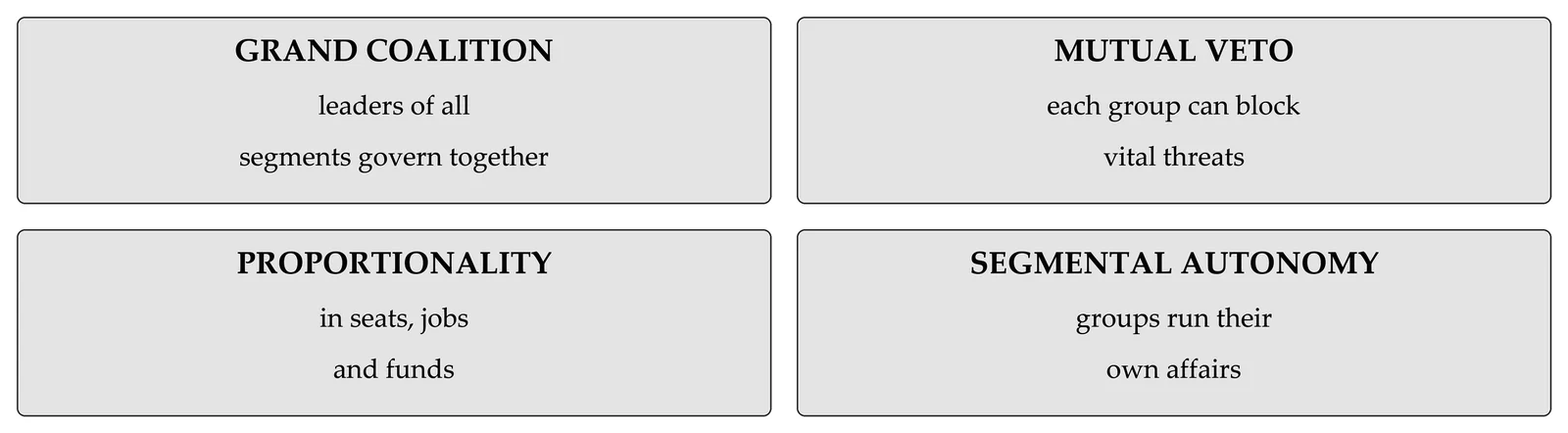
Consociational democracy is a system of power-sharing among the elites of different religious, linguistic or ethnic groups in a divided society. Arend Lijphart identified four features: a grand coalition, a mutual veto, proportionality and segmental autonomy. He argued that India, in its early decades, worked as a consociational democracy.
Origins of Consociational Theory
Arend Lijphart developed consociational theory from his study of the Netherlands in The Politics of Accommodation (1968) and his article Consociational Democracy (1969). Dutch society was divided into separate pillars, Catholic, Protestant, socialist and liberal, each with its own schools, newspapers, unions and parties, yet the country was stable. Lijphart explained this by the cooperation of the elites of each pillar, who shared power and respected each other’s autonomy. The word comes from the Latin consociatio, used by the German thinker Johannes Althusius in his Politica (1603) to describe a federation of associations.
Consociational Systems around the World
- Switzerland. Since 1959, the seven-member Federal Council has been shared among the main parties by a so-called magic formula, along with linguistic and regional balance.
- Belgium. Divisions between Dutch-speaking Flemish and French-speaking Walloons led to a federal state in 1993, with linguistic parity in the cabinet.
- Lebanon. The National Pact of 1943 divided top offices among religious communities, and the Taif Agreement of 1989 split parliament equally between Christians and Muslims.
- Northern Ireland. The Good Friday Agreement of 1998 created a power-sharing executive of unionists and nationalists, with cross-community voting on key issues.
- Bosnia and Herzegovina. The Dayton Agreement of 1995 created a three-member presidency of Bosniak, Croat and Serb members.
Lijphart on India
In The Puzzle of Indian Democracy (1996), Lijphart argued that India, despite its great diversity, had succeeded as a democracy because it was consociational. The Congress party acted as a grand coalition including all major groups; linguistic states after 1956, minority educational institutions under Article 30 and separate personal laws gave segmental autonomy; reservations and balanced representation in cabinets provided proportionality; and an informal minority veto protected groups such as Muslims on matters like personal law. He suggested that India’s difficulties after the 1960s arose partly from the decline of these practices.
Critics and Alternatives
Brian Barry, in an essay of 1975, argued that consociational theory exaggerated the role of elites and could not easily be applied outside small European states. Donald Horowitz, in Ethnic Groups in Conflict (1985), proposed an integrative or centripetal alternative, using electoral systems that reward parties for winning votes across groups instead of entrenching group divisions. Other critics argue that consociationalism freezes identities, weakens opposition and may break down, as Lebanon’s civil war of 1975 to 1990 showed. Lijphart later broadened his analysis in Patterns of Democracy (1999), comparing majoritarian and consensus democracies and arguing that consensus systems perform at least as well in governance and better in representation.
1.4 Important Questions
- Question 1 Discuss the theory of participatory democracy with reference to Macpherson and Pateman.
- Question 2 What is deliberative democracy? Discuss its promises and criticisms.
- Question 3 Explain Lijphart’s theory of consociational democracy. Is India a consociational democracy?
- Question 4 What is communicative democracy? Discuss with reference to Habermas and Young.
DU asks the same idea in different words. So learn one broad answer for each question below; the same answer works for every question joined by OR.
Important Question 1
Discuss the theory of participatory democracy with reference to Macpherson and Pateman.
OR
Examine the main features and criticisms of participatory democracy.
OR
Why do participatory theorists criticise elitist theories of democracy?
Model Answer
“The major function of participation in the theory of participatory democracy is therefore an educative one, educative in the very widest sense.”
— Carole Pateman, Participation and Democratic Theory (1970)
Introduction. In the mid-twentieth century, many political scientists defined democracy narrowly as competition among elites for votes, and saw low participation as normal or even useful. Participatory democrats challenged this view. C.B. Macpherson and Carole Pateman argued that real democracy requires active participation by citizens in many areas of life.
1. Meaning
Participatory democracy is a theory and practice in which citizens take part directly in making decisions that affect them, through assemblies, councils, workplace bodies and local institutions, in addition to electing representatives.
2. Elitist Theory
Joseph Schumpeter, in Capitalism, Socialism and Democracy (1942), defined democracy as a method in which leaders compete for the people’s vote. Later theorists suggested that too much participation could threaten stability, so apathy among ordinary citizens was not a problem.
3. Pateman’s Critique
Carole Pateman, in Participation and Democratic Theory (1970), argued that the elitist theory had abandoned the classical idea of democracy found in Rousseau, John Stuart Mill and G.D.H. Cole, in which participation is central.
4. The Educative Function
For Pateman, the main function of participation is educative. By participating, people develop the psychological qualities and practical skills of democratic citizens, such as confidence, responsibility and the ability to cooperate.
5. Workplace Democracy
Pateman argued that the workplace is the most important area for participation, because most people spend their lives at work. She distinguished partial participation, where workers influence decisions, from full participation, where they share equal power.
6. Macpherson’s Real World of Democracy
C.B. Macpherson, in The Real World of Democracy, argued that liberal democracy is only one form of democracy, alongside the communist and the post-colonial forms, and that liberal democracy combined democracy with a market society that produced inequality.
7. Macpherson’s Retrieval
In Democratic Theory: Essays in Retrieval (1973), Macpherson criticised the view of people as consumers maximising utility. He argued that democracy should allow people to develop and exercise their human capacities, and that market inequality limits this developmental power.
8. Models of Democracy
Macpherson described models of liberal democracy, from protective democracy, which protects citizens from government, to developmental democracy, inspired by Mill, to equilibrium democracy of competing elites, and argued for a participatory model.
9. Participation and Equality
Participatory democrats argue that real participation requires reducing social and economic inequality, since the poor lack the time, resources and confidence to take part.
10. Practices
Examples include participatory budgeting, first used in Porto Alegre, Brazil in 1989, citizens’ assemblies, workers’ councils, and in India gram sabhas and Kerala’s People’s Plan Campaign of 1996.
11. India
The 73rd and 74th Amendments of 1992 created gram sabhas and ward committees, giving citizens a direct role in local decisions, and social audits allow villagers to check public works.
12. Criticisms
Critics argue that direct participation is impractical in large, complex societies, that most people lack time or interest, and that participatory bodies may be dominated by activists or local elites.
13. Response
Participatory democrats reply that participation can be combined with representation at different levels, and that institutions can be designed to include ordinary people, for example through selection by lot.
14. Continuing Relevance
Declining trust in parties and representatives has renewed interest in participatory democracy, as governments experiment with consultation, citizens’ juries and digital participation.
15. Rousseau, Mill and Cole
Pateman draws on three classical thinkers. Rousseau held that citizens must take part in making the laws they obey, which makes them free. John Stuart Mill argued that participation in local government and juries educates citizens. G.D.H. Cole’s guild socialism extended participation to industry, where workers would govern their own workplaces through democratic councils.
16. Evaluation
Participatory democracy enriches democracy by making citizens active participants, though it must be combined with representative institutions.
Conclusion. Thus, participatory democracy calls for direct citizen participation in politics, work and community. Pateman criticised elitist theory and stressed the educative function of participation and workplace democracy, while Macpherson criticised liberal market democracy and argued for developmental power. Gram sabhas and participatory budgeting show its practice.
Important Question 2
What is deliberative democracy? Discuss its promises and criticisms.
OR
Can deliberative democracy work in deeply divided societies? Discuss.
OR
Examine the arguments for and against deliberative democracy.
Model Answer
“Outcomes are democratically legitimate if and only if they could be the object of a free and reasoned agreement among equals.”
— Joshua Cohen, Deliberation and Democratic Legitimacy (1989)
Introduction. Deliberative democracy became one of the most influential ideas in democratic theory from the 1990s. It holds that democracy is not only about counting votes or bargaining among interests, but about reasoned public discussion through which citizens justify their views to one another. Thinkers such as Joshua Cohen, Samuel Freeman and Darrin Hicks explain its promise, while critics question whether it is realistic.
1. Meaning
Deliberative democracy holds that political decisions should be made through free, equal and reasoned discussion among those affected, aiming at agreement or at least mutual understanding, rather than simply aggregating preferences.
2. Aggregative and Deliberative Models
The aggregative model treats democracy as counting fixed preferences through voting. The deliberative model holds that preferences can change through discussion, as people learn from one another and consider the common good.
3. Cohen’s Ideal Procedure
Joshua Cohen argued that outcomes are legitimate if they could be the object of free and reasoned agreement among equals. His ideal deliberative procedure is free, reasoned, equal and aimed at rational consensus.
4. Gutmann and Thompson
Amy Gutmann and Dennis Thompson argued that deliberation should follow principles of reciprocity, giving reasons others can accept; publicity, making reasons public; and accountability, answering to those affected.
5. Freeman’s Sympathetic Comment
Samuel Freeman traces deliberative democracy to Rawls’s idea of public reason and Habermas’s discourse theory, and explains that its core is that citizens should decide on the basis of the common good and reasons all can accept, not private interest.
6. Hicks on Its Promises
Darrin Hicks identifies the promises of deliberative democracy: more legitimate decisions, better-informed choices, greater mutual respect among citizens and the development of civic virtues through participation in reasoned debate.
7. Practices
Deliberative practices include citizens’ assemblies, deliberative polls developed by James Fishkin, and consensus conferences. Ireland’s citizens’ assembly discussed abortion before the referendum of 2018.
8. Vij’s Critique
Kristoffer Ahlstrom-Vij argues that deliberative democracy remains untenable, because psychological evidence shows that group discussion often produces polarisation and bias rather than better decisions, undermining its claim to improve outcomes.
9. Group Polarisation
Cass Sunstein described a law of group polarisation, in which like-minded groups become more extreme after discussion. Critics say this shows the dangers of deliberation in echo chambers.
10. Exclusion
Feminist and other critics argue that deliberation favours educated, articulate and confident speakers, excluding those who express themselves differently, such as women, minorities and the poor.
11. Addis on Divided Societies
Adeno Addis examines whether deliberation can work in severely fractured societies. He argues that well-designed deliberative institutions can help build a shared sense of belonging across groups, complementing power-sharing arrangements.
12. Deliberation and Power
Critics argue that deliberation ignores inequalities of power and that real politics involves conflict and bargaining. Defenders reply that deliberation is an ideal against which actual practices can be judged.
13. India
In India, parliamentary debate, committee hearings, public consultations and gram sabhas offer spaces for deliberation, though they are often limited by party discipline, hierarchy and time.
14. Digital Deliberation
Digital platforms allow wide public discussion but also spread misinformation and polarisation, raising new questions about the conditions for good deliberation.
15. Public Reason
John Rawls’s idea of public reason requires that citizens justify basic political decisions by reasons that others, holding different religious and moral views, can reasonably accept. Deliberative democrats adopt this idea, so that public debate rests on shared political values rather than on doctrines that only some citizens hold.
16. Evaluation
Deliberative democracy offers a powerful ideal of reasoned self-government, but it must address problems of inequality, polarisation and exclusion.
Conclusion. Thus, deliberative democracy holds that legitimate decisions arise from free and reasoned agreement among equals, as Cohen argued. Freeman and Hicks explain its promise, Addis its potential in divided societies, while Vij and others point to polarisation, bias and exclusion. It remains an important ideal for improving democratic practice.
Important Question 3
Explain Lijphart’s theory of consociational democracy. Is India a consociational democracy?
OR
Discuss the features of consociational democracy and its criticisms.
OR
Distinguish between majoritarian and consensus models of democracy.
Model Answer
“Consociational democracy means government by elite cartel designed to turn a democracy with a fragmented political culture into a stable democracy.”
— Arend Lijphart, Consociational Democracy (1969)
Introduction. Many societies are divided by religion, language, ethnicity or race. Majority rule in such societies may lead permanent minorities to feel excluded and turn to conflict. Arend Lijphart developed the theory of consociational democracy to explain how such divided societies can remain stable democracies through power-sharing among the elites of different groups.
1. Meaning
Consociational democracy is a form of democracy in which the leaders of the main segments of a plural society share power and cooperate to manage their differences, instead of one majority ruling over others.
2. Origin of the Theory
Lijphart developed the theory in 1969 after studying the Netherlands, where Catholics, Protestants, socialists and liberals lived in separate pillars but their leaders cooperated at the top, producing a stable democracy.
3. Grand Coalition
The first feature is a grand coalition, in which the leaders of all significant segments take part in governing the country together, instead of a narrow majority government.
4. Mutual Veto
The second is a mutual veto, which allows each group to block decisions that threaten its vital interests, giving minorities protection against being outvoted.
5. Proportionality
The third is proportionality in political representation, civil service appointments and allocation of public funds, so that each group receives a fair share.
6. Segmental Autonomy
The fourth is segmental autonomy, which allows each group to manage its own internal affairs, such as education, culture and personal law, often through federalism or community institutions.
7. Examples
Lijphart cited the Netherlands, Belgium, Switzerland and Austria as consociational democracies. Power-sharing was also used in Lebanon from 1943, in Bosnia after 1995 and in Northern Ireland after the Good Friday Agreement of 1998.
8. Patterns of Democracy
In Patterns of Democracy (1999), Lijphart compared 36 democracies and distinguished majoritarian democracies, such as Britain, from consensus democracies, which share power widely. He argued that consensus democracies perform as well or better and are kinder and gentler.
9. Lijphart on India
In 1996, Lijphart argued that India, especially under Congress dominance in its early decades, was a consociational democracy: Congress acted as a grand coalition, linguistic states and minority rights gave autonomy, reservations and cabinet balance ensured proportionality, and minorities had informal vetoes.
10. Critics on India
Scholars such as Paul Brass and Steven Wilkinson argued that India is not consociational, since it rejected separate electorates, does not guarantee minority vetoes and has seen the decline of power-sharing practices with the rise of majoritarian politics.
11. Criticisms of the Theory
Critics argue that consociationalism freezes group divisions, gives too much power to elites, weakens opposition and accountability, and can break down, as in Lebanon’s civil war from 1975.
12. Integrative Alternatives
Donald Horowitz proposed integrative or centripetal approaches, such as electoral systems that reward parties for winning votes across groups, as an alternative to consociational power-sharing.
13. Relevance
Consociational ideas remain relevant to plural societies, including India, where federalism, reservations, coalition governments and minority rights involve elements of power-sharing.
14. Consensus in Indian Federalism
Institutions such as the GST Council, inter-state councils and coalition governments since 1989 show consensual elements in Indian democracy, even if it is not fully consociational.
15. Favourable Conditions
Lijphart identified conditions that help consociational democracy succeed: a balance of power among groups so that none dominates, a small number of segments, a small total population, external threats that encourage unity, overarching loyalties to the country and a tradition of elite accommodation. Where these are absent, power-sharing is harder to sustain.
16. Evaluation
Consociational theory explains how power-sharing can stabilise divided democracies, though its applicability to India is debated.
Conclusion. Thus, Lijphart’s consociational democracy rests on a grand coalition, mutual veto, proportionality and segmental autonomy, as in the Netherlands and Switzerland. He saw India as consociational under Congress dominance, but critics such as Brass and Wilkinson disagree. Despite criticisms of elitism and rigidity, power-sharing remains vital for plural societies.
Important Question 4
What is communicative democracy? Discuss with reference to Habermas and Young.
OR
Examine Habermas’s theory of communicative action and its implications for democracy.
OR
How does communicative democracy differ from deliberative democracy?
Model Answer
“No force except that of the better argument is exercised.”
— Jürgen Habermas, Legitimation Crisis (1975)
Introduction. Communicative democracy is the idea that democracy rests on communication among citizens aimed at mutual understanding. It draws on Jürgen Habermas’s theory of communicative action, and was developed by Iris Marion Young and Adela Cortina as a broader and more inclusive version of deliberative democracy. It asks how people with different backgrounds can genuinely understand and recognise one another.
1. Habermas’s Communicative Action
In The Theory of Communicative Action (1981), Habermas distinguished strategic action, aimed at success by influencing others, from communicative action, aimed at reaching mutual understanding through language.
2. Lifeworld and System
Habermas contrasted the lifeworld of shared meanings and everyday communication with systems of money and power, the market and the state, and warned that systems were colonising the lifeworld.

3. The Ideal Speech Situation
Habermas described an ideal speech situation in which all can participate, raise any claim and question any assertion, free from coercion, so that only the force of the better argument decides.
4. Performative Contradiction
Martin Matustik explains Habermas’s argument that anyone who denies the norms of rational discussion while arguing commits a performative contradiction, since the act of arguing already assumes those norms.
5. Discourse Ethics
Habermas’s discourse ethics holds that valid norms are those that all affected could accept as participants in a practical discourse, making communication the basis of moral and political legitimacy.
6. Between Facts and Norms
In Between Facts and Norms (1992), Habermas described a two-track model in which public opinion formed in the informal public sphere feeds into formal law-making by parliaments, linking communication with democratic institutions.
7. Ingram on Communicative Ethics
David Ingram examines the limits and possibilities of communicative ethics for democracy, noting that complexity, pluralism and inequality make the ideal hard to realise, while it still offers a standard for judging institutions.
8. Young’s Critique of Deliberation
Iris Marion Young argued that deliberative democracy privileges calm, dispassionate and articulate speech, a style associated with educated men, and may exclude groups whose ways of speaking differ.
9. Young’s Communicative Democracy
Young proposed communicative democracy, which adds greeting, the public recognition of others as equals; rhetoric, the use of emotion and style; and narrative or storytelling, sharing lived experience, to argument.
10. Cortina’s Version
Adela Cortina presents communicative democracy as a version of deliberative democracy based on discourse ethics, in which citizens recognise one another as valid interlocutors and combine reasoning with mutual respect and care, which she calls cordial reason.
11. Difference from Deliberative Democracy
Communicative democracy is wider than deliberative democracy: it values understanding and recognition, not only rational agreement, and accepts many forms of expression as part of public communication.
12. Relevance to India
In a diverse society like India, communicative democracy suggests that public life should welcome testimony, protest songs, storytelling and local languages, so that Dalits, Adivasis, women and minorities are heard on their own terms.
13. Criticisms
Critics argue that the ideal speech situation is unrealistic, that power and interests cannot be excluded from communication, and that rhetoric can be used to manipulate as well as include.
14. The Public Sphere Today
Social media has transformed the public sphere, enabling wide communication but also misinformation and polarisation, which tests Habermas’s hopes for rational public opinion.
15. The Public Sphere
Habermas’s earlier work, The Structural Transformation of the Public Sphere (1962), described how coffee houses, salons and newspapers in eighteenth-century Europe created a space where private people came together to discuss public matters. He argued that commercial mass media later weakened this rational public sphere, a concern that underlies his theory of communicative democracy.
16. Recognition and Difference
Communicative democracy is linked with the politics of recognition. Thinkers such as Charles Taylor and Axel Honneth argue that people need recognition of their identity and dignity, and misrecognition is a form of harm. Communication that greets and acknowledges others, as Young suggests, is therefore part of treating citizens as equals in a diverse society.
17. Evaluation
Communicative democracy deepens democratic theory by stressing mutual understanding and inclusive forms of communication.
Conclusion. Thus, communicative democracy rests on Habermas’s communicative action, ideal speech situation and discourse ethics, in which only the force of the better argument counts. Young widened it to include greeting, rhetoric and narrative, and Cortina grounded it in mutual recognition and cordial reason, making democracy more inclusive of diverse voices.
Short Notes
(a) Educative function of participation
Carole Pateman’s idea that participation develops citizens’ democratic skills, confidence and sense of responsibility.
(b) Mutual veto
In consociational democracy, the power of each group to block decisions threatening its vital interests.
(c) Ideal speech situation
Habermas’s idea of communication free from coercion, in which all can participate and only the better argument prevails.
(d) Segmental autonomy
In consociational democracy, the right of each group to manage its own internal affairs, such as education, culture and personal law.
More notes: DSE-14 Democracy and Governance
These notes are prepared by PADHO TO AISE for study help. They are not an official University of Delhi publication.