

Semester VIII DSE-14 Democracy and Governance
Unit IV · 23 min read · Updated 24 Nov 2026
As per the University of Delhi (DU) BA (Hons) Political Science syllabus
Contents
- 4.1 Ideas, Interests and Institutions
- Theories of the Policy Process
- Ideas in Indian Policy
- Interests and Institutions in Indian Policy
- 4.2 NITI Aayog and Regulatory Institutions
- Structure and Work of NITI Aayog
- India’s Regulatory Institutions
- Independence and Accountability of Regulators
- 4.3 Lobbying Institutions
- Business Associations in India
- Workers and Farmers
- Regulating Lobbying
- Civil Society and Think Tanks
- 4.4 Important Questions
- Discuss the role of NITI Aayog in policy-making in India.
- Discuss the role of regulatory institutions in India with reference to SEBI, TRAI and the Competition Commission.
- Discuss the role of lobbying institutions in public policy in India.
- How do ideas, interests and institutions shape public policy? Discuss with examples from India.
- Short Notes
अर्थशास्त्रियों और राजनीतिक दार्शनिकों के विचार, चाहे सही हों या गलत, आम धारणा से कहीं अधिक शक्तिशाली होते हैं।
The ideas of economists and political philosophers, both when they are right and when they are wrong, are more powerful than is commonly understood.
— John Maynard Keynes, The General Theory of Employment, Interest and Money (1936)
PUBLIC policy is what governments choose to do or not to do. Political scientists explain policy through three Is: ideas, such as beliefs about planning or markets; interests, such as those of business, workers and farmers; and institutions, the rules and organisations through which decisions are made. This chapter examines the role of NITI Aayog, which replaced the Planning Commission in 2015, regulatory institutions such as SEBI, TRAI and the Competition Commission of India, and lobbying institutions such as chambers of commerce, trade unions and farmers’ associations, drawing on Santosh Mehrotra and Sylvie Guichard, Stanley Kochanek and others.

4.1 Ideas, Interests and Institutions
Ideas shape how problems are defined and which solutions seem possible, as when India moved from planning to market reforms in 1991. Interests of organised groups press for policies that benefit them. Institutions such as Parliament, the bureaucracy, federal bodies, courts and regulators set the rules within which ideas and interests compete. Peter Hall and Hugh Heclo showed that good policy analysis must consider all three.
Theories of the Policy Process
- Policy paradigms. Peter Hall, in a 1993 essay, distinguished first-order changes in policy settings, second-order changes in instruments and rare third-order changes in the whole paradigm, such as Britain’s shift from Keynesianism to monetarism around 1979.
- Powering and puzzling. Hugh Heclo, in Modern Social Politics in Britain and Sweden (1974), argued that policy is made not only by powering, i.e. struggles over power, but also by puzzling, i.e. collective learning about problems.
- Multiple streams. John Kingdon, in Agendas, Alternatives and Public Policies (1984), argued that change happens when the problem, policy and politics streams meet in a policy window.
- Epistemic communities. Peter Haas (1992) showed how networks of experts shape policy, especially on technical issues such as the environment.
- Path dependence. Paul Pierson (2000) argued that once institutions are set up, increasing returns make it costly to change course.
Ideas in Indian Policy
Big shifts in Indian policy show the power of ideas. After independence, the idea of planned development, influenced by the Soviet model and the Mahalanobis strategy of the Second Plan (1956), dominated policy. In July 1991, faced with a severe balance of payments crisis, Finance Minister Manmohan Singh ended his budget speech by quoting Victor Hugo that no power on earth can stop an idea whose time has come, announcing liberalisation. In the 2000s, rights-based ideas promoted by activists and the National Advisory Council produced the Right to Information Act (2005), the rural employment guarantee (2005), the Right to Education Act (2009) and the National Food Security Act (2013).
Interests and Institutions in Indian Policy
Interests and institutions shape how ideas become policy. The Goods and Services Tax, debated for more than a decade, became possible only after the 101st Amendment of 2016 created the GST Council, in which the Union and the states share decisions, so the institution reconciled the interests of states worried about losing revenue. The three farm laws of 2020, by contrast, were passed quickly without wide consultation or committee scrutiny, and the organised interests of farmers in Punjab, Haryana and western Uttar Pradesh forced their repeal in 2021. The contrast shows that durable reform requires institutions that bring affected interests into the process.
4.2 NITI Aayog and Regulatory Institutions
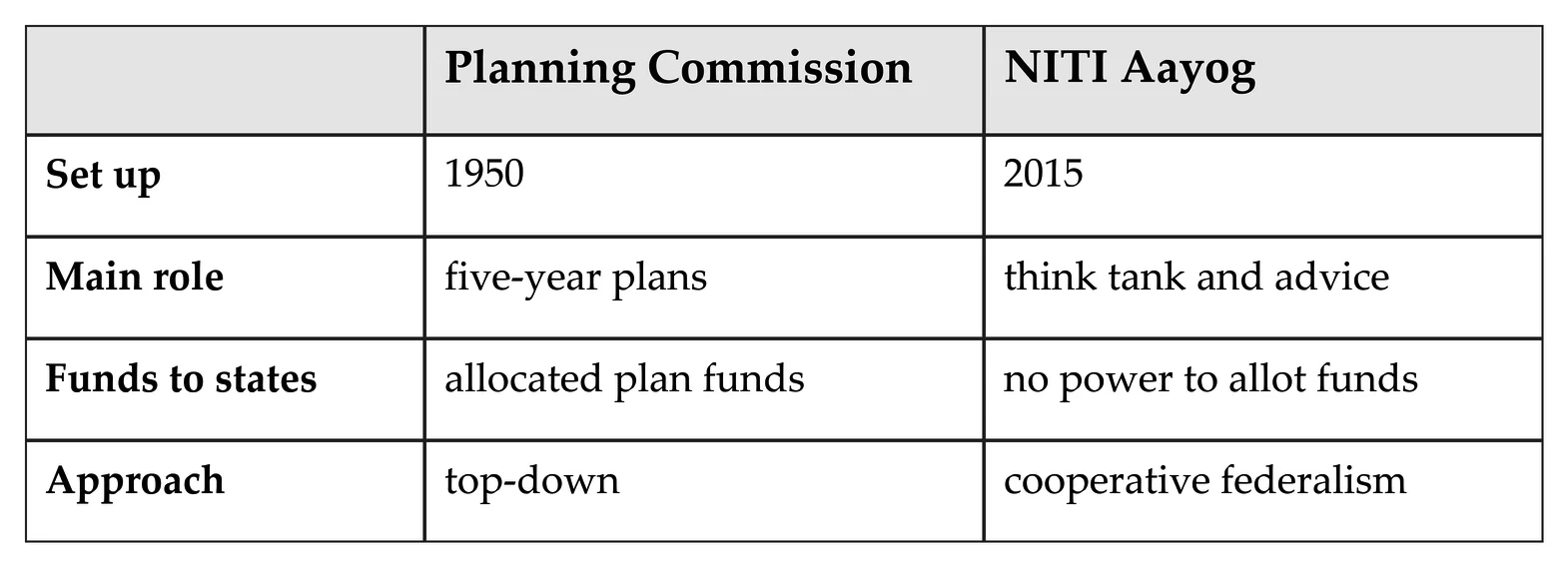
NITI Aayog, the National Institution for Transforming India, replaced the Planning Commission in 2015 as a policy think tank that promotes cooperative federalism. After liberalisation, India also created independent regulators, such as SEBI for securities markets, TRAI for telecommunications and the Competition Commission of India, while the Ministry of Corporate Affairs oversees company law, creating what scholars call a regulatory state.
Structure and Work of NITI Aayog
- Governing Council. It includes the Prime Minister as chairperson, the Chief Ministers of all states and Union territories with legislatures and the Lieutenant Governors of other Union territories.
- Leadership. A Vice-Chairperson, full-time members, part-time members, ex officio Union ministers and a Chief Executive Officer run its work.
- From plans to visions. The Twelfth Five-Year Plan, ending in 2017, was the last; NITI Aayog replaced plans with a vision, strategy and action agenda.
- Indices. It ranks states through the SDG India Index (from 2018), the State Health Index, the School Education Quality Index and the Composite Water Management Index, encouraging competitive federalism.
- Programmes. The Aspirational Districts Programme of 2018 targets backward districts, and the Atal Innovation Mission of 2016 promotes innovation.
India’s Regulatory Institutions
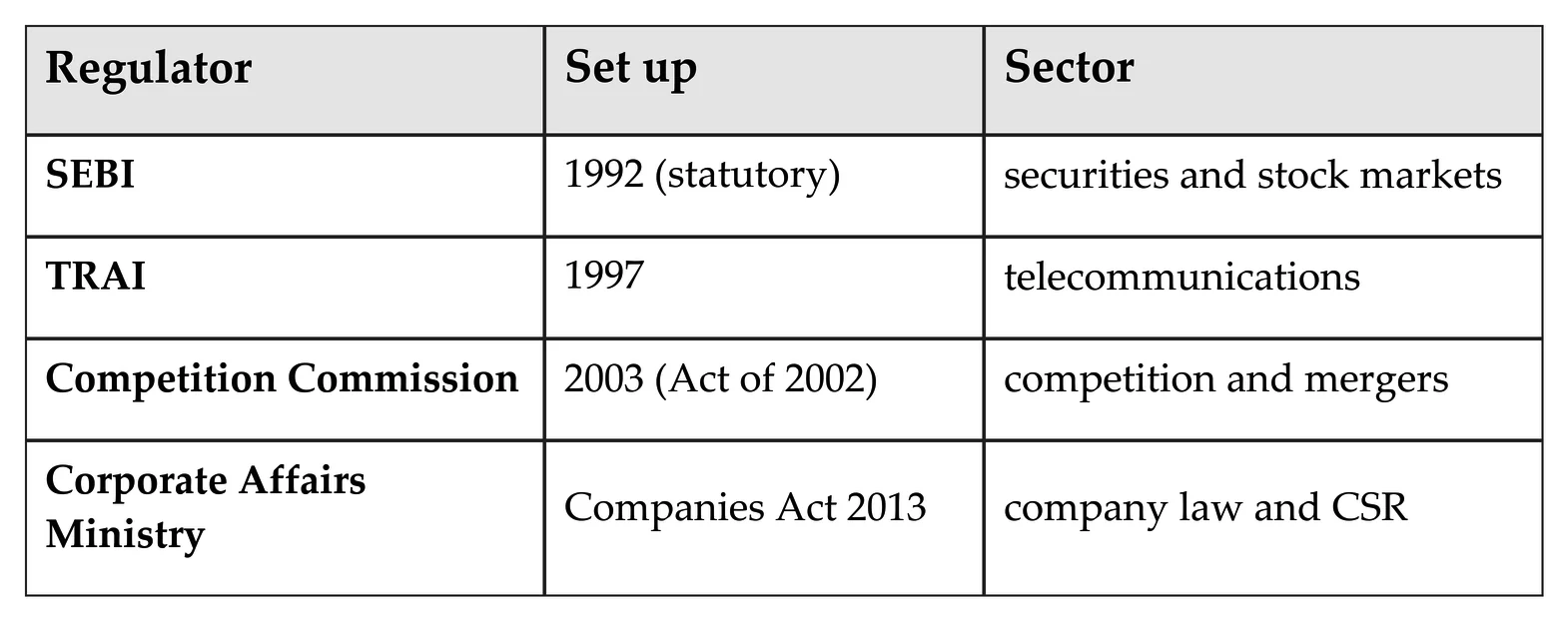
India’s regulatory state grew after 1991. SEBI was set up in 1988 and given statutory powers in 1992 after the Harshad Mehta securities scam. TRAI was created by an Act of 1997 to regulate telecommunications, and an appellate tribunal was added in 2000. The Competition Act of 2002 created the Competition Commission, which became fully functional in 2009 and in 2022 imposed large penalties on Google for abusing its dominance in Android. Other regulators include the IRDAI for insurance (1999), the Central Electricity Regulatory Commission (1998) and the FSSAI for food safety (2006). Devesh Kapur and Madhav Khosla, in Regulation in India (2019), examine their design, capacity and performance, and the Financial Sector Legislative Reforms Commission (2011 to 2013) proposed a unified framework for financial regulation.
Independence and Accountability of Regulators
- Appointments. Regulators are appointed by the government, and many are retired civil servants, which raises doubts about their independence from ministries.
- Tenure and removal. Fixed tenures and protection from arbitrary removal are meant to shield regulators from political pressure.
- Regulatory capture. George Stigler, in The Theory of Economic Regulation (1971), argued that regulators often come to serve the industries they regulate rather than the public.
- Weak oversight. Parliament rarely examines the performance of regulators in detail, and overlapping mandates, for example between SEBI, the RBI and the Ministry of Corporate Affairs, create confusion.
4.3 Lobbying Institutions
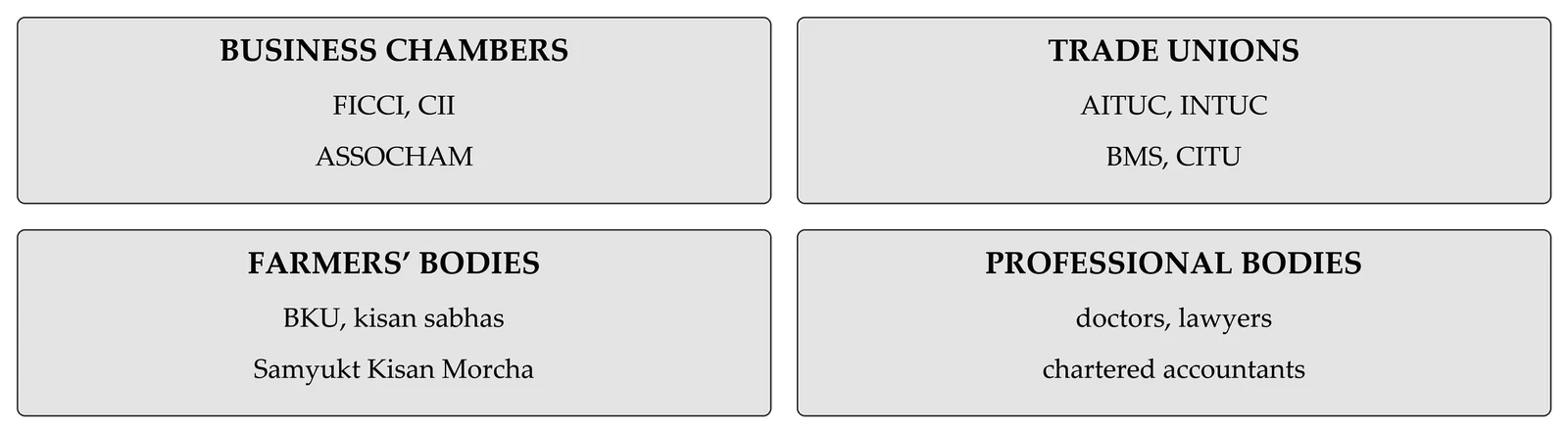
Organised interests try to influence policy through representations, consultations, media campaigns and protests. Chambers of commerce such as FICCI, CII and ASSOCHAM speak for business, trade unions for workers and farmers’ associations for cultivators. India has no law regulating lobbying, so influence often works through informal channels.
Business Associations in India
- FICCI. Founded in 1927 with the support of G.D. Birla and Purshottamdas Thakurdas, it represented Indian business during the freedom movement and after.
- ASSOCHAM. Founded in 1920, it originally represented mainly British firms in India.
- CII. It grew from an engineering association of 1895 and took its present name in 1992, becoming the leading voice of business during liberalisation.
- The Bombay Plan. In 1944, leading industrialists proposed a plan for state-led industrialisation, showing early business engagement with policy.
- Kochanek’s analysis. Stanley Kochanek, in Business and Politics in India (1974), showed how business influenced policy through associations, contacts with ministers and party funding.
Workers and Farmers
India’s trade unions are closely linked with political parties: the AITUC (1920) with the communists, the INTUC (1947) with the Congress, the BMS (1955) with the Sangh Parivar and the CITU (1970) with the CPI(M). Their influence declined with the growth of informal work, and the four labour codes passed in 2019 and 2020 faced union opposition. Farmers organised through movements such as Sharad Joshi’s Shetkari Sanghatana (1979) and Mahendra Singh Tikait’s Bharatiya Kisan Union. Lloyd and Susanne Rudolph, in In Pursuit of Lakshmi (1987), described these as demand groups of bullock capitalists. The Samyukt Kisan Morcha led the year-long protest that secured repeal of the three farm laws in 2021.
Regulating Lobbying
Many democracies regulate lobbying. The United States requires registration and disclosure under the Lobbying Disclosure Act of 1995, and the European Union maintains a Transparency Register. India has no such law, so influence works through informal access, industry consultations and party funding. Controversies, such as the leaked Radia tapes of 2010, raised concerns about corporate influence. In Association for Democratic Reforms v. Union of India (February 2024), the Supreme Court struck down the electoral bonds scheme of 2018 for violating voters’ right to information about political funding, a major step towards transparency in the relationship between money and policy.
Civil Society and Think Tanks
Besides business, unions and farmers, civil society groups and think tanks also influence policy. Social movements such as the Mazdoor Kisan Shakti Sangathan, which campaigned for the right to information, the Narmada Bachao Andolan, which challenged large dams from the late 1980s, and India Against Corruption in 2011 shaped national debates. Think tanks such as the Centre for Policy Research (1973) and the Observer Research Foundation (1990) supply research and ideas to policymakers. Their influence depends on access, credibility and the openness of government to consultation, which varies from one government to another.
4.4 Important Questions
- Question 1 Discuss the role of NITI Aayog in policy-making in India.
- Question 2 Discuss the role of regulatory institutions in India with reference to SEBI, TRAI and the Competition Commission.
- Question 3 Discuss the role of lobbying institutions in public policy in India.
- Question 4 How do ideas, interests and institutions shape public policy? Discuss with examples from India.
DU asks the same idea in different words. So learn one broad answer for each question below; the same answer works for every question joined by OR.
Important Question 1
Discuss the role of NITI Aayog in policy-making in India.
OR
How does NITI Aayog differ from the Planning Commission?
OR
Has NITI Aayog strengthened cooperative federalism? Discuss.
Model Answer
“Strong States make a strong nation.”
— Cabinet Resolution establishing NITI Aayog (1 January 2015)
Introduction. For more than six decades, India’s development was guided by the Planning Commission through five-year plans. In 2015, it was replaced by NITI Aayog, the National Institution for Transforming India, a policy think tank meant to promote cooperative federalism and innovative policy. Santosh Mehrotra and Sylvie Guichard have examined this shift from planning to a new model of policy advice.
1. The Planning Commission
The Planning Commission was set up by a Cabinet resolution in March 1950 with the Prime Minister as chairman. It prepared twelve five-year plans between 1951 and 2017 and allocated plan funds to states.
2. Criticisms of the Planning Commission
By the 2000s, the Planning Commission was criticised as a top-down body that imposed uniform schemes on diverse states, used its control over funds to influence states and had lost relevance in a market economy.
3. Creation of NITI Aayog
In August 2014, the Prime Minister announced that the Planning Commission would be replaced, and NITI Aayog was created by a Cabinet resolution on 1 January 2015.
4. Structure
NITI Aayog is chaired by the Prime Minister and has a Governing Council of all Chief Ministers and Lieutenant Governors, a Vice-Chairperson, full-time members, ex-officio Union ministers and a Chief Executive Officer. Regional councils address issues shared by groups of states.
5. Cooperative Federalism
NITI Aayog aims to involve states as partners in policy-making through the Governing Council and regional councils, reflecting the idea that strong states make a strong nation.
6. Competitive Federalism
NITI Aayog ranks states on indices of health, education, water management and the Sustainable Development Goals, encouraging competition among states to improve performance.
7. Think Tank Role
As a think tank, NITI Aayog prepares strategy documents, such as the Strategy for New India at 75 (2018), advises ministries and promotes innovation through the Atal Innovation Mission, set up in 2016.
8. Aspirational Districts
The Aspirational Districts Programme, launched in 2018, focuses on improving health, education, agriculture, infrastructure and financial inclusion in more than a hundred backward districts through monitoring and competition.
9. Monitoring and Evaluation
NITI Aayog’s Development Monitoring and Evaluation Office evaluates government schemes, providing evidence for policy decisions.
10. Funds and the Finance Commission
Unlike the Planning Commission, NITI Aayog has no power to allocate funds. Transfers to states are now decided mainly by the Finance Commission and the Ministry of Finance.
11. Mehrotra and Guichard’s Assessment
Santosh Mehrotra and Sylvie Guichard argue that while the Planning Commission had become outdated, India still needs long-term planning for challenges such as employment, inequality and climate change, and question whether NITI Aayog has the capacity and independence to provide it.
12. Criticisms
Critics say NITI Aayog lacks statutory status, is dominated by the Centre, has limited influence on budgets and functions more as an adviser to the Union government than as a forum of states.
13. Defence
Supporters argue that NITI Aayog is more flexible, evidence-based and state-friendly than the Planning Commission, and that its indices and programmes have improved governance outcomes.
14. Ideas and Institutions
The shift from the Planning Commission to NITI Aayog reflects a change of ideas, from state-led planning to market-friendly policy and federal competition, embodied in a new institution.
15. Sustainable Development Goals
NITI Aayog coordinates India’s work on the UN Sustainable Development Goals adopted in 2015. Its SDG India Index, first released in 2018, ranks states and union territories on goals such as ending poverty, health, education, gender equality and clean energy, helping states identify gaps and encouraging them to improve through comparison.
16. Evaluation
NITI Aayog has changed India’s policy machinery, promoting cooperative and competitive federalism, though its long-term planning role is debated.
Conclusion. Thus, NITI Aayog replaced the Planning Commission in 2015 as a think tank promoting cooperative and competitive federalism, through its Governing Council, state indices, Aspirational Districts and evaluation. It cannot allocate funds, and Mehrotra and Guichard question its capacity for long-term planning, but it reflects a major shift in ideas and institutions of policy.
Important Question 2
Discuss the role of regulatory institutions in India with reference to SEBI, TRAI and the Competition Commission.
OR
Examine the rise of the regulatory state in India after 1991.
OR
What are the problems of independence and accountability of regulators?
Model Answer
“To protect the interests of investors in securities and to promote the development of, and to regulate, the securities market.”
— Securities and Exchange Board of India Act, 1992, Preamble
Introduction. After economic liberalisation in 1991, the Indian state moved from directly owning and controlling industries to regulating markets through independent bodies. This produced what scholars call a regulatory state. SEBI, TRAI, the Competition Commission of India and the Ministry of Corporate Affairs are key institutions that shape the behaviour of companies and markets.
1. The Regulatory State
A regulatory state governs markets by setting rules, licensing, monitoring and punishing violations, often through agencies with expertise and some independence from day-to-day politics, rather than by state ownership.
2. Why Regulators
Independent regulators are expected to bring expertise, stability and impartiality, protect consumers and investors, ensure fair competition and give confidence to private investors.
3. SEBI
The Securities and Exchange Board of India was set up in 1988 and given statutory powers in 1992, after the securities scam of that year. It regulates stock exchanges, brokers and listed companies and acts against insider trading and fraud.
4. SEBI’s Role
SEBI has introduced electronic trading, disclosure rules, takeover regulations and corporate governance norms, helping India’s capital markets grow, though it has faced criticism over enforcement in major cases.
5. TRAI
The Telecom Regulatory Authority of India was created in 1997 to regulate telecom services, tariffs and interconnection. A 2000 amendment created a separate appellate tribunal for disputes.
6. TRAI’s Role
TRAI has helped make Indian mobile services among the cheapest in the world. In 2016, it banned differential pricing of data, upholding net neutrality against schemes that offered free access only to selected websites.
7. The Competition Commission
The Competition Act of 2002 replaced the old monopolies law and created the Competition Commission of India, which acts against anti-competitive agreements, abuse of dominant position and harmful mergers.
8. CCI’s Role
The CCI has penalised cartels in cement and other industries and imposed large penalties on technology companies, such as Google in 2022, for abusing dominance in digital markets.
9. Ministry of Corporate Affairs
The Ministry of Corporate Affairs administers the Companies Act of 2013, which requires larger companies to spend two per cent of profits on corporate social responsibility, and oversees the insolvency framework of 2016.
10. Independence
Regulators’ independence is limited because the government appoints their members, often retired bureaucrats, controls budgets and can issue policy directions, raising doubts about impartiality.
11. Accountability
Regulators make rules with the force of law but are not elected, so their accountability to Parliament, courts and the public is a concern. Parliamentary committees and judicial review provide some checks.
12. Regulatory Capture
Regulators may be captured by the industries they regulate, through lobbying, revolving doors between regulators and companies, and dependence on industry information.
13. Overlaps and Reforms
Overlapping jurisdictions among regulators, ministries and courts cause confusion. The Financial Sector Legislative Reforms Commission (2011–13) recommended a unified framework for financial regulation.
14. Ideas and Interests
The rise of regulators reflects the idea that markets need rules and expert supervision, while business and consumer interests compete to shape regulatory decisions.
15. Evaluation
Regulatory institutions have become central to India’s economic governance, but their independence, accountability and capacity need strengthening.
Conclusion. Thus, after 1991 India built a regulatory state with SEBI for securities, TRAI for telecom, the Competition Commission against monopolies and the Ministry of Corporate Affairs for company law. These bodies have improved markets and protected consumers, but questions about independence, accountability and capture remain.
Important Question 3
Discuss the role of lobbying institutions in public policy in India.
OR
Examine the role of chambers of commerce, trade unions and farmers’ associations in policy-making.
OR
How do interest groups influence public policy in India?
Model Answer
“By a faction, I understand a number of citizens, whether amounting to a majority or a minority of the whole, who are united and actuated by some common impulse of passion, or of interest, adverse to the rights of other citizens, or to the permanent and aggregate interests of the community.”
— James Madison, The Federalist No. 10 (1787)
Introduction. In every democracy, organised groups try to influence public policy in their favour. These lobbying institutions, or interest groups, include business associations, trade unions, farmers’ organisations and professional bodies. In India, their influence has grown since liberalisation, though lobbying is not formally regulated. Stanley Kochanek’s study of Indian business associations is a classic work in this field.
1. Meaning
Lobbying is the attempt by organised groups to influence the decisions of legislators and officials. Interest groups differ from parties because they seek to influence policy rather than to win elections and form governments.
2. Methods
Groups lobby through memoranda, meetings with ministers and officials, pre-budget consultations, testimony to parliamentary committees, media campaigns, funding of parties, protests and strikes.
3. Business Chambers
The Federation of Indian Chambers of Commerce and Industry (FICCI), founded in 1927, the Associated Chambers of Commerce (ASSOCHAM), founded in 1920, and the Confederation of Indian Industry (CII) are the main business associations.
4. Kochanek on Business
Stanley Kochanek studied FICCI and Indian business, showing how business associations sought access to ministers and officials, especially in a licence-permit system where government decisions determined profits.
5. Business after Liberalisation
Since 1991, business influence has grown, with chambers taking part in policy consultations on taxes, trade and regulation. The CII became influential by presenting itself as a partner in development.
6. Trade Unions
Major trade unions include the All India Trade Union Congress (1920), the Indian National Trade Union Congress (1947), the Hind Mazdoor Sabha, the Bharatiya Mazdoor Sangh (1955) and the Centre of Indian Trade Unions (1970), most linked with political parties.
7. Influence of Unions
Unions influence labour laws, wages and social security through negotiations, nationwide strikes and party links, though their strength has declined with the growth of informal work.
8. Farmers’ Associations
From the late 1970s, new farmers’ movements such as Sharad Joshi’s Shetkari Sanghatana and Mahendra Singh Tikait’s Bharatiya Kisan Union demanded better prices, cheaper inputs and loan waivers.
9. The Farm Laws Protest
In 2020–21, farmers’ unions under the Samyukt Kisan Morcha protested for more than a year at the borders of Delhi against three farm laws, which Parliament repealed in November 2021, showing the power of organised farmers.
10. Professional Bodies
Professional bodies such as the Indian Medical Association, bar councils and associations of chartered accountants influence policy in their fields.
11. Rudolphs on Demand Groups
Lloyd and Susanne Rudolph argued that India had weak, fragmented interest groups facing a strong state, which they called involuted pluralism, and that demand groups such as students and farmers often used agitation rather than formal lobbying.
12. Money and Influence
Corporate funding of parties raises concerns about undue influence. The electoral bonds scheme of 2018 allowed anonymous donations until the Supreme Court struck it down in 2024.
13. Absence of Regulation
India has no law requiring registration or disclosure of lobbying, unlike the United States or the European Union, which makes influence less transparent.
14. Unequal Influence
Well-organised and wealthy groups have more influence than the poor, informal workers and marginalised communities, raising questions of fairness in policy-making.
15. Evaluation
Lobbying institutions are a normal part of democracy, but their influence must be transparent and balanced so that all interests are heard.
Conclusion. Thus, lobbying institutions such as FICCI, CII and ASSOCHAM, trade unions such as AITUC and BMS, and farmers’ bodies such as the BKU influence policy through consultation, pressure and protest. Kochanek showed business access to the state, the farm laws protest showed farmers’ power, and the lack of regulation raises concerns about transparency.
Important Question 4
How do ideas, interests and institutions shape public policy? Discuss with examples from India.
OR
Examine the three Is approach to the study of public policy.
OR
Discuss the role of ideas in policy change in India.
Model Answer
“The ideas of economists and political philosophers, both when they are right and when they are wrong, are more powerful than is commonly understood. Indeed the world is ruled by little else.”
— John Maynard Keynes, The General Theory (1936)
Introduction. Why do governments adopt the policies they do? Political scientists have offered explanations based on ideas, interests and institutions, sometimes called the three Is. Peter Hall and Hugh Heclo argued that policy outcomes result from the interaction of all three. Indian examples, from economic reforms to the GST and the farm laws, show how they work together.
1. The Three Is
The three Is approach explains policy through ideas, the beliefs and knowledge of policy-makers; interests, the goals of groups affected by policy; and institutions, the rules and organisations that structure decisions.
2. Ideas
Ideas define problems and solutions. Peter Hall described policy paradigms, frameworks of ideas that guide policy, such as the shift from Keynesian economics to monetarism in Britain in the 1970s and 1980s.
3. Ideas in India
India’s policy was shaped by Nehruvian ideas of planning and self-reliance until the balance of payments crisis of 1991 brought a shift to market reforms. In the 2000s, ideas of rights-based development led to the RTI, MGNREGA and the right to food.
4. Epistemic Communities
Experts and epistemic communities, such as economists, scientists and policy think tanks, spread ideas that shape policy, as in the role of economists in the 1991 reforms and of activists in the National Advisory Council from 2004.
5. Interests
Interest-based explanations hold that policies reflect the power of organised groups. Pranab Bardhan argued that Indian policy was shaped by three dominant classes: industrial capitalists, rich farmers and professionals in the bureaucracy.
6. Interests in India
Farmers’ interests have shaped subsidies on fertiliser, power and minimum support prices, while business interests have influenced taxation and industrial policy, and unions have resisted changes in labour law.
7. Institutions
Institutional explanations stress that rules and organisations shape who participates and how. New institutionalists such as James March and Johan Olsen argued that institutions shape preferences and behaviour, not only reflect them.
8. Institutions in India
Federalism, coalition politics, the courts, Parliament and the bureaucracy shape Indian policy. For example, courts have created policies on food, environment and elections through public interest litigation.
9. Path Dependence
Institutions create path dependence, as earlier choices make some options easier and others harder later. India’s long tradition of state-led planning shaped the gradual pace of its reforms.
10. The GST Example
The Goods and Services Tax of 2017 combined the idea of one nation, one tax with the interests of states worried about revenue, resolved through a new institution, the GST Council, created by the 101st Amendment of 2016.
11. The Farm Laws Example
The farm laws of 2020 reflected the idea of market reform in agriculture, but they clashed with farmers’ interests and were passed through institutions with limited consultation, leading to protests and repeal in 2021.
12. Interaction of the Three Is
The three Is interact: ideas are adopted when they serve interests, interests are organised through institutions, and institutions are created or reformed under the influence of ideas.
13. Heclo’s View
Hugh Heclo argued that policy-making is a process of collective puzzling as well as powering, meaning that learning and ideas matter alongside the struggle for power.
14. Limitations
The three Is approach can be too broad to predict outcomes, and it may underplay the role of leadership, crises and chance events.
15. The 1991 Reforms
The reforms of 1991 show all three Is at work. A balance of payments crisis opened space for new ideas of liberalisation promoted by economists and international lenders. Business interests that had outgrown the licence system supported change, while institutions such as the Finance Ministry and a minority government under P.V. Narasimha Rao shaped a gradual, consensual pace of reform.
16. Evaluation
The three Is provide a balanced framework for understanding public policy, showing how beliefs, power and rules together shape what governments do.
Conclusion. Thus, public policy is shaped by ideas, such as planning or market reform; interests, such as Bardhan’s dominant classes, farmers and business; and institutions, such as federalism, courts and the GST Council. Hall and Heclo show that these interact, as the 1991 reforms, the GST and the repeal of the farm laws illustrate.
Short Notes
(a) Cooperative federalism
The idea that the Centre and states should work together as partners in policy-making, which NITI Aayog was created to promote.
(b) Regulatory capture
The situation in which a regulator comes to serve the interests of the industry it regulates rather than the public.
(c) Policy paradigm
Peter Hall’s term for a framework of ideas that defines policy goals, instruments and the nature of problems.
(d) Involuted pluralism
Lloyd and Susanne Rudolph’s term for India’s pattern of many weak, fragmented interest groups facing a strong and dominant state.
More notes: DSE-14 Democracy and Governance
These notes are prepared by PADHO TO AISE for study help. They are not an official University of Delhi publication.