

Generic Electives (GE) GE-7 Politics of Globalisation
Unit 3 · 23 min read · Updated 27 Nov 2026
As per the University of Delhi (DU) Generic Elective (GE) syllabus offered by the Department of Political Science
Contents
- 3.1 Sovereignty and the Political Dimensions of Globalisation
- Krasner’s Four Meanings of Sovereignty
- Political Dimensions of Globalisation
- Elizabeth and Ozioko on Sovereignty
- The Resilience of the State
- 3.2 Beyond the State System: Hedley Bull
- Alternatives to the States System
- Neo-Medievalism
- Bull’s Conclusion
- 3.3 Shift from State to Market: Strange and Mathews
- Susan Strange: The Declining Authority of States
- Jessica Mathews: Power Shift
- Counter-Arguments
- India’s Experience
- 3.4 Important Questions
- Examine the impact of globalisation on the sovereignty of the nation-state.
- Discuss Hedley Bull’s views on whether the world is moving beyond the states system.
- Has globalisation led to a shift of power from the state to the market? Discuss with reference to Susan Strange and Jessica Mathews.
- Discuss the relationship between human rights, humanitarian intervention and state sovereignty in a globalised world.
- Short Notes
विश्व बाज़ारों की अवैयक्तिक शक्तियाँ अब उन राज्यों से अधिक शक्तिशाली हो गई हैं जिनके पास समाज और अर्थव्यवस्था पर अंतिम राजनीतिक सत्ता मानी जाती है।
The impersonal forces of world markets… are now more powerful than the states to whom ultimate political authority over society and economy is supposed to belong.
— Susan Strange, The Retreat of the State (1996)
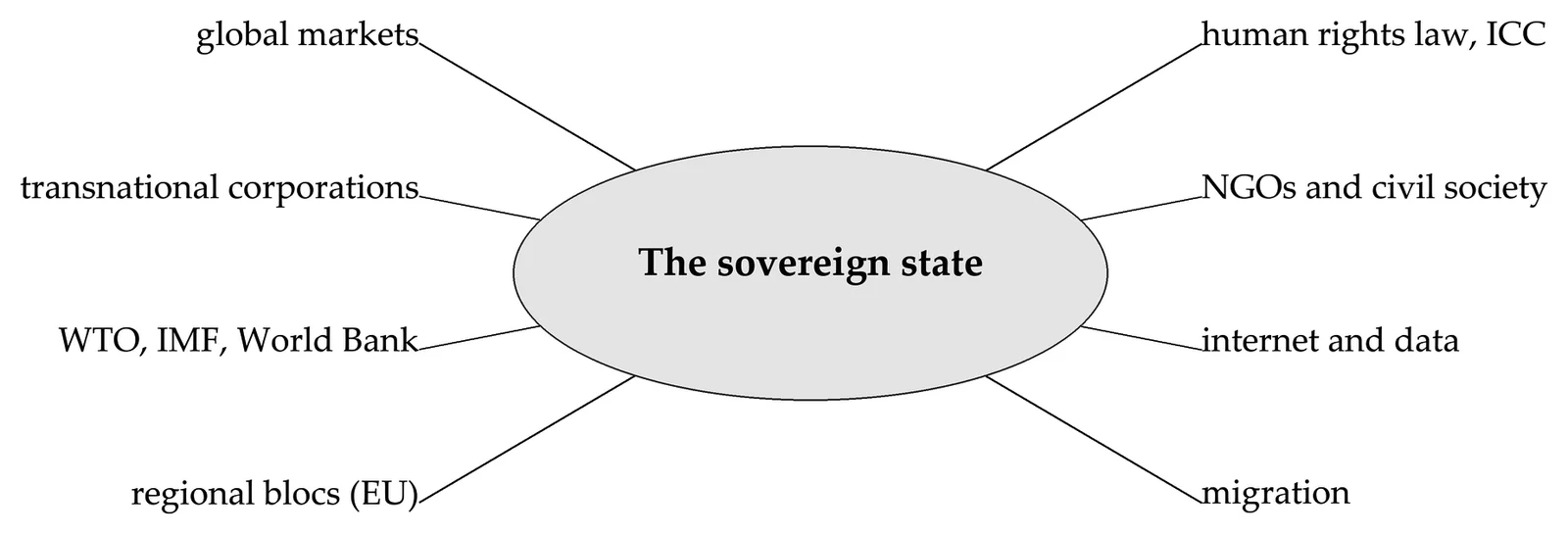
SSOVEREIGNTY, the supreme authority of the state over its territory and people, has been the foundation of the modern international system since the Peace of Westphalia (1648). Globalisation has raised the question whether this foundation is weakening. Global markets, transnational corporations, international institutions, human rights norms and non-state actors seem to limit what states can do. This chapter examines the political dimensions of globalisation’s impact on sovereignty, Hedley Bull’s reflections on whether we are moving beyond the state system, and the debate on a shift from state to market.
3.1 Sovereignty and the Political Dimensions of Globalisation
Sovereignty means that the state has supreme authority within its territory (internal sovereignty) and is independent of any external authority (external sovereignty). Thinkers such as Jean Bodin and Thomas Hobbes developed the idea, and the Peace of Westphalia (1648) established a system of territorial states that recognised each other’s independence and the principle of non-intervention. The UN Charter (1945) affirmed the sovereign equality of all members and the principle of non-intervention in domestic affairs (Article 2(7)).
Krasner’s Four Meanings of Sovereignty
Stephen Krasner, in Sovereignty: Organized Hypocrisy (1999), distinguished four meanings: domestic sovereignty, the organisation and effectiveness of authority within a state; interdependence sovereignty, the ability to control flows across borders; international legal sovereignty, recognition by other states; and Westphalian sovereignty, the exclusion of external actors from domestic authority. He argued that sovereignty has always been violated when powerful states found it convenient, hence organised hypocrisy, and that globalisation mainly affects interdependence sovereignty.
Political Dimensions of Globalisation
- International institutions. Bodies such as the UN, WTO, IMF and World Bank make rules that bind states; WTO dispute settlement can rule against national laws.
- Regional integration. In the European Union, member states have pooled sovereignty over trade, currency (for euro members) and many laws, and EU law takes precedence over national law.
- International law and human rights. Human rights treaties, the International Criminal Court (2002) and the norm of the Responsibility to Protect (2005) mean that the way a state treats its citizens is no longer purely its domestic affair.
- Global governance. Problems such as climate change, pandemics, terrorism and financial crises require cooperation, leading to multi-level governance in which states share authority.
- Non-state actors. Transnational corporations, NGOs, global media, terrorist networks and criminal organisations operate across borders and influence outcomes.
- Technology. The internet and digital platforms make it harder for states to control information, though states have also developed new tools of surveillance and control.
- Migration. Large flows of migrants and refugees test states’ control over borders and membership.
Elizabeth and Ozioko on Sovereignty
In a UN document on the effect of globalisation on the sovereignty of states, Elizabeth and Ozioko argued that globalisation has eroded the economic and political autonomy of states, especially developing countries, which must accept the conditions of international financial institutions and global markets. Developed states shape the rules of globalisation, while weaker states lose the capacity to make independent policy, so the impact of globalisation on sovereignty is unequal.
The Resilience of the State
At the same time, states remain the main actors in world politics. They control armies, make laws, collect taxes and decide whether to join international institutions. States created the institutions of globalisation and can leave them, as Britain left the EU (Brexit, 2020) with the slogan of taking back control. The rise of China, the return of economic nationalism and the response to the Covid-19 pandemic show that state power remains central. Sovereignty is therefore being transformed and redistributed, not abolished.
3.2 Beyond the State System: Hedley Bull
Hedley Bull, a leading figure of the English School of international relations, argued in The Anarchical Society (1977) that states form an international society, sharing common rules and institutions, such as diplomacy, international law, the balance of power and the role of great powers, even in the absence of a world government. In the chapter Beyond the States System?, he examined whether the states system was being replaced by some other form of world political organisation.
Alternatives to the States System
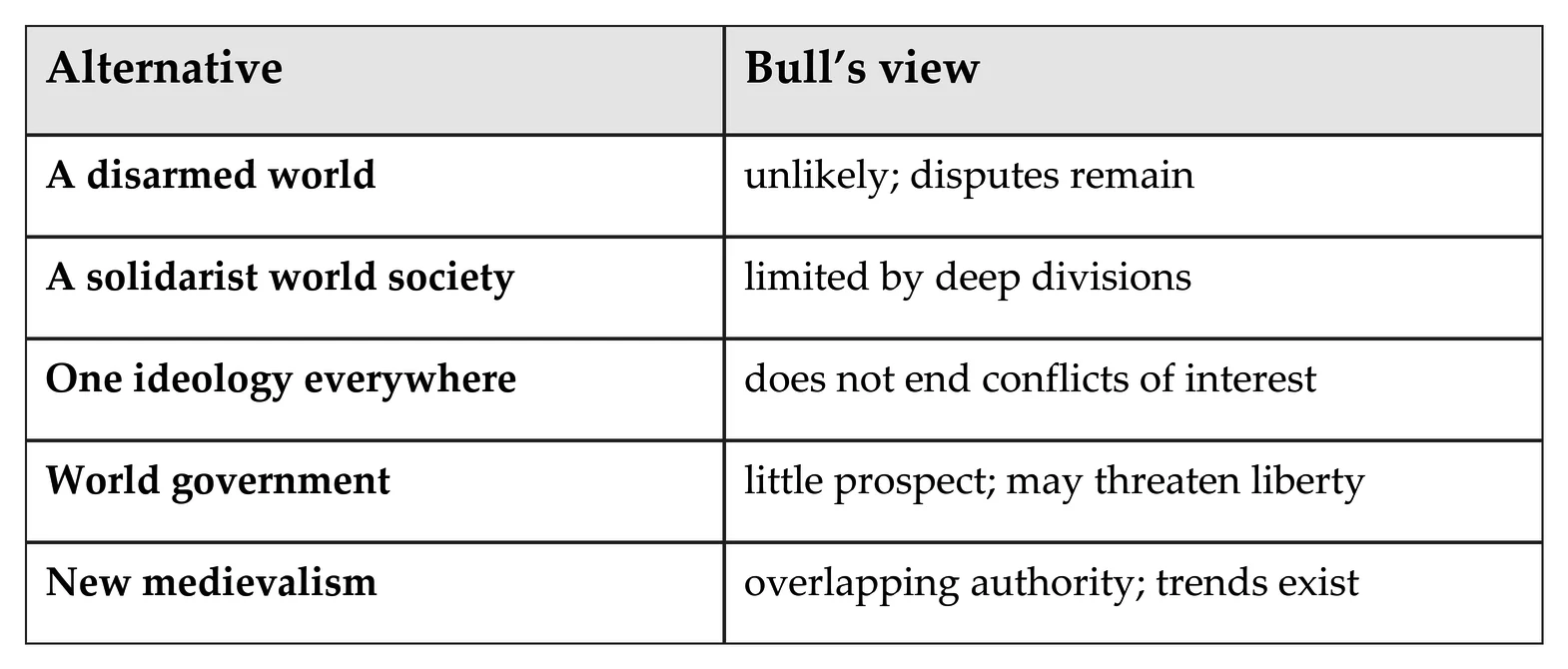
- A disarmed world. A world in which states have abandoned arms; Bull thought this unlikely and not necessarily more orderly.
- A solidarist world society. A world in which states cooperate closely on shared values such as human rights and collective security.
- An ideologically homogeneous world. A world in which all states share one ideology, such as liberal democracy or communism.
- World government. A single global authority, achieved by conquest or agreement; Bull saw little prospect of this.
- A new medievalism. A system of overlapping authority and multiple loyalty, similar to medieval Europe, in which states share authority with sub-national, regional and global bodies and transnational organisations.
Neo-Medievalism
Bull identified five trends that might point towards a new medievalism: the regional integration of states, as in Europe; the disintegration of states through secessionist movements; the restoration of private international violence by terrorist and guerrilla groups; the growth of transnational organisations, such as corporations and international NGOs; and the technological unification of the world. These trends anticipated many features of contemporary globalisation.
Bull’s Conclusion
However, Bull concluded that the states system was not yet obsolete. States remained the main holders of power and loyalty, and the alternatives were either unlikely or not clearly better at providing order. He argued that the society of states, if adapted to new challenges, remained the best available framework for world order. Many scholars today see Bull’s idea of neo-medievalism as a useful description of a world in which states coexist with the EU, the WTO, global corporations and transnational networks.
3.3 Shift from State to Market: Strange and Mathews
Susan Strange: The Declining Authority of States
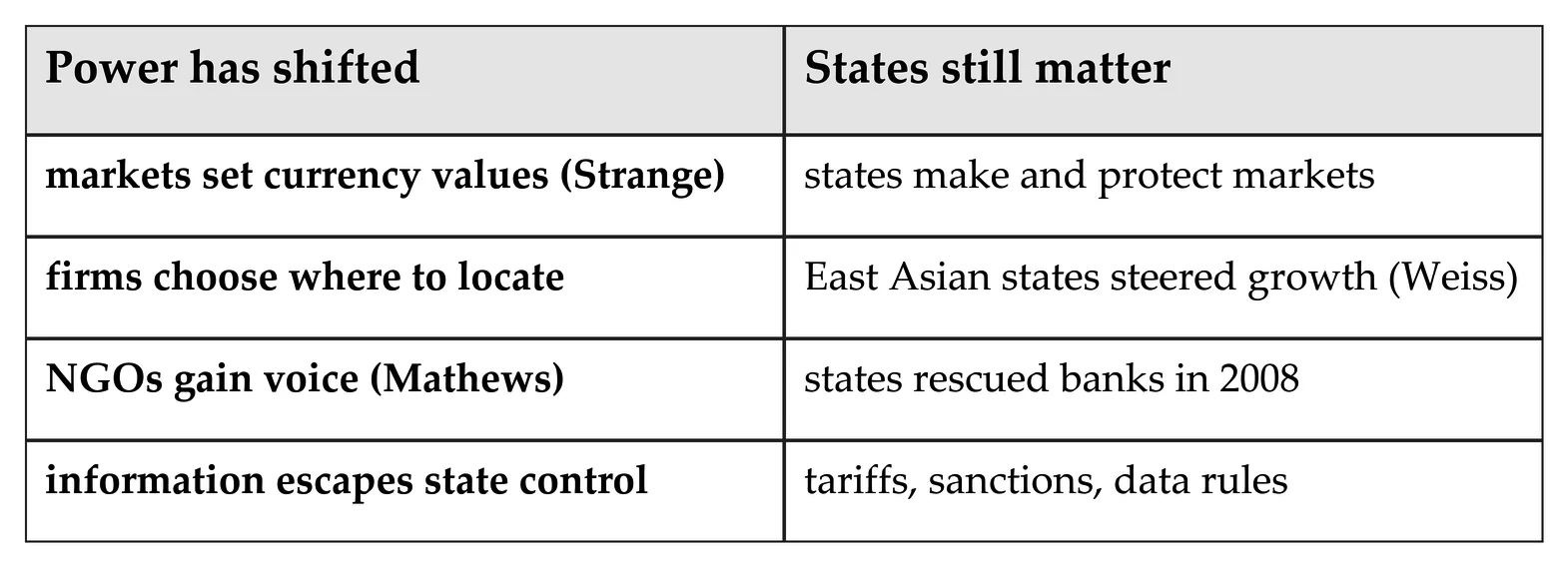
Susan Strange, a pioneer of international political economy, argued in The Retreat of the State (1996) that the impersonal forces of world markets had become more powerful than states. She noted that states had lost authority over key areas such as the value of their currencies, the movement of capital, the location of industry and taxation of corporations. Authority had shifted upwards to international bodies, sideways to markets and transnational corporations, and in some cases downwards to regions and localities. Some functions were exercised by no one, creating an ungoverned space in the world economy. Strange stressed that this shift was partly the result of choices made by powerful states, especially the United States, which deregulated finance.
Jessica Mathews: Power Shift
Jessica Mathews, in Power Shift (1997), argued that the end of the Cold War brought a novel redistribution of power among states, markets and civil society. NGOs, international organisations and businesses were taking on roles once reserved for states, helped by the information revolution, which broke the state’s monopoly over information. She cited the role of NGOs in the campaign to ban landmines (1997) and in environmental negotiations. Mathews argued that states were not disappearing but would increasingly have to share power with non-state actors.
Counter-Arguments
- The myth of the powerless state. Linda Weiss (1998) argued that capable states, such as those of East Asia, can harness globalisation and that state capacity remains decisive.
- States make markets. Markets depend on states to enforce contracts, protect property and provide infrastructure, and states chose to liberalise.
- Crisis and the return of the state. States rescued banks in 2008, led responses to the Covid-19 pandemic and are pursuing industrial policy, as in the United States and India.
- Unequal impact. Powerful states such as the United States and China shape global markets, while weak states are most constrained, so the shift is uneven.
- New forms of control. States regulate the internet, demand data localisation and use sanctions and tariffs as tools of power, showing digital and economic sovereignty.
India’s Experience
India liberalised its economy in 1991 and joined the WTO in 1995, accepting new constraints. Yet it has used its sovereignty to protect agriculture in WTO negotiations, regulate foreign investment, build digital public infrastructure under national control, and pursue strategic autonomy in foreign policy. India’s experience shows that states can engage with globalisation while retaining significant policy space.
3.4 Important Questions
- Question 1 Examine the impact of globalisation on the sovereignty of the nation-state.
- Question 2 Discuss Hedley Bull’s views on whether the world is moving beyond the states system.
- Question 3 Has globalisation led to a shift of power from the state to the market? Discuss with reference to Susan Strange and Jessica Mathews.
- Question 4 Discuss the relationship between human rights, humanitarian intervention and state sovereignty in a globalised world.
DU asks the same idea in different words. So learn one broad answer for each question below; the same answer works for every question joined by OR.
Important Question 1
Examine the impact of globalisation on the sovereignty of the nation-state.
OR
Has globalisation eroded state sovereignty? Discuss.
OR
Discuss the political dimensions of globalisation.
Model Answer
“The Organization is based on the principle of the sovereign equality of all its Members.”
— Charter of the United Nations (1945), Article 2(1)
Introduction. Sovereignty, the supreme authority of the state within its territory and its independence from external control, has been the foundation of the international system since 1648. Globalisation, through markets, institutions, international law and non-state actors, appears to limit this authority. Scholars debate whether sovereignty is eroding, being transformed or remaining intact.
1. Meaning of Sovereignty
Internal sovereignty is the state’s supreme authority within its territory, and external sovereignty is its independence from outside control. Bodin and Hobbes developed the concept.
2. Westphalia and the UN Charter
The Peace of Westphalia (1648) established a system of territorial states recognising each other’s independence, and the UN Charter affirmed sovereign equality and non-intervention.
3. Krasner’s Four Sovereignties
Krasner distinguished domestic, interdependence, international legal and Westphalian sovereignty, arguing that globalisation mainly reduces interdependence sovereignty, the control of cross-border flows.
4. Economic Constraints
Global capital markets punish states that adopt policies disliked by investors, and states compete to attract investment by lowering taxes and regulations.
5. International Institutions
The WTO, IMF and World Bank make rules binding on states. IMF loan conditions and WTO dispute rulings limit national policy choices.
6. Regional Integration
In the European Union, member states have pooled sovereignty over trade, currency and many laws, and EU law takes precedence over national law.
7. Human Rights and International Law
Human rights treaties, the International Criminal Court of 2002 and the Responsibility to Protect of 2005 mean that a state’s treatment of its citizens is subject to international concern.
8. Global Problems
Climate change, pandemics, terrorism and financial crises cross borders and require cooperation, leading states to share authority in global governance.
9. Non-State Actors
Transnational corporations, NGOs, global media and terrorist and criminal networks operate across borders and influence outcomes beyond the control of states.
10. Technology and Information
The internet makes it harder for states to control information, though states have developed new tools of surveillance and regulation of digital platforms.
11. Unequal Impact
Elizabeth and Ozioko argued that globalisation erodes the sovereignty of developing countries most, since they must accept the rules of institutions and markets shaped by powerful states.
12. States Remain Central
States control armies, laws and taxes, created global institutions and can leave them, as Britain left the EU in 2020 to take back control.
13. Return of the State
The rise of China, economic nationalism, industrial policies and state responses to the pandemic show that state power remains central in world politics.
14. India’s Sovereignty
India has joined global institutions while protecting agriculture at the WTO, regulating investment and pursuing strategic autonomy, showing how sovereignty can be exercised in a globalised world.
15. Transformation of Sovereignty
Most scholars argue that sovereignty is being transformed and shared rather than lost, as states exercise authority together with other actors at many levels.
16. Digital Sovereignty
States increasingly assert digital sovereignty by requiring data about their citizens to be stored locally, regulating social media platforms and banning foreign apps on security grounds, as India did with many Chinese apps in 2020. This shows that states are extending sovereignty into cyberspace rather than surrendering it.
17. Evaluation
Globalisation has constrained state sovereignty, especially for weaker states, but the state remains the primary actor and the source of legitimacy in world politics.
Conclusion. Thus, globalisation affects sovereignty through markets, institutions, regional integration, human rights norms, global problems and non-state actors, reducing especially the control of cross-border flows. Yet states, whose sovereign equality the UN Charter affirms, remain central, and sovereignty is being transformed rather than abolished.
Important Question 2
Discuss Hedley Bull’s views on whether the world is moving beyond the states system.
OR
Write a note on the idea of new medievalism.
OR
Is the states system becoming obsolete? Discuss with reference to Hedley Bull.
Model Answer
“If modern states were to come to share their authority over their citizens, and their ability to command their loyalties, on the one hand with regional and world authorities, and on the other hand with sub-state or sub-national authorities, to such an extent that the concept of sovereignty ceased to be applicable, then a neo-mediaeval form of universal political order might be said to have emerged.”
— Hedley Bull, The Anarchical Society (1977)
Introduction. Hedley Bull, a leading thinker of the English School, argued that sovereign states form an international society with shared rules and institutions. In The Anarchical Society (1977), he asked whether the states system was being replaced by another form of world political organisation. His discussion of alternatives, especially the new medievalism, anticipated debates on globalisation.
1. The English School
The English School holds that states, though living in anarchy without world government, form an international society bound by common rules, values and institutions.
2. Institutions of International Society
Bull identified the balance of power, international law, diplomacy, war and the special role of great powers as institutions that maintain order among states.
3. Is the States System Obsolete
Bull asked whether the states system was declining and examined several alternative forms of world order that might replace it.
4. A Disarmed World
A world without arms was one alternative, but Bull thought it unlikely and not necessarily more orderly, since disputes would remain.
5. A Solidarist World Society
A world in which states cooperate closely on shared values, such as human rights and collective security, was another possibility, but deep divisions among states limited it.
6. An Ideologically Homogeneous World
A world in which all states share one ideology might reduce conflict, but Bull noted that ideological unity does not end conflicts of interest.
7. World Government
A world government, by conquest or agreement, would end anarchy, but Bull saw little prospect of it and feared it might threaten liberty.
8. The New Medievalism
Bull described a possible new medievalism, a system of overlapping authority and multiple loyalty, like medieval Europe, where states share authority with other bodies.
9. Regional Integration
The integration of states into regional bodies, as in the European Community, was one trend that suggested the new medievalism.
10. Disintegration of States
Secessionist movements that break up states, such as those in many parts of the world, were another trend pointing beyond the states system.
11. Private International Violence
The return of private violence by terrorist and guerrilla groups, outside state control, challenged the state’s monopoly of force.
12. Transnational Organisations and Technology
The growth of transnational corporations and NGOs, and the technological unification of the world, created actors and links that cut across state boundaries.
13. Bull’s Conclusion
Bull concluded that the states system was not yet obsolete, since states remained the main holders of power and loyalty, and the alternatives were not clearly better.
14. Relevance Today
The European Union, global corporations, international NGOs and terrorist networks today resemble Bull’s new medievalism, with overlapping authorities beside states.
15. Criticism
Critics argue that Bull was too state-centric and underestimated the power of markets and transnational forces, while others think his caution has been justified.
16. Evaluation
Bull’s analysis remains valuable for recognising trends beyond the state while explaining the continuing resilience of the society of states.
Conclusion. Thus, Bull examined alternatives to the states system, including a disarmed world, a solidarist society, ideological unity, world government and a new medievalism of overlapping authority. He concluded that the states system was not yet obsolete, though his idea of a new medievalism aptly describes many features of today’s globalised world.
Important Question 3
Has globalisation led to a shift of power from the state to the market? Discuss with reference to Susan Strange and Jessica Mathews.
OR
Examine Susan Strange’s argument on the declining authority of states.
OR
Discuss the redistribution of power among states, markets and civil society.
Model Answer
“The end of the Cold War has brought no mere adjustment among states but a novel redistribution of power among states, markets, and civil society.”
— Jessica T. Mathews, Power Shift (1997)
Introduction. One of the central debates about globalisation concerns whether power has shifted from states to markets and non-state actors. Susan Strange argued that the authority of states has declined in the face of world markets, and Jessica Mathews argued that power has been redistributed among states, markets and civil society. Others insist that states remain powerful.
1. The Question
The debate asks whether states still control their economies and societies, or whether markets, corporations and non-state actors now hold decisive power.
2. Susan Strange
Strange, a pioneer of international political economy, argued in The Retreat of the State (1996) that the impersonal forces of world markets had become more powerful than states.
3. Areas of Lost Authority
Strange noted that states had lost control over the value of currencies, capital movements, the location of industry and the taxation of mobile corporations.
4. Directions of the Shift
Authority had moved upwards to international bodies, sideways to markets and corporations, downwards to regions, and in some areas to no one, leaving ungoverned spaces.
5. States Chose This
Strange stressed that the retreat of the state resulted partly from choices made by powerful states, especially the United States, which deregulated finance.
6. Jessica Mathews
Mathews argued in Power Shift (1997) that the end of the Cold War brought a novel redistribution of power among states, markets and civil society.
7. The Information Revolution
She argued that the information revolution broke the state’s monopoly over information, empowering NGOs, businesses and citizens to act across borders.
8. Rise of NGOs
Mathews cited the role of NGOs in the campaign to ban landmines, which led to the Ottawa Treaty of 1997, and in environmental negotiations, as evidence of civil society power.
9. Transnational Corporations
Large corporations control global production chains and technology, and some have revenues larger than the economies of many states, giving them great influence.
10. Linda Weiss’s Critique
Weiss argued in The Myth of the Powerless State (1998) that capable states, especially in East Asia, can harness globalisation, and that state capacity remains decisive.
11. States Make Markets
Markets depend on states to enforce contracts, protect property, maintain money and provide infrastructure, so markets and states are interdependent rather than opposed.
12. The 2008 Crisis and the Pandemic
States rescued banks in 2008 and led the response to Covid-19 with lockdowns, vaccines and relief, showing that markets rely on states in crises.
13. New Economic Nationalism
Tariffs, sanctions, industrial policies and controls on technology and data show states reasserting economic sovereignty, as in the US-China rivalry.
14. Unequal Effects
Powerful states shape global markets, while weaker states are most constrained, so the shift of power from state to market is uneven across the world.
15. India’s Case
India liberalised and joined the WTO, but retained control over key sectors, built national digital infrastructure and protected agriculture, showing continued state agency.
16. Credit Rating Agencies and Markets
Private credit rating agencies such as Standard and Poor’s and Moody’s influence the borrowing costs of governments, and a downgrade can force austerity, as in the European debt crisis after 2010. Strange saw such private bodies as examples of authority exercised by markets rather than states.
17. Big Tech Platforms
Technology companies such as Google, Meta and Amazon now control vast flows of information, commerce and data across borders, raising new questions about the power of corporations over public life. States have responded with competition cases, data protection laws and taxes on digital services.
18. Evaluation
Power has been redistributed among states, markets and civil society, but states remain central actors whose choices shape how globalisation unfolds.
Conclusion. Thus, Strange argued that world markets had become more powerful than states, and Mathews saw a redistribution of power among states, markets and civil society. Critics such as Weiss and recent crises show that states remain powerful, so the shift is real but partial and uneven.
Important Question 4
Discuss the relationship between human rights, humanitarian intervention and state sovereignty in a globalised world.
OR
Examine the principle of the Responsibility to Protect.
OR
Is sovereignty a responsibility rather than a right? Discuss.
Model Answer
“Each individual State has the responsibility to protect its populations from genocide, war crimes, ethnic cleansing and crimes against humanity.”
— UN World Summit Outcome Document (2005), paragraph 138
Introduction. Traditional sovereignty meant that how a state treated its citizens was its own affair, protected by the principle of non-intervention. Globalisation of human rights norms has challenged this view. The idea of humanitarian intervention and the principle of the Responsibility to Protect suggest that sovereignty carries responsibilities, and that the international community may act when states commit or allow mass atrocities.
1. Traditional Sovereignty
The Westphalian principle of non-intervention, affirmed in Article 2(7) of the UN Charter, protected states from outside interference in their domestic affairs.
2. Globalisation of Human Rights
The Universal Declaration of Human Rights (1948) and later treaties made human rights a matter of international concern, limiting the claim of absolute sovereignty.

3. Humanitarian Intervention
Humanitarian intervention is the use of force by states to stop mass atrocities in another state without its consent, as claimed by NATO in Kosovo in 1999.
4. Failures of the 1990s
The failure to prevent genocide in Rwanda (1994) and the massacre at Srebrenica (1995) led to calls for a new approach to protecting civilians.
5. Sovereignty as Responsibility
The International Commission on Intervention and State Sovereignty (2001) argued that sovereignty is a responsibility to protect citizens, not only a right to non-interference.
6. The 2005 World Summit
The UN World Summit endorsed the Responsibility to Protect, under which states must protect their populations from genocide, war crimes, ethnic cleansing and crimes against humanity.
7. Three Pillars
R2P rests on three pillars: the state’s responsibility to protect, the international community’s duty to assist states, and timely and decisive collective action through the Security Council when states fail.
8. Libya, 2011
The Security Council authorised action in Libya in 2011 under R2P, but the intervention led to regime change and instability, causing distrust among countries such as India, China and Russia.
9. Syria and Selectivity
The failure to act in Syria, due to vetoes in the Security Council, showed the selectivity of R2P and its dependence on great power politics.
10. International Criminal Court
The ICC, established in 2002, can prosecute individuals for genocide, war crimes and crimes against humanity, limiting the impunity once protected by sovereignty.
11. Concerns of the Global South
Many developing countries fear that humanitarian intervention can be a cover for great power interests and a return of colonial interference.
12. India’s Position
India supports R2P’s first two pillars but is cautious about the use of force, stressing sovereignty, non-intervention and Security Council authorisation.
13. Globalised Media and Civil Society
Global media and NGOs expose atrocities and pressure governments to act, illustrating how globalisation strengthens human rights advocacy.
14. Sovereignty Reconceived
Sovereignty is increasingly seen as conditional on respect for basic human rights, though states still defend the principle of non-intervention.
15. Dilemmas
The tension between protecting human rights and respecting sovereignty remains unresolved, as interventions can save lives but also cause harm and serve political interests.
16. Universal Jurisdiction
Some states allow their courts to try individuals for grave crimes such as torture and genocide wherever they were committed. The arrest of former Chilean dictator Augusto Pinochet in London in 1998 on a Spanish warrant showed that even former heads of state could no longer rely fully on sovereign immunity.
17. Sanctions as an Alternative
Short of military force, states and the UN use targeted sanctions, such as asset freezes and travel bans on leaders, to pressure governments that abuse human rights. Sanctions avoid war but can harm ordinary people, as debates on sanctions against Iraq in the 1990s showed, and they are often applied selectively.
18. Evaluation
The globalisation of human rights has transformed sovereignty from an absolute right into a responsibility, but its application depends on power politics.
Conclusion. Thus, human rights norms, humanitarian intervention, the ICC and the Responsibility to Protect have challenged absolute sovereignty, suggesting that each state has the responsibility to protect its populations. Yet selective application and fears of great power interference show that sovereignty and human rights remain in tension.
Short Notes
(a) Westphalian sovereignty
The principle, associated with the Peace of Westphalia (1648), that states have exclusive authority over their territory and that external actors should not interfere in domestic affairs.
(b) New medievalism
Hedley Bull’s idea of a world order of overlapping authority and multiple loyalty, in which states share authority with regional, sub-national and transnational bodies.
(c) Pooled sovereignty
The sharing of sovereign powers by states in common institutions, as in the European Union, where members jointly make laws and policies.
(d) Responsibility to Protect
A principle endorsed by the UN World Summit in 2005 that each state must protect its people from genocide, war crimes, ethnic cleansing and crimes against humanity, and that the international community may act through the Security Council when a state manifestly fails to do so.
(e) Organized hypocrisy
Stephen Krasner’s description (1999) of sovereignty as a set of norms that states proclaim but regularly violate when their interests require, showing that sovereignty has never been absolute in practice.
More notes: GE-7 Politics of Globalisation
These notes are prepared by PADHO TO AISE for study help. They are not an official publication.