
Generic Electives (GE) GE-7 Politics of Globalisation
Unit 5 · 23 min read · Updated 27 Nov 2026
As per the University of Delhi (DU) Generic Elective (GE) syllabus offered by the Department of Political Science
Contents
- 5.1 Social Movements: Concepts and Debates
- Recurring Questions in the Study of Movements
- Old and New Social Movements
- Transnational Activism
- 5.2 Global Social Movements and Democracy
- The Alter-Globalisation Movement
- Social Movements and Democracy
- Indian Movements and Globalisation
- Other Responses: Populism and Nationalism
- 5.3 International Migration
- Types and Causes of Migration
- Migration and Globalisation
- India and Migration
- Governance and Backlash
- 5.4 Important Questions
- Discuss the nature and role of global social movements as responses to globalisation.
- Examine the relationship between social movements and democracy in a globalising world.
- International migration is the human face of globalisation. Discuss.
- Discuss the challenges of governing international migration and refugees, with reference to India.
- Short Notes
एक दूसरी दुनिया संभव है।
Another world is possible.
— World Social Forum, slogan of the first Forum, Porto Alegre (2001)
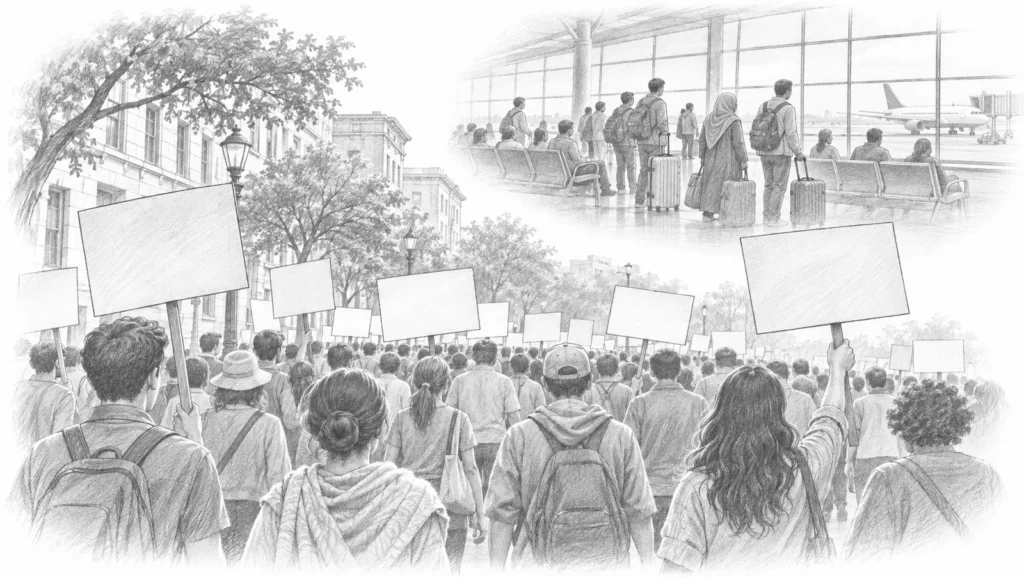
GGLOBALISATION has not been accepted passively. Around the world, people have organised to resist its harmful effects and to shape it differently, from the Zapatista uprising in Mexico and the protests at Seattle to the World Social Forum, climate strikes and campaigns for women’s rights. At the same time, millions of people have responded to globalisation by moving across borders in search of work, safety and opportunity. This chapter examines global social movements as responses and resistances to globalisation, and international migration, often called the human face of globalisation.

5.1 Social Movements: Concepts and Debates
A social movement is a sustained, collective effort by people who share a common identity and grievances to bring about or resist social and political change, usually through non-institutional means such as protests, campaigns and civil disobedience. Donatella della Porta and Mario Diani describe social movements as networks of informal interactions among individuals, groups and organisations, engaged in political or cultural conflicts, on the basis of a shared collective identity.
Recurring Questions in the Study of Movements
In Social Movements in a Globalizing World (1999), della Porta, Hanspeter Kriesi and Dieter Rucht identified recurring questions in the study of social movements: why movements emerge, how people are mobilised, what resources and organisations they use, how they frame issues, what political opportunities help or hinder them, and what effects they have. Major approaches include resource mobilisation theory, which stresses organisation and resources; political process theory, associated with Charles Tilly and Sidney Tarrow, which stresses political opportunities; framing theory, which stresses how movements interpret issues to win support; and new social movement theory.
Old and New Social Movements
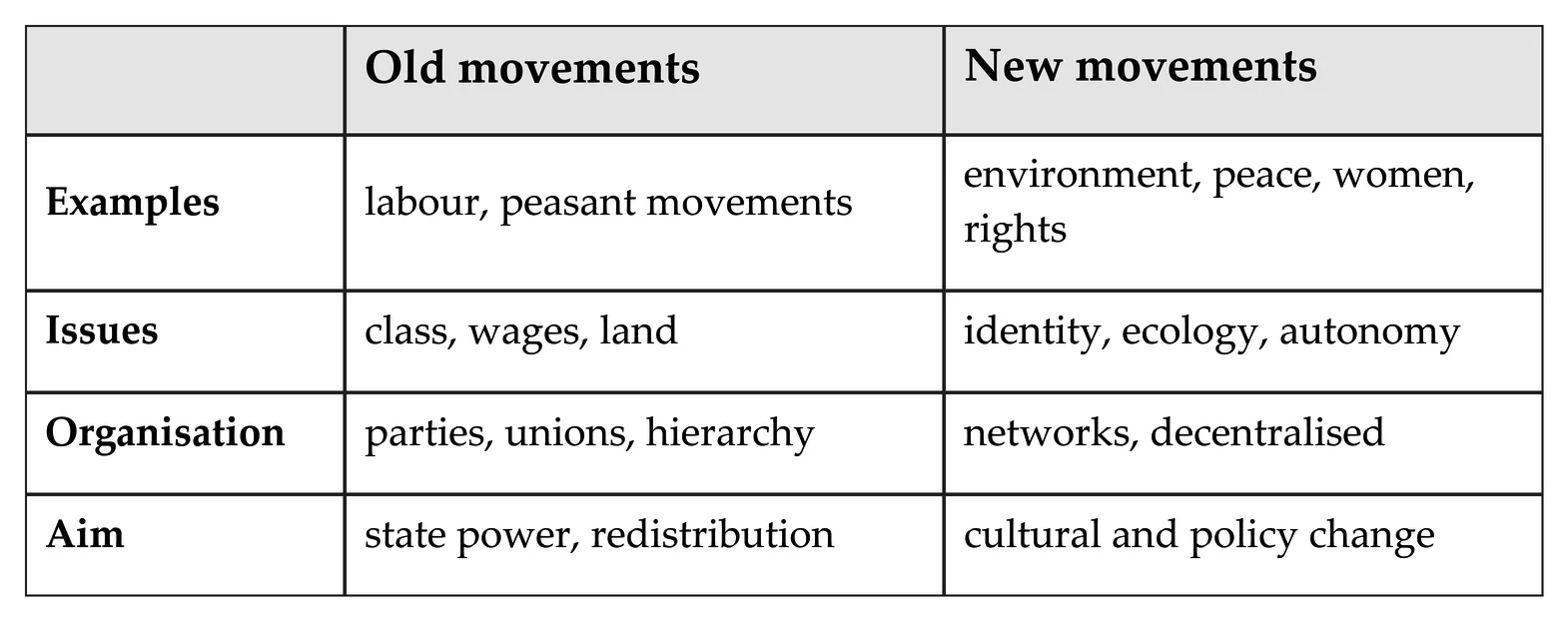
Old social movements, such as labour and peasant movements, focused on material interests and class conflict and often sought state power. New social movements, studied by Alain Touraine, Alberto Melucci and Claus Offe, emerged from the 1960s around issues of identity, environment, peace, gender and human rights. They are usually decentralised, rely on networks rather than parties, and seek cultural change and autonomy as well as policy change. Many global movements combine both, linking economic justice with identity and ecology.
Transnational Activism
Globalisation has made movements increasingly transnational. Margaret Keck and Kathryn Sikkink, in Activists Beyond Borders (1998), described transnational advocacy networks and the boomerang pattern, in which activists blocked by their own state reach out to allies abroad, who then pressure that state through other governments and international organisations. Sidney Tarrow, in The New Transnational Activism (2005), described rooted cosmopolitans, activists rooted in national contexts who engage in transnational networks, and global framing, the use of global symbols to frame local struggles. Sanjeev Khagram showed how the Narmada movement built global alliances with international NGOs to pressure the World Bank, and how the campaign that women’s rights are human rights succeeded at the Vienna Human Rights Conference (1993) and the Beijing Women’s Conference (1995).
5.2 Global Social Movements and Democracy
The Alter-Globalisation Movement
From the 1990s, a broad global justice or alter-globalisation movement emerged against neo-liberal globalisation. Its participants preferred the term alter-globalisation to anti-globalisation, since they sought a different, fairer globalisation rather than isolation.
- The Zapatistas. On 1 January 1994, the day the North American Free Trade Agreement came into force, the Zapatista Army of National Liberation rose in Chiapas, Mexico, demanding land, dignity and autonomy for indigenous people, and used the internet to win global support.
- Jubilee 2000. A global campaign by churches and NGOs demanded cancellation of the debts of poor countries, contributing to debt relief initiatives.
- The Battle of Seattle. In November and December 1999, tens of thousands of trade unionists, environmentalists and activists protested at the WTO ministerial conference in Seattle, which ended without agreement.
- The World Social Forum. Launched at Porto Alegre, Brazil, in 2001 as a counterpart to the World Economic Forum at Davos, under the slogan Another world is possible; it was held in Mumbai in 2004.
- Occupy Wall Street. In 2011, after the financial crisis, protesters occupied Zuccotti Park in New York under the slogan We are the 99%, highlighting inequality; similar protests spread worldwide.
- Climate movements. Fridays for Future, begun by Greta Thunberg in 2018, and Extinction Rebellion mobilised millions of young people for climate action.
- Women’s and rights movements. Global campaigns such as Me Too (2017) and the movement for LGBTQ rights spread through social media across countries.
Social Movements and Democracy
Della Porta and her colleagues argued that social movements democratise democracy. They give voice to groups excluded from formal politics, bring new issues onto the agenda, hold governments and corporations accountable, and promote participatory and deliberative forms of democracy in their own organisations. At the global level, where there is no world government and international institutions are not directly elected, movements and NGOs help fill the democratic deficit by representing affected people and demanding transparency. Critics argue that global movements are not themselves democratically accountable, that they are dominated by Northern NGOs and that they are better at opposing than proposing alternatives.
Indian Movements and Globalisation
India has a rich tradition of movements responding to globalisation: the Narmada Bachao Andolan against displacement; farmers’ movements against WTO rules and seed patents, such as the Karnataka Rajya Raitha Sangha’s campaigns in the 1990s; the Plachimada struggle against a soft drinks plant; the right to information and right to food campaigns; and the farmers’ protest of 2020–21 against the farm laws. Many of these movements combined local struggles with global networks.
Other Responses: Populism and Nationalism
Not all resistance to globalisation is progressive. Since 2016, right-wing populist and nationalist movements, such as those behind Brexit and Donald Trump’s America First policies, have opposed free trade, immigration and international institutions, appealing to those who feel left behind. Joseph Stiglitz, in Globalization and Its Discontents Revisited (2018), argued that the failure to share the gains of globalisation fuelled this backlash. Responses to globalisation therefore range from demands for global justice to economic nationalism.

5.3 International Migration
International migration is the movement of people across national borders to live, temporarily or permanently, in another country. Brian Keeley, in an OECD study (2009), called it the human face of globalisation, because while goods and capital move freely, the movement of people raises the most sensitive political and social questions. The International Organization for Migration estimated that there were about 281 million international migrants in 2020, around 3.6% of the world’s population.
Types and Causes of Migration
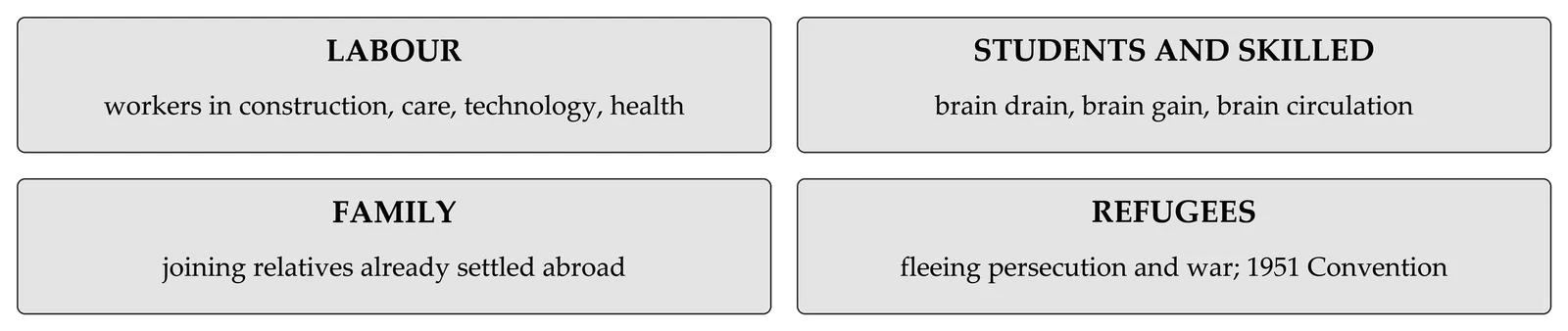
- Labour migration. Workers move for jobs, from low-skilled workers in construction and domestic work to highly skilled professionals in technology and health.
- Students and skilled migrants. Students and professionals move for education and careers, raising issues of brain drain, brain gain and brain circulation.
- Family migration. People join family members already settled abroad.
- Refugees and asylum seekers. People flee persecution, war and violence; the 1951 Refugee Convention protects refugees and forbids non-refoulement, returning them to danger.
- Irregular migration and trafficking. Some migrants move without legal permission, often exposing them to exploitation and trafficking.
- Climate migration. Environmental disasters and climate change increasingly force people to move.
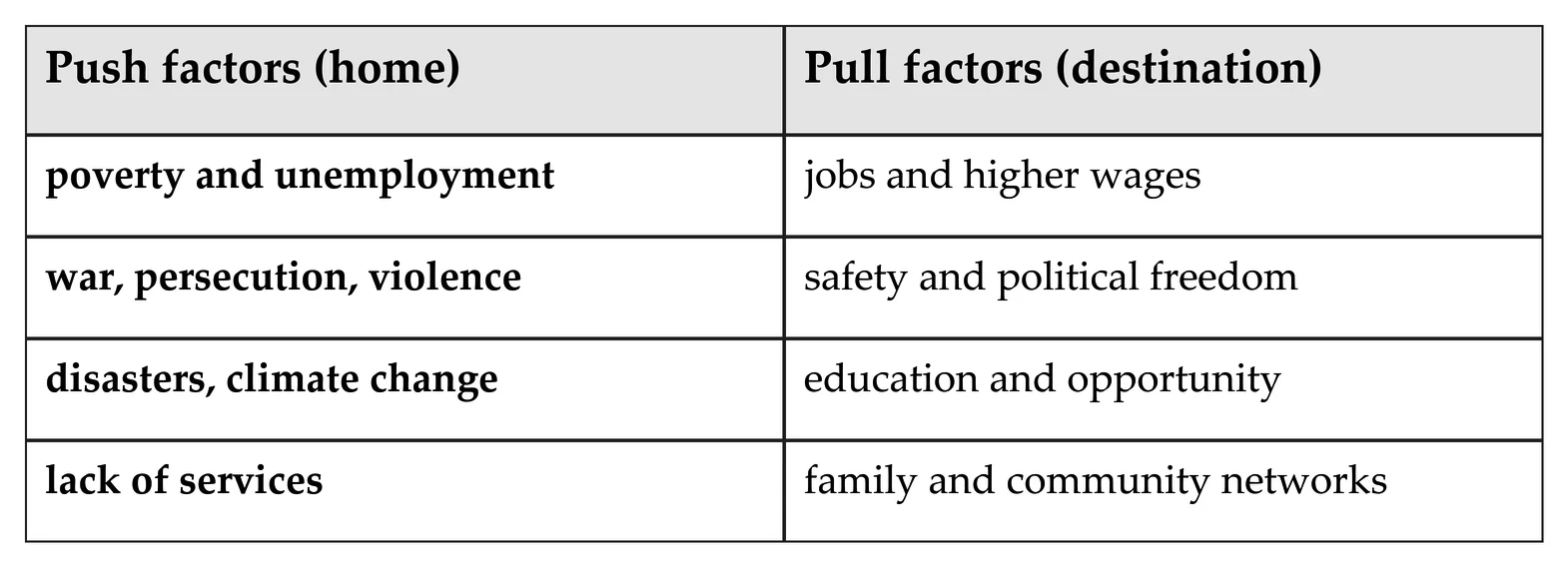
- Push and pull factors. Poverty, unemployment, conflict and persecution push people out, while jobs, higher wages, safety and family networks pull them in.
Migration and Globalisation
As Christine Inglis and her co-editors explain in The Handbook of International Migration (2020), migration is shaped by global inequalities, labour demand, technology and transport, and by state policies. Migrants form transnational communities that maintain ties with their home countries through visits, communication, investment and politics. Remittances, money sent home by migrants, are a major source of income for many developing countries; India is the world’s largest recipient, receiving over 100 billion US dollars a year in recent years.
India and Migration
India has the world’s largest diaspora. Millions of Indians work in the Gulf countries, often in low-wage jobs under the kafala sponsorship system, which ties workers to employers and has been criticised for abuses. Indian professionals and students are prominent in the United States, Britain, Canada and Australia. India also hosts refugees, such as Tibetans and Sri Lankan Tamils, though it has not signed the 1951 Refugee Convention. The government observes Pravasi Bharatiya Divas on 9 January to engage the diaspora, and the Covid-19 pandemic saw the Vande Bharat Mission bring back stranded Indians.
Governance and Backlash
Migration is governed mainly by national states, which control borders and citizenship. The Global Compact for Safe, Orderly and Regular Migration and the Global Compact on Refugees, both of 2018, are the first global frameworks, though non-binding. Migration has become politically contentious in many host countries, with anti-immigrant movements, border walls and restrictions on asylum, while ageing societies need migrant workers. The challenge is to govern migration in a way that protects migrants’ rights and benefits both sending and receiving societies.
5.4 Important Questions
- Question 1 Discuss the nature and role of global social movements as responses to globalisation.
- Question 2 Examine the relationship between social movements and democracy in a globalising world.
- Question 3 International migration is the human face of globalisation. Discuss.
- Question 4 Discuss the challenges of governing international migration and refugees, with reference to India.
DU asks the same idea in different words. So learn one broad answer for each question below; the same answer works for every question joined by OR.
Important Question 1
Discuss the nature and role of global social movements as responses to globalisation.
OR
Examine the alter-globalisation movement.
OR
How has globalisation transformed social movements? Discuss.
Model Answer
“People and groups who are rooted in specific national contexts, but who engage in contentious political activities that involve them in transnational networks of contacts and conflicts.”
— Sidney Tarrow, The New Transnational Activism (2005), defining rooted cosmopolitans
Introduction. Globalisation has produced not only integration but also resistance. Global social movements, networks of activists, NGOs and communities across borders, have challenged neo-liberal globalisation and demanded justice for workers, farmers, indigenous peoples, women and the environment. They have also used the tools of globalisation, such as the internet and cheap travel, to organise across continents.
1. Meaning of Social Movements
Della Porta and Diani describe social movements as networks of informal interactions among individuals and groups engaged in political or cultural conflicts on the basis of a shared collective identity.
2. Approaches to Study
Resource mobilisation theory stresses organisation and resources, political process theory stresses political opportunities, and framing theory stresses how movements interpret issues to win support.
3. Old and New Movements
Old movements focused on class and material interests, while new social movements, studied by Touraine, Melucci and Offe, focus on identity, environment, peace and rights through decentralised networks.
4. Transnational Advocacy Networks
Keck and Sikkink showed how activists use the boomerang pattern, appealing to allies abroad to pressure their own governments through other states and international organisations.
5. Rooted Cosmopolitans
Tarrow described rooted cosmopolitans, activists rooted in national contexts who join transnational networks and use global framing to strengthen local struggles.
6. The Zapatistas
The Zapatista uprising in Chiapas on 1 January 1994, the day NAFTA came into force, demanded rights for indigenous people and used the internet to build global solidarity.
7. Jubilee 2000
The Jubilee 2000 campaign by churches and NGOs demanded cancellation of poor countries’ debts and contributed to debt relief initiatives for heavily indebted poor countries.
8. The Battle of Seattle
In 1999, tens of thousands of protesters disrupted the WTO ministerial conference in Seattle, which ended without agreement, marking the arrival of the global justice movement.
9. The World Social Forum
Launched at Porto Alegre in 2001 as an alternative to the World Economic Forum, the WSF brought together movements under the slogan another world is possible, meeting in Mumbai in 2004.
10. Occupy and Inequality
Occupy Wall Street in 2011, under the slogan we are the 99%, highlighted inequality after the financial crisis and inspired similar protests worldwide.
11. Climate Movements
Fridays for Future, begun by Greta Thunberg in 2018, mobilised millions of young people worldwide to demand urgent action on climate change.
12. Women’s Rights Are Human Rights
Khagram showed how the global women’s movement succeeded in having women’s rights recognised as human rights at the Vienna (1993) and Beijing (1995) conferences.
13. The Narmada Movement
The Narmada Bachao Andolan built alliances with international NGOs to pressure the World Bank, which withdrew from the Sardar Sarovar project in 1993.
14. Achievements
Global movements have influenced debt relief, trade negotiations, climate agreements and human rights norms, and changed public debate on globalisation.
15. Limitations
Critics argue that global movements are dominated by Northern NGOs, lack democratic accountability and are better at opposing than proposing alternatives.
16. Evaluation
Global social movements show that globalisation can be contested and reshaped from below, making it more accountable to people.
Conclusion. Thus, global social movements, from the Zapatistas, Jubilee 2000 and Seattle to the World Social Forum, Occupy and climate strikes, respond to globalisation by demanding justice and accountability. Rooted cosmopolitans, as Tarrow calls them, link local struggles to global networks, though movements face limits of representation and unity.
Important Question 2
Examine the relationship between social movements and democracy in a globalising world.
OR
Social movements democratise democracy. Discuss.
OR
Discuss the different responses to globalisation, including populism and nationalism.
Model Answer
“Everyone has the right to freedom of peaceful assembly and association.”
— Universal Declaration of Human Rights (1948), Article 20(1)
Introduction. Social movements and democracy are closely linked. Democracy provides the freedoms of speech, assembly and association that movements need, and movements in turn deepen democracy by giving voice to the excluded and holding power accountable. In a globalising world, where many decisions are taken by international institutions and markets beyond national control, movements play a special role in democratising global governance.
1. Freedoms Needed by Movements
Movements depend on the rights of free expression, peaceful assembly and association, recognised in the Universal Declaration of Human Rights and in democratic constitutions.
2. Della Porta’s Argument
Della Porta and her colleagues argued that social movements democratise democracy by expanding participation and bringing new voices and issues into politics.
3. Voice for the Excluded
Movements give voice to groups excluded from formal politics, such as workers, women, indigenous peoples, Dalits and the poor, whose concerns are often ignored by parties.
4. Setting the Agenda
Movements bring new issues onto the political agenda, such as environmental protection, gender equality and global debt, which later become part of mainstream politics.
5. Accountability
Movements monitor governments, corporations and international institutions, exposing abuses and demanding transparency and responsiveness.
6. Participatory and Deliberative Democracy
Many movements practise participatory and deliberative democracy in their own organisations, as in the open assemblies of the World Social Forum and Occupy.
7. The Global Democratic Deficit
International institutions such as the IMF and WTO are not directly accountable to citizens, creating a democratic deficit that global movements and NGOs try to fill.
8. Transnational Advocacy
Through the boomerang pattern, activists blocked at home can use international allies and norms to pressure their governments, strengthening rights and democracy.
9. Indian Experience
Indian movements such as the RTI campaign, the Narmada movement and the farmers’ protest of 2020–21 show how movements shape policy and deepen democracy.
10. Movements and the Internet
Social media helps movements mobilise quickly and globally, as in the Arab Spring of 2011 and Me Too, though it can also spread misinformation and enable surveillance.
11. Limits of Movements
Movements are not themselves democratically elected, may be dominated by well-resourced groups and can struggle to turn protest into lasting institutional change.
12. State Responses
States may respond to movements with reforms, co-optation or repression, and restrictions on protest and foreign funding limit civil society in many countries.
13. Populist Backlash
Since 2016, right-wing populist movements behind Brexit and Trump’s America First have opposed free trade, immigration and international institutions.
14. Causes of the Backlash
Stiglitz argued in 2018 that the failure to share the gains of globalisation with workers and left-behind regions fuelled discontent and populism.
15. Range of Responses
Responses to globalisation range from demands for global justice and fair rules to economic nationalism and protectionism, showing that globalisation is politically contested.
16. Movements and Global Institutions
Pressure from movements has led international institutions to open up: the World Bank created an Inspection Panel in 1993 after the Narmada campaign, and the WTO and IMF now publish more documents and consult civil society. Such changes show how movements can make global governance more transparent, though critics say the reforms are limited.
17. Digital Repression
Governments also use technology against movements, through internet shutdowns, surveillance, online harassment and laws against misinformation. India has recorded many regional internet shutdowns, which civil liberties groups criticise, showing that digital tools can both empower and restrict democratic protest.
18. Evaluation
Social movements are vital to democracy in a globalising world, but their democratic value depends on inclusiveness and respect for the rights of others.
Conclusion. Thus, social movements depend on democratic freedoms such as the right to peaceful assembly and in turn democratise democracy by giving voice to the excluded, setting agendas and holding power accountable. They help fill the global democratic deficit, while populist nationalism shows another, more exclusionary response to globalisation.
Important Question 3
International migration is the human face of globalisation. Discuss.
OR
Discuss the causes and consequences of international migration.
OR
Examine the significance of the Indian diaspora and remittances.
Model Answer
“Everyone has the right to leave any country, including his own, and to return to his country.”
— Universal Declaration of Human Rights (1948), Article 13(2)
Introduction. While goods and capital move relatively freely in a globalised world, the movement of people remains tightly controlled by states. Yet millions of people move across borders every year for work, education, family and safety. Brian Keeley of the OECD called international migration the human face of globalisation, since it most directly affects people’s lives, identities and communities.
1. Meaning
International migration is the movement of people across national borders to live in another country, temporarily or permanently, for work, study, family reunion or protection.
2. Scale
The International Organization for Migration estimated about 281 million international migrants in 2020, around 3.6% of the world’s population.
3. Why the Human Face
Keeley argued that migration is the human face of globalisation because it involves people, not goods, raising sensitive questions of identity, rights, belonging and social change.
4. Push Factors
Poverty, unemployment, conflict, persecution, environmental disasters and lack of opportunities push people to leave their countries.
5. Pull Factors
Jobs, higher wages, education, safety, political freedom and family networks pull migrants to particular destinations.
6. Labour Migration
Most migrants move for work, from low-skilled jobs in construction, agriculture and domestic work to skilled jobs in technology, medicine and research.
7. Skilled Migration
The movement of skilled workers raises issues of brain drain for sending countries, brain gain for receiving countries and brain circulation when migrants return or invest at home.
8. Refugees
Refugees flee persecution and war; the 1951 Refugee Convention protects them, and conflicts in Syria, Afghanistan, Ukraine and elsewhere have displaced millions.
9. Transnationalism
Inglis and her co-editors show that migrants form transnational communities, keeping ties with their home countries through communication, travel, investment and politics.
10. Remittances
Remittances are a major source of income for many developing countries. India is the world’s largest recipient, receiving over 100 billion US dollars a year in recent years.
11. The Indian Diaspora
India has the world’s largest diaspora, with professionals in the West and millions of workers in the Gulf, and the diaspora contributes to India’s economy, image and diplomacy.
12. Gulf Migration and the Kafala System
Many Indian workers in the Gulf are employed under the kafala sponsorship system, which ties them to employers and has been criticised for abuses such as withheld wages and passports.
13. Benefits for Host Countries
Migrants fill labour shortages, contribute to economic growth and help ageing societies sustain their workforce and welfare systems.
14. Challenges
Migrants often face exploitation, discrimination and insecurity, while host societies experience debates over jobs, culture and integration, fuelling anti-immigrant politics.
15. Global Governance
The Global Compact for Safe, Orderly and Regular Migration (2018) is the first global framework on migration, though it is non-binding and states retain control over borders.
16. Feminisation of Migration
Women now form almost half of international migrants, many working as nurses, domestic workers and carers. Their earnings support families at home, but domestic workers in particular face isolation, long hours and abuse, which the ILO Domestic Workers Convention of 2011 seeks to address.
17. Internal and International Migration
In India, internal migration from poorer states such as Bihar and Uttar Pradesh to cities and richer states is far larger than international migration. The plight of internal migrants during the Covid-19 lockdown of 2020 showed that migrants within countries also face insecurity and exclusion from welfare.
18. Evaluation
International migration connects societies and benefits both sending and receiving countries, but it must be governed with respect for migrants’ rights and dignity.
Conclusion. Thus, international migration, driven by push and pull factors and shaped by global inequality, is the human face of globalisation, as Keeley argued. Remittances, diasporas and transnational communities link societies, while exploitation, refugee crises and backlash show the need for rights-based governance of migration.
Important Question 4
Discuss the challenges of governing international migration and refugees, with reference to India.
OR
Examine the international refugee regime and its limitations.
OR
Write a note on the Global Compact for Migration.
Model Answer
“No Contracting State shall expel or return a refugee in any manner whatsoever to the frontiers of territories where his life or freedom would be threatened on account of his race, religion, nationality, membership of a particular social group or political opinion.”
— Convention Relating to the Status of Refugees (1951), Article 33(1) (abridged)
Introduction. Migration is one of the most politically sensitive issues of globalisation. States guard their sovereign right to decide who enters, yet migration and refugee flows cross borders and require cooperation. The international community has built a refugee regime and, more recently, global compacts on migration, but governing migration remains difficult. India faces these challenges as a major sending country and a host of refugees.
1. State Sovereignty over Borders
States control entry, residence and citizenship, and migration policy is seen as a core aspect of sovereignty, which makes global governance of migration weak.
2. The 1951 Refugee Convention
The 1951 Convention and its 1967 Protocol define refugees as people fleeing persecution and protect them from being returned to danger under the principle of non-refoulement.
3. UNHCR
The UN High Commissioner for Refugees, established in 1950, protects and assists refugees and seeks solutions such as voluntary return, local integration and resettlement.
4. Growing Displacement
Conflicts and persecution have displaced record numbers of people, with UNHCR reporting more than 120 million forcibly displaced people worldwide by 2024.
5. Limits of the Refugee Regime
Most refugees are hosted by developing countries, burden-sharing is weak, and the Convention does not cover people displaced by climate change or poverty.
6. The Global Compacts of 2018
The Global Compact for Safe, Orderly and Regular Migration and the Global Compact on Refugees provide frameworks for cooperation, but they are non-binding.
7. Labour Migration Governance
Bilateral agreements, the ILO’s conventions on migrant workers and recruitment regulations aim to protect labour migrants, but enforcement is weak in many destinations.
8. Irregular Migration
Restrictive policies push many migrants into irregular routes, exposing them to smugglers, traffickers and deadly journeys, as in the Mediterranean.
9. Backlash in Host Countries
Anti-immigrant movements, border walls and restrictions on asylum in Europe and North America reflect fears about jobs, security and culture.
10. India as a Sending Country
India is the world’s largest source of migrants. The Emigration Act of 1983 regulates recruitment of workers for certain countries, and the government runs welfare funds and help desks for overseas workers.
11. Protecting Indian Workers
India has signed labour agreements with Gulf countries and evacuated citizens in crises, such as from Kuwait in 1990, from Yemen in 2015 and during Covid-19 under the Vande Bharat Mission.
12. India as a Host
India hosts refugees such as Tibetans and Sri Lankan Tamils, though it has not signed the 1951 Convention and deals with refugees through administrative policies.
13. Indian Courts and Refugees
Indian courts have applied Article 21 to protect the lives of refugees, holding that the right to life extends to all persons, not only citizens.
14. Climate Migration
Climate change, through rising seas, droughts and floods, will increasingly force people to move, including in South Asia, creating new governance challenges.
15. Rights-Based Governance
Scholars argue for governance that protects migrants’ human rights, ensures safe and legal pathways and shares responsibility among states.
16. Citizenship and Belonging
Migration raises questions of citizenship and belonging. India’s Citizenship (Amendment) Act of 2019, which offers a faster path to citizenship for certain religious minorities from neighbouring countries, sparked debate over whether citizenship should depend on religion, showing how migration governance touches on identity.
17. Evaluation
Governing migration requires balancing state sovereignty with human rights and cooperation, a balance that remains elusive at the global level.
Conclusion. Thus, international migration is governed mainly by sovereign states, while the 1951 Refugee Convention, UNHCR and the 2018 global compacts provide limited international frameworks based on non-refoulement and cooperation. India, as a major sending country and a host of refugees, illustrates the challenges of protecting migrants in a globalised world.
Short Notes
(a) World Social Forum
An annual gathering of social movements and NGOs, first held at Porto Alegre in 2001 as an alternative to the World Economic Forum, under the slogan another world is possible.
(b) Boomerang pattern
Keck and Sikkink’s idea that activists blocked by their own state reach out to allies abroad, who pressure that state through other governments and international organisations.
(c) Non-refoulement
The principle in Article 33 of the 1951 Refugee Convention that refugees must not be returned to a country where their life or freedom would be threatened.
(d) Rooted cosmopolitans
Sidney Tarrow’s term for activists who are rooted in national contexts but take part in transnational networks of contacts and conflicts, linking local struggles with global campaigns.
(e) Remittances
Money sent home by migrants working abroad; India is the world’s largest recipient, and remittances support household incomes, education and health in many developing countries.
More notes: GE-7 Politics of Globalisation
These notes are prepared by PADHO TO AISE for study help. They are not an official publication.