
Semester VIII MDSE-15 India and the World
Unit 1 · 26 min read · Updated 24 Nov 2026
As per the University of Delhi (DU) BA (Hons) Political Science syllabus
Contents
- 1.1 Determinants of India’s Foreign Policy
- Guiding Principles of India’s Foreign Policy
- Nehru’s Foundations
- Geography and Security
- Institutions of Foreign Policy
- 1.2 The Cold War and Non-Alignment
- Milestones of Non-Alignment
- Tests of Non-Alignment
- Non-Alignment and the Global South
- 1.3 Nuclear Armaments and After the Cold War
- Milestones of India’s Nuclear Policy
- The Civil Nuclear Deal
- Foreign Policy after the Cold War
- Debates on India’s Strategic Culture
- 1.4 Important Questions
- Discuss the key determinants of India’s foreign policy.
- Discuss the influence of the Cold War on India’s foreign policy.
- Discuss India’s nuclear policy and its influence on India’s foreign policy.
- Discuss the changes in India’s foreign policy after the Cold War.
- Short Notes
आप कोई भी नीति बनाएँ, किसी देश के विदेशी मामलों को चलाने की कला यह पता लगाने में है कि देश के लिए सबसे अधिक लाभदायक क्या है।
Whatever policy you may lay down, the art of conducting the foreign affairs of a country lies in finding out what is most advantageous to the country.
— Jawaharlal Nehru, Constituent Assembly (4 December 1947)
IINDIA’s foreign policy is shaped by its geography, history, economy, domestic politics and leadership, and by the changing international system. After independence, India pursued non-alignment during the Cold War, kept away from military blocs and championed decolonisation. It developed nuclear capability, conducting tests in 1974 and 1998. After the Cold War, it turned to economic diplomacy and new partnerships. This chapter situates India’s foreign policy through its determinants, the influence of the Cold War and nuclear armaments, drawing on Jayanta Bandyopadhyaya, B.R. Nanda, Ashok Kapur, C. Raja Mohan and Sumit Ganguly.
1.1 Determinants of India’s Foreign Policy
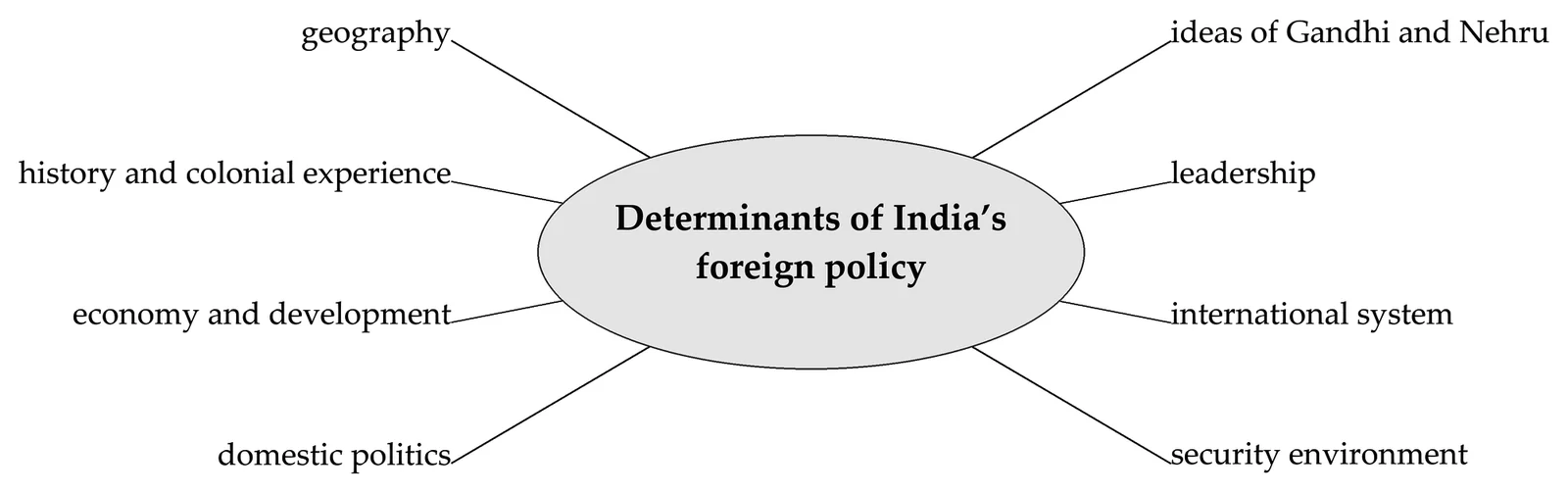
A country’s foreign policy is the set of goals and means it uses in dealing with other states. India’s is shaped by geography, as a large state with a long land border and a central position in the Indian Ocean; by history, especially colonial rule and Partition; by its economy and development needs; by domestic politics and leadership; and by the international system, from Cold War bipolarity to today’s multipolarity.
Guiding Principles of India’s Foreign Policy
- Panchsheel. The five principles of peaceful coexistence, set out in the India–China agreement on trade with Tibet of 29 April 1954, are mutual respect for territorial integrity and sovereignty, mutual non-aggression, non-interference in internal affairs, equality and mutual benefit, and peaceful coexistence.
- Anti-colonialism and anti-racism. In 1946, even before independence, India raised the treatment of Indians in South Africa at the UN, and it consistently supported decolonisation in Asia and Africa.
- Peaceful settlement of disputes. Article 51 of the Constitution directs the state to promote international peace and security, maintain just relations between nations, respect international law and encourage settlement of disputes by arbitration.
- Strategic autonomy. India has sought to keep its freedom of decision by avoiding binding alliances, from non-alignment in the Cold War to multi-alignment today.
- Development. Foreign policy has been used to secure capital, technology, markets and energy for India’s development.
Nehru’s Foundations
Jawaharlal Nehru, who served as both Prime Minister and Minister of External Affairs from 1947 to 1964, shaped India’s foreign policy more than anyone else. In a broadcast on 7 September 1946, as head of the interim government, he declared that India would keep away from the power politics of groups aligned against one another, which had led to world wars. His approach combined idealism, such as support for the UN, disarmament and Asian-African solidarity, with a realistic recognition that a poor, newly independent country needed peace and freedom of action to develop. Jayantanuja Bandyopadhyaya, in The Making of India’s Foreign Policy (1970), analysed how such determinants and the personal role of leaders shaped policy.
Geography and Security
India’s geography gives it both opportunities and challenges. It has a land border of more than 15,000 kilometres with seven countries, including two nuclear-armed neighbours, China and Pakistan, with whom it has unresolved territorial disputes. Its coastline of about 7,500 kilometres and its island territories in the Andaman and Nicobar and Lakshadweep groups give it a central position in the Indian Ocean, through which most of its trade and energy imports pass; India imports more than eighty-five per cent of its crude oil. These facts make the security of land borders and sea lanes central to its foreign policy.
Institutions of Foreign Policy
Foreign policy is made mainly by the executive. The Ministry of External Affairs and the Indian Foreign Service conduct diplomacy, while the Prime Minister’s Office has grown in importance. The National Security Council was created in 1998, with Brajesh Mishra as the first National Security Adviser. Parliament debates foreign policy and its committees examine it, but treaties do not need parliamentary approval. States sometimes influence policy, as Tamil Nadu has on Sri Lanka and West Bengal did when it blocked the Teesta water-sharing agreement with Bangladesh in 2011.
1.2 The Cold War and Non-Alignment
During the Cold War, India refused to join either the American or the Soviet bloc and led the Non-Aligned Movement, seeking independence of judgement, peace and decolonisation. Wars with China in 1962 and Pakistan in 1965 and 1971, and the Indo-Soviet Treaty of 1971, pushed India closer to the Soviet Union while it remained formally non-aligned.

Milestones of Non-Alignment
- 1953 → India chaired the Neutral Nations Repatriation Commission in Korea, under General K.S. Thimayya, after the Korean War.
- 1954 → India chaired the International Control Commissions set up after the Geneva conference on Indo-China.
- 1955 → At the Asian-African Conference at Bandung, twenty-nine countries endorsed principles of peaceful coexistence.
- 1961 → The first Non-Aligned summit at Belgrade, led by Nehru, Tito, Nasser, Nkrumah and Sukarno, brought together twenty-five countries.
- 1983 → India hosted the seventh Non-Aligned summit at New Delhi under Indira Gandhi’s chairmanship.
Tests of Non-Alignment
Non-alignment faced severe tests. India criticised the Anglo-French invasion of Suez in 1956 but was slow to condemn the Soviet intervention in Hungary the same year, which critics saw as double standards. The American Secretary of State John Foster Dulles described neutrality in 1956 as immoral and short-sighted. The war with China in 1962 forced India to seek Western military help, and the Soviet Union mediated the Tashkent Declaration of January 1966 after the war with Pakistan in 1965. In 1971, faced with the United States’ tilt towards Pakistan and China’s hostility, India signed the Indo-Soviet Treaty of Peace, Friendship and Cooperation on 9 August 1971; when the American Seventh Fleet sailed into the Bay of Bengal in December, India pressed on and Bangladesh was liberated on 16 December 1971. The Simla Agreement of 1972 committed India and Pakistan to settle differences bilaterally.
Non-Alignment and the Global South
India used the Non-Aligned Movement and the Group of 77 to press for economic justice. In 1974, the UN General Assembly called for a New International Economic Order, demanding fairer terms of trade, transfer of technology and reform of international financial institutions. India’s muted response to the Soviet invasion of Afghanistan in 1979 again drew criticism. Scholars debate whether non-alignment was a principled policy or a pragmatic strategy, but most agree that it gave India a voice in world affairs far beyond its material power in the early decades.
1.3 Nuclear Armaments and After the Cold War
India opposed the discriminatory nuclear order, refused to sign the NPT and the CTBT, and conducted nuclear tests in 1974 and 1998, adopting a doctrine of no first use and credible minimum deterrence. After the Cold War, India moved towards economic diplomacy, closer ties with the United States and East Asia, and a pragmatic pursuit of great-power status, which C. Raja Mohan described as crossing the Rubicon.

Milestones of India’s Nuclear Policy
- 1948 → The Atomic Energy Commission was set up under Homi Bhabha.
- 1968 → India refused to sign the Nuclear Non-Proliferation Treaty, calling it discriminatory because it allowed five states to keep nuclear weapons while denying them to all others.
- 1974 → India conducted a peaceful nuclear explosion at Pokhran on 18 May; in response, supplier states formed the Nuclear Suppliers Group in 1975.
- 1988 → Rajiv Gandhi presented an Action Plan for a nuclear-weapon-free world at the UN.
- 1996 → India refused to sign the Comprehensive Test Ban Treaty.
- 1998 → India conducted five tests on 11 and 13 May and declared itself a nuclear weapon state; Pakistan tested later that month.
- 2003 → India’s nuclear doctrine adopted credible minimum deterrence, no first use, massive retaliation against a nuclear attack and civilian control through the Nuclear Command Authority.
The Civil Nuclear Deal
The India–US civil nuclear agreement ended India’s nuclear isolation. After a joint statement by Prime Minister Manmohan Singh and President George W. Bush in July 2005, the United States passed the Hyde Act in 2006 and the two countries concluded a 123 Agreement in 2007. In September 2008, after India agreed to separate civilian and military facilities and place civilian ones under IAEA safeguards, the Nuclear Suppliers Group granted India a waiver allowing nuclear trade. India later joined the Missile Technology Control Regime (2016), the Wassenaar Arrangement (2017) and the Australia Group (2018), but its bid for membership of the Nuclear Suppliers Group has been blocked, mainly by China.
Foreign Policy after the Cold War
The end of the Cold War and the economic crisis of 1991 forced a major rethinking. Prime Minister P.V. Narasimha Rao launched the Look East Policy, established full diplomatic relations with Israel in January 1992 and began improving ties with the United States. The Gujral Doctrine of 1996 promised generosity without demanding reciprocity from smaller neighbours. C. Raja Mohan, in Crossing the Rubicon (2003), argued that India had abandoned many of its old positions for pragmatic pursuit of national interest. Since 2014, policies such as Neighbourhood First, Act East and SAGAR (Security and Growth for All in the Region, 2015) and an approach of multi-alignment, engaging the United States, Russia, Europe and the Global South at the same time, have defined India’s outlook. Shivshankar Menon’s Choices (2016) describes the hard decisions behind these policies.
Debates on India’s Strategic Culture
In a study for the RAND Corporation in 1992, the American analyst George Tanham argued that India lacked a tradition of systematic strategic thinking, partly because of its history, geography and culture. Indian scholars rejected this view, pointing to Kautilya’s Arthashastra, the strategic ideas of the epics and the Mughal and Maratha experience of statecraft. Kanti Bajpai identified competing schools in modern Indian thinking: Nehruvians, who stress diplomacy and cooperation; neoliberals, who stress economic strength and interdependence; and hyperrealists, who stress military power. Most analysts agree that Indian policy has blended these approaches, combining restraint and autonomy with a growing willingness to use power to protect national interests.
1.4 Important Questions
- Question 1 Discuss the key determinants of India’s foreign policy.
- Question 2 Discuss the influence of the Cold War on India’s foreign policy.
- Question 3 Discuss India’s nuclear policy and its influence on India’s foreign policy.
- Question 4 Discuss the changes in India’s foreign policy after the Cold War.
DU asks the same idea in different words. So learn one broad answer for each question below; the same answer works for every question joined by OR.
Important Question 1
Discuss the key determinants of India’s foreign policy.
OR
Examine the domestic and international factors that shape India’s foreign policy.
OR
How do geography and history influence India’s foreign policy?
Model Answer
“The State shall endeavour to promote international peace and security; maintain just and honourable relations between nations; foster respect for international law and treaty obligations.”
— Constitution of India, Article 51
Introduction. Foreign policy is the set of goals, principles and strategies a state uses in its relations with other states. India’s foreign policy has been shaped by a combination of lasting factors, such as geography and history, and changing factors, such as leadership, domestic politics and the international system. Jayanta Bandyopadhyaya’s The Making of India’s Foreign Policy remains a classic study of these determinants.
1. Meaning of Determinants
Determinants are the factors that shape a country’s foreign policy goals and choices. Some are relatively permanent, such as location and size, while others change, such as governments, economic needs and global power balances.
2. Geography
India is a large country with long land borders with Pakistan, China, Nepal, Bangladesh and others, and a long coastline at the centre of the Indian Ocean. Its geography makes the security of its borders and sea lanes a central concern.
3. History and Colonial Experience
Two centuries of colonial rule made India strongly anti-imperialist and committed to the freedom of colonised peoples. Partition in 1947 left a legacy of conflict with Pakistan, especially over Kashmir.
4. Ideas of Gandhi and Nehru
Gandhi’s non-violence and Nehru’s internationalism shaped India’s commitment to peace, disarmament, the United Nations and non-alignment, giving its foreign policy a moral dimension.
5. Economy and Development
As a developing country, India has used foreign policy to obtain capital, technology, energy and markets. Nehru said that foreign policy is ultimately the outcome of economic policy, an idea that became even more important after 1991.
6. Domestic Politics
Domestic politics influences foreign policy through parties, public opinion, coalitions and states. For example, Tamil Nadu’s concerns have shaped policy towards Sri Lanka, and West Bengal’s position has affected water sharing with Bangladesh.
7. Leadership
Leaders have shaped India’s foreign policy, from Nehru’s non-alignment and Indira Gandhi’s assertiveness in 1971 to Vajpayee’s nuclear tests and Modi’s emphasis on diplomacy and global leadership.
8. The International System
The structure of the international system, bipolar during the Cold War, unipolar after 1991 and increasingly multipolar today, has shaped India’s options and alignments.
9. Security Environment
Rivalry with Pakistan, the border dispute with China, terrorism and instability in the neighbourhood make security a central determinant of India’s foreign policy.
10. Institutions
Foreign policy is made by the Prime Minister’s Office, the Ministry of External Affairs, the National Security Council created in 1998 and other ministries, with Parliament providing debate and oversight.
11. Bandyopadhyaya’s Analysis
Jayanta Bandyopadhyaya analysed both the determinants of India’s foreign policy, such as geography, economy and ideology, and the processes and institutions through which it is made.
12. Mathur and Kamath
D. Mathur and P.M. Kamath studied the conduct of India’s foreign policy, showing how diplomacy, institutions and leadership translate goals into action.
13. A South Asian View
Imtiaz Ahmed, a Bangladeshi scholar, examined India’s role in South Asia, showing how smaller neighbours often see India’s size and power as dominating, which shapes their policies towards India.
14. Diaspora and Culture
India’s large diaspora and cultural influence, through films, yoga and religion, are increasingly important in its foreign relations.
15. Energy Security
India imports most of its oil and much of its gas, so energy security has become a major determinant of foreign policy. Relations with Gulf countries, Russia, the United States and African and Latin American producers are shaped by the need for secure and affordable energy, as shown by India’s purchases of discounted Russian oil after 2022.
16. Maritime Interests
India’s long coastline, island territories and dependence on sea trade make the Indian Ocean central to its interests. Concerns about piracy, the security of sea lanes and the growing presence of China have led India to strengthen its navy and build partnerships with island and littoral states under the vision of Security and Growth for All in the Region, announced in 2015.
17. Evaluation
India’s foreign policy results from the interaction of lasting and changing determinants, which together explain both continuity and change.
Conclusion. Thus, India’s foreign policy is shaped by geography, colonial history, the ideas of Gandhi and Nehru, economic needs, domestic politics, leadership, the security environment and the international system. Bandyopadhyaya, Mathur and Kamath, and Ahmed show how these determinants interact, explaining both continuity and change.
Important Question 2
Discuss the influence of the Cold War on India’s foreign policy.
OR
Examine India’s policy of non-alignment during the Cold War.
OR
Why did India move closer to the Soviet Union in the 1970s?
Model Answer
“We propose, as far as possible, to keep away from the power politics of groups, aligned against one another, which have led in the past to world wars and which may again lead to disasters on an even vaster scale.”
— Jawaharlal Nehru, radio broadcast (7 September 1946)
Introduction. India became independent as the Cold War began, dividing the world between the American and Soviet blocs. India chose non-alignment, refusing to join either military bloc while engaging with both. The Cold War nonetheless shaped India’s choices, as wars with China and Pakistan and great-power alignments pushed India closer to the Soviet Union.
1. The Cold War
After 1945, the United States and the Soviet Union competed for global influence through alliances such as NATO and the Warsaw Pact, arms races and proxy conflicts, dividing the world into two blocs.
2. Meaning of Non-Alignment
Non-alignment meant not joining military blocs and judging each issue on its merits. Nehru insisted it was not neutrality or passivity but an active policy of independence and peace.
3. Reasons for Non-Alignment
India chose non-alignment to protect its newly won independence, to focus on development, to obtain aid from both blocs, to avoid being drawn into wars and to promote peace and decolonisation.
4. Panchsheel and Bandung
India and China agreed on the Panchsheel, five principles of peaceful coexistence, in 1954, and the Bandung Conference of Asian and African countries in 1955 promoted solidarity among newly independent states.
5. The Non-Aligned Movement
The Non-Aligned Movement held its first summit at Belgrade in 1961, led by Nehru, Nasser of Egypt, Tito of Yugoslavia, Sukarno of Indonesia and Nkrumah of Ghana.
6. India’s Mediation
India played mediating roles in the Korean War and in Indo-China in the 1950s, gaining prestige as a voice of peace, as B.R. Nanda’s volume on the Nehru years describes.
7. The 1962 War
China’s attack in 1962 exposed India’s military weakness and led India to seek help from the United States and Britain, showing the limits of non-alignment.
8. Wars with Pakistan
Sumit Ganguly’s study of the origins of war in South Asia examines the wars of 1947, 1965 and 1971, which were shaped by Cold War alignments, as Pakistan joined US-led alliances.
9. The Indo-Soviet Treaty
In August 1971, India signed a Treaty of Peace, Friendship and Cooperation with the Soviet Union, which gave it support during the Bangladesh war, when the United States tilted towards Pakistan.
10. The Indira Gandhi Years
Studies of the Indira Gandhi years show a more assertive, realist foreign policy, including the 1971 war, the 1974 nuclear test and close ties with the Soviet Union, while retaining non-alignment.
11. The Second Cold War
Fred Halliday described a second Cold War from the late 1970s, after the Soviet invasion of Afghanistan in 1979. India’s muted response and US support for Pakistan complicated its position.
12. Bradnock on India after 1971
Robert Bradnock examined India’s foreign policy after 1971, showing its emergence as the dominant power in South Asia and its efforts to manage relations with both superpowers.
13. Criticisms of Non-Alignment
Critics argued that non-alignment was in practice tilted towards the Soviet Union and that it neglected military preparedness. Supporters replied that it preserved India’s autonomy.
14. Legacy
The legacy of non-alignment lives on in India’s idea of strategic autonomy, its refusal to join military alliances and its links with countries of the global South.
15. Economic Aid from Both Blocs
Non-alignment allowed India to receive help from both blocs. The Soviet Union helped build the Bhilai steel plant and supplied arms, while the United States provided food aid under its PL-480 programme in the 1950s and 1960s. Dennis Merrill’s study shows how American aid was linked to Cold War goals of keeping India away from communism.
16. Kashmir and the Great Powers
The Kashmir dispute was drawn into Cold War politics. Western powers often supported Pakistan’s positions in the United Nations, while the Soviet Union used its veto in the Security Council to protect India. This pattern reinforced India’s closeness to Moscow and its suspicion of Western mediation.
17. Non-Alignment and Decolonisation
India used the Non-Aligned Movement and the United Nations to support the freedom struggles of Asian and African peoples, oppose apartheid in South Africa and call for a fairer world economic order. This gave India leadership among newly independent states, though its influence depended more on moral authority than on material power during the Cold War.
18. Evaluation
The Cold War shaped India’s foreign policy profoundly, and non-alignment allowed India to preserve its independence while adapting to changing threats.
Conclusion. Thus, India responded to the Cold War with non-alignment, expressed in Panchsheel, Bandung and the Non-Aligned Movement of 1961. Wars with China and Pakistan and US support for Pakistan led to the Indo-Soviet Treaty of 1971, while non-alignment’s legacy continues in strategic autonomy.
Important Question 3
Discuss India’s nuclear policy and its influence on India’s foreign policy.
OR
Why did India refuse to sign the NPT and the CTBT?
OR
Examine India’s nuclear doctrine and the Indo-US nuclear deal.
Model Answer
“India will not be the first to initiate a nuclear strike, but will respond with punitive retaliation should deterrence fail.”
— Draft Report on Indian Nuclear Doctrine (1999)
Introduction. Nuclear weapons have been a central issue in India’s foreign policy. India long advocated global disarmament while refusing to accept a nuclear order that allowed only five states to keep nuclear weapons. It conducted nuclear explosions in 1974 and declared itself a nuclear weapon state after tests in 1998. Ashok Kapur and others have analysed India’s nuclear behaviour.
1. Early Policy
India set up the Atomic Energy Commission in 1948 under Homi Bhabha. Nehru supported peaceful uses of nuclear energy and called for nuclear disarmament, while keeping the option of weapons open.
2. China’s Test
China’s nuclear test in 1964, two years after the 1962 war, created a security threat that pushed India to consider developing nuclear weapons.
3. The NPT
India refused to sign the Nuclear Non-Proliferation Treaty of 1968 because it divided the world into nuclear haves and have-nots, allowing five states to keep weapons while banning others.
4. Pokhran I, 1974
India conducted a peaceful nuclear explosion at Pokhran on 18 May 1974. In response, nuclear supplier states formed the Nuclear Suppliers Group to restrict nuclear trade.
5. Disarmament Diplomacy
In 1988, Prime Minister Rajiv Gandhi presented an action plan for a nuclear-weapon-free world to the UN, showing India’s continued commitment to universal disarmament.
6. The CTBT
India refused to sign the Comprehensive Test Ban Treaty of 1996, arguing that it did not commit nuclear states to disarmament and would freeze inequality.
7. Pokhran II, 1998
In May 1998, India conducted five nuclear tests and declared itself a nuclear weapon state. Pakistan followed with its own tests, and the United States and others imposed sanctions.
8. Kapur’s Analysis
Ashok Kapur, in Pokhran and Beyond, explains India’s nuclear behaviour as a response to security threats, especially from China, and to a discriminatory global order, and as a step towards greater status.
9. Nuclear Doctrine
India’s nuclear doctrine, adopted in 2003, rests on credible minimum deterrence, no first use, civilian control through a Nuclear Command Authority and non-use against non-nuclear states.
10. The Indo-US Nuclear Deal
The India–US civil nuclear agreement, agreed in 2005 and completed in 2008, and the Nuclear Suppliers Group’s waiver of 2008 allowed India to engage in civil nuclear trade without signing the NPT.
11. Export Control Regimes
India joined the Missile Technology Control Regime in 2016, the Wassenaar Arrangement in 2017 and the Australia Group in 2018, though China has blocked its entry to the Nuclear Suppliers Group.
12. Impact on Relations
Nuclear policy shaped India’s relations: it strained ties with the United States in 1998, but the nuclear deal later transformed the relationship. It also made deterrence central to relations with Pakistan and China.
13. Nuclear Deterrence in South Asia
Nuclear weapons have made full-scale war between India and Pakistan more dangerous, though crises such as Kargil in 1999 showed that limited conflicts can still occur.
14. Criticisms
Critics argue that nuclear weapons increased insecurity in South Asia and diverted resources from development, while supporters say they ensure India’s security and strategic autonomy.
15. The Kargil Conflict
The Kargil conflict of 1999, a year after the nuclear tests, showed that nuclear weapons did not prevent limited war. Pakistani forces occupied heights in Kargil, and India pushed them back while keeping the conflict limited to its own side of the Line of Control, which won India international sympathy and showed the importance of restraint under nuclear conditions.
16. Civil Nuclear Energy
India’s nuclear programme also aims at energy for development. After the 2008 waiver, India signed civil nuclear agreements with France, Russia, the United States, Japan, Australia and others, and Russia built reactors at Kudankulam in Tamil Nadu, though questions about liability laws have slowed some projects.
17. Evaluation
India’s nuclear policy combined opposition to discrimination with pursuit of security, and it has become an accepted nuclear power outside the NPT.
Conclusion. Thus, India rejected the NPT and CTBT as discriminatory, tested nuclear devices in 1974 and 1998 and adopted a doctrine of no first use and credible minimum deterrence. Kapur explains this through security and status, and the Indo-US nuclear deal and NSG waiver of 2008 brought India into the global nuclear order.
Important Question 4
Discuss the changes in India’s foreign policy after the Cold War.
OR
Examine Raja Mohan’s argument that India crossed the Rubicon in foreign policy.
OR
How did economic liberalisation change India’s foreign policy?
Model Answer
“Ultimately, foreign policy is the outcome of economic policy.”
— Jawaharlal Nehru, Constituent Assembly (4 December 1947)
Introduction. The end of the Cold War in 1991, the collapse of the Soviet Union and India’s economic crisis of the same year forced a major rethinking of India’s foreign policy. India moved towards economic diplomacy, new partnerships with the United States, Israel and East Asia, nuclear weaponisation and a pragmatic pursuit of great-power status. C. Raja Mohan described these changes as crossing the Rubicon.
1. The Changed World
The collapse of the Soviet Union in 1991 removed India’s main strategic partner and left the United States as the sole superpower, requiring India to adjust its relationships.
2. Economic Crisis and Reforms
India’s balance of payments crisis of 1991 led to economic reforms, making trade, investment and technology central goals of foreign policy.

3. Look East
From 1991–92, India adopted a Look East policy to build economic and strategic ties with Southeast and East Asia, later renamed Act East in 2014.
4. New Relationships
India established full diplomatic relations with Israel in 1992 and began improving relations with the United States, ending decades of distance.
5. The Gujral Doctrine
I.K. Gujral, as foreign minister and Prime Minister in 1996–97, proposed that India should be generous with smaller neighbours without expecting reciprocity, to build trust in South Asia.
6. Nuclear Tests
The nuclear tests of 1998 marked a decisive break with past ambiguity and signalled India’s determination to be a major power.
7. Raja Mohan’s Argument
C. Raja Mohan, in Crossing the Rubicon, argued that India moved from Nehruvian idealism to pragmatic realism, from a socialist to a market economy, from leading the Third World to pursuing its own interests and from opposition to the West to engagement with it.
8. Strategic Partnerships
India built strategic partnerships with many countries, including Russia (2000), the United States, Japan, France and the European Union, without forming military alliances.
9. Hirst on War and Power
Paul Hirst argued that the nature of war and power was changing in the twenty-first century, with new threats such as terrorism and new forms of conflict, which India also had to address.
10. Terrorism
Terrorism, including the attack on Parliament in 2001 and the Mumbai attacks of 2008, became a central concern, shaping relations with Pakistan and cooperation with other states.
11. Multi-Alignment
India now pursues multi-alignment or strategic autonomy, engaging with the United States through the Quad while maintaining ties with Russia and taking part in BRICS and the Shanghai Cooperation Organisation.
12. Neighbourhood First
Since 2014, India has emphasised a Neighbourhood First policy, investing in connectivity and development projects in South Asia, though tensions with some neighbours persist.
13. Global Role
India has sought a larger global role, hosting the G20 in 2023, seeking a permanent seat in the Security Council and presenting itself as a voice of the global South.
14. Continuity
Despite change, continuities remain: India still values autonomy, avoids alliances, supports multilateralism and seeks a just world order.
15. Economic Diplomacy
Economic diplomacy has become central, with Indian embassies promoting trade, investment and technology. India has signed trade agreements with countries such as the United Arab Emirates and Australia in 2022 and the United Kingdom in 2025, and seeks to attract investment through campaigns such as Make in India, launched in 2014.
16. The Indo-Pacific
India has embraced the idea of the Indo-Pacific, linking the Indian and Pacific Oceans as one strategic space. Its vision, outlined by the Prime Minister at the Shangri-La Dialogue in 2018, stresses a free, open and inclusive region based on rules, a view shared with partners such as the United States, Japan, Australia and ASEAN.
17. Diaspora Diplomacy
Since the 2000s, India has actively engaged its diaspora through Pravasi Bharatiya Divas, first held in 2003, and Overseas Citizenship of India. The diaspora contributes remittances, investment and political support, and large community events abroad have become part of India’s diplomacy.
18. Voice of the Global South
During its G20 presidency in 2023, India hosted a Voice of the Global South summit and helped the African Union become a permanent member of the G20. This reflects a post-Cold War strategy of combining partnership with major powers and leadership of developing countries, so that India can bridge North and South.
19. Evaluation
After the Cold War, India’s foreign policy became more pragmatic, economic and power-conscious, while retaining its commitment to autonomy.
Conclusion. Thus, after 1991 India adopted economic diplomacy, Look East, ties with Israel and the United States, nuclear weapons and strategic partnerships, which Raja Mohan called crossing the Rubicon. Terrorism, multi-alignment and a larger global role shape its policy today, while strategic autonomy remains a lasting principle.
Short Notes
(a) Panchsheel
The five principles of peaceful coexistence agreed by India and China in 1954, including mutual respect for sovereignty and non-interference.
(b) No first use
India’s nuclear doctrine that it will not be the first to use nuclear weapons but will retaliate massively if attacked.
(c) Gujral Doctrine
I.K. Gujral’s policy of generosity towards smaller neighbours without expecting reciprocity, to build trust in South Asia.
(d) Strategic autonomy
India’s aim of keeping freedom of choice in foreign policy by building many partnerships without joining formal military alliances.
More notes: MDSE-15 India and the World
These notes are prepared by PADHO TO AISE for study help. They are not an official University of Delhi publication.