
Semester VIII MDSE-15 India and the World
Unit 2 · 23 min read · Updated 24 Nov 2026
As per the University of Delhi (DU) BA (Hons) Political Science syllabus
Contents
- 2.1 India and the United States
- Milestones of India–US Relations
- Pillars of the Partnership
- Persistent Differences
- 2.2 India and Russia
- Milestones of India–Russia Relations
- Areas of Cooperation
- Challenges in the Relationship
- 2.3 India, China and Japan
- Milestones of India–China Relations
- Issues between India and China
- Milestones of India–Japan Relations
- 2.4 Important Questions
- Discuss the evolution of India–US relations.
- Discuss India–Russia relations.
- Discuss India–China relations.
- Discuss India–Japan relations in the context of the Indo-Pacific.
- Short Notes
यह समय है अमेरिका से जुड़ने, चीन को संभालने, यूरोप से संबंध बढ़ाने, रूस को आश्वस्त करने और जापान को साथ लाने का।
This is a time for us to engage America, manage China, cultivate Europe, reassure Russia, bring Japan into play.
— S. Jaishankar, The India Way (2020)
IINDIA’s relations with the major powers, the United States, Russia, China and Japan, are central to its foreign policy. Each relationship has a distinct history: estrangement turning into partnership with the United States, a long friendship with Russia, rivalry and interdependence with China, and a growing strategic partnership with Japan. This chapter examines these relationships, drawing on H.W. Brands, Harold Gould and Sumit Ganguly, Satu Limaye, Prem Budhwar, Steven Hoffmann, Robert Sutter and Vinay Kaura.

2.1 India and the United States
India–US relations moved from a cold peace during the Cold War, as H.W. Brands called it, to a strategic partnership in the twenty-first century. The civil nuclear deal of 2008, defence agreements, the Quad and growing trade have brought the two democracies closer, though differences remain over trade, Russia and immigration.
Milestones of India–US Relations
- 1954 → The US alliance with Pakistan, through military aid and the SEATO and Baghdad pacts, created lasting Indian suspicion.
- 1956 → Under the PL-480 programme, the United States supplied large quantities of food grain to India.
- 1971 → The United States tilted towards Pakistan during the Bangladesh war.
- 1998 → The United States imposed sanctions after India’s nuclear tests, but talks between Jaswant Singh and Strobe Talbott began a new dialogue.
- 2000 → President Bill Clinton’s visit marked a turning point.
- 2008 → The civil nuclear agreement was signed.
- 2016 to 2020 → The United States named India a Major Defence Partner, and the two signed the foundational defence agreements LEMOA (2016), COMCASA (2018) and BECA (2020).
Pillars of the Partnership
India and the United States now cooperate across many areas. Defence cooperation includes joint exercises, arms purchases such as transport aircraft and helicopters, and co-production of military equipment. A 2+2 dialogue of foreign and defence ministers began in 2018. The Initiative on Critical and Emerging Technology of 2022 to 2023 promoted cooperation in semiconductors, artificial intelligence, space and telecommunications. Trade has grown, and the United States has become India’s largest trading partner. More than four million people of Indian origin live in the United States, and Indians receive the largest share of skilled worker visas, making the diaspora a bridge between the two countries.
Persistent Differences
Differences remain. The two countries have disputed tariffs, market access, intellectual property and data rules. India’s purchases of Russian arms and oil, especially after 2022, have caused friction, and in 2025 the United States imposed steep tariffs on Indian goods, partly over India’s purchases of Russian oil, straining relations and prompting trade negotiations. Restrictions on immigration and visas affect Indian students and workers. India insists on strategic autonomy and will not become a formal ally. Scholars such as Dennis Kux, in Estranged Democracies (1992), and H.W. Brands, in India and the United States: The Cold Peace (1990), show that relations have moved through cycles of closeness and distance.
2.2 India and Russia
Russia, and earlier the Soviet Union, has been India’s most consistent partner, supplying arms, supporting it at the UN and signing the Treaty of Peace, Friendship and Cooperation in 1971. Since 2000, the two countries have a strategic partnership, though Russia’s closeness to China and the war in Ukraine create new challenges.

Milestones of India–Russia Relations
- 1955 → Soviet leaders Khrushchev and Bulganin visited India and declared support for India’s position on Kashmir; the Soviet Union also helped build the Bhilai steel plant.
- 1957 to 1971 → The Soviet Union used its veto in the Security Council several times to block resolutions on Kashmir that India opposed.
- 1971 → The Treaty of Peace, Friendship and Cooperation was signed.
- 1993 → After the Soviet collapse, a new Treaty of Friendship and Cooperation replaced the 1971 treaty without its security clause.
- 2000 → President Putin’s visit produced a Declaration on Strategic Partnership and annual summits, upgraded in 2010 to a special and privileged strategic partnership.
- 2022 onwards → After Russia’s invasion of Ukraine, India refused to condemn Russia at the UN, called for dialogue and greatly increased its purchases of Russian oil.
Areas of Cooperation
- Defence. Russia supplied MiG and Sukhoi aircraft, tanks, submarines and the aircraft carrier Vikramaditya (2013), and the two countries jointly produce the BrahMos missile, developed from 1998; India bought the S-400 air defence system in 2018.
- Nuclear energy. Russia is building the Kudankulam nuclear power plant in Tamil Nadu, whose first unit began operating in 2013.
- Energy. After 2022, Russia became India’s largest supplier of crude oil.
- Connectivity. The two support the International North-South Transport Corridor through Iran and a maritime route between Chennai and Vladivostok.
- Space. Russia trained Indian astronauts for the Gaganyaan human spaceflight programme.
Challenges in the Relationship
The relationship faces new strains. Russia’s growing closeness to China, its main partner since sanctions after 2014 and 2022, worries India, which has a hostile border with China. Russia’s share of India’s arms imports has declined, according to the Stockholm International Peace Research Institute, as India diversifies to France, the United States and Israel and promotes domestic production. Trade is heavily imbalanced because of oil imports, and payment problems arise from sanctions. Western pressure over India’s ties with Russia adds a further challenge. Yet both countries value a partnership that gives each diplomatic options in a multipolar world.
2.3 India, China and Japan
India and China began with friendship and Panchsheel but fought a war in 1962 and still dispute their border, while trade between them has grown. Japan has become one of India’s closest partners, investing in infrastructure and sharing a vision of a free and open Indo-Pacific.
Milestones of India–China Relations
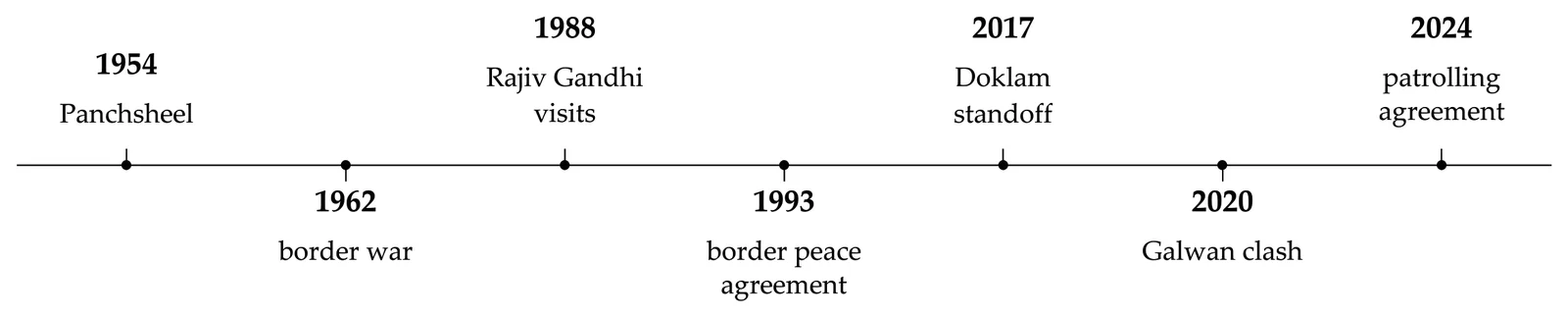
- 1950 → India was among the first non-communist countries to recognise the People’s Republic of China.
- 1954 → The Panchsheel agreement was signed, and the slogan Hindi-Chini bhai-bhai became popular.
- 1959 → The Dalai Lama fled to India after an uprising in Tibet, and border clashes began.
- 1962 → China defeated India in a war fought in Ladakh and the North-East Frontier Agency; China kept Aksai Chin.
- 1988 → Rajiv Gandhi’s visit to Beijing began a thaw, followed by agreements on maintaining peace along the Line of Actual Control in 1993 and 1996.
- 2017 → Indian and Chinese troops faced off for seventy-three days at Doklam.
- 2020 → Twenty Indian soldiers died in a clash in the Galwan valley on 15 June, the first deadly clash since 1975.
- 2024 → An agreement on patrolling arrangements in eastern Ladakh in October was followed by a meeting between Modi and Xi Jinping at Kazan.
Issues between India and China
The core issue is the boundary dispute, covering Aksai Chin in the west and Arunachal Pradesh, which China claims, in the east, along a boundary based partly on the McMahon Line drawn at the Simla Conference of 1914. China’s close partnership with Pakistan, including the China-Pakistan Economic Corridor through Pakistan-occupied Kashmir, which India opposes as part of the Belt and Road Initiative, is another problem. China has blocked India’s membership of the Nuclear Suppliers Group and, for years, the listing of Pakistan-based terrorists at the UN. India’s trade deficit with China has approached a hundred billion dollars a year, and India restricted Chinese investment and banned many Chinese apps after 2020. Concerns also arise over Chinese dams on the Brahmaputra and its growing presence in the Indian Ocean.
Milestones of India–Japan Relations
- 1948 and 1952 → Justice Radhabinod Pal dissented at the Tokyo war crimes tribunal, and India signed a separate peace treaty with Japan, waiving reparations.
- 1958 → Japan’s first yen loan went to India.
- 1982 → The Maruti-Suzuki partnership began, transforming India’s car industry.
- 2007 → Prime Minister Shinzo Abe addressed the Indian Parliament on the confluence of the two seas, the Pacific and Indian Oceans.
- 2014 → The relationship became a special strategic and global partnership.
- 2015 to 2016 → Agreements were signed on the Mumbai–Ahmedabad high-speed rail project and on civil nuclear cooperation.
Japan is one of India’s largest sources of development assistance and investment, funding projects such as the Delhi Metro and the dedicated freight corridors. The two countries hold 2+2 dialogues, naval exercises and cooperate in the Quad. They share concerns about China’s assertiveness and a vision of a free and open Indo-Pacific, though trade between them remains below its potential.
2.4 Important Questions
- Question 1 Discuss the evolution of India–US relations.
- Question 2 Discuss India–Russia relations.
- Question 3 Discuss India–China relations.
- Question 4 Discuss India–Japan relations in the context of the Indo-Pacific.
DU asks the same idea in different words. So learn one broad answer for each question below; the same answer works for every question joined by OR.
Important Question 1
Discuss the evolution of India–US relations.
OR
How did India and the United States move from estrangement to strategic partnership?
OR
Examine the significance of the Indo-US civil nuclear deal.
Model Answer
“Today, our relationship has overcome the hesitations of history.”
— Narendra Modi, address to the US Congress (2016)
Introduction. India and the United States are the world’s largest and oldest democracies, but for much of the Cold War their relations were distant and sometimes hostile. Since the 1990s, and especially since the nuclear deal of 2008, they have built a strategic partnership covering defence, technology, trade and the Indo-Pacific. Scholars such as H.W. Brands, Harold Gould, Sumit Ganguly and Satu Limaye trace this evolution.
1. Early Relations
The United States supported Indian independence, but differences soon emerged. India’s non-alignment and the US alliance with Pakistan from 1954 created distrust, while American food aid in the 1950s and 1960s, studied by Dennis Merrill, linked the two countries economically.
2. The Cold Peace
H.W. Brands described India–US relations during the Cold War as a cold peace: no conflict, but little warmth, as the two countries disagreed on the Soviet Union, Pakistan, China and nuclear policy.
3. The 1971 Crisis
During the Bangladesh war of 1971, the United States tilted towards Pakistan and sent an aircraft carrier group to the Bay of Bengal, a low point in relations that pushed India closer to the Soviet Union.
4. Gould and Ganguly
Harold Gould and Sumit Ganguly’s volume, The Hope and the Reality, examines relations from Roosevelt to Bush, showing a recurring gap between hopes of partnership and the reality of divergent interests.
5. Limaye on Accommodation
Satu Limaye described the 1980s as a period of accommodation, as both countries tried to manage differences and expand cooperation in technology and trade despite Cold War divisions.
6. After the Cold War
The end of the Cold War and India’s economic reforms opened new possibilities. American companies invested in India, and the Indian American community grew in influence.
7. The 1998 Sanctions
India’s nuclear tests of 1998 led to US sanctions, but intensive dialogue between Jaswant Singh and Strobe Talbott and President Clinton’s visit in 2000 began a new phase.
8. The Nuclear Deal
The civil nuclear agreement, agreed in 2005 and completed in 2008, recognised India as a responsible nuclear power outside the NPT and removed a major obstacle to cooperation.
9. Defence Partnership
The United States named India a Major Defence Partner in 2016, and the two countries signed foundational agreements on logistics in 2016, communications in 2018 and geospatial cooperation in 2020, along with large arms purchases.
10. Technology and Trade
The Initiative on Critical and Emerging Technology of 2023 expanded cooperation in semiconductors, space and artificial intelligence. The United States has become one of India’s largest trading partners.
11. The Quad and the Indo-Pacific
India and the United States cooperate with Japan and Australia in the Quad, whose leaders first met in 2021, sharing concerns about China’s rise in the Indo-Pacific.
12. Differences
Differences remain over trade and tariffs, visas for Indian professionals, India’s purchases of Russian oil and arms, and US criticism of India’s domestic policies. Tariff tensions rose sharply in 2025.
13. Kheli on the Triangle
Shirin Tahir-Kheli examined the India–Pakistan–US triangle, showing that the United States gradually de-linked its relations with India from its relations with Pakistan.
14. Strategic Autonomy
India values its partnership with the United States but avoids a formal alliance, preserving its strategic autonomy and relations with other powers.
15. People-to-People Ties
More than four million Indian Americans live in the United States, and Indian students form one of the largest groups of foreign students there. Indian professionals play a major role in the American technology sector. These people-to-people ties create strong constituencies for good relations in both countries, even when governments disagree on trade or policy.
16. Counter-Terrorism Cooperation
After the attacks of 11 September 2001 and the Mumbai attacks of 2008, India and the United States expanded cooperation against terrorism, sharing intelligence and designating terrorist groups. The extradition of a Mumbai attack accused from the United States to India in 2025 showed this cooperation, though differences over Pakistan’s role persisted at times.
17. Evaluation
India–US relations have been transformed from a cold peace into a broad strategic partnership, though differences continue.
Conclusion. Thus, India–US relations moved from Brands’s cold peace and the 1971 crisis, through Limaye’s accommodation and the 1998 sanctions, to the nuclear deal of 2008, defence agreements, technology cooperation and the Quad. As Gould and Ganguly show, hopes and realities still diverge on trade and Russia, but the partnership is now broad.
Important Question 2
Discuss India–Russia relations.
OR
Why has Russia been a consistent partner of India?
OR
Examine the challenges in India–Russia relations after 2014.
Model Answer
“In the event of either Party being subjected to an attack or a threat thereof, the High Contracting Parties shall immediately enter into mutual consultations in order to remove such threat.”
— India–Soviet Treaty of Peace, Friendship and Cooperation (1971), Article IX
Introduction. India’s relationship with Russia, and earlier with the Soviet Union, has been one of the most stable in its foreign policy. The Soviet Union supported India diplomatically, economically and militarily during the Cold War, and the relationship continued as a strategic partnership after 1991. Prem Budhwar, and Roger Kanet and Alexander Kozhemiakin, examine its past, present and future.
1. Early Ties
The Soviet Union initially viewed India with suspicion but warmed after Stalin’s death. Khrushchev’s visit to India in 1955 and Soviet support for India’s positions on Kashmir and Goa built friendship.
2. Economic Cooperation
The Soviet Union helped India build heavy industries, such as the Bhilai steel plant, which began production in 1959, and supported India’s planned development.
3. Diplomatic Support
The Soviet Union used its veto in the UN Security Council to block resolutions on Kashmir unfavourable to India, earning lasting goodwill.
4. The 1971 Treaty
The Treaty of Peace, Friendship and Cooperation of August 1971 provided for consultations in case of threats and gave India crucial support during the Bangladesh war against US and Chinese pressure.
5. Defence
For decades, most of India’s military equipment, including fighter aircraft, tanks and submarines, came from the Soviet Union and Russia, creating deep dependence.
6. After 1991
The collapse of the Soviet Union disrupted ties, but a new Treaty of Friendship was signed in 1993. Budhwar shows how both countries rebuilt relations on a pragmatic basis.
7. Strategic Partnership
In 2000, India and Russia signed a declaration of strategic partnership, upgraded in 2010 to a special and privileged strategic partnership, with annual summits.
8. Joint Projects
Joint projects include the BrahMos cruise missile, developed by a joint venture since 1998, the Kudankulam nuclear power plant and the S-400 air defence system agreed in 2018.
9. Russia’s Foreign Policy
Roger Kanet and Alexander Kozhemiakin show that post-Soviet Russia sought to restore its great-power status, balancing the West and building ties in Asia, including with India and China.
10. Energy
After Western sanctions on Russia following the invasion of Ukraine in 2022, India greatly increased its imports of discounted Russian oil, making Russia one of its largest oil suppliers.
11. The Ukraine War
India did not condemn Russia in UN votes on Ukraine, calling for dialogue and diplomacy. The Prime Minister told President Putin in 2022 that today’s era is not of war.
12. The China Factor
Russia’s growing closeness to China, especially after 2014, worries India, since China is India’s main rival and Russia may become dependent on Beijing.
13. Declining Arms Share
India has diversified its arms purchases towards the United States, France and Israel and promoted domestic production, reducing Russia’s share in its defence imports.
14. Connectivity
India and Russia are developing the International North-South Transport Corridor through Iran and a maritime route between Chennai and Vladivostok to expand trade.
15. Trade Imbalance
Trade between India and Russia grew rapidly after 2022 because of oil imports, but it is heavily unbalanced, as India buys far more than it sells. Payment problems caused by sanctions, and the difficulty of using rupees and roubles, show the challenges of building a balanced economic relationship beyond defence and energy.
16. Space and Nuclear Cooperation
Russia has been a long-standing partner in space and nuclear energy. The Soviet Union launched India’s first satellite, Aryabhata, in 1975 and took Rakesh Sharma into space in 1984. Russian help in building the Kudankulam nuclear plant and in training astronauts for India’s Gaganyaan mission shows continuing cooperation in advanced technology.
17. Multilateral Cooperation
India and Russia cooperate in BRICS, the Shanghai Cooperation Organisation and the Russia–India–China grouping, sharing interests in a multipolar world order. Russia has supported India’s bid for a permanent seat in the UN Security Council, while India has avoided joining Western criticism of Russia in many forums.
18. Evaluation
India–Russia relations remain strong because of history, defence and energy, though Russia’s ties with China and the Ukraine war create new strains.
Conclusion. Thus, India–Russia relations rest on Soviet support at the UN, industrial help, the 1971 treaty and defence cooperation, continued through the strategic partnership of 2000. Budhwar shows their resilience, but Russia’s closeness to China, the Ukraine war and India’s diversification are reshaping the relationship.
Important Question 3
Discuss India–China relations.
OR
Examine the boundary dispute between India and China.
OR
Is India–China relationship one of cooperation or competition? Discuss.
Model Answer
“Mutual respect for each other’s territorial integrity and sovereignty, mutual non-aggression, mutual non-interference in each other’s internal affairs, equality and mutual benefit, and peaceful co-existence.”
— Panchsheel Agreement between India and China (1954)
Introduction. India and China, the two most populous countries and ancient civilisations, have a complex relationship of cooperation and rivalry. They began with friendship and the Panchsheel principles, fought a war in 1962 and still dispute their long border. At the same time, trade between them has grown greatly. Steven Hoffmann and others have analysed this relationship.
1. Early Friendship
India was among the first countries to recognise the People’s Republic of China in 1950. The Panchsheel Agreement of 1954 set out five principles of peaceful coexistence, and the slogan Hindi-Chini bhai bhai expressed friendship.
2. Tibet
China’s control of Tibet and the Dalai Lama’s flight to India in 1959, where he was given asylum, created deep tension between the two countries.
3. The 1962 War
Disputes over the boundary in Aksai Chin and the North-East Frontier Agency led to war in October 1962, in which India suffered a severe defeat. Steven Hoffmann’s study examines how Indian decision-makers handled the crisis.
4. Normalisation
Ambassadors were restored in 1976, and Prime Minister Rajiv Gandhi’s visit to China in 1988 began normalisation. Agreements in 1993 and 1996 aimed to maintain peace along the Line of Actual Control.
5. Boundary Talks
Special Representatives were appointed in 2003 to negotiate the boundary, and an agreement on political parameters was signed in 2005, but the dispute remains unresolved.
6. Trade
China has become one of India’s largest trading partners, but India runs a very large trade deficit, importing electronics, machinery and chemicals.
7. Doklam and Galwan
A 73-day standoff at Doklam in 2017 and a deadly clash in the Galwan valley in June 2020, in which twenty Indian soldiers died, sharply worsened relations.
8. After Galwan
India restricted Chinese investments and apps after 2020. In October 2024, the two countries agreed on patrolling arrangements in remaining friction areas, beginning a cautious thaw.
9. China and Pakistan
China’s close partnership with Pakistan, including the China-Pakistan Economic Corridor through territory India claims, deepens Indian concerns.
10. Indian Ocean
China’s growing presence in the Indian Ocean, through ports and bases in countries around India, is seen in India as strategic encirclement.
11. Global Issues
India and China cooperate in BRICS, the Shanghai Cooperation Organisation and climate negotiations, often sharing positions as developing countries.
12. Sutter on China’s Role
Robert Sutter examines how the United States sought to shape China’s role in world affairs, a factor that also affects India’s strategy towards China.
13. Blocking India
China has blocked India’s entry into the Nuclear Suppliers Group and for years blocked UN listing of Pakistan-based terrorists, adding to distrust.
14. Managing the Relationship
India seeks to manage China through deterrence along the border, economic caution, partnerships with other powers and continued dialogue.
15. Informal Summits
Prime Minister Modi and President Xi held informal summits at Wuhan in 2018 and Chennai in 2019 after the Doklam standoff, aiming to build trust between leaders. The Galwan clash of 2020 showed the limits of this approach, as the military situation on the border overrode diplomatic warmth at the top.
16. Water and the Brahmaputra
China controls the upper reaches of the Brahmaputra and other rivers that flow into India. Chinese dam building, including a very large project on the Yarlung Tsangpo announced in recent years, worries India about water flows and floods, adding another dimension to the rivalry.
17. Economic Dependence
India depends on China for many inputs, such as electronic components, solar panels and pharmaceutical ingredients. Since 2020, India has sought to reduce this dependence through production-linked incentive schemes and supply chain partnerships with other countries, but complete decoupling is difficult.
18. Evaluation
India–China relations combine competition and cooperation, with the boundary dispute and strategic rivalry dominating since 2020.
Conclusion. Thus, India–China relations moved from Panchsheel friendship to war in 1962, as Hoffmann analyses, and then to normalisation from 1988 with border agreements and growing trade. Doklam and Galwan revived rivalry, China–Pakistan ties and the Indian Ocean add tension, and the relationship remains one of managed competition.
Important Question 4
Discuss India–Japan relations in the context of the Indo-Pacific.
OR
Why have India and Japan become close strategic partners?
OR
Examine economic and strategic cooperation between India and Japan.
Model Answer
“The Pacific and the Indian Oceans are now bringing about a dynamic coupling as seas of freedom and of prosperity.”
— Shinzo Abe, Confluence of the Two Seas, address to the Indian Parliament (2007)
Introduction. India and Japan have long cultural ties through Buddhism and a history free of conflict. After decades of modest relations, they have become close strategic partners in the twenty-first century, driven by economic complementarity, shared democratic values and concern about China’s rise. Vinay Kaura and others analyse this partnership in the context of Asia’s emerging geopolitics.
1. Historical Ties
Buddhism spread from India to Japan, and figures such as Tagore and Swami Vivekananda engaged with Japan. Justice Radhabinod Pal’s dissent at the Tokyo war crimes tribunal is remembered warmly in Japan.
2. Post-War Relations
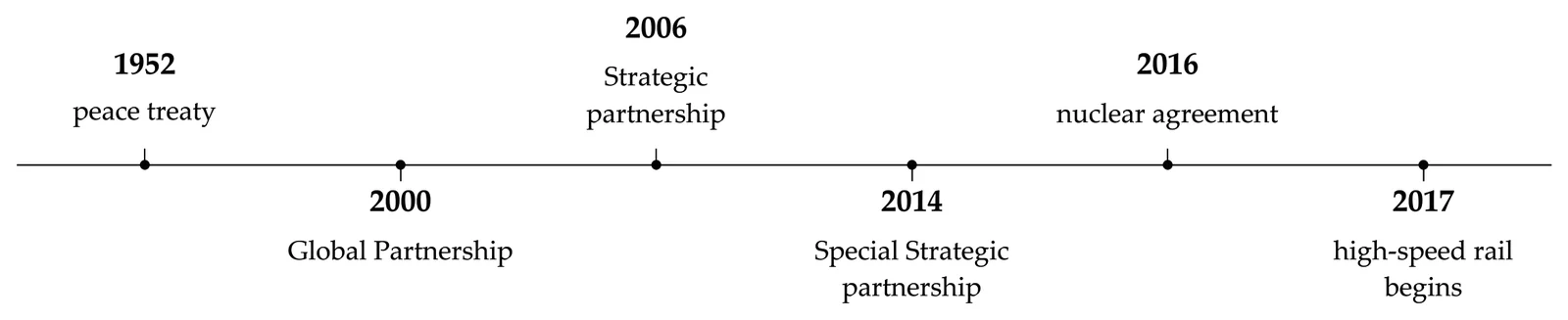
India declined to join the San Francisco peace conference and signed a separate peace treaty with Japan in 1952, waiving reparations. Japan began giving development aid to India in 1958.
3. Cold War Distance
During the Cold War, Japan was a US ally while India was non-aligned and close to the Soviet Union, so relations remained limited. Shibusawa Masahide’s study shows Japan’s focus on the Asia-Pacific rather than South Asia.
4. Nuclear Tests and Recovery
Japan imposed sanctions after India’s 1998 nuclear tests, but Prime Minister Mori’s visit in 2000 launched a Global Partnership, which was upgraded to a Strategic and Global Partnership in 2006.
5. Abe’s Vision
Shinzo Abe, in his speech to the Indian Parliament in 2007, spoke of the confluence of the two seas, linking the Indian and Pacific Oceans, which laid the foundation of the Indo-Pacific idea.
6. Special Strategic Partnership
In 2014, the two countries upgraded their ties to a Special Strategic and Global Partnership, and Japan pledged large investments in Indian infrastructure.
7. Development Assistance
Japan is the largest provider of development aid to India, financing the Delhi Metro, freight corridors, and the Mumbai–Ahmedabad high-speed rail project, which began in 2017.
8. Civil Nuclear Agreement
Japan, the only country to have suffered nuclear attacks, signed a civil nuclear agreement with India in 2016, showing deep trust despite India not signing the NPT.
9. Defence Cooperation
Japan became a permanent participant in the Malabar naval exercise in 2015, and the two countries hold foreign and defence ministers’ dialogues and signed a logistics agreement in 2020.
10. Kaura on Geopolitics
Vinay Kaura argues that India–Japan relations are shaped by Asia’s emerging geopolitics, especially China’s rise, which gives both countries strong reasons to cooperate.
11. The Quad
India and Japan, with the United States and Australia, are members of the Quad, cooperating on maritime security, vaccines, critical technologies and infrastructure.
12. Connectivity in the Region
India and Japan cooperate on infrastructure in third countries, such as projects in Sri Lanka, Bangladesh and India’s North-east, offering alternatives to China’s Belt and Road Initiative.
13. Limitations
Trade between India and Japan remains modest compared with their economic size, and Japanese investors complain about regulatory and infrastructure problems in India.
14. Shared Values
Both countries emphasise democracy, the rule of law and a free and open Indo-Pacific, giving their partnership a basis in shared values as well as interests.
15. Japanese Investment in Manufacturing
Japanese companies such as Suzuki have played a major role in India’s manufacturing, especially automobiles. Maruti Suzuki, a joint venture from the early 1980s, transformed India’s car industry. Japan has also helped develop industrial corridors and supported India’s semiconductor and clean energy ambitions.
16. North-East and Act East
Japan is the only country India has invited to undertake development projects in its sensitive North-eastern states, through the Act East Forum set up in 2017. Japanese-funded roads, bridges and power projects aim to connect the region with Southeast Asia, linking Japan’s strategy with India’s Act East policy.
17. Evaluation
India–Japan relations have become one of Asia’s most important partnerships, driven by complementarity, shared values and concern about China.
Conclusion. Thus, India–Japan relations, rooted in Buddhism and the 1952 treaty, grew from limited Cold War ties to the Special Strategic and Global Partnership of 2014. Abe’s confluence of two seas, Japanese aid and investment, the 2016 nuclear agreement, defence ties and the Quad reflect, as Kaura shows, Asia’s changing geopolitics.
Short Notes
(a) 123 Agreement
The India–US civil nuclear cooperation agreement completed in 2008, which allowed nuclear trade with India outside the NPT.
(b) Special and privileged strategic partnership
The status of India–Russia relations since 2010, reflecting deep cooperation in defence, energy and diplomacy.
(c) Line of Actual Control
The de facto boundary between India and China, which has not been agreed and is the site of standoffs such as Galwan in 2020.
More notes: MDSE-15 India and the World
These notes are prepared by PADHO TO AISE for study help. They are not an official University of Delhi publication.