
Generic Electives (GE) GE-4 Understanding International Relations
Unit 4 · 23 min read · Updated 27 Nov 2026
As per the University of Delhi (DU) Generic Elective (GE) syllabus offered by the Department of Political Science
Contents
- 4.1 War and Conflict from the Global South
- War and State-Making
- What Makes the World Dangerous
- 4.2 The Changing Landscape of Conflict: New Wars
- Kaldor’s New Wars
- Other Changes in Conflict
- The Expanding Reach of Organised Violence
- 4.3 Forms of Violence
- Galtung’s Typology
- Why Does Politics Turn into Violence
- Militarisation, Conflict and Women in South Asia
- Other Forms of Violence
- 4.4 Important Questions
- Discuss the changing nature of conflict in the contemporary world with reference to Mary Kaldor’s idea of new wars.
- Examine war and conflict from the perspective of the Global South.
- Discuss the different forms of violence with reference to Galtung and Bourke.
- Examine the relationship between militarisation, conflict and women, with special reference to South Asia.
- Short Notes
युद्ध अन्य साधनों द्वारा नीति की निरंतरता मात्र है।
War is a mere continuation of policy by other means.
— Carl von Clausewitz, On War (1832)
WWAR has been central to the study of International Relations, which was born after the First World War with the hope of preventing its repetition. But the nature of conflict has changed. Most wars since 1945 have been fought within states, in the Global South, with civilians as the main victims. New forms of conflict, terrorism, hybrid and cyber warfare, have emerged, and scholars now recognise forms of violence beyond the battlefield, such as structural, cultural and gender-based violence. This chapter examines the changing landscape and nature of conflict and the different forms of violence.
4.1 War and Conflict from the Global South
Mainstream IR has focused on interstate war among great powers, such as the two world wars and the Cold War. John Lewis Gaddis described the Cold War as a long peace, since the great powers avoided direct war with each other after 1945. But Arlene Tickner, in War and Conflict (2020), points out that this long peace was experienced very differently in the Global South, where most of the wars after 1945 took place: wars of decolonisation, proxy wars of the Cold War, civil wars, ethnic conflicts and insurgencies, from Korea and Vietnam to Angola, Afghanistan, Central America and the Middle East.
War and State-Making
Charles Tilly argued that in Europe, war made the state and the state made war: rulers built states by raising armies, collecting taxes and establishing bureaucracies to fight wars. In the Global South, by contrast, states were created by colonialism and decolonisation, often with arbitrary borders and weak institutions. As Mohammed Ayoob argued, their conflicts are often linked to incomplete state-building, with challenges from ethnic groups, insurgents and secessionists. Tickner argues that IR must understand war from these experiences, not only from European history.
What Makes the World Dangerous
Michael Dillon, in What Makes the World Dangerous? (2008), argues that danger is not simply out there but is defined by how societies understand threats. Security policies construct certain people, places and activities as dangerous, which justifies particular responses. After the attacks of 11 September 2001, the war on terror defined terrorism as the main threat, leading to wars in Afghanistan and Iraq, surveillance and restrictions on liberty. The Copenhagen School, associated with Barry Buzan and Ole Wæver, calls this process securitisation: an issue becomes a security issue when political leaders present it as an existential threat and the audience accepts extraordinary measures to deal with it.
4.2 The Changing Landscape of Conflict: New Wars
Kaldor’s New Wars
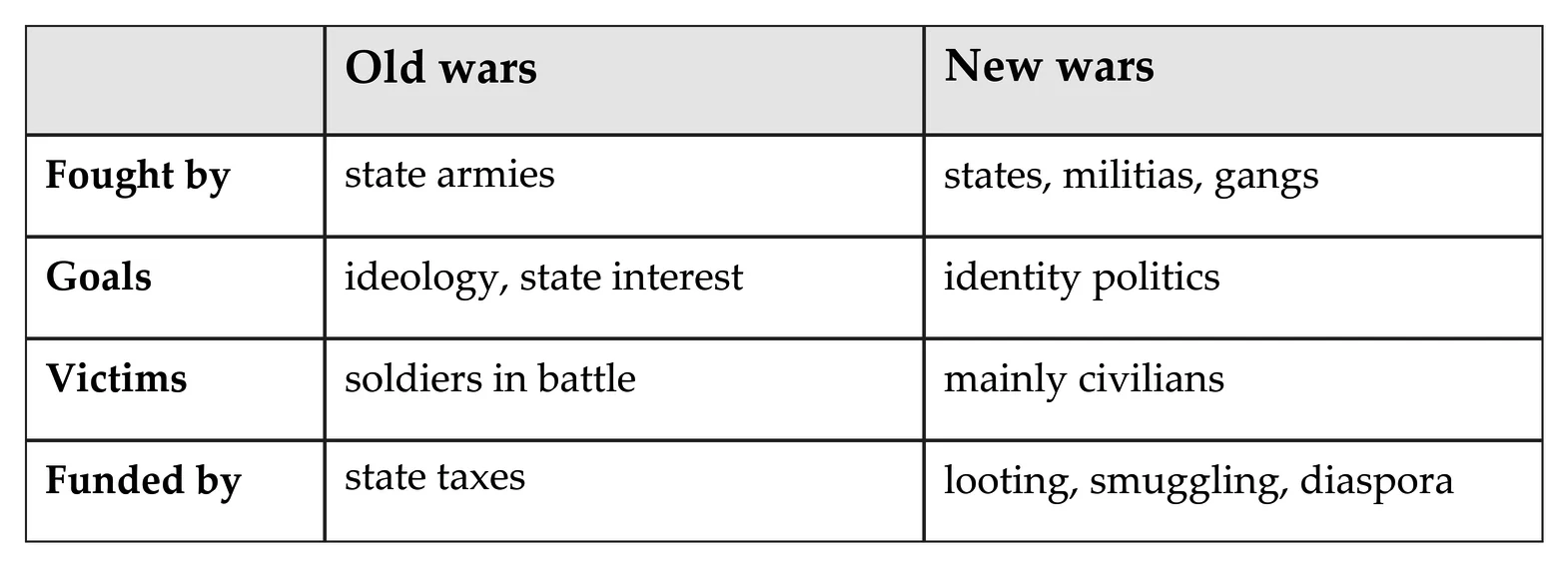
Mary Kaldor, in New and Old Wars (1999), argued that the wars of the 1990s, such as those in Bosnia, Rwanda and Somalia, were a new type of war produced by globalisation. In In Defense of New Wars (2013), she responded to critics and restated her argument. She contrasted old wars, fought between states by regular armies for political goals, with new wars, which differ in their goals, methods and financing.
- Goals. New wars are fought in the name of identity, ethnic, religious or tribal, rather than ideology or state interest; identity politics excludes others.
- Methods. Violence is directed mainly against civilians, through ethnic cleansing, mass killing, sexual violence and displacement, rather than battles between armies.
- Actors. They involve a mix of state forces, paramilitaries, warlords, criminal gangs, mercenaries and foreign fighters, blurring the line between war, organised crime and human rights violations.
- Financing. They are financed through a globalised war economy: looting, smuggling of drugs, diamonds and oil, hostage-taking, diaspora remittances and humanitarian aid diversion, which makes them self-perpetuating.
- Response. Kaldor argued that new wars require a cosmopolitan response focused on protecting civilians and building legitimate political authority, rather than conventional military victory.
Critics such as Stathis Kalyvas argued that new wars are not really new, since civil wars in the past also involved atrocities and looting, and that the distinction exaggerates differences. Kaldor replied that the concept captures a logic of contemporary war that requires new policy responses.
Other Changes in Conflict
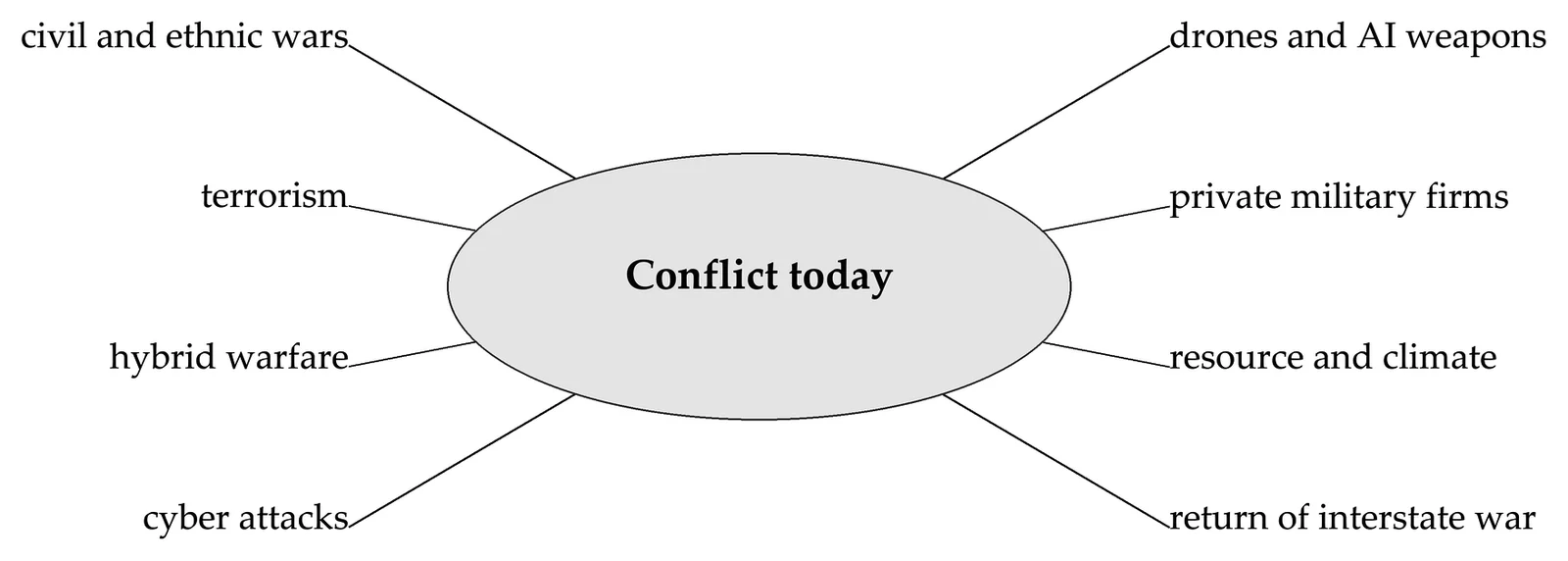
- Terrorism. Transnational terrorist networks such as al-Qaeda and the Islamic State have carried out mass-casualty attacks, as on 11 September 2001 and in Mumbai on 26 November 2008.
- Asymmetric and hybrid warfare. Weaker actors use guerrilla tactics against stronger ones, while states combine military force with cyber attacks, disinformation and proxies, as in Russia’s actions in Ukraine.
- Cyber warfare. Attacks on computer networks, such as the Stuxnet attack on Iran’s nuclear programme discovered in 2010, threaten infrastructure without physical invasion.
- New technologies. Drones, artificial intelligence and autonomous weapons are changing warfare, raising ethical and legal questions.
- Private military companies. Firms such as the Wagner Group have fought in Africa, Syria and Ukraine, adding to the privatisation of violence.
- Resource and climate conflicts. Competition over water, land and minerals, worsened by climate change, can contribute to conflict.
- Return of interstate war. Russia’s invasion of Ukraine in 2022 and wars in the Middle East show that interstate war has not disappeared.
The Expanding Reach of Organised Violence
David Held and his colleagues, in Global Transformations (1999), described the globalisation of organised violence: the global arms trade, the spread of military technology, international alliances and the global reach of great power militaries. Military power and its effects now cross borders easily, so conflicts in one region affect others through refugees, terrorism and economic disruption.
4.3 Forms of Violence
Galtung’s Typology
The Norwegian peace scholar Johan Galtung broadened the concept of violence. He defined violence as present when human beings are influenced so that their actual realisations are below their potential realisations. He distinguished three forms, often shown as the violence triangle:
- Direct violence. Visible, physical violence by identifiable actors, such as killing, torture and war.
- Structural violence (1969). Harm caused by unjust social, economic and political structures, such as poverty, hunger, discrimination and lack of access to health care, which kill or harm people slowly without an identifiable perpetrator.
- Cultural violence (1990). Aspects of culture, such as religion, ideology, language and art, that justify or legitimise direct and structural violence, such as caste ideologies or racist beliefs.
Galtung also distinguished negative peace, the absence of direct violence, from positive peace, the absence of structural and cultural violence and the presence of justice. Rob Nixon later spoke of slow violence, gradual harm such as environmental degradation that occurs out of sight.
Why Does Politics Turn into Violence
Joanna Bourke, in Why Does Politics Turn into Violence? (2008), examines how ordinary people come to commit violence. She draws on studies showing that people can be trained, ordered or persuaded to kill: Stanley Milgram’s experiments on obedience to authority; Christopher Browning’s Ordinary Men (1992), which showed how ordinary German policemen became mass killers in the Holocaust; and the role of dehumanising language, ideology and propaganda in genocides such as Rwanda (1994). She argues that violence is not simply natural but is produced by political, social and cultural processes, which can also be resisted. Hannah Arendt, in On Violence (1970), distinguished power, which arises from people acting together, from violence, which is instrumental and appears where power is lost.
Militarisation, Conflict and Women in South Asia
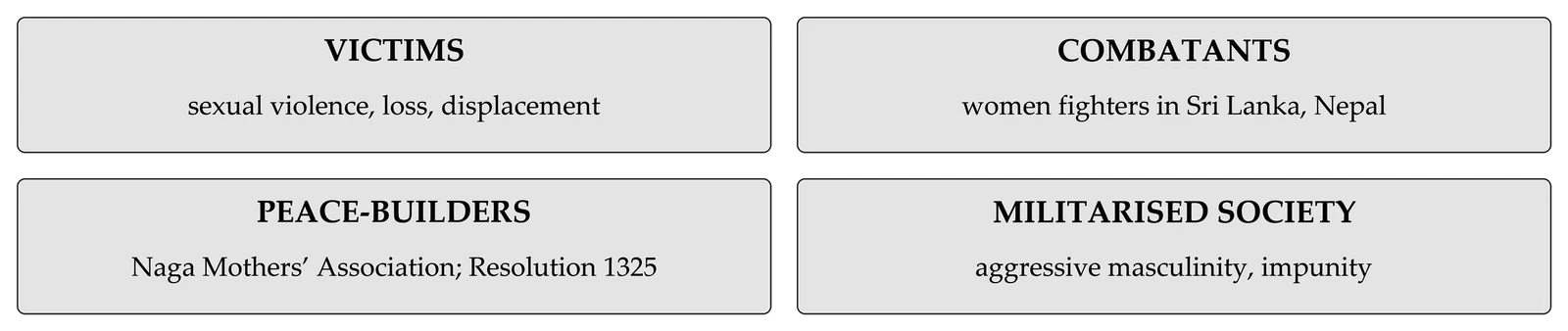
Anuradha Chenoy, in Militarization, Conflict and Women in South Asia (1998), shows how conflict and militarisation affect women. Militarisation spreads military values, such as hierarchy, obedience and aggressive masculinity, into society, increasing violence against women. Women suffer sexual violence used as a weapon of war, as during the Partition of 1947 and the Bangladesh war of 1971; they lose family members, homes and livelihoods; and they bear the burden of caring for the displaced and wounded. Women are also combatants, as in Sri Lanka and Nepal, and peace activists, as in the Naga Mothers’ Association and women’s groups in Kashmir and Manipur. The UN Security Council’s Resolution 1325 (2000) on Women, Peace and Security recognised women’s role in preventing conflict and building peace.
Other Forms of Violence
Other forms include state violence against citizens, terrorism, communal and caste violence, domestic violence, and violence against refugees and migrants. Roland Bleiker, in Can We Move beyond Conflict? (2008), argues that moving beyond violence requires not only political settlements but also reconciliation, dialogue and new ways of seeing the other, drawing on traditions of non-violence such as Gandhi’s and on art and memory.

4.4 Important Questions
- Question 1 Discuss the changing nature of conflict in the contemporary world with reference to Mary Kaldor’s idea of new wars.
- Question 2 Examine war and conflict from the perspective of the Global South.
- Question 3 Discuss the different forms of violence with reference to Galtung and Bourke.
- Question 4 Examine the relationship between militarisation, conflict and women, with special reference to South Asia.
DU asks the same idea in different words. So learn one broad answer for each question below; the same answer works for every question joined by OR.
Important Question 1
Discuss the changing nature of conflict in the contemporary world with reference to Mary Kaldor’s idea of new wars.
OR
Distinguish between old wars and new wars.
OR
Examine the changing landscape of conflict after the Cold War.
Model Answer
“New wars involve a blurring of the distinctions between war, organised crime and large-scale violations of human rights.”
— Mary Kaldor, New and Old Wars (1999) (abridged)
Introduction. The nature of war has changed significantly since 1945, and especially since the end of the Cold War. Wars between great powers have become rare, while civil wars, ethnic conflicts, terrorism and new forms of warfare have increased. Mary Kaldor’s concept of new wars offers an influential account of these changes, linking them to globalisation.
1. Old Wars
Old wars, as theorised by Clausewitz, were fought between states by regular armies for political goals, with a clear distinction between soldiers and civilians.
2. Kaldor’s Argument
Kaldor argued in 1999 that the wars of the 1990s, such as in Bosnia and Rwanda, represented a new type of war produced by globalisation and state weakness.
3. Identity Politics
New wars are fought in the name of ethnic, religious or tribal identity rather than ideology or national interest, using identity to mobilise supporters and exclude others.
4. Violence against Civilians
Violence targets civilians through ethnic cleansing, massacres, sexual violence and forced displacement, rather than battles between armies.
5. Blurring of Categories
New wars blur the distinctions between war, organised crime and human rights violations, involving state forces, paramilitaries, warlords and criminal gangs.
6. The Globalised War Economy
New wars are financed through looting, smuggling, hostage-taking, diaspora remittances and diversion of aid, making violence self-sustaining.
7. Cosmopolitan Response
Kaldor called for a cosmopolitan response focused on protecting civilians and building legitimate authority, rather than conventional military victory.
8. Criticism
Kalyvas and others argued that new wars are not new, since past civil wars also involved atrocities and looting, and that the distinction is exaggerated.
9. Kaldor’s Defence
In 2013, Kaldor defended the concept as capturing a distinct logic of contemporary conflict that requires new forms of policy and intervention.
10. Terrorism
Transnational terrorist networks such as al-Qaeda and the Islamic State have carried out mass-casualty attacks, as on 11 September 2001 and in Mumbai in 2008.
11. Hybrid Warfare
States combine military force with cyber attacks, disinformation and proxies, blurring war and peace, as Russia did in Crimea in 2014.
12. Cyber and Technological Warfare
Cyber attacks such as Stuxnet, drones and autonomous weapons are changing warfare, raising new legal and ethical questions.
13. Privatisation of Violence
Private military companies such as the Wagner Group have fought in several conflicts, adding to the privatisation of violence.
14. Return of Interstate War
Russia’s invasion of Ukraine in 2022 and wars in the Middle East show that interstate war has not disappeared, though it now combines old and new features.
15. Globalisation of Violence
Held shows that the global arms trade and military technology spread organised violence across borders, linking conflicts to the world economy.
16. Conflict Data
The Uppsala Conflict Data Program, which records armed conflicts since 1946, shows that most conflicts after the Cold War have been fought within states, often with foreign involvement, and that the number of state-based conflicts has risen again in recent years, reaching some of the highest levels since the Second World War.
17. Humanitarian Consequences
New wars produce massive displacement: wars in Syria, Afghanistan, Sudan and Ukraine have created millions of refugees and internally displaced persons. Hospitals, schools and markets are often attacked, and humanitarian access is blocked, violating international humanitarian law.
18. Evaluation
Kaldor’s concept captures important features of contemporary conflict, though the landscape now includes both new wars and the return of interstate war.
Conclusion. Thus, conflict has shifted from Clausewitzian interstate wars to new wars marked by identity politics, violence against civilians and a globalised war economy, blurring war, crime and human rights violations, as Kaldor argued. Terrorism, hybrid and cyber warfare and the return of interstate war complete the changing landscape.
Important Question 2
Examine war and conflict from the perspective of the Global South.
OR
Was the Cold War a long peace? Discuss.
OR
What makes the world dangerous? Discuss with reference to securitisation.
Model Answer
“War made the state, and the state made war.”
— Charles Tilly, The Formation of National States in Western Europe (1975)
Introduction. Mainstream IR has studied war mainly from the experience of Europe and the great powers. Scholars from the Global South argue that this perspective hides the reality that most wars since 1945 have been fought in Asia, Africa and Latin America. Understanding war from the South requires attention to colonialism, state-building and the ways in which danger is defined.
1. The Long Peace
John Lewis Gaddis described the Cold War as a long peace, since the great powers avoided direct war with each other after 1945.
2. Tickner’s Critique
Arlene Tickner argues that the long peace was experienced very differently in the South, where wars of decolonisation, proxy wars and civil wars killed millions.

3. Wars of Decolonisation
Colonised peoples fought for independence in Algeria, Vietnam, Kenya, Angola and elsewhere, often facing brutal repression by colonial powers.
4. Proxy Wars
The superpowers fought proxy wars in Korea, Vietnam, Afghanistan, Angola and Central America, where local conflicts were fuelled by Cold War rivalry.
5. Tilly on State-Making
Tilly argued that in Europe, war made the state and the state made war, as rulers built states by raising armies and taxes to fight wars.
6. Different State-Making in the South
States in the South were created by colonialism and decolonisation, often with arbitrary borders and weak institutions, rather than through centuries of war.
7. Internal Conflicts
Ayoob argued that the main security threats for Third World states are internal, arising from ethnic conflict, insurgency and secession linked to incomplete state-building.
8. South Asian Examples
South Asia has seen the Partition violence of 1947, wars between India and Pakistan, the Bangladesh war of 1971, the Sri Lankan civil war and insurgencies in many regions.
9. Dillon on Danger
Michael Dillon argues that danger is defined by how societies understand threats, and security policies construct certain people and places as dangerous.
10. Securitisation
The Copenhagen School argues that an issue becomes a security issue when leaders present it as an existential threat and the audience accepts extraordinary measures.
11. The War on Terror
After 2001, the war on terror securitised terrorism, justifying wars in Afghanistan and Iraq and restrictions on liberty, with heavy costs in the Global South.
12. Human Security
The UNDP’s Human Development Report of 1994 proposed human security, focusing on the safety of people from hunger, disease and violence rather than only the state.
13. Structural Causes
Poverty, inequality, resource exploitation and external intervention contribute to conflict in the South, linking war to the global political economy.
14. Peace-Building
The South has also produced traditions of peace, such as Gandhi’s non-violence, Non-Alignment and regional peace processes, which offer alternatives to militarism.
15. Implications for IR
Understanding war from the South requires IR to include colonial history, internal conflicts and human security, not only great power rivalry.
16. Colonial Borders and Conflict
Many conflicts in Africa and Asia arise from borders drawn by colonial powers without regard to ethnic and religious communities, such as the Berlin Conference of 1884–85 in Africa and the Radcliffe Line in South Asia. These borders divided some peoples and joined others together, sowing future disputes.
17. Intervention and Its Consequences
External interventions, such as the Soviet invasion of Afghanistan in 1979, the US-led invasion of Iraq in 2003 and the NATO intervention in Libya in 2011, often deepened conflict in the South, showing how great power policies shape violence far from their own territory.
18. India’s Peacekeeping Role
India is one of the largest contributors of troops to UN peacekeeping, having served in missions from Korea and Congo to South Sudan and Lebanon. This reflects a Southern commitment to multilateral peace operations rather than unilateral intervention.
19. Evaluation
The Global South perspective shows that war and danger look different depending on where one stands, enriching IR’s understanding of conflict.
Conclusion. Thus, while Tilly showed that war made the state in Europe, states in the South were made by colonialism and face internal conflicts, as Tickner and Ayoob argue. The long peace was not peaceful for the South, and Dillon’s analysis of danger and securitisation shows how threats are constructed.
Important Question 3
Discuss the different forms of violence with reference to Galtung and Bourke.
OR
Distinguish between direct, structural and cultural violence.
OR
Why does politics turn into violence? Discuss.
Model Answer
“Violence is present when human beings are being influenced so that their actual somatic and mental realizations are below their potential realizations.”
— Johan Galtung, Violence, Peace, and Peace Research (1969)
Introduction. Violence is usually understood as physical harm, such as killing in war. But scholars have broadened the concept to include harm caused by unjust structures and cultural beliefs. Johan Galtung’s typology of direct, structural and cultural violence, and Joanna Bourke’s analysis of why politics turns into violence, help us understand the many forms violence takes.
1. Galtung’s Definition
Galtung defined violence broadly as present when people are influenced so that their actual realisations fall below their potential realisations.
2. Direct Violence
Direct violence is visible, physical harm by identifiable actors, such as killing, torture, rape and war, which most people recognise as violence.
3. Structural Violence
Structural violence is harm caused by unjust social, economic and political structures, such as poverty, hunger and discrimination, which kill slowly without a visible perpetrator.
4. Cultural Violence
Cultural violence refers to aspects of culture, such as religion, ideology and language, that justify direct and structural violence, such as caste or racist ideologies.
5. The Violence Triangle
Galtung showed that the three forms reinforce each other: cultural violence legitimises structural violence, which can erupt into direct violence.
6. Negative and Positive Peace
Negative peace is the absence of direct violence, while positive peace is the absence of structural and cultural violence and the presence of justice.
7. Slow Violence
Rob Nixon described slow violence, gradual harm such as environmental degradation and toxic pollution, which occurs out of sight and mainly affects the poor.
8. Bourke’s Question
Joanna Bourke asks why politics turns into violence and how ordinary people come to commit acts of violence, including mass killing.
9. Obedience to Authority
Milgram’s experiments showed that many ordinary people would inflict apparent harm on others when ordered by an authority figure.
10. Ordinary Men
Browning’s Ordinary Men (1992) showed how ordinary German policemen became mass killers in the Holocaust through conformity, obedience and peer pressure.
11. Dehumanisation
Dehumanising language and propaganda, such as describing victims as cockroaches during the Rwandan genocide of 1994, make violence against them easier.
12. Training and Ideology
Military training, nationalist and religious ideologies and the glorification of violence prepare people to kill, showing that violence is socially produced.
13. Arendt on Power and Violence
Hannah Arendt distinguished power, which arises from people acting together, from violence, which is instrumental and appears where power is lost.
14. Indian Examples
Caste atrocities, communal riots, custodial violence and the structural violence of hunger and poverty show the many forms of violence in Indian society.
15. Moving beyond Violence
Bleiker argues that moving beyond violence requires reconciliation, dialogue and new ways of seeing the other, drawing on traditions such as Gandhi’s non-violence.
16. Genocide and Its Prevention
The Genocide Convention of 1948, drafted after the Holocaust with the efforts of Raphael Lemkin, defined genocide as acts committed with intent to destroy a national, ethnic, racial or religious group. Yet genocides in Cambodia, Rwanda and Srebrenica show the difficulty of prevention.
17. Gender-Based Violence
Feminist scholars show that violence against women, in homes, workplaces and public spaces, is a form of both direct and structural violence rooted in patriarchy. In India, laws such as the Protection of Women from Domestic Violence Act, 2005, seek to address it.
18. Non-Violence as Response
Gandhi’s satyagraha showed that organised non-violent resistance can challenge powerful states. Studies by Erica Chenoweth and Maria Stephan found that non-violent campaigns between 1900 and 2006 succeeded more often than violent ones, offering an alternative to violence.
19. Evaluation
A broad understanding of violence reveals harms hidden in everyday structures and beliefs, and shows that building peace requires justice as well as the end of fighting.
Conclusion. Thus, Galtung distinguished direct, structural and cultural violence and defined violence as anything that keeps people below their potential, while Bourke shows that politics turns into violence through obedience, ideology and dehumanisation. Understanding these forms is essential for building positive peace.
Important Question 4
Examine the relationship between militarisation, conflict and women, with special reference to South Asia.
OR
Discuss the gendered impact of conflict.
OR
Examine the role of women in conflict and peace-building.
Model Answer
“Reaffirming the important role of women in the prevention and resolution of conflicts and in peace-building.”
— UN Security Council Resolution 1325 (2000), Preamble
Introduction. War and conflict are often seen as the affairs of men, soldiers and states. Feminist scholars show that conflict and militarisation have deeply gendered effects: women suffer particular forms of violence and hardship, but they are also combatants, survivors and peace-builders. Anuradha Chenoy’s study of South Asia illustrates these patterns.
1. Gender and Conflict
Feminist IR scholars such as Cynthia Enloe and J. Ann Tickner show that war is shaped by ideas of masculinity and femininity, and affects men and women differently.
2. Meaning of Militarisation
Militarisation is the spread of military values, institutions and priorities into society, such as hierarchy, obedience, secrecy and the glorification of force.
3. Chenoy’s Study
Anuradha Chenoy examined how militarisation and conflict in South Asia affect women, linking state security policies to violence in everyday life.
4. Militarised Masculinity
Militarisation promotes aggressive masculinity, which Chenoy links to increased violence against women in conflict zones and in society more broadly.
5. Sexual Violence as a Weapon
Sexual violence has been used as a weapon of war to terrorise communities, as during the Partition of 1947 and the Bangladesh war of 1971.
6. Displacement and Loss
Women lose family members, homes and livelihoods in conflict, and often become heads of households and carers for the displaced and wounded.
7. Conflict Zones in South Asia
Women in Kashmir, the North-East, Sri Lanka and Afghanistan have faced violence, disappearance of family members and restrictions on movement due to prolonged conflict.
8. Women as Combatants
Women have also been combatants, as in the Liberation Tigers of Tamil Eelam in Sri Lanka and the Maoist army in Nepal, challenging the image of women only as victims.
9. Women as Peace-Builders
Women’s groups such as the Naga Mothers’ Association and women’s initiatives in Kashmir and Manipur have worked for dialogue, justice and peace.
10. Resolution 1325
UN Security Council Resolution 1325 of 2000 recognised women’s role in conflict prevention and peace-building and called for their participation and protection.
11. Women in Peacekeeping
India deployed the first all-female formed police unit in UN peacekeeping in Liberia in 2007, showing women’s contribution to peace operations.
12. Structural Violence against Women
Militarisation diverts resources from health and education, deepening structural violence that affects women most, as Galtung’s concept suggests.
13. Laws and Impunity
Special laws giving security forces immunity in conflict areas have been criticised for allowing impunity for violence against women.
14. Gender and Security
Feminist scholars argue for redefining security to include freedom from violence in homes and communities, not only the defence of borders.
15. Challenges
Despite Resolution 1325, women remain under-represented in peace negotiations and post-conflict governments, and sexual violence often goes unpunished.
16. Masculinity and the Military
Cynthia Enloe showed how militaries depend on ideas of masculinity and on women’s roles as wives, nurses and workers, and how military bases affect local women. Militarisation thus reshapes gender relations beyond the battlefield.
17. India’s National Action Plan Debate
India supports Resolution 1325 in principle and has increased the role of women in its armed forces, including permanent commission after the Supreme Court’s 2020 judgment in Babita Puniya, but it has not adopted a national action plan on Women, Peace and Security, unlike many countries.
18. Evaluation
Understanding the gendered impact of militarisation and conflict reveals hidden costs of war and the vital role of women in building lasting peace.
Conclusion. Thus, militarisation and conflict in South Asia, as Chenoy shows, have produced militarised masculinity, sexual violence, displacement and loss for women, while women have also been combatants and peace-builders. Resolution 1325 recognised women’s role in peace, though their full participation remains a challenge.
Short Notes
(a) New wars
Mary Kaldor’s term for post-Cold War conflicts fought in the name of identity, targeting civilians and financed by a globalised war economy.
(b) Structural violence
Johan Galtung’s term for harm caused by unjust social and economic structures, such as poverty and discrimination, without an identifiable perpetrator.
(c) Securitisation
The Copenhagen School’s idea that an issue becomes a security issue when leaders present it as an existential threat and the audience accepts extraordinary measures.
More notes: GE-4 Understanding International Relations
These notes are prepared by PADHO TO AISE for study help. They are not an official publication.