
Generic Electives (GE) GE-4 Understanding International Relations
Unit 1 · 24 min read · Updated 27 Nov 2026
As per the University of Delhi (DU) Generic Elective (GE) syllabus offered by the Department of Political Science
Contents
- 1.1 What is IR
- Blaney: Where, When and What is IR
- IR from the Global South
- Theory and the World
- 1.2 Understanding Space: How Do We Sense Our Planet
- Simon Dalby: Not Taking Nature for Granted
- The Anthropocene
- Dipesh Chakrabarty: The Planetary Age
- Implications for IR
- 1.3 Ways of Knowing and Being: Peoples, Histories and Civilisations
- Pin-Fat: How Do We Begin to Think about the World
- Relational IR
- Pluriverse and Inter-Cosmological Relations
- Peoples, Histories and Civilisations
- 1.4 Important Questions
- What is International Relations? Discuss its evolution and the critique of mainstream IR from the Global South.
- How do we understand space and sense our planet? Discuss with reference to Dalby and Chakrabarty.
- Discuss relational approaches to International Relations and the idea of the pluriverse.
- How do we begin to think about the world? Discuss the role of ontology, epistemology and language in IR.
- Short Notes
जलवायु परिवर्तन की मानवजनित व्याख्याएँ प्राकृतिक इतिहास और मानव इतिहास के बीच सदियों पुराने मानवतावादी भेद के ढह जाने का संकेत देती हैं।
The anthropogenic explanations of climate change spell the collapse of the age-old humanist distinction between natural history and human history.
— Dipesh Chakrabarty, The Climate of History (2009)
WWHAT is the world, and how do we make sense of it? International Relations (IR) is usually defined as the study of relations among states: war, diplomacy, trade and international organisations. But the world is more than states. It includes peoples, histories and civilisations, markets and movements, and the planet itself, whose climate is now changing because of human activity. This chapter asks what IR is, how we can understand space and sense our planet, and how different ways of knowing and being from around the world can help us think about the international.
1.1 What is IR
International Relations is the study of the relations among states and other actors across borders: war and peace, diplomacy, trade, international law and organisations, and transnational movements. The conventional story says that IR became an academic discipline in 1919, when the Woodrow Wilson Chair of International Politics was established at Aberystwyth in Wales after the First World War, with the aim of preventing future wars. The discipline is often told as a series of great debates: between idealists (liberal internationalists) and realists such as E.H. Carr and Hans Morgenthau; between traditional and scientific methods; between neo-realists such as Kenneth Waltz and neo-liberals; and later between rationalists and constructivists and critical theorists.
Blaney: Where, When and What is IR
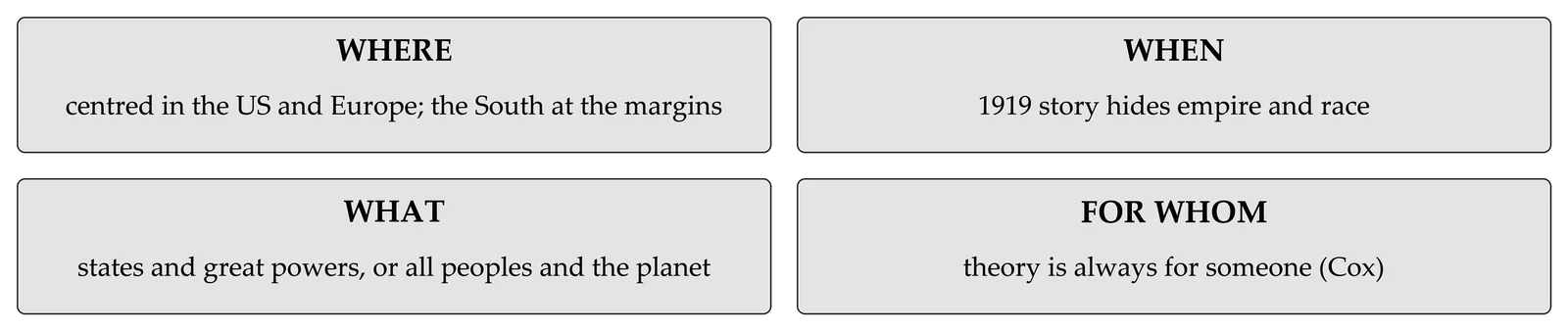
David Blaney, in Where, When and What is IR? (2020), questions this conventional story from the standpoint of the Global South. He asks where IR is, noting that it has been centred in the United States and Europe; when it began, noting that the 1919 origin myth ignores the role of empire and race in early IR, which was often concerned with managing colonial peoples; and what it studies, noting that a narrow focus on states and great powers excludes the experiences of most of humanity. He argues that IR must be opened to the histories, ideas and voices of the colonised and marginalised.
IR from the Global South
- Eurocentrism. Mainstream IR theories were developed mainly from European and American history, such as the Westphalian state system and the Cold War.
- Neglect of colonialism. The founding narrative ignores how empire, slavery and racial hierarchy shaped the international order.
- Different concerns. For many countries of the South, the key issues have been decolonisation, development, state-building, internal conflict and inequality rather than great power rivalry.
- Global IR. Amitav Acharya has called for a Global IR that recognises multiple histories and contributions, such as Indian, Chinese and African ideas of order.
- Indian thinking. Indian scholars point to resources such as Kautilya’s Arthashastra, the idea of Vasudhaiva Kutumbakam (the world is one family), Gandhi’s non-violence and Nehru’s non-alignment.
Theory and the World
Robert Cox famously wrote that theory is always for someone and for some purpose, meaning that every theory reflects a particular standpoint and interests. IR theories are not neutral mirrors of reality; they shape how we see the world and what we consider possible. This insight encourages us to ask whose world IR describes and whose voices it leaves out.
1.2 Understanding Space: How Do We Sense Our Planet
IR has usually understood space as territory: the world divided into sovereign states with fixed borders. Maps show coloured blocks of states, as if nature were simply a background to human politics. Recent thinking challenges this view and asks us to take nature and the planet seriously.
Simon Dalby: Not Taking Nature for Granted
Simon Dalby, in What Happens If We Don’t Take Nature for Granted? (2008), argues that conventional IR treats nature as a stable, external backdrop, a source of resources or a theatre of war. But human activities, such as industrialisation, urbanisation, agriculture and fossil fuel use, are transforming the earth’s systems, causing climate change, biodiversity loss and pollution. Humans are not outside nature but part of it, and our political, economic and security arrangements depend on and reshape the biosphere. Dalby argues that security should be rethought as protecting the conditions of life rather than only defending territory, and that environmental change requires new forms of global cooperation.
The Anthropocene
The atmospheric chemist Paul Crutzen, who shared the Nobel Prize in Chemistry in 1995, proposed in 2000 that we have entered a new geological epoch, the Anthropocene, in which humans have become the dominant force shaping the planet. Evidence includes rising greenhouse gases, changes in the nitrogen cycle, the spread of plastics and radioactive particles, and mass extinction of species. The concept challenges the separation of human history from natural history.
Dipesh Chakrabarty: The Planetary Age
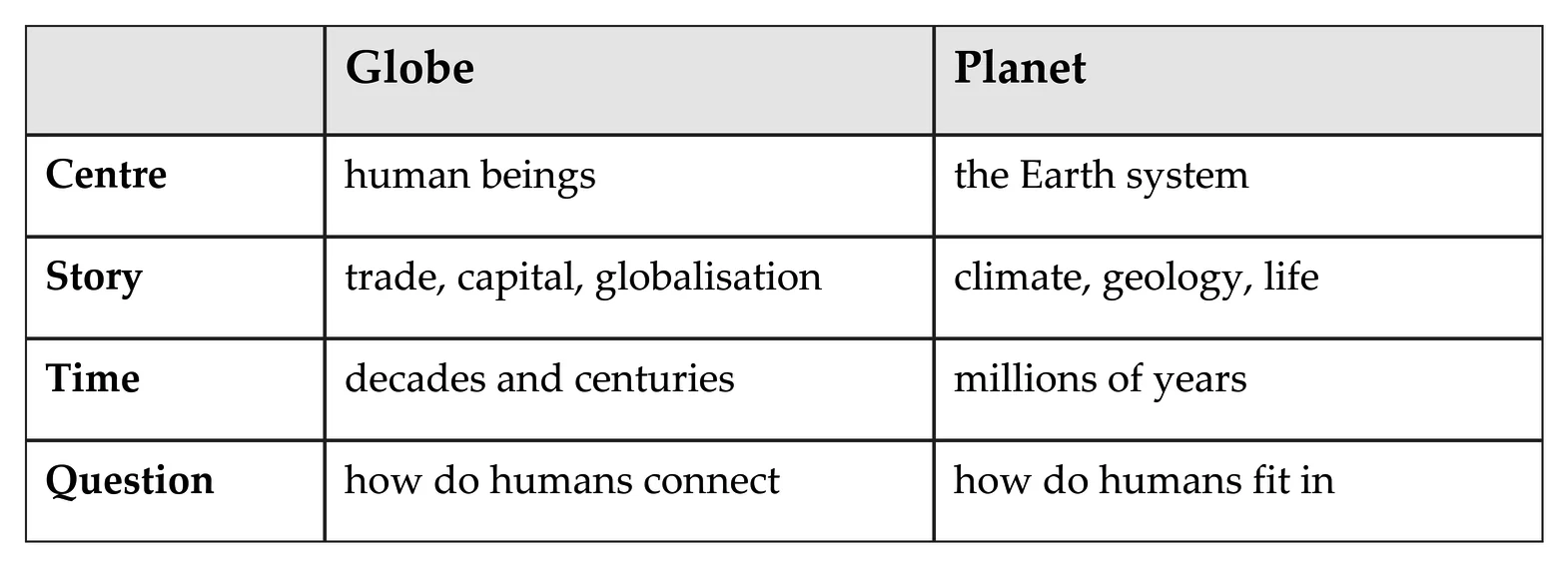
The historian Dipesh Chakrabarty, in The Climate of History in a Planetary Age (2021), argues that climate change forces us to think on two scales at once: the scale of human history, measured in decades and centuries, and the scale of planetary or geological history, measured in millions of years. He distinguishes the globe, the world of human connection, capitalism and globalisation, from the planet, the Earth system of which humans are only one part. Globalisation is a human-centred story, while the planetary perspective decentres the human, reminding us that the Earth system does not exist for human purposes. Climate change brings these two together, since human economic activity now affects the planet’s climate. Chakrabarty also stresses that responsibility for climate change is unequal, since rich countries have emitted far more.
Implications for IR
Taking the planet seriously changes IR. It requires thinking about global commons such as the atmosphere and oceans, the security implications of climate change such as sea-level rise and migration, the rights of future generations and non-human life, and forms of cooperation beyond territorial sovereignty. It also links IR with the concerns of indigenous peoples and the Global South, who often have different relationships with nature.
1.3 Ways of Knowing and Being: Peoples, Histories and Civilisations
How we understand the world depends on our ontology, our assumptions about what exists, and our epistemology, our assumptions about how we can know it. Mainstream IR assumes a world made up of separate, sovereign states pursuing their interests. Other ways of knowing and being, drawn from different peoples, histories and civilisations, offer alternative understandings.
Pin-Fat: How Do We Begin to Think about the World
Véronique Pin-Fat, in How Do We Begin to Think about the World? (2008), argues that how we begin, with what questions and concepts, shapes what we can see. Drawing on the philosopher Ludwig Wittgenstein, she shows that language and concepts are not neutral: they frame the world in particular ways. Starting from the state, sovereignty and anarchy produces one picture of the world; starting from people, relationships or suffering produces another. She encourages students to reflect critically on the assumptions built into the ways we think about global politics.
Relational IR
A group of scholars, Tamara Trownsell, Amaya Querejazu, Giorgio Shani, Navnita Chadha Behera, Jarrad Reddekop and Arlene Tickner, in Recrafting International Relations through Relationality (2019) and Differing about Difference (2021), argue for relational approaches to IR. Mainstream IR assumes that separate entities, states, individuals or nations, exist first and then enter into relations. Relational thinking reverses this: relations come first, and entities are constituted by their relationships. Such thinking is found in many traditions:
- Indian thought. Ideas such as Vasudhaiva Kutumbakam and the interconnectedness of all beings in many Indian philosophies; Navnita Chadha Behera has written on rethinking IR from Indian perspectives.
- African thought. The idea of Ubuntu, often expressed as I am because we are, stresses that personhood is formed through relationships with others.
- Andean thought. Indigenous ideas such as Buen Vivir (Sumak Kawsay), living well in harmony with community and nature, recognised in the constitutions of Ecuador (2008) and Bolivia (2009).
- East Asian thought. Confucian and Daoist ideas of harmony and relational roles, and Japanese ideas of relational selves, as discussed by Kosuke Shimizu.
Pluriverse and Inter-Cosmological Relations
Arturo Escobar, in Pluriversal Politics (2020), and Ashish Kothari and others, in Pluriverse: A Post-Development Dictionary (2019), describe the world as a pluriverse, a world in which many worlds fit, borrowing a phrase from the Zapatistas. Instead of one universal model of modernity and development, there are many ways of being in the world, each with its own relationship to nature and community. Giorgio Shani suggests that IR could be reimagined as inter-cosmological relations, relations among different cosmologies or worldviews, rather than only among states. Milja Kurki argues for IR in a relational universe, connecting human politics with ecological and cosmic relations.
Peoples, Histories and Civilisations
These approaches encourage IR to learn from the histories of peoples and civilisations beyond the West: the Indian Ocean world, the tributary system of East Asia, the Islamic world, African kingdoms and indigenous nations. They remind us that the Westphalian state system is only one historical form of order, and that the experience of colonised and indigenous peoples is central to understanding the modern world. Critics warn that relational and pluriversal approaches can romanticise traditions or overlook power and conflict within them, but they open IR to a richer understanding of the world.

1.4 Important Questions
- Question 1 What is International Relations? Discuss its evolution and the critique of mainstream IR from the Global South.
- Question 2 How do we understand space and sense our planet? Discuss with reference to Dalby and Chakrabarty.
- Question 3 Discuss relational approaches to International Relations and the idea of the pluriverse.
- Question 4 How do we begin to think about the world? Discuss the role of ontology, epistemology and language in IR.
DU asks the same idea in different words. So learn one broad answer for each question below; the same answer works for every question joined by OR.
Important Question 1
What is International Relations? Discuss its evolution and the critique of mainstream IR from the Global South.
OR
Where, when and what is IR? Discuss with reference to David Blaney.
OR
Examine the call for a Global IR.
Model Answer
“Theory is always for someone and for some purpose.”
— Robert W. Cox, Social Forces, States and World Orders (1981)
Introduction. International Relations is usually defined as the study of relations among states, covering war, diplomacy, trade and international organisations. Its conventional history begins in 1919 and proceeds through great debates among theories. Scholars from the Global South question this story, asking where, when and what IR is, and whose experiences it includes or excludes.
1. Meaning of IR
IR studies relations among states and other actors across borders, including war and peace, diplomacy, international law, trade, organisations and transnational movements.
2. The 1919 Origin Story
The conventional story dates the discipline to 1919, when the Woodrow Wilson Chair was set up at Aberystwyth after the First World War, with the aim of understanding and preventing war.
3. Idealism and Realism
The first great debate pitted idealists, who believed in international law and the League of Nations, against realists such as E.H. Carr and Hans Morgenthau, who stressed power and national interest.
4. Later Debates
Later debates set traditional against scientific methods, neo-realists such as Kenneth Waltz against neo-liberals, and rationalists against constructivists and critical theorists.
5. Blaney’s Questions
David Blaney asks where IR is, when it began and what it studies, showing that the conventional answers reflect a Western standpoint.
6. Where Is IR
IR has been centred in the United States and Europe, whose universities, journals and theories dominate the field, while scholarship from the South is often marginalised.
7. When Did IR Begin
Blaney notes that the 1919 myth ignores the role of empire and race in early IR, which was often concerned with managing colonial peoples and the hierarchy of civilisations.
8. What Does IR Study
A narrow focus on states and great powers excludes the experiences of most of humanity, such as colonialism, development, internal conflict and inequality.
9. Eurocentrism
Mainstream theories are drawn mainly from European and American history, such as the Westphalian system and the Cold War, and treat them as universal.
10. Concerns of the South
For countries of the Global South, key issues have included decolonisation, non-alignment, state-building, development and fair global rules rather than only great power rivalry.
11. Cox on Theory
Robert Cox argued that theory is always for someone and for some purpose, so IR theories reflect the standpoint and interests of those who produce them.
12. Global IR
Amitav Acharya called in 2014 for a Global IR that recognises multiple histories, contributions and voices, rather than treating Western experience as universal.
13. Indian Contributions
Indian resources for IR include Kautilya’s Arthashastra, the idea of Vasudhaiva Kutumbakam, Gandhi’s non-violence and Nehru’s non-alignment.
14. Beyond States
Contemporary IR also studies non-state actors, social movements, the environment, gender and culture, widening the scope of the discipline.
15. Criticism of the Critique
Some argue that Global South critiques risk replacing one parochialism with another, or overlook the useful insights of mainstream theories.
16. Race and the Origins of IR
Scholars such as Robert Vitalis have shown that early American IR was openly concerned with race development and the management of colonial peoples; the journal now known as Foreign Affairs began in 1910 as the Journal of Race Development. This history supports Blaney’s argument that empire and race lie at the origins of the discipline.
17. IR in India
International Relations in India developed after independence at institutions such as the Indian School of International Studies (1955), later part of Jawaharlal Nehru University. Kanti Bajpai and Siddharth Mallavarapu have collected Indian contributions to theorising the region and the nation, showing that IR can be studied from Indian standpoints.
18. Evaluation
IR is best understood as a plural discipline that must include the histories and voices of all peoples to make sense of the world.
Conclusion. Thus, IR is conventionally the study of relations among states, dated to 1919 and told through great debates. Blaney and other Global South scholars show that this story hides empire, race and the experiences of most of humanity. As Cox reminds us, theory is always for someone, so a Global IR must include many voices.
Important Question 2
How do we understand space and sense our planet? Discuss with reference to Dalby and Chakrabarty.
OR
Examine the significance of the Anthropocene for International Relations.
OR
Distinguish between the globe and the planet with reference to Dipesh Chakrabarty.
Model Answer
“It seems appropriate to assign the term Anthropocene to the present, in many ways human-dominated, geological epoch.”
— Paul J. Crutzen, Geology of Mankind (2002)
Introduction. IR has traditionally understood space as territory, the world divided into sovereign states, with nature as a stable background. Climate change and environmental crises challenge this view. Simon Dalby and Dipesh Chakrabarty argue that we must take nature and the planet seriously, recognising that human activity now shapes the Earth system itself.
1. Space as Territory
Conventional IR sees space as the territory of sovereign states with fixed borders, as shown on political maps, and nature as a source of resources or a theatre of conflict.
2. Dalby’s Argument
Dalby argues that IR takes nature for granted, treating it as a stable, external backdrop, when in fact human activities are transforming the Earth’s systems.
3. Humans within Nature
Dalby stresses that humans are part of nature, not outside it, and that political and economic arrangements depend on and reshape the biosphere.
4. Rethinking Security
Dalby argues that security should mean protecting the conditions of life, such as a stable climate and ecosystems, rather than only defending territory against other states.
5. The Anthropocene
Paul Crutzen proposed in 2000 that we have entered the Anthropocene, an epoch in which humans are the dominant force shaping the planet’s geology and ecology.
6. Evidence of the Anthropocene
Rising greenhouse gases, changes in the nitrogen cycle, the spread of plastics, mass extinction and the global spread of radioactive particles mark human impact on the planet.
7. Chakrabarty’s Two Histories
Chakrabarty argues that climate change collapses the distinction between natural history and human history, since human activity now affects geological processes.
8. Globe and Planet
He distinguishes the globe, the human-centred world of connection, capitalism and globalisation, from the planet, the Earth system of which humans are only one part.
9. Decentring the Human
The planetary perspective decentres the human, reminding us that the Earth system does not exist for human purposes and operates on timescales of millions of years.
10. Two Scales of Time
Climate change forces us to think on the human scale of decades and the geological scale of millennia at once, which challenges ordinary political thinking.
11. Unequal Responsibility
Chakrabarty also stresses that responsibility is unequal: rich countries have emitted most historical greenhouse gases, while poor countries suffer the worst effects.
12. Global Commons
Taking the planet seriously means attending to global commons such as the atmosphere and oceans, which no state can protect alone.
13. Climate and Security
Sea-level rise, droughts and extreme weather threaten lives, food and water, and may cause migration and conflict, making climate a security issue.
14. Indigenous and Southern Perspectives
Indigenous peoples and communities of the South often have relationships with nature based on care and reciprocity, offering alternatives to the exploitation of nature.
15. India’s Perspective
India stresses common but differentiated responsibilities and climate justice, while expanding renewable energy and promoting sustainable lifestyles through Mission LiFE.
16. Planetary Boundaries
Scientists led by Johan Rockström proposed in 2009 nine planetary boundaries, such as climate change, biodiversity loss and freshwater use, within which humanity can safely operate. Studies suggest that several boundaries have already been crossed, giving scientific form to Dalby’s and Chakrabarty’s concerns.
17. Climate and Small Island States
For small island states such as Tuvalu and the Maldives, sea-level rise threatens their very territory and existence as states. Their situation shows how the planetary crisis challenges the territorial basis of the international system and raises new questions about statehood and migration.
18. Evaluation
The planetary turn shows that IR can no longer ignore nature; understanding the world requires understanding the Earth system and human impact on it.
Conclusion. Thus, Dalby shows that IR must stop taking nature for granted, and Chakrabarty distinguishes the human-centred globe from the planet that decentres the human. In the Anthropocene named by Crutzen, sensing our planet means recognising that human history and natural history have become intertwined.
Important Question 3
Discuss relational approaches to International Relations and the idea of the pluriverse.
OR
What is relational IR? How does it challenge mainstream IR?
OR
Examine the idea of IR as inter-cosmological relations.
Model Answer
“A world where many worlds fit.”
— Zapatista Army of National Liberation, Fourth Declaration of the Lacandon Jungle (1996)
Introduction. Mainstream IR assumes a world of separate, sovereign states pursuing their interests. Relational approaches, developed by scholars from around the world, argue that relations come first and that entities are constituted through their relationships. Combined with the idea of the pluriverse, a world of many worlds, they offer new ways of knowing and being in international relations.
1. Mainstream Assumptions
Realism and liberalism assume that separate units, states or individuals, exist first and then interact, pursuing interests in an anarchic system without world government.
2. The Relational Turn
Trownsell, Querejazu, Shani, Behera, Reddekop and Tickner argue for recrafting IR through relationality, starting from relations rather than separate units.
3. Relations Come First
In relational thinking, entities are constituted by their relationships. A state, a nation or a person is what it is because of its relations with others and with nature.
4. Differing about Difference
In a 2021 article, these scholars showed that relational ideas exist in many traditions around the world, and that IR must engage with this diversity rather than one universal model.
5. Indian Traditions
Indian ideas such as Vasudhaiva Kutumbakam and the interconnectedness of all beings offer relational resources; Navnita Chadha Behera has written on reimagining IR from India.
6. African Ubuntu
The African idea of Ubuntu, often expressed as I am because we are, holds that personhood is formed through relationships with others, emphasising community and solidarity.
7. Andean Buen Vivir
The Andean idea of Buen Vivir, living well in harmony with community and nature, has been recognised in the constitutions of Ecuador (2008) and Bolivia (2009).
8. East Asian Thought
Confucian and Daoist ideas of harmony and relational roles, and Japanese ideas of relational selves discussed by Kosuke Shimizu, provide further relational perspectives.
9. The Pluriverse
Escobar and Kothari describe the world as a pluriverse, a world where many worlds fit, borrowing the Zapatista phrase, against one universal model of modernity.
10. Post-Development
The Pluriverse dictionary (2019) gathers alternatives to Western development, such as degrowth, ecological swaraj and Buen Vivir, rooted in diverse cultures.
11. Inter-Cosmological Relations
Giorgio Shani suggests reimagining IR as relations among different cosmologies or worldviews, not only among states, taking religious and indigenous worldviews seriously.
12. Kurki’s Relational Universe
Milja Kurki argues for IR in a relational universe, connecting human politics with ecological and cosmic relations, and moving beyond human-centred thinking.
13. Implications for Nature
Relational approaches see humans as part of a web of life, supporting care for nature and the rights of non-human beings, relevant to climate politics.
14. Implications for Peace
If identities are relational, conflicts can be transformed by changing relationships, encouraging dialogue, reconciliation and cooperation.
15. Criticism
Critics warn that relational and pluriversal approaches can romanticise traditions, overlook hierarchies such as caste and gender within them, and offer little guidance on power politics.
16. Rights of Nature
Relational ideas have entered law: Ecuador’s constitution of 2008 recognised the rights of nature, New Zealand granted legal personhood to the Whanganui River in 2017, and the Uttarakhand High Court in 2017 declared the Ganga and Yamuna to be living entities, though the Supreme Court stayed that order.
17. Ecological Swaraj
Ashish Kothari of the Indian group Kalpavriksh has developed the idea of radical ecological democracy or ecological swaraj, combining local self-governance, ecological sustainability and social justice, drawing on Gandhian and indigenous traditions as an Indian contribution to the pluriverse.
18. Evaluation
Relational IR and the pluriverse open the discipline to many ways of knowing and being, enriching our understanding of the world.
Conclusion. Thus, relational IR argues that relations come first and draws on Indian, African, Andean and East Asian traditions, while the pluriverse imagines, in the Zapatista phrase, a world where many worlds fit. These ideas challenge the mainstream image of separate states and open IR to inter-cosmological dialogue.
Important Question 4
How do we begin to think about the world? Discuss the role of ontology, epistemology and language in IR.
OR
Discuss Véronique Pin-Fat’s argument on how we begin to think about the world.
OR
Theories shape the world they describe. Discuss.
Model Answer
“The limits of my language mean the limits of my world.”
— Ludwig Wittgenstein, Tractatus Logico-Philosophicus (1921), 5.6
Introduction. Before we can study the world, we must decide how to begin: what exists, how we can know it, and with what concepts. These questions of ontology, epistemology and language shape what we see and what we miss. Véronique Pin-Fat argues that how we begin to think about the world determines the picture of global politics we arrive at.
1. Ontology
Ontology concerns what exists. Mainstream IR assumes that the world is made up of sovereign states in an anarchic system, while other approaches see individuals, classes, genders or relations as basic.
2. Epistemology
Epistemology concerns how we can know the world. Positivists believe in objective, scientific knowledge, while interpretivists argue that knowledge depends on meanings and perspectives.

3. Methodology
Methodology concerns the methods used to gain knowledge, such as statistical analysis, case studies, historical interpretation or discourse analysis.
4. Pin-Fat’s Question
Pin-Fat asks how we begin to think about the world, arguing that our starting point, our questions and concepts, shapes the world we can see.
5. Wittgenstein and Language
Drawing on Wittgenstein, Pin-Fat shows that language is not a neutral mirror of reality; concepts frame the world in particular ways and set the limits of what we can think.
6. Starting from the State
If we begin with the state, sovereignty and anarchy, we see a world of power politics, security dilemmas and national interest, as realists do.
7. Starting from People
If we begin with people, their suffering, needs and relationships, we see a world of poverty, violence, migration and human rights, as critical and feminist scholars do.
8. Theories as Lenses
Theories act as lenses that highlight some aspects of the world and hide others, so no single theory gives a complete picture.
9. Theories Shape Reality
Constructivists such as Alexander Wendt argue that anarchy is what states make of it, meaning that shared ideas and practices shape international reality.
10. Cox and Critical Theory
Robert Cox distinguished problem-solving theory, which takes the world as given, from critical theory, which asks how the existing order came about and how it might change.
11. Feminist Questions
Cynthia Enloe asked where the women are in international politics, showing that starting from women’s lives reveals hidden forms of power in war, diplomacy and the economy.
12. Post-Colonial Questions
Post-colonial scholars begin from the experience of colonised peoples, revealing the role of empire and race in shaping the international order.
13. Many Ways of Knowing
Relational and indigenous approaches offer different ontologies in which humans, nature and the cosmos are interconnected, expanding the ways of knowing in IR.
14. Reflexivity
Pin-Fat encourages reflexivity, the habit of examining our own assumptions, so that we become aware of how our starting points shape our conclusions.
15. Value for Students
Thinking critically about how we begin helps students avoid treating any theory as the truth and to appreciate the diversity of perspectives on world politics.
16. Maps as Ways of Seeing
Maps are a clear example of how starting points shape vision. The Mercator projection enlarges Europe and North America relative to Africa and South America, while other projections give a different picture. Choosing a map, like choosing a theory, shapes how we see the world and its centres and margins.
17. Levels of Analysis
Kenneth Waltz, in Man, the State and War (1959), showed that explanations of war differ depending on whether we begin with human nature, the internal character of states or the structure of the international system. His three images illustrate Pin-Fat’s point that where we begin determines what we find.
18. Evaluation
How we begin to think about the world is not a technical matter but shapes our politics; awareness of this makes IR more open and self-critical.
Conclusion. Thus, ontology, epistemology, methodology and language shape how we understand the world. Pin-Fat, drawing on Wittgenstein’s insight that the limits of our language are the limits of our world, shows that starting from the state or from people produces very different pictures of global politics.
Short Notes
(a) Global IR
Amitav Acharya’s call (2014) for an International Relations that recognises the histories, ideas and contributions of all regions, not only the West.
(b) Anthropocene
The proposed geological epoch, named by Paul Crutzen, in which human activity has become the dominant force shaping the Earth’s climate and ecosystems.
(c) Pluriverse
The idea of a world where many worlds fit, with diverse ways of being and relating to nature, against one universal model of modernity and development.
More notes: GE-4 Understanding International Relations
These notes are prepared by PADHO TO AISE for study help. They are not an official publication.