
Semester VI DSE-4a Understanding Security
Unit III · 21 min read · Updated 24 Nov 2026
As per the University of Delhi (DU) BA (Hons) Political Science syllabus
Contents
- 3.1 National Security: From Within and Outside
- Buzan: The National Security Problem
- Wolfers and the Ambiguity of National Security
- Fjäder: Resilience in the Age of Globalisation
- Terrorism and Organised Crime
- Terrorism and the International Community
- 3.2 Energy Security
- Meaning of Energy Security
- Raphael and Stokes: The Geopolitics of Oil
- India’s Energy Security
- Climate Change and Security
- 3.3 Cyber Security and Public Health
- Cyber Security
- Public Health and Security
- Securing the Global Commons
- 3.4 Important Questions
- Discuss the challenges to national security from within and outside.
- Discuss energy security as a challenge to international security.
- Discuss cyber security as a challenge to international security.
- Discuss the relationship between public health and security.
- Short Notes
विकास के बिना हम सुरक्षा का आनंद नहीं ले पाएँगे, सुरक्षा के बिना विकास का आनंद नहीं ले पाएँगे, और मानवाधिकारों के सम्मान के बिना हम इनमें से किसी का भी आनंद नहीं ले पाएँगे।
We will not enjoy development without security, we will not enjoy security without development, and we will not enjoy either without respect for human rights.
— Kofi Annan, In Larger Freedom (2005)
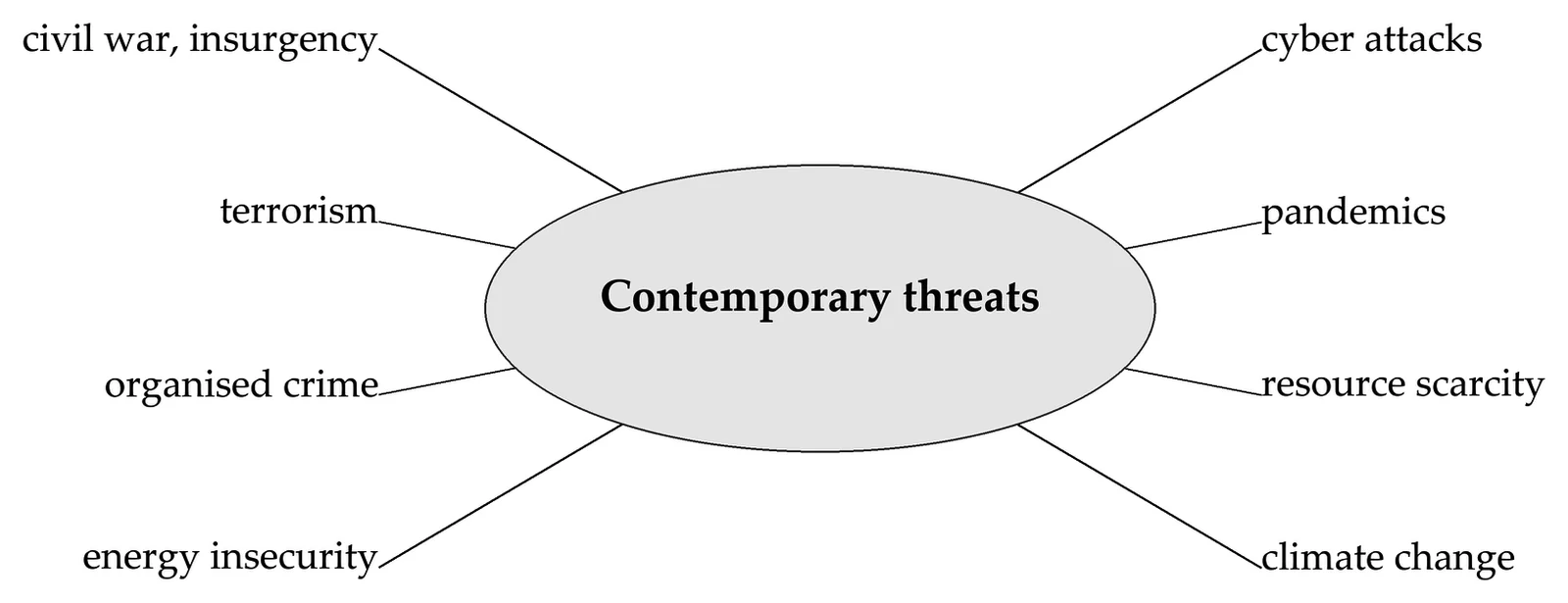
TTHE threats that states and people face today are very different from those of the Cold War. Many states are threatened more from within, by civil war, insurgency and terrorism, than by foreign armies. Terrorist networks and organised crime operate across borders. Modern societies depend on secure supplies of energy, on computer networks that can be attacked from anywhere, and on public health systems that can be overwhelmed by a new virus. This chapter studies Unit III of the syllabus: national security from within and outside, and the new threats of energy security, cyber security and public health.
3.1 National Security: From Within and Outside
Buzan: The National Security Problem
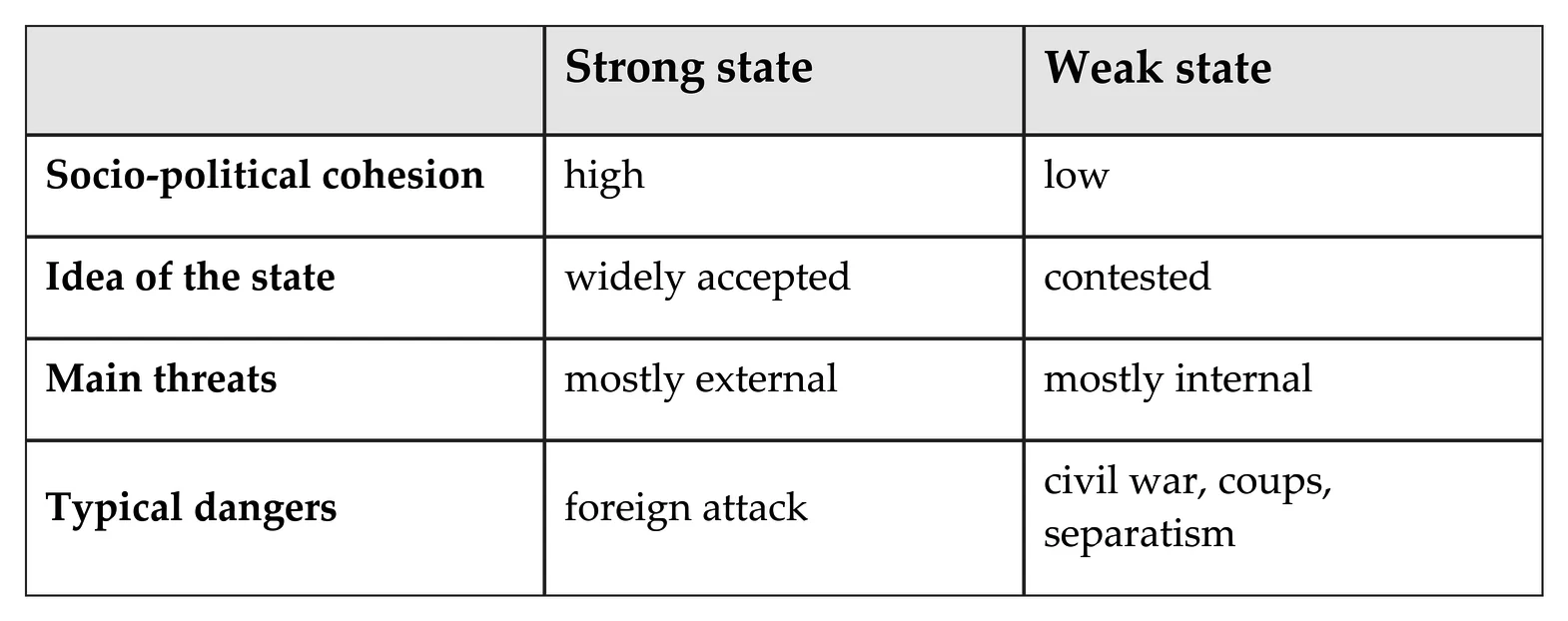
Barry Buzan, in The National Security Problem in International Relations (from People, States and Fear), explains that national security is shaped by the nature of the state itself. He distinguishes strong states, which have a high degree of socio-political cohesion, i.e. their idea of the state, institutions and territory are widely accepted by the population, from weak states, where these are contested. Strong states face mainly external threats, while weak states face their most serious threats from within: civil war, insurgency, separatism and coups. Many postcolonial states are weak in this sense, though they may have strong armies. Buzan also notes that the security of the state and the security of its people can diverge, since governments may themselves threaten their citizens.
Wolfers and the Ambiguity of National Security
Arnold Wolfers (1952) warned that national security is an ambiguous symbol that can be used to justify almost any policy. Different states, and different groups within states, define the values to be protected and the level of security needed in different ways. Excessive pursuit of security can be self-defeating, leading to arms races or the erosion of freedoms at home.
Fjäder: Resilience in the Age of Globalisation
Christian Fjäder, in The Nation-State, National Security and Resilience in the Age of Globalisation (2014), argues that globalisation has made states interdependent and exposed them to threats they cannot prevent, such as financial crises, pandemics and attacks on critical infrastructure. National security strategies have therefore turned to resilience, i.e. the capacity of societies and systems to absorb shocks, adapt and recover. Resilience shifts attention from preventing every threat to preparing citizens, businesses and institutions to cope, while keeping the state at the centre of coordination.
Terrorism and Organised Crime
Michael E. Smith, in International Security (2017), discusses terrorism, i.e. the use or threat of violence against civilians to create fear and achieve political goals. He explains the debates on defining terrorism, the shift from nationalist and leftist groups to religiously motivated transnational networks such as al-Qaeda and the Islamic State, and the responses after the attacks of 11 September 2001, including the war on terror, intelligence cooperation and controls on terrorist financing. John Picarelli (2008) shows that transnational organised crime, such as drug trafficking, human trafficking, arms smuggling and money laundering, has become a security issue because it corrupts states, funds insurgents and terrorists and exploits globalisation.
- From within. Insurgency, separatism, communal violence and Maoism in India, civil wars in Syria and Yemen.
- From outside. Interstate war, cross-border terrorism and proxy wars.
- Blurred line. Many threats combine both, as when foreign states support domestic insurgents.
- Responses. The UN Global Counter-Terrorism Strategy (2006), FATF standards on terror financing and the Palermo Convention (2000) on organised crime.
Terrorism and the International Community
Despite many conventions on specific acts of terrorism, such as hijacking and terrorist financing, the UN has no comprehensive definition of terrorism. India proposed a Comprehensive Convention on International Terrorism in 1996, but it remains stalled because states disagree over whether struggles against foreign occupation should be excluded and whether the acts of state forces should be covered. The UN Security Council’s 1267 sanctions regime, which lists individuals and groups linked to al-Qaeda and the Islamic State, has been used by India to seek the listing of Pakistan-based terrorists.
3.2 Energy Security
Meaning of Energy Security
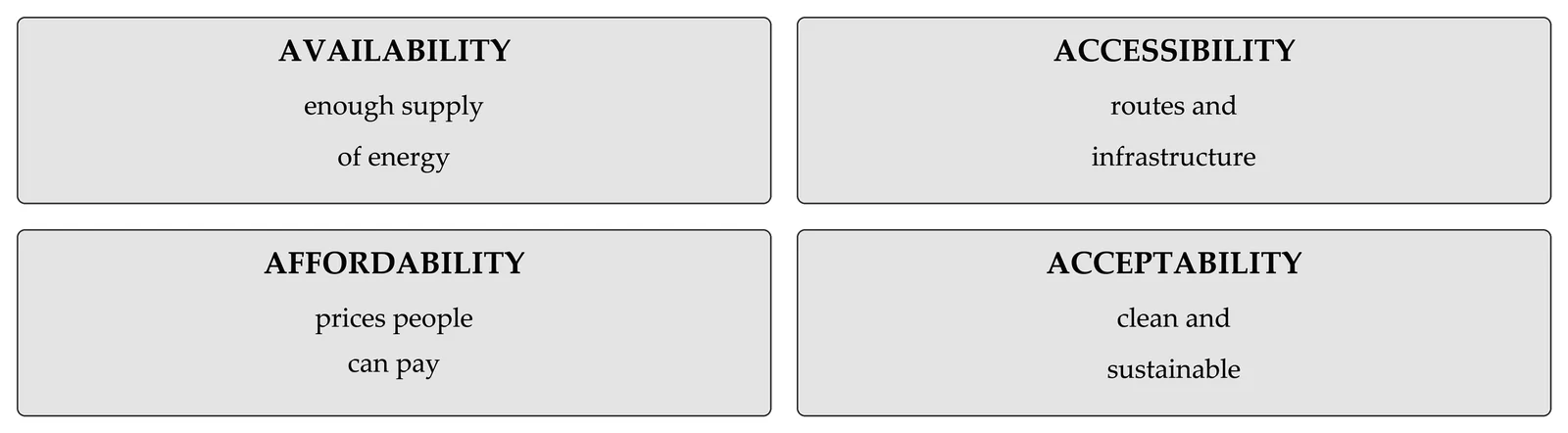
The International Energy Agency defines energy security as the uninterrupted availability of energy sources at an affordable price. Scholars often describe it through the four As: availability of supply, accessibility through routes and infrastructure, affordability of prices and acceptability in environmental terms. Energy security matters because modern economies, militaries and daily life depend on oil, gas, coal and electricity.
Raphael and Stokes: The Geopolitics of Oil
Sam Raphael and Doug Stokes, in Energy Security (2013), argue that energy security is deeply political. For major consumers such as the United States, securing the flow of oil from the Persian Gulf has long been a strategic priority, leading to military bases, alliances with oil-producing states and interventions. They show how the 1973 oil embargo by Arab producers, which quadrupled prices, made energy a security issue and led to the creation of the International Energy Agency (1974) and strategic petroleum reserves. Energy security for consumers can mean insecurity for people in producing regions, where oil wealth has fuelled authoritarianism, conflict and environmental damage.
- Chokepoints. About a fifth of the world’s oil passes through the Strait of Hormuz, and much of Asia’s trade through the Strait of Malacca.
- Gas and coercion. Russia’s cut in gas supplies to Europe after its invasion of Ukraine in 2022 showed how energy can be used as a weapon.
- Scarcity and conflict. Richard Matthew (2008) and Gavin Bridge (2015) show that scarcity of resources and the way it is framed can shape conflict and the making of world order.
- Energy transition. The shift to renewable energy reduces dependence on oil but creates new dependencies on critical minerals such as lithium and rare earths.
India’s Energy Security
India imports more than four-fifths of its crude oil, making it vulnerable to price shocks and supply disruptions. It has built strategic petroleum reserves at Visakhapatnam, Mangaluru and Padur, diversified suppliers, invested in overseas oil fields, and increased imports of discounted Russian oil after 2022. It co-founded the International Solar Alliance (2015), set a target of net zero emissions by 2070, and is expanding solar and wind power to reduce import dependence.
Climate Change and Security
Climate change is increasingly seen as a threat multiplier, a term used in a US defence review of 2014, because it worsens water scarcity, food insecurity, migration and disasters, which can fuel conflict. The UN Security Council first debated climate and security in 2007. In December 2021 a draft resolution on climate and security was vetoed by Russia, and India also voted against it, arguing that climate change should be dealt with under the UN climate convention, where the principle of common but differentiated responsibilities applies, rather than by the Security Council.
3.3 Cyber Security and Public Health
Cyber Security
Smith (2017) explains that cyberspace creates new vulnerabilities because economies, governments and militaries depend on networked computers. Threats include cyber crime, espionage, attacks on critical infrastructure and cyber warfare. Cyber attacks are cheap, fast and hard to attribute, which complicates deterrence. Major incidents include the attacks on Estonia (2007), the Stuxnet virus that damaged Iran’s nuclear centrifuges (2010), the NotPetya attack (2017) and the Colonial Pipeline ransomware attack in the United States (2021).
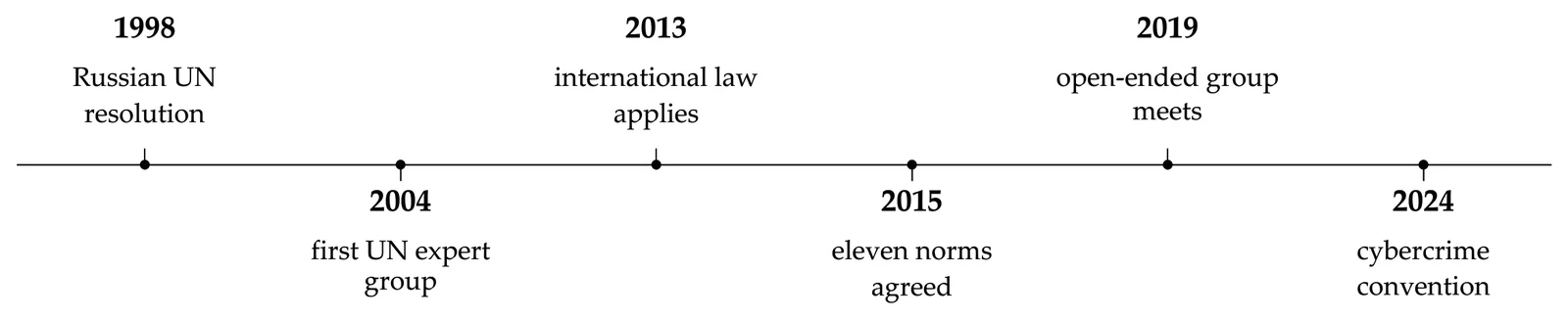
Tim Maurer, in Cyber Norm Emergence at the United Nations (2011), traces how the UN took up cyber security. Russia proposed a resolution on information security in 1998, and a series of Groups of Governmental Experts followed. The 2013 group agreed that international law, including the UN Charter, applies to cyberspace, and the 2015 group proposed eleven voluntary norms of responsible state behaviour, such as not attacking critical infrastructure in peacetime. States still disagree: Western states favour an open internet and multistakeholder governance, while Russia and China stress state sovereignty over information. In December 2024 the UN General Assembly adopted a convention against cybercrime. Qerim Qerimi (2020) links smart technologies with human security and global justice, warning about surveillance and digital inequality.
Public Health and Security
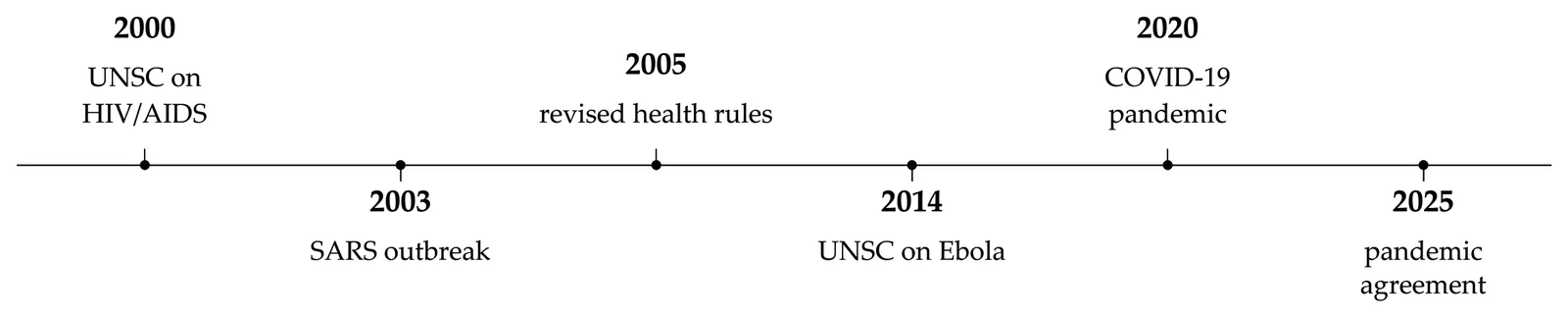
Smith (2017) shows that infectious diseases have become security issues because they can kill large numbers, disrupt economies, weaken militaries and destabilise states. The UN Security Council discussed HIV/AIDS in Resolution 1308 (2000) and declared the Ebola outbreak in West Africa a threat to international peace and security in Resolution 2177 (2014). The International Health Regulations (2005) require states to report outbreaks to the WHO, which can declare a public health emergency of international concern. COVID-19, declared such an emergency in January 2020 and a pandemic in March 2020, killed millions and caused the deepest global recession since the Second World War.
Simon Rushton, in Global Health Security: Security for Whom? Security from What? (2011), argues that the global health security agenda has focused narrowly on protecting Western states from emerging infectious diseases and bioterrorism that might cross their borders, rather than on the everyday health insecurity of the poor in the Global South, such as malaria, maternal mortality and lack of basic health care. COVID-19 confirmed these inequalities, as rich countries secured vaccines first. India supplied vaccines to many countries through Vaccine Maitri (2021) and, with South Africa, proposed a waiver of intellectual property rules on COVID-19 products at the WTO in 2020.
Securing the Global Commons
Outer space, the high seas and cyberspace are global commons that no state owns but all depend on. The Outer Space Treaty (1967) bans weapons of mass destruction in orbit, but anti-satellite tests by China (2007) and India (Mission Shakti, 2019) and the growth of space debris raise new concerns. Satellites are vital for communication, navigation and military operations, so threats to them are threats to national and global security.
3.4 Important Questions
- Question 1 Discuss the challenges to national security from within and outside.
- Question 2 Discuss energy security as a challenge to international security.
- Question 3 Discuss cyber security as a challenge to international security.
- Question 4 Discuss the relationship between public health and security.
DU asks the same idea in different words. So learn one broad answer for each question below; the same answer works for every question joined by OR.
Important Question 1
Discuss the challenges to national security from within and outside.
OR
Examine Barry Buzan’s distinction between strong and weak states.
OR
Discuss terrorism and organised crime as threats to national security.
Model Answer
“A state is a human community that (successfully) claims the monopoly of the legitimate use of physical force within a given territory.”
— Max Weber, Politics as a Vocation (1919)
Introduction. National security was traditionally seen as defence against foreign armies. Today many states face their most serious threats from within, while terrorism and organised crime blur the line between internal and external threats. Barry Buzan explains this through the distinction between strong and weak states, and Christian Fjäder shows how states now seek resilience against shocks.
1. Traditional View
Traditionally, national security meant protecting territory and sovereignty from external military attack. The army was the main instrument.
2. Weber’s State
Weber defined the state by its monopoly of legitimate force. When this monopoly is challenged from within, national security is threatened.
3. Buzan’s Strong and Weak States
Buzan distinguishes strong states with high socio-political cohesion from weak states where the idea and institutions of the state are contested.
4. Internal Threats in Weak States
Weak states face their main threats from within: civil war, insurgency, separatism and coups.
5. State versus People
Buzan notes that the state can itself threaten its citizens, so state security and human security may diverge.
6. Wolfers’s Warning
Wolfers warned that national security is an ambiguous symbol that can justify almost any policy.
7. Terrorism
Smith explains terrorism as violence against civilians to create fear for political goals, now often transnational and religiously motivated.
8. After 9/11
The attacks of 2001 led to the war on terror, intelligence cooperation and controls on terrorist financing.
9. Organised Crime
Picarelli shows that drug, arms and human trafficking corrupt states and fund insurgents and terrorists.
10. Blurred Boundaries
Foreign support for domestic insurgents blurs the line between threats from within and outside.
11. Resilience
Fjäder argues that globalisation exposes states to shocks they cannot prevent, so they seek resilience to absorb and recover.
12. International Responses
The UN Counter-Terrorism Strategy (2006), FATF standards and the Palermo Convention (2000) coordinate responses.
13. Indian Examples
India faces Maoism and separatism from within and cross-border terrorism from outside, often linked.
14. Costs of Security Measures
Harsh security laws can erode civil liberties and alienate communities, worsening internal threats.
15. Development and Security
Addressing poverty and grievances is part of national security, since neglect fuels insurgency.
16. Criticism
Critics say the weak-strong distinction can stigmatise postcolonial states and ignore external causes of weakness.
17. Lone Actors and Radicalisation
Online radicalisation has produced lone-actor attacks that are hard to detect, forcing states to combine intelligence with community engagement.
18. Critical Infrastructure
Power grids, ports, communications and financial systems are now key targets, so protecting critical infrastructure is central to national security.
19. Evaluation
National security today requires dealing with internal and external threats together, balancing force, governance and rights.
Conclusion. Thus, when the state’s monopoly of legitimate force, as Weber defined it, is challenged from within or outside, national security is at stake. Buzan’s strong and weak states and Fjäder’s resilience show that security now depends on cohesion and preparedness as much as on armies.
Important Question 2
Discuss energy security as a challenge to international security.
OR
Examine the geopolitics of oil and energy security.
OR
Discuss India’s energy security challenges and responses.
Model Answer
“Safety and certainty in oil lie in variety and variety alone.”
— Winston Churchill, House of Commons (17 July 1913)
Introduction. Energy security means reliable access to energy at affordable prices. Because modern economies and militaries depend on oil, gas and electricity, energy has become a major security issue. Sam Raphael and Doug Stokes show how the geopolitics of oil shapes foreign policy, while the energy transition creates new challenges. India, a large importer, faces serious energy security concerns.
1. Meaning
The IEA defines energy security as the uninterrupted availability of energy at an affordable price.
2. The Four As
Scholars describe energy security through availability, accessibility, affordability and acceptability.
3. Churchill and Oil
When Britain switched its navy to oil before 1914, Churchill stressed that security lay in variety of supply.
4. The 1973 Oil Shock
The Arab oil embargo of 1973 quadrupled prices and made energy a central security concern.
5. The IEA and Reserves
Consumers created the International Energy Agency in 1974 and built strategic petroleum reserves.
6. Raphael and Stokes on the Gulf
They show that securing Gulf oil shaped US military bases, alliances and interventions.
7. Insecurity for Producers
Oil wealth has fuelled authoritarianism and conflict in producing regions, so consumer security can mean producer insecurity.
8. Chokepoints
The Strait of Hormuz and the Strait of Malacca are vital routes whose closure would disrupt supplies.
9. Energy as a Weapon
Russia’s gas cuts to Europe after 2022 showed how suppliers can use energy for coercion.
10. Scarcity and Conflict
Matthew and Bridge show that resource scarcity and how it is framed can shape conflict and world order.
11. Energy Transition
Renewables reduce oil dependence but create new dependencies on critical minerals such as lithium.
12. India’s Dependence
India imports more than four-fifths of its crude oil, making it vulnerable to shocks.
13. India’s Reserves and Diversification
India built strategic reserves, diversified suppliers and bought discounted Russian oil after 2022.
14. Renewable Push
India co-founded the International Solar Alliance in 2015 and targets net zero emissions by 2070.
15. Climate and Energy
Climate change makes acceptability a key dimension, linking energy security with environmental security.
16. Criticism
Critics warn that securitising energy can justify military intervention and neglect the energy poverty of the poor.
17. Energy Diplomacy
India’s energy diplomacy includes long-term contracts with Gulf producers, investments in Russian fields and partnerships for liquefied natural gas.
18. Energy Poverty
Energy security also means access for the poor; India’s Ujjwala scheme (2016) provided cooking gas connections to poor households.
19. OPEC and Prices
OPEC, founded in 1960, and the wider OPEC Plus group coordinate production to influence prices, which affects importers such as India.
20. Nuclear Energy
Nuclear power offers low-carbon energy, and the India-US nuclear deal of 2008 opened access to fuel and technology, though costs and safety concerns remain.
21. Evaluation
Energy security combines geopolitics, economics and climate, requiring diversification and cooperation.
Conclusion. Thus, energy security, which Churchill said lay in variety alone, remains central to international security. From the oil shocks to Russian gas and the energy transition, states like India must diversify supplies and invest in clean energy to stay secure.
Important Question 3
Discuss cyber security as a challenge to international security.
OR
Examine the emergence of cyber norms at the United Nations.
OR
Discuss the problem of cyber warfare and attribution.
Model Answer
“International law, and in particular the Charter of the United Nations, is applicable and is essential to maintaining peace and stability and promoting an open, secure, peaceful and accessible ICT environment.”
— Report of the UN Group of Governmental Experts (2013), paragraph 19
Introduction. Cyberspace has become a domain of security alongside land, sea, air and space. Economies, governments and militaries depend on networked computers that can be attacked from anywhere. Michael Smith explains the nature of cyber threats, and Tim Maurer traces how the United Nations has tried to develop norms for responsible state behaviour in cyberspace.
1. A New Domain
Cyberspace is now treated as a domain of conflict, with states creating cyber commands.
2. Types of Threats
Threats include cyber crime, espionage, attacks on critical infrastructure and cyber warfare.
3. Low Cost and High Impact
Cyber attacks are cheap and fast, and small actors can cause great damage.
4. Attribution Problem
It is hard to know who carried out an attack, which complicates deterrence and response.
5. Estonia 2007
Massive attacks on Estonia’s government and banks in 2007 showed the vulnerability of digital societies.
6. Stuxnet
The Stuxnet virus, discovered in 2010, damaged Iran’s nuclear centrifuges, showing cyber weapons can cause physical harm.
7. Ransomware
NotPetya (2017) and the Colonial Pipeline attack (2021) showed the economic damage of ransomware.
8. Maurer on UN Norms
Maurer traces how Russia’s 1998 resolution led to UN expert groups on information security.
9. International Law Applies
The 2013 expert group agreed that international law and the UN Charter apply to cyberspace.
10. Eleven Norms
The 2015 group proposed eleven voluntary norms, such as not attacking critical infrastructure in peacetime.
11. Divided Visions
Western states favour an open, multistakeholder internet, while Russia and China stress state control of information.
12. Cybercrime Convention
In December 2024 the UN General Assembly adopted a convention against cybercrime.
13. Human Security Dimension
Qerimi warns that smart technologies can enable surveillance and deepen digital inequality.
14. India’s Responses
India has CERT-In, NCIIPC and the Defence Cyber Agency, and takes part in UN cyber discussions.
15. Public-Private Cooperation
Since most infrastructure is privately owned, governments must cooperate with companies for cyber security.
16. Criticism
Voluntary norms lack enforcement, and states continue offensive cyber operations.
17. Tallinn Manual
Experts brought together by a NATO centre in Tallinn produced the Tallinn Manual (2013), explaining how international law applies to cyber warfare.
18. Cyber Deterrence
States try to deter cyber attacks by improving defences, naming attackers publicly and threatening sanctions or counter-attacks.
19. Election Interference
Cyber operations and disinformation have been used to influence elections, as alleged in the US election of 2016, turning cyber security into a threat to democracy.
20. Supply Chain Risks
Concerns that telecom equipment could be used for espionage led several countries, including India, to restrict certain Chinese vendors from 5G networks.
21. Evaluation
Cyber security requires national capacity, international norms and cooperation in a domain with no borders.
Conclusion. Thus, cyber threats are cheap, fast and hard to attribute. The UN experts’ agreement that international law applies to cyberspace and the 2015 norms are important steps, but deep divisions and weak enforcement keep cyberspace insecure.
Important Question 4
Discuss the relationship between public health and security.
OR
Discuss Simon Rushton’s critique of the global health security agenda.
OR
Examine COVID-19 as a challenge to national and international security.
Model Answer
“The health of all peoples is fundamental to the attainment of peace and security and is dependent upon the fullest co-operation of individuals and States.”
— Constitution of the World Health Organization, Preamble (1946)
Introduction. Infectious diseases have become security issues because they can kill large numbers, disrupt economies and destabilise states. The UN Security Council has discussed HIV/AIDS and Ebola, and COVID-19 caused a global crisis. Michael Smith explains the security dimensions of health, while Simon Rushton asks whose security the global health security agenda serves.
1. Health as Security
Diseases can kill more people than wars and weaken economies and armies. This makes health a security concern.
2. WHO’s Founding Vision
The WHO Constitution of 1946 linked the health of all peoples with peace and security.
3. HIV/AIDS
The Security Council discussed HIV/AIDS in Resolution 1308 (2000), the first time a disease was treated as a security issue.
4. SARS and the IHR
The SARS outbreak of 2003 led to the revised International Health Regulations of 2005.
5. Ebola
Resolution 2177 (2014) declared the Ebola outbreak in West Africa a threat to international peace and security.
6. COVID-19
COVID-19, declared a pandemic in March 2020, killed millions and caused a deep global recession.
7. Smith on Health Security
Smith shows how health threats affect state stability, economies and military readiness.
8. Rushton’s Questions
Rushton asks security for whom and from what, showing that the agenda focuses on protecting the West.
9. Emerging Diseases
The global health security agenda focuses on new infectious diseases and bioterrorism that might cross borders.
10. Neglected Health Insecurity
Everyday threats to the poor, such as malaria and maternal mortality, receive less attention.
11. Vaccine Inequality
During COVID-19, rich countries secured vaccines first, confirming Rushton’s concerns.
12. India’s Role
India supplied vaccines through Vaccine Maitri and, with South Africa, sought a WTO waiver on COVID-19 intellectual property.
13. Securitization of Health
Treating health as security can mobilise resources but also justify lockdowns, surveillance and border closures.
14. Pandemic Agreement
The World Health Assembly adopted a Pandemic Agreement in May 2025 to improve preparedness and equity.
15. One Health
The One Health approach links human, animal and environmental health, since many diseases come from animals.
16. Criticism
Critics argue that securitising health can militarise responses and divert attention from building health systems.
17. Bioterrorism
The anthrax letters sent in the United States in 2001 raised fears of bioterrorism, which shaped the health security agenda of rich countries.
18. Health Systems
Strong public health systems, surveillance and trained workers are the best defence against outbreaks, more than border controls.
19. Antimicrobial Resistance
The spread of bacteria resistant to antibiotics threatens to make common infections deadly again, a slow but serious global health security challenge.
20. Economic Impact
The pandemic caused the deepest global recession since the Second World War, showing how health shocks become economic and political crises.
21. Evaluation
Health is now central to security, but a just approach must protect the most vulnerable, not only the powerful.
Conclusion. Thus, as the WHO Constitution declared, the health of all peoples is fundamental to peace and security. COVID-19 confirmed this, while Rushton reminds us to ask whose security health policies serve.
Short Notes
(a) Weak state
In Buzan’s terms, a state with low socio-political cohesion, whose idea, institutions and territory are contested, so that its main threats come from within.
(b) Energy security
The uninterrupted availability of energy at an affordable price, often described through availability, accessibility, affordability and acceptability.
(c) International Health Regulations
Binding rules revised in 2005 that require states to report outbreaks to the WHO, which can declare a public health emergency of international concern.
More notes: DSE-4a Understanding Security
These notes are prepared by PADHO TO AISE for study help. They are not an official University of Delhi publication.