

Semester VI DSE-4a Understanding Security
Unit II · 23 min read · Updated 24 Nov 2026
As per the University of Delhi (DU) BA (Hons) Political Science syllabus
Contents
- 2.1 Traditional Approaches: Realism and Liberalism
- Smith: The Traditional Roots of Security
- Realism
- Liberalism
- Realism and Liberalism in Practice
- 2.2 Critical Approaches and Constructivism
- Critical Approaches to Security
- Constructivism and Security
- Constructivism in Asia
- 2.3 Gender and Security; Securitization
- Gender and Security
- Securitization
- Securitization in India
- 2.4 Important Questions
- Compare the realist and liberal approaches to security.
- Discuss the critical approaches to security.
- Discuss the constructivist approach to security.
- Discuss the gender perspective on security.
- Explain the concept of securitization and desecuritization.
- Short Notes
अराजकता वही है जो राज्य उसे बनाते हैं।
Anarchy is what states make of it.
— Alexander Wendt, International Organization (1992)
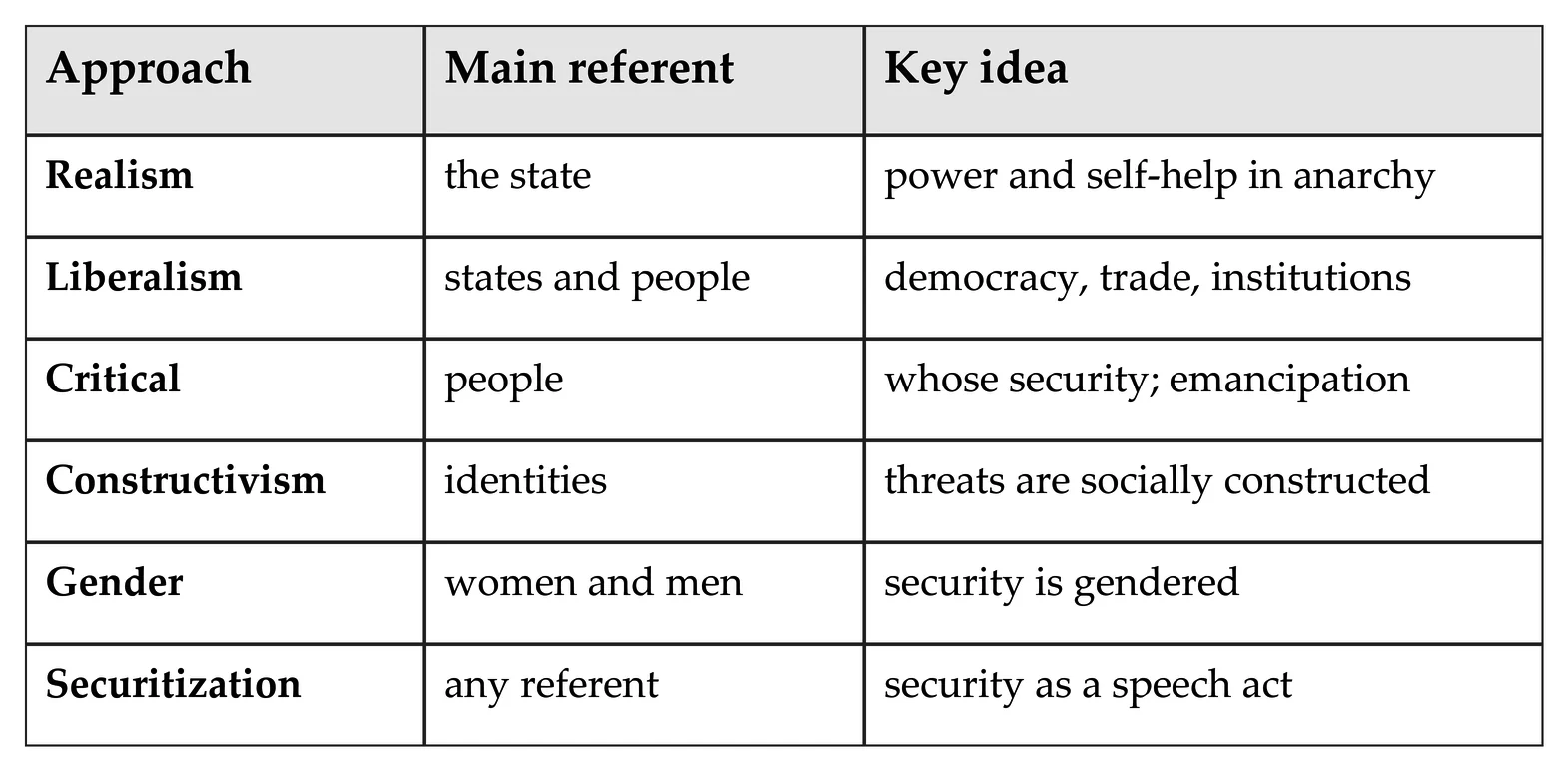
HHOW we understand security depends on the theory through which we look. Realists see a dangerous world of competing states; liberals see possibilities for cooperation; critical theorists ask whose security is being protected; constructivists show that threats are shaped by ideas and identities; feminists reveal the gendered nature of war and protection; and the Copenhagen School shows how issues become security issues through speech. This chapter studies the five approaches listed in Unit II of the syllabus: traditional approaches (realism and liberalism), critical approaches, constructivism, gender and security, and securitization.
2.1 Traditional Approaches: Realism and Liberalism
Smith: The Traditional Roots of Security
Edward Smith, in The Traditional Roots to Security: Realism and Liberalism (2015), explains that the study of security developed from two old traditions. Both see the state as central and focus on war and peace, but they disagree on whether conflict can be overcome.
Realism
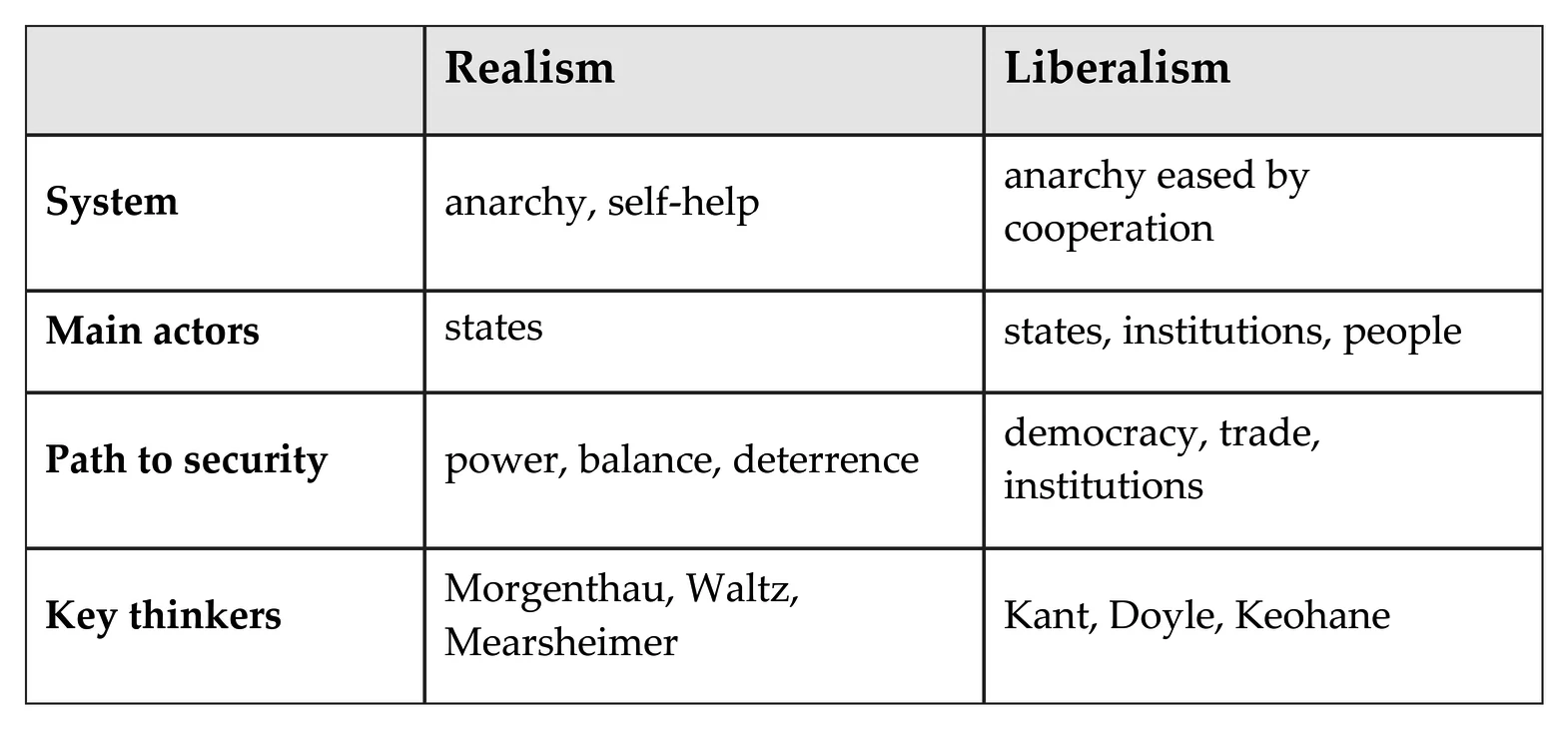
Realism sees international politics as a struggle for power in a condition of anarchy, i.e. without a world government. Classical realists such as Thucydides, Machiavelli, Hobbes and Hans Morgenthau traced conflict to human nature and the drive for power. Kenneth Waltz’s neorealism (1979) traced it to the structure of the system: in anarchy, states must rely on self-help and worry about relative power. Charles Glaser (2013) distinguishes defensive realism, which holds that states seek enough power to be secure and that restraint is often wise, from offensive realism, associated with John Mearsheimer (2001), which holds that states maximise power and seek hegemony. For realists, security comes from military strength, the balance of power, alliances and deterrence, and the security dilemma makes cooperation difficult.
Liberalism
Liberalism accepts anarchy but believes that cooperation can reduce insecurity. Patrick Morgan (2013) explains the main liberal paths to security:
- Democratic peace. Following Immanuel Kant’s Perpetual Peace (1795), Michael Doyle (1983) observed that liberal democracies rarely, if ever, fight each other.
- Economic interdependence. Trade raises the cost of war and creates shared interests.
- International institutions. Neoliberal institutionalists such as Robert Keohane argue that institutions reduce uncertainty, monitor compliance and make cooperation easier.
- Collective security. The League of Nations and the UN aimed at all states acting together against an aggressor.
- Arms control. Agreements such as the NPT (1968) and US-Soviet treaties show how rivals can cooperate to reduce danger.
Realism and Liberalism in Practice
- Nuclear deterrence. During the Cold War, the superpowers relied on mutually assured destruction, a realist logic of deterrence by the threat of unacceptable damage.
- Arms control. After the Cuban Missile Crisis of 1962, the superpowers signed the Partial Test Ban Treaty (1963) and later strategic arms agreements, a liberal logic of cooperation among rivals.
- Alliances and communities. NATO (1949) began as a realist alliance against the Soviet Union, while the European Union became a liberal community in which war among members is unthinkable.
- India. India’s nuclear deterrent and military modernisation reflect realist thinking, while its commitment to UN peacekeeping and multilateral institutions reflects liberal ideas.
- Ukraine. The Russian invasion of Ukraine in 2022 revived realist debates about great-power spheres of influence and liberal debates about sanctions and institutions.
2.2 Critical Approaches and Constructivism
Critical Approaches to Security
Critical security studies challenges the state-centric, military focus of traditional approaches and asks whose security is being protected and at whose cost. Columba Peoples and Nick Vaughan-Williams, in Critical Security Studies: An Introduction (2010), describe several strands:
- Welsh or Aberystwyth School. Ken Booth and Richard Wyn Jones link security with emancipation and make people the ultimate referent.
- Paris School. Didier Bigo and Jef Huysmans study how security professionals, such as police, border and intelligence agencies, produce insecurity through everyday practices of surveillance and control.
- Postcolonial perspectives. These show that security studies developed from the experience of Western great powers and ignored the colonial origins of many conflicts, the insecurity of postcolonial states and peoples, and the racial hierarchies in international order.
- Critical human security. Edward Newman (2010) argues that human security should be linked with critical approaches, so that it questions power structures rather than simply serving state policy.
- Antiracist security studies. Navnita Chadha Behera, Kristina Hinds and Arlene Tickner (2021) call on critical security studies to confront race and colonialism, which even critical scholars had neglected.

Constructivism and Security
Constructivism argues that the international system is shaped by ideas, norms and identities, not only by material power. Alexander Wendt (1992) argued that anarchy does not automatically produce self-help; it depends on how states understand each other, as enemies, rivals or friends. Shahin Malik, in Constructing Security (2015), and Christine Agius (2013) explain that threats are socially constructed: whether a weapon is threatening depends on who holds it and how they are seen. Five hundred British nuclear weapons, Wendt noted, are less threatening to the United States than five North Korean ones.
- Culture of national security. Peter Katzenstein’s edited volume (1996) showed how norms and identities shape states’ security policies.
- Security communities. Karl Deutsch (1957) and later Emanuel Adler and Michael Barnett (1998) described groups of states, such as Western Europe or ASEAN, among whom war has become unthinkable.
- Norms. Nina Tannenwald (1999) explained the non-use of nuclear weapons since 1945 partly by a nuclear taboo.
- Identity and threat. India’s view of China and Pakistan, and Pakistan’s view of India, are shaped by history, memory and identity as well as power.

Constructivism in Asia
Amitav Acharya, in Constructing a Security Community in Southeast Asia (2001), argued that ASEAN had developed shared norms, such as non-interference, consensus and the peaceful settlement of disputes, often called the ASEAN Way, which helped prevent war among its members despite their differences. By contrast, South Asia, divided by India-Pakistan rivalry and mistrust, has not developed such a community, and SAARC has remained weak. Constructivists argue that changes in identity and perception, such as the settlement of the India-Bangladesh land boundary in 2015, can gradually transform relations between neighbours.
2.3 Gender and Security; Securitization
Gender and Security
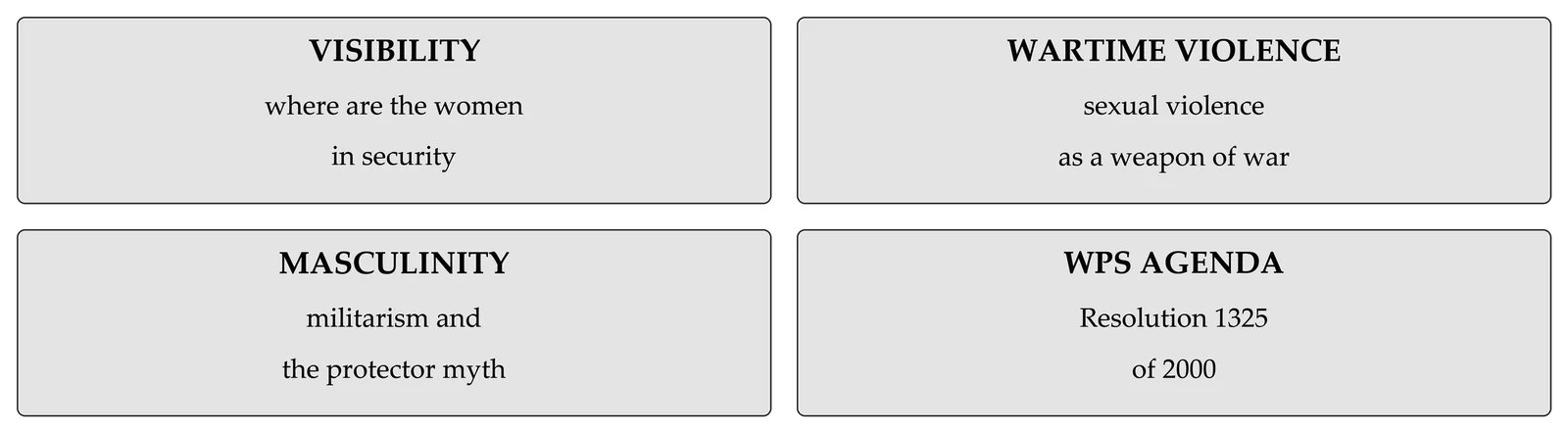
Feminist scholars argue that traditional security studies are gender-blind. Peoples and Vaughan-Williams (2010) and Caroline Kennedy (2013) show how feminist approaches transformed the field. J. Ann Tickner, in Gender in International Relations (1992), argued that realism reflects masculine values of autonomy, power and control, and that security should be redefined to include freedom from structural and domestic violence. Cynthia Enloe asked where the women are in international politics, revealing their roles as soldiers’ wives, factory workers near bases and victims of wartime violence. Carol Cohn (1987) showed how the abstract language of nuclear strategists hid the human reality of nuclear war.
- Gendered violence. Sexual violence has been used as a weapon of war, as in Bosnia and Rwanda in the 1990s; UN Security Council Resolution 1820 (2008) recognised it as a tactic of war.
- Protector myth. Security policies often claim to protect women while excluding them from decisions and militarising society.
- Women, Peace and Security. UN Security Council Resolution 1325 (2000) called for women’s participation in peace processes and protection from gender-based violence.
- India. India sent the first all-women formed police unit to a UN mission, in Liberia in 2007, and women now serve in combat roles in the armed forces.
Securitization
The theory of securitization was developed by Ole Wæver (1995) and the Copenhagen School (Buzan, Wæver and de Wilde, 1998). It argues that security is not an objective condition but a speech act: an issue becomes a security issue when a securitizing actor, such as a political leader, presents it as an existential threat to a referent object, and an audience accepts this claim. Once securitized, the issue is lifted out of normal politics, and extraordinary measures, such as secrecy, emergency powers or the use of force, become acceptable. Wæver argued that desecuritization, returning issues to normal political debate, is usually preferable, since securitization can undermine democracy.
Ralf Emmers (2013) distinguishes a securitizing move, the attempt to present an issue as a threat, from a successful securitization, which requires audience acceptance and the adoption of extraordinary measures. Examples include migration presented as a threat to national identity, HIV/AIDS recognised by the UN Security Council in Resolution 1308 (2000), terrorism after 2001 and COVID-19 in 2020. Critics argue that the theory is Eurocentric, assumes democratic audiences and neglects the voices of those who cannot speak, such as silenced women.

Securitization in India
Securitization theory helps analyse Indian debates. Illegal migration in Assam has been framed as a threat to identity and security, leading to the National Register of Citizens. Water disputes with Pakistan were linked with terrorism when India placed the Indus Waters Treaty in abeyance in 2025. In March 2020, the government invoked the Epidemic Diseases Act, 1897 and the Disaster Management Act, 2005 to deal with COVID-19, treating the pandemic as an emergency that justified extraordinary measures such as a nationwide lockdown.
- Welsh School: security as emancipation of people.
- Paris School: security as the everyday practice of security professionals.
- Copenhagen School: security as a speech act that lifts issues out of normal politics.
2.4 Important Questions
- Question 1 Compare the realist and liberal approaches to security.
- Question 2 Discuss the critical approaches to security.
- Question 3 Discuss the constructivist approach to security.
- Question 4 Discuss the gender perspective on security.
- Question 5 Explain the concept of securitization and desecuritization.
DU asks the same idea in different words. So learn one broad answer for each question below; the same answer works for every question joined by OR.
Important Question 1
Compare the realist and liberal approaches to security.
OR
Examine the traditional approaches to security.
OR
Discuss the realist view of security and the security dilemma.
Model Answer
“The strong do what they can and the weak suffer what they must.”
— Thucydides, History of the Peloponnesian War (tr. Richard Crawley)
Introduction. Realism and liberalism are the traditional approaches to security. Both place the state at the centre, but realists see a world of permanent competition for power, while liberals believe that democracy, trade and institutions can reduce insecurity. Edward Smith shows that these two traditions formed the roots of security studies.
1. Shared Starting Point
Both realism and liberalism accept that the international system is anarchic, with no world government. They differ on what follows from this.
2. Classical Realism
Thucydides, Machiavelli, Hobbes and Morgenthau traced conflict to human nature and the drive for power. The Melian dialogue shows power deciding outcomes.
3. Neorealism
Waltz traced conflict to the structure of anarchy, which forces states to rely on self-help. States worry about relative power.
4. Defensive and Offensive Realism
Glaser explains that defensive realists see states seeking enough power for security, while offensive realists like Mearsheimer see them maximising power.
5. Security Dilemma
Measures that make one state safer make others feel threatened, leading to arms races. Realists see this as hard to escape.
6. Realist Tools
Realists seek security through military strength, alliances, the balance of power and deterrence.
7. Liberal Optimism
Liberals believe that cooperation can reduce insecurity even in anarchy. Progress is possible.
8. Democratic Peace
Following Kant, Doyle observed that liberal democracies rarely fight each other. Spreading democracy can spread peace.
9. Interdependence
Trade raises the cost of war and creates shared interests, encouraging peaceful relations.
10. Institutions
Keohane argues that institutions reduce uncertainty and help states cooperate, as in arms control regimes.
11. Collective Security
Liberals support collective security through the League and the UN, where all states act against aggressors.
12. Morgan on Liberalism
Morgan shows how liberal ideas shaped the post-1945 order of institutions, alliances of democracies and arms control.
13. Realist Critique of Liberalism
Realists argue that institutions reflect power and fail when great powers disagree, as the UN’s record in many conflicts shows.
14. Liberal Critique of Realism
Liberals argue that realism cannot explain lasting peace in Europe or cooperation through the EU and NATO.
15. Indian Examples
India’s nuclear deterrence reflects realism, while its support for the UN and peacekeeping reflects liberal ideas.
16. Common Limits
Critics argue that both approaches are state-centric and neglect people, identity and gender.
17. Neoliberal Institutionalism
Keohane’s After Hegemony (1984) argued that institutions can sustain cooperation even after the decline of a hegemon, because they lower the costs of agreement.
18. Balance of Threat
Stephen Walt refined realism by arguing that states balance against threats, not just power, considering intentions, proximity and offensive capability.
19. Cold War Deterrence
Mutually assured destruction between the superpowers reflected realist logic, while arms control treaties after 1962 reflected liberal hopes for managed cooperation.
20. Evaluation
Realism explains enduring rivalry and liberalism explains cooperation; together they form the base of security studies.
Conclusion. Thus, realists, echoing Thucydides that the strong do what they can, see security in power and deterrence, while liberals see it in democracy, trade and institutions. Both remain influential, though newer approaches challenge their state-centrism.
Important Question 2
Discuss the critical approaches to security.
OR
Examine the postcolonial perspective on security studies.
OR
Discuss the Welsh and Paris Schools of critical security studies.
Model Answer
“Decolonization is always a violent phenomenon.”
— Frantz Fanon, The Wretched of the Earth (1961; tr. Constance Farrington)
Introduction. Critical security studies challenges the traditional, state-centric focus on military threats. It asks whose security is being protected, who defines threats and how security practices can themselves create insecurity. Columba Peoples and Nick Vaughan-Williams describe several strands, including the Welsh School, the Paris School and postcolonial perspectives.
1. Meaning of Critical Security Studies
Critical security studies questions the assumptions of traditional approaches. It treats security as a political and ethical question, not a technical one.
2. Whose Security
Critical scholars ask whose security a policy serves. State security may mean insecurity for citizens or minorities.
3. The Welsh School
Booth and Wyn Jones link security with emancipation, freeing people from war, poverty and oppression.
4. People as Referent
The Welsh School makes individuals the ultimate referent of security, not the state.
5. The Paris School
Bigo and Huysmans study how police, border and intelligence agencies produce insecurity through surveillance and control.
6. Security as Practice
For the Paris School, security is what security professionals do in everyday routines, not only what leaders say.
7. Postcolonial Perspectives
Postcolonial scholars show that security studies grew from Western great-power experience and ignored the colonised world.
8. Colonial Origins of Conflict
Many conflicts, such as Kashmir or the Middle East, have colonial roots that traditional theories overlook.
9. Fanon and Violence
Fanon showed how colonial violence shaped the struggle for freedom, revealing security from the standpoint of the colonised.
10. Insecurity of Postcolonial States
Postcolonial states often face internal threats, weak legitimacy and external intervention, which Western theories neglect.
11. Race and Security
Behera, Hinds and Tickner call for an antiracist critical security studies that confronts racial hierarchies in world order.
12. Critical Human Security
Newman argues that human security should question power structures, not merely serve state policy.
13. Indian Relevance
Critical approaches help analyse laws such as AFSPA or surveillance, asking whether they secure or endanger citizens.
14. Contribution
Critical approaches have widened the field to include people, ethics and the voices of the marginalised.
15. Methods
They use historical, sociological and discourse analysis rather than only material or quantitative methods.
16. Criticism
Realists argue that critical approaches neglect real military threats and offer little practical policy guidance.
17. Frankfurt School Roots
The Welsh School draws on the Frankfurt School of critical theory, which seeks to understand society in order to change it and free people from domination.
18. Security and the Subaltern
Postcolonial scholars ask how the poor, women, minorities and indigenous peoples experience security, voices often missing from state-centred analysis.
19. Security Professionals
The Paris School shows that agencies with an interest in their own budgets and powers may exaggerate threats, which affects how societies understand danger.
20. Evaluation
Critical approaches enrich security studies by asking who benefits and who suffers from security practices.
Conclusion. Thus, critical approaches, from the Welsh and Paris Schools to postcolonial perspectives informed by Fanon’s insight into the violence of decolonisation, ask whose security matters and reveal how security practices can create insecurity.
Important Question 3
Discuss the constructivist approach to security.
OR
Examine Alexander Wendt’s argument that anarchy is what states make of it.
OR
Explain the idea of security communities.
Model Answer
“A security community, therefore, is one in which there is real assurance that the members of that community will not fight each other physically, but will settle their disputes in some other way.”
— Karl W. Deutsch and others, Political Community and the North Atlantic Area (1957)
Introduction. Constructivism argues that security is shaped by ideas, norms and identities, not only by material power. Alexander Wendt argued that anarchy does not automatically produce conflict, and scholars such as Shahin Malik and Christine Agius show that threats are socially constructed. Constructivism explains why some states see each other as enemies and others as friends.
1. Ideas Matter
Constructivists argue that the international system is made of shared ideas as well as material forces. Meaning shapes behaviour.
2. Wendt on Anarchy
Wendt argued that anarchy is what states make of it; self-help is not inevitable but depends on how states see each other.
3. Cultures of Anarchy
Wendt described cultures of anarchy in which states treat each other as enemies, rivals or friends.
4. Threats Are Constructed
Malik and Agius show that whether something is a threat depends on how it is interpreted, not only on its material features.
5. The Nuclear Example
Wendt noted that British nuclear weapons are less threatening to the US than a few North Korean ones, because of identity and friendship.
6. Identity and Interest
States’ identities shape their interests, and interests shape what they see as security.
7. Katzenstein’s Culture of National Security
Katzenstein showed how norms and identities explain differences in states’ security policies, such as post-war Germany and Japan.
8. Security Communities
Deutsch described security communities in which members have real assurance that they will not fight each other.
9. Adler and Barnett
Adler and Barnett developed the idea, pointing to Western Europe and ASEAN as communities where war has become unthinkable.
10. Norms
Norms such as the nuclear taboo, described by Tannenwald, restrain the use of certain weapons.
11. Change
Because identities can change, constructivism allows for transformation from enmity to friendship, as between France and Germany.
12. India and Its Neighbours
India-Pakistan hostility is shaped by memories of partition and identity, not only by power.
13. Link to Securitization
Constructivism shares with the Copenhagen School the idea that threats are made through language and interpretation.
14. Contribution
Constructivism explains why states with similar power behave differently and how peace can be built.
15. Limits
Critics argue that constructivism has trouble explaining when and why identities change.
16. Realist Response
Realists argue that material power remains decisive and that ideas follow power.
17. Strategic Culture
Constructivism connects with the idea of strategic culture, the shared beliefs and habits of a nation’s security community, which shapes choices such as India’s restraint.
18. Norms of Sovereignty
Norms such as sovereignty and non-intervention are themselves social constructions that have changed over time, as the debate on the Responsibility to Protect shows.
19. The ASEAN Way
Acharya showed that ASEAN’s norms of non-interference and consensus helped build a security community in South-East Asia despite differences among members.
20. Changing Perceptions
The settlement of the India-Bangladesh land boundary in 2015 shows how changing perceptions can turn old disputes into cooperation.
21. Evaluation
Constructivism shows that security depends on ideas and identities, opening space for change and cooperation.
Conclusion. Thus, constructivism shows that anarchy is what states make of it and that threats are socially constructed. Security communities, where members are assured that they will not fight each other, show how shared identities can transform security.
Important Question 4
Discuss the gender perspective on security.
OR
Examine the feminist critique of traditional security studies.
OR
Discuss the significance of UN Security Council Resolution 1325.
Model Answer
“Urges Member States to ensure increased representation of women at all decision-making levels in national, regional and international institutions and mechanisms for the prevention, management, and resolution of conflict.”
— UN Security Council Resolution 1325 (2000), paragraph 1
Introduction. Feminist scholars argue that traditional security studies are gender-blind, ignoring women’s experiences and the masculine values built into ideas of power and protection. J. Ann Tickner, Cynthia Enloe and Carol Cohn transformed the field by asking where the women are and how gender shapes war and security. The Women, Peace and Security agenda brought these concerns into the United Nations.
1. Gender-Blind Security
Traditional security studies treated states and soldiers as neutral, ignoring how gender shapes war and peace.
2. Tickner’s Critique
Tickner argued that realism reflects masculine values of autonomy, power and control. Security must be redefined.
3. Where Are the Women
Enloe revealed women’s roles as wives of soldiers, workers near bases and victims of violence. Their labour sustains militaries.
4. Language of Strategy
Cohn showed how the abstract language of nuclear strategists hid the human reality of nuclear war.
5. Redefining Security
Feminists include freedom from domestic and structural violence in the meaning of security.
6. Sexual Violence in War
Rape has been used as a weapon of war, as in Bosnia and Rwanda. Resolution 1820 (2008) recognised it as a tactic of war.
7. The Protector Myth
States claim to protect women while excluding them from decisions and militarising society.
8. Masculinity and Militarism
Ideas of manhood linked to soldiering and toughness shape security policies and justify war.
9. Women as Agents
Women are not only victims but also combatants, peacemakers and leaders. Their agency is often ignored.
10. Resolution 1325
Resolution 1325 (2000) called for women’s participation in peace processes and protection from gender-based violence.
11. National Action Plans
Many countries have adopted national action plans on Women, Peace and Security to implement 1325.
12. Peoples and Vaughan-Williams
They show that gender analysis is central to critical security studies, not an add-on.
13. Kennedy on Gender and Security
Kennedy shows how feminist ideas moved from the margins to the mainstream of security studies.
14. Indian Examples
India sent the first all-women formed police unit to Liberia in 2007, and women now serve in combat roles.
15. Intersectionality
Women’s insecurity varies by class, caste, race and region, so gender analysis must consider these differences.
16. Criticism
Critics say feminist approaches can essentialise women as peaceful, while defenders reject that view.
17. Peace Processes
Studies show that peace agreements are more likely to last when women take part in negotiations, which supports the Women, Peace and Security agenda.
18. Gender and Terrorism
Feminist scholars also study how gender shapes radicalisation, recruitment and counter-terrorism policies, showing the wide reach of gender analysis.
19. Women in Combat
The opening of combat roles to women in many armed forces, including India’s, challenges the idea that soldiering is naturally male.
20. Evaluation
The gender perspective reveals hidden insecurities and has changed both theory and UN practice.
Conclusion. Thus, feminist scholars showed that security is gendered and that women’s experiences must be central. Resolution 1325’s call for women’s representation in conflict prevention and resolution shows how these ideas reached global policy.
Important Question 5
Explain the concept of securitization and desecuritization.
OR
Discuss the Copenhagen School’s theory of securitization.
OR
Examine securitization as a speech act with examples.
Model Answer
“By uttering ‘security’, a state-representative moves a particular development into a specific area, and thereby claims a special right to use whatever means are necessary to block it.”
— Ole Wæver, Securitization and Desecuritization (1995)
Introduction. Securitization theory, developed by Ole Wæver and the Copenhagen School, argues that security is not an objective condition but a speech act. An issue becomes a security issue when an actor presents it as an existential threat and an audience accepts this, allowing extraordinary measures. Wæver argued that desecuritization, returning issues to normal politics, is usually better.
1. The Copenhagen School
Buzan, Wæver and de Wilde developed securitization theory in the 1990s at the Copenhagen Peace Research Institute.
2. Security as Speech Act
Wæver argued that saying security does something: it moves an issue into a special area of urgency.
3. Securitizing Actor
A securitizing actor, usually a political leader or government, presents an issue as a threat.
4. Referent Object
The actor claims that a referent object, such as the state or national identity, faces an existential threat.
5. Audience
Securitization succeeds only if a relevant audience accepts the claim. Without acceptance, it remains a securitizing move.
6. Extraordinary Measures
Once securitized, the issue is lifted out of normal politics, and secrecy, emergency powers or force become acceptable.
7. Spectrum of Issues
Issues can be non-politicised, politicised or securitized, moving along a spectrum.
8. Desecuritization
Wæver argued that returning issues to normal politics is usually preferable, since securitization can harm democracy.
9. Emmers on Moves and Success
Emmers distinguishes a securitizing move from successful securitization, which requires acceptance and action.
10. Migration
Migration is often securitized as a threat to national identity, justifying border controls and detention.
11. Health
The UN Security Council recognised HIV/AIDS as a security issue in Resolution 1308 (2000), and COVID-19 was securitized in 2020.
12. Terrorism
After 2001, terrorism was securitized worldwide, justifying wars, surveillance and special laws.
13. Indian Examples
Illegal migration, cross-border terrorism and pandemics have been framed as security issues, enabling special measures.
14. Normative Concern
Securitization can be used to silence opponents and avoid debate, which is why the theory urges caution.
15. Criticism
Critics argue that the theory is Eurocentric, assumes democratic audiences and ignores voices that cannot speak.
16. Contribution
The theory explains how issues become security issues and helps analyse the politics of threat.
17. Regional Security Complexes
The Copenhagen School links securitization with regional security complexes, since the issues states securitize most often concern their neighbours.
18. Silence and Securitization
Lene Hansen criticised the theory for ignoring those who cannot speak security, such as women facing violence, whose insecurity remains invisible.
19. COVID-19 in India
In March 2020, India invoked the Epidemic Diseases Act and the Disaster Management Act to impose a nationwide lockdown, a clear case of extraordinary measures after securitization.
20. Evaluation
Securitization theory shows that security is a political choice, with important consequences for democracy and rights.
Conclusion. Thus, securitization theory shows that by uttering security, leaders claim a special right to use whatever means are necessary. Since this can bypass normal politics, Wæver’s preference for desecuritization reminds us to scrutinise every call to treat an issue as a security threat.
Short Notes
(a) Democratic peace
The liberal observation, associated with Kant and Doyle, that liberal democracies rarely, if ever, fight wars against each other.
(b) Security community
A group of states, such as Western Europe or ASEAN, among whom there is real assurance that disputes will be settled without war.
(c) Securitizing move
An attempt by an actor to present an issue as an existential threat; it becomes successful securitization only if an audience accepts it.
(d) Nuclear taboo
Nina Tannenwald’s term (1999) for the widely shared norm against the use of nuclear weapons, which constructivists argue helps explain why they have not been used in war since 1945, alongside deterrence.
More notes: DSE-4a Understanding Security
These notes are prepared by PADHO TO AISE for study help. They are not an official University of Delhi publication.