
Semester III DSC-7 Political Theory: Concepts and Debates
Unit IV · 25 min read · Updated 24 Nov 2026
As per the University of Delhi (DU) BA (Hons) Political Science syllabus
Contents
- 4.1 The Meaning and Analysis of Rights
- 4.2 Rights: Natural, Moral and Legal
- 4.3 The Evolution of the Concept of Rights
- 4.4 Rights and Obligations
- 4.5 Debate: Human Rights – Universalism or Cultural Relativism
- 4.6 Important Questions
- Discuss the evolution of the concept of rights.
- What are the challenges posed by cultural relativism to the notion of human rights?
- Discuss the relationship between rights and obligations.
- Short Notes
अधिकार सामाजिक जीवन की वे परिस्थितियाँ हैं जिनके बिना कोई भी व्यक्ति, सामान्यतः, अपना सर्वश्रेष्ठ रूप प्राप्त नहीं कर सकता।
Rights are those conditions of social life without which no man can seek, in general, to be himself at his best.
— Harold Laski, A Grammar of Politics (1925)
TODAY WE SPEAK of rights everywhere: the right to life, to free speech, to education, to food, to privacy, to a clean environment. Citizens go to court to enforce them, movements struggle to win them, and governments are judged by whether they respect them. But what is a right? Where do rights come from: from nature, from morality or from the law? Do rights come with obligations? And are human rights truly universal, or are they the values of one culture imposed on others? In this chapter we study the meaning and analysis of rights, the distinction between natural, moral and legal rights, the evolution of the concept of rights, the relationship between rights and obligations, and the debate on human rights: universalism or cultural relativism.
4.1 The Meaning and Analysis of Rights
A right is a justified claim that an individual or group can make on others or on the state, to be allowed to do something, to receive something, or to be protected from something. P.S. Talukdar explains that rights are not simply powers or desires: they are claims that are recognised and justified, and that impose obligations on others. Harold Laski described rights as the conditions of social life without which no one can be at his best. Ronald Dworkin described rights as ‘trumps’ that override ordinary considerations of the general welfare.
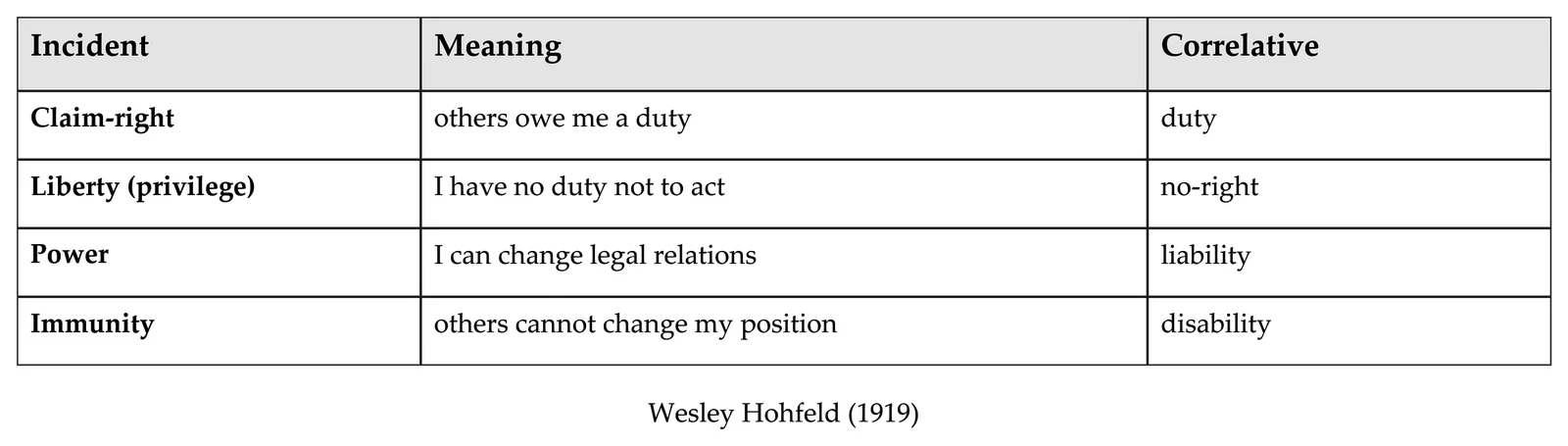
Wesley Hohfeld [होफ़ेल्ड] (1919) showed that the word ‘right’ covers four different relations, each with a correlative (Figure 4.2): a claim-right, which corresponds to someone else’s duty; a liberty or privilege, the absence of a duty not to act; a power, the ability to change legal relations, as in making a will; and an immunity, protection from others’ power to change one’s position. Catriona McKinnon explains the two main theories of why rights exist. The will or choice theory (H.L.A. Hart) holds that rights protect the right-holder’s control over the duties of others. The interest or benefit theory (Joseph Raz, Neil MacCormick) holds that rights protect important interests that justify placing others under duties.
4.2 Rights: Natural, Moral and Legal
A. Natural rights
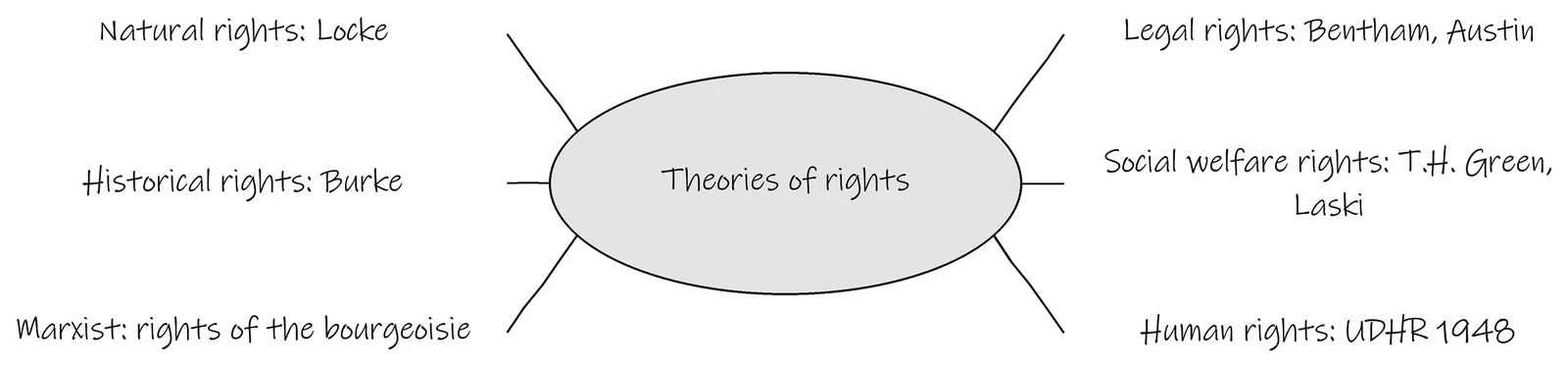
Natural rights are rights that people possess simply by being human, before and independently of any government. They are universal, inalienable and discoverable by reason. John Locke, in the Second Treatise (1690), held that people have natural rights to life, liberty and property, and that governments exist to protect them; a government that violates them may be resisted. The American Declaration of Independence (1776) spoke of ‘unalienable rights’ to life, liberty and the pursuit of happiness, and the French Declaration of the Rights of Man and of the Citizen (1789) proclaimed natural, imprescriptible rights. Criticism: Jeremy Bentham called natural rights ‘simple nonsense’ and ‘nonsense upon stilts’, because rights can only be created by law; Edmund Burke preferred the inherited rights of Englishmen to abstract rights; and Marx saw them as the rights of egoistic, isolated property-owners.
B. Moral rights
Moral rights are claims justified by moral principles, whether or not the law recognises them. A person may have a moral right to be told the truth, or to be treated with dignity, even where no law enforces it. Kant grounded such rights in the dignity of rational beings, who must be treated as ends and never merely as means. Joel Feinberg, in ‘The Nature and Value of Rights’ (1970), imagined a ‘Nowheresville’ without rights, where people receive benefits only as favours, and argued that rights give people dignity because they can claim what is due to them. Moral rights are often the basis for campaigns to change the law.
C. Legal rights
Legal rights are rights recognised and enforced by the law of a state. Legal positivists, from Bentham and John Austin to H.L.A. Hart, hold that rights are creations of law; Bentham said that right is the child of law. Legal rights include civil rights, such as freedom of speech, political rights, such as voting, and social rights, such as education. In India the Fundamental Rights in Part III are legal rights enforceable in the courts under Articles 32 and 226. Legal rights give certainty and remedies, but they can also be unjust or incomplete, which is why moral and natural rights arguments are used to criticise and reform them.
4.3 The Evolution of the Concept of Rights
The concept of rights has developed over many centuries:
- Ancient and medieval duty-based orders: in ancient Greece, India and medieval Europe, political thought focused on duties and the proper place of each person in an ordered community, such as dharma in India. Rights existed as the privileges of particular estates, as in the Magna Carta (1215), which limited the English king’s power over barons.
- Natural rights (17th century): Hobbes and Locke grounded rights in the individual. The English Bill of Rights (1689) followed the Glorious Revolution.
- Age of revolutions (18th century): the American Declaration (1776) and Bill of Rights (1791) and the French Declaration (1789) proclaimed universal rights. Thomas Paine’s Rights of Man (1791) defended them, and Mary Wollstonecraft’s A Vindication of the Rights of Woman (1792) claimed them for women.
- Critiques and extension (19th century): utilitarians and legal positivists rejected natural rights, Marx criticised bourgeois rights, while movements extended the vote to workers and abolished slavery.
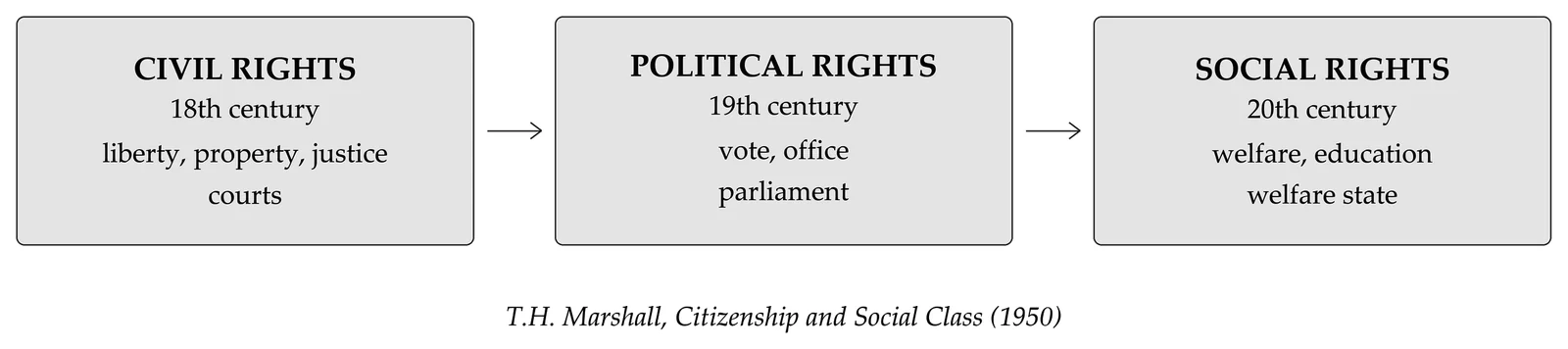
- Social rights (20th century): T.H. Marshall, in Citizenship and Social Class (1950), traced the growth of citizenship in Britain from civil rights in the eighteenth century, to political rights in the nineteenth, to social rights, such as education, health and welfare, in the twentieth (Figure 4.4).
- Human rights (after 1945): after the horrors of the Second World War, the Universal Declaration of Human Rights (1948) proclaimed rights for all human beings. India’s Hansa Mehta helped change its wording from ‘all men’ to ‘all human beings’. The two Covenants of 1966 covered civil and political, and economic, social and cultural rights.
- Generations of rights: Karel Vasak (1977) described three generations: first-generation civil and political rights (liberty); second-generation economic, social and cultural rights (equality); and third-generation collective or solidarity rights, such as the rights to development, peace, a healthy environment and self-determination (fraternity).
- Group and new rights: recent theory recognises the rights of minorities and indigenous peoples (Will Kymlicka), and debates the rights of future generations, animals and nature.
In India, the Constitution guaranteed civil and political rights as Fundamental Rights and placed social and economic rights in the Directive Principles. Through the expansion of Article 21, courts have recognised rights to livelihood, education, health, privacy and a clean environment, and laws such as the RTI, MGNREGA and the Food Security Act have created socio-economic rights.
4.4 Rights and Obligations
Rights and obligations are closely linked. According to the correlativity thesis, which Hohfeld’s analysis supports, every claim-right corresponds to a duty on someone else: my right to life is your duty not to kill me; my right to education is the state’s duty to provide schools. Rights also impose obligations on the right-holder. The idealist T.H. Green held that rights are powers recognised by society as necessary for the common good, so they carry the obligation to use them for that good. Laski wrote that rights are correlative with functions: I have rights because I contribute to the well-being of society.
Several traditions give priority to duties. In Indian thought, dharma emphasises the duties appropriate to one’s position. Gandhi held that the true source of rights is duty, and that if everyone performed their duties, rights would follow. The Indian Constitution added Fundamental Duties (Article 51A) in 1976. Communitarians such as Mary Ann Glendon (Rights Talk, 1991) criticised the language of rights for neglecting responsibility and community. Onora O’Neill argued that rights are empty unless someone has a clearly allocated duty to fulfil them; otherwise they are mere ‘manifesto rights’. Liberals reply that rights must not be made conditional on performing duties, since that would let the state withdraw rights from those it considers undeserving. The best view is that rights and obligations are mutually dependent: rights create duties for others, and a society of rights requires citizens who accept obligations.
4.5 Debate: Human Rights – Universalism or Cultural Relativism
Human rights are rights that every person has simply by being human, regardless of nationality, religion, race, sex or culture. Tom Campbell explains that the idea combines a moral claim, equal human dignity, with an international legal framework built after 1945. The Vienna Declaration of 1993 affirmed that all human rights are universal, indivisible, interdependent and interrelated. But the claim of universality has been challenged (Figure 4.5).
A. Universalism
Universalists argue that human rights rest on our common humanity and dignity, which do not vary across cultures. Every person can suffer torture, hunger and humiliation, and every person has an interest in freedom and security. Jack Donnelly argues that rights are universal at the level of basic concepts, though they may be interpreted differently in different places (‘relative universality’); Martha Nussbaum’s list of central capabilities offers a cross-cultural basis; and Rawls hoped for an overlapping consensus on basic rights among different traditions.
B. Cultural relativism
Cultural relativists argue that moral values, including rights, depend on culture, so there is no neutral standpoint from which to judge other cultures. As early as 1947, the American Anthropological Association warned that a declaration of rights might impose Western values. In the 1990s, leaders in East Asia promoted ‘Asian values’, which they said placed community, order, family and duties above individual rights, and the Bangkok Declaration (1993) of Asian states asked that national and regional particularities be kept in mind. The Cairo Declaration on Human Rights in Islam (1990) placed rights within Islamic law.
C. The challenges relativism poses to human rights
- Western origins: the idea of rights grew from Western liberal individualism, so its claim to universality may be a form of cultural imperialism; Makau Mutua criticised the human rights movement for portraying non-Western peoples as ‘savages, victims and saviours’.
- Individual versus community: many societies value the family and community over the autonomous individual.
- Duties before rights: traditions such as dharma or Confucian ethics emphasise obligations rather than claims.
- Defence of practices: practices such as child marriage, female genital cutting or caste rules are defended as culture.
- Sovereignty: relativism supports non-interference by outsiders in a state’s internal affairs.
- Selectivity: powerful states use human rights selectively against rivals while ignoring abuses by allies.
- Development priorities: some governments argue that economic development must come before civil and political freedoms.
D. Responses
Universalists reply that culture is not fixed or uniform; those who speak for a culture are often its powerful members, and the victims of a practice may reject it. Amartya Sen, in ‘Human Rights and Asian Values’ (1997), showed that Asian traditions also contain ideas of liberty and tolerance, as in the edicts of Ashoka and the policies of Akbar. Abdullahi Ahmed An-Na’im [अन-नईम] proposed a cross-cultural approach in which human rights are legitimised through internal debate within each culture, and Bhikhu Parekh argued for intercultural dialogue to reach agreement on basic values. Donnelly distinguishes strong relativism, which would deny universal rights altogether, from weak relativism, which accepts universal rights but allows variation in their interpretation and implementation; most scholars accept the second.

4.6 Important Questions
- Question 1 Discuss the evolution of the concept of rights.
- Question 2 What are the challenges posed by cultural relativism to the notion of human rights?
- Question 3 Discuss the relationship between rights and obligations.
DU asks the same idea in different words. So learn one broad answer for each question below; the same answer works for every question joined by OR.
Important Question 1
Discuss the evolution of the concept of rights.
OR
Distinguish between natural, moral and legal rights.
OR
Explain the generations of rights.
Model Answer
“Natural rights is simple nonsense: natural and imprescriptible rights, rhetorical nonsense, nonsense upon stilts.”
— Jeremy Bentham, Anarchical Fallacies (written 1796)
Introduction. A right is a justified claim that imposes obligations on others or on the state. The concept of rights has evolved over centuries, from the privileges of a few to the universal human rights of all, and from civil liberties to social, economic and collective rights.
1. Duty-Based Orders
Ancient and medieval political thought, in Greece, India and Europe, emphasised duties and each person’s place in an ordered community, such as dharma. Rights existed mainly as privileges of estates, as in the Magna Carta (1215). Magna Carta (1215), for example, protected the liberties of barons against the king rather than the rights of all people, and in Indian thought claims were embedded in the duties of varna and ashrama.
2. Natural Rights
In the seventeenth century, Hobbes and Locke grounded rights in the individual. Locke’s natural rights to life, liberty and property, which governments exist to protect, justified the Glorious Revolution and the English Bill of Rights (1689). For Locke these rights existed in the state of nature before government, so governments that violated them could be resisted; Hobbes, by contrast, made the right of self-preservation the basis of an absolute sovereign.
3. The Age of Revolutions
The American Declaration (1776) and the French Declaration of the Rights of Man (1789) proclaimed universal rights; Paine defended them and Wollstonecraft claimed them for women. Olympe de Gouges wrote the Declaration of the Rights of Woman (1791), and abolitionists demanded rights for slaves, showing that the language of universal rights could be turned against the exclusions of its authors.
4. Critiques
Bentham called natural rights nonsense upon stilts, holding that rights are created by law; Burke preferred inherited rights; Marx criticised the rights of egoistic property-owners. These critiques led to legal and social conceptions of rights. Marx argued in On the Jewish Question (1843) that the rights of man were the rights of the separated individual of bourgeois society, protecting private property rather than human emancipation.
5. Moral and Legal Rights
Moral rights are claims justified by moral principles, grounded in dignity, whether or not recognised by law; legal rights are recognised and enforced by the state, as with Fundamental Rights in India. The gap between the two drives reform: claims of Dalits, women and LGBTQ persons began as moral demands and became legal rights through legislation and judgments such as Navtej Singh Johar (2018).
6. Marshall’s Three Stages
T.H. Marshall traced the growth of civil rights in the eighteenth century, political rights in the nineteenth and social rights, such as education and welfare, in the twentieth. In Citizenship and Social Class (1950), Marshall argued that social rights were needed to make civil and political rights meaningful for the working class, giving a theory to the British welfare state.
7. Struggles of Excluded Groups
In the twentieth century the struggles of excluded groups widened rights. The American civil rights movement led by Martin Luther King Jr. demanded that equal rights be made real for African Americans, leading to the Civil Rights Act of 1964, while feminist and anti-colonial movements claimed rights for women and colonised peoples.
8. Human Rights
After the Second World War, the UDHR (1948) and the Covenants of 1966 proclaimed rights for all human beings; India’s Hansa Mehta ensured the phrase ‘all human beings’. The Holocaust convinced the world that the treatment of individuals could no longer be left wholly to sovereign states, and the UDHR became the foundation of international human rights law, monitored by UN bodies and regional courts.
9. Generations and Group Rights
Vasak identified civil-political, socio-economic and solidarity rights as three generations. Recent theory adds minority and indigenous rights, and debates rights of future generations and nature. Third-generation rights include the rights to development, peace and a healthy environment, which belong to peoples and require international cooperation.
10. The Indian Experience
India’s Constitution guaranteed Fundamental Rights and Directive Principles; courts expanded Article 21 to include livelihood, education, health and privacy, and laws created rights to information, work and food. The Right to Information Act (2005), MGNREGA (2005), the Right to Education Act (2009) and the National Food Security Act (2013) created what has been called a rights-based approach to welfare.
11. Rights in the Digital Age
The concept continues to evolve with technology: the Supreme Court recognised privacy as a fundamental right in Puttaswamy (2017), and debates on data protection, surveillance and internet access show new claims emerging.
12. Will and Interest Theories
As rights expanded, theorists debated their basis. The will theory of H.L.A. Hart holds that a right gives its holder control over another’s duty, which explains rights that can be waived but not the rights of children or animals. The interest theory of Joseph Raz holds that a right exists when an important interest justifies imposing a duty on others, which better explains welfare and children’s rights.
13. Rights as Trumps
Ronald Dworkin’s idea that rights are trumps over ordinary policy goals captured the modern view that certain individual interests must not be sacrificed even for the general welfare, which is why courts can strike down laws that violate fundamental rights.
Conclusion. Thus, the concept of rights has evolved from privileges and natural rights to universal, indivisible human rights, expanding both who holds rights and what rights they hold.
Important Question 2
What are the challenges posed by cultural relativism to the notion of human rights?
OR
Are human rights universal? Discuss with reference to cultural relativism.
OR
Discuss the ‘Asian values’ debate on human rights.
Model Answer
“All human rights are universal, indivisible and interdependent and interrelated.”
— Vienna Declaration and Programme of Action (1993)
Introduction. Human rights claim to belong to every person simply by being human. Cultural relativism challenges this claim, arguing that moral values depend on culture and that universal human rights may impose the values of one culture, the liberal West, on others.
1. The Universalist Claim
Universalists ground human rights in common humanity and dignity. Every person can suffer torture and hunger and has interests in freedom and security; the UDHR (1948) expresses this universal standard. Article 1 of the UDHR declares that all human beings are born free and equal in dignity and rights, and the Vienna Declaration (1993) affirmed that all human rights are universal, indivisible and interdependent.
2. Meaning of Cultural Relativism
Relativists hold that values are relative to culture and there is no neutral standpoint to judge other cultures. The American Anthropological Association warned in 1947 that a universal declaration might be ethnocentric. Relativism has two forms: a descriptive claim that cultures in fact hold different values, and a normative claim that no culture may judge another. Only the second directly challenges universal human rights.
3. Western Origins
Rights emerged from Western liberal individualism; relativists see universal rights as cultural imperialism, and Mutua criticised the ‘savages, victims and saviours’ narrative. Critics point to the roots of rights in European natural law and to the use of human rights language by Western powers to justify intervention and sanctions.
4. Community and Duties
Many cultures value community, family and duties above individual claims, as in dharma or Confucian ethics; the ‘Asian values’ argument stressed order and community. In the 1990s, leaders such as Lee Kuan Yew of Singapore argued that Asian societies value harmony, discipline and the family, and that Western individualism had produced crime and social breakdown.
5. The Bangkok and Cairo Declarations
The Bangkok Declaration (1993) asked that regional and national particularities be considered; the Cairo Declaration (1990) placed rights within Islamic law. Critics replied that these declarations were made by governments, many of them authoritarian, and Asian non-governmental organisations meeting at the same time issued their own declaration affirming the universality of rights.
6. Practices, Sovereignty and Selectivity
Relativism is used to defend practices such as child marriage or caste rules as culture, to resist outside interference in the name of sovereignty, and to expose the selective use of human rights by powerful states. Selective criticism, such as ignoring the abuses of allies while condemning rivals, weakens the moral authority of human rights.
7. Development First
Some governments argue that economic development must precede civil and political freedoms, challenging the indivisibility of rights. Sen replied in Development as Freedom (1999) that political freedoms help development, since no major famine has occurred in a functioning democracy with a free press.
8. Responses
Sen showed that Asian traditions, such as Ashoka and Akbar, contain liberty and tolerance; An-Na’im proposed cross-cultural legitimacy through internal debate; Parekh proposed intercultural dialogue; Donnelly accepts weak relativism in interpretation but not strong relativism.
9. Relativism and Power
Critics note that claims about a culture’s ‘true’ values are usually made by its most powerful members, such as governments, clergy or elders, while dissenters, women and minorities within it may disagree. Relativism can thus become a shield for those in power rather than a defence of a people’s way of life.
10. Evaluation
Relativism rightly warns against imposing one culture and against hypocrisy, but cultures are not uniform, and the victims of oppressive practices often demand rights. Universal rights can be interpreted in culturally sensitive ways without abandoning universality. A sensible position, which Jack Donnelly calls ‘relative universality’, holds that the core of human rights is universal while their interpretation and implementation may legitimately vary across societies.
11. The Cross-Cultural Making of the UDHR
The Universal Declaration was not drafted by the West alone. Its drafters included P.C. Chang of China, Charles Malik of Lebanon, Hernán Santa Cruz of Chile and Hansa Mehta of India, and a UNESCO survey of thinkers from many traditions found agreement on basic rights. The philosopher Jacques Maritain remarked that they agreed about the rights on condition that no one asked them why, showing that different cultures could accept the same rights for different reasons.
12. Gender and Relativism
Relativist arguments are often used against women’s rights, defending practices in marriage, inheritance or dress as culture. Several states have entered reservations to the women’s convention (CEDAW) on family law. Feminists reply that culture is often defined by men in power, and that women within each culture are themselves challenging oppressive practices. Martha Nussbaum argues that women in every culture share basic capabilities that oppressive practices deny, which gives a universal standard for judging such practices.
13. An Indian Perspective
Indian thought, with its emphasis on dharma and duties, Gandhi’s link between rights and duties, and the Constitution’s blend of individual and group rights, shows that universal rights can be grounded in non-Western traditions, while India itself has often stressed socio-economic rights and the right to development.
Conclusion. Thus, cultural relativism challenges the foundations and application of human rights, but the best response is dialogue that grounds universal rights in many cultures rather than abandoning them.
Important Question 3
Discuss the relationship between rights and obligations.
OR
Are rights and duties correlative? Discuss.
Model Answer
“The true source of rights is duty. If we all discharge our duties, rights will not be far to seek.”
— M.K. Gandhi
Introduction. Rights and obligations are two sides of social life. A right is a justified claim; an obligation is a duty to act or refrain from acting. Political theorists debate whether they are correlative and which comes first.
1. The Correlativity Thesis
Hohfeld showed that a claim-right corresponds to a duty on another: my right to life is your duty not to kill me, my right to education is the state’s duty to provide schools. Hohfeld’s Fundamental Legal Conceptions (1919) distinguished claim-rights, liberties, powers and immunities, and showed that only claim-rights correspond strictly to duties on others.
2. Duties of the Right-Holder
Rights also impose duties on their holders: to respect the equal rights of others and use rights responsibly. Green saw rights as powers recognised for the common good. For Green, society recognises rights because they enable individuals to contribute to the common good, so a right cannot be claimed against the very society that recognises it.
3. Laski’s View
Laski held that rights are correlative with functions: we have rights because we contribute to society, and rights must be exercised in a way that serves its well-being. In A Grammar of Politics (1925), Laski described rights as those conditions of social life without which no one can seek to be himself at his best, and made the citizen’s loyalty to the state depend on its securing them.
4. Duty-Centred Traditions
Indian thought centred on dharma, the duties of one’s station. Gandhi held that duty is the true source of rights; the Constitution added Fundamental Duties (Article 51A) in 1976. Replying to a UNESCO inquiry on human rights in 1947, Gandhi wrote that he had learnt from his mother that all rights to be deserved and preserved came from duty well done.
5. Communitarian Critique
Glendon criticised ‘rights talk’ for neglecting responsibility; communitarians argue that a society of rights needs citizens with a sense of obligation. Mary Ann Glendon’s Rights Talk (1991) argued that American political language had become absolute, individualistic and silent about responsibility, and Amitai Etzioni’s communitarian movement called for a balance of rights and responsibilities.
6. O’Neill: Obligations First
Onora O’Neill argued that rights are meaningful only when duties are clearly allocated to someone; otherwise they are ‘manifesto rights’, as with many socio-economic rights. In Towards Justice and Virtue (1996), she argued that starting from obligations makes clear who must act: a right to food means little unless someone has the duty to provide it.
7. The Liberal Caution
Liberals warn that making rights conditional on duties lets the state withdraw rights from those it considers undeserving; basic rights belong to all. Historically, states have denied rights to groups said to have failed in their duties, such as the poor or dissenters, which is why liberal constitutions make basic rights unconditional.
8. Positive and Negative Duties
Rights correspond to different kinds of duties: negative duties to refrain, such as not torturing, and positive duties to provide, such as schools and health care. Henry Shue, in Basic Rights (1980), showed that every basic right involves duties to avoid depriving, to protect from deprivation and to aid the deprived.
9. Rights, Duties and Citizenship
T.H. Marshall saw citizenship as a status that brings both rights and duties, such as paying taxes, education, work and military service. Republican thinkers add civic virtue: citizens must take part in public life and defend common institutions, or rights will not survive.
10. Obligations to Future Generations and Nature
Environmental thinkers argue that the present generation owes duties to future generations who cannot claim rights today. Some courts have gone further: in 2017 the Uttarakhand High Court declared the Ganga and Yamuna to be living entities, though the Supreme Court stayed the ruling.
11. Evaluation
Rights and obligations are mutually dependent: rights create duties for others and require responsible citizens, though basic rights should not depend on fulfilling duties. Rights without duties produce selfish individualism, while duties without rights produce oppression; a democratic society needs both.
12. Rights, Duties and the Indian Constitution
The Indian Constitution places Fundamental Rights in Part III and Fundamental Duties in Part IVA. Courts have used the duties to interpret the scope of rights, for example the duty to protect the environment, and Article 51A(k) places on parents the duty to provide education to their children, complementing the child’s right to education under Article 21A.
13. Rights and Political Obligation
The question also connects with political obligation: why should citizens obey the state? Liberal theories ground the obligation to obey in the state’s protection of rights, so that a state that systematically violates rights weakens the obligation of citizens, a view that justifies civil disobedience in extreme cases. This is why social contract thinkers from Locke onwards made the duty of obedience conditional on the protection of rights.
Conclusion. Thus, rights and obligations go together; a rights-respecting society needs both enforceable claims and a culture of responsibility.
Short Notes
(a) Rights versus obligations
Rights are justified claims; obligations are duties. Hohfeld’s correlativity thesis holds that every claim-right corresponds to a duty on another. Duty-centred traditions such as dharma and Gandhi’s thought put duties first, while liberals insist that basic rights must not depend on performing duties. India’s Fundamental Rights and Fundamental Duties express both.
(b) The Universal Declaration of Human Rights (1948)
Adopted by the UN General Assembly on 10 December 1948, it proclaims civil, political, economic, social and cultural rights for all human beings, beginning with the statement that all human beings are born free and equal in dignity and rights. Though not legally binding, it inspired the Covenants of 1966 and many constitutions.
(c) Natural rights
Natural rights are rights that human beings are believed to possess by nature, by virtue of being human, before and independently of any government. Locke, in the Second Treatise of Government (1690), named them as life, liberty and property, and argued that governments are formed to protect them and may be resisted if they violate them. The idea inspired the American Declaration of Independence (1776) and the French Declaration of the Rights of Man (1789). Bentham attacked it as ‘nonsense upon stilts’, arguing that rights are created by law, but the idea survives in modern human rights, which are grounded in human dignity rather than in the will of any state.
More notes: DSC-7 Political Theory: Concepts and Debates
These notes are prepared by PADHO TO AISE for study help. They are not an official University of Delhi publication.