
Semester III DSC-7 Political Theory: Concepts and Debates
Unit V · 22 min read · Updated 24 Nov 2026
As per the University of Delhi (DU) BA (Hons) Political Science syllabus
Contents
- 5.1 Democracy: Idea and Practice
- 5.2 Liberal Democracy and its Critics
- 5.3 Multiculturalism and Toleration
- 5.4 Debate: Representation vs Participation
- 5.5 Important Questions
- Critically analyse the liberal theory of democracy.
- How does representative democracy address the challenges of diversity? Explain with reference to the concept of multiculturalism.
- Discuss the debate between representation and participation in democracy.
- Short Notes
जनता का, जनता द्वारा, जनता के लिए शासन।
Government of the people, by the people, for the people.
— Abraham Lincoln, Gettysburg Address (1863)
DEMOCRACY is today the most widely accepted form of government: almost every regime, even an authoritarian one, claims to be democratic. Yet for most of history democracy was regarded with suspicion, as the rule of the ignorant many. What does democracy really mean? Is it simply choosing leaders in competitive elections, or does it require that citizens take part in decisions themselves? Is liberal democracy, the form found in most Western countries and in India, the best form, or does it hide the rule of a few? And how can a democracy treat as equals citizens who belong to many different cultures, religions and languages? In this chapter we study the idea and practice of democracy, liberal democracy and its critics, multiculturalism and toleration, and the debate between representation and participation.
5.1 Democracy: Idea and Practice
A. The idea
Democracy means rule by the people. In ancient Athens, citizens gathered in the assembly to make laws and took turns in office chosen by lot, a form of direct democracy, though women, slaves and foreigners were excluded; Plato condemned it as the rule of the ignorant. Abraham Lincoln’s phrase, government of the people, by the people, for the people, captures the modern ideal. Janaki Srinivasan explains that democracy rests on three core values: popular sovereignty, the people as the ultimate source of authority; political equality, one person one vote; and freedom, without which citizens cannot form and express their views. Thomas Christiano distinguishes instrumental justifications of democracy, which say it produces better decisions and protects interests, from intrinsic justifications, which say it is the only way to treat citizens as equals in deciding their common life.
B. The practice
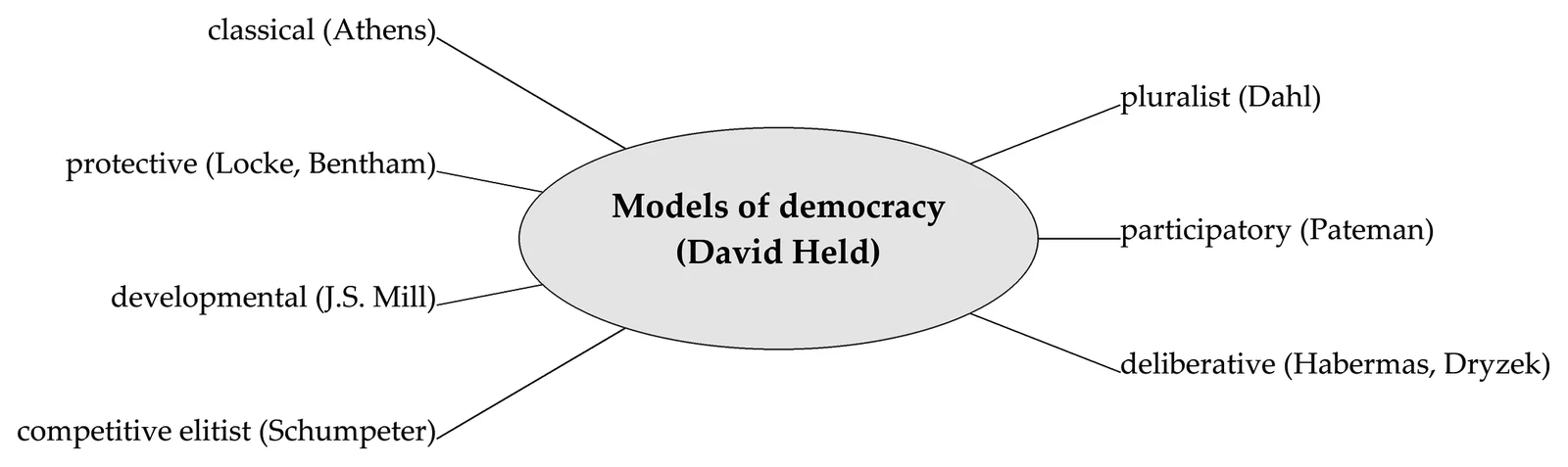
Modern democracies are mostly representative: citizens elect representatives who make decisions. Robert Dahl, in Polyarchy (1971), called real democracies ‘polyarchies’ and identified their institutions: elected officials, free and fair elections, inclusive suffrage, the right to run for office, freedom of expression, access to alternative sources of information and freedom of association. David Owen notes that democracy is both an ideal and a set of practices, and that the gap between them is a constant source of criticism. India practises democracy on an enormous scale, with universal adult franchise since 1951–52, but also faces the challenges of inequality, money power and polarisation. David Held distinguishes several models of democracy (Figure 5.2).
5.2 Liberal Democracy and its Critics
A. The liberal theory of democracy
Liberal democracy combines democracy, rule by the majority through elections, with liberalism, limited government and protection of individual rights. Its theory developed over several centuries:
- Consent and limited government: Locke argued that legitimate government rests on the consent of the governed and exists to protect natural rights.
- Checks and balances: James Madison and the American founders designed institutions to prevent the tyranny of any faction, including the majority.
- Protective democracy: Jeremy Bentham and James Mill defended voting as a way for citizens to protect their interests against rulers.
- Developmental democracy: J.S. Mill, in Considerations on Representative Government (1861), argued that participation develops citizens’ intellectual and moral capacities, and that representative government is the best form for large modern states, though he feared the ignorance of the masses.
- Competitive elitism: Joseph Schumpeter, in Capitalism, Socialism and Democracy (1942), defined democracy as an institutional arrangement in which leaders acquire the power to decide by means of a competitive struggle for the people’s vote; citizens choose rulers, they do not rule.
- Pluralism: Robert Dahl argued that power is dispersed among many competing groups, so no single group dominates.
The main features of liberal democracy are representative government chosen in free and fair elections; universal suffrage; constitutionalism and the rule of law; protection of civil liberties and minority rights; separation of powers and an independent judiciary; a free press and civil society; political pluralism and party competition; and, usually, a market economy.
B. The critics
- Marxist critique: liberal democracy gives formal political equality while leaving economic inequality and class power untouched. C.B. Macpherson, in The Life and Times of Liberal Democracy (1977), traced it to the ‘possessive individualism’ of market society. Lenin called bourgeois democracy democracy for the rich minority.
- Elitist critique: Gaetano Mosca and Vilfredo Pareto argued that a minority always rules; Robert Michels’s ‘iron law of oligarchy’ (1911) held that even democratic parties are run by elites; C. Wright Mills described a ‘power elite’ (1956).
- Participatory critique: Rousseau, Carole Pateman and Benjamin Barber argued that voting every few years is a ‘thin’ democracy; real democracy needs active participation.
- Feminist critique: Carole Pateman’s The Sexual Contract (1988) argued that the liberal social contract rested on the subordination of women, and Anne Phillips showed that women remain excluded from representation.
- Multicultural and difference critique: Iris Marion Young argued that ‘universal’ citizenship ignores group differences and silences oppressed groups.
- Deliberative critique: Jürgen Habermas and John Dryzek argued that aggregating votes is not enough; legitimacy comes from reasoned public deliberation.
- Contemporary concerns: Colin Crouch’s idea of ‘post-democracy’ (2004) describes democracies in which elections continue but real power passes to corporations and elites, while populist leaders claim to speak for ‘the people’ against institutions.
5.3 Multiculturalism and Toleration
A. Multiculturalism
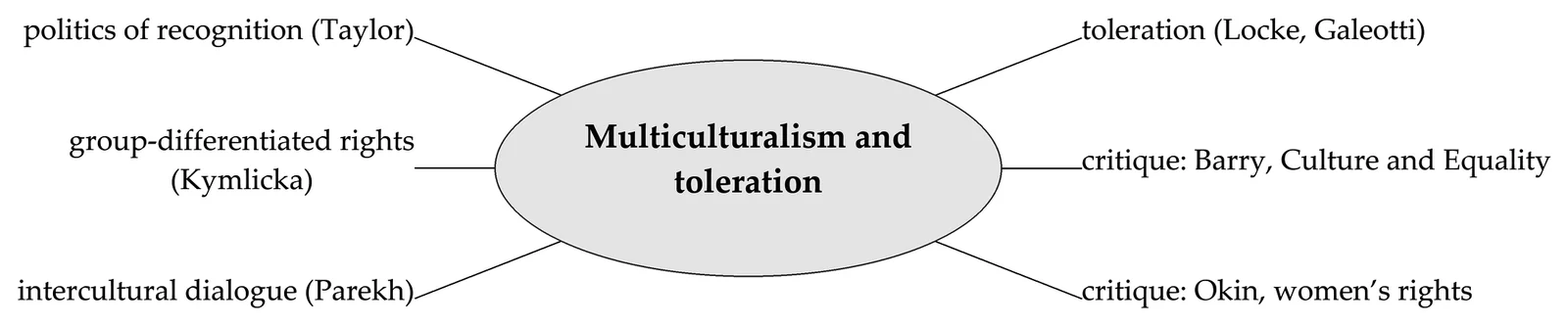
Multiculturalism refers both to the fact of cultural diversity in a society and to the normative view that the state should recognise and accommodate cultural groups rather than require them to assimilate. Monica Mookherjee and Jonathan Seglow explain the main theories (Figure 5.3):
- The politics of recognition: Charles Taylor (1992) argued that identity is shaped by recognition; misrecognition, as when a culture is treated as inferior, inflicts real harm. Beside the politics of equal dignity, which treats everyone the same, we need a politics of difference that recognises distinct identities.
- Liberal multiculturalism: Will Kymlicka, in Multicultural Citizenship (1995), argued that a person’s societal culture provides the context within which meaningful choices are made, so liberals should protect it. He distinguished national minorities, entitled to self-government rights, from immigrant (polyethnic) groups, entitled to support for cultural practices, and supported special representation rights. He accepted external protections that protect groups from the majority, but rejected internal restrictions that limit the freedom of group members.
- Intercultural dialogue: Bhikhu Parekh, in Rethinking Multiculturalism (2000), argued that every culture is partial and gains from dialogue with others; a multicultural society should be built through dialogue, not by imposing liberal values.
- Critics: Brian Barry, in Culture and Equality (2001), argued that group rights undermine equal treatment and distract from economic inequality; Susan Okin asked whether multiculturalism is bad for women, since group traditions often oppress women; conservatives worry about social cohesion; and Amartya Sen warned against treating people as members of a single cultural identity.
B. Toleration
Toleration means putting up with beliefs or practices of which one disapproves, without using force to suppress them. John Locke’s A Letter Concerning Toleration (1689) argued that the state should not coerce religious belief, since true belief cannot be forced. Mill extended toleration to all opinions and ways of life that do not harm others. Anna Elisabetta Galeotti, in Toleration as Recognition (2002), argued that toleration today is not only about leaving people alone but about the public recognition of minority identities as legitimate members of society. Karl Popper warned of the ‘paradox of tolerance’: unlimited tolerance may allow the intolerant to destroy tolerance. India has its own traditions of toleration, from Ashoka’s edicts calling for respect for all sects to Akbar’s sulh-i-kul.
C. India as a multicultural democracy
India’s Constitution has strong multicultural features: cultural and educational rights of minorities (Articles 29–30), separate personal laws, linguistic states, the Eighth Schedule, autonomous councils under the Sixth Schedule and reservations in legislatures for Scheduled Castes and Tribes. Rajeev Bhargava describes this as a distinctive Indian multiculturalism, combining individual and group rights.
5.4 Debate: Representation vs Participation
A. Representation
In a representative democracy, citizens elect representatives to make decisions. Edmund Burke, in his speech to the electors of Bristol (1774), defended the trustee model: a representative owes the people his judgement and betrays them if he sacrifices it to their opinion. The delegate model holds that representatives should follow the wishes of their constituents, and the mandate model that they should implement their party’s programme. Mill argued that representative government is the best form for large states. Supporters argue that representation is necessary in large, complex societies, allows expertise and deliberation, and protects against impulsive majorities. Hanna Pitkin showed that representation has several meanings: formal, descriptive, symbolic and substantive.
B. Participation
Participatory democrats argue that representation alone alienates citizens. Rousseau held that sovereignty cannot be represented and that the English were free only during elections. Carole Pateman, in Participation and Democratic Theory (1970), argued that participation in the workplace and community educates citizens and develops their capacity for self-government. Benjamin Barber’s Strong Democracy (1984) called for neighbourhood assemblies and civic participation. Gandhi’s gram swaraj imagined self-governing villages. Deliberative democrats such as Habermas and Dryzek argue that legitimacy depends on citizens reasoning together in public. Practical forms include referendums, gram sabhas, participatory budgeting (Porto Alegre, 1989), citizens’ juries and citizens’ assemblies.

Most theorists today see the two as complementary: representation makes democracy workable on a large scale, while participation and deliberation at local and issue levels make it more legitimate, educative and responsive. India combines a parliamentary system with gram sabhas and social audits.
5.5 Important Questions
- Question 1 Critically analyse the liberal theory of democracy.
- Question 2 How does representative democracy address the challenges of diversity? Explain with reference to the concept of multiculturalism.
- Question 3 Discuss the debate between representation and participation in democracy.
DU asks the same idea in different words. So learn one broad answer for each question below; the same answer works for every question joined by OR.
Important Question 1
Critically analyse the liberal theory of democracy.
OR
Discuss liberal democracy and its critics.
OR
What are the main features of liberal democracy? Discuss its limitations.
Model Answer
“The democratic method is that institutional arrangement for arriving at political decisions in which individuals acquire the power to decide by means of a competitive struggle for the people’s vote.”
— Joseph Schumpeter, Capitalism, Socialism and Democracy (1942)
Introduction. Liberal democracy combines rule by the majority through elections with liberal principles of limited government and individual rights. It is the dominant form of democracy in the world today, including in India, but it has been criticised from many directions.
1. Consent and Limited Government
Locke grounded legitimate government in the consent of the governed and limited it to protecting natural rights. The American founders added checks and balances to prevent the tyranny of factions, including the majority. Madison argued in The Federalist No. 10 (1787) that a large republic with many factions would prevent any single majority from oppressing the rest.
2. Protective and Developmental Democracy
Bentham and James Mill saw voting as a way to protect citizens’ interests. J.S. Mill saw participation as developing citizens’ capacities and representative government as the best form for large states. C.B. Macpherson, in The Life and Times of Liberal Democracy (1977), called these the protective and developmental models, followed by the equilibrium (pluralist-elitist) and participatory models.
3. Competitive Elitism and Pluralism
Schumpeter defined democracy as competition among leaders for votes; citizens choose rulers rather than rule. Dahl described polyarchy, in which power is dispersed among competing groups. Schumpeter, in Capitalism, Socialism and Democracy (1942), argued that the classical idea of a rational common good was unrealistic; Dahl, in Who Governs? (1961), found that different groups influenced different issues in New Haven.
4. Features
Liberal democracy has free and fair elections, universal suffrage, constitutionalism and the rule of law, protection of rights and minorities, separation of powers, an independent judiciary, a free press, party competition and usually a market economy. Dahl listed the institutions of polyarchy as elected officials, free and fair elections, inclusive suffrage, the right to run for office, freedom of expression, alternative sources of information and associational autonomy.
5. Liberal Democracy and Capitalism
Liberal democracy grew alongside market capitalism, and thinkers disagree about their relationship. Milton Friedman, in Capitalism and Freedom (1962), argued that economic freedom is a precondition of political freedom, while Marxists and social democrats argue that concentrated economic power undermines political equality as money shapes elections and the media.
6. The Marxist Critique
Marxists argue that formal political equality hides economic inequality and class power. Macpherson traced liberal democracy to possessive individualism; Lenin called it democracy for the rich. Ralph Miliband, in The State in Capitalist Society (1969), argued that state officials and business elites share backgrounds and interests, so the state serves capital even in a democracy.
7. The Elitist Critique
Mosca and Pareto held that a minority always rules; Michels’s iron law of oligarchy and Mills’s power elite showed how elites dominate parties and institutions. Michels, studying the German Social Democratic Party in Political Parties (1911), concluded that whoever says organisation says oligarchy.
8. Participatory and Deliberative Critiques
Rousseau, Pateman and Barber criticised ‘thin’ democracy based only on voting; Habermas and Dryzek argued that legitimacy requires public deliberation. They argue that voting once in five years leaves citizens passive spectators of politics.
9. Feminist and Multicultural Critiques
Pateman’s Sexual Contract exposed the exclusion of women; Phillips and Young argued that universal citizenship ignores group differences and silences the oppressed.
10. Evaluation
Liberal democracy protects freedom and allows peaceful change of government better than any alternative, but its critics show that political equality is undermined by economic inequality, elite power and exclusion. Crouch’s idea of post-democracy warns that the form can survive while the substance declines. The rise of leaders who use elections to weaken courts, the media and the opposition also shows that elections without liberal constitutionalism can produce what Fareed Zakaria (1997) called ‘illiberal democracy’.
11. Liberal Democracy in India
India adopted liberal democracy with universal adult franchise, Fundamental Rights, an independent judiciary and a free press, in a poor and unequal society. It has survived and deepened through high participation by the poor and marginalised, but faces the problems the critics identified: the power of money in elections, the dominance of elites in parties, the exclusion of women, and tensions between majority rule and minority rights.
12. The Defenders’ Reply
Defenders of liberal democracy argue that its flaws can be corrected within it, through rights, courts, elections and civil society, while its alternatives have produced tyranny. Winston Churchill remarked in 1947 that democracy is the worst form of government except all those other forms that have been tried. Francis Fukuyama even argued in 1989 that liberal democracy marked the ‘end of history’, the final form of human government, though later events have made the claim look premature.
Conclusion. Thus, the liberal theory of democracy offers a strong framework of rights and representation, but it must be deepened through participation, deliberation and greater social equality to fulfil its democratic promise.
Important Question 2
How does representative democracy address the challenges of diversity? Explain with reference to the concept of multiculturalism.
OR
Discuss multiculturalism and toleration.
OR
Examine Kymlicka’s theory of multicultural citizenship.
Model Answer
“Due recognition is not just a courtesy we owe people. It is a vital human need.”
— Charles Taylor, ‘The Politics of Recognition’ (1992)
Introduction. Most modern democracies, India above all, contain many cultural, religious, linguistic and ethnic groups. Majority rule can marginalise minorities, so democracies must find ways to represent and accommodate diversity. Multiculturalism provides the main theoretical framework for doing so.
1. The Challenge of Diversity
In a diverse society, simple majority rule may permanently exclude minorities, and a uniform national culture may force them to assimilate. Representation must therefore reflect diversity, not only numbers. Bhikhu Parekh notes that most modern states contain several religious, linguistic and ethnic communities, so the old model of a culturally homogeneous nation-state no longer fits.
2. The Politics of Recognition
Taylor argued that identity depends on recognition and that misrecognition harms; democracy must combine equal dignity with recognition of difference. In ‘The Politics of Recognition’ (1992), Taylor argued that the liberal politics of equal dignity, which treats everyone identically, may be blind to difference and force minorities into the majority’s mould.
3. Kymlicka’s Multicultural Citizenship
Kymlicka argued that societal culture provides the context of choice. He supported self-government rights for national minorities, polyethnic rights for immigrants and special representation rights, accepting external protections but not internal restrictions. In Multicultural Citizenship (1995), Kymlicka distinguished ‘external protections’, which shield a group from the wider society and are acceptable, from ‘internal restrictions’, which limit the freedom of group members and are not.
4. Parekh and Dialogue
Parekh argued that cultures are partial and benefit from dialogue; a multicultural society should be built on intercultural dialogue rather than imposed values. In Rethinking Multiculturalism (2000), Parekh argued that no culture embodies all that is valuable, and that the shared political culture of a multicultural society should be shaped through dialogue among all its communities.
5. Institutional Mechanisms
Representative democracies use proportional representation, reserved seats, federalism and linguistic states, group rights and Lijphart’s consociational arrangements of grand coalitions, mutual veto, proportionality and segmental autonomy. Phillips’s politics of presence and Young’s group representation support including groups in legislatures.
6. Toleration
Locke’s and Mill’s toleration allowed different beliefs to coexist; Galeotti argues that toleration today requires public recognition of minority identities. Toleration means accepting beliefs and practices that one disapproves of; it is weaker than respect but essential in societies with deep disagreements.
7. The Indian Model
India accommodates diversity through minority rights (Articles 29–30), personal laws, linguistic states, the Sixth Schedule and reservations for SCs and STs, which Bhargava calls Indian multiculturalism.
8. Criticisms
Barry argued that group rights undermine equality; Okin warned that they may harm women; others fear fragmentation, and Sen warned against reducing people to a single identity. Brian Barry’s Culture and Equality (2001) defended one law for all, and Susan Okin’s essay ‘Is Multiculturalism Bad for Women?’ (1999) warned that group rights may strengthen patriarchal control within communities.
9. Evaluation
Multicultural democracy works best when it protects groups against domination while protecting individuals within groups, and when representation is combined with dialogue and common citizenship. India’s experience shows both the strength and the tension of this approach: it has held vast diversity together democratically, while debates on personal laws and a uniform civil code reveal the conflict between group autonomy and individual equality.
10. Consociational Democracy
Arend Lijphart showed that divided societies such as the Netherlands, Belgium and Switzerland remained stable through consociational arrangements: a grand coalition of the leaders of all major groups, a mutual veto on vital matters, proportionality in representation and public appointments, and autonomy for each group in its own affairs. Elements of this model, such as coalition governments and group autonomy, appear in many plural democracies.
11. Group Representation
Iris Marion Young argued that oppressed groups should have guaranteed representation, and Anne Phillips defended a ‘politics of presence’, since members of excluded groups bring experiences that others cannot represent. Reserved seats for Scheduled Castes and Scheduled Tribes, and for women in local bodies and now in legislatures, apply this idea in India.
12. Federalism and Linguistic States
Federalism allows territorially concentrated groups to govern themselves; India’s linguistic reorganisation of states and its special provisions for tribal areas show how a representative democracy can accommodate diversity through territory as well as through representation.
Conclusion. Thus, representative democracy can meet the challenge of diversity through recognition, group rights, inclusive representation and toleration, balanced with individual rights and shared citizenship.
Important Question 3
Discuss the debate between representation and participation in democracy.
OR
Examine participatory and deliberative democracy.
OR
Explain Burke’s theory of representation.
Model Answer
“The English people believes itself to be free; it is gravely mistaken; it is free only during the election of Members of Parliament.”
— Jean-Jacques Rousseau, The Social Contract (1762)
Introduction. Democracy can mean either that citizens elect representatives who decide on their behalf, or that citizens take part in decisions themselves. The debate between representation and participation concerns the nature and quality of democracy.
1. The Case for Representation
In large, complex societies direct democracy is impractical. Representation allows a division of labour, expertise and deliberation, and protects against impulsive majorities; Mill considered it the best form of government. Madison saw representation as a way to refine and enlarge public views by passing them through a chosen body of citizens.
2. Burke’s Trustee Model
Burke told his Bristol electors (1774) that a representative owes them his judgement, not merely obedience; he should act for the nation’s good, not as a mouthpiece. Burke withdrew from the Bristol election of 1780, partly because he had voted by his own judgement on Irish trade and Catholic relief against his constituents’ wishes, which shows the tension within the trustee model.
3. Delegate and Mandate Models
The delegate model requires representatives to follow constituents’ wishes; the mandate model requires them to implement their party’s programme. Pitkin showed the formal, descriptive, symbolic and substantive meanings of representation. In India, the anti-defection law in effect imposes a party mandate, since members must vote as the party whip directs.
4. Rousseau’s Critique
Rousseau argued that sovereignty cannot be represented: the general will must be expressed by citizens themselves; the English were free only at elections. In The Social Contract (1762), Rousseau said that the English believe themselves free but are free only while electing members of Parliament, and become slaves as soon as the members are elected.
5. Participatory Democracy
Pateman argued that participation in workplaces and communities educates citizens; Barber called for strong democracy through civic participation; Gandhi envisioned gram swaraj. Carole Pateman’s Participation and Democratic Theory (1970) and Benjamin Barber’s Strong Democracy (1984) argued that participation produces better informed, more public-spirited and more confident citizens.
6. Deliberative Democracy
Habermas and Dryzek argue that decisions are legitimate when they result from free and reasoned public deliberation among equals, not mere counting of votes. James Fishkin’s deliberative polls, in which a random sample of citizens discuss an issue with experts before giving their views, show how deliberation changes opinions.
7. Practices
Referendums, gram sabhas, participatory budgeting (Porto Alegre), social audits and citizens’ assemblies bring citizens directly into decisions. Switzerland combines representative institutions with frequent referendums and citizens’ initiatives, showing that direct and representative democracy can work together.
8. Limitations
Participation can be time-consuming, dominated by the articulate and powerful, and difficult on a large scale; representation can become distant and elitist. Referendums can reduce complex issues to yes-or-no choices, as critics of the Brexit referendum of 2016 argued, while representative bodies can be captured by wealthy interests.
9. Mill on Representative Government
J.S. Mill, in Considerations on Representative Government (1861), argued that the ideally best form of government is representative, because it combines the participation of citizens, which educates them, with the competence of trained representatives. He favoured proportional representation to give minorities a voice, a link between the two ideals. Mill also supported proportional representation, following Thomas Hare, so that minorities would be heard, and argued for votes for women.
10. Representation in India
India combines the world’s largest elections with reserved seats for Scheduled Castes, Scheduled Tribes and now women, so that representation reflects social diversity. Yet critics point to weak links between members and voters, the dominance of party leaders and limited deliberation in Parliament.
11. Digital Participation
Digital technology has created new forms of participation, such as online petitions, public consultations on draft laws and social media campaigns, though it also spreads misinformation and may exclude those without access.
12. Participation in India
The 73rd and 74th Amendments (1992) made gram sabhas and ward committees part of the constitutional structure, and social audits under MGNREGA allow villagers to examine public spending. These institutions bring participation into a representative system, though their working is often weakened by elite capture.
13. Citizens’ Assemblies
Recent experiments such as Ireland’s Citizens’ Assembly (2016–18), a randomly selected group of citizens whose recommendations led to referendums, show how deliberation by ordinary citizens can complement representative institutions. Similar assemblies have been used in British Columbia on electoral reform (2004) and in France on climate policy (2019–20).
14. Evaluation
The two are best seen as complementary. Representation makes government possible in large and complex societies, while participation and deliberation keep representatives accountable and educate citizens. A healthy democracy needs strong representative institutions that remain open to continuous citizen participation, from local bodies to public consultations.
Conclusion. Thus, representation and participation are complementary: representation makes democracy workable, while participation and deliberation make it legitimate and alive.
Short Notes
(a) Toleration
Putting up with beliefs or practices of which one disapproves without suppressing them. Locke’s Letter Concerning Toleration (1689) argued that the state should not coerce faith; Mill extended toleration to all self-regarding conduct; Galeotti sees modern toleration as public recognition of minority identities. Popper’s paradox of tolerance warns that tolerating the intolerant can destroy tolerance.
(b) Deliberative democracy
A theory, associated with Jürgen Habermas and John Dryzek, holding that democratic legitimacy comes from free, equal and reasoned public deliberation, in which citizens justify their views to one another, rather than from the mere aggregation of preferences through voting.
(c) Consociational democracy
Arend Lijphart’s model for divided societies, based on a grand coalition of the leaders of all major groups, a mutual veto, proportionality in representation and appointments, and segmental autonomy for each group. It explains how countries such as the Netherlands and Switzerland remained stable despite deep divisions.
More notes: DSC-7 Political Theory: Concepts and Debates
These notes are prepared by PADHO TO AISE for study help. They are not an official University of Delhi publication.