
Semester II DSC-4 Perspectives on Public Administration
Unit I · 33 min read · Updated 24 Nov 2026
As per the University of Delhi (DU) BA (Hons) Political Science syllabus
Contents
- 1.1 Meaning, Nature and Scope of Public Administration
- 1.2 Ancient Roots of Public Administration: Perspectives from India (Kautilya’s Arthashastra)
- 1.3 Modern PA: An Overview of the Theoretical Journey
- 1.4 Principles of Public Administration
- 1.5 Theorising Public Administration
- 1.6 Important Questions
- Trace the evolution of Public Administration as a discipline.
- Discuss the administrative ideas of Kautilya as contained in the Arthashastra.
- Critically examine the principles approach to public administration.
- What is theory in public administration? Discuss the possibilities of theorising public administration.
- Short Notes
संविधान बनाने से अधिक कठिन अब उसे चलाना होता जा रहा है।
It is getting to be harder to run a constitution than to frame one.
— Woodrow Wilson, The Study of Administration (1887)
EVERY GOVERNMENT has two faces. One face makes decisions: it passes laws, frames policies and announces programmes. The other face carries them out: it collects taxes, runs schools and hospitals, keeps records, maintains order and delivers services to citizens. This second face is public administration. It is as old as government itself, and in India it was described in detail more than two thousand years ago in Kautilya’s Arthashastra. But as a separate subject of study it began only in 1887, when Woodrow Wilson argued that running a government had become harder than making a constitution. In this chapter we study what public administration is, its ancient roots in India, the journey of the modern discipline from Wilson to the present, the ‘principles’ that early thinkers believed would make administration scientific, and finally what it means to build theory in public administration.
1.1 Meaning, Nature and Scope of Public Administration
The word administration comes from the Latin ad and ministrare, which mean ‘to serve’ or ‘to manage’. Administration in general is the organisation of people and resources to achieve a goal. When this activity is carried out by the government, for public purposes and under public law, it becomes public administration. Woodrow Wilson defined it as the ‘detailed and systematic execution of public law’; L.D. White described it as all the operations whose purpose is the fulfilment or enforcement of public policy; and Dwight Waldo called it the art and science of management applied to the affairs of the state.
A. Nature: two views
Scholars differ on what exactly public administration includes. According to the integral view, held by L.D. White and Marshall Dimock, public administration includes all the activities of all the people in a public organisation, from the head of a department to the clerk and the peon, whether managerial, technical or routine. According to the managerial view, held by Luther Gulick, Herbert Simon and Pfiffner, public administration includes only the managerial activities of those at the top, i.e. planning, organising, directing and controlling, and not the routine work of lower employees. The managerial view focuses on the art of management; the integral view reminds us that administration is the work of the whole organisation.
B. Scope
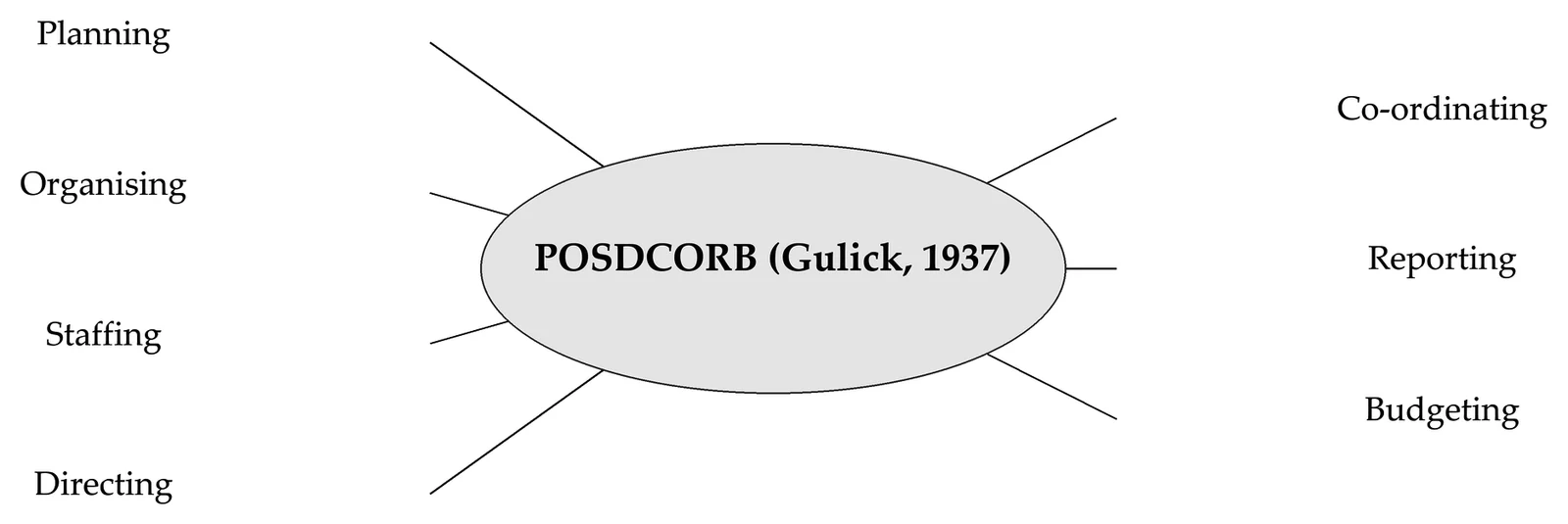
The scope of public administration has been described in two ways. The POSDCORB view of Gulick says that the subject studies the seven functions of the executive: planning, organising, staffing, directing, co-ordinating, reporting and budgeting (Figure 1.5). The subject-matter view says that this is too narrow, because administration is not only a set of techniques but also the substantive services that government provides, such as defence, education, health and agriculture, each with its own problems. Today the scope is very wide. It includes the study of organisations, personnel, finance, public policy, accountability and control, administrative law, comparative and development administration, and new areas such as governance, digital government and gender.
C. Public and private administration
Is administering a government department the same as managing a company? Henri Fayol and the scientific-management writers believed that the principles of administration are the same everywhere. But Paul Appleby, in Big Democracy (1945), argued that ‘government is different’, because public administration is political: it works in a fish bowl, under public scrutiny, and must answer to Parliament, the courts and the people. The differences are clear. Public administration serves the public interest rather than profit; it is bound by law and procedure; it is accountable to many masters; it often holds a monopoly, as in policing or taxation; and it must treat all citizens equally. Graham Allison put the debate memorably in 1979 when he asked whether public and private management are ‘fundamentally alike in all unimportant respects’. The similarities are in technique; the differences are in purpose and accountability.
1.2 Ancient Roots of Public Administration: Perspectives from India (Kautilya’s Arthashastra)
Public administration as a discipline is modern, but administration as a practice is very old. Egyptian, Chinese, Greek and Roman civilisations all had organised bureaucracies, and China recruited officials by examination for over a thousand years. In India, the most systematic ancient text on government is the Arthashastra [अर्थशास्त्र] of Kautilya [कौटिल्य], also called Chanakya or Vishnugupta, traditionally regarded as the minister of Chandragupta Maurya (4th century BCE). The text was rediscovered and published by R. Shamasastry in 1909. It is a manual on how to acquire, protect and govern a state, and much of it is concerned with what we would today call administration. Scholars such as A. Kumar and B. Muniapan have shown that it contains a remarkably modern understanding of organisation and management.
A. The state and its seven elements
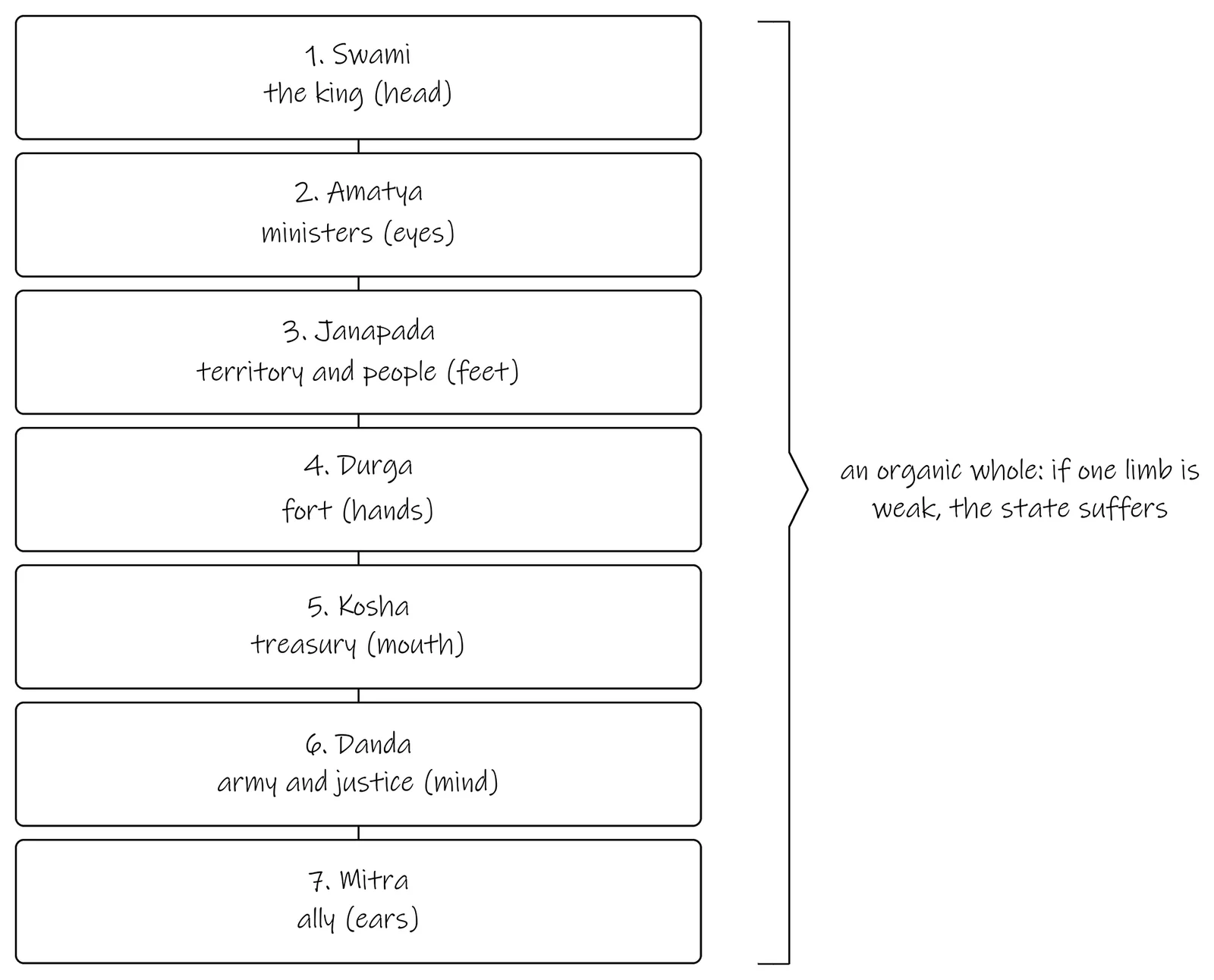
Kautilya described the state as an organism with seven limbs, the saptanga theory (Figure 1.2): the king (swami), the ministers (amatya), the territory and people (janapada), the fortified capital (durga), the treasury (kosha), the army (danda) and the ally (mitra). Each limb depends on the others, and administration is the work of keeping all of them healthy. Note that the treasury is central: Kautilya wrote that all undertakings depend on finance, so the treasury deserves the foremost attention.
B. The administrative structure
At the top was the king, the chief executive, who was expected to work long hours according to a strict timetable, hear petitions and supervise officials. He was advised by a small council of mantrins (ministers) and a larger mantriparishad (council of ministers). Below them was a large, specialised bureaucracy of amatyas [अमात्य] (officers). Two officials headed the financial system: the samaharta [समाहर्ता] (collector-general), who supervised revenue collection, and the sannidhata [सन्निधाता] (treasurer), who looked after the treasury and stores. The work of government was divided among about thirty adhyakshas [अध्यक्ष] (superintendents) of departments such as agriculture, mines, trade, weights and measures, forests, ships, liquor, the mint and the armoury, a clear example of division of work by function. Local administration was organised in a hierarchy from the village (grama) upwards, with the gopa in charge of a group of villages and the sthanika in charge of a district.
C. Recruitment, discipline and control
Kautilya insisted that officers be appointed on the basis of qualifications, such as birth in the country, learning, skill, intelligence, health and loyalty, and that their integrity be tested by secret tests called upadhas [उपधा]: tests of piety (dharma), of greed (artha), of lust (kama) and of fear (bhaya). Officers who passed different tests were placed in different posts. He knew that officials might be corrupt: he listed forty ways of embezzlement and remarked that just as it is impossible not to taste honey placed on the tongue, it is impossible for an official not to taste a little of the king’s revenue. So he recommended frequent transfers, audits of accounts, rewards and punishments, and a network of spies to watch officials.
D. Welfare and the purpose of administration
Kautilya’s administration was not only about control. He wrote that in the happiness of the subjects lies the happiness of the king, and in their welfare his welfare. The state was expected to build irrigation works, protect trade, regulate prices and weights, help orphans, the old and the sick, and provide relief in famines. In modern language, the Arthashastra describes a welfare-oriented, bureaucratic state.
E. Relevance today
Many ideas of modern public administration are found in Kautilya: division of work, hierarchy, merit-based recruitment, training, performance appraisal, financial control, audit, anti-corruption measures, a code of conduct for officials and the goal of public welfare. Muniapan reads the text as a guide to organisational management, with lessons for planning, leadership and human resources. At the same time, Kautilya’s administration served a monarch, relied heavily on spies and punishment, and did not know modern ideas of democratic accountability or citizens’ rights. Studying the Arthashastra also reminds us that public administration has non-Western roots, a point stressed by perspectives from the Global South.
1.3 Modern PA: An Overview of the Theoretical Journey
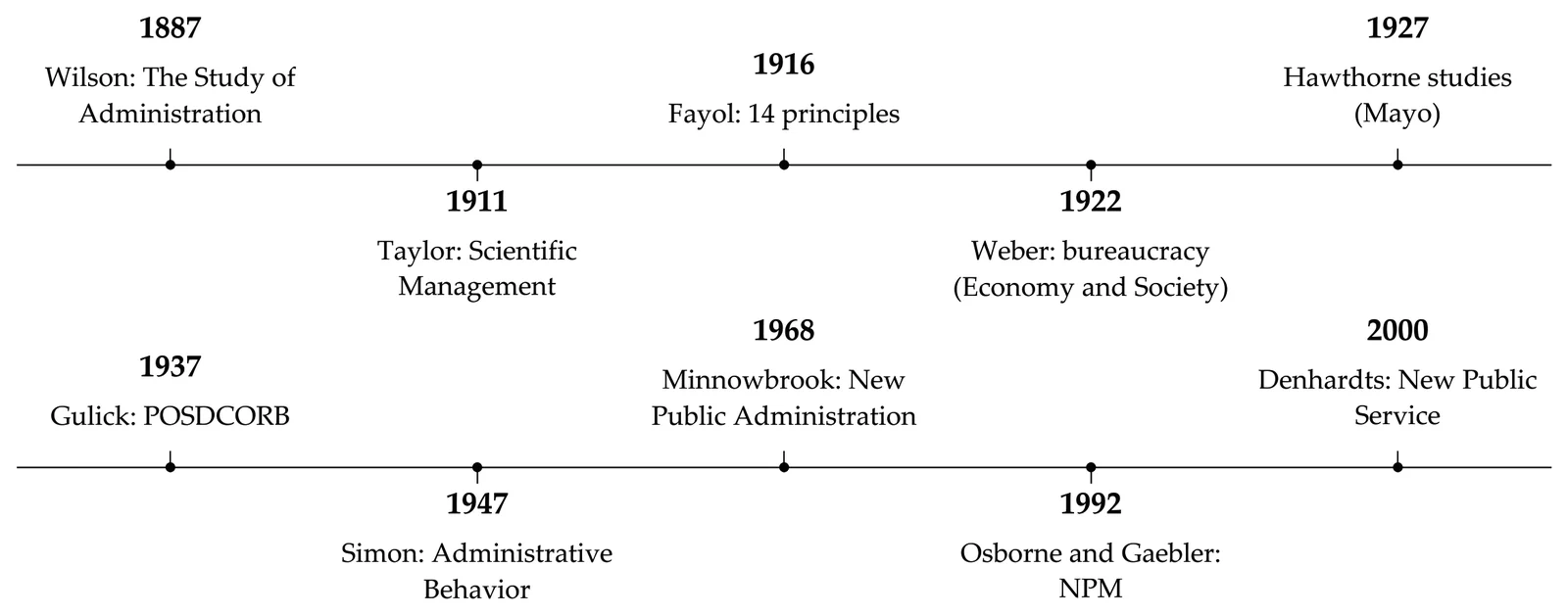
The modern discipline of public administration was born in the United States at the end of the nineteenth century, when government was growing rapidly and the ‘spoils system’, under which jobs were given to party supporters, had made administration corrupt and inefficient. Its journey can be followed through the five paradigms described by Nicholas Henry, together with the challenges and new movements that came after them (Figure 1.3).
A. The beginning: Wilson and the politics–administration dichotomy (1887–1926)
Woodrow Wilson’s essay ‘The Study of Administration’, published in the Political Science Quarterly in 1887, is regarded as the founding text of the discipline. Wilson made four arguments. First, administration had become more complex than constitution-making and deserved its own science. Second, administration is separate from politics: ‘administration lies outside the proper sphere of politics’, since politics sets the tasks for administration but should not interfere in its work. Third, administration is a field of business, which should be run efficiently. Fourth, America could learn administrative methods even from autocratic countries such as Prussia and France without adopting their politics; as he put it, one could borrow a murderer’s clever way of sharpening a knife without borrowing his intention. Frank Goodnow, in Politics and Administration (1900), developed this into the politics–administration dichotomy: politics is the expression of the will of the state, and administration is the execution of that will. Henry calls this period Paradigm 1: the politics/administration dichotomy (1900–1926). L.D. White’s textbook (1926) assumed that administration is a value-free activity whose goal is economy and efficiency.
B. The search for principles (1927–1937)
In Paradigm 2: the principles of administration, scholars believed that there are scientific principles of administration that apply everywhere. W.F. Willoughby’s Principles of Public Administration (1927), Mooney and Reiley’s Onward Industry! (1931) and Gulick and Urwick’s Papers on the Science of Administration (1937) were the high points. This was the ‘golden age’ of orthodoxy, influenced by Taylor’s scientific management and Weber’s bureaucracy, which we study in Chapter 2.
C. Challenges (1938–1950)
The orthodoxy was soon challenged. Chester Barnard’s The Functions of the Executive (1938) showed the importance of informal organisation and cooperation. The New Deal and the Second World War showed that administrators make policy, so the dichotomy was unrealistic. Herbert Simon’s article ‘The Proverbs of Administration’ (1946) argued that the so-called principles were contradictory proverbs. Robert Dahl (1947) said that a science of administration was impossible unless it dealt with values, human behaviour and the social setting. Dwight Waldo’s The Administrative State (1948) showed that the orthodox theory was itself a political philosophy.
D. An identity crisis (1950–1970)
Having lost its principles, the discipline searched for a home. In Paradigm 3: public administration as political science (1950–1970), it returned to political science departments, but there it was treated as a second-class field. In Paradigm 4: public administration as management (1956–1970), it joined schools of business and management, where it lost its ‘public’ character. Waldo described this as an identity crisis. Meanwhile, the comparative and development administration movement, led by Fred Riggs and Edward Weidner, studied administration in the new nations of Asia and Africa.
E. Public administration as public administration (1970– )
In Paradigm 5, public administration became an independent discipline with its own schools, journals and association; the National Association of Schools of Public Affairs and Administration (NASPAA) was founded in 1970. Its focus became public policy and public management, and its locus the public interest. Within this period several new movements appeared. The New Public Administration, launched at the Minnowbrook Conference of 1968 and reported in Frank Marini’s Toward a New Public Administration (1971), demanded relevance, values, social equity and change. Vincent Ostrom’s The Intellectual Crisis in American Public Administration (1973) introduced public choice theory. From the 1980s the New Public Management applied market methods to government, and from the 2000s the New Public Service and governance perspectives stressed citizenship, networks and collaboration (Chapter 3). Feminist and Global South perspectives have also questioned the assumptions of the mainstream (Chapter 4).
| Paradigm | Period | Locus (where) | Focus (what) |
|---|---|---|---|
| 1. Politics/administration dichotomy | 1900–1926 | Government bureaucracy | Not clearly defined |
| 2. Principles of administration | 1927–1937 | Anywhere | Universal principles |
| 3. PA as political science | 1950–1970 | Government bureaucracy | Unclear; politics |
| 4. PA as management | 1956–1970 | Unclear | Management techniques |
| 5. PA as PA | 1970– | Public interest, public affairs | Public policy and management |
F. Three approaches to public administration (Rosenbloom)
David Rosenbloom and his co-authors show that this long journey has left behind three different approaches, each with its own values. The managerial approach, from Wilson and Taylor to the New Public Management, values efficiency, economy and effectiveness. The political approach, from Appleby onwards, values representativeness, responsiveness and accountability to elected officials and the people. The legal approach, rooted in administrative and constitutional law, values the rights of individuals, due process and equity. The three often pull in different directions, and good administration must balance them.
1.4 Principles of Public Administration
The classical writers believed that administration could be made scientific by discovering principles, general rules of organisation that apply to every organisation, public or private, whatever its purpose. These ideas came from the experience of industry, the army and the church, and they still shape the structure of government departments.
A. Fayol’s principles
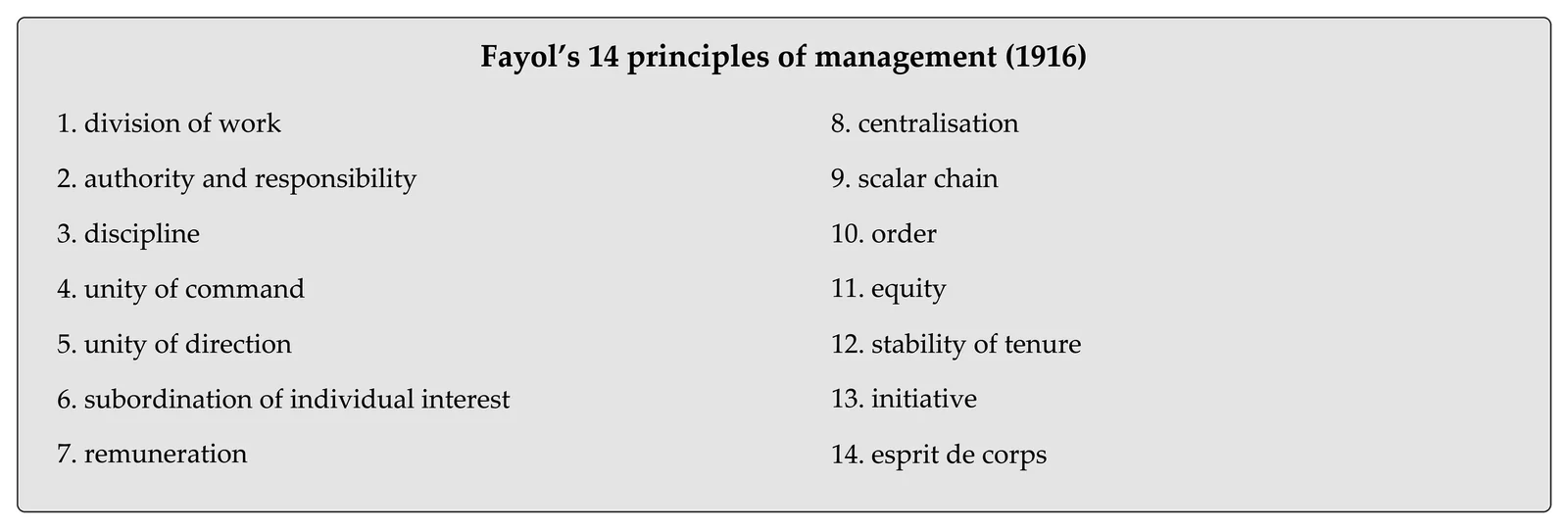
The French industrialist Henri Fayol [फेयोल], in General and Industrial Management (1916), identified five functions of management, to plan, organise, command, co-ordinate and control, and fourteen principles (Figure 1.4). The most important for public administration are division of work, authority and responsibility, unity of command (each employee has only one superior), unity of direction, centralisation and the scalar chain, the line of authority from top to bottom. Fayol allowed one exception, the ‘gang plank’, by which officials at the same level could communicate directly to save time.
B. Gulick, Urwick and POSDCORB
Luther Gulick [गुलिक], a member of President Roosevelt’s Committee on Administrative Management (the Brownlow Committee), summed up the work of the chief executive in the acronym POSDCORB (1937): Planning, Organising, Staffing, Directing, CO-ordinating, Reporting and Budgeting (Figure 1.5). Gulick also gave four bases on which work can be divided into departments, the ‘four Ps’: purpose (for example, health or education), process (for example, engineering or accounting), persons or clientele (for example, tribal welfare) and place (for example, a regional office). Lyndall Urwick brought together the principles of Fayol, Taylor and Mooney into a list of twenty-nine principles.
C. Other classical principles
- Hierarchy (scalar principle): authority flows from top to bottom in a series of steps; Mooney and Reiley called it the scalar process.
- Span of control: a superior can effectively supervise only a limited number of subordinates; V.A. Graicunas (1933) showed mathematically that relationships multiply rapidly as subordinates are added.
- Unity of command: an employee should receive orders from one superior only, to avoid confusion.
- Co-ordination: Mooney called it the first principle of organisation, the orderly arrangement of group effort.
- Line and staff: line agencies carry out the main work, while staff agencies, such as planning units, advise them.
- Delegation and centralisation: authority can be delegated downwards, but final responsibility remains with the superior.
D. The critique of the principles
Herbert Simon’s ‘The Proverbs of Administration’ (1946) was the decisive attack. He argued that the principles are like proverbs, which always come in contradictory pairs, such as ‘look before you leap’ and ‘he who hesitates is lost’. For example, a narrow span of control requires many levels of hierarchy, but the principle of efficiency requires as few levels as possible; specialisation by purpose conflicts with specialisation by process; and unity of command conflicts with specialisation, since an accountant in a health department must follow both the health officer and the finance department. The principles, Simon said, are not scientific laws but criteria for describing and diagnosing situations. Dahl added that they ignore values, human behaviour and differences between countries, and the human relations school (Chapter 2) showed that they ignore the informal organisation. Yet the principles have not disappeared: they remain useful guides for designing organisations, provided they are applied with judgement.
1.5 Theorising Public Administration
A theory is a set of related ideas that describes, explains or predicts something, or tells us what ought to be done. H. George Frederickson and his co-authors, in The Public Administration Theory Primer, begin with ‘the possibilities of theory’. They admit that public administration has often been seen as a practical field without theory of its own. But they argue that theory is necessary, because every administrator acts on some theory, stated or unstated, about why people behave as they do and how institutions work; theory makes these assumptions clear and testable.
A. Types of theory
Stephen K. Bailey (1968) identified four kinds of theory in public administration, and the classification is still useful:
- Descriptive-explanatory theory describes and explains how administration actually works, for example Weber’s account of bureaucracy or Riggs’s prismatic society.
- Normative theory says what administration ought to do and what values it should serve, for example the New Public Administration’s demand for social equity.
- Assumptive theory studies the nature of the administrator and the human beings in organisations, for example the assumptions behind McGregor’s Theory X and Theory Y.
- Instrumental theory develops techniques for achieving goals more efficiently, for example Taylor’s time-and-motion studies or performance budgeting.
B. The main families of theory
Frederickson and his co-authors show that public administration does not have one grand theory but many middle-range theories, each answering a different question. Theories of political control of bureaucracy ask how elected officials control administrators; theories of bureaucratic politics show that administrators also make policy; public institutional theory studies how rules and institutions shape behaviour; public management theory studies how public organisations can perform better; decision theory and rational choice theory study how administrators make choices; postmodern theory questions the claim of administration to objective knowledge; and governance theory studies how government works with markets and civil society. Each borrows from political science, economics, sociology or management, which shows that public administration is an interdisciplinary field.
C. Public administration as a science
Wilson and the classical writers hoped to build a science of administration. Dahl replied in 1947 that this was impossible unless the discipline dealt with three problems: it cannot ignore values, it must study real human behaviour, and it must take account of different social settings, because principles that work in one country may fail in another. Simon replied that administration can be scientific if facts are separated from values and decisions are studied empirically. The debate continues, but most scholars now see public administration as both a science and an art: it uses systematic knowledge, but applying it requires judgement and values. The growth of comparative, feminist and Global South perspectives also shows that theory must be sensitive to context.
1.6 Important Questions
- Question 1 Trace the evolution of Public Administration as a discipline.
- Question 2 Discuss the administrative ideas of Kautilya as contained in the Arthashastra.
- Question 3 Critically examine the principles approach to public administration.
- Question 4 What is theory in public administration? Discuss the possibilities of theorising public administration.
DU asks the same idea in different words. So learn one broad answer for each question below; the same answer works for every question joined by OR.
Important Question 1
Trace the evolution of Public Administration as a discipline.
OR
Discuss the paradigms of public administration given by Nicholas Henry.
OR
Examine the politics–administration dichotomy. Is it still relevant?
OR
Give an overview of the theoretical journey of modern public administration.
Model Answer
“Administration lies outside the proper sphere of politics. Administrative questions are not political questions.”
— Woodrow Wilson, ‘The Study of Administration’ (1887)
Introduction. Public administration is the machinery through which the state carries out its laws and policies. As an activity it is as old as government, but as a discipline it began with Woodrow Wilson’s essay of 1887. Since then it has passed through several stages, which Nicholas Henry describes as five paradigms, each defined by its locus (where administration is found) and its focus (what it studies).
1. The Founding: Wilson’s Essay
Wilson wrote at a time when the American ‘spoils system’ had made government corrupt. He argued that administration had become harder than constitution-making and needed its own science; that administration is separate from politics and is a field of business; and that America could borrow efficient methods even from autocracies without borrowing their politics. The Pendleton Act of 1883, which introduced merit recruitment in the United States, provided the practical background. Wilson observed that it was getting harder to run a constitution than to frame one.
2. Paradigm 1: The Politics–Administration Dichotomy (1900–1926)
Frank Goodnow, in Politics and Administration (1900), argued that politics expresses the will of the state and administration executes it. The locus of public administration was the government bureaucracy, but its focus was not clearly defined. L.D. White’s Introduction to the Study of Public Administration (1926) treated administration as a value-free activity aimed at economy and efficiency.
3. Paradigm 2: The Principles of Administration (1927–1937)
Scholars now believed that there are universal principles of administration, valid in any organisation. Willoughby’s Principles of Public Administration (1927), Mooney and Reiley’s Onward Industry! (1931) and Gulick and Urwick’s Papers on the Science of Administration (1937), with its famous POSDCORB, marked this ‘golden age’. The focus was the principles; the locus could be anywhere.
4. The Challenge to Orthodoxy (1938–1950)
Barnard (1938) stressed informal organisation; the New Deal showed that administrators make policy; Simon’s ‘The Proverbs of Administration’ (1946) exposed the contradictions of the principles; Dahl (1947) argued that a science of administration must deal with values, behaviour and social settings; and Waldo’s The Administrative State (1948) showed that orthodox theory was itself a political theory.
5. Paradigms 3 and 4: An Identity Crisis (1950–1970)
Public administration returned to political science (Paradigm 3), where it was treated as a junior field, and at the same time joined management schools (Paradigm 4), where it lost its public character. Waldo called this an identity crisis. In this period comparative and development administration, led by Fred Riggs, studied the administrations of new nations.
6. Paradigm 5: Public Administration as Public Administration (1970– )
With NASPAA (1970), the subject became an independent discipline whose focus was public policy and management and whose locus was the public interest. The New Public Administration of Minnowbrook (1968) demanded relevance, values and social equity; public choice theory (Ostrom, 1973) applied economics to administration; the New Public Management of the 1980s and 1990s applied market methods; and the New Public Service and governance perspectives of the 2000s stressed citizenship, networks and collaboration. The Minnowbrook Conference (1968) and the New Public Administration brought values of equity and relevance.
7. The Politics–Administration Dichotomy Today
The dichotomy is no longer accepted in its strict form. Administrators advise ministers, draft laws, use discretion and shape policy; Appleby called administration a political process. Yet the dichotomy keeps a normative value: it protects civil servants from political interference, supports a neutral and merit-based civil service, and reminds us that elected representatives, not officials, must take final decisions. In India, the tension between a ‘committed’ and a ‘neutral’ bureaucracy shows that the debate is still alive.
8. The Discipline in India
In India the discipline grew with the Indian Institute of Public Administration (1954) and university departments, focusing on development administration, Panchayati Raj and administrative reform.
9. Critical Evaluation
The journey shows that the discipline has moved from a narrow concern with efficiency to a broad concern with values, citizens and governance. Rosenbloom shows that it now contains managerial, political and legal approaches. Critics note that the story told by Henry is American-centred; Kautilya’s Arthashastra and Chinese administrative traditions show that the practice and even the theory of administration are much older and more global.
Conclusion. Thus, public administration has grown from Wilson’s plea for an efficient, non-political administration into a mature, interdisciplinary discipline that studies how the state can serve citizens efficiently, accountably and justly.
Important Question 2
Discuss the administrative ideas of Kautilya as contained in the Arthashastra.
OR
Examine the ancient roots of public administration in India.
OR
Evaluate the relevance of Kautilya’s Arthashastra for modern public administration.
Model Answer
“In the happiness of his subjects lies the happiness of the king; in their welfare, his welfare.”
— Kautilya, Arthashastra (Book I)
Introduction. Long before Wilson, India had a detailed theory and practice of administration. The Arthashastra of Kautilya [कौटिल्य], traditionally dated to the Mauryan period (4th century BCE) and rediscovered by R. Shamasastry in 1909, is a manual of statecraft that describes the organisation, personnel, finance and control of a large, centralised state. It shows that the roots of public administration are not only Western.
1. The Saptanga Theory of the State
Kautilya saw the state as an organism of seven limbs: swami (king), amatya (ministers), janapada (territory and people), durga (fort), kosha (treasury), danda (army) and mitra (ally). Administration is the art of keeping these elements strong and in harmony.
2. The King as Chief Executive
The king was the head of the administration. Kautilya gave him a strict daily timetable divided into sixteen parts for hearing reports, receiving petitions, consulting ministers and inspecting the army. He warned that a king who is not active and accessible will be deceived by his officers. His day and night were divided into sixteen periods for hearing reports, receiving petitions, consulting ministers and inspecting the army.
3. Ministers and Councils
The king was advised by a small group of trusted mantrins and a larger mantriparishad. Kautilya advised consultation with three or four ministers, since a single minister may act arbitrarily and too many may leak secrets, but final decisions remained with the king. In urgent matters he was to follow the opinion of the majority of the council. Secret deliberation in a small group was stressed to prevent leaks.
4. A Specialised Bureaucracy
The administration was organised by function. The samaharta (collector-general) supervised revenue, the sannidhata (treasurer) kept the treasury and stores, and around thirty adhyakshas (superintendents) headed departments such as agriculture, trade, mines, forests, weights and measures and the mint. Local administration ran from the village upwards through the gopa and the sthanika. This is an early example of departmentalisation and hierarchy. Superintendents (adhyakshas) headed departments such as agriculture, mines, trade, forests, weights and measures and the mint.
5. Local Administration
The kingdom was divided into provinces and districts, with the gopa in charge of five or ten villages and the sthanika in charge of a quarter of a district, linking villages to the centre.
6. Recruitment, Training and Discipline
Officers were selected for learning, skill, health and loyalty, and their character was tested by secret upadhas, tests of piety, greed, lust and fear. Kautilya listed forty forms of embezzlement and compared the temptation of officials to honey on the tongue. He prescribed audits, transfers, rewards and punishments, and a system of spies (gudhapurushas) to watch officials. Kautilya described secret tests (upadha) of loyalty against the temptations of religion, wealth, lust and fear.
7. Finance and Economic Administration
Kautilya regarded the treasury as the root of the state. He described sources of revenue, accounting procedures, the annual budget year and audit, and gave the state an active economic role in agriculture, mining, trade, prices and public works. He warned that officials misappropriate revenue as surely as fish drink water, and listed forty ways of embezzlement.
8. Welfare and Justice
The aim of administration was the welfare (yogakshema) of the people: protection, prosperity and relief for the weak. The state settled disputes through courts, protected consumers against false weights and provided famine relief. The king was to provide for orphans, the aged, the sick and helpless women.
9. Kautilya and Weber Compared
Kautilya’s bureaucracy resembles Weber’s in its hierarchy, specialisation and salaried officials, but it rested on the personal authority of the king rather than on impersonal legal rules.
10. Relevance and Limits
Kautilya’s ideas anticipate many modern principles: division of work, hierarchy, merit, integrity tests, financial control, audit, anti-corruption measures and welfare. Muniapan finds in them lessons for leadership and management. But his administration served an absolute monarch, depended on espionage and harsh punishment, and lacked democratic accountability and rights. Its value today lies in its practical wisdom, not in its political framework. Its limits lie in its monarchical, centralised and espionage-heavy character.
Conclusion. Thus, the Arthashastra is one of the earliest and most complete treatises on administration in the world. It shows that efficient, honest and welfare-oriented administration was a concern of Indian thought more than two thousand years before the modern discipline was born.
Important Question 3
Critically examine the principles approach to public administration.
OR
Discuss Gulick’s POSDCORB and its significance.
OR
Explain Simon’s critique of the principles of administration.
Model Answer
“Administrative description suffers currently from superficiality, oversimplification, lack of realism.”
— Herbert Simon, ‘The Proverbs of Administration’ (1946)
Introduction. Between the two world wars, scholars believed that administration could be made a science by discovering universal principles of organisation. This principles approach, also called the classical or administrative management approach, was developed by Fayol, Mooney and Reiley, Gulick and Urwick. It dominated public administration until it was challenged by Simon and the behavioural school.
1. Meaning of the Principles Approach
The approach assumes that there is one best way to organise any institution, that this can be discovered through experience and reasoning, and that the resulting principles apply everywhere, in government, business, the army or the church. Its concern is the formal structure of organisation and its value is efficiency.
2. Fayol’s Contribution
Henri Fayol (1916) gave five functions of management, planning, organising, commanding, co-ordinating and controlling, and fourteen principles, including division of work, authority and responsibility, discipline, unity of command, unity of direction, centralisation, the scalar chain and esprit de corps. His fourteen principles included division of work, authority and responsibility, unity of command, the scalar chain and esprit de corps.
3. Mooney and Reiley
In Onward Industry! (1931) James Mooney and Alan Reiley identified the co-ordinative principle, the scalar principle of hierarchy and the functional principle of specialisation, drawing examples from the church, the army and industry.
4. Gulick, Urwick and POSDCORB
Gulick summed up the functions of the chief executive as POSDCORB: planning, organising, staffing, directing, co-ordinating, reporting and budgeting. He gave the four bases of departmentalisation, purpose, process, persons and place, and stressed span of control and unity of command. Urwick combined the ideas of Fayol, Taylor and Mooney into twenty-nine principles. Gulick’s ideas influenced the Brownlow Committee (1937) and the reorganisation of the American executive.
5. Other Principles
The approach also gave the principles of hierarchy, span of control (Graicunas, 1933), line and staff, delegation and centralisation. These shaped the structure of ministries, departments and field offices across the world, including in India.
6. Urwick’s Synthesis
Lyndall Urwick, in The Elements of Administration (1943), combined the ideas of Fayol, Taylor and Mooney into a single set of principles of administration.
7. Influence on Government
The Brownlow Committee (1937), for which Gulick wrote his famous paper on POSDCORB, used these principles to reorganise the US federal executive, and similar ideas shaped reorganisations elsewhere.
8. Simon’s Critique
Simon argued that the principles are proverbs that contradict each other. A narrow span of control increases the number of levels of hierarchy and slows communication; specialisation by purpose conflicts with specialisation by process; and unity of command conflicts with the need for specialised advice. The principles do not tell us which to apply in a given situation, so they are not scientific laws. Simon proposed instead to study decision-making and human behaviour empirically.
9. Other Criticisms
Dahl (1947) said the principles ignore values, human behaviour and social settings. The human relations school showed that they ignore informal groups and human feelings. Critics also called the approach mechanistic, since it treats people as parts of a machine, and its ‘principles’ were drawn from limited experience, mostly American and European industry. The human relations school showed that informal groups and morale matter as much as formal structure.
10. Principles in Indian Administration
Indian administration shows both the value and the limits of the principles: unity of command is weakened when district officials report to many departments at once.
11. Significance Today
Despite its weaknesses, the principles approach gave public administration its first systematic body of knowledge, a common vocabulary and practical guidance for designing organisations. POSDCORB remains a convenient summary of executive functions, and principles such as hierarchy, delegation and co-ordination are still used, though as flexible guidelines rather than laws.
Conclusion. Thus, the principles approach was the first attempt to make administration a science. Simon showed that it was not scientific, but its ideas continue to guide the structure of organisations when applied with judgement.
Important Question 4
What is theory in public administration? Discuss the possibilities of theorising public administration.
OR
Discuss the meaning, nature and scope of public administration.
OR
Is public administration a science? Discuss.
Model Answer
“There is nothing so practical as a good theory.”
— Kurt Lewin, Field Theory in Social Science (1951)
Introduction. Public administration is often seen as a practical subject concerned with getting things done. Yet every administrative action rests on assumptions about people, organisations and society. Theorising means making these assumptions explicit, organising them into general explanations and testing them. H. George Frederickson and his co-authors, in The Public Administration Theory Primer, argue that theory is both possible and necessary in public administration.
1. Meaning of Public Administration
Wilson defined public administration as the detailed and systematic execution of public law; White saw it as the fulfilment of public policy; Gulick linked it to the work of the executive. According to the integral view (White, Dimock) it includes all activities of a public organisation; according to the managerial view (Gulick, Simon) only its managerial activities. Pfiffner described it as getting the work of government done by coordinating the efforts of people.
2. Scope of Public Administration
The POSDCORB view sees the scope as the functions of the executive; the subject-matter view adds the substantive services of government. Today the scope includes organisation theory, personnel and financial administration, public policy, accountability, comparative and development administration, governance and gender. Some include only the executive branch; others include all activities of government that implement policy.
3. Meaning of Theory
A theory is a set of related propositions that describes, explains, predicts or prescribes. Frederickson argues that theory gives order to facts, helps us understand why administrations behave as they do, and improves practice by making assumptions clear. Good theory is parsimonious, testable and useful to practitioners.
4. Types of Theory
Stephen Bailey (1968) distinguished descriptive-explanatory theory (how things are, such as Weber’s bureaucracy), normative theory (what ought to be, such as social equity), assumptive theory (the nature of human beings in organisations, such as McGregor’s Theory X and Y) and instrumental theory (techniques to achieve goals, such as Taylor’s time studies). Bailey’s four types were descriptive-explanatory, normative, assumptive and instrumental theory.
5. The Families of Theory
The Primer identifies many middle-range theories: political control of bureaucracy, bureaucratic politics, institutional theory, public management, decision theory, rational choice, postmodern theory and governance. Public administration has no single grand theory but a rich set of theories borrowed from political science, economics, sociology and management. Each explains part of administrative reality rather than all of it.
6. Major Theoretical Traditions
The discipline has produced classical, human relations, behavioural, systems, ecological, public choice, new public management and governance theories, each reflecting the problems of its time.
7. Grand and Middle-Range Theory
Grand theories try to explain all of administration, while middle-range theories, favoured by Frederickson and Smith, explain particular aspects such as bureaucratic control or implementation.

8. Public Administration as a Science
Wilson and the classical writers hoped to build a science of administration. Dahl (1947) argued that this was difficult because administration involves values, human behaviour and different social settings. Simon replied that it could become a science if facts were separated from values. Waldo saw it as a profession that combines science and art. Dahl (1947) argued that a science of administration would need comparative study and attention to values and human behaviour.
9. Theory and Practice
Theory guides practice by clarifying problems and options, while practice tests and refines theory; Waldo argued that public administration is a profession that needs both.
10. Challenges to Theorising
Public administration faces special difficulties: it is shaped by politics and law, it differs from country to country, and practitioners often prefer practical rules to theory. Postmodern, feminist and Global South scholars also argue that mainstream theory reflects Western, male experience and must be broadened. Its multidisciplinary nature and the diversity of countries make universal theories difficult.
11. Public Administration and Political Science
Public administration shares with political science the study of power and the state, but adds the study of organisations, management and policy implementation.
12. Theorising in India
Indian scholars have theorised administration in relation to development, decentralisation and the colonial legacy, and Kautilya’s Arthashastra shows an ancient tradition of administrative thought.
13. Evaluation
Theory has helped public administration to grow from a set of techniques into a discipline. It allows comparison, explanation and improvement, and it links administration to the larger questions of democracy and justice. Its interdisciplinary nature is a strength, not a weakness. The search for theory continues as new challenges such as digital government arise.
Conclusion. Thus, public administration is both a practice and a field of theory. Its theories may not have the precision of the natural sciences, but they help administrators understand, explain and improve the work of government.
Short Notes
(a) Wilson’s ‘The Study of Administration’ (1887)
Published in the Political Science Quarterly, this essay is regarded as the founding text of public administration. Wilson argued that it had become harder to run a constitution than to frame one, that administration needed its own science, that administration lies outside the sphere of politics and is a field of business, and that democracies could borrow efficient methods from other countries. His ideas laid the basis of the politics–administration dichotomy.
(b) The Minnowbrook Conference (1968)
Organised by Dwight Waldo at Minnowbrook, Syracuse University, the conference brought together young scholars who rejected value-free, efficiency-centred administration. The ‘New Public Administration’ that emerged, described in Marini’s Toward a New Public Administration (1971) and associated with H. George Frederickson, stressed relevance, values, social equity, change and client-focused administration. Later conferences were held in 1988 and 2008.
(c) Public and private administration
The two are alike in techniques of management, but differ in purpose and accountability. Public administration serves the public interest, works under law and public scrutiny, is accountable to legislatures and courts, must treat citizens equally and often enjoys a monopoly; private administration seeks profit and answers mainly to owners. Appleby said ‘government is different’; Fayol stressed the similarities.
More notes: DSC-4 Perspectives on Public Administration
These notes are prepared by PADHO TO AISE for study help. They are not an official University of Delhi publication.