
Semester II DSC-4 Perspectives on Public Administration
Unit IV · 24 min read · Updated 24 Nov 2026
As per the University of Delhi (DU) BA (Hons) Political Science syllabus
Contents
- 4.1 Sex, Gender and the Claim of Neutrality
- 4.2 Feminist Critiques of Mainstream Public Administration
- 4.3 Gender and Governance
- 4.4 Gender Sensitivity and Participation in Administration
- 4.5 Important Questions
- Discuss the gender perspective on public administration with special reference to Camilla Stivers.
- What is gender mainstreaming? Discuss the relationship between gender and governance.
- Discuss women’s participation in administration and the need for gender sensitivity.
- Short Notes
समाज के सभी क्षेत्रों में समानता के आधार पर महिलाओं का सशक्तिकरण और पूर्ण भागीदारी, समानता, विकास और शांति के लिए मूलभूत है।
Women’s empowerment and their full participation on the basis of equality in all spheres of society … are fundamental for the achievement of equality, development and peace.
— Beijing Declaration, Fourth World Conference on Women (1995)
FOR MOST OF ITS HISTORY public administration claimed to be gender-neutral. Its theories spoke of ‘the administrator’, ‘the worker’ and ‘the citizen’ as if they had no sex or gender. Yet the thinkers we have studied, Wilson, Taylor, Weber, Simon, were all men; the offices they described were filled almost entirely by men; and the policies they designed often ignored the different lives of women. Feminist scholars such as Camilla Stivers argue that this neutrality was an illusion, because the very images of the good administrator were masculine. In this chapter we study the gender perspective on public administration: how gender shapes theory, how gender can be brought into governance and policy, and how the participation of women and of gender minorities in administration can be made real.
4.1 Sex, Gender and the Claim of Neutrality
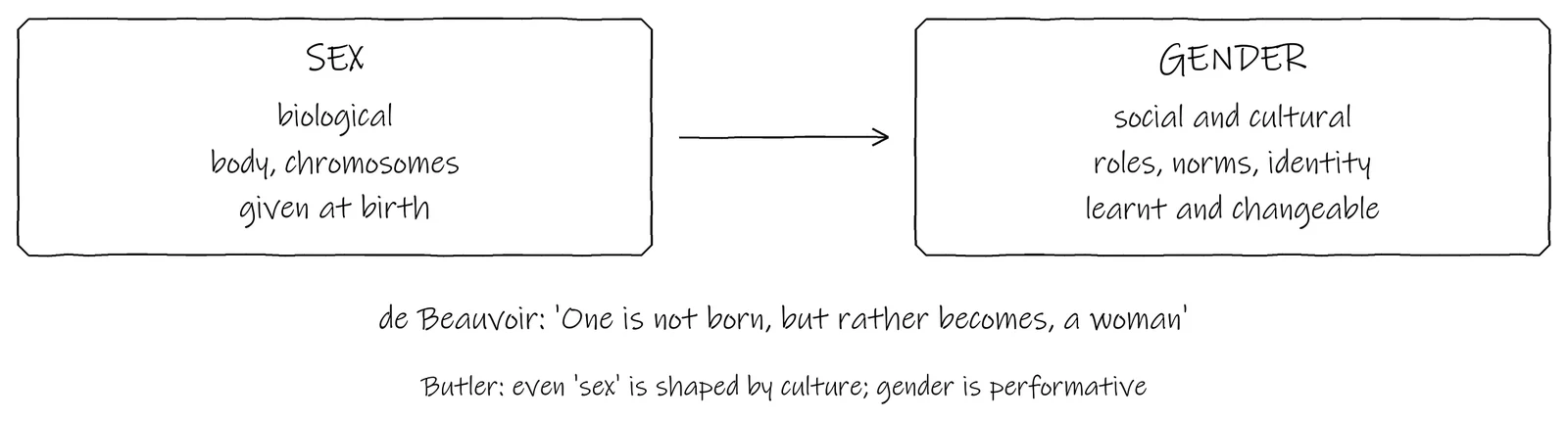
Feminist thinkers distinguish sex, the biological differences between male and female bodies, from gender, the social roles, behaviours and expectations that a society attaches to being a man or a woman (Figure 4.2). Gender is learnt, varies across societies and can change. Amy Wharton, in The Sociology of Gender, shows that gender operates at three levels: in individuals, as identities and traits; in interactions, as people treat one another according to gender expectations; and in institutions, such as the family, the market and the state, whose rules and practices are themselves gendered.
Public administration is one such institution. Its claim to be neutral meant in practice that it took men’s lives as the standard. Joan Acker (1990) showed that organisations assume an abstract, ‘disembodied’ worker who is available full-time and has no family responsibilities, an image that fits men who have wives at home far better than women. Rosabeth Moss Kanter, in Men and Women of the Corporation (1977), showed that women who form a small minority in an organisation become tokens, highly visible, stereotyped and under pressure to behave like men. A gender perspective therefore asks two questions: how does gender shape the theory and practice of administration, and how can administration be made fair to all genders?
4.2 Feminist Critiques of Mainstream Public Administration
A. Camilla Stivers: gender images in public administration
Camilla Stivers [स्टाइवर्स], in Gender Images in Public Administration: Legitimacy and the Administrative State (1993; second edition 2002), gave the most influential feminist critique of the discipline. She asks how the administrative state, whose officials are not elected, justifies its power. Public administration has relied on three images to establish its legitimacy, and each of them, she argues, is culturally masculine:
- The administrator as expert: legitimacy comes from scientific, objective, rational knowledge. But objectivity, detachment and the separation of reason from emotion have long been associated with masculinity, while care, intuition and connection, associated with women, are treated as unprofessional.
- The administrator as leader: legitimacy comes from vision, decisiveness and the ability to direct others. The image of the heroic, autonomous leader is a masculine one, and women who show these qualities are often criticised for being unfeminine.
- The administrator as virtuous citizen: legitimacy comes from public spirit and service to the community. But the classical idea of the virtuous citizen, from Greece to the American founders, was a man active in public life, who depended on women’s unpaid work in the private sphere.
Stivers also shows that women were written out of the history of public administration. In the Progressive Era (1890s–1920s), women reformers in the settlement-house movement, such as Jane Addams of Hull House in Chicago, did pioneering work in public health, sanitation, child welfare and the investigation of social problems, which they called ‘municipal housekeeping’. Yet the history of the discipline remembers only the ‘bureau men’ of efficiency and science. Her conclusion is not simply that more women should be appointed, but that the discipline must rethink its ideas of expertise, leadership and citizenship: expertise should be more responsive and connected to citizens, leadership more collaborative, and the private sphere of care recognised as part of public life.
B. Other feminist critiques
- Kathy Ferguson, in The Feminist Case Against Bureaucracy (1984), argued that bureaucracy’s hierarchy makes subordinates and clients dependent and powerless, in a way similar to the subordination of women, and called for non-hierarchical, participatory organisations.
- Gendered organisations (Acker, 1990): jobs, hierarchies and evaluations assume a male worker without care responsibilities.
- Glass ceiling, glass walls and sticky floor: women are blocked from the top posts, confined to ‘soft’ departments such as social welfare rather than finance or defence, and concentrated in lower grades.
- Intersectionality: Kimberlé Crenshaw (1989) showed that gender combines with race, caste, class, disability and sexuality, so that a Dalit or tribal woman faces disadvantages different from those of an upper-caste woman.

4.3 Gender and Governance
Gender and governance concerns two things: whether women and gender minorities take part in the processes of governance, and whether governance produces outcomes that are fair to them. Policies may be classified by how they treat gender. Gender-blind policies ignore gender differences; gender-neutral policies try not to affect men and women differently; gender-sensitive policies recognise the different needs, roles and constraints of women and men; and gender-transformative policies try to change the unequal relations of power between them.
A. From WID to GAD
Development thinking about women passed through three stages. The Women in Development (WID) approach of the 1970s, inspired by Ester Boserup [बोसरप]’s Woman’s Role in Economic Development (1970), sought to include women in development projects. The Women and Development (WAD) approach stressed that women had always been part of development but on unequal terms. The Gender and Development (GAD) approach of the 1980s shifted attention from women alone to the social relations between women and men. Caroline Moser (1993) distinguished women’s practical gender needs, such as water, fuel and health care, which arise from their existing roles, from their strategic gender needs, such as legal rights, equal wages and freedom from violence, which challenge their subordination. Good gender policy must meet both.
B. Gender mainstreaming
The Beijing Platform for Action, adopted at the Fourth World Conference on Women (1995), made gender mainstreaming the global strategy for gender equality. The UN Economic and Social Council (1997) defined it as the process of assessing the implications for women and men of any planned action, including legislation, policies or programmes, in all areas and at all levels. Mainstreaming means that gender is not left to a separate women’s ministry but is considered in every policy, from transport and finance to agriculture and defence. Its tools include sex-disaggregated data, gender analysis, gender impact assessment, gender audits and gender budgeting. International commitments such as CEDAW (1979, ratified by India in 1993) and Sustainable Development Goal 5 on gender equality (2015) support it.
C. Gender budgeting
Gender budgeting analyses government budgets to see how they affect women and men differently and to allocate resources for gender equality. Australia produced the first ‘women’s budget’ in 1984. India introduced a Gender Budget Statement with the Union Budget in 2005–06, set up gender budgeting cells in ministries, and several states have followed. The statement lists schemes meant wholly for women and those in which a substantial share goes to women. Critics note that it often records spending rather than measuring outcomes.
D. Women in political governance
The 73rd and 74th Constitutional Amendments (1992) reserved one-third of seats and chairperson posts in panchayats and municipalities for women, and many states have raised this to one-half. Around fourteen lakh women now serve as elected representatives in local bodies. Studies such as Chattopadhyay and Duflo (2004) found that women pradhans invested more in the public goods that women had asked for, such as drinking water. The problem of the ‘proxy’ representative, where a husband (the ‘sarpanch pati’) exercises power in the name of an elected woman, shows that reservation must be supported by training and social change. The Constitution (106th Amendment) Act, 2023 (Nari Shakti Vandan Adhiniyam) reserves one-third of seats in the Lok Sabha and state assemblies for women, to take effect after the next census and delimitation.
E. Sexual minorities and public policy
A gender perspective also includes persons whose gender identity or sexuality does not fit the binary of man and woman. In NALSA v. Union of India (2014) the Supreme Court recognised transgender persons as a ‘third gender’ with the right to self-identification; in Navtej Singh Johar v. Union of India (2018) it decriminalised consensual same-sex relations by reading down Section 377; and Parliament passed the Transgender Persons (Protection of Rights) Act, 2019, which was criticised for requiring certification by a district magistrate. S. Dhall’s study of public policy discourse on sexual minorities (2022) shows how policy has had to balance democratic aspirations for equal rights, political expediency and competing moral claims, and argues that administrative agencies need sensitivity and inclusive procedures if rights recognised by courts are to become real.
4.4 Gender Sensitivity and Participation in Administration
A. Women in the civil services
Women entered the higher civil services in India only after independence; Anna Rajam Malhotra became the first woman IAS officer in 1951. Discriminatory rules once required women in the Indian Foreign Service to obtain permission to marry and allowed their dismissal on marriage; in C.B. Muthamma v. Union of India (1979) the Supreme Court struck these down as violating equality. Although the share of women among new recruits has risen, women remain a minority in the senior civil service and are under-represented in the police and in technical services.
B. Why participation matters: representative bureaucracy
The theory of representative bureaucracy, introduced by J. Donald Kingsley (1944), holds that a bureaucracy that reflects the composition of society will be more legitimate and responsive. Frederick Mosher (1968) distinguished passive representation, where officials share the social characteristics of the people, from active representation, where they act in the interests of those groups. Hanna Pitkin’s classification of representation (Figure 4.4) helps us see the three gains from women’s participation: descriptive representation (women present in office), substantive representation (women’s interests acted upon), and symbolic representation (women officers as role models who increase trust in government). Drude Dahlerup [डालेरुप] (1988) argued that a ‘critical mass’ of about 30 per cent may be needed before women can change an institution, though ‘critical acts’ by a few determined women can also make a difference.

C. Barriers to participation
- Patriarchal norms that see administration and authority as men’s work.
- The double burden: women carry most of the unpaid care work at home, the ‘second shift’ described by Arlie Hochschild (1989).
- Organisational culture: long hours, frequent transfers, field postings without facilities and informal male networks.
- Sexual harassment and an unsafe working environment.
- Stereotyping and tokenism: women are placed in ‘soft’ departments and judged more harshly.
- Lack of mentoring and role models at senior levels.
D. Gender sensitivity in administration
Gender sensitivity means awareness of the different needs, roles and constraints of women, men and gender minorities, and the willingness to act on it. In administration it takes several forms:
- Safe workplaces: the Supreme Court’s Vishaka guidelines (1997) led to the Sexual Harassment of Women at Workplace (Prevention, Prohibition and Redressal) Act, 2013, which requires Internal Complaints Committees in every office.
- Supportive service rules: maternity leave of 26 weeks (2017 amendment), child care leave for women employees, flexible postings for couples and crèches.
- Gender training: modules on gender sensitivity in the training of civil servants and police officers.
- Gender-sensitive service delivery: women police stations (the first was set up in Kozhikode in 1973), One Stop Centres for women affected by violence (2015), women help-lines and separate facilities in public offices.
- Gender audits and sex-disaggregated data to monitor whether programmes reach women.
E. Participation beyond the bureaucracy
Women participate in governance not only as officials but also as citizens. Self-help groups, such as Kerala’s Kudumbashree (1998) and the National Rural Livelihoods Mission, social audits under MGNREGA, mahila sabhas in gram panchayats and women’s movements have made women active partners in planning and monitoring. This connects the gender perspective with the New Public Service and collaborative governance studied in Chapter 3.
4.5 Important Questions
- Question 1 Discuss the gender perspective on public administration with special reference to Camilla Stivers.
- Question 2 What is gender mainstreaming? Discuss the relationship between gender and governance.
- Question 3 Discuss women’s participation in administration and the need for gender sensitivity.
DU asks the same idea in different words. So learn one broad answer for each question below; the same answer works for every question joined by OR.
Important Question 1
Discuss the gender perspective on public administration with special reference to Camilla Stivers.
OR
Is public administration gender-neutral? Discuss.
OR
Examine the feminist critique of mainstream public administration.
Model Answer
“One is not born, but rather becomes, a woman.”
— Simone de Beauvoir, The Second Sex (1949)
Introduction. Mainstream public administration has presented itself as neutral, rational and universal. The gender perspective argues that this neutrality hides a male standard: theories, organisations and policies were built around men’s experiences. Camilla Stivers’s Gender Images in Public Administration (1993, 2002) is the most important statement of this critique.
1. Sex and Gender
Sex refers to biological difference; gender to the social roles and expectations attached to it. Wharton shows that gender works at the levels of individuals, interactions and institutions, including the state. Gender shapes expectations about work, leadership and care.
2. The Myth of Neutrality
The founders of public administration, Wilson, Taylor, Weber, Gulick and Simon, assumed a universal administrator and worker who was in fact male. Acker (1990) showed that organisations assume a ‘disembodied’ worker without family duties, and Kanter (1977) showed how women in a minority become tokens. Their ideal of the rational, impersonal administrator carried masculine assumptions.
3. Stivers: Expertise
Public administration claims legitimacy through expertise, which values objectivity, detachment and reason. These qualities have been culturally defined as masculine, while care and connection, associated with women, are devalued. Stivers developed this argument in Gender Images in Public Administration (1993).
4. Stivers: Leadership and Virtue
The image of the decisive, heroic leader and of the virtuous citizen active in public life are also masculine. The citizen of classical republicanism depended on women’s unpaid work in the private sphere, which remained invisible. These images exclude qualities associated with women, such as care and cooperation.
5. Women Written Out of History
Stivers shows that women reformers of the Progressive Era, such as Jane Addams and the settlement-house workers, contributed to public health, sanitation and welfare through ‘municipal housekeeping’, but the history of the discipline remembers only the ‘bureau men’. She developed this argument in Bureau Men, Settlement Women (2000).
6. Other Feminist Critiques
Ferguson (1984) argued that bureaucratic hierarchy creates dependence similar to women’s subordination. Feminists also point to the glass ceiling, glass walls and sticky floor, and Crenshaw’s intersectionality shows that gender combines with caste, class and race.
7. Care as a Public Value
Feminists argue that care, empathy and relationship-building are essential public skills, not private feminine traits, and that administration should value them.
8. Towards a Gender-Sensitive Public Administration
Stivers calls for rethinking expertise as responsive and connected to citizens, leadership as collaborative, and citizenship as including care. In practice this means representation of women, gender-sensitive policies and gender mainstreaming.
9. Glass Ceilings and Glass Cliffs
Women in public services often face a ‘glass ceiling’ that blocks promotion to top posts and a ‘glass cliff’ of being appointed to lead in crises, which shows structural barriers.
10. Intersectionality
Gender interacts with caste, class and race, so Dalit and Adivasi women face additional barriers in administration and as citizens.
11. Evaluation
The gender perspective exposed the hidden assumptions of mainstream theory and widened the discipline. Critics say that linking reason with men and care with women may reinforce stereotypes, and that women administrators do not always act for women. Yet the evidence of unequal representation and gender-blind policies supports its central claim. It shows that public administration must be gender-aware to be democratic.
12. Gender Images in Indian Administration
The Indian administrative tradition also carries masculine images. The district collector was imagined as a paternal mai-baap figure, firm and commanding; field postings in remote areas, law and order duties and night work were long considered unsuitable for women; and women officers were often assigned to welfare, education or culture rather than finance, home or industry. Such images limit women’s careers and shape how citizens perceive authority. Women officers are often given ‘soft’ portfolios such as social welfare.
13. Women in Public Administration Today
Women are still a minority in senior civil service positions and in the police across most countries, including India. Those who reach the top often face tokenism, as Kanter showed, and pressure to adopt masculine styles of leadership, which supports Stivers’s argument that the problem lies in the images of administration, not only in numbers. Mentoring and flexible work can help more women reach senior posts.
Conclusion. Thus, public administration is not gender-neutral. A gender perspective makes it more truthful about its past and more just in its practice.
Important Question 2
What is gender mainstreaming? Discuss the relationship between gender and governance.
OR
Examine gender budgeting as a tool of gender-sensitive governance.
OR
Discuss the role of women in local governance in India.
Model Answer
“Mainstreaming a gender perspective is the process of assessing the implications for women and men of any planned action, including legislation, policies or programmes, in all areas and at all levels.”
— UN Economic and Social Council, Agreed Conclusions (1997)
Introduction. Governance is not gender-neutral: who takes part in decisions and whom policies benefit are shaped by gender. Gender and governance therefore studies both women’s participation in governance and the gender effects of policies. Gender mainstreaming is the main strategy for making governance gender-just.
1. Types of Policy
Policies may be gender-blind, gender-neutral, gender-sensitive or gender-transformative, depending on whether they ignore, avoid, recognise or seek to change gender inequalities. Gender-blind policies ignore gender, gender-neutral ones try not to affect either sex, gender-sensitive ones address different needs, and gender-transformative ones seek to change unequal relations.
2. From WID to GAD
The WID approach (Boserup, 1970) added women to development; WAD stressed their unequal integration; GAD focused on power relations between women and men. Moser distinguished practical gender needs from strategic gender needs. GAD, from the 1980s, focused on gender relations and power rather than on women alone.
3. Meaning of Gender Mainstreaming
Adopted by the Beijing Platform for Action (1995) and defined by ECOSOC (1997), mainstreaming means assessing the implications for women and men of every policy at every level, so that gender equality becomes the responsibility of all departments, not only a women’s ministry. ECOSOC defined it as assessing the implications for women and men of any planned action, including legislation, policies and programmes.
4. National Framework
India’s National Commission for Women (1992), the National Policy for the Empowerment of Women (2001) and laws on domestic violence and workplace harassment provide the framework for mainstreaming.
5. International Commitments
CEDAW (1979), which India ratified in 1993, and Sustainable Development Goal 5 commit governments to gender equality.
6. Tools
Its tools include sex-disaggregated data, gender analysis, gender impact assessment, gender audits, gender training and gender budgeting. CEDAW (1979) and SDG 5 (2015) provide the international framework. Gender audits examine whether institutions and programmes promote equality.
7. Gender Budgeting
Gender budgeting examines how public spending affects women and men and allocates resources for equality. Australia began it in 1984; India introduced a Gender Budget Statement in 2005–06 and gender budgeting cells in ministries. Its weakness is that it often counts allocations rather than measuring outcomes. India began gender budgeting in 2005–06, and many ministries have gender budget cells.
8. Gender and Governance
Good governance requires gender equality in participation, access to services and justice; women’s presence in decision-making shifts priorities towards water, health and safety.
9. Women in Political Governance
The 73rd and 74th Amendments (1992) reserved one-third of local seats for women, and many states provide one-half. Around fourteen lakh women serve in local bodies, and studies show that they change priorities towards water, health and education. The 106th Amendment (2023) extends one-third reservation to the Lok Sabha and state assemblies. The 106th Amendment (2023) extends one-third reservation to the Lok Sabha and state assemblies.
10. Inclusion of Sexual Minorities
The NALSA (2014) and Navtej Singh Johar (2018) judgements and the Transgender Persons Act (2019) brought gender minorities into governance debates; Dhall shows how policy balances democratic aspirations, political expediency and moral claims.
11. Challenges
Mainstreaming often becomes a formality; proxy representation, weak data, lack of training and patriarchal attitudes limit its impact; and gender is still treated as a ‘women’s issue’ rather than a dimension of all policy. Patriarchal attitudes within institutions also resist change.
12. Gender-Sensitive Policies in India
Many recent schemes are designed with gender in mind. Beti Bachao Beti Padhao (2015) addresses the declining child sex ratio; Ujjwala (2016) provides LPG connections to women in poor households, a practical gender need; houses under PM Awas Yojana are registered in the name of women or jointly; and Mission Shakti (2022) brings together schemes for the safety and empowerment of women. Moser’s framework helps us see that most such schemes meet practical needs, while strategic needs require changes in property, wages and power.
13. Evaluation
Gender mainstreaming has put gender on the agenda of every ministry, but it succeeds only when backed by political will, resources, data and accountability; otherwise it becomes a box-ticking exercise.
Conclusion. Thus, gender mainstreaming seeks to make every act of governance fair to all genders. It requires participation, resources and political will, not only declarations.
Important Question 3
Discuss women’s participation in administration and the need for gender sensitivity.
OR
Examine the barriers to women’s participation in public administration in India.
OR
Discuss representative bureaucracy with reference to gender.
Model Answer
“Representing here means acting in the interest of the represented, in a manner responsive to them.”
— Hanna Pitkin, The Concept of Representation (1967)
Introduction. Administration that is meant to serve all citizens must include all of them. The participation of women in administration and the gender sensitivity of administrative practice are therefore matters of justice, legitimacy and effectiveness.
1. Women in the Civil Services
Anna Rajam Malhotra became the first woman IAS officer in 1951. Discriminatory service rules were struck down in C.B. Muthamma (1979). The share of women among new recruits has grown, but they remain under-represented in senior posts, the police and technical services. Until 1979 service rules discriminated against married women officers, and C.B. Muthamma successfully challenged such discrimination in the foreign service.
2. Representative Bureaucracy
Kingsley (1944) argued that a bureaucracy reflecting society is more legitimate. Mosher distinguished passive from active representation. Pitkin’s descriptive, substantive and symbolic representation shows how women’s presence can change both outcomes and public trust. It can be passive, reflecting society’s composition, or active, when officials advance the interests of their group.
3. Critical Mass and Critical Acts
Kanter showed that tokens face pressure to conform. Dahlerup argued that a critical mass of about 30 per cent may be needed for change, though critical acts by individual women can also transform institutions. Kanter (1977) suggested that groups below about fifteen per cent are treated as tokens.
4. Women in the Police
Women form a small share of India’s police, and their presence improves responsiveness to crimes against women; several states reserve a third of police posts for women.
5. Barriers to Participation
Patriarchal norms, the double burden of care, long hours and transfers, sexual harassment, stereotyping into ‘soft’ departments, the glass ceiling and the lack of mentors restrict women’s entry and advancement. Safety concerns and the lack of childcare also limit field postings.
6. Meaning of Gender Sensitivity
Gender sensitivity is awareness of the different needs and constraints of women, men and gender minorities, and action to address them in workplaces and in service delivery. It requires training officials to recognise gender bias in their own decisions.
7. Gender-Sensitive Measures
They include the Vishaka guidelines (1997) and the POSH Act (2013) with Internal Complaints Committees; maternity leave of 26 weeks and child care leave; gender training for officials and police; women police stations and One Stop Centres; gender audits and sex-disaggregated data. Child care leave of up to two years for women central government employees and women’s help desks in police stations are other examples.
8. Women in Panchayats as Administrators
Women sarpanches handle budgets, schemes and officials and gain administrative experience; studies show that training and support help them overcome proxy control.
9. Participation as Citizens
Women participate in governance through panchayats, self-help groups such as Kudumbashree, mahila sabhas and social audits, which make administration more responsive to their needs.
10. The Global Picture
Countries such as the Nordic states have high proportions of women in senior public posts, supported by family-friendly policies, which shows that institutions can change.
11. Evaluation
Participation and sensitivity have improved, but numbers alone are not enough: women officials face pressure to conform, and policies often remain formal. Real change requires changes in organisational culture and in the division of care work. Both more women and gender-aware men are needed for gender-sensitive administration.
12. Representative Bureaucracy in India
India uses reservation in public employment for Scheduled Castes, Scheduled Tribes and Other Backward Classes. There is no general reservation for women in central services, but several states reserve a share of government jobs for women, for example Bihar (35 per cent, 2016), and the Union Home Ministry has advised states to raise the share of women in the police to 33 per cent. Women’s reservation in some state services follows the same logic.
13. Role Models and Symbolic Representation
Pioneers such as Anna Rajam Malhotra, the first woman IAS officer, and Kiran Bedi, the first woman IPS officer (1972), became role models whose presence changed what young women believed was possible, an example of symbolic representation. Such role models encourage girls to aspire to public service.
Conclusion. Thus, women’s participation and gender sensitivity make administration more representative, legitimate and effective. They are essential for a public administration that serves all citizens equally.
Short Notes
(a) Gender budgeting
The analysis of government budgets from a gender perspective to see how revenue and spending affect women and men differently, and the allocation of resources for gender equality. Begun in Australia (1984), it was introduced in India through the Gender Budget Statement of 2005–06 and gender budgeting cells in ministries.
(b) Vishaka guidelines
Guidelines laid down by the Supreme Court in Vishaka v. State of Rajasthan (1997), after the gang rape of Bhanwari Devi, a social worker, to prevent sexual harassment of women at the workplace, drawing on CEDAW. They were replaced by the Sexual Harassment of Women at Workplace Act, 2013, which requires Internal Complaints Committees.
(c) Practical and strategic gender needs
Caroline Moser’s distinction: practical gender needs arise from women’s existing roles, such as water, fuel, health care and child care; strategic gender needs aim to change women’s subordinate position, such as legal rights, equal wages, political representation and freedom from violence.
(d) Gender mainstreaming
A strategy endorsed by the Beijing Platform for Action (1995) and defined by the UN Economic and Social Council in 1997 as assessing the implications for women and men of any planned action, including laws, policies and programmes, in all areas and at all levels. Its aim is to make gender equality a concern of all policies rather than of separate women’s programmes alone.
More notes: DSC-4 Perspectives on Public Administration
These notes are prepared by PADHO TO AISE for study help. They are not an official University of Delhi publication.