

Semester VII DSE-7 Public Policy
Unit III · 19 min read · Updated 24 Nov 2026
As per the University of Delhi (DU) BA (Hons) Political Science syllabus
Contents
- 3.1 The Meaning of Policy Analysis
- 3.2 The Rational Approach and Simon
- 3.3 Incrementalism: Lindblom
- 3.4 Mixed Scanning: Etzioni
- 3.5 Institutionalism
- 3.6 Important Questions
- Discuss Herbert Simon’s approach to rational decision-making.
- Compare the rational-comprehensive model with Lindblom’s incrementalism.
- Explain Etzioni’s mixed-scanning approach to decision-making.
- Discuss institutionalism as an approach to policy analysis.
- Short Notes
मनुष्य का व्यवहार तर्कसंगत होने का इरादा रखता है, परंतु केवल सीमित रूप से।
Human behaviour is intendedly rational, but only limitedly so.
— Herbert A. Simon, Administrative Behavior
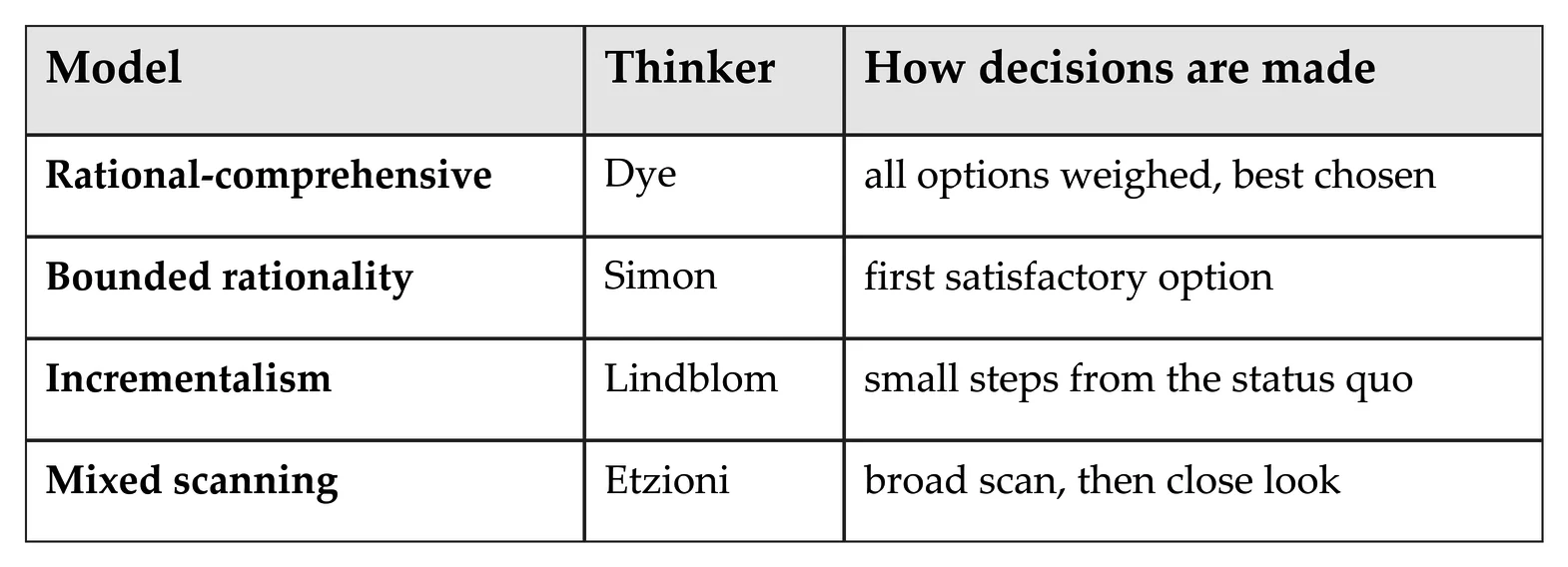
HOW do governments decide among possible policies? Should they consider every alternative and choose the best, as the rational approach suggests, or move in small steps from what already exists, as incrementalism claims? Policy analysis offers several models. Herbert Simon showed that rationality is bounded, Charles Lindblom defended the science of muddling through, Amitai Etzioni proposed mixed scanning as a third approach, and the new institutionalism of James March and Johan Olsen and of Peter Hall and Rosemary Taylor showed how institutions shape policy. This chapter studies these models.
3.1 The Meaning of Policy Analysis
Policy analysis is the systematic study of policy problems and alternatives to help decision-makers choose, and the study of how policy decisions are actually made. Thomas Dye describes it as finding out what governments do, why they do it and what difference it makes. Weimer and Vining treat it as client-oriented advice, while W.I. Jenkins emphasises its political and organisational context. Models of decision-making range from the rational-comprehensive ideal to incremental adjustment.
3.2 The Rational Approach and Simon
The rational-comprehensive model asks decision-makers to identify all goals, list every alternative, predict all consequences and choose the option that gives the greatest net benefit. Herbert Simon argued that real decision-makers cannot meet these demands, because of limited information, time and cognitive capacity. Their rationality is bounded, and instead of maximising they satisfice, choosing the first alternative that is good enough.

3.3 Incrementalism: Lindblom
Charles Lindblom contrasted the root method of comprehensive analysis with the branch method of successive limited comparisons, in which policy-makers consider only a few alternatives that differ slightly from existing policy. He argued that this muddling through is both how policy is actually made and a sensible way to make it in a pluralist democracy, through partisan mutual adjustment among groups.
3.4 Mixed Scanning: Etzioni
Amitai Etzioni argued that rationalism is unrealistic and incrementalism conservative. His mixed scanning combines a broad scan of the whole field for fundamental decisions with detailed examination of selected areas for incremental decisions, like a weather system that uses both a wide-angle camera and a close-up camera.
3.5 Institutionalism
Institutionalism explains policy through the rules, organisations and norms of government. The old institutionalism described formal structures, while the new institutionalism of March and Olsen argues that institutions shape actors’ behaviour and preferences. Hall and Taylor distinguish historical, rational choice and sociological institutionalism.

3.6 Important Questions
- Question 1 Discuss Herbert Simon’s approach to rational decision-making.
- Question 2 Compare the rational-comprehensive model with Lindblom’s incrementalism.
- Question 3 Explain Etzioni’s mixed-scanning approach to decision-making.
- Question 4 Discuss institutionalism as an approach to policy analysis.
DU asks the same idea in different words. So learn one broad answer for each question below; the same answer works for every question joined by OR.
Important Question 1
Discuss Herbert Simon’s approach to rational decision-making.
OR
Examine Simon’s concepts of bounded rationality and satisficing.
OR
‘Administrative man satisfices rather than maximises.’ Discuss.
Model Answer
“Whereas economic man maximizes, selects the best alternative from among all those available to him, his cousin, whom we shall call administrative man, satisfices, looks for a course of action that is satisfactory or ‘good enough’.”
— Herbert A. Simon, Administrative Behavior (2nd edn, 1957)
Introduction. Herbert Simon, in Administrative Behavior (1947), placed decision-making at the heart of administration and policy. He accepted rationality as the aim of decision-makers but showed that it is limited by human and organisational constraints. His concepts of bounded rationality and satisficing transformed public administration, economics and policy analysis and earned him the Nobel Prize in 1978.
1. Decision-Making as the Core
Simon argued that administration is essentially a process of decision-making. Every action is preceded by a choice, and the study of organisations should focus on how decisions are made, rather than on formal principles of administration.
2. Critique of the Proverbs
In 1946, Simon criticised the classical principles of administration, such as unity of command and span of control, as proverbs that contradict each other. He called for a scientific study of administration based on observation of how decisions are made.
3. Facts and Values
Influenced by logical positivism, Simon distinguished factual premises, which can be tested, from value premises, which express goals. Administrative science can study the factual elements, while values are set by political choice.
4. The Means-Ends Chain
Decisions form a chain in which each end becomes a means to a higher end. Rational decision-making selects the means best suited to reach given ends, but the chain is often incomplete and goals are rarely clear.
5. The Rational Ideal
Comprehensive rationality would require knowing all alternatives, all their consequences and a complete ranking of values. The decision-maker would then choose the alternative with the best outcome, as economic theory assumes of economic man.
6. Bounded Rationality
Simon argued that human rationality is bounded. People have incomplete knowledge, cannot foresee all consequences, can consider only a few alternatives and have limited time and attention. Behaviour is intendedly rational, but only limitedly so.
7. Satisficing
Because of these limits, administrative man satisfices: he searches for alternatives until he finds one that meets an acceptable standard, and then stops. Aspiration levels rise or fall with experience. Satisficing is a realistic description of how decisions are made.
8. Organisations and Rationality
Organisations help individuals overcome their limits by dividing work, setting standard procedures, providing information, training members and using authority. Organisational loyalty, or identification, shapes the premises from which members decide.
9. Programmed and Non-Programmed Decisions
In The New Science of Management Decision (1960), Simon distinguished programmed decisions, routine and repetitive, which can be handled by rules, from non-programmed decisions, new and unstructured, which require judgement.
10. Intelligence, Design and Choice
Simon described decision-making in three phases: intelligence, finding occasions for decision; design, developing possible courses of action; and choice, selecting among them. This sequence influenced later models of the policy process.
11. Rational Decision-Making in Business
In his Nobel lecture, published in 1979, Simon showed that business firms also make decisions under bounded rationality, using search, satisficing and rules of thumb rather than perfect optimisation, while computers and operations research expand the bounds of rationality.
12. Influence
Simon’s ideas shaped the behavioural approach to organisations, the work of James March on organisations, the behavioural theory of the firm and research on artificial intelligence. They also underlie modern behavioural public policy.
13. Relevance to Policy
Policy-makers work with limited information and time, rely on routines and heuristics and often accept satisfactory rather than optimal solutions. Simon’s model explains this and suggests ways to improve decisions through better information and organisation.
14. Criticisms
Critics such as Dwight Waldo questioned Simon’s separation of facts and values, arguing that administration is inherently political. Lindblom argued that even bounded rationality demands more analysis than policy-makers can perform.
15. Evaluation
Simon replaced the unrealistic ideal of perfect rationality with a realistic theory of bounded rationality, making decision-making the central subject of administration and policy analysis.
Conclusion. Thus, Herbert Simon placed decision-making at the core of administration and showed that rationality is bounded by limited information, time and cognitive capacity. Instead of maximising like economic man, administrative man satisfices, and organisations help extend the limits of rationality. His ideas remain foundational to policy analysis.
Important Question 2
Compare the rational-comprehensive model with Lindblom’s incrementalism.
OR
Discuss Charles Lindblom’s ‘science of muddling through’.
OR
Critically examine incrementalism as a model of policy-making.
Model Answer
“A rational policy is one that achieves ‘maximum social gain’; that is, governments should choose policies resulting in gains to society that exceed costs by the greatest amount.”
— Thomas R. Dye, Understanding Public Policy
Introduction. Two classic models describe how policy decisions are made. The rational-comprehensive model asks decision-makers to analyse all options and choose the best. Charles Lindblom, in ‘The Science of “Muddling Through”’ (1959), argued that real policy-makers proceed incrementally, making small changes from existing policy, and that this is often wise. The debate between them is central to policy analysis.
1. The Rational-Comprehensive Model
Thomas Dye describes a rational policy as one that achieves maximum social gain. Decision-makers must know all of society’s values and their relative weights, all policy alternatives, all consequences of each alternative and the ratio of benefits to costs, and then choose the most efficient alternative.
2. Steps of Rational Analysis
The model proceeds by defining the problem, clarifying and ranking goals, identifying all alternatives, predicting their consequences, comparing them by their costs and benefits, and selecting the alternative that best achieves the goals.
3. Barriers to Rationality
Dye notes many barriers: there is no agreement on societal values, conflicting values cannot be compared, policy-makers pursue their own interests, past investments create sunk costs, information is costly and incomplete, the future is uncertain and the bureaucracy is fragmented.
4. Lindblom’s Root and Branch
Lindblom called the comprehensive approach the root method, starting afresh from fundamentals each time. He contrasted it with the branch method of successive limited comparisons, which builds out from the current situation step by step.
5. Successive Limited Comparisons
In the branch method, goals and means are chosen together rather than separately; a good policy is one on which analysts agree, rather than one that maximises a goal; analysis is drastically limited, ignoring many alternatives and consequences; and policy proceeds through a series of small comparisons.
6. Policy Made and Re-made
Lindblom argued that policy is not made once and for all but made and re-made endlessly. Small steps allow mistakes to be corrected and reduce the risk of large errors, so muddling through is a science rather than a failure.
7. Partisan Mutual Adjustment
In The Intelligence of Democracy (1965), Lindblom argued that in a pluralist democracy, many groups and agencies adjust to one another through bargaining. This partisan mutual adjustment coordinates policy without a central planner.
8. Advantages of Incrementalism
Incrementalism is realistic, politically feasible, reduces conflict, builds on existing experience, allows learning and avoids the dangers of untested grand schemes. It fits the limited knowledge and divided power of democratic systems.
9. Incremental Budgeting
Aaron Wildavsky, in The Politics of the Budgetary Process (1964), showed that budgets are usually made incrementally, starting from last year’s base and adjusting at the margins, a clear example of incrementalism in practice.
10. Still Muddling
In 1979, Lindblom distinguished simple incremental analysis, disjointed incrementalism and strategic analysis, and acknowledged that incrementalism struggles with grand issues. He still argued that policy-makers should muddle through better, not abandon it.
11. Criticisms of Incrementalism
Yehezkel Dror argued in 1964 that incrementalism is conservative, reinforcing inertia, and works only when existing policies are satisfactory and conditions stable. In times of crisis or rapid change, small steps may be inadequate.
12. Bias towards the Powerful
Critics also argue that incrementalism favours established interests, since it builds on existing policies that reflect existing power. Groups excluded from bargaining remain excluded.
13. Indian Illustrations
Indian budgets and many welfare schemes evolve incrementally. In contrast, the economic reforms of 1991, demonetisation in 2016 and the Goods and Services Tax in 2017 were non-incremental, large-scale changes.
14. Synthesis
In practice, policy-making combines both models: rational analysis informs choices, while political realities produce incremental change. Etzioni’s mixed scanning attempts such a synthesis.
15. Evaluation
The rational model is an ideal standard, while incrementalism is a realistic description of democratic policy-making. Each has strengths and weaknesses depending on the problem and context.
Conclusion. Thus, the rational-comprehensive model seeks maximum social gain through analysis of all alternatives, while Lindblom’s incrementalism makes policy through successive limited comparisons and partisan mutual adjustment. Incrementalism is realistic and safe but can be conservative, as Dror argued, so policy-making often combines both approaches.
Important Question 3
Explain Etzioni’s mixed-scanning approach to decision-making.
OR
‘Mixed scanning is a third approach to decision-making.’ Discuss.
OR
Compare mixed scanning with the rational and incremental models.
Model Answer
“Policy is not made once and for all; it is made and re-made endlessly.”
— Charles E. Lindblom, ‘The Science of “Muddling Through”’ (1959)
Introduction. Amitai Etzioni, in ‘Mixed-Scanning: A “Third” Approach to Decision-Making’ (1967), proposed a model that combines elements of the rational and incremental approaches. He criticised rationalism as unrealistic and incrementalism as conservative, and argued that effective decision-makers combine broad overviews with detailed examination of selected options.
1. Critique of Rationalism
Etzioni argued that the rational-comprehensive model is utopian. No decision-maker has the information, resources or time to examine all alternatives and consequences, and attempting to do so can paralyse action.
2. Critique of Incrementalism
He criticised incrementalism for being conservative and biased in favour of the powerful and organised. It neglects basic social innovations, and in times of crisis small steps may simply continue in the wrong direction.
3. Fundamental and Incremental Decisions
Etzioni pointed out that incremental decisions take place within a context set by fundamental decisions, which determine basic directions. Even incrementalists implicitly rely on such fundamental choices, which incrementalism cannot explain.
4. Mixed Scanning
Mixed scanning combines a high-order, fundamental scan of the whole field, which identifies the main options without detail, with detailed, incremental examination of the most promising ones. Fundamental decisions set the context, and incremental decisions work out the details.
5. The Weather Satellite Analogy
Etzioni compared mixed scanning to a weather observation system that uses a broad-angle camera to cover all parts of the sky without great detail, and a second camera that zooms in on areas revealed by the first as needing closer examination.
6. The Procedure
The decision-maker lists relevant alternatives, eliminates those with crippling objections, examines the remaining ones in more detail, implements decisions in stages, and reviews results, scanning more broadly if things go wrong.
7. Flexibility
The balance between broad and detailed scanning varies with the decision-maker’s capacities and the situation. In crises or periods of rapid change, more fundamental scanning is needed; in stable times, more incremental adjustment is appropriate.
8. The Active Society
Etzioni developed these ideas in The Active Society (1968), arguing that societies can guide their own development through knowledge, consensus and power. Mixed scanning was part of his theory of societal guidance.
9. Mixed Scanning Revisited
In 1986, Etzioni restated the model and showed that it describes how effective decision-makers, such as doctors, act under uncertainty: they scan broadly, focus on promising options, proceed in stages, hedge their bets and remain ready to change course.
10. Comparison with Other Models
Compared with rationalism, mixed scanning is more realistic because it does not require examining everything in detail. Compared with incrementalism, it is more innovative because it allows fundamental reconsideration of direction.
11. Dror’s Normative-Optimum Model
Yehezkel Dror proposed another alternative, combining rational analysis with extra-rational elements such as judgement, creativity and intuition, and emphasising continuous learning in policy-making.
12. Applications
Mixed scanning is used in fields such as disaster management, where responders survey the whole situation and then focus on critical areas. In India, long-term vision documents combined with annual budgets and mission-mode programmes reflect a similar logic.
13. Criticisms
Critics argue that mixed scanning is vague about how to divide attention between broad and detailed scanning, and that it may amount to little more than common sense. Lindblom argued that incrementalism already allows for some broader review.
14. Significance
Mixed scanning shows that decision-makers need both vision and caution. It provides a framework for combining strategic direction with practical, step-by-step implementation.
15. Evaluation
Etzioni’s mixed scanning offers a realistic and flexible middle path between rationalism and incrementalism, combining fundamental choices with incremental adjustments.
Conclusion. Thus, Etzioni’s mixed scanning is a third approach that combines a broad scan for fundamental decisions with detailed examination for incremental ones, like a weather system using wide-angle and zoom cameras. It avoids the utopianism of rationalism and the conservatism of incrementalism, offering a flexible model of decision-making.
Important Question 4
Discuss institutionalism as an approach to policy analysis.
OR
Examine the new institutionalism of March and Olsen.
OR
Discuss Hall and Taylor’s three new institutionalisms.
Model Answer
“The organization of political life makes a difference.”
— James G. March and Johan P. Olsen, ‘The New Institutionalism’ (1984)
Introduction. Institutionalism explains public policy through the institutions of government: formal rules, organisations and informal norms that shape how decisions are made. After being eclipsed by behaviouralism, institutionalism returned in the 1980s as the new institutionalism, led by James March and Johan Olsen. Peter Hall and Rosemary Taylor later identified three distinct strands of this approach.
1. Meaning of Institutions
Institutions are the rules of the game: constitutions, laws, organisations, procedures and norms that structure political behaviour. They define who has power, how decisions are made and what options are considered legitimate.
2. The Old Institutionalism
Traditional political science studied formal institutions, constitutions, legislatures and courts, in a descriptive and legal way. Thomas Dye’s institutional model treats policy as the output of government institutions, which give it legitimacy, universality and coercive force.
3. The Behavioural Challenge
In the 1950s and 1960s, behaviouralists shifted attention from institutions to individual and group behaviour, treating institutions as mere arenas in which behaviour takes place. Policy was explained by the preferences and power of actors.
4. March and Olsen’s New Institutionalism
In 1984, March and Olsen argued that institutions are not neutral arenas but political actors in their own right. Institutions shape preferences, define identities and influence outcomes, so the organisation of political life makes a difference.
5. Logic of Appropriateness
March and Olsen distinguished the logic of consequences, in which actors calculate costs and benefits, from the logic of appropriateness, in which actors follow rules and norms that define appropriate behaviour for their role. Much behaviour in institutions follows the second logic.
6. Hall and Taylor’s Three Strands
Peter Hall and Rosemary Taylor, in ‘Political Science and the Three New Institutionalisms’ (1996), distinguished historical institutionalism, rational choice institutionalism and sociological institutionalism, each with a different view of how institutions affect behaviour.
7. Historical Institutionalism
Historical institutionalism emphasises path dependence: choices made at critical junctures shape later development and are hard to reverse. Institutions distribute power unequally and produce unintended consequences, explaining why policies persist over long periods.
8. Rational Choice Institutionalism
Rational choice institutionalism sees actors as having fixed preferences and pursuing them strategically. Institutions provide rules and incentives that reduce uncertainty and transaction costs and solve collective action problems, as Elinor Ostrom showed in Governing the Commons (1990).
9. Sociological Institutionalism
Sociological institutionalism stresses culture, norms and symbols. Organisations adopt practices because they are seen as legitimate rather than efficient, and organisations in the same field come to resemble each other, a process DiMaggio and Powell called isomorphism.
10. Institutions and Policy Outcomes
Institutions shape policy through veto points, where change can be blocked, such as federalism, second chambers and courts. Systems with many veto players change policy slowly, while centralised systems can act faster.
11. Institutional Change
Later scholars explained how institutions change gradually through layering new rules on old ones, drift as old rules fail to adapt, and conversion of old institutions to new purposes.
12. Indian Applications
Institutionalism helps explain Indian policy: the colonial bureaucracy’s persistence after 1947, the long life of the Planning Commission, the role of the GST Council in shaping tax policy and the influence of federalism and coalitions on policy change.
13. Institutionalism in Policy Analysis
For policy analysts, institutionalism suggests that good policy requires attention to institutional design, the incentives and norms it creates and the path dependence that limits reform.
14. Criticisms
Critics argue that institutionalism can be deterministic, struggles to explain change and uses vague definitions of institutions. Different strands also disagree about how institutions work.
15. Discursive Institutionalism
Vivien Schmidt later proposed a fourth strand, discursive institutionalism, which focuses on ideas and the discourse through which they are communicated. Institutions change, she argues, when actors develop new ideas and persuade others through debate. This strand explains how policy paradigms shift, as when ideas of liberalisation replaced planning in India after 1991.
16. Evaluation
The new institutionalism restored institutions to the centre of policy analysis, showing that rules, organisations and norms shape behaviour and outcomes.
Conclusion. Thus, institutionalism explains policy through the rules, organisations and norms of government. March and Olsen’s new institutionalism showed that institutions shape preferences and follow a logic of appropriateness, while Hall and Taylor distinguished historical, rational choice and sociological institutionalisms, each illuminating how institutions shape public policy.
Short Notes
(a) Satisficing
Herbert Simon’s term for choosing the first alternative that meets an acceptable standard, rather than searching for the best. It reflects bounded rationality: the limits of information, time and cognitive capacity in real decision-making.
(b) Partisan mutual adjustment
Charles Lindblom’s idea that in a pluralist democracy, policy is coordinated through bargaining and adjustment among many groups and agencies, each pursuing its own interests, without a central planner.
(c) Path dependence
The idea, central to historical institutionalism, that choices made at critical moments shape later development and become hard to reverse, because institutions and interests grow around them.
(d) Logic of appropriateness
March and Olsen’s idea that actors in institutions often act by following rules and norms that define appropriate behaviour for their role and situation, rather than by calculating the costs and benefits of each action.
More notes: DSE-7 Public Policy
These notes are prepared by PADHO TO AISE for study help. They are not an official University of Delhi publication.