

Semester VII DSE-7 Public Policy
Unit I · 19 min read · Updated 24 Nov 2026
As per the University of Delhi (DU) BA (Hons) Political Science syllabus
Contents
- 1.1 Meaning and Scope of Public Policy
- 1.2 Typology of Public Policy
- 1.3 Institutional Development of Policy-Making
- 1.4 Actors in Public Policy
- 1.5 Important Questions
- What is public policy? Discuss its nature and scope.
- Discuss the typology of public policy.
- Discuss the role of the state and the institutional development of policy-making in India.
- Discuss the role of interest groups, political parties and civil society in public policy.
- Short Notes
सार्वजनिक नीति वह सब कुछ है जिसे सरकारें करने या न करने का चुनाव करती हैं।
Public policy is whatever governments choose to do or not to do.
— Thomas R. Dye, Understanding Public Policy
EVERY day, governments decide how much to spend on schools, which crops to support, how to control pollution and whom to tax. These choices, and the choices not to act, make up public policy. The study of public policy asks what policies are, what types exist, which institutions make them and how actors such as interest groups, political parties and civil society influence them. This chapter introduces the meaning, scope and typology of public policy and its actors, drawing on Thomas Dye, R.K. Sapru, B. Guy Peters and Jon Pierre, Carol Weiss, and Bidyut Chakrabarty and Mohit Bhattacharya.

1.1 Meaning and Scope of Public Policy
Public policy is a course of action, or inaction, chosen by government to deal with a problem. Thomas Dye defines it as whatever governments choose to do or not to do, and James Anderson as a purposive course of action followed by an actor in dealing with a problem. Policy is broader than a single decision: it includes laws, programmes, budgets and rules, and it unfolds through a policy cycle of agenda setting, formulation, decision, implementation and evaluation. Harold Lasswell founded the policy sciences in 1951 as a problem-oriented, multidisciplinary study meant to serve democracy.
1.2 Typology of Public Policy
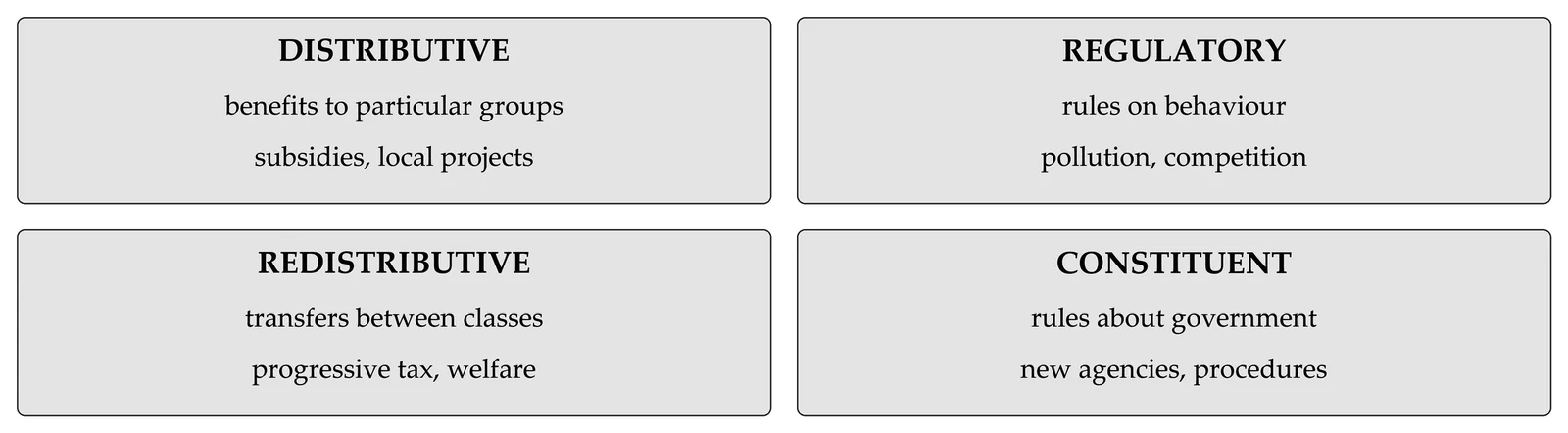
Scholars classify policies to understand how they are made. Theodore Lowi argued that ‘policies determine politics’: distributive policies give benefits to particular groups, regulatory policies control behaviour, redistributive policies transfer resources between classes, and constituent policies set up the rules and institutions of government. Each type produces a different pattern of conflict. Other typologies distinguish substantive from procedural, material from symbolic and public from private goods.
1.3 Institutional Development of Policy-Making
In India, the Constitution sets the framework of policy-making: Parliament legislates, the executive and the bureaucracy formulate and implement, the judiciary reviews, and the Directive Principles give direction. Over time, institutions such as the Planning Commission (1950), later replaced by NITI Aayog (2015), regulatory bodies, evaluation offices and advisory councils have developed. R.K. Sapru traces how policy-making became more complex, specialised and consultative.
1.4 Actors in Public Policy
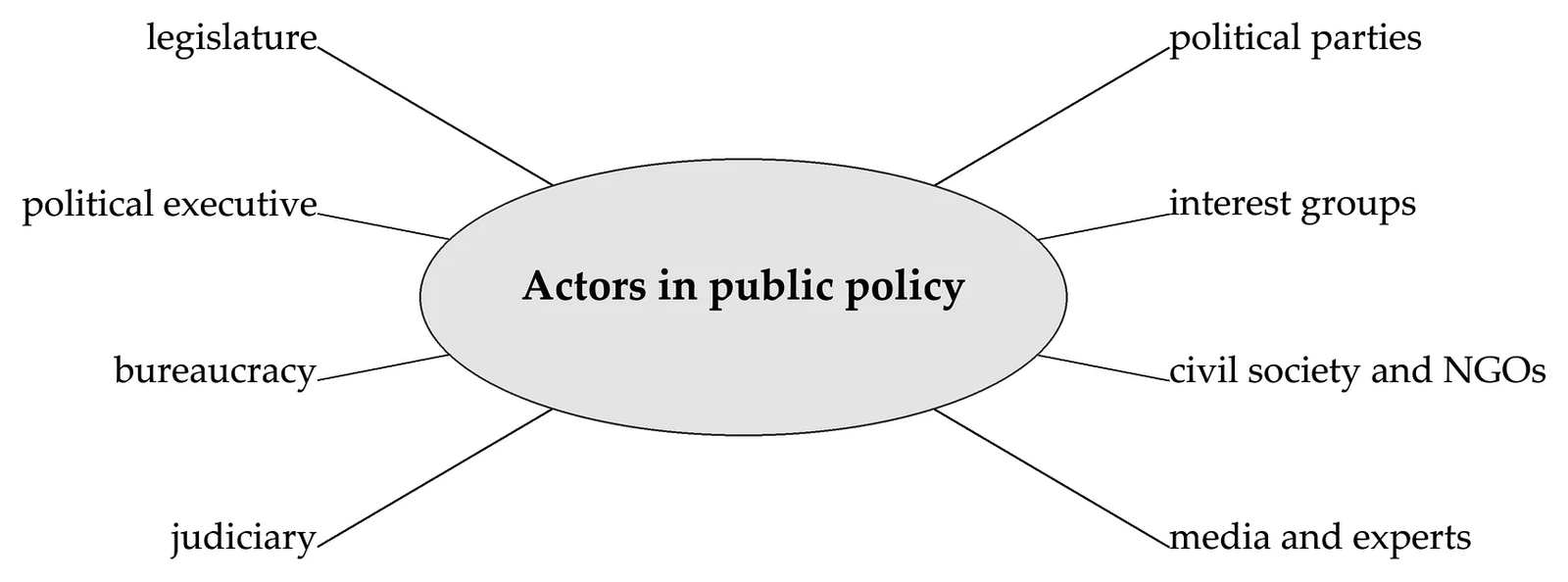
Policy is shaped by official actors, the legislature, executive, bureaucracy and judiciary, and by unofficial actors: political parties, interest groups, civil society, the media and experts. Peters and Pierre’s Handbook of Public Policy surveys these actors, and Carol Weiss shows that research influences policy mainly by gradually changing how problems are understood. Chakrabarty and Bhattacharya describe the shift from government to governance, in which policy is made through networks of state and non-state actors.
1.5 Important Questions
- Question 1 What is public policy? Discuss its nature and scope.
- Question 2 Discuss the typology of public policy.
- Question 3 Discuss the role of the state and the institutional development of policy-making in India.
- Question 4 Discuss the role of interest groups, political parties and civil society in public policy.
DU asks the same idea in different words. So learn one broad answer for each question below; the same answer works for every question joined by OR.
Important Question 1
What is public policy? Discuss its nature and scope.
OR
Discuss the meaning of public policy and the growth of policy studies.
OR
Examine Harold Lasswell’s idea of the policy sciences.
Model Answer
“A political system can be designated as those interactions through which values are authoritatively allocated for a society.”
— David Easton, A Systems Analysis of Political Life (1965)
Introduction. Public policy refers to what governments do, and choose not to do, to deal with public problems. It covers decisions on education, health, the economy, security and the environment. The systematic study of public policy developed after the Second World War, led by Harold Lasswell, and has become a central part of political science and public administration.
1. Definitions
Thomas Dye defines public policy as whatever governments choose to do or not to do. James Anderson calls it a purposive course of action followed by an actor or set of actors in dealing with a problem or matter of concern. David Easton links policy to the authoritative allocation of values for a society.
2. Policy and Decision
A policy is broader than a single decision. It is a pattern of action over time, made up of many decisions, laws, rules, programmes and budget allocations. For example, India’s education policy includes laws, schemes, funding decisions and regulations made over many years.
3. Characteristics
Public policy is goal-oriented, made by those with public authority, and backed by the power of the state. It can be positive, involving action, or negative, involving a deliberate decision not to act. It affects large numbers of people and allocates benefits and costs among them.
4. Lasswell and the Policy Sciences
Harold Lasswell, with Daniel Lerner, launched the policy sciences in 1951. He argued that the study of policy should be problem-oriented, multidisciplinary, contextual and normative, aimed at improving human dignity in a democracy. He also described politics as who gets what, when and how.
5. Growth of Policy Studies
Policy studies expanded in the United States in the 1960s, when large social programmes needed analysis and evaluation. Think tanks such as the RAND Corporation and the Brookings Institution and new schools of public policy contributed to the field, which later spread worldwide.
6. Analysis of and for Policy
Scholars distinguish analysis of policy, which studies how and why policies are made and what effects they have, from analysis for policy, which provides advice to decision-makers. Both are part of the scope of policy studies.
7. The Policy Cycle
Policy is often studied as a cycle of stages: agenda setting, policy formulation, decision-making, implementation and evaluation. The cycle is a simplification, since stages overlap, but it helps organise the study of the policy process.
8. Policy and Politics
Policy-making is political, because it involves conflict over values and the distribution of resources. Interest groups, parties and citizens compete to shape policy, and outcomes reflect power as well as reason.
9. From Government to Governance
Bidyut Chakrabarty and Mohit Bhattacharya describe the shift from government to governance, in which policies are made and delivered through networks and partnerships of the state, markets and civil society. The World Bank’s good governance agenda from the late 1980s spread this idea.
10. Research and Policy
Carol Weiss argued in 1977 that social research seldom shapes policy directly. Instead, it performs an enlightenment function, gradually changing how policy-makers understand problems and options. Research thus influences policy in diffuse and long-term ways.
11. Policy Studies in India
R.K. Sapru traces the growth of policy studies in India from the planning era, when the Planning Commission and Five-Year Plans dominated, to the period after liberalisation, when new areas such as regulation, environment and social rights expanded the field.
12. Policy and Administration
Woodrow Wilson’s early distinction between politics, which makes policy, and administration, which implements it, has given way to the recognition that administrators also shape policy through advice, interpretation and implementation.
13. Values in Policy
Policy involves choices among values such as efficiency, equity, liberty, security and sustainability. Policy analysis therefore has both empirical and normative dimensions, as Lasswell recognised.
14. Limits
Policies often have unintended consequences, face implementation gaps and are shaped by limited information. The study of public policy helps understand these limits and improve policy design.
15. Evaluation
Public policy is central to modern government, and its study combines description, explanation and prescription. As Dye and Lasswell show, it asks what governments do, why, and with what effect.
Conclusion. Thus, public policy is whatever governments choose to do or not to do in dealing with public problems. Its study, launched by Lasswell’s policy sciences, examines the content, process and effects of policy through the policy cycle, and increasingly recognises the role of governance networks and research in shaping policy.
Important Question 2
Discuss the typology of public policy.
OR
Examine Theodore Lowi’s classification of public policies.
OR
Distinguish between distributive, regulatory and redistributive policies with examples.
Model Answer
“Policies determine politics.”
— Theodore Lowi, ‘Four Systems of Policy, Politics, and Choice’ (1972)
Introduction. Public policies differ widely in their content and in the politics they generate. Scholars therefore classify them into types. The most influential typology was developed by Theodore Lowi, who argued that each type of policy produces its own kind of politics. Other scholars, such as James Anderson, Robert Salisbury and James Q. Wilson, offered further classifications.
1. Why Classify Policies
Classification helps us compare policies, predict the kind of conflict they will produce and understand which actors are likely to be involved. It moves policy studies beyond case studies towards general explanation.
2. Lowi’s Arenas of Power
Theodore Lowi, in 1964, argued that the type of policy determines the type of politics around it. He identified distributive, regulatory and redistributive policies as distinct arenas of power, and in 1972 added constituent policy.
3. Distributive Policy
Distributive policies give benefits to particular groups or areas, while their costs are spread across all taxpayers. They produce little open conflict and are often made through bargaining among legislators. Examples include the Members of Parliament Local Area Development Scheme (1993) and rural roads under the Pradhan Mantri Gram Sadak Yojana (2000).
4. Regulatory Policy
Regulatory policies impose rules on the behaviour of individuals or firms, such as limits on pollution, standards for food or rules for competition. They produce conflict between those regulated and those protected. Examples include the work of SEBI, the Telecom Regulatory Authority of India (1997) and the Competition Act of 2002.
5. Redistributive Policy
Redistributive policies transfer resources from one class or group to another, as in progressive taxation, land reforms, reservations and welfare programmes. They produce intense ideological conflict, because they involve clear winners and losers.
6. Constituent Policy
Constituent policies set up or change the rules and institutions of government, such as creating new agencies, redrawing constituencies or amending procedures. Examples include the creation of new states and the establishment of NITI Aayog.
7. Substantive and Procedural
James Anderson distinguishes substantive policies, which deal with what government will do, such as building highways, from procedural policies, which deal with how things will be done and by whom, such as the rules of administrative procedure.
8. Material and Symbolic
Material policies provide tangible resources or impose real costs. Symbolic policies appeal to values and identity without changing material conditions much, such as renaming places or declaring commemorative days.
9. Public and Private Goods
Some policies provide public goods, which are non-excludable and non-rival, such as defence, clean air and street lighting. Others provide private goods that could be supplied by markets, such as subsidised housing or electricity.
10. Self-Regulatory Policy
Robert Salisbury added self-regulatory policy, in which the state allows a group to regulate itself, as when professional councils regulate doctors and lawyers. Such policies benefit the regulated group and attract little public attention.
11. Wilson’s Typology
James Q. Wilson classified policies by whether costs and benefits are concentrated or diffuse, producing majoritarian, client, entrepreneurial and interest-group politics. For example, concentrated benefits and diffuse costs produce client politics, in which a small group lobbies successfully.
12. Sectoral Classification
Policies are also classified by sector: economic, social, foreign, defence, environmental and cultural. This is the most common classification in government, which organises ministries by sector.
13. Typology in India
Indian examples fit Lowi’s categories: distributive subsidies and local projects, regulation of telecom and finance, redistribution through land reform and reservations, and constituent changes such as the 73rd Amendment.
14. Limitations
Critics argue that many policies combine several types, and that classifying them depends on perception. A welfare programme can be both distributive and redistributive, which makes typologies hard to apply strictly.
15. Evaluation
Typologies help explain why different policies generate different politics. Lowi’s insight that policies determine politics remains influential, though real policies rarely fit one box.
Conclusion. Thus, public policies can be classified as distributive, regulatory, redistributive and constituent, following Theodore Lowi, as well as substantive or procedural, material or symbolic. As Lowi argued, policies determine politics, since each type produces a distinct pattern of conflict and actors.
Important Question 3
Discuss the role of the state and the institutional development of policy-making in India.
OR
Examine the institutional framework of public policy-making in India.
OR
What is the role of the bureaucracy and the judiciary in policy-making?
Model Answer
“It is getting to be harder to run a constitution than to frame one.”
— Woodrow Wilson, ‘The Study of Administration’ (1887)
Introduction. The state is the central actor in public policy, because only it has the authority to make binding decisions for society. In India, policy-making takes place within the framework of the Constitution and through a range of institutions that have developed and changed since Independence. R.K. Sapru traces this institutional development, which has made policy-making more complex and specialised.
1. The State as Central Actor
Only the state can make policies backed by legal authority and coercion. Dye’s institutional model studies policy as the output of government institutions, whose structures and rules shape what policies are made and how.
2. The Constitutional Framework
The Constitution divides powers between the Union and the states through the Seventh Schedule, assigns roles to the legislature, executive and judiciary, and gives direction to policy through the Directive Principles of State Policy.
3. Parliament
Parliament makes laws, approves the budget and scrutinises the executive through questions, debates and committees. Departmentally related standing committees, introduced in 1993, examine bills and budgets in detail, though many bills in recent years have been passed without committee scrutiny.
4. The Political Executive
The Prime Minister, the Cabinet and cabinet committees take the main policy decisions. The Prime Minister’s Office has become increasingly important in coordinating policy across ministries.
5. The Bureaucracy
Civil servants advise ministers, draft policies and laws, and implement programmes. Their permanence, expertise and control over information give them considerable influence. Max Weber described bureaucracy as the most efficient form of administration but warned of its power.
6. Planning Institutions
The Planning Commission, set up in 1950, dominated economic policy for decades through Five-Year Plans. It was replaced in 2015 by NITI Aayog, a think tank that promotes cooperative federalism and long-term strategy.
7. Finance and the Budget
The Finance Ministry shapes policy through the annual budget, which allocates resources across sectors. The Finance Commission, appointed every five years, recommends how central taxes are shared with the states.
8. The Judiciary
Through judicial review and public interest litigation, courts have shaped policy in areas such as environment, food security and workplace rights. Examples include the Vishaka guidelines (1997), orders on the right to food and the shift of Delhi’s buses to cleaner fuel. Critics call this judicial policy-making.
9. Federal Institutions
States make policy in areas such as agriculture, health and police. Institutions such as the Inter-State Council, set up in 1990, and the GST Council coordinate policy between the Union and the states.
10. Local Governments
The 73rd and 74th Amendments of 1992 gave constitutional status to panchayats and municipalities, enabling local planning and implementation of policies on rural development, sanitation and local services.
11. Regulatory Agencies
Since liberalisation, independent regulators have been created, such as SEBI for securities, TRAI for telecom and the Competition Commission. They make and enforce rules in specialised sectors at arm’s length from ministries.
12. Evaluation Institutions
The Programme Evaluation Organisation, set up in 1952, evaluated development programmes. It was merged into the Development Monitoring and Evaluation Office in 2015. The Comptroller and Auditor General also audits government spending.
13. Advisory Bodies
Advisory bodies such as the Economic Advisory Council to the Prime Minister and, from 2004 to 2014, the National Advisory Council bring experts and civil society into policy-making. The Administrative Reforms Commissions of 1966 and 2005 recommended institutional reforms.
14. Institutional Development
Sapru shows that policy institutions in India have become more numerous, specialised and technology-driven, with e-governance, data systems and consultation processes. Yet coordination across institutions remains a challenge.
15. Evaluation
The Indian state makes policy through a complex institutional framework that has grown since Independence. Its effectiveness depends on coordination, accountability and openness to citizens.
Conclusion. Thus, the state is the central actor in public policy, working through Parliament, the executive, the bureaucracy, the judiciary, federal and local institutions, regulators and advisory bodies. As Sapru shows, these institutions have developed from the planning era to the present, making policy-making more complex and specialised.
Important Question 4
Discuss the role of interest groups, political parties and civil society in public policy.
OR
Examine the role of non-state actors in the policy process.
OR
How has civil society influenced public policy in India?
Model Answer
“In democratic countries the science of association is the mother science; the progress of all the others depends on the progress it has made.”
— Alexis de Tocqueville, Democracy in America (1840)
Introduction. Public policy is not made by the state alone. Interest groups, political parties, civil society organisations, the media and experts all try to shape what governments do. Pluralist theory sees policy as the outcome of competition among such groups, while critics point to unequal influence. In India, civil society has played a notable role in policies on information, employment and food.
1. The Pluralist View
Pluralists such as David Truman and Robert Dahl saw policy as the result of competition and bargaining among many groups, with the state acting as a referee. No single group dominates, and policy reflects a balance of interests.
2. Interest Groups
Interest groups are organisations that seek to influence policy without contesting elections. They include business associations, trade unions, farmers’ organisations, professional bodies and caste and religious associations.
3. Business Associations
Bodies such as FICCI (1927), ASSOCHAM (1920) and the Confederation of Indian Industry influence economic policy through consultations, reports and access to ministers. They played an important role in shaping liberalisation and are consulted before budgets.
4. Labour and Farmers
Trade unions and farmers’ organisations influence policy through strikes, protests and electoral pressure. The farmers’ protests of 2020–21 forced the repeal of three farm laws, showing the power of organised agrarian interests.
5. Lobbying and Money
Lobbying is not formally regulated in India, and the influence of money on policy is a concern. In 2024, the Supreme Court struck down the electoral bonds scheme, citing the voters’ right to information about political funding.
6. Political Parties
Parties aggregate interests, present programmes in manifestos and, when in power, turn them into policy. Coalition governments negotiated common programmes, such as the Common Minimum Programme of 2004, which shaped major rights-based laws.
7. Civil Society
Civil society includes non-governmental organisations, social movements, community groups and think tanks. They raise issues, provide information, mobilise citizens, monitor implementation and sometimes deliver services.
8. Civil Society in India
The Mazdoor Kisan Shakti Sangathan’s campaign led to the Right to Information Act of 2005, and civil society members of the National Advisory Council helped draft the rural employment guarantee, the Forest Rights Act and the National Food Security Act.
9. The Media
The media shape the policy agenda by deciding which issues receive attention and how they are framed. Media coverage of events such as the Delhi gang rape of 2012 pushed rapid changes in law.
10. Experts and Research
Experts, universities and think tanks provide evidence and ideas. Carol Weiss showed that research usually influences policy indirectly through an enlightenment function, gradually reshaping how problems and solutions are understood.
11. International Actors
International organisations such as the World Bank, the IMF and the United Nations influence policy through loans, conditions, norms and goals such as the Sustainable Development Goals adopted in 2015.
12. Policy Networks
Policy is often made within networks of officials, interest groups and experts. Close networks are called policy communities or iron triangles, while looser ones are called issue networks, a term used by Hugh Heclo in 1978.
13. Peters and Pierre on Actors
Peters and Pierre emphasise that the relationship between state and non-state actors varies across countries and sectors. Strong states can steer networks, while weak states may be captured by powerful interests.
14. Unequal Influence
Critics argue that the pluralist picture hides inequality: business and the wealthy are better organised and better connected than the poor. Elite capture and the weak voice of marginalised groups remain serious problems.
15. Evaluation
Non-state actors enrich policy-making by bringing information, demands and participation, but their influence is unequal. Democratic policy requires opening the process to weaker voices.
Conclusion. Thus, public policy is shaped not only by the state but by interest groups, political parties, civil society, the media, experts and international organisations. In India, civil society contributed to landmark rights-based laws, but the unequal influence of organised interests remains a challenge for democratic policy-making.
Short Notes
(a) Policy sciences
Harold Lasswell’s term, introduced in 1951, for a problem-oriented, multidisciplinary and normative study of policy aimed at improving decision-making and human dignity in democracy. It laid the foundation of modern policy studies.
(b) Enlightenment function of research
Carol Weiss’s idea that social research influences policy mainly by gradually changing how policy-makers understand problems and possibilities, rather than by directly providing answers for particular decisions.
(c) Issue networks
A term used by Hugh Heclo in 1978 for loose, open networks of experts, officials and activists who share knowledge about a policy area, in contrast to closed iron triangles of officials, legislators and interest groups.
More notes: DSE-7 Public Policy
These notes are prepared by PADHO TO AISE for study help. They are not an official University of Delhi publication.