
Semester VIII DSE-15 Power Dilemmas in International Relations
Unit IV · 24 min read · Updated 24 Nov 2026
As per the University of Delhi (DU) BA (Hons) Political Science syllabus
Contents
- 4.1 Global Citizenship and Diasporas
- Roots of Cosmopolitanism
- Contemporary Views of Global Citizenship
- India and Its Diaspora
- 4.2 Social Globalisation and INGOs
- History of INGOs
- How INGOs Exercise Influence
- Campaigns that Changed Treaties
- Criticisms and State Responses
- 4.3 Debating Power and Its Limits
- Sources and Forms of Soft Power
- India’s Soft Power
- The Changing Nature of Power
- 4.4 Important Questions
- Discuss cosmopolitanism and global citizenship with reference to Parekh.
- Discuss the role of international NGOs in social globalisation and global governance.
- Discuss the debate on hard, soft and smart power.
- Discuss the limits of power in international relations.
- Short Notes
शक्ति तब उत्पन्न होती है जब लोग मिलकर काम करते हैं, और जिस क्षण वे बिखर जाते हैं, वह गायब हो जाती है।
Power springs up between men when they act together and vanishes the moment they disperse.
— Hannah Arendt, The Human Condition (1958)
POWER in world politics is not held only by states. Citizens, diasporas, non-governmental organisations and social movements also exercise power across borders. This chapter examines power from the people’s perspective: cosmopolitanism and global citizenship, the role of international NGOs in social globalisation, the debate on hard, soft, smart and radical power, and the limits of power in an uncertain world. It draws on Bhikhu Parekh, Rahel Kunz, Sarah Stroup, Ruth Grant and Robert Keohane, Joseph Nye, Ernest Wilson, Peter Katzenstein and Lucia Seybert, and Moisés Naím.
4.1 Global Citizenship and Diasporas
Global citizenship is the idea that people have responsibilities and loyalties beyond their own state, to humanity as a whole. Bhikhu Parekh proposes a globally oriented citizenship, rooted in one’s own community but concerned with the welfare of outsiders. Diasporas, communities living outside their homeland, have become important actors, sending remittances, lobbying governments and linking societies.
Roots of Cosmopolitanism
The idea of world citizenship is ancient. When asked where he came from, the Greek philosopher Diogenes is said to have replied that he was a citizen of the world (kosmopolites). The Stoics developed the idea of a universal community of reason. Immanuel Kant, in Perpetual Peace (1795), proposed a cosmopolitan right of universal hospitality, the right of a stranger not to be treated with hostility. In Indian thought, the Maha Upanishad’s phrase vasudhaiva kutumbakam, the world is one family, expresses a similar ideal, and Rabindranath Tagore, in Nationalism (1917), criticised aggressive nationalism in favour of a universal humanism.
Contemporary Views of Global Citizenship
- Concentric circles. Martha Nussbaum, in Patriotism and Cosmopolitanism (1994), drew on the Stoic image of concentric circles of self, family, community and humanity, urging that we draw the outer circles closer to the centre.
- Rooted cosmopolitanism. Kwame Anthony Appiah, in Cosmopolitanism (2006), argued that we can be loyal to our own communities while respecting the value of every human life and learning from difference.
- Globally oriented citizenship. Bhikhu Parekh rejects both a rootless world citizenship and narrow nationalism, arguing that citizens should press their own states to act justly towards outsiders.
- Global citizenship education. UNESCO has promoted education for global citizenship, and the Sustainable Development Goals (target 4.7) include it.
India and Its Diaspora
India has one of the largest diasporas in the world, with more than thirty million non-resident Indians and persons of Indian origin, and it receives more remittances than any other country, over a hundred billion dollars a year in recent years. Robin Cohen, in Global Diasporas (1997), distinguished victim, labour, imperial, trade and cultural diasporas, and Indian migration includes indentured labourers taken to Fiji, Mauritius and the Caribbean in the nineteenth century as well as professionals in the West and workers in the Gulf. After the L.M. Singhvi committee reported in 2002, India began celebrating Pravasi Bharatiya Divas on 9 January from 2003 and introduced Overseas Citizenship of India in 2005. The Indian-American community lobbied for the India–US nuclear deal of 2008, and India evacuated citizens through the Vande Bharat Mission in 2020 and Operation Ganga in 2022.
4.2 Social Globalisation and INGOs
Social globalisation is the spread of people, ideas, information and organisations across borders. International non-governmental organisations (INGOs), such as Amnesty International, Greenpeace and Médecins Sans Frontières, campaign for human rights, the environment and humanitarian relief. They influence treaties and monitor states, though questions arise about their own accountability.
History of INGOs
International non-governmental organisations have a long history. The British and Foreign Anti-Slavery Society was founded in 1839, and the International Committee of the Red Cross in 1863, after Henri Dunant described the suffering of wounded soldiers in A Memory of Solferino (1862). Article 71 of the UN Charter allowed ECOSOC to consult NGOs, giving them a formal place in the UN system. Their numbers grew rapidly after the 1970s with the spread of human rights and environmental movements, cheaper travel and, later, the internet.
How INGOs Exercise Influence
- Information politics. Margaret Keck and Kathryn Sikkink, in Activists beyond Borders (1998), showed how networks gather and spread reliable information that states cannot ignore.
- Symbolic politics. They use powerful stories and symbols to frame issues and mobilise public opinion.
- Leverage politics. They persuade powerful states and institutions to pressure violators, as in the boomerang pattern, where domestic groups blocked at home seek allies abroad who pressure their government.
- Accountability politics. They hold governments to their stated commitments, publicising gaps between promises and practice.
- Expertise and service. Groups such as Médecins Sans Frontières deliver services where states fail, which gives them credibility and access.
Campaigns that Changed Treaties
INGOs have helped produce major treaties. The International Campaign to Ban Landmines, coordinated by Jody Williams, worked with Canada and other states to secure the Ottawa Treaty of 1997. The Coalition for the International Criminal Court pushed for the Rome Statute of 1998. The Jubilee 2000 campaign won debt relief for poor countries. The International Campaign to Abolish Nuclear Weapons won the Nobel Peace Prize in 2017 for its role in the Treaty on the Prohibition of Nuclear Weapons adopted that year.
Criticisms and State Responses
Critics question the accountability of INGOs, which are not elected and answer mainly to donors. Ruth Grant and Robert Keohane (2005) argue that they need stronger mechanisms of accountability. Clifford Bob, in The Marketing of Rebellion (2005), showed that local movements must compete for the attention of Northern NGOs, so causes that fit Western concerns receive more support. Many states have restricted foreign-funded NGOs. In India, the Foreign Contribution (Regulation) Act of 2010, tightened in 2020, led to the cancellation of thousands of NGO licences, and Amnesty International halted its operations in India in September 2020.
4.3 Debating Power and Its Limits
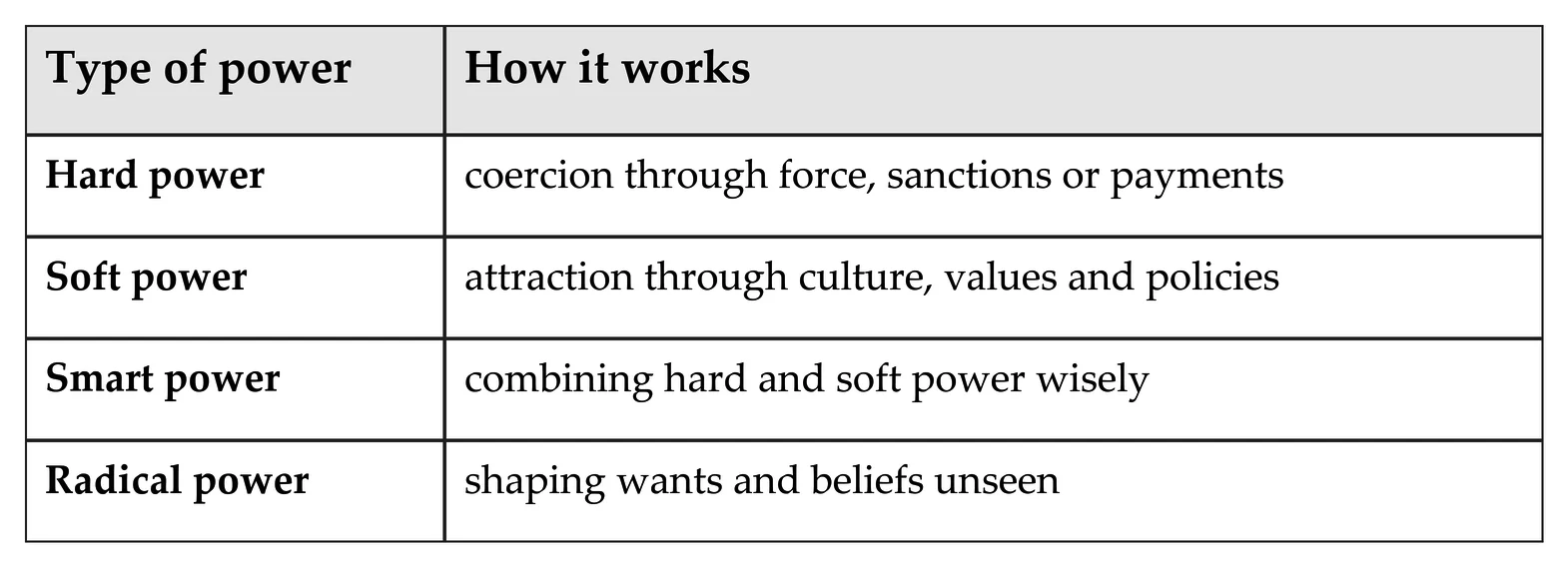
Joseph Nye distinguished hard power, based on coercion and payment, from soft power, based on attraction, and later spoke of smart power combining both. Radical power, following Lukes, shapes what others want. Yet power has limits: Moisés Naím argues that power is easier to get, harder to use and easier to lose, and Katzenstein and Seybert show how uncertainty produces unexpected protean power.

Sources and Forms of Soft Power
- Three sources. Nye, in Soft Power (2004), identified a country’s culture, its political values when it lives up to them and its foreign policies when seen as legitimate.
- Smart power. Suzanne Nossel (2004) and Nye in The Future of Power (2011) described smart power as the skilful combination of hard and soft power.
- Sharp power. In 2017, analysts at the National Endowment for Democracy coined the term sharp power for authoritarian efforts to manipulate opinion abroad through censorship, disinformation and influence operations.
- Public diplomacy. States promote soft power through cultural centres, broadcasting, scholarships and exchanges, such as China’s Confucius Institutes from 2004.
India’s Soft Power
India’s soft power rests on its civilisational heritage, democracy, diaspora, films and spiritual traditions. The UN General Assembly declared 21 June the International Day of Yoga in December 2014, on India’s proposal, with a record number of co-sponsors. The Indian Council for Cultural Relations, founded in 1950 by Maulana Abul Kalam Azad, promotes cultural exchange, and the revival of Nalanda University links India with Asian Buddhist traditions. During the pandemic, India’s Vaccine Maitri initiative of 2021 supplied vaccines to many countries. Shashi Tharoor, in Pax Indica (2012), argues that India’s soft power is a major asset, but scholars note that poverty, social conflict and weak delivery limit its appeal.
The Changing Nature of Power
Moisés Naím, in The End of Power (2013), argues that three revolutions have weakened traditional power holders: the more revolution, as there are more people, countries and organisations; the mobility revolution, as people, money and ideas move freely; and the mentality revolution, as people expect more and defer less. Peter Katzenstein and Lucia Seybert, in Protean Power (2018), distinguish control power, which works under calculable risk, from protean power, the unexpected creativity of actors in conditions of uncertainty. Andrew Bacevich, in The Limits of Power (2008), warned that American overreach was undermining its strength. Together these works show that power today is real but more diffuse, fragile and contested than before.
4.4 Important Questions
- Question 1 Discuss cosmopolitanism and global citizenship with reference to Parekh.
- Question 2 Discuss the role of international NGOs in social globalisation and global governance.
- Question 3 Discuss the debate on hard, soft and smart power.
- Question 4 Discuss the limits of power in international relations.
DU asks the same idea in different words. So learn one broad answer for each question below; the same answer works for every question joined by OR.
Important Question 1
Discuss cosmopolitanism and global citizenship with reference to Parekh.
OR
Is global citizenship possible? Discuss.
OR
Examine the growing importance of diasporas in world politics.
Model Answer
“The person whose allegiance is to the worldwide community of human beings.”
— Martha Nussbaum, Patriotism and Cosmopolitanism (1994), describing the cosmopolitan
Introduction. Globalisation has led many to ask whether people should see themselves as citizens of the world rather than only of their nation. Cosmopolitanism holds that all human beings form one moral community. Bhikhu Parekh critically examines this idea and proposes a more grounded form of global citizenship, while scholars such as Rahel Kunz and Fiona Adamson show the growing role of diasporas in world politics.
1. Meaning of Cosmopolitanism
Cosmopolitanism is the view that every human being has equal moral worth and that our obligations extend to all humanity, not only to fellow citizens. It goes back to the Stoics and Kant.
2. Meaning of Global Citizenship
Global citizenship refers to a sense of belonging to and responsibility for the world community, expressed through concern for global problems, support for human rights and participation in transnational action.

3. Parekh’s Critique of World Citizenship
Bhikhu Parekh argues that strong cosmopolitanism, which asks us to treat all humans as fellow citizens, is too abstract. There is no world state with institutions of citizenship, and people’s identities and loyalties are rooted in particular communities.
4. Parekh’s Critique of Narrow Nationalism
At the same time, Parekh rejects narrow nationalism that ignores outsiders. In an interdependent world, a state’s policies affect people elsewhere, so citizens cannot ignore their impact on humanity.
5. Globally Oriented Citizenship
Parekh proposes globally oriented citizenship: people remain citizens of their own political community but take responsibility for ensuring that their country acts justly towards others, does not harm them and helps those in need.
6. Duties to Outsiders
Global citizens should press their governments to respect human rights, provide aid, accept refugees, reform unfair trade and act on climate change, turning global concern into national political action.
7. Diasporas
Diasporas are communities that live outside their country of origin but keep links with it. India’s diaspora is one of the largest in the world and sends more remittances home than any other.
8. Kunz on the Discovery of Diasporas
Rahel Kunz shows that international organisations and states began to discover diasporas as development actors in the 2000s, promoting remittances and diaspora investment, which changed how power is diffused in global governance.
9. Adamson on Diaspora Politics
Fiona Adamson argues that diaspora politics is growing in importance, as states court their diasporas for investment and influence, and diasporas lobby host governments and take part in homeland politics.
10. India and Its Diaspora
India celebrates Pravasi Bharatiya Divas, offers Overseas Citizenship of India and engages its diaspora as a bridge to other countries, especially the United States and the Gulf.
11. Transnational Activism
Global citizens act through transnational movements on climate change, human rights and global justice, such as the climate strikes led by young people from 2018.
12. Who Governs the Globe
Deborah Avant, Martha Finnemore and Susan Sell show that global governance involves many non-state actors, giving citizens and organisations channels of influence beyond the state.
13. Criticisms
Critics argue that global citizenship is an elite identity of the mobile and educated, and that diasporas can also export conflict, as when diaspora groups fund militant movements.
14. India’s Traditions
Tagore’s universalism and the ideal of Vasudhaiva Kutumbakam offer Indian versions of cosmopolitanism rooted in culture rather than abstract world citizenship.
15. Global Citizenship Education
UNESCO and many school systems now promote global citizenship education, which teaches students about human rights, sustainability and cultural diversity and encourages them to act on global problems. Supporters see it as preparing young people for an interdependent world, while critics worry that it may neglect national civic education or present a narrow Western view of global values.
16. Diaspora and Foreign Policy
Diasporas can shape the foreign policy of their host countries. The Indian American community played a role in building support in the United States Congress for the India–US civil nuclear agreement of 2008. Such influence shows how people’s power operates through transnational communities as well as through states.
17. Evaluation
Global citizenship is best understood, as Parekh suggests, as a global orientation of national citizenship, while diasporas show how people’s power crosses borders.
Conclusion. Thus, cosmopolitanism treats humanity as one moral community, but Parekh argues that strong world citizenship is unrealistic and proposes globally oriented citizenship rooted in national communities. Kunz and Adamson show how diasporas have become important actors, as India’s engagement with its diaspora illustrates.
Important Question 2
Discuss the role of international NGOs in social globalisation and global governance.
OR
How do NGOs interact with states in international relations?
OR
Are international NGOs accountable? Discuss.
Model Answer
“The Economic and Social Council may make suitable arrangements for consultation with non-governmental organizations which are concerned with matters within its competence.”
— Charter of the United Nations, Article 71 (1945)
Introduction. Social globalisation, the spread of people, ideas and organisations across borders, has increased the role of non-state actors in world politics. International NGOs campaign for human rights, environmental protection, development and humanitarian relief, and influence international decisions. Sarah Stroup, Ronnie Krut and others examine their role, while Ruth Grant and Robert Keohane raise questions about their accountability.
1. Social Globalisation
Social globalisation refers to the growing flow of people, information, cultural products and ideas across borders, supported by travel, migration, media and the internet.
2. Meaning of INGOs
International NGOs are private, non-profit organisations that operate in several countries, such as the Red Cross (1863), Oxfam (1942), Amnesty International (1961), Greenpeace (1971) and Médecins Sans Frontières (1971).
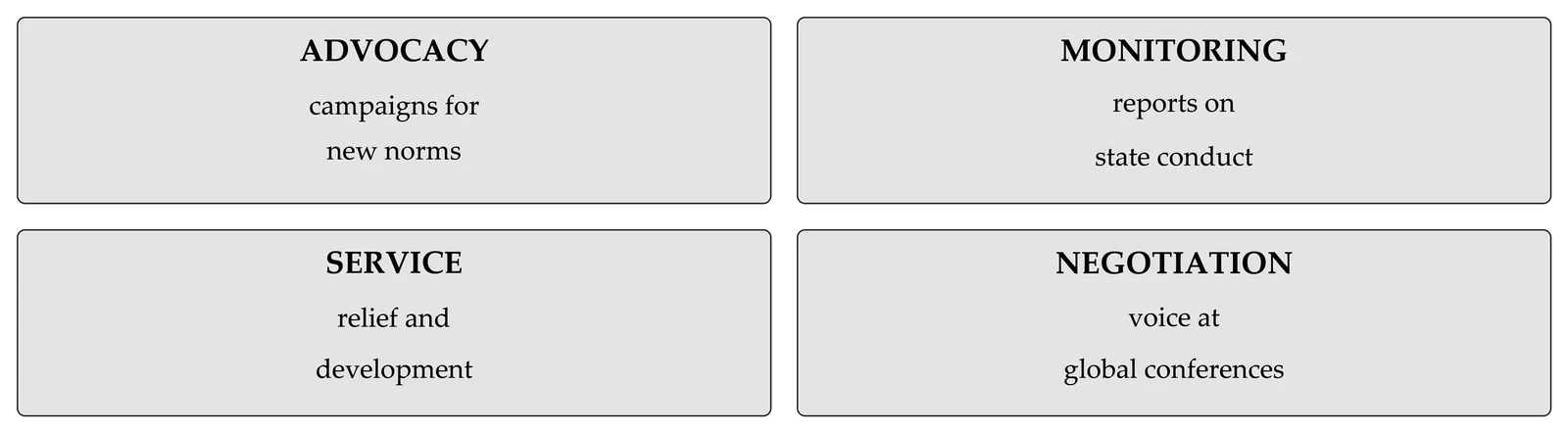
3. Advocacy
INGOs campaign to create new international norms and laws. The International Campaign to Ban Landmines helped achieve the Ottawa Treaty of 1997, and a coalition of NGOs supported the Rome Statute of the International Criminal Court in 1998.
4. Monitoring
NGOs such as Amnesty International and Human Rights Watch monitor and report on states’ human rights records, using publicity to shame governments into changing behaviour.
5. Service Delivery
Humanitarian and development NGOs deliver relief in disasters and conflicts and run programmes in health, education and livelihoods, often in partnership with governments and the UN.
6. Krut on NGO Influence
Riva Krut and colleagues, in a UNRISD study of 1997, found that NGOs gained influence at UN conferences such as Rio in 1992 and Beijing in 1995, but that access was uneven and dominated by better-resourced Northern NGOs.
7. Stroup on NGO–State Interaction
Sarah Stroup shows that NGOs interact with states in different ways, cooperating, lobbying or confronting, and that their strategies are shaped by the political and legal environment of their home countries.
8. Transnational Advocacy Networks
Margaret Keck and Kathryn Sikkink described a boomerang pattern, in which local activists blocked by their own state appeal to international allies, who pressure that state from outside.
9. Ruhlman on Global Governance
Molly Ruhlman examines NGOs as participants in global governance, providing expertise, representing affected groups and helping implement agreements, which gives them a growing institutional role.
10. Grant and Keohane on Accountability
Ruth Grant and Robert Keohane argue that accountability in world politics depends on mechanisms such as hierarchy, supervision, fiscal control, law, markets, peer pressure and public reputation. NGOs rely mainly on reputation and are not accountable to the people they claim to represent.
11. Northern Dominance
Critics argue that many powerful INGOs are based in the global North and funded by Western donors, so they may impose Northern priorities on the global South.
12. States’ Responses
Some states restrict foreign-funded NGOs, as India has done through amendments to the Foreign Contribution (Regulation) Act, arguing that they interfere in domestic affairs, while critics see this as shrinking civic space.
13. Successes
NGO campaigns contributed to debt relief through the Jubilee 2000 campaign and to the Treaty on the Prohibition of Nuclear Weapons of 2017, for which ICAN won the Nobel Peace Prize.
14. People’s Power
INGOs show that people organised across borders can exercise power by shaping norms, agendas and public opinion, even without armies or wealth.
15. NGOs at Climate Talks
Thousands of NGOs attend UN climate conferences as observers. They provide research, publicise vulnerable communities’ concerns and track government pledges. Climate Action Network, a coalition of more than a thousand organisations, coordinates their work, though NGOs complain that their access to negotiating rooms has been restricted at recent conferences.
16. Evaluation
INGOs are important actors in social globalisation and global governance, though their accountability and representativeness are contested.
Conclusion. Thus, INGOs such as Amnesty, Greenpeace and MSF advocate, monitor and deliver services, shaping treaties like the Ottawa Treaty and the Rome Statute. Krut, Stroup and Ruhlman show their growing influence, while Grant and Keohane question their accountability, and critics point to Northern dominance and state restrictions.
Important Question 3
Discuss the debate on hard, soft and smart power.
OR
What is soft power? Examine its sources and limits.
OR
Is the distinction between hard and soft power useful? Discuss.
Model Answer
“Soft power is the ability to get what you want through attraction rather than coercion or payments.”
— Joseph S. Nye, Soft Power (2004)
Introduction. The debate on hard and soft power, launched by Joseph Nye in 1990, has changed how scholars and governments think about power. Hard power coerces, while soft power attracts. Nye later added smart power, the combination of both, and critics such as Pinar Bilgin and Berivan Eliş and Steven Lukes have questioned these distinctions, pointing also to radical power.
1. Hard Power
Hard power is the ability to make others act through coercion or inducement, using military force, threats, economic sanctions or payments, the carrots and sticks of international politics.
2. Soft Power
Soft power is the ability to shape others’ preferences through attraction, so that they want what you want. It co-opts rather than coerces.
3. Sources of Soft Power
Nye identifies three sources of soft power: culture, when it is attractive to others; political values, when a country lives up to them; and foreign policies, when they are seen as legitimate and moral.
4. Nye on the Future of Power
In The Future of Power, Nye argues that power is shifting from West to East and diffusing from states to non-state actors, especially through cyber technology, so states must combine different forms of power.
5. Smart Power
Smart power is the ability to combine hard and soft power into effective strategies. Ernest Wilson defines it as the capacity to combine elements of hard and soft power in ways that are mutually reinforcing.
6. Lackey’s Analysis
Douglas Lackey examines the philosophical basis of the distinction, asking whether soft power is morally better than hard power and noting that attraction can also involve manipulation.
7. Bilgin and Eliş’s Critique
Pinar Bilgin and Berivan Eliş argue that the line between hard and soft power is blurred, since military and economic strength can create attraction, and call for a more realistic analysis that sees how they work together.
8. Radical Power
Radical power, drawing on Steven Lukes’s third face of power, works by shaping others’ wants and beliefs without their awareness. Lukes argued that soft power can be either empowering or manipulative.
9. Sharp Power
Analysts have used the term sharp power for efforts by authoritarian states to manipulate information and influence opinion abroad, which differ from genuine attraction.
10. US Soft Power
The United States has enjoyed great soft power through its universities, films, technology and democratic values, but actions such as the Iraq war of 2003 damaged its attractiveness.
11. China’s Soft Power
China has invested in Confucius Institutes, media and development finance to build soft power, though its political system and assertive policies limit its attractiveness in many countries.
12. India’s Soft Power
India’s soft power includes yoga, recognised by the International Day of Yoga since 2015, cinema, cuisine, Buddhism, its diaspora and democracy, as well as vaccine supplies to other countries in 2021.
13. Limits of Soft Power
Soft power is slow, diffuse and largely produced by society rather than government, so states cannot easily control or use it in crises.
14. Hard Power Still Matters
The war in Ukraine and rising military spending show that hard power remains central, so soft power complements rather than replaces it.
15. Public Diplomacy
States build soft power through public diplomacy, communicating directly with foreign publics through cultural centres, scholarships, broadcasting and exchanges. India’s Indian Council for Cultural Relations, set up in 1950, and its scholarship programmes for students from Africa and Asia are examples of efforts to turn culture and education into influence.
16. Soft Power Rankings
Indices such as the Soft Power 30 and the Global Soft Power Index try to measure countries’ attractiveness through culture, education, government, digital presence and global engagement. Critics note that such rankings reflect Western perceptions and cannot show whether attraction actually changes other states’ behaviour.
17. Evaluation
The hard–soft distinction is useful but simplified; effective power combines coercion, attraction and the shaping of preferences.
Conclusion. Thus, Nye distinguished hard power, based on coercion and payment, from soft power, based on attraction through culture, values and policies, and proposed smart power as their combination, as Wilson explains. Bilgin and Eliş show that the line is blurred, and Lukes’s radical power reminds us that shaping preferences can also manipulate.
Important Question 4
Discuss the limits of power in international relations.
OR
Why do powerful states often fail to achieve their goals?
OR
Examine Naím’s argument about the end of power.
Model Answer
“In the 21st century, power is easier to get, harder to use, and easier to lose.”
— Moisés Naím, The End of Power (2013)
Introduction. Powerful states do not always get what they want. History is full of examples of great powers failing against weaker opponents, and globalisation, technology and social change have made power harder to use. Peter Katzenstein and Lucia Seybert, Moisés Naím and Andrew Bacevich examine the limits of power in a world of uncertainty and change.
1. The Problem
Theories of power often assume that more resources produce more influence. Yet the United States failed in Vietnam, the Soviet Union in Afghanistan and the United States again in Iraq and Afghanistan, despite overwhelming capabilities.
2. The Paradox of Unrealised Power
David Baldwin called this the paradox of unrealised power: resources useful in one context, such as nuclear weapons, may be useless in another, such as counter-insurgency or trade negotiations.
3. Katzenstein and Seybert on Uncertainty
Peter Katzenstein and Lucia Seybert distinguish risk, which can be calculated, from uncertainty, which cannot. Most theories of power assume calculable risk and therefore fail to anticipate unexpected events.
4. Control Power and Protean Power
They distinguish control power, the ability to shape outcomes in predictable conditions, from protean power, the effect of improvisation and innovation by actors in uncertain conditions, as in the Arab uprisings of 2011 or the financial crisis of 2008.
5. Naím’s End of Power
Moisés Naím argues that power is decaying: it is easier to get, harder to use and easier to lose, as new micropowers such as small parties, start-ups, activists and insurgents challenge established states and corporations.
6. The Three Revolutions
Naím explains this through the More revolution, the growth of people and resources; the Mobility revolution, the movement of people, money and ideas; and the Mentality revolution, the decline of deference to authority.
7. Bacevich on American Power
Andrew Bacevich, in The Limits of Power (2008), argues that the United States overestimated its military power, overextended itself in wars and neglected domestic problems of debt and consumption, leading to an end of American exceptionalism.
8. Imperial Overstretch
Paul Kennedy warned that great powers decline when their military commitments exceed their economic base, a pattern he called imperial overstretch.
9. Nationalism and Resistance
Nationalism and local resistance limit the power of outside states, as occupied peoples resist foreign rule even against superior force, as in Vietnam and Afghanistan.
10. Nuclear Deterrence
Nuclear weapons limit the use of force among nuclear powers, since war between them could be catastrophic, as shown by India and Pakistan and by the Cold War superpowers.
11. Interdependence
Economic interdependence limits power because coercion harms the coercer as well, as sanctions and trade wars affect both sides.
12. Legitimacy
Power without legitimacy provokes resistance and balancing. Actions seen as illegitimate, such as the Iraq war, can weaken a state’s influence even when it wins militarily.
13. Afghanistan, 2021
The withdrawal of the United States from Afghanistan in August 2021 and the return of the Taliban after twenty years of war showed the limits of even the strongest military power.
14. Lessons
The limits of power suggest that states should combine force with diplomacy, legitimacy and cooperation, and recognise uncertainty in planning.
15. The War in Ukraine
Russia’s invasion of Ukraine in 2022 was expected by many to succeed quickly because of Russia’s much larger military. Instead, Ukrainian resistance, Western support, sanctions and the use of drones and new technology led to a long and costly war, showing how will, alliances and innovation can limit the power of a stronger state.
16. Non-State Actors
Terrorist groups, insurgents and criminal networks with few resources can inflict great harm on powerful states. The attacks of 11 September 2001 showed how a small group could change world politics, and cyber attacks by small groups can disrupt infrastructure, illustrating Naím’s argument that micropowers constrain the powerful.
17. Domestic Constraints
Domestic politics limits the use of power. Public opinion turned against the wars in Vietnam and Iraq, legislatures restrict military action and budgets, and leaders must win elections. Democracies in particular find it hard to sustain long and costly wars without public support.
18. Evaluation
Power in international relations is limited by context, uncertainty, resistance, interdependence and legitimacy.
Conclusion. Thus, power has limits, as failures in Vietnam, Iraq and Afghanistan show. Katzenstein and Seybert explain how uncertainty creates protean power, Naím argues that power is decaying through the More, Mobility and Mentality revolutions, and Bacevich shows the limits of American power, while deterrence, interdependence and legitimacy constrain all states.
Short Notes
(a) Globally oriented citizenship
Bhikhu Parekh’s idea of citizenship rooted in one’s own political community but committed to ensuring that it acts justly towards the rest of the world.
(b) Smart power
The combination of hard and soft power in mutually reinforcing ways, an idea developed by Joseph Nye and Ernest Wilson.
(c) Protean power
Katzenstein and Seybert’s term for the effect of improvisation and innovation by actors in conditions of uncertainty.
(d) Boomerang pattern
Keck and Sikkink’s term for the process in which local activists blocked by their own state appeal to international allies, who then pressure that state from outside.
More notes: DSE-15 Power Dilemmas in International Relations
These notes are prepared by PADHO TO AISE for study help. They are not an official University of Delhi publication.