
Semester VIII DSE-15 Power Dilemmas in International Relations
Unit I · 25 min read · Updated 24 Nov 2026
As per the University of Delhi (DU) BA (Hons) Political Science syllabus
Contents
- 1.1 Understanding Power
- Classic Definitions of Power
- Elements of National Power
- The Paradox of Unrealised Power
- Barnett and Duvall’s Taxonomy
- 1.2 Perspectives on Power
- Realism and Power
- Liberalism and Power
- Constructivist, Postcolonial, Critical and Feminist Views
- 1.3 Indian Understandings of Power
- Kautilya’s Three Kinds of Power
- Features of Kautilya’s View of Power
- The Buddha and Gandhi on Power
- Power in Indian Strategic Thought Today
- 1.4 Important Questions
- What is power in international relations? Discuss its different dimensions.
- Compare the realist and liberal perspectives on power in international relations.
- Discuss the postcolonial, sociological and critical perspectives on power.
- Discuss Indian understandings of power with reference to Kautilya and the Buddha.
- Short Notes
शक्तिशाली वह करते हैं जो वे कर सकते हैं, और कमज़ोर वह सहते हैं जो उन्हें सहना पड़ता है।
The strong do what they can and the weak suffer what they must.
— Thucydides, History of the Peloponnesian War, the Melian Dialogue (tr. R. Crawley)
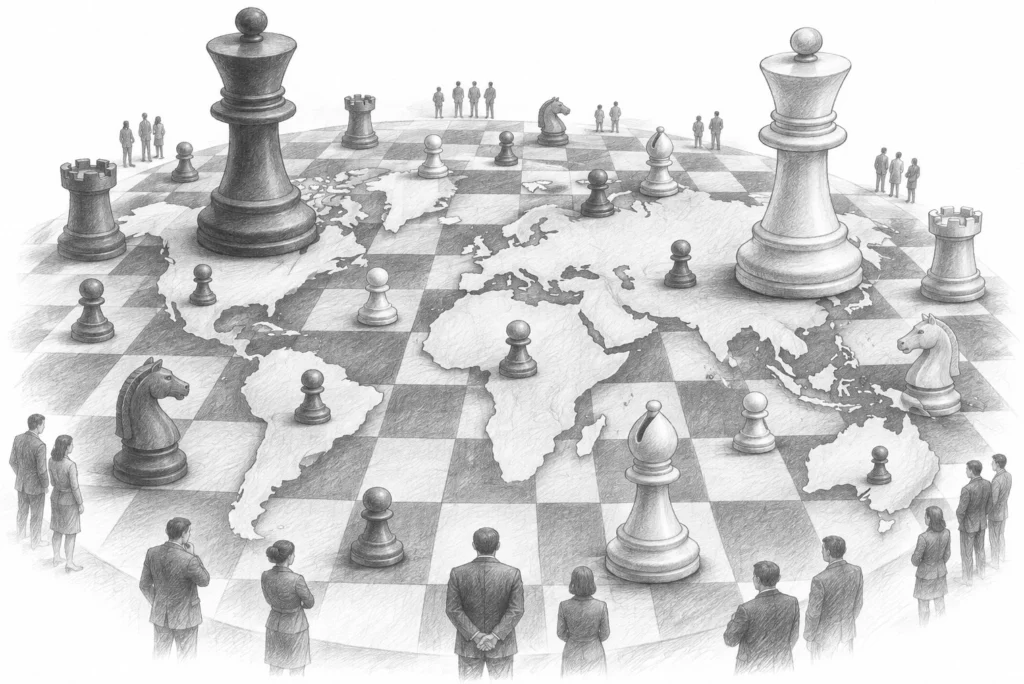
POWER is the most central and the most contested concept in international relations. Realists see it as military and economic capability, liberals as influence through interdependence and institutions, constructivists as shaped by ideas and identities, and postcolonial and critical thinkers as structures of race, class and hegemony. Indian traditions, from Kautilya to the Buddha, offer their own understandings. This chapter explains the meaning of power and these perspectives, drawing on Martha Finnemore, Tuomas Forsberg, Steven Lukes, John Mearsheimer, Robert Keohane and Joseph Nye, Alexander Wendt, Geeta Chowdhry and Medha Bisht.

1.1 Understanding Power
Power in international relations is the ability of an actor to achieve its goals and to influence others. It can be seen as resources, such as armies, wealth and population, or as a relationship, the ability to make others act differently. Steven Lukes distinguished three faces of power: winning decisions, controlling the agenda and shaping what others want. Martha Finnemore and Judith Goldstein show that while state power remains central, its forms are changing.
Classic Definitions of Power
- Weber. Max Weber, in Economy and Society (1922), defined power as the chance of a person to carry out his own will in a social relationship even against resistance.
- Dahl. Robert Dahl, in The Concept of Power (1957), said that A has power over B to the extent that A can get B to do something B would not otherwise do; this is the first face of power, seen in observable decisions.
- Bachrach and Baratz. In Two Faces of Power (1962), they added a second face: the power to keep issues off the agenda through non-decision-making.
- Lukes. Steven Lukes, in Power: A Radical View (1974), added a third face: the power to shape people’s wants and beliefs so that they accept their own domination.
- Arendt. Hannah Arendt, in On Violence (1970), saw power as the human ability to act in concert, which belongs to a group rather than an individual, and distinguished it from violence.
- Foucault. Michel Foucault, in works such as Discipline and Punish (1975), saw power as spread throughout society, productive rather than only repressive and closely linked with knowledge.
Elements of National Power
Hans Morgenthau, in Politics Among Nations (1948), listed nine elements of national power: geography, natural resources, industrial capacity, military preparedness, population, national character, national morale, the quality of diplomacy and the quality of government. He insisted that power is relative, always measured against other states, and dynamic, changing over time. He gave special importance to diplomacy, which he called the brains of national power, because it combines the other elements into effective policy.
The Paradox of Unrealised Power
David Baldwin, in an essay of 1979, called attention to the paradox of unrealised power: states that seem powerful on paper often fail to achieve their goals. The United States, with overwhelming resources, could not win in Vietnam, and later struggled in Iraq and Afghanistan, from which it withdrew in August 2021. Baldwin explained that power resources are useful only in particular contexts, or policy-contingency frameworks: nuclear weapons do not help win a trade dispute or defeat an insurgency. This is why scholars prefer to analyse power as a relationship in a specific domain and scope rather than as a stock of resources.
Barnett and Duvall’s Taxonomy
Michael Barnett and Raymond Duvall, in Power in International Politics (2005), classified power along two dimensions, whether it works through direct interaction or through social relations, and whether it is specific or diffuse. This gives four types: compulsory power, the direct control of one actor over another; institutional power, exercised indirectly through rules and organisations; structural power, which constitutes the positions and capacities of actors, such as capital and labour; and productive power, which works through discourse and knowledge to shape identities. The scheme helps students connect the realist, liberal, Marxist and post-structural views of power.
1.2 Perspectives on Power
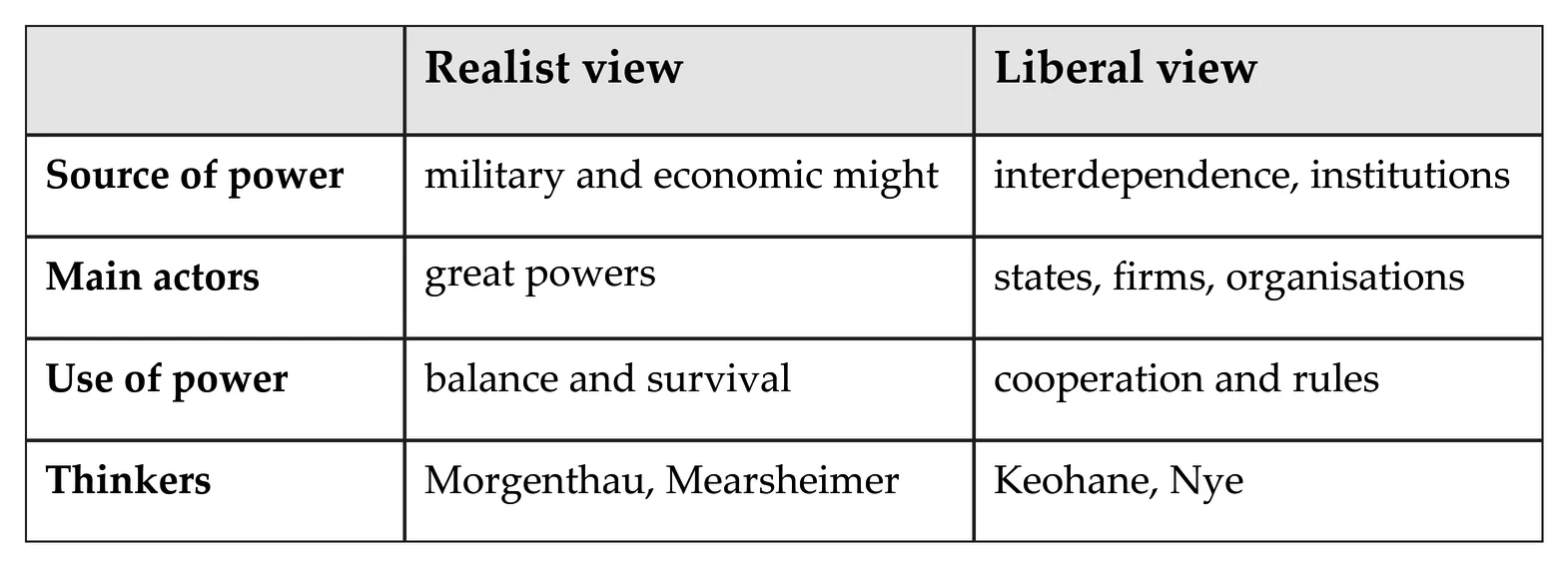
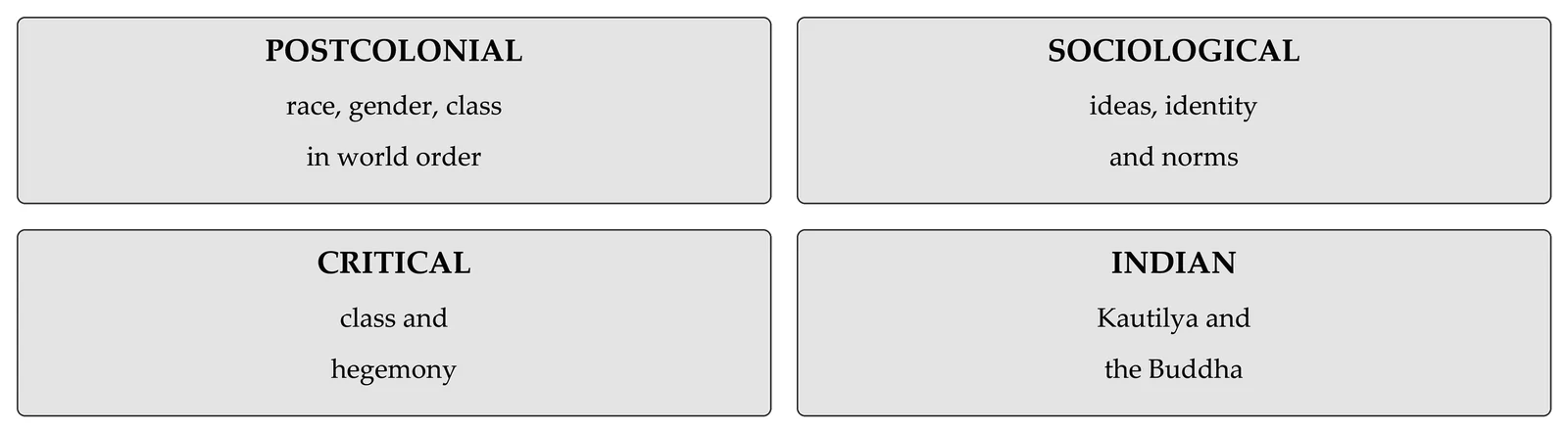
Realists treat power as material capability and the main goal of states in an anarchic world. Liberals stress interdependence, institutions and persuasion. Sociological or constructivist thinkers argue that power depends on shared ideas and identities. Postcolonial scholars show how race, gender and class shape global power, and critical thinkers see power in structures of class and hegemony.
Realism and Power
Realists trace their tradition to Thucydides, whose Melian Dialogue in the History of the Peloponnesian War has the Athenians tell the people of Melos that the strong do what they can and the weak suffer what they must. Morgenthau defined politics as a struggle for power and interest as defined in terms of power. Kenneth Waltz, in Theory of International Politics (1979), argued that anarchy, the absence of a world government, forces states to rely on self-help and that the distribution of capabilities among great powers explains international outcomes. John Mearsheimer, in The Tragedy of Great Power Politics (2001), argued that states seek to maximise their relative power and, ideally, become regional hegemons.
Liberalism and Power
- Complex interdependence. Robert Keohane and Joseph Nye, in Power and Interdependence (1977), described a world of multiple channels of contact, no fixed hierarchy of issues and a minor role for military force among advanced states.
- Sensitivity and vulnerability. They distinguished sensitivity, how quickly one state is affected by changes elsewhere, from vulnerability, how costly it is to adjust; asymmetric interdependence is a source of power.
- Institutions. Keohane, in After Hegemony (1984), argued that institutions reduce uncertainty and transaction costs, helping states cooperate even without a dominant power.
- Democratic peace. Michael Doyle (1983), drawing on Kant’s Perpetual Peace (1795), argued that liberal democracies rarely, if ever, fight one another.
- Persuasion. Richard Ned Lebow shows that influence through persuasion and legitimacy can be more lasting than coercion.
Constructivist, Postcolonial, Critical and Feminist Views
- Constructivism. Alexander Wendt, in Anarchy is What States Make of It (1992) and Social Theory of International Politics (1999), argued that the meaning of power depends on shared ideas: five hundred British nuclear weapons are less threatening to the United States than five North Korean ones.
- Postcolonialism. Building on Edward Said’s Orientalism (1978), postcolonial scholars show how Western knowledge represented non-Western peoples as backward; Jaswant Singh’s article Against Nuclear Apartheid (1998) criticised a nuclear order that allowed five states to keep weapons while denying them to others.
- Critical theory. Robert Cox, in Social Forces, States and World Orders (1981), wrote that theory is always for someone and for some purpose, and analysed world orders as combinations of material power, ideas and institutions.
- Feminism. Cynthia Enloe, in Bananas, Beaches and Bases (1989), and J. Ann Tickner, in Gender in International Relations (1992), showed how gender shapes power, from military bases to the idea of the rational, masculine statesman.
1.3 Indian Understandings of Power
Kautilya’s Arthashastra offers a comprehensive view of state power based on the seven elements of the state and three kinds of power, which Medha Bisht reads as a philosophy of strategy. The Buddha’s teaching, as William Long shows, stresses moral power, restraint and interdependence. Together they show that Indian thought combined realism with ethics.

Kautilya’s Three Kinds of Power
Kautilya (Arthashastra 6.2 and 9.1) distinguishes three kinds of power (shakti): mantra-shakti, the power of counsel, knowledge and diplomacy; prabhava-shakti, the power of the treasury and the army; and utsaha-shakti, the power of energy and valour of the leader. He ranks counsel highest, then material strength, then personal energy, arguing that a king with good counsel can defeat even stronger enemies. Victory depends on combining power with the right place and time, a view close to modern ideas of strategy.
Features of Kautilya’s View of Power
- Comprehensive. Power combines the seven elements of the state, from the king and ministers to the treasury, army and allies, so economic and military strength go together.
- Relative. A king’s power is always assessed against that of other kings in the mandala.
- Purposive. Power serves yogakshema, the security and welfare of the people, and the protection of dharma.
- Flexible means. The four upayas and the six measures allow the king to choose the least costly way to achieve his aims.
- Knowledge-based. Intelligence, counsel and the science of politics (anvikshiki and dandaniti) guide the use of power.
Medha Bisht, in Kautilya’s Arthashastra: Philosophy of Strategy (2020), argues that Kautilya’s strategic thought rests on an understanding of human nature, ethics and statecraft, and is not merely a manual of tricks.
The Buddha and Gandhi on Power
William Long, in A Buddhist Approach to International Relations (2021), argues that the Buddhist idea of dependent origination (pratityasamutpada), the teaching that everything arises in dependence on other things, implies a radical interdependence among states and peoples. The Chakkavatti Sihanada Sutta describes a wheel-turning king who rules by dhamma and warns that poverty leads to theft and violence. Gandhi developed a similar idea of moral power: writing in Young India in 1925, he distinguished power based on fear of punishment from power based on love and held the latter to be far more effective and lasting. Satyagraha showed how non-violent mass action could challenge an empire.
Power in Indian Strategic Thought Today
Kanti Bajpai identified several schools in contemporary Indian strategic thought: Nehruvianism, which stresses diplomacy, non-alignment and international cooperation; neoliberalism, which stresses economic growth and trade as the basis of power; and hyperrealism, which stresses military strength and deterrence. Indian policy has combined these, for example by pursuing strategic autonomy, economic reform and nuclear deterrence together. Scholars argue that this blend reflects a long Indian tradition, from Kautilya to the Buddha and Gandhi, of joining realism with ethical restraint.
1.4 Important Questions
- Question 1 What is power in international relations? Discuss its different dimensions.
- Question 2 Compare the realist and liberal perspectives on power in international relations.
- Question 3 Discuss the postcolonial, sociological and critical perspectives on power.
- Question 4 Discuss Indian understandings of power with reference to Kautilya and the Buddha.
DU asks the same idea in different words. So learn one broad answer for each question below; the same answer works for every question joined by OR.
Important Question 1
What is power in international relations? Discuss its different dimensions.
OR
Examine the distinction between power as resources and power as relationship.
OR
Discuss Lukes’s three-dimensional view of power and its relevance to international relations.
Model Answer
“A has power over B to the extent that he can get B to do something that B would not otherwise do.”
— Robert Dahl, The Concept of Power (1957)
Introduction. Power is central to international relations, yet scholars disagree about what it is and how to measure it. It may be understood as the resources a state possesses, as its ability to influence others, or as deeper structures that shape what actors want. Thinkers such as Robert Dahl, Steven Lukes, Tuomas Forsberg and Martha Finnemore have clarified these dimensions.
1. Meaning
Power is generally understood as the ability of an actor to achieve its goals, to influence the behaviour of others or to shape outcomes. In international relations, the main actors are states, but power is also exercised by organisations, firms and social movements.
2. Power as Resources
One view sees power as the possession of resources, such as territory, population, natural resources, economic wealth, military strength and technology. Larger resources are assumed to give greater power.
3. Power as Relationship
Another view sees power as a relationship: the ability of A to make B do something B would not otherwise do, as Robert Dahl defined it. Resources matter only if they can be converted into influence in particular situations.
4. The Paradox of Unrealised Power
David Baldwin noted the paradox of unrealised power: powerful states sometimes fail to get their way, as the United States did in Vietnam. This shows that resources do not automatically produce outcomes.
5. Forsberg’s Interdisciplinary View
Tuomas Forsberg shows that power has been studied from many disciplines and that it includes power over others, power to achieve goals and power with others through cooperation, each relevant to international relations.
6. The First Face
Lukes’s first face of power, based on Dahl, is visible power in open conflicts over decisions, where the actor who wins the decision has more power.
7. The Second Face
The second face, identified by Peter Bachrach and Morton Baratz, is the power to set the agenda and keep some issues off the table, so that conflicts never reach the point of decision.
8. The Third Face
Lukes added a third, radical face: the power to shape people’s wants, beliefs and perceptions, so that they accept a situation that is against their interests without realising it.
9. Lukes on Soft Power
In 2005, Lukes applied his framework to international relations, arguing that soft power can work through the third face, shaping preferences, but that attraction may also involve manipulation.
10. Finnemore and Goldstein
Martha Finnemore and Judith Goldstein argue that state power remains fundamental in the contemporary world, but that globalisation, technology and new actors have changed how power is exercised and what it can achieve.
11. Guzzini on the Concept
Stefano Guzzini shows that the concept of power is not neutral: calling something power implies that it could be otherwise and that someone is responsible, so the language of power is itself political.
12. Measuring Power
Scholars try to measure power through indices of population, economy, military spending and technology, but such measures ignore skill, will, legitimacy and the context in which power is used.
13. Context and Scope
Baldwin stresses that power must be specified by scope and domain: a state may be powerful in trade but weak in culture, or powerful against some states but not others.
14. Changing Forms
Today, power also flows through networks, information, finance and technology, giving influence to actors who control data, supply chains and communication.
15. Power to and Power over
Scholars distinguish power over others, the ability to control or coerce, from power to, the capacity to achieve goals, which may be exercised jointly. Climate cooperation, pandemic response and global health show that many problems need collective power to act, so that states increase their power by cooperating rather than by dominating one another.
16. Structural Power
Susan Strange distinguished relational power, getting others to do what they would not otherwise do, from structural power, the power to shape the frameworks within which others must operate. She identified four structures, security, production, finance and knowledge, and argued that control of these gave the United States great power even when its relational power seemed to decline.
17. Evaluation
Power is multidimensional: it includes resources, relationships, agenda control and the shaping of beliefs, and its meaning depends on context.
Conclusion. Thus, power in international relations can be seen as resources or as relationships, as Dahl defined it. Lukes’s three faces add agenda control and the shaping of preferences, while Forsberg, Finnemore and Goldstein, Guzzini and Baldwin show that power is complex, contextual and changing in a globalised world.
Important Question 2
Compare the realist and liberal perspectives on power in international relations.
OR
Examine Mearsheimer’s offensive realist view of power.
OR
How do Keohane and Nye understand power under complex interdependence?
Model Answer
“International politics, like all politics, is a struggle for power.”
— Hans J. Morgenthau, Politics Among Nations (1948)
Introduction. Realism and liberalism are the two oldest theories of international relations, and they understand power differently. Realists see power as the material capability that states need to survive in an anarchic world. Liberals see power as more diverse, shaped by interdependence, institutions and persuasion. John Mearsheimer and T.V. Paul represent realism, while Robert Keohane, Joseph Nye and Daniel Philpott represent liberal views.
1. Realist Assumptions
Realists assume that the international system is anarchic, with no world government, so states must rely on their own power for survival. Power is both a means and an end of foreign policy.
2. Classical Realism
Hans Morgenthau argued that international politics is a struggle for power rooted in human nature, and that states define their interest in terms of power.
3. Neorealism
Kenneth Waltz located the struggle for power in the structure of the system. States seek security, and the distribution of capabilities among them, such as bipolarity or multipolarity, shapes their behaviour.
4. Mearsheimer’s Offensive Realism
John Mearsheimer, in The Tragedy of Great Power Politics (2001), argues that great powers seek to maximise their relative power, aiming at regional hegemony, because they can never be sure of others’ intentions.
5. Latent and Military Power
Mearsheimer distinguishes latent power, based on wealth and population, from military power, especially land power. He argues that large bodies of water limit the projection of power, which he calls the stopping power of water.
6. Balance of Power
T.V. Paul explains the enduring axioms of balance of power theory: states balance against rising powers through hard balancing with arms and alliances, soft balancing through institutions and diplomacy, and asymmetric balancing against non-state threats.
7. Schmidt on Realist Conceptions
Brian Schmidt shows that realists themselves disagree, some seeing power as material resources and others as relational influence, so realism does not offer one single concept of power.
8. Liberal Assumptions
Liberals argue that cooperation is possible, that economic interdependence and international institutions reduce conflict, and that power has many sources besides military force.
9. Complex Interdependence
Robert Keohane and Joseph Nye, in Power and Interdependence (1977), described complex interdependence, with multiple channels between societies, no fixed hierarchy of issues and a minor role for military force.
10. Asymmetric Interdependence
Keohane and Nye argued that power arises from asymmetric interdependence: the less dependent actor has power over the more dependent one. They distinguished sensitivity, the cost of change, from vulnerability, the ability to adjust.
11. Philpott on Ideas and Authority
Daniel Philpott argues that ideas, such as the right of self-determination and human rights, changed the distribution of authority in international society, leading to colonial independence and internationally sanctioned intervention.
12. Lebow on Persuasion
Richard Ned Lebow emphasises the power of persuasion: influence is more lasting when based on shared values and legitimacy than when based on coercion.
13. Points of Difference
Realists stress relative gains, military force and the balance of power; liberals stress absolute gains, institutions and interdependence. Realists see power as the core of politics; liberals see it as one factor among many.
14. Relevance Today
The rivalry between the United States and China revives realist concerns, while global trade, supply chains and climate cooperation show the continuing relevance of liberal views.
15. Defensive and Offensive Realism
Realists disagree on how much power states seek. Defensive realists, following Waltz, argue that states seek enough power to be secure, since excessive expansion provokes balancing. Offensive realists, such as Mearsheimer, argue that states maximise power because security can never be guaranteed. The difference affects whether rising powers are expected to be cautious or aggressive.
16. Evaluation
Realism and liberalism offer complementary insights: power is both material capability and influence shaped by interdependence and institutions.
Conclusion. Thus, realists such as Morgenthau, Waltz and Mearsheimer see power as material capability pursued for survival, and Paul shows the logic of balancing. Liberals such as Keohane and Nye stress complex interdependence, and Philpott and Lebow the power of ideas and persuasion. Together they give a fuller picture of power.
Important Question 3
Discuss the postcolonial, sociological and critical perspectives on power.
OR
How does the constructivist approach understand power in international relations?
OR
Examine the postcolonial critique of power in international relations.
Model Answer
“Anarchy is what states make of it.”
— Alexander Wendt, International Organization (1992)
Introduction. Beyond realism and liberalism, other perspectives offer different understandings of power. Sociological or constructivist thinkers stress the role of ideas and identities. Postcolonial scholars show how race, gender and class, rooted in colonialism, shape global power. Critical thinkers, drawing on Marx and Gramsci, see power in structures of class and hegemony.
1. The Sociological Perspective
The sociological or constructivist perspective holds that international politics is socially constructed. The meaning of material power depends on shared ideas, norms and identities.
2. Wendt on Ideas
Alexander Wendt argued that material forces matter only through the structure of shared knowledge in which they are embedded. Five hundred British nuclear weapons are less threatening to the United States than five North Korean ones, because of shared identities.
3. Guzzini’s Constructivist Analysis
Stefano Guzzini argues that power is both a concept used by analysts and a practice that shapes reality. Defining issues as matters of power assigns responsibility and opens them to political action.
4. MacDonald on Ideas
David MacDonald shows that ideas, such as visions of regional order, can be a source of power, especially for regional powers seeking to lead their neighbourhoods.
5. The Postcolonial Perspective
Postcolonial scholars argue that mainstream international relations is Eurocentric and ignores colonialism, which created the modern world order and its hierarchies.
6. Chowdhry and Nair
Geeta Chowdhry and Sheila Nair argue that power in the postcolonial world is shaped by race, gender and class. Colonial ideas of civilised and uncivilised peoples continue to influence how the global South is treated.
7. Epstein on the Postcolonial
Charlotte Epstein explains that postcolonial theory reveals how the identities of states and peoples were formed through colonial encounters, and how the voices of the colonised were silenced.
8. The Nuclear Order
Shampa Biswas shows that the global nuclear order, which allows some states nuclear weapons and denies them to others, reflects postcolonial hierarchies of who can be trusted with power.
9. The Critical Perspective
Critical theorists, influenced by Marx, see power rooted in capitalism and class relations. Bob Jessop’s account of Marxist theory treats the state as a social relation shaped by class struggle.
10. Gramscian Hegemony
Robert Cox and others used Antonio Gramsci’s idea of hegemony to show how dominant states and classes rule through consent as well as coercion, by making their ideas appear as common sense.
11. Cox’s Insight
Robert Cox argued that theory is always for someone and for some purpose, meaning that theories of power themselves serve particular interests.
12. Linklater on Emancipation
Andrew Linklater argued that critical theory should go beyond realism and Marxism to examine how power and order can be transformed towards human emancipation.
13. Feminist Insights
Feminist scholars add that power in international relations is gendered, as military strength and statecraft are associated with masculinity while women’s roles are ignored.
14. Relevance
These perspectives help explain why global institutions favour the West, why the global South demands reform, and how ideas and identities shape conflict and cooperation.
15. Norms as Power
Constructivists show that norms, such as the taboo on using nuclear weapons, the ban on landmines and the rejection of colonial rule, constrain even powerful states. Norm entrepreneurs, including small states and civil society groups, can change what is considered acceptable behaviour, showing that power also works through shaping standards of legitimacy.
16. Voices from the Global South
Postcolonial and critical scholars point to demands from the global South for a more equal world order, from the Bandung Conference of 1955 and the Non-Aligned Movement to calls for a New International Economic Order in the 1970s and for reform of the UN Security Council and financial institutions today. These demands challenge hierarchies of power inherited from colonialism.
17. Identity and Interest
Constructivists argue that what states want depends on who they think they are. India’s identity as a postcolonial, non-aligned democracy shaped its support for decolonisation, its suspicion of military alliances and its demand for strategic autonomy. Changes in identity, as after the end of the Cold War, can change how states define their interests and use their power.
18. Evaluation
Sociological, postcolonial and critical perspectives broaden the study of power to include ideas, identities, history and structures of inequality.
Conclusion. Thus, constructivists such as Wendt and Guzzini show that power depends on shared ideas; postcolonial scholars such as Chowdhry, Nair and Biswas show the role of race, gender, class and colonial hierarchy; and critical thinkers such as Cox, Jessop and Linklater locate power in class and hegemony, enriching the study of power.
Important Question 4
Discuss Indian understandings of power with reference to Kautilya and the Buddha.
OR
Examine Kautilya’s idea of comprehensive national power.
OR
How does a Buddhist approach to international relations understand power?
Model Answer
“The power of deliberation is intellectual strength; the possession of a prosperous treasury and a strong army is the strength of sovereignty; and martial power is physical strength.”
— Kautilya, Arthashastra, Book VI (tr. R. Shamasastry)
Introduction. Indian traditions offer rich understandings of power that differ from Western theories. Kautilya’s Arthashastra provides a comprehensive, strategic view of state power, while the Buddha’s teachings stress moral power, restraint and interdependence. Scholars such as Medha Bisht, G. Adityakiran and William Long have shown the relevance of these traditions to international relations today.
1. Kautilya’s Purpose of Power
For Kautilya, power is a means to secure the welfare and security of the people, yogakshema. The king seeks power to protect the state and promote prosperity, not merely for its own sake.
2. The Seven Elements
Kautilya’s seven elements of the state, the ruler, ministers, territory and people, fort, treasury, army and ally, together make up the power of a state. Strength in one element can compensate for weakness in another.
3. Three Kinds of Power
Kautilya distinguishes the power of counsel (mantra-shakti), intellectual strength and good advice; the power of might (prabhava-shakti), a full treasury and strong army; and the power of energy (utsaha-shakti), the drive and courage of the leader. He ranks counsel highest.
4. Bisht’s Philosophy of Strategy
Medha Bisht reads the Arthashastra as a philosophy of strategy, in which power is used with judgement according to circumstances, combining diplomacy, economy, intelligence and force to achieve the state’s goals.
5. Comprehensive National Power
G. Adityakiran argues that Kautilya offered a pioneering account of comprehensive national power, combining economic, military, diplomatic and moral elements, an idea now used in strategic studies, including in China’s measures of national power.
6. Mandala and Upayas
Kautilya’s mandala theory and four methods, conciliation, gifts, dissension and force, show that power is relational and that force is only one tool, used when others fail.
7. The Buddha on Politics
William Long, in A Buddhist Approach to International Relations, shows that the Buddha’s teachings address politics, economics and statecraft, offering principles for just rule and peaceful relations.
8. Moral Power
The Buddhist ideal of the righteous ruler, the cakkavatti, rules by dhamma rather than force. Power rests on moral authority, generosity and the welfare of the people.
9. Interdependence
The Buddhist idea of dependent origination holds that all things arise in relation to others. Applied to international relations, it suggests that security depends on cooperation and that harming others harms oneself.
10. Restraint and Non-Violence
Buddhist ethics stress restraint, non-violence and the reduction of greed, hatred and delusion, which Long sees as causes of conflict among states.
11. Ashoka’s Example
After the Kalinga war, Ashoka adopted dhamma, renounced conquest by force and sent envoys to promote moral principles, an example of power exercised through moral influence.
12. Modern Echoes
Gandhi’s satyagraha used soul-force rather than physical force, and Nehru’s non-alignment and emphasis on peace drew on moral power. India’s soft power today includes yoga, Buddhism and democratic values.
13. Realism and Ethics
Indian traditions combine realism, as in Kautilya, with ethics, as in the Buddha. Many scholars see this blend in India’s strategic culture and its idea of strategic autonomy.
14. Criticisms
Critics warn against romanticising ancient traditions or using them selectively to justify present policies, and note that ancient texts addressed very different political worlds.
15. Nehru and Moral Power
Jawaharlal Nehru believed that a newly independent India, lacking military and economic strength, could exercise influence through moral leadership, non-alignment and support for decolonisation and disarmament. India played a mediating role in the Korean War and in Indo-China in the 1950s, showing power based on diplomacy and principle, though the 1962 war with China exposed its limits.
16. Strategic Culture
Scholars debate whether India has a distinct strategic culture. Some, such as George Tanham in 1992, argued that India lacked a tradition of strategic thinking, while others point to Kautilya, the Mahabharata and the Buddhist tradition as sources of a strategic culture marked by restraint, defensive realism and a preference for autonomy over alliances.
17. Evaluation
Indian understandings of power offer both strategic realism and moral restraint, enriching global debates on power.
Conclusion. Thus, Kautilya saw power as comprehensive, built from the seven elements and three shaktis, and used strategically for the people’s welfare, as Bisht and Adityakiran show. The Buddha, as Long explains, stressed moral power, interdependence and restraint. Together, from Ashoka to Gandhi, these traditions combine realism with ethics.
Short Notes
(a) Third face of power
Steven Lukes’s idea of power as the ability to shape others’ wants and beliefs so that they accept a situation against their interests.
(b) Complex interdependence
Keohane and Nye’s model of world politics with multiple channels between societies, no fixed hierarchy of issues and a minor role for military force.
(c) Mantra-shakti
Kautilya’s power of counsel, the intellectual strength of good advice and planning, which he valued above might and energy.
More notes: DSE-15 Power Dilemmas in International Relations
These notes are prepared by PADHO TO AISE for study help. They are not an official University of Delhi publication.