
Semester III DSC-9 Constitutional Government and Democracy in India
Unit II · 37 min read · Updated 24 Nov 2026
As per the University of Delhi (DU) BA (Hons) Political Science syllabus
Contents
- 2.1 The Legislature: Parliament
- 2.2 Debates on Representation
- 2.3 The Executive: The President
- 2.4 The Executive: The Prime Minister
- 2.5 The Judiciary: Appointment of Judges
- 2.6 Powers and Functions of the Supreme Court
- 2.7 Important Questions
- Discuss the powers and functions of the Indian Parliament. Has Parliament declined as a deliberative institution?
- Discuss the debates around diverse representation in the Indian Parliament. Will reservation of seats for women promote women’s empowerment?
- Discuss the powers and functions of the President of India. Explain the role of the President in the changing party system.
- Discuss the changing role of the Prime Minister in India.
- Discuss the process of appointment of judges in the Supreme Court and High Courts. Analyse the contemporary debates about it.
- Short Notes
संसदीय प्रणाली की सिफ़ारिश करके प्रारूप संविधान ने अधिक स्थिरता की तुलना में अधिक उत्तरदायित्व को प्राथमिकता दी है।
The Draft Constitution in recommending the Parliamentary system of Executive has preferred more responsibility to more stability.
— B.R. Ambedkar, Constituent Assembly, 4 November 1948
EVERY CONSTITUTION creates organs of government and divides power among them. The Indian Constitution creates a legislature (Parliament), an executive (the President, the Prime Minister and the Council of Ministers) and a judiciary (the Supreme Court and the High Courts). Unlike the United States, India does not have a strict separation of powers: the executive sits in the legislature and is responsible to it, while an independent judiciary checks both through judicial review. In this chapter we study the powers and functions of Parliament and the debates on representation, the election, powers and changing roles of the President and the Prime Minister, and the appointment of judges and the powers of the higher judiciary.
2.1 The Legislature: Parliament
A. Composition
Parliament is bicameral. The Lok Sabha (House of the People) is directly elected by universal adult franchise from single-member territorial constituencies through the first-past-the-post system, for a term of five years unless dissolved earlier. The Rajya Sabha (Council of States) represents the states: its members are elected by the elected members of the state legislative assemblies through proportional representation by the single transferable vote, one-third retiring every two years, and twelve are nominated by the President for their contribution to literature, science, art and social service. The President is also part of Parliament, because no bill becomes law without the President’s assent.
B. Powers and functions
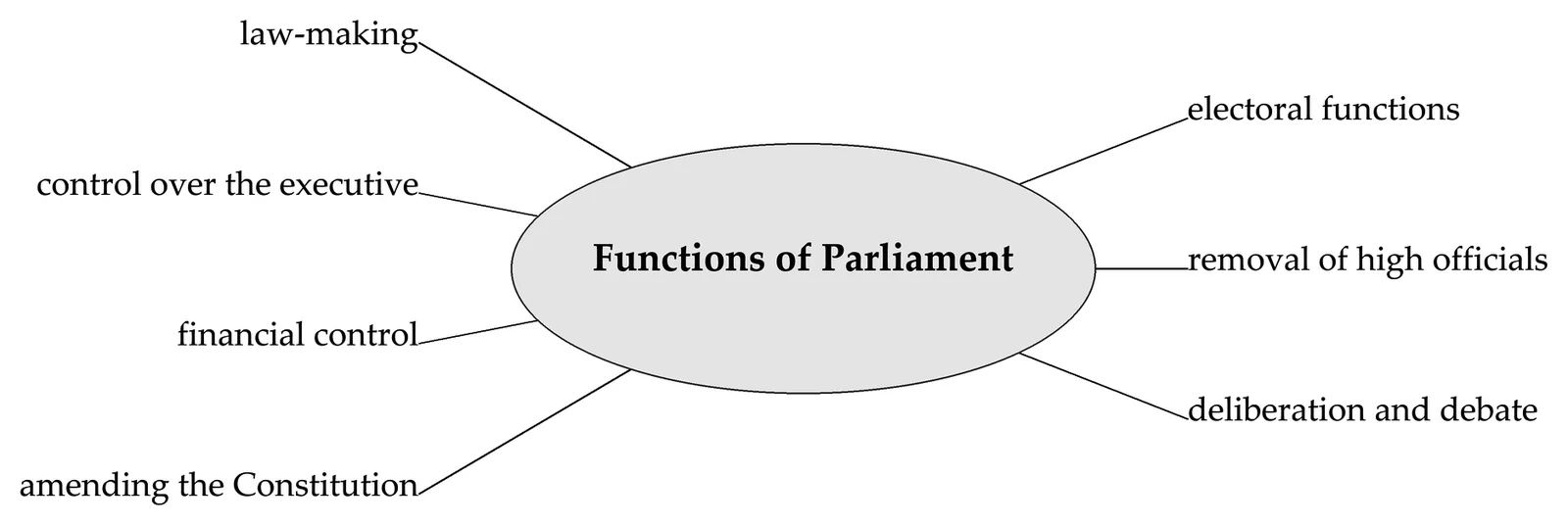
B.L. Shankar and Valerian Rodrigues, in The Indian Parliament: A Democracy at Work (2011), describe Parliament as the central institution of Indian democracy. Its main functions are shown in Figure 2.2:
- Law-making: Parliament makes laws on the Union List, the Concurrent List and, in special circumstances (Articles 249–253), even on the State List.
- Control over the executive: the Council of Ministers is collectively responsible to the Lok Sabha (Article 75(3)); Parliament controls it through question hour, zero hour, calling-attention motions, adjournment motions, debates and, finally, the no-confidence motion.
- Financial control: no tax can be levied and no money spent without Parliament’s approval. It passes the budget, and its committees, such as the Public Accounts Committee, examine spending. The Lok Sabha has the final say on money bills (Article 110).
- Constituent function: Parliament amends the Constitution under Article 368, subject to the basic structure.
- Electoral function: members take part in electing the President and Vice-President.
- Judicial and removal functions: Parliament can impeach the President and remove judges of the Supreme Court and High Courts, the Comptroller and Auditor General and the Chief Election Commissioner.
- Deliberation and representation: Parliament is the nation’s main forum of debate, where the grievances of citizens and regions are voiced.
C. The debate on Parliament’s decline
Many scholars speak of a decline of Parliament. M.R. Madhavan, in ‘Parliament’ (in Kapur, Mehta and Vaishnav, eds., Rethinking Public Institutions in India, 2017), and the research of PRS Legislative Research show several trends. The number of sitting days has fallen sharply; frequent disruptions waste time; many bills are passed with little debate; the share of bills sent to departmentally related standing committees fell from about 71 per cent in the 15th Lok Sabha to about 16 per cent in the 17th; governments rely on ordinances; and contested laws have been passed as money bills to bypass the Rajya Sabha. Madhavan also argues that the anti-defection law (Tenth Schedule, 1985), by forcing members to vote as their party whip directs, has reduced MPs to party delegates and weakened the scrutiny of the executive. Others note that committees still do valuable work, that question hour remains a check, and that Parliament continues to reflect India’s diversity.
2.2 Debates on Representation
Who sits in Parliament matters, because representation is not only about votes but also about presence. Hanna Pitkin, in The Concept of Representation (1967), distinguished descriptive representation (representatives who resemble the represented), substantive representation (acting in their interests) and symbolic representation (Figure 2.3). Anne Phillips, in The Politics of Presence (1995), argued that the presence of excluded groups in legislatures matters in itself, because their interests cannot be fully represented by others.

A. Territorial representation and the social profile of Parliament
The Constituent Assembly rejected separate electorates, which it saw as a cause of Partition, and chose joint electorates with reserved constituencies for the Scheduled Castes and Scheduled Tribes (Article 330), now extended until 2030. Over time the social profile of the Lok Sabha has changed. Christophe Jaffrelot has described the rise of OBC and lower-caste representatives, especially in north India after the 1990s, as a ‘silent revolution’. At the same time, critics point to the growing number of very wealthy MPs and of members facing criminal cases, the low representation of Muslims, and the dominance of political families. The freeze on the reallocation of seats among states, based on the 1971 census and extended to the first census after 2026 (42nd and 84th Amendments), raises a further debate: states with faster population growth are under-represented, but a fresh delimitation could reduce the share of southern states that controlled their population.
B. Women’s representation and the 106th Amendment
Women formed only about 4–5 per cent of the first Lok Sabha and about 14 per cent of the Lok Sabhas elected in 2019 and 2024, far below their share of the population. The Women’s Reservation Bill was first introduced in 1996 and passed by the Rajya Sabha in 2010, but lapsed amid disagreement, especially over a quota within the quota for OBC women. The Constitution (106th Amendment) Act, 2023, the Nari Shakti Vandan Adhiniyam, reserves one-third of seats in the Lok Sabha, the state assemblies and the Delhi assembly for women, including one-third of the SC and ST seats, for fifteen years. It will take effect only after the delimitation that follows the first census after its commencement, and reserved seats will rotate after each delimitation.
Shirin M. Rai and Carole Spary, in Performing Representation: Women Members in the Indian Parliament (2019), show that women MPs face party gatekeeping, gendered expectations and limited access to important committees, yet they bring new issues into debate and perform representation in distinctive ways. Experience with the one-third reservation in panchayats since 1993 is encouraging: a study by Raghabendra Chattopadhyay and Esther Duflo (2004) found that women heads of village councils invested more in public goods, such as drinking water, that women had asked for. Critics warn of proxy representation (the ‘sarpanch-pati’ phenomenon), of benefits going mainly to elite women, and of rotation weakening members’ links with constituencies.
2.3 The Executive: The President
A. Election
The President is elected indirectly by an electoral college consisting of the elected members of both Houses of Parliament and the elected members of the legislative assemblies of the states, including Delhi and Puducherry (Article 54). The election is by proportional representation by means of the single transferable vote and secret ballot, and the votes are weighted to ensure uniformity among states, according to population, and parity between the states taken together and Parliament (Article 55). The President holds office for five years and can be removed by impeachment for ‘violation of the Constitution’, by a two-thirds majority of the total membership of each House (Article 61).
B. Powers and functions
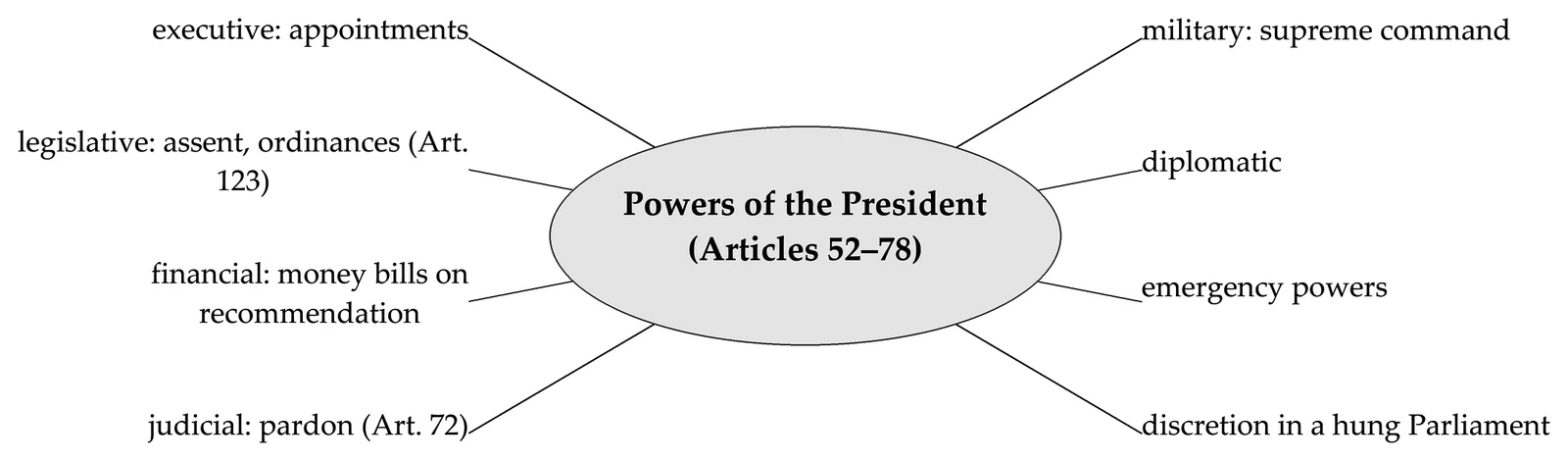
The executive power of the Union is vested in the President (Article 53), whose powers are wide on paper (Figure 2.4):
- Executive: appointing the Prime Minister and, on the PM’s advice, other ministers, governors, judges, the CAG, the Chief Election Commissioner and ambassadors.
- Legislative: summoning and proroguing Parliament, dissolving the Lok Sabha, addressing Parliament, nominating members, and giving or withholding assent to bills (Article 111); issuing ordinances when Parliament is not in session (Article 123).
- Financial: money bills and the budget can be introduced only on the President’s recommendation.
- Judicial: granting pardons, reprieves and remissions (Article 72).
- Military and diplomatic: supreme command of the armed forces; treaties and diplomatic relations are made in the President’s name.
- Emergency: proclaiming national emergency (Article 352), President’s Rule (Article 356) and financial emergency (Article 360).
C. Constitutional head and areas of discretion
In practice the President is a constitutional head who acts on the aid and advice of the Council of Ministers headed by the Prime Minister (Article 74). Ambedkar compared the position to that of the British monarch. The 42nd Amendment (1976) made this advice binding; the 44th Amendment (1978) allowed the President to send it back once for reconsideration, after which it must be accepted. Yet the President retains some room for judgement: choosing a Prime Minister when no party has a majority, deciding whether to dissolve the Lok Sabha when a government loses its majority, returning a bill or advice once, and delaying assent, since Article 111 sets no time limit. President Zail Singh used this ‘pocket veto’ on the Indian Post Office (Amendment) Bill in 1986.
D. The changing role of the President and the party system
James Manor, who has studied the Indian presidency closely, shows that the President’s actual influence depends on the party system. During one-party dominance (1952–67 and the 1970s–80s), when governments had large majorities, the President was largely a ceremonial figure, although Rajendra Prasad differed with Nehru over the Hindu Code Bill and Zail Singh clashed with Rajiv Gandhi. In the coalition era (1989–2014), when no party won a majority, the President’s discretion became important. R. Venkataraman developed the practice of inviting the leader of the largest party or pre-poll alliance and asking for proof of majority on the floor; Shankar Dayal Sharma invited Atal Bihari Vajpayee as head of the largest party in 1996; K.R. Narayanan asked for letters of support before appointing a Prime Minister in 1998, returned recommendations for President’s Rule in Uttar Pradesh (1997) and Bihar (1998), and called himself a ‘working President’. A.P.J. Abdul Kalam returned the Office of Profit Bill in 2006. With the return of single-party majorities since 2014, the space for discretion has again narrowed.
2.4 The Executive: The Prime Minister
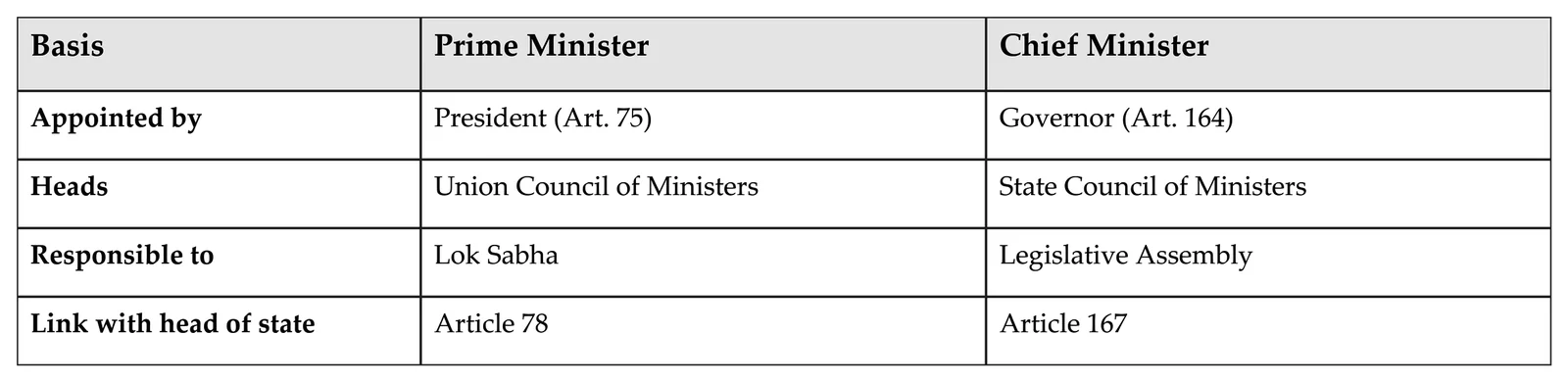
The Prime Minister is appointed by the President (Article 75) and is, by convention, the leader of the party or coalition that commands a majority in the Lok Sabha. The PM heads the Council of Ministers, chooses and dismisses ministers, chairs the cabinet, leads the Lok Sabha, communicates the decisions of the cabinet to the President (Article 78), chairs bodies such as NITI Aayog, directs foreign policy and leads the ruling party. The 91st Amendment (2003) limits the Council of Ministers to 15 per cent of the strength of the Lok Sabha. Because ministers are collectively responsible to the Lok Sabha, the PM’s position depends on keeping the support of the House (Figure 2.5).
In Nehru to the Nineties: The Changing Office of Prime Minister in India (1994), James Manor and his co-authors show that the office has changed with personalities and party systems. Jawaharlal Nehru dominated government but worked through the cabinet and Parliament. Indira Gandhi centralised power in the Prime Minister’s Secretariat, weakened party organisation and state leaders, and used the Emergency to rule personally. In the coalition era, Prime Ministers such as V.P. Singh, I.K. Gujral, Atal Bihari Vajpayee and Manmohan Singh had to manage allies through coordination committees and common minimum programmes, becoming more like a ‘first among equals’; under the UPA, the National Advisory Council chaired by Sonia Gandhi created what critics called a dual centre of power. Since 2014 the office has again become dominant, with power centred in the Prime Minister’s Office, a trend that scholars describe as the ‘presidentialisation’ of parliamentary government.
2.5 The Judiciary: Appointment of Judges
A. Constitutional provisions
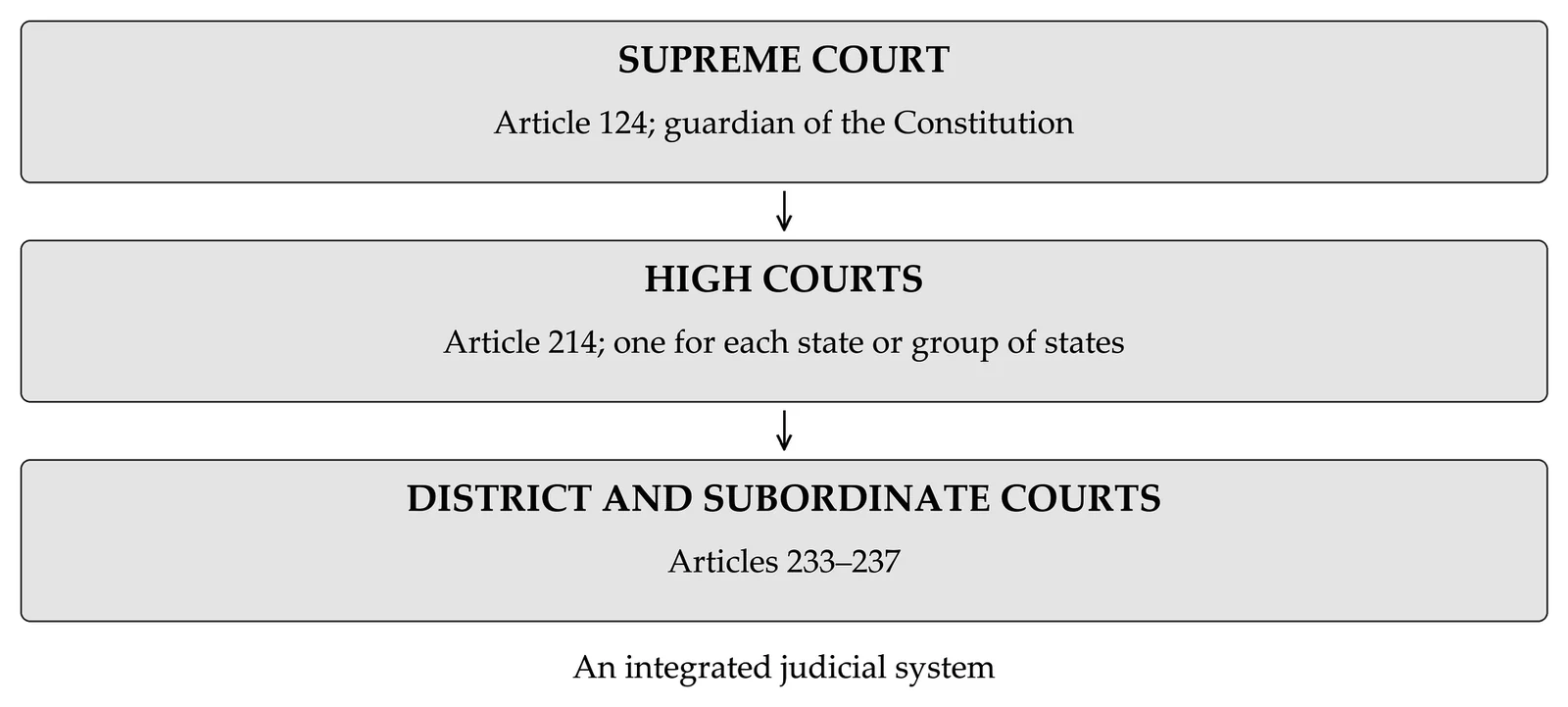
India has an integrated judiciary with the Supreme Court at the top (Article 124), High Courts in the states (Article 214) and subordinate courts below. Under Article 124(2), judges of the Supreme Court are appointed by the President after consultation with such judges of the Supreme Court and High Courts as the President thinks necessary, and the Chief Justice of India must always be consulted for judges other than the CJI. High Court judges are appointed under Article 217 after consultation with the CJI, the Governor and the Chief Justice of the High Court. Judges can be removed only by Parliament, by a special majority, for proved misbehaviour or incapacity (Article 124(4)); no judge has yet been removed, though Justice Soumitra Sen resigned in 2011 after the Rajya Sabha voted for his removal.
B. The Judges Cases
The meaning of ‘consultation’ has been settled through a series of judgments (Figure 2.6). The background was the government’s supersession of senior judges in appointing Chief Justices in 1973 and 1977, which the judiciary saw as punishment for judgments against the government.
- First Judges Case (S.P. Gupta, 1981): consultation did not mean concurrence, so the executive had the final say.
- Second Judges Case (Supreme Court Advocates-on-Record Association, 1993): the Court reversed this, holding that the opinion of the CJI, formed with senior judges, had primacy. This created the collegium system.
- Third Judges Case (Presidential Reference, 1998): the collegium for Supreme Court appointments was to consist of the CJI and the four senior-most judges.
- NJAC (2014): the 99th Amendment and the National Judicial Appointments Commission Act created a commission of the CJI, two senior judges, the Law Minister and two eminent persons.
- Fourth Judges Case (2015): the Court struck down the NJAC by four to one, holding that judicial primacy in appointments is part of the independence of the judiciary, a basic feature. The government and the Court have since debated a revised Memorandum of Procedure.

C. Contemporary debates
India is almost unique in letting judges appoint judges. Defenders of the collegium argue that it protects the courts from political interference. Critics, including Justice J. Chelameswar in his dissent in the NJAC case, argue that it is opaque, that it lacks accountability and that it has not improved the quality or diversity of appointments. Arghya Sengupta, in Independence and Accountability of the Indian Higher Judiciary (2019), argues that judicial independence and accountability must go together. Current debates concern: transparency (since 2017 the collegium publishes some of its decisions); delays, as the government sometimes withholds or separates recommended names; vacancies in High Courts; the lack of diversity, with few women and few judges from Scheduled Castes, Scheduled Tribes and OBCs; and post-retirement appointments, which may affect independence.
2.6 Powers and Functions of the Supreme Court
The Supreme Court is the guardian of the Constitution and the final court of appeal (Figure 2.7). Its jurisdiction includes:
- Original jurisdiction in disputes between the Union and the states, or between states (Article 131).
- Writ jurisdiction to enforce Fundamental Rights through habeas corpus, mandamus, prohibition, certiorari and quo warranto (Article 32), which Ambedkar called the ‘heart and soul’ of the Constitution.
- Appellate jurisdiction in constitutional, civil and criminal cases (Articles 132–134), and special leave to appeal against any judgment (Article 136).
- Advisory jurisdiction on questions referred by the President (Article 143).
- A court of record with power to punish for contempt (Article 129); its law is binding on all courts (Article 141); it can do complete justice (Article 142) and review its own judgments (Article 137).
- Judicial review of laws and amendments, including the basic structure doctrine.
From the late 1970s the Court expanded its role through public interest litigation, relaxing the rules of standing so that anyone could approach it on behalf of the poor. Upendra Baxi called this ‘social action litigation’, and the Court used it to protect bonded labourers, prisoners and the environment. Madhav Khosla and Ananth Padmanabhan, in their study of the Supreme Court (2017), show how the Court has become involved in governance on a vast scale. Pratap Bhanu Mehta warned of the ‘rise of judicial sovereignty’ (2007), and critics speak of judicial overreach, an enormous backlog of cases and inconsistency between benches.
2.7 Important Questions
- Question 1 Discuss the powers and functions of the Indian Parliament. Has Parliament declined as a deliberative institution?
- Question 2 Discuss the debates around diverse representation in the Indian Parliament. Will reservation of seats for women promote women’s empowerment?
- Question 3 Discuss the powers and functions of the President of India. Explain the role of the President in the changing party system.
- Question 4 Discuss the changing role of the Prime Minister in India.
- Question 5 Discuss the process of appointment of judges in the Supreme Court and High Courts. Analyse the contemporary debates about it.
DU asks the same idea in different words. So learn one broad answer for each question below; the same answer works for every question joined by OR.
Important Question 1
Discuss the powers and functions of the Indian Parliament. Has Parliament declined as a deliberative institution?
OR
Examine the role of Parliament in controlling the executive.
Model Answer
“The Draft Constitution in recommending the Parliamentary system of Executive has preferred more responsibility to more stability.”
— B.R. Ambedkar, Constituent Assembly, 4 November 1948
Introduction. Parliament, consisting of the President, the Lok Sabha and the Rajya Sabha, is the central institution of Indian democracy. Because India chose a parliamentary system, Parliament not only makes laws but also holds the executive responsible. Its effectiveness, however, has become a matter of serious debate.
1. Composition
The Lok Sabha is directly elected through first-past-the-post from territorial constituencies, while the Rajya Sabha represents the states through indirect election and includes twelve nominated members. The Lok Sabha is more powerful, because the government is responsible to it and it controls money bills. The Rajya Sabha acts as a revising chamber and a voice of the states. The Lok Sabha has 543 elected members; the Rajya Sabha has up to 250, of whom twelve are nominated.
2. Law-making
Parliament makes laws on the Union and Concurrent Lists and, under Articles 249–253, even on state subjects in special circumstances. Bills pass through three readings in each House, may be examined by committees, and become law on the President’s assent. Disagreements between the Houses over ordinary bills can be resolved in a joint sitting. Joint sittings under Article 108 have been held only three times, in 1961, 1978 and 2002, the last to pass the Prevention of Terrorism Act. Money bills can be introduced only in the Lok Sabha, and the Rajya Sabha can only recommend changes within fourteen days.
3. Control over the Executive
The Council of Ministers is collectively responsible to the Lok Sabha. Parliament holds it accountable through question hour, zero hour, calling-attention and adjournment motions, debates on the President’s address and, ultimately, votes of confidence and no-confidence, which ended the governments of Morarji Desai (1979), V.P. Singh (1990), H.D. Deve Gowda (1997) and Atal Bihari Vajpayee (1999). Committees on government assurances and subordinate legislation add further scrutiny. Departmentally related standing committees, created in 1993, examine the bills and demands for grants of each ministry.
4. Financial Control
No tax can be imposed and no expenditure made without Parliament’s consent. The budget is debated and voted, demands for grants are examined, and the Public Accounts Committee scrutinises the reports of the Comptroller and Auditor General. This makes the executive answerable for the use of public money. The Estimates Committee and the Committee on Public Undertakings add further scrutiny. Audit reports of the Comptroller and Auditor General, examined by the Public Accounts Committee, have exposed major irregularities, such as in the allocation of telecom spectrum.
5. Constituent, Electoral and Judicial Functions
Parliament amends the Constitution under Article 368, subject to the basic structure, takes part in electing the President and Vice-President, and can impeach the President and remove judges and other high officials. It is also the nation’s main forum of deliberation and representation. Parliament can also create new states and alter state boundaries by ordinary law under Articles 2–4.
6. The Rajya Sabha
The Rajya Sabha acts as a revising chamber and the voice of the states; it cannot be dissolved, can delay ordinary bills, and has special powers under Articles 249 and 312. Its role grows when governments lack a majority in it, though the money-bill route has sometimes been used to bypass it.
7. Parliament and the Courts
Parliament’s amending power is limited by judicial review: under the basic structure doctrine even a two-thirds majority cannot destroy the Constitution’s essential features, while Parliament often responds to judgments by amending laws.
8. Signs of Decline
Madhavan and PRS Legislative Research show that sitting days have fallen from about 135 a year in the 1950s to about 55 in the 17th Lok Sabha, that disruptions waste much time, and that the share of bills referred to committees fell from about 71 per cent to about 16 per cent. Bills are often passed in minutes without debate. Private members’ bills rarely pass: only fourteen have become law since independence, the last in 1970.
9. Causes of Decline
The anti-defection law forces members to follow the whip and reduces independent scrutiny. Large majorities, the frequent use of ordinances, the use of the money-bill route to bypass the Rajya Sabha, and confrontational politics have also weakened deliberation. The executive increasingly makes policy through delegated legislation. Important bills, such as the farm laws of 2020, were passed with little debate and later repealed.
10. Reforms Proposed
Suggested reforms include a minimum number of sitting days, compulsory referral of bills to committees, an anti-defection law limited to confidence and money votes, more time for private members and better research support for MPs.
11. A Balanced View
Parliament still matters. Committees produce valuable reports, question hour exposes the government, and the Lok Sabha is far more socially representative than in the 1950s. Coalition periods showed that Parliament can force governments to compromise. Reforms such as more sitting days, compulsory committee scrutiny and a narrower anti-defection law could restore its role. The live broadcasting of proceedings has also made Parliament more visible to citizens.
Conclusion. Thus, Parliament has wide powers on paper, but its deliberative role has weakened in practice; strengthening it is essential for responsible government.
Important Question 2
Discuss the debates around diverse representation in the Indian Parliament. Will reservation of seats for women promote women’s empowerment?
OR
Examine the significance of the 106th Constitutional Amendment (Women’s Reservation Act, 2023).
OR
How representative is the Indian Parliament? Discuss.
Model Answer
“Representing here means acting in the interest of the represented, in a manner responsive to them.”
— Hanna Pitkin, The Concept of Representation (1967)
Introduction. A democratic legislature should reflect the diversity of the society it governs. India’s Parliament has become more representative over time, but women, minorities and the poor remain under-represented. The 106th Amendment (2023), reserving one-third of seats for women, has renewed the debate on whether presence leads to empowerment.
1. Meanings of Representation
Pitkin distinguished descriptive, substantive and symbolic representation, while Anne Phillips argued for a ‘politics of presence’, holding that excluded groups must be present in legislatures because others cannot fully speak for their experiences. These ideas frame the debate on diversity in Parliament. Descriptive representation matters because representatives who share experiences of exclusion are more likely to raise issues that others ignore.
2. Constitutional Design
The Constituent Assembly rejected separate electorates, which it associated with Partition, and adopted joint electorates with reserved constituencies for Scheduled Castes and Scheduled Tribes (Article 330). The nomination of Anglo-Indians was ended by the 104th Amendment (2019), while SC and ST reservation was extended to 2030. Reserved seats with joint electorates went back to the Poona Pact of 1932 between Gandhi and Ambedkar, a compromise between separate electorates and no protection at all.
3. Changing Social Profile
Jaffrelot describes the rise of OBC and lower-caste MPs after the 1990s as a ‘silent revolution’, showing that democracy has widened representation. Yet Muslims are under-represented, the number of wealthy MPs and MPs facing criminal charges has grown, and political families dominate many seats. Muslims, about 14 per cent of the population, hold only around 4–5 per cent of Lok Sabha seats.
4. Regional Representation and Delimitation
Seats among states remain frozen on the basis of the 1971 census until after the first census after 2026. A fresh delimitation will raise the question of fairness between populous northern states and southern states that controlled population growth, and the Rajya Sabha’s weak role as a federal chamber adds to the debate. Constituency boundaries are redrawn by an independent Delimitation Commission whose orders cannot ordinarily be challenged in court.
5. Minorities and the Poor
Muslims and other religious minorities have no reserved seats, and the high cost of elections excludes the poor; critics propose state funding of elections and more inclusive candidate selection by parties.
6. Representation in the Rajya Sabha
The Rajya Sabha was meant to represent the states, but since a 2003 amendment removed the domicile requirement, members need not live in the state they represent, which critics say weakens its federal character; the Supreme Court upheld the change in Kuldip Nayar (2006).
7. Women’s Under-representation
Women formed about 4–5 per cent of the first Lok Sabha and about 14 per cent in 2019 and 2024. Parties give few tickets to women, and Rai and Spary show that women MPs face gatekeeping and gendered expectations once elected, although they bring new issues into Parliament.
8. Women in Assemblies and Panchayats
Women’s share is even lower in many state assemblies, often below ten per cent, while in panchayats, thanks to reservation, they hold nearly half of all seats.
9. The 106th Amendment
The Nari Shakti Vandan Adhiniyam reserves one-third of seats in the Lok Sabha and state assemblies for women, including within SC and ST seats, for fifteen years, with rotation after each delimitation. It will apply only after the next census and delimitation, and it does not provide a separate quota for OBC women. Because it depends on the delayed census and a fresh delimitation, reserved seats may not take effect before the general election of 2029 or later.
10. Arguments that Reservation Empowers
Reservation will create a critical mass of women legislators, change the agenda towards issues such as health, water and safety, and provide role models. The panchayat experience supports this: Chattopadhyay and Duflo found that women heads invested more in public goods women wanted, and the confidence of women in local politics has grown. International experience, as in Rwanda and the Nordic countries, shows that quotas can raise women’s representation quickly. Reservation can also change how voters and parties see women as leaders, as the panchayat experience shows.
11. Limits and Criticisms
Critics fear proxy representation by male relatives, the dominance of elite and upper-caste women in the absence of an OBC sub-quota, and weak links with constituencies because of rotation. Presence does not automatically produce empowerment if party control, patriarchy and the anti-defection law silence members. Empowerment also requires education, economic independence, safety and change within party organisations, not only seats.
Conclusion. Thus, Parliament has become more diverse but remains unequal; women’s reservation is a necessary step towards empowerment, though its success will depend on implementation and wider social change.
Important Question 3
Discuss the powers and functions of the President of India. Explain the role of the President in the changing party system.
OR
‘The President of India is a constitutional head.’ Discuss.
OR
Examine the discretionary powers of the President of India.
Model Answer
“A working President, not an executive President, nor a rubber-stamp President.”
— K.R. Narayanan, describing his view of the office
Introduction. The President is the head of the Indian state, in whose name the executive power of the Union is exercised. Although the Constitution gives the President wide powers, the parliamentary system makes the President a constitutional head who acts on ministerial advice. The actual role, however, has varied with the party system.
1. Election and Removal
The President is elected indirectly by an electoral college of the elected members of Parliament and the state assemblies, through proportional representation by the single transferable vote, with weighted votes ensuring uniformity among states and parity between states and the Union. The term is five years, and the President can be impeached for violation of the Constitution by a two-thirds majority of each House. No President has ever been impeached. The election of V.V. Giri in 1969, when Indira Gandhi backed him against her own party’s official candidate, showed that presidential elections can become political battles.
2. Executive and Legislative Powers
The President appoints the Prime Minister, ministers, governors, judges and other high officials. The President summons and prorogues Parliament, dissolves the Lok Sabha, addresses Parliament, gives assent to bills under Article 111, and issues ordinances under Article 123 when Parliament is not in session. Ordinances lapse unless approved by Parliament within six weeks of its reassembly, and the Supreme Court has held repeated re-promulgation to be a fraud on the Constitution.
3. Financial, Judicial, Military and Emergency Powers
Money bills require the President’s recommendation; the President grants pardons under Article 72, is the supreme commander of the armed forces, and proclaims emergencies under Articles 352, 356 and 360. The President also appoints the Finance Commission every five years.
4. Pardoning Power
Under Article 72 the President can pardon, commute or remit sentences, including death sentences, on the government’s advice; in Kehar Singh (1989) and Epuru Sudhakar (2006) the Court held that this power is subject to limited judicial review.
5. A Constitutional Head
Article 74 requires the President to act on the aid and advice of the Council of Ministers. The 42nd Amendment made this advice binding, and the 44th Amendment allowed the President to return it once for reconsideration. Ambedkar compared the position to that of the British Crown: the President represents the nation but does not rule it. In Shamsher Singh (1974) the Supreme Court held that the President and Governors must act on ministerial advice except in a few well-defined situations.
6. Comparison with the American President
Unlike the American President, who is directly elected, heads the government and cannot be removed by a vote of no confidence, the Indian President is indirectly elected and acts on ministerial advice; real executive power lies with the Prime Minister.
7. Areas of Discretion
The President has room for judgement in appointing a Prime Minister when no party has a majority, in deciding whether to dissolve the Lok Sabha, in returning a bill or advice once, and in delaying assent because Article 111 sets no time limit, as Zail Singh did with the Post Office Bill in 1986. The President may also seek the Supreme Court’s advisory opinion under Article 143 on questions of public importance.
8. The Era of One-Party Dominance
When the Congress had large majorities, the President’s role was mostly ceremonial. Even so, Rajendra Prasad differed with Nehru on the Hindu Code Bill, and Zail Singh’s relations with Rajiv Gandhi were tense, showing that the office could be a source of friction. Prasad also questioned whether the President was bound by advice, but practice firmly established the conventions of a constitutional head.
9. The Coalition Era
From 1989 to 2014, with hung Parliaments, the President’s discretion became crucial. Venkataraman invited the leader of the largest party and required a floor test; Narayanan sought letters of support in 1998 and returned recommendations for President’s Rule in Uttar Pradesh and Bihar; Kalam returned the Office of Profit Bill. Manor shows that weak governments allowed Presidents to play a larger role as guardians of constitutional norms.
10. Assent to State Bills
Under Article 201 the President also decides on state bills reserved by Governors, and delays in such decisions have become part of recent federal disputes, leading to a presidential reference to the Supreme Court.
11. The Return of Majority Governments
Since 2014, single-party majorities have narrowed the space for presidential discretion, and debates now centre on whether Presidents should question ordinances or controversial bills more actively. Presidents have also used speeches to draw attention to issues, as when Pranab Mukherjee warned against the excessive use of ordinances.
Conclusion. Thus, the President is a constitutional head whose real influence rises when the party system is fragmented and falls when governments have clear majorities.
Important Question 4
Discuss the changing role of the Prime Minister in India.
OR
Examine the position of the Prime Minister in the Indian parliamentary system.
Model Answer
“The Prime Minister is the key-stone of the Cabinet arch.”
— John Morley, on the office of Prime Minister in the British system
Introduction. The Prime Minister is the real head of government in India’s parliamentary system. The Constitution says little about the office, so its power has depended on the personality of the incumbent, the strength of the ruling party and the nature of the party system.
1. Appointment and Constitutional Position
The President appoints as Prime Minister the leader who commands a majority in the Lok Sabha (Article 75). The PM heads the Council of Ministers, which is collectively responsible to the Lok Sabha, and is the link between the cabinet and the President (Article 78). A Prime Minister must be a member of Parliament or become one within six months; Indira Gandhi in 1966 and Manmohan Singh in 2004 became Prime Minister as members of the Rajya Sabha.
2. Powers and Functions
The PM chooses and dismisses ministers, allocates portfolios, chairs the cabinet, leads the Lok Sabha, advises the President on appointments and dissolution, directs foreign policy, chairs NITI Aayog and leads the ruling party. The 91st Amendment limits the ministry to 15 per cent of the Lok Sabha. The PM also controls key appointments through the Appointments Committee of the Cabinet and chairs the National Security Council. The PM also represents India at summits such as the G20 and BRICS.
3. The PM and the Cabinet
Cabinet government means collective decision-making, but in practice the PM sets the agenda, shapes the cabinet committees and can override ministers. The British idea of the PM as ‘first among equals’ fits coalition periods better than periods of dominance.
4. Nehru: Dominant but Institutional
Nehru dominated policy as leader of the freedom movement and of a hegemonic Congress, but he worked through the cabinet, Parliament and the party, and respected the federal role of chief ministers. His early cabinets included strong figures such as Patel, Azad and Ambedkar, and he used Parliament as a forum of national education.
5. Indira Gandhi: Centralisation
Indira Gandhi centralised power in the Prime Minister’s Secretariat, weakened the party organisation and state leaders, and used the Emergency to rule personally. Manor’s study shows how this personalised the office. The Congress split of 1969, bank nationalisation and the ‘Garibi Hatao’ victory of 1971 built a direct link between the Prime Minister and the voters.
6. The Coalition Era
From 1989 to 2014, Prime Ministers depended on allies. Vajpayee and Manmohan Singh managed coalitions through coordination committees and common minimum programmes, becoming more like ‘first among equals’. Under the UPA, the National Advisory Council headed by Sonia Gandhi was criticised as a second centre of power. Coalition Prime Ministers also had to give portfolios to regional parties, which strengthened federal voices in the Union government.
7. The Prime Minister’s Office
The PMO, originally a small secretariat, has grown into a powerful centre of policy coordination and monitoring, and its strength is a good indicator of how centralised a government is.
8. Return of a Dominant Prime Minister
Since 2014, single-party majorities have restored a powerful Prime Minister, with decision-making concentrated in the Prime Minister’s Office and campaigns centred on the leader’s personality. Scholars call this the ‘presidentialisation’ of parliamentary government. Elections have increasingly become referendums on the Prime Minister, strengthening the office’s mandate.
9. Relations with the President
The PM is the main channel between the cabinet and the President under Article 78. Relations have usually been smooth, but tensions arose between Nehru and Rajendra Prasad and between Rajiv Gandhi and Zail Singh, showing that the PM’s dominance depends on respecting constitutional conventions. Article 78 requires the PM to keep the President informed of all decisions of the Council of Ministers.
10. The PM and Parliament
The PM’s relationship with Parliament has also changed: Nehru took part in debates regularly, while later Prime Ministers have spoken in Parliament less often and have relied more on direct communication with the public.
11. Checks on the Prime Minister
The PM remains accountable to the Lok Sabha, to the party, to coalition partners when needed, to the courts, to federal institutions and to the media, and can be removed by a no-confidence motion. Even dominant Prime Ministers face limits, as Indira Gandhi’s defeat in 1977 showed.
12. Comparison with the British Prime Minister
Like the British Prime Minister, the Indian PM leads the majority party, chooses ministers and advises the head of state on dissolution; but India’s federalism, coalition politics and judicial review set different limits.
13. Evaluation
The office is flexible: strong when the party system is dominant and weaker in coalitions. Excessive centralisation can weaken cabinet government and Parliament, while excessive dependence on allies can produce paralysis. Scholars therefore describe the office as elastic, expanding and contracting with political circumstances.
Conclusion. Thus, the Prime Minister’s role has swung between dominance and coalition management, shaped above all by the party system.
Important Question 5
Discuss the process of appointment of judges in the Supreme Court and High Courts. Analyse the contemporary debates about it.
OR
Examine the evolution of the collegium system.
OR
Discuss the debate between judicial independence and accountability in the appointment of judges.
Model Answer
“To allow the Chief Justice practically a veto upon the appointment of judges is really to transfer the authority to the Chief Justice which we are not prepared to vest in the President or the Government of the day.”
— B.R. Ambedkar, Constituent Assembly, 24 May 1949
Introduction. An independent judiciary is essential to constitutional democracy, and the method of appointing judges determines its independence. In India the process has moved from executive primacy to the judiciary’s own collegium, and remains one of the most contested questions of constitutional government.
1. Constitutional Provisions
Article 124(2) provides for the appointment of Supreme Court judges by the President after consultation with judges, the CJI always being consulted. Article 217 provides for High Court judges to be appointed after consultation with the CJI, the Governor and the High Court Chief Justice. Removal is possible only by Parliament for proved misbehaviour or incapacity. A Supreme Court judge must have been a High Court judge for five years, an advocate for ten years, or a distinguished jurist; judges retire at 65 in the Supreme Court and 62 in the High Courts.
2. Supersessions
In 1973 the government appointed A.N. Ray as Chief Justice, superseding three senior judges after Kesavananda Bharati, and in 1977 it superseded H.R. Khanna after his dissent in the Emergency case. These events convinced many that executive control threatened judicial independence. Supporters of the government at the time openly spoke of the need for a ‘committed judiciary’, which alarmed defenders of judicial independence.
3. First Judges Case (1981)
In S.P. Gupta the Court held that ‘consultation’ did not mean ‘concurrence’, so the executive had the final word. Justice P.N. Bhagwati’s judgment held that the Chief Justice’s opinion had no primacy over that of other constitutional functionaries.
4. Second and Third Judges Cases
In 1993 the Court reversed itself, giving primacy to the CJI acting with senior judges, and in 1998 it fixed the collegium as the CJI and four senior-most judges for Supreme Court appointments. Judges thus came to appoint judges. For High Court appointments, the High Court collegium of the Chief Justice and two senior judges makes recommendations, which then go to the Supreme Court collegium. The collegium system thus rests on judicial interpretation, not on the text of the Constitution.
5. The NJAC and the Fourth Judges Case
The 99th Amendment and the NJAC Act (2014) created a commission of judges, the Law Minister and eminent persons. In 2015 the Court struck it down, holding judicial primacy to be part of the basic structure; Justice Chelameswar dissented, criticising the collegium’s opacity. The majority held that giving the Law Minister and eminent persons a decisive say would compromise independence, while admitting that the collegium itself needed reform.
6. Debate: Transparency and Accountability
Critics argue that the collegium works in secrecy, with no clear criteria, and is accountable to no one. Sengupta argues that independence and accountability must go together. Since 2017 the collegium publishes some decisions, but the Memorandum of Procedure is still disputed. In January 2018 four senior judges of the Supreme Court held a press conference to raise concerns about the allocation of cases, showing tensions within the judiciary itself.
7. Debate: Delays, Vacancies and Diversity
The government sometimes delays or separates recommended names, leaving many High Court vacancies. Few women and few judges from SC, ST and OBC backgrounds reach the higher courts, which raises questions of legitimacy. Justice B.V. Nagarathna is in line to become the first woman Chief Justice of India in 2027.
8. Debate: The Case for Judicial Primacy
Defenders of the collegium recall the supersessions of 1973 and 1977 and argue that executive control would make judges dependent on the government, which is the largest litigant before the courts. They saw the NJAC’s provision allowing any two members to block a candidate as a threat to judicial independence.
9. Debate: Transfers and Post-Retirement Posts
Concerns about independence also arise from the opaque transfer of High Court judges under Article 222, which can look like punishment, and from post-retirement appointments of judges to tribunals, commissions and even the Rajya Sabha, which may tempt judges to please the government.
10. Judicial Accountability Mechanisms
Besides impeachment, accountability depends on an in-house procedure adopted by the Supreme Court in 1999, under which complaints against judges are examined by a committee of judges; critics say it is opaque and rarely leads to action.
11. The Memorandum of Procedure
Since 2015 the government and the Court have negotiated a revised Memorandum of Procedure, covering criteria, a secretariat and the government’s power to object on grounds of national security, but it has not been finalised.
12. The Way Forward
Suggestions include a transparent collegium with published criteria, a secretariat, time limits for the government, and a reformed commission that preserves judicial primacy while adding accountability. Comparative models, such as the United Kingdom’s Judicial Appointments Commission (2005), combine judicial participation with independent lay members.
Conclusion. Thus, the appointment of judges reflects the tension between independence and accountability; a balanced, transparent process is needed to protect both.
Short Notes
(a) Powers and functions of the Supreme Court
The Supreme Court has original jurisdiction in Union–state and inter-state disputes (Article 131), writ jurisdiction to enforce Fundamental Rights (Article 32), appellate jurisdiction and special leave to appeal (Articles 132–136), and advisory jurisdiction (Article 143). It is a court of record, its law binds all courts, it can do complete justice (Article 142), and it exercises judicial review, including the basic structure doctrine. Through public interest litigation it has protected the rights of the poor.
(b) Pocket veto
Because Article 111 sets no time limit for the President’s assent to a bill, the President can keep a bill pending indefinitely. Zail Singh did this with the Indian Post Office (Amendment) Bill in 1986. The power cannot be used for money bills or constitutional amendments.
(c) Ordinance-making power
Under Article 123 the President, on the advice of the Union government, can issue ordinances when Parliament is not in session; they lapse six weeks after Parliament reassembles. The Court held in D.C. Wadhwa (1987) and Krishna Kumar Singh (2017) that repeated re-promulgation is a fraud on the Constitution.
More notes: DSC-9 Constitutional Government and Democracy in India
These notes are prepared by PADHO TO AISE for study help. They are not an official University of Delhi publication.