
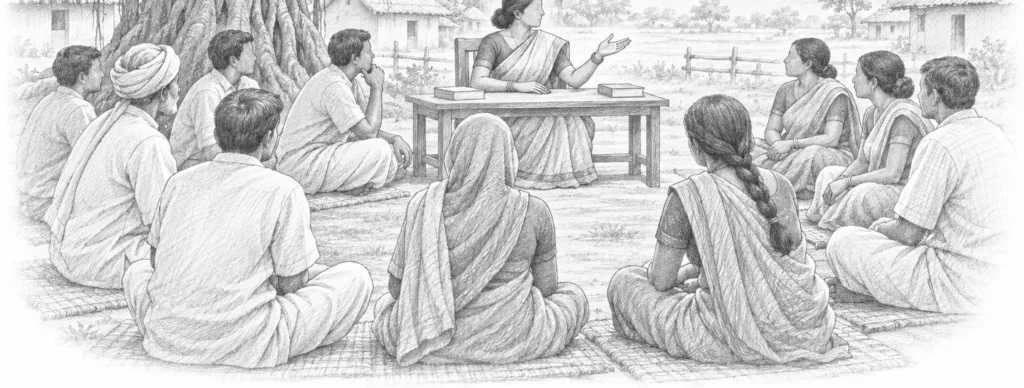
Semester III DSC-9 Constitutional Government and Democracy in India
Unit III · 24 min read · Updated 24 Nov 2026
As per the University of Delhi (DU) BA (Hons) Political Science syllabus
Contents
- 3.1 The Nature of Indian Federalism
- 3.2 Centre–State Relations
- 3.3 Asymmetrical Federalism
- 3.4 Decentralization: Meaning and History
- 3.5 Panchayats and Municipalities after 1992
- 3.6 Working of Local Governments: Achievements and Challenges
- 3.7 Important Questions
- What do you understand by federalism? Discuss the constitutional provisions for asymmetrical federalism in India.
- Discuss the working of Panchayati Raj Institutions in India. What have been their achievements and challenges in the last three decades?
- Discuss the major issues in Centre–State relations in India.
- Short Notes
यह संविधान एक संघीय संविधान है, क्योंकि यह दोहरी राज्य-व्यवस्था स्थापित करता है।
The Draft Constitution is a Federal Constitution inasmuch as it establishes what may be called a Dual Polity.
— B.R. Ambedkar, Constituent Assembly, 4 November 1948
INDIA IS A UNION OF STATES in which power is divided between the Union government and the state governments, and, since 1993, shared further with elected panchayats and municipalities. Article 1 calls India a ‘Union of States’, and Ambedkar explained that the word ‘Union’ was chosen because the federation was not the result of an agreement among states and no state has the right to secede. In this chapter we study the nature of Indian federalism, Centre–State relations in the legislative, administrative and financial fields, the special arrangements known as asymmetrical federalism, and the working of Panchayats and Municipalities after the 73rd and 74th Amendments.
3.1 The Nature of Indian Federalism
Federalism is a system in which power is constitutionally divided between a central government and regional governments, each supreme in its own sphere. Alfred Stepan distinguished ‘coming together’ federations, like the United States, formed by independent units, from ‘holding together’ federations, like India, created by a central authority to keep a diverse country united. Louise Tillin, in Indian Federalism (2019), shows that the makers of the Constitution, facing Partition, the princely states and communal violence, deliberately designed a centralised federation. K.C. Wheare therefore called India ‘quasi-federal’, and others have described it as an ‘indestructible Union of destructible states’, because Parliament can create new states and change their boundaries by ordinary law (Articles 2–4).
Rajeev Dhavan and Rekha Saxena, in their account of ‘The Republic of India’ (2006), list the federal features: a written constitution, a division of powers, a rigid amendment procedure for federal provisions, an independent judiciary to settle disputes, and a second chamber representing states. They also list the unitary features: a strong centre with residuary powers, single citizenship, an integrated judiciary, all-India services, governors appointed by the Union, emergency powers, and the power to reorganise states. Granville Austin called the result ‘cooperative federalism’, and W.H. Morris-Jones described it as ‘bargaining federalism’, because the Union and the states constantly negotiate.
3.2 Centre–State Relations
A. Legislative relations
Article 246 and the Seventh Schedule divide subjects among three lists (Figure 3.2): the Union List (originally 97 subjects, such as defence, foreign affairs, currency and railways), the State List (originally 66, such as police, public order, public health and agriculture) and the Concurrent List (originally 47, such as education, forests, marriage and criminal law), on which both can legislate but Union law prevails in case of conflict (Article 254). The 42nd Amendment (1976) moved education, forests and some other subjects to the Concurrent List. Residuary powers belong to the Union (Article 248). Parliament can legislate on state subjects if the Rajya Sabha so resolves by a two-thirds majority (Article 249), during an emergency (Article 250), at the request of two or more states (Article 252) and to implement treaties (Article 253). Governors can also reserve state bills for the President’s consideration (Article 200).

B. Administrative relations
States must exercise their executive power so as to comply with Union laws (Article 256), and the Union can give directions to states (Article 257); failure to comply can justify President’s Rule (Article 365). The all-India services (IAS, IPS and IFoS) serve both levels but are controlled by the Union. The Governor, appointed by the President, is both the constitutional head of the state and a link with the Union, and the misuse of this office has been a major source of conflict. Article 263 provides for an Inter-State Council, set up only in 1990 on the Sarkaria Commission’s recommendation.
C. Financial relations
The Union controls the most elastic taxes, while states have large spending responsibilities, creating a vertical fiscal imbalance. A Finance Commission, appointed every five years (Article 280), recommends how central taxes are shared with the states and distributed among them; the Union also gives grants (Articles 275 and 282). The Goods and Services Tax, introduced by the 101st Amendment (2016), pooled most indirect taxes and created the GST Council (Article 279A), in which the Union and states decide together, though states have lost much of their independent taxing power.
D. Phases and debates
Centre–State relations have changed with the party system. Under Congress dominance (1950–67), conflicts were settled within the party. After 1967, when non-Congress governments came to power in many states, demands for autonomy grew: the Rajamannar Committee of Tamil Nadu (1969), the Anandpur Sahib Resolution (1973) and the West Bengal memorandum (1977). The Union frequently misused Article 356 to dismiss opposition governments. The Sarkaria Commission (1983–88) recommended restraint in using Article 356, consultation on Concurrent List laws and the appointment of non-partisan governors; the Punchhi Commission (2007–10) made further proposals. In S.R. Bommai (1994) the Supreme Court made President’s Rule subject to judicial review and required a floor test. The coalition era (1989–2014) federalised Indian politics, as regional parties joined Union governments. Since 2014 there has been talk of ‘cooperative and competitive federalism’, with NITI Aayog replacing the Planning Commission (2015), but also complaints of re-centralisation through the GST, central agencies, conditional schemes and governors withholding assent to state bills. In 2025, in a case brought by Tamil Nadu, the Supreme Court held that governors cannot sit indefinitely on bills passed by state legislatures, and the President then sought the Court’s advisory opinion on the question under Article 143.
3.3 Asymmetrical Federalism
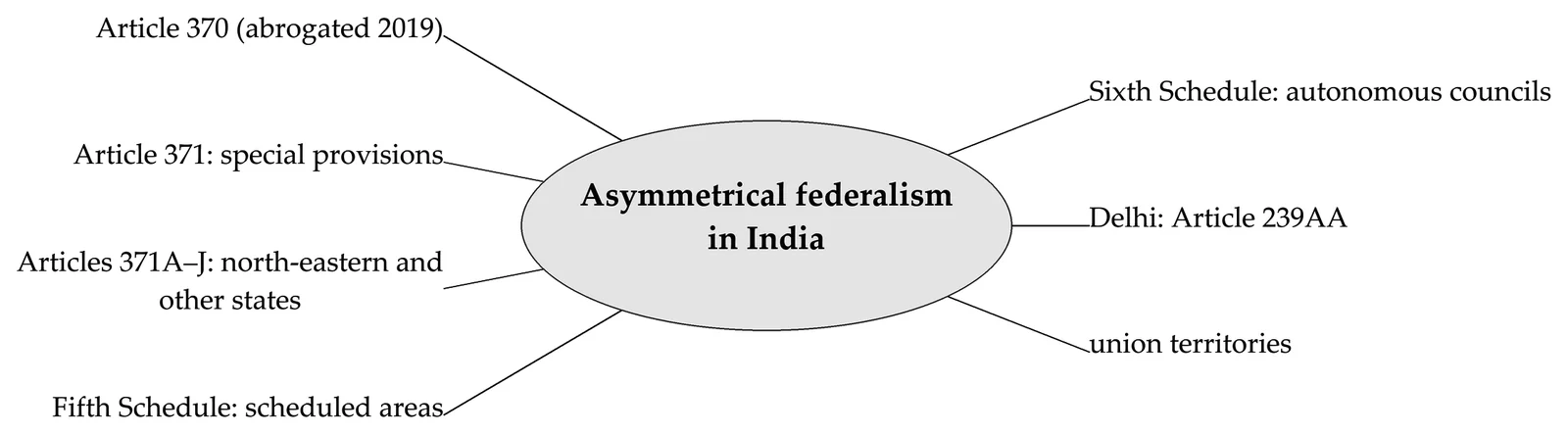
In a symmetrical federation all units have the same powers; in an asymmetrical federation some units have special powers or status because of their history, culture, geography or the circumstances in which they joined. M.P. Singh and Rekha Saxena, in their study of asymmetrical federalism (2013), and Tillin show that India has used asymmetry to accommodate diversity and to settle conflicts in border regions. Asymmetry takes several forms (Figure 3.3):
- Article 370 (Jammu and Kashmir): J&K had its own constitution, and most Union laws applied only with the state’s concurrence. In August 2019 the provision was made inoperative and the state was reorganised into two union territories; the Supreme Court upheld this in December 2023.
- Article 371: special responsibility of the Governor for development boards for Vidarbha, Marathwada and the rest of Maharashtra, and for Saurashtra and Kutch in Gujarat.
- Articles 371A–371J: special provisions for Nagaland (no Act of Parliament on Naga religious and social practices, customary law or ownership of land applies unless the state assembly agrees), Assam, Manipur (a committee of hill-area members), Andhra Pradesh and Telangana, Sikkim, Mizoram (similar to Nagaland, after the Mizo Accord of 1986), Arunachal Pradesh, Goa and the Hyderabad–Karnataka region of Karnataka.
- Fifth Schedule: administration of scheduled areas with tribal populations in other states, with Tribes Advisory Councils and special powers of the Governor; PESA (1996) extended self-government to these areas.
- Sixth Schedule: autonomous district councils with legislative, executive and judicial powers in tribal areas of Assam, Meghalaya, Tripura and Mizoram.
- Union territories and Delhi: union territories are governed by the Union, but Delhi has an elected assembly with limited powers under Article 239AA (69th Amendment, 1991). Disputes between Delhi’s government and the Lieutenant Governor led to Supreme Court judgments in 2018 and 2023 and to a law in 2023 giving the Union control over services.
Evaluation. Supporters argue that asymmetry has helped hold India together by giving distinct regions a sense of security, as peace accords in Mizoram and elsewhere show; it reflects a ‘holding together’ federation that accommodates rather than suppresses diversity. Critics argue that special status can encourage separatism, create inequality among citizens and states, and slow integration, an argument made when Article 370 was revoked. Others reply that the removal of special status without the consent of the people concerned weakens trust and federal bargains.
3.4 Decentralization: Meaning and History
Decentralization means the transfer of authority from higher to lower levels of government. It may take the form of deconcentration (field offices of the central government), delegation (authority given to semi-autonomous bodies), devolution (powers given to elected local governments) or privatisation (Figure 3.4). Democratic decentralization means devolution: local people elect their own governments and decide local matters.

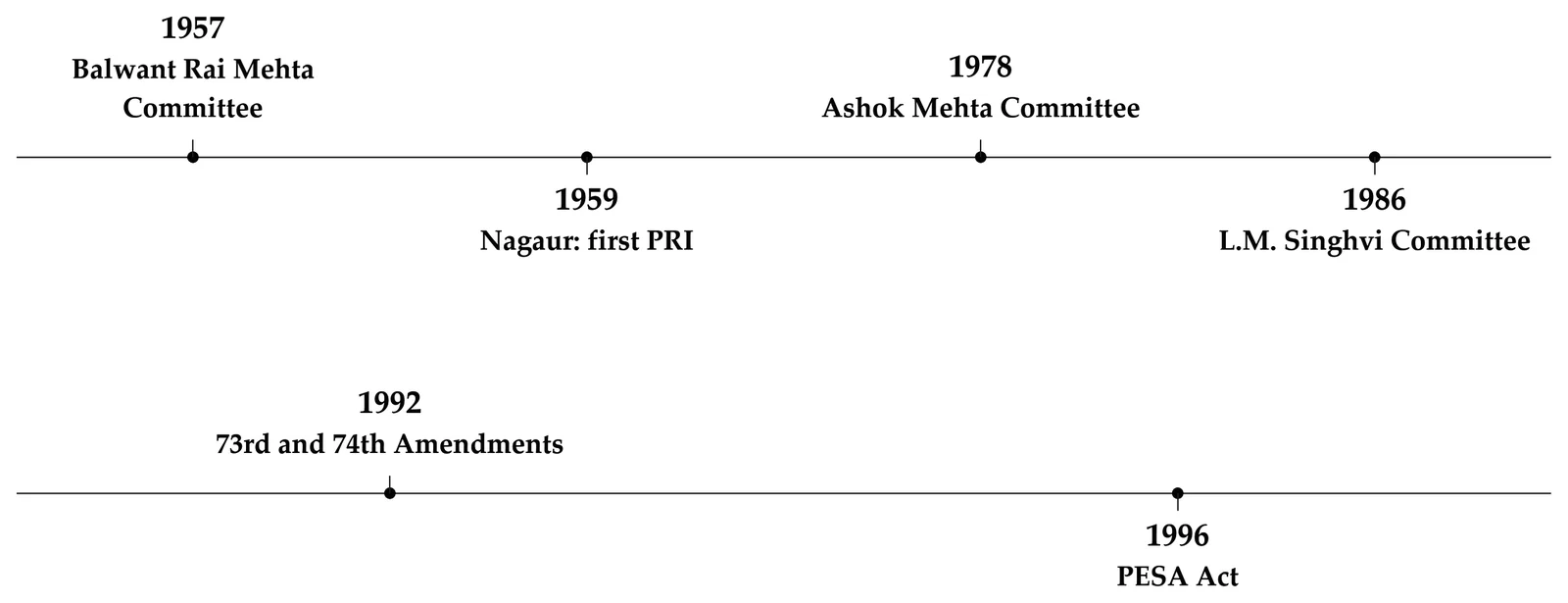
Gandhi’s idea of gram swaraj (village self-rule) inspired a demand for village republics, but Ambedkar criticised the village as ‘a sink of localism, a den of ignorance, narrow-mindedness and communalism’. The Constituent Assembly placed village panchayats only in the Directive Principles (Article 40). The Balwant Rai Mehta Committee (1957) recommended a three-tier system, first introduced at Nagaur in Rajasthan on 2 October 1959. Interest declined in the late 1960s. The Ashok Mehta Committee (1978) proposed a two-tier system, and states such as West Bengal (1978) and Karnataka (1987) revived panchayats. The L.M. Singhvi Committee (1986) recommended constitutional status, and after the failure of the 64th Amendment Bill in 1989, the 73rd and 74th Amendments were passed in 1992 and came into force in 1993 (Figure 3.6).
3.5 Panchayats and Municipalities after 1992
A. The 73rd Amendment: Panchayats (Part IX)
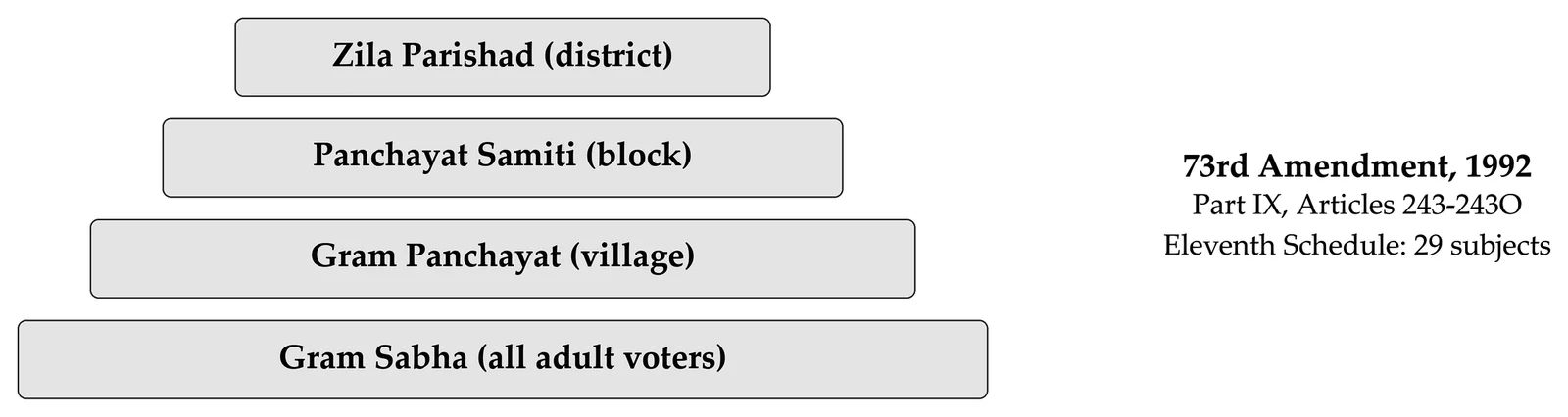
- Gram Sabha of all registered voters of a village (Article 243A).
- Three tiers at village, intermediate (block) and district levels, except in states with a population below twenty lakh (Article 243B) (Figure 3.5).
- Direct elections to seats at all levels; a five-year term, with elections within six months of dissolution (Article 243E).
- Reservation for Scheduled Castes and Scheduled Tribes in proportion to population, and one-third of seats and chairpersons’ posts for women (Article 243D); many states have raised this to 50 per cent.
- A State Election Commission to conduct elections (Article 243K) and a State Finance Commission every five years to review panchayat finances (Article 243I).
- Devolution of powers on 29 subjects in the Eleventh Schedule, such as agriculture, drinking water, primary education and poverty alleviation, at the discretion of state legislatures (Article 243G).
B. The 74th Amendment: Municipalities (Part IXA)
The 74th Amendment provides for nagar panchayats for areas in transition from rural to urban, municipal councils for smaller urban areas and municipal corporations for larger cities (Article 243Q), with direct elections, reservations for SCs, STs and women, ward committees in cities of three lakh or more, and the State Election and Finance Commissions. The Twelfth Schedule lists 18 functions, such as urban planning, water supply, public health and slum improvement. District Planning Committees (Article 243ZD) and Metropolitan Planning Committees (Article 243ZE) are meant to integrate rural and urban planning. The Panchayats (Extension to Scheduled Areas) Act (PESA), 1996, gives the gram sabhas of Fifth Schedule areas powers over minor forest produce, land alienation, minor minerals and local disputes.
3.6 Working of Local Governments: Achievements and Challenges
A. Achievements
Peter Ronald deSouza described the 73rd and 74th Amendments as the ‘second wind of democracy’ in India. Today there are about 2.5 lakh panchayats and more than 30 lakh elected representatives, of whom about 14 lakh are women. Regular elections have created a large new political class at the grassroots, including Dalits, Adivasis and women, many of whom have moved into state and national politics. Women’s presence has changed local priorities, as studies of drinking water and sanitation show. Panchayats implement major programmes such as MGNREGA, and successive Finance Commissions have given grants directly to local bodies. Kerala’s People’s Plan Campaign (1996), which devolved about a third of the state’s plan funds to local bodies, showed what genuine devolution can achieve, and states such as Karnataka, West Bengal and Madhya Pradesh have also experimented with participatory planning and social audits.
B. Challenges
Kuldeep Mathur, in Panchayati Raj (2013), and James Manor, in his studies of decentralisation, show that the Amendments created the structure but left the substance to the states. The key problem is the incomplete devolution of the ‘three Fs’: functions, funds and functionaries. Most panchayats have few own revenues and depend on tied grants; staff remain under state departments; and parallel bodies, such as line department committees and MP and MLA local area development schemes, bypass them. Other problems include elite capture and caste dominance, proxy representation of women by male relatives, weak gram sabhas with low attendance, the dependence of State Election Commissions and Finance Commissions on state governments, and delayed elections. In cities, municipalities are weaker still: mayors are often indirectly elected with short terms, state-controlled parastatals handle major functions, and municipal finances are very limited. Manor argues that decentralisation works only when local bodies have adequate powers, adequate resources and strong accountability mechanisms together.
3.7 Important Questions
- Question 1 What do you understand by federalism? Discuss the constitutional provisions for asymmetrical federalism in India.
- Question 2 Discuss the working of Panchayati Raj Institutions in India. What have been their achievements and challenges in the last three decades?
- Question 3 Discuss the major issues in Centre–State relations in India.
DU asks the same idea in different words. So learn one broad answer for each question below; the same answer works for every question joined by OR.
Important Question 1
What do you understand by federalism? Discuss the constitutional provisions for asymmetrical federalism in India.
OR
Examine the nature of Indian federalism with reference to asymmetrical arrangements.
OR
‘Asymmetrical federalism has helped to hold India together.’ Discuss.
Model Answer
“The Draft Constitution is a Federal Constitution inasmuch as it establishes what may be called a Dual Polity.”
— B.R. Ambedkar, Constituent Assembly, 4 November 1948
Introduction. Federalism is a system in which power is constitutionally divided between a central government and regional governments. India has a federal system with a strong centre, designed to hold together a diverse country. One of its most distinctive features is asymmetry: certain states and regions enjoy special constitutional arrangements.
1. Meaning of Federalism
In a federation, the constitution divides powers between two levels of government, each with its own sphere, and an independent judiciary settles disputes. Stepan distinguished ‘coming together’ federations, formed by independent units, from ‘holding together’ federations, like India, created to keep a diverse country united. India belongs to the second type, which explains both its centralisation and its asymmetry. K.C. Wheare defined the federal principle as the method of dividing powers so that the general and regional governments are each, within a sphere, coordinate and independent.
2. Federal Features
The Constitution provides for a dual polity, a written division of powers in the Seventh Schedule, an independent judiciary, the Rajya Sabha as a chamber of states, and a special amendment procedure for federal provisions. S.R. Bommai (1994) held federalism to be part of the basic structure. Amendments affecting federal provisions, such as the lists or the representation of states, also need ratification by half the state legislatures under Article 368(2).
3. Unitary Features
At the same time, the Union has residuary powers, can reorganise states, appoints governors, controls the all-India services and can assume state powers during emergencies. Wheare therefore called India ‘quasi-federal’, and Tillin shows that the makers consciously chose a centralised federation because of Partition and the integration of princely states. Austin called the result ‘cooperative federalism’, and Morris-Jones ‘bargaining federalism’.
4. Linguistic Reorganisation
The reorganisation of states on linguistic lines in 1956, after Potti Sriramulu’s death and the States Reorganisation Commission’s report, showed how federalism could accommodate cultural diversity; new states such as Jharkhand, Chhattisgarh and Uttarakhand (2000) and Telangana (2014) answered later regional demands.
5. Meaning of Asymmetrical Federalism
In an asymmetrical federation, some units have powers or protections that others lack. Singh and Saxena show that asymmetry in India accommodates regions with distinct histories, cultures and circumstances of accession, especially in the north-east and in tribal areas. Asymmetry can be de jure, written into the constitution, or de facto, arising from differences of size, population and wealth; India has both.
6. Article 370 and Article 371
Article 370 gave Jammu and Kashmir its own constitution and limited the application of Union laws until it was made inoperative in 2019, a decision upheld by the Supreme Court in 2023. Article 371 provides development boards for regions of Maharashtra and Gujarat. The abrogation used a Presidential Order under Article 370 itself, with the Governor’s concurrence while the state was under President’s Rule, which critics argued bypassed the people of the state.
7. Articles 371A–371J
Special provisions protect the customary law, religious practices and land ownership of Nagaland and Mizoram, create hill-area committees in Manipur, and make special arrangements for Assam, Sikkim, Arunachal Pradesh, Goa, Andhra Pradesh, Telangana and the Hyderabad–Karnataka region. Many arose from peace accords, such as the Mizo Accord of 1986. Article 371A, for example, protects Naga customary law, religious practices and ownership of land from Acts of Parliament unless the Nagaland Assembly agrees.
8. Fifth and Sixth Schedules and Delhi
The Fifth Schedule protects scheduled areas through Tribes Advisory Councils and the Governor’s special powers, strengthened by PESA (1996). The Sixth Schedule creates autonomous district councils in the north-east. Delhi has an elected assembly with limited powers under Article 239AA, a source of frequent conflict with the Union. In 2023 the Supreme Court held that Delhi’s elected government controls services, but Parliament then passed a law restoring the Union’s control.
9. Other Asymmetries
Asymmetry also operates through the Rajya Sabha, where states are represented roughly by population rather than equally as in the United States Senate, and through the former ‘special category’ status that gave hill and border states more central assistance.
10. Holding Together through Bargaining
Many asymmetric arrangements emerged from negotiations and accords, such as the Nagaland agreement of 1960, the Mizo Accord of 1986 and the Bodo accords, showing that Indian federalism works through political bargaining as well as constitutional text.
11. Evaluation
Supporters see asymmetry as a democratic way of accommodating diversity and ending insurgencies. Critics argue that it can create inequality among citizens and encourage separatism. The revocation of Article 370 without the consent of the state’s people has raised concerns about the security of other federal bargains. Tillin argues that this flexibility has been a source of strength rather than weakness for Indian unity.
Conclusion. Thus, Indian federalism is centralised yet flexible, and its asymmetrical provisions have been an important means of holding a diverse nation together.
Important Question 2
Discuss the working of Panchayati Raj Institutions in India. What have been their achievements and challenges in the last three decades?
OR
Examine the significance of the 73rd and 74th Constitutional Amendments.
OR
‘Decentralization is the second wind of democracy in India.’ Discuss.
Model Answer
“Independence must begin at the bottom. Thus, every village will be a republic or panchayat having full powers.”
— M.K. Gandhi, Harijan, 28 July 1946
Introduction. Panchayati Raj Institutions are elected bodies of rural self-government. Although Gandhi dreamt of village republics, the Constitution originally placed panchayats only in the Directive Principles. The 73rd Amendment (1992) gave them constitutional status, and after three decades their record shows real achievements alongside serious limitations.
1. Background
The Balwant Rai Mehta Committee (1957) recommended a three-tier system, begun at Nagaur in 1959, but panchayats declined in the 1960s. The Ashok Mehta Committee (1978) and the L.M. Singhvi Committee (1986) prepared the ground for constitutional status, and the 73rd and 74th Amendments came into force in 1993. Rajiv Gandhi’s government introduced the 64th Amendment Bill in 1989, which failed in the Rajya Sabha; the Narasimha Rao government passed the 73rd and 74th Amendments in 1992.
2. Main Provisions
The Amendment provides for a gram sabha, a three-tier structure, direct elections every five years, reservation for SCs, STs and one-third for women, a State Election Commission, a State Finance Commission and devolution of 29 subjects in the Eleventh Schedule. PESA (1996) extended self-government to scheduled areas. Elections must be held every five years, and if a panchayat is dissolved early, within six months. The 74th Amendment made similar provisions for municipalities, with eighteen functions in the Twelfth Schedule.
3. Achievement: Deepening Democracy
Regular elections in about 2.5 lakh panchayats have produced more than 30 lakh elected representatives. deSouza calls this the second wind of democracy, because it brought government closer to the people and created a new generation of local leaders. Panchayats have also become a training ground for leaders who later enter state and national politics.
4. Achievement: Social Inclusion
About 14 lakh women and large numbers of Dalit and Adivasi representatives now hold office. Studies show that women leaders invest more in drinking water and other public goods, and that their presence has changed attitudes towards women in public life. Many states, beginning with Bihar in 2006, raised women’s reservation in panchayats to 50 per cent.
5. Achievement: Development and Participation
Panchayats implement MGNREGA and other schemes, receive direct Finance Commission grants, and conduct social audits. Kerala’s People’s Plan Campaign showed how devolution of funds can encourage participatory planning. Social audits, first institutionalised in Andhra Pradesh under MGNREGA, allow villagers to check public spending openly.
6. Challenge: The Three Fs
Mathur and Manor show that devolution of functions, funds and functionaries has remained incomplete because it depends on state governments. Panchayats have little own revenue, depend on tied grants, and lack their own staff, while parallel bodies bypass them. Own-source revenue from property tax and fees remains very small in most states.
7. Challenge: Social Power and Participation
Local elites and dominant castes often capture panchayats; women are sometimes represented by male relatives; gram sabhas meet irregularly with low attendance; and corruption in schemes is common. State Election and Finance Commissions are often weak. Gram sabhas are often attended mainly by men and dominant groups, and their decisions are rarely binding on officials. Violence and intimidation during panchayat elections in some states also discourage participation.
8. Achievement: Funds and Planning
The 14th and 15th Finance Commissions transferred large grants directly to panchayats, and digital tools such as e-Gram Swaraj have improved planning and accounting. Gram Panchayat Development Plans, prepared with the gram sabha, have made planning more participatory, at least on paper.
9. Challenge: State and Bureaucratic Control
State governments often control panchayats through collectors and block development officers, can suspend or dissolve them, and delay elections, while panchayat secretaries remain state employees. Manor argues that without political will at the state level, constitutional mandates remain on paper. The Supreme Court has repeatedly directed states to hold overdue local elections.
10. Expert Recommendations
The Second Administrative Reforms Commission (2007) recommended a clear division of functions among the tiers, stronger State Finance Commissions and greater powers for gram sabhas. Kerala, with its People’s Plan, and Karnataka are often cited as leading examples.
11. Urban Local Bodies
Municipalities under the 74th Amendment face similar problems in sharper form: weak mayors, parastatal agencies controlling key functions, limited finances and delayed elections. Mayors in most cities have short, ceremonial terms, unlike directly elected executive mayors elsewhere. Many municipal elections, including in large cities, have been delayed for years.
Conclusion. Thus, three decades of Panchayati Raj have widened democracy and inclusion, but real self-government requires states to devolve powers, resources and staff.
Important Question 3
Discuss the major issues in Centre–State relations in India.
OR
‘India is a quasi-federal state.’ Discuss.
Model Answer
“The Draft Constitution can be both unitary as well as federal according to the requirements of time and circumstances.”
— B.R. Ambedkar, Constituent Assembly, 4 November 1948
Introduction. Centre–State relations concern how the Union and the states share legislative, administrative and financial powers. The Constitution created a federation with a strong centre, and the balance between them has shifted with the party system, leading to long-standing demands for greater state autonomy.
1. Legislative Relations
The Seventh Schedule divides subjects into Union, State and Concurrent Lists; Union law prevails on concurrent subjects, residuary powers lie with the Union, and Parliament can legislate on state subjects in special circumstances. Governors can reserve state bills for the President. Parliament can also legislate on any subject to implement international treaties (Article 253).
2. Administrative Relations
States must comply with Union laws and directions (Articles 256–257), all-India services are controlled by the Union, and governors are appointed by the Union, making the office a frequent source of dispute. Disputes over central forces, central investigating agencies and the transfer of IAS officers have become common flashpoints.
3. Financial Relations
The Union controls the most productive taxes while states have heavy spending duties. Finance Commissions share taxes, and the GST Council has made indirect taxation a joint decision, though states have lost fiscal autonomy and complain of delayed compensation. The 15th Finance Commission recommended that states receive 41 per cent of the divisible pool of central taxes, but cesses and surcharges, which are not shared, have grown.
4. Fiscal Federalism after GST
The GST pooled indirect taxes and created a forum for joint decisions, but states lost much of their taxing autonomy and depended on compensation, which ended in 2022, leading to complaints from several states.
5. The Governor’s Role
The Governor’s discretion in appointing Chief Ministers in hung assemblies, recommending President’s Rule and reserving or delaying assent to state bills has made the office a major source of conflict; the Sarkaria Commission recommended appointing eminent persons from outside the state who were not active politicians.
6. Article 356
President’s Rule was used more than a hundred times, often against opposition governments. The Sarkaria Commission urged restraint, and S.R. Bommai (1994) subjected it to judicial review and the floor test. Bommai also held that secularism is a basic feature and that a state government acting against it could be dismissed.
7. Demands for Autonomy
The Rajamannar Committee, the Anandpur Sahib Resolution and the West Bengal memorandum demanded more powers for states. The Sarkaria and Punchhi Commissions recommended consultation, the Inter-State Council and non-partisan governors. The Anandpur Sahib Resolution, for example, sought to limit the Union to defence, foreign affairs, communications, railways and currency.
8. Party System and Federalism
Under Congress dominance, disputes were settled within the party; after 1967 and especially in the coalition era, regional parties federalised national politics. Since 2014, critics point to re-centralisation through the GST, central agencies and governors delaying assent to state bills. M.P. Singh and Rekha Saxena describe the coalition period as one of the ‘federalisation’ of the Indian polity.
9. Inter-State Disputes
Federalism also involves disputes among states, especially over river waters such as the Cauvery and Krishna, which are settled by tribunals under the Inter-State River Water Disputes Act, 1956 (Article 262), and over boundaries, such as those between Assam and its neighbours.
10. Cooperative and Competitive Federalism
Since 2015 the Union has spoken of cooperative federalism through NITI Aayog’s Governing Council and of competitive federalism through rankings of states on business, health and education, which encourage states to compete for investment.
11. Institutions of Cooperation
Forums for cooperation include the Inter-State Council (1990), the Zonal Councils, the GST Council and NITI Aayog’s Governing Council of chief ministers. Critics note that the Inter-State Council meets rarely, so these forums have not replaced bargaining through party channels.
12. Recent Disputes
Recent disputes concern governors delaying assent to state bills, the use of central investigating agencies in opposition-ruled states, conditions attached to centrally sponsored schemes, and the delimitation of constituencies after the next census. In 2025 the Supreme Court held that governors cannot sit indefinitely on bills passed by state legislatures.
13. Evaluation
India is federal in structure but unitary in spirit during crises. Its flexibility has helped it survive, but healthy federalism requires trust, consultation and respect for state autonomy. Bommai’s recognition of federalism as part of the basic structure gives the states a constitutional guarantee.
Conclusion. Thus, Centre–State relations remain a field of continuous bargaining, shaped as much by politics as by constitutional text.
Short Notes
(a) Sixth Schedule
The Sixth Schedule provides for autonomous district councils in tribal areas of Assam, Meghalaya, Tripura and Mizoram, with powers to make laws on land, forests, customary law and inheritance, to administer justice through village courts and to collect certain taxes.
(b) GST Council
Created by the 101st Amendment (2016) under Article 279A, the GST Council, chaired by the Union Finance Minister and including state finance ministers, recommends GST rates and rules. The Union has one-third of the votes and the states two-thirds, and decisions need a three-fourths majority.
(c) PESA, 1996
The Panchayats (Extension to Scheduled Areas) Act extends Part IX to Fifth Schedule areas, giving gram sabhas powers over minor forest produce, land alienation, minor minerals, village markets and the protection of customs.
More notes: DSC-9 Constitutional Government and Democracy in India
These notes are prepared by PADHO TO AISE for study help. They are not an official University of Delhi publication.