

Semester V DSE-3a International Political Economy
Unit V · 21 min read · Updated 24 Nov 2026
As per the University of Delhi (DU) BA (Hons) Political Science syllabus
Contents
- 6.1 ICT and the Cyber Economy
- Technology and Global Shifts
- Castells: The Network Society
- Brass and Hornsby: Digital Innovation and IPE
- Cyber Security and Commerce
- 6.2 Economic Crises and Global Economic Governance
- Pauly: The Political Economy of Global Financial Crises
- Wade and Veneroso: The Asian Crisis
- Helleiner: Lessons of 2008
- Stiglitz: The Burden of Debt
- Hale, Held and Young: Gridlock
- 6.3 Global Civil Society
- Scholte: Global Civil Society
- Cerny: The Changing Logic of Collective Action
- Trade, Justice and Civil Society
- 6.4 Important Questions
- Discuss the impact of ICT and the cyber economy on the international political economy.
- Discuss the causes and consequences of global economic crises with reference to 1997 and 2008.
- Discuss the problem of global economic governance with reference to gridlock and debt.
- Discuss the role of global civil society in the international political economy.
- Short Notes
रचनात्मक विनाश की यह प्रक्रिया पूंजीवाद का मूल तथ्य है।
This process of Creative Destruction is the essential fact about capitalism.
— Joseph A. Schumpeter, Capitalism, Socialism and Democracy (1942)
TTHE world economy of the twenty-first century looks very different from that of Bretton Woods. Digital platforms, data and online payments have created a cyber economy; financial crises such as those of 1997 and 2008 have shown how quickly turmoil spreads; and citizens’ groups across borders, from debt campaigners to climate activists, have become actors in global economic governance. This chapter studies Unit V of the syllabus: ICT and the cyber economy, economic crises and the problem of governing the global economy, and global civil society.
6.1 ICT and the Cyber Economy
Technology and Global Shifts
Technological change has always reshaped the world economy. Peter Dicken, in Global Shift (7th edition, 2015), draws on Schumpeter to describe technology as gales of creative destruction that create new industries and destroy old ones. Transport and communication technologies, from container ships to the internet, have shrunk time and space, making it possible to split production into stages across countries. Information and communication technologies (ICT) are the latest and perhaps most powerful of these waves.
Castells: The Network Society
Manuel Castells, in The Rise of the Network Society (1996; second edition 2010), argues that a new economy emerged at the end of the twentieth century. It is informational, because productivity depends on the capacity to generate and apply knowledge; global, because its core activities are organised on a planetary scale; and networked, because production and competition take place through networks of firms and units. In this network society, power lies with those who control the switches between networks, and those who are disconnected are excluded.
Brass and Hornsby: Digital Innovation and IPE
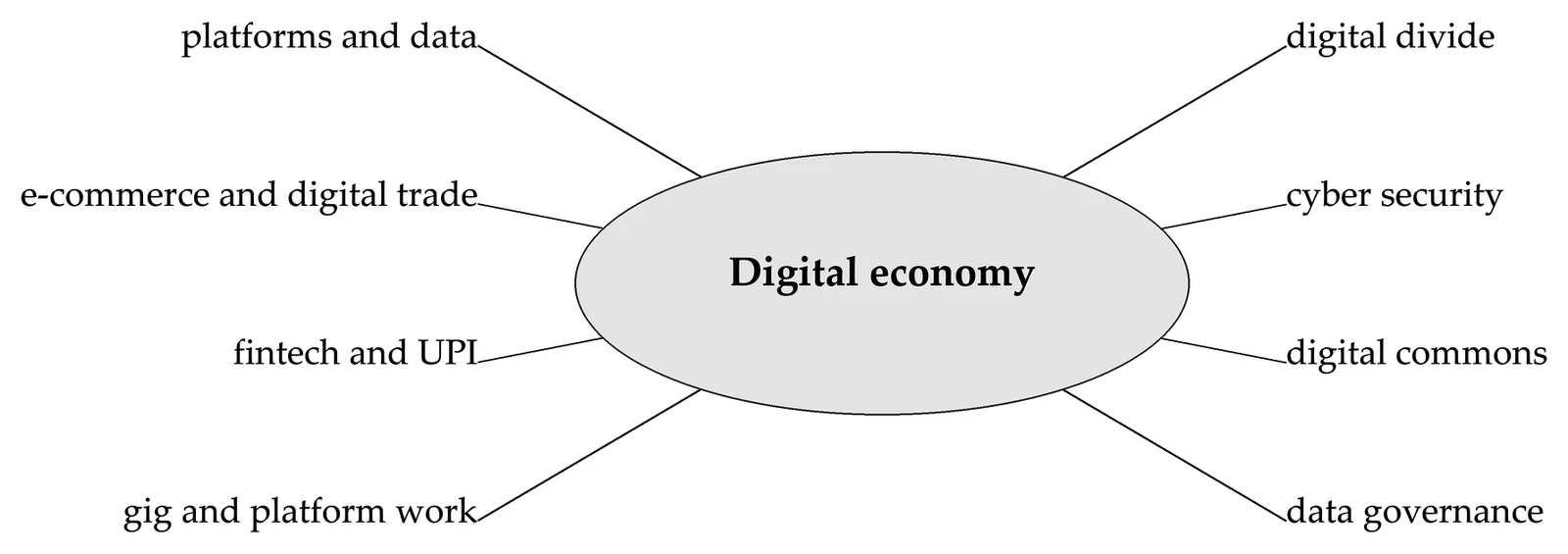
Irina Brass and David Hornsby, in Digital Technological Innovation and the International Political Economy (2019), argue that digital technologies raise classic IPE questions about states, markets and power in new forms. Data has become a key economic resource, and a few platform companies, such as Google, Amazon, Meta, Alibaba and Tencent, control vast amounts of it, giving them market power and political influence. States compete for leadership in technologies such as artificial intelligence and semiconductors, and they disagree on how to govern data: the United States favours market-led rules, the European Union strong privacy protection, China state control, and India a model of public digital public infrastructure. Robert O’Brien and Marc Williams (2016) note that the digital economy also changes labour, through automation and platform work, and widens or narrows inequalities depending on access.
- Platform economy. Online marketplaces, ride-hailing and food delivery apps create gig work with flexibility but little security.
- Digital trade. Services such as software, streaming and online education cross borders without customs posts, raising disputes over taxes and data flows.
- Fintech. Mobile payments and digital lending, such as UPI in India and M-Pesa in Kenya, have brought millions into the financial system.
- Digital divide. Unequal access to devices, internet and skills, between and within countries, can deepen existing inequalities.
- Digital commons. Andreas Wittel (2013) describes an economy of contribution in the digital commons, such as Wikipedia and open-source software, which resists commodification.
Cyber Security and Commerce
David Fidler, in Cybersecurity, Global Commerce, and International Organizations (2021), shows that cyber attacks, ransomware and theft of intellectual property threaten global commerce, while disputes over data localisation and national security restrictions on technology firms fragment the digital economy. International organisations such as the WTO, OECD and UN have struggled to create common rules. India illustrates both sides: it has built an influential digital public infrastructure (Aadhaar, UPI and the wider India Stack), promoted it during its G20 presidency in 2023, and passed the Digital Personal Data Protection Act in 2023, while also banning many Chinese apps on security grounds in 2020.
6.2 Economic Crises and Global Economic Governance
Pauly: The Political Economy of Global Financial Crises
Louis Pauly, in The Political Economy of Global Financial Crises (2017), argues that financial crises are a recurring feature of capitalism, not rare accidents. Booms fuelled by credit and optimism are followed by panics and busts, as economists such as Hyman Minsky and Charles Kindleberger described. Because finance is global but political authority is national, crises raise the question of who acts as lender of last resort and who bears the costs. Responses depend on cooperation among major states and central banks, and on whether the leading power is willing to provide stability.
Wade and Veneroso: The Asian Crisis
Robert Wade and Frank Veneroso, in The Asian Crisis: The High Debt Model Versus the Wall Street-Treasury-IMF Complex (1998), argued that East Asian economies had grown through a high debt model: households saved a lot, banks lent heavily to firms, and governments coordinated investment. This model worked while capital controls protected it, but financial liberalisation, pressed by what they called the Wall Street-Treasury-IMF complex, exposed it to volatile foreign capital. When capital fled in 1997, starting with Thailand, the IMF demanded high interest rates, spending cuts and structural reforms, which deepened the crisis and opened Asian assets to foreign buyers.
Helleiner: Lessons of 2008
Eric Helleiner, in Understanding the 2007–2008 Global Financial Crisis: Lessons for Scholars of IPE (2011), examines the worst crisis since the Great Depression, which began in the American subprime mortgage market and spread worldwide after the collapse of Lehman Brothers in September 2008. He asks why few IPE scholars foresaw it, and draws lessons: the importance of the politics of financial regulation, the power of ideas such as faith in efficient markets, and the surprising persistence of American financial dominance, as investors fled to the dollar even though the crisis began in the United States. He also notes that reforms after the crisis were more modest than many expected.

Stiglitz: The Burden of Debt
Joseph Stiglitz, in Making Globalization Work (2006), devotes a chapter to the burden of debt. He argues that developing countries were often encouraged to borrow too much, in foreign currencies and at variable interest rates, so that they bore the risks of exchange rate and interest rate changes. When crises came, creditors were protected while citizens suffered austerity. He proposes reforms such as lending in local currencies, GDP-linked bonds, an international sovereign bankruptcy mechanism, and the doctrine of odious debt, under which debts incurred by dictators for their own benefit need not be repaid. Charles Lipson (1981) had earlier shown how creditor banks and governments organised collectively to manage the Third World debt crisis, through bodies such as the Paris Club.
Hale, Held and Young: Gridlock
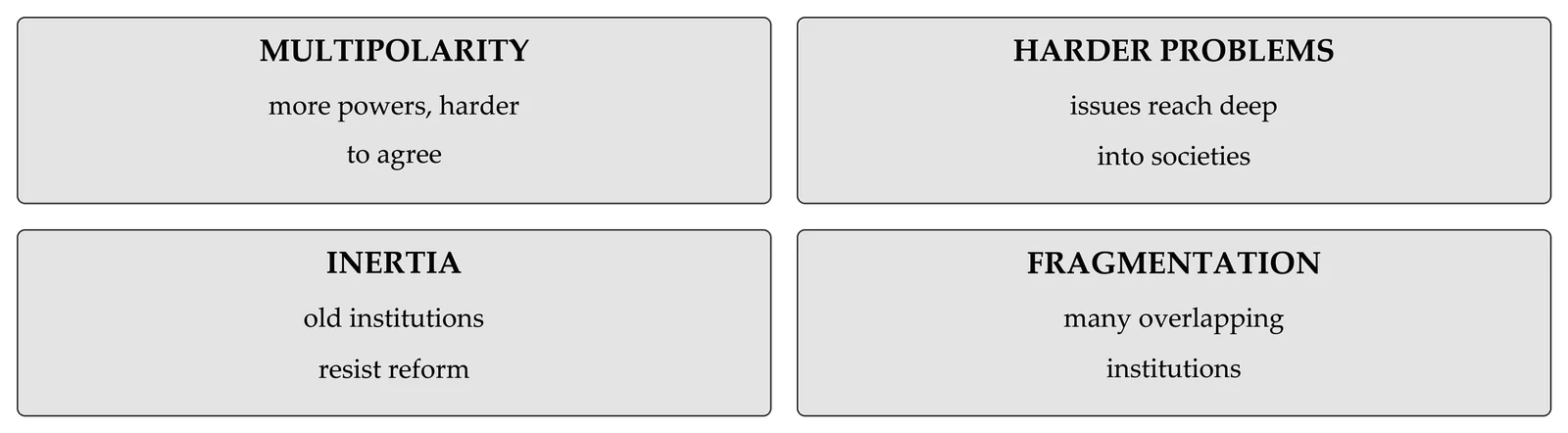
Thomas Hale, David Held and Kevin Young, in Gridlock: Why Global Cooperation is Failing when We Need It Most (2013), argue that the success of post-1945 institutions in creating an interdependent world has produced new problems that the same institutions cannot solve. They identify four pathways to gridlock: growing multipolarity, which makes agreement among more powerful states harder; harder problems, which reach deep into domestic societies; institutional inertia, as old bodies resist reform; and fragmentation, as overlapping institutions multiply. In the economy, gridlock appears in the stalled Doha Round, weak financial regulation and slow reform of the IMF, though the G20 response in 2008–09 showed that cooperation is possible in emergencies.
6.3 Global Civil Society
Scholte: Global Civil Society
Jan Aart Scholte, in Global Civil Society (2000), defines civil society as the political space where voluntary associations seek to shape the rules that govern social life. Global civil society includes groups that operate across borders or address global issues: non-governmental organisations, social movements, trade unions, religious bodies, think tanks, and business and professional associations. They engage with institutions such as the IMF, the World Bank and the WTO by lobbying, campaigning, protesting and monitoring.
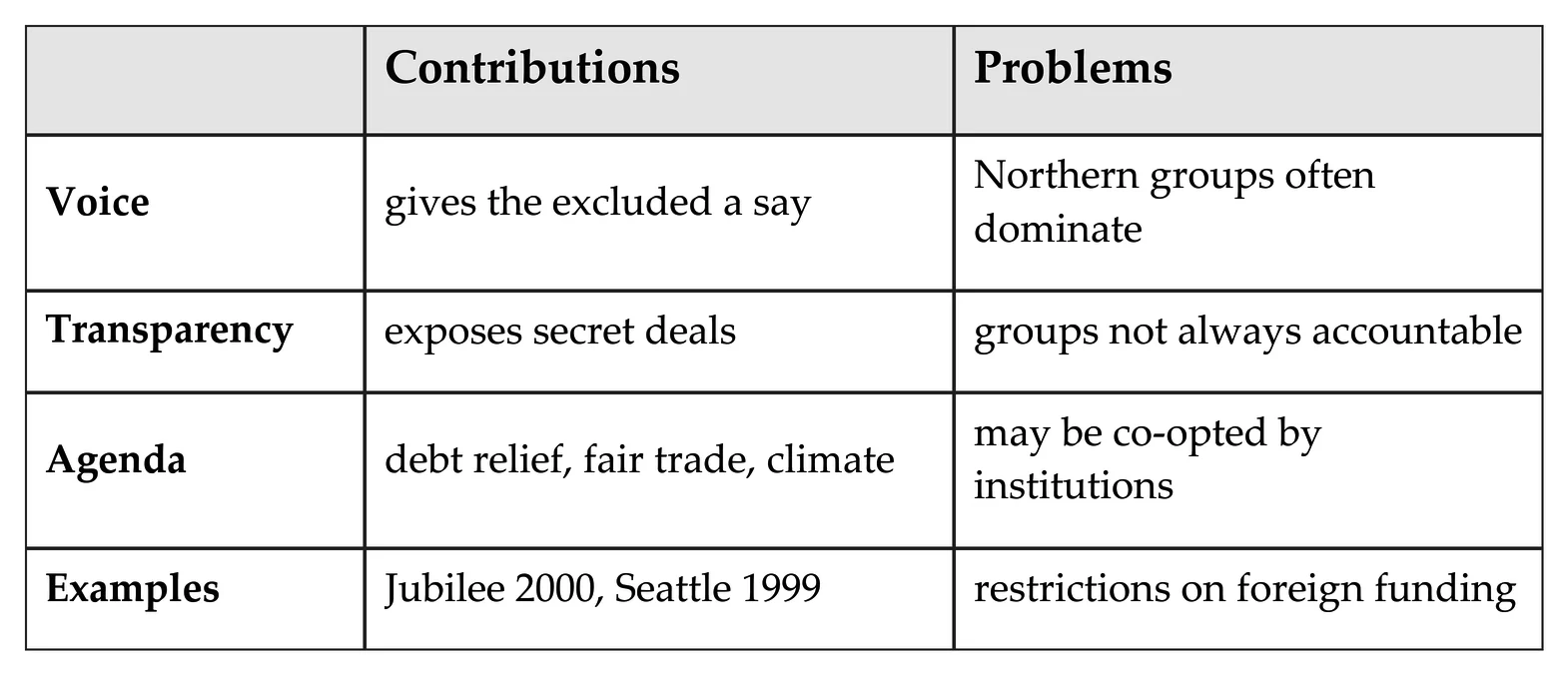
- Contributions. Scholte argues that civil society can give voice to people excluded from official decision-making, increase transparency and accountability, spread public education and add legitimacy to global governance.
- Problems. Civil society groups may be unrepresentative, dominated by well-funded Northern organisations, poorly accountable themselves, or co-opted by the institutions they seek to change.
- Examples. The Jubilee 2000 campaign helped win debt relief for poor countries; the protests at the WTO meeting in Seattle in 1999 drew global attention to trade; the World Social Forum (2001) offered a meeting place for movements under the slogan that another world is possible.
Cerny: The Changing Logic of Collective Action
Philip Cerny, in Globalization and the Changing Logic of Collective Action (2003), argues that globalisation changes how groups organise to pursue common goals. As capital becomes mobile and markets global, the national state turns into a competition state, focused on making the country attractive to investors rather than on protecting citizens from the market. Interest groups, firms and movements therefore increasingly act across borders, forming transnational coalitions and networks, while purely national collective action loses power. Politics becomes more complex, multi-level and fragmented.
Trade, Justice and Civil Society
Dev Nathan, D. Narasimha Reddy and Govind Kelkar (2008) show how civil society groups in India and elsewhere responded to crises in agriculture and livelihoods linked to trade liberalisation, through campaigns, fair trade networks and alternative models of production. Amartya Sen, in The Idea of Justice (2009), argues that justice is a matter of public reasoning that should not stop at national borders. Human rights are strong ethical claims, and global justice can be advanced through open discussion across countries, in which civil society, the media and international dialogue play key roles, even without a world government.
6.4 Important Questions
- Question 1 Discuss the impact of ICT and the cyber economy on the international political economy.
- Question 2 Discuss the causes and consequences of global economic crises with reference to 1997 and 2008.
- Question 3 Discuss the problem of global economic governance with reference to gridlock and debt.
- Question 4 Discuss the role of global civil society in the international political economy.
DU asks the same idea in different words. So learn one broad answer for each question below; the same answer works for every question joined by OR.
Important Question 1
Discuss the impact of ICT and the cyber economy on the international political economy.
OR
Examine the political economy of the digital economy and data.
OR
Discuss Manuel Castells’s idea of the network society.
Model Answer
“Networks constitute the new social morphology of our societies, and the diffusion of networking logic substantially modifies the operation and outcomes in processes of production, experience, power, and culture.”
— Manuel Castells, The Rise of the Network Society (1996)
Introduction. Information and communication technologies have transformed production, trade, finance and work. Digital platforms and data have become sources of wealth and power, and states compete to lead in new technologies. Castells calls this a network society, and Brass and Hornsby show how digital innovation raises old IPE questions about states, markets and power in new forms.
1. Technology and Creative Destruction
Schumpeter and Dicken describe technology as gales of creative destruction that create new industries and destroy old ones.
2. Shrinking Time and Space
Transport and communication technologies allowed production to be split into stages across many countries.
3. Castells’s Network Society
Castells argues that the new economy is informational, global and networked, with power lying in control of networks.
4. Data as a Resource
Data has become a key economic resource, collected and analysed by firms to create value.
5. Platform Power
A few platform companies control vast data and markets, giving them economic and political influence.
6. Brass and Hornsby
They argue that digital innovation raises questions of state power, market concentration and global governance.
7. Rival Models of Data Governance
The US favours market-led rules, the EU privacy protection, China state control and India digital public infrastructure.
8. Technology Rivalry
States compete for leadership in artificial intelligence and semiconductors, using subsidies and export controls.
9. Digital Trade
Software, streaming and online services cross borders easily, raising disputes over taxes and data flows.
10. Fintech and Inclusion
UPI in India and M-Pesa in Kenya show how digital payments can bring millions into the financial system.
11. Labour and the Gig Economy
Platform work offers flexibility but little security, and automation threatens some jobs, as O’Brien and Williams note.
12. The Digital Divide
Unequal access to devices, internet and skills can widen inequalities between and within countries.
13. Digital Commons
Wittel describes an economy of contribution in projects such as Wikipedia and open-source software, which resists commodification.
14. Cyber Security
Fidler shows that cyber attacks and data disputes threaten global commerce and fragment the digital economy.
15. India’s Digital Model
India’s Aadhaar, UPI and India Stack, promoted at the G20 in 2023, offer a public alternative to platform-led models.
16. Criticism
Critics warn of surveillance, exclusion of those without access and the concentration of power in a few firms or states.
17. Taxing the Digital Economy
Because digital firms earn profits where they have users but no physical presence, countries including India introduced equalisation levies, and the OECD negotiated a two-pillar deal in 2021 on taxing multinationals.
18. Artificial Intelligence
Artificial intelligence may transform productivity and work, and control over advanced chips, data and computing power is becoming a new source of structural power in the world economy.
19. Evaluation
The cyber economy creates new wealth and new inequalities, making digital governance a central issue of IPE.
Conclusion. Thus, as Castells argues, networks have become the new social morphology of our societies. ICT has transformed the world economy, creating platform power, data rivalry and digital inclusion, and governing it fairly is one of the main challenges for states and international institutions.
Important Question 2
Discuss the causes and consequences of global economic crises with reference to 1997 and 2008.
OR
Examine Wade and Veneroso’s explanation of the Asian financial crisis.
OR
Discuss the lessons of the 2007–08 global financial crisis for International Political Economy.
Model Answer
“As long as the music is playing, you’ve got to get up and dance. We’re still dancing.”
— Chuck Prince, Chief Executive of Citigroup (July 2007)
Introduction. Economic crises are a recurring feature of global capitalism. The Asian crisis of 1997 and the global financial crisis of 2007–08 showed how quickly turmoil spreads in a financially integrated world and how political choices shape both causes and responses. Louis Pauly, Robert Wade, Frank Veneroso and Eric Helleiner explain these crises from an IPE perspective.
1. Crises as Recurring
Pauly argues that financial crises are a normal feature of capitalism, not rare accidents.
2. Boom and Bust
Minsky and Kindleberger showed how credit-fuelled booms lead to manias, panics and crashes.
3. The Lender of Last Resort
Because finance is global but authority is national, crises raise the question of who provides emergency support.
4. The Asian High Debt Model
Wade and Veneroso describe East Asia’s model of high savings, high corporate debt and state coordination.
5. Liberalisation and Fragility
Financial liberalisation, pushed by the Wall Street-Treasury-IMF complex, exposed this model to volatile capital.
6. The 1997 Crash
Capital fled from Thailand in July 1997, and the crisis spread to Indonesia, South Korea and Malaysia.
7. IMF Response
IMF demands for high interest rates and spending cuts deepened recessions, according to Wade, Veneroso and Stiglitz.
8. Subprime Origins of 2008
The 2008 crisis began with risky mortgages in the US, packaged into complex securities sold worldwide.
9. Lehman Brothers
The collapse of Lehman Brothers in September 2008 turned the crisis into a global panic.
10. Prince’s Warning
Chuck Prince’s remark about dancing while the music played shows how banks kept taking risks during the boom.
11. Helleiner’s Lessons
Helleiner stresses the politics of regulation, the power of ideas about efficient markets and the persistence of dollar dominance.
12. Global Response
The G20 coordinated stimulus and expanded IMF resources, preventing a repeat of the 1930s.
13. Limited Reform
Post-crisis reforms such as Basel III strengthened banks, but deeper changes to global finance were limited.
14. Impact on India
India faced capital outflows and slower growth in 2008, but its partly closed capital account limited the damage.
15. Social Consequences
Crises caused unemployment, poverty and inequality, fuelling political backlash and populism.
16. Criticism
Some economists blame crises mainly on domestic mismanagement rather than on global finance or the IMF.
17. Contagion
Crises spread through contagion: investors who lose money in one market sell assets in others, and trade and banking links transmit shocks, as the Asian crisis spread from Thailand to South Korea within months.
18. Moral Hazard
Bailouts raise the problem of moral hazard, since banks that expect rescue may take greater risks, a dilemma regulators have faced in every major crisis.
19. Central Banks as Rescuers
In 2008 and again in 2020, the US Federal Reserve provided dollar swap lines to other central banks, acting as a global lender of last resort and reinforcing the dollar’s central role.
20. Evaluation
The crises of 1997 and 2008 show that global finance needs stronger regulation and cooperation.
Conclusion. Thus, crises from 1997 to 2008 show how liberalised finance and risky booms lead to busts. As Prince’s remark about dancing while the music played reveals, markets rarely restrain themselves, and Pauly, Wade and Helleiner show that politics shapes both crises and their resolution.
Important Question 3
Discuss the problem of global economic governance with reference to gridlock and debt.
OR
Examine Hale, Held and Young’s argument that global cooperation is gridlocked.
OR
Discuss Joseph Stiglitz’s view of the burden of debt on developing countries.
Model Answer
“We designated the G-20 to be the premier forum for our international economic cooperation.”
— G20 Leaders’ Statement, Pittsburgh Summit (25 September 2009)
Introduction. Global economic governance means the rules and institutions through which states manage the world economy. The success of post-war institutions created deep interdependence, but also new problems that are hard to solve. Hale, Held and Young call this gridlock, and Joseph Stiglitz shows how the burden of debt on developing countries reflects unfair rules.
1. Meaning of Global Governance
Global economic governance includes institutions such as the IMF, World Bank, WTO and G20, and the rules they make.
2. Post-War Success
Post-1945 institutions helped create an open, interdependent world economy with rising prosperity.
3. Self-Reinforcing Interdependence
Hale, Held and Young argue that this success created problems the old institutions cannot handle.
4. Growing Multipolarity
More powerful states must now agree, making decisions harder than when a few Western states dominated.
5. Harder Problems
Issues such as financial regulation and climate change reach deep into domestic societies and policies.
6. Institutional Inertia
Old institutions resist reform, as seen in the slow change of IMF voting shares.
7. Fragmentation
Overlapping institutions and forums multiply, making coordination more difficult.
8. Examples of Gridlock
The stalled Doha Round and weak global financial regulation show gridlock in the economy.
9. The G20 Exception
In 2008–09 the G20 coordinated a strong response, showing that cooperation is possible in emergencies.
10. Stiglitz on Debt
Stiglitz argues that poor countries were encouraged to borrow too much, in foreign currencies and at variable rates.
11. Unfair Burden
When crises came, creditors were protected while citizens suffered austerity.
12. Stiglitz’s Reforms
He proposes local-currency lending, GDP-linked bonds, a sovereign bankruptcy mechanism and the doctrine of odious debt.
13. Lipson on Creditors
Charles Lipson showed how creditors organised collectively, through the Paris Club and bank committees, to manage debt crises.
14. Debt Relief Initiatives
HIPC, the Multilateral Debt Relief Initiative and the G20 Common Framework sought to reduce the debts of poor countries.
15. India’s Role
India’s G20 presidency in 2023 highlighted debt vulnerabilities of the Global South and reform of development banks.
16. Criticism
Some argue gridlock is overstated, since new forms of cooperation, such as networks and minilateral deals, keep emerging.
17. Climate Finance
Gridlock is also visible in climate finance: rich countries’ promise of 100 billion dollars a year by 2020 was met only late, deepening mistrust between North and South.
18. Beyond Gridlock
In a later book, Beyond Gridlock (2017), Hale and Held examined pathways through which cooperation can still succeed, such as leadership by coalitions and pressure from civil society.
19. Informal Clubs
As formal bodies stall, informal clubs such as the G7, the G20 and the BRICS have become important, though they lack the legal authority and universal membership of the UN system.
20. Evaluation
Global economic governance is under strain, and fairer rules on debt and voice are needed to break the gridlock.
Conclusion. Thus, Hale, Held and Young show that global cooperation is gridlocked by multipolarity, harder problems, inertia and fragmentation, while Stiglitz shows how debt rules burden the poor. The G20, designated in 2009 as the premier forum for economic cooperation, shows both the possibility and the limits of reform.
Important Question 4
Discuss the role of global civil society in the international political economy.
OR
Examine Jan Aart Scholte’s view of global civil society.
OR
Discuss Philip Cerny’s argument on globalisation and the changing logic of collective action.
Model Answer
“Another world is possible.”
— Slogan of the World Social Forum, first held at Porto Alegre in 2001
Introduction. Global civil society consists of voluntary associations that seek to shape the rules of global life, such as NGOs, social movements, unions and think tanks. Jan Aart Scholte examines their contributions and problems, Philip Cerny shows how globalisation changes collective action, and Amartya Sen links civil society to global public reasoning about justice.
1. Meaning of Civil Society
Scholte defines civil society as the political space where voluntary associations seek to shape the rules of social life.
2. Global Civil Society
Global civil society includes groups that work across borders or on global issues, from NGOs to unions.
3. Engaging Institutions
Civil society groups lobby, campaign, protest and monitor institutions such as the IMF, World Bank and WTO.
4. Giving Voice
They give voice to people excluded from official decisions, such as farmers, workers and indigenous communities.
5. Transparency and Accountability
Civil society exposes secret negotiations and holds institutions accountable for their policies.
6. Jubilee 2000
The Jubilee 2000 campaign helped win debt relief for poor countries, showing civil society’s influence.
7. Seattle 1999
Mass protests at the WTO meeting in Seattle drew global attention to the social costs of trade rules.
8. The World Social Forum
The World Social Forum, under the slogan another world is possible, gave movements a global meeting place.
9. Scholte’s Concerns
Scholte warns that civil society can be unrepresentative, Northern-dominated, poorly accountable or co-opted.
10. Cerny’s Competition State
Cerny argues that globalisation turns the national state into a competition state focused on attracting investment.
11. Transnational Collective Action
Groups therefore act across borders, forming transnational coalitions, while national action loses power.
12. Fair Trade and Livelihoods
Nathan, Reddy and Kelkar show how civil society responded to agrarian crises with campaigns and fair trade networks.
13. Sen’s Public Reasoning
Amartya Sen argues that justice depends on public reasoning across borders, in which civil society plays a central role.
14. Indian Examples
Movements such as the Narmada Bachao Andolan and campaigns on access to medicines engaged global institutions and firms.
15. Restrictions on NGOs
Many governments, including India through the Foreign Contribution (Regulation) Act, have tightened control over foreign-funded NGOs.
16. Criticism
Critics argue that civil society lacks democratic mandate and may serve donor or Northern agendas.
17. Digital Activism
Social media allow movements to organise across borders quickly, as in global climate strikes inspired by young activists from 2018, though online activism can be shallow and short-lived.
18. Business in Civil Society
Business associations and corporate foundations are also part of civil society, and often have more resources and access than citizens’ groups, raising questions about whose voice is heard.
19. Access to Medicines
Campaigns by civil society groups and countries such as South Africa and India helped secure the Doha Declaration on TRIPS and Public Health (2001), affirming the right to protect public health through measures such as compulsory licensing.
20. Evaluation
Global civil society democratises global economic governance, though its legitimacy and influence remain uneven.
Conclusion. Thus, global civil society, inspired by the belief that another world is possible, brings excluded voices into global economic governance. Scholte, Cerny and Sen show both its promise and its limits in a world where states compete for capital.
Short Notes
(a) Network society
Castells’s term for a society in which key economic and social activities are organised through networks powered by information technology.
(b) Gridlock
Hale, Held and Young’s term for the failure of global cooperation caused by multipolarity, harder problems, institutional inertia and fragmentation.
(c) Competition state
Philip Cerny’s term for the state that, under globalisation, focuses on making its economy attractive to mobile capital rather than on shielding citizens from markets.
More notes: DSE-3a International Political Economy
These notes are prepared by PADHO TO AISE for study help. They are not an official University of Delhi publication.