
Semester V DSE-3a International Political Economy
Unit IV · 22 min read · Updated 24 Nov 2026
As per the University of Delhi (DU) BA (Hons) Political Science syllabus
Contents
- 5.1 The International Monetary and Financial Structure
- Balaam and Dillman: The Monetary and Finance Structure
- The Trilemma
- Helleiner: The Evolution of the System
- Setser: A Neo-Westphalian Financial System
- Wade: Choking the South
- 5.2 Global Financial Institutions: The IMF and the World Bank
- Williams: Global Economic Institutions
- The IMF
- The World Bank
- 5.3 Regional Financial Institutions and the Global South
- Rana and Pardo: Complementarity
- Cooper: The BRICS New Development Bank
- Oatley: The Global Capital Flow Cycle
- Nel: What Emerging Powers Want
- 5.4 Important Questions
- Trace the evolution of the international monetary and financial system.
- Discuss the role of the IMF and the World Bank in the global political economy.
- Discuss the rise of regional financial institutions and their relationship with global institutions.
- Discuss the problems faced by developing countries in international finance.
- Short Notes
हम साथ मिलकर काम करना सीख रहे हैं। यदि हम ऐसा करते रहे, तो यह दुःस्वप्न, जिसमें हममें से अधिकांश ने अपने जीवन का बहुत बड़ा भाग बिताया है, समाप्त हो जाएगा।
We have been learning to work together. If we can so continue, this nightmare, in which most of us here present have spent too much of our lives, will be over.
— John Maynard Keynes, Closing speech at the Bretton Woods conference, 22 July 1944
MMONEY is the lifeblood of the world economy. Every trade, loan and investment across borders requires exchanging currencies, and every country needs foreign exchange to pay for imports and debts. Who decides the value of currencies, who lends in a crisis and on what terms, and why do poor countries suffer most when global finance turns? This chapter studies Unit IV of the syllabus: the international monetary and financial structure, from the gold standard to Bretton Woods and the age of floating currencies and dollar dominance; and the international and regional financial institutions, from the IMF and the World Bank to the Asian Development Bank, the AIIB and the BRICS New Development Bank.
5.1 The International Monetary and Financial Structure
Balaam and Dillman: The Monetary and Finance Structure
Balaam and Dillman (2014), following Susan Strange, describe the international monetary and finance structure as the set of rules, institutions and practices that govern exchange rates, international payments and the flow of credit. Its key questions are which currency is used for international trade and reserves, how exchange rates are set, who provides liquidity in a crisis, and how much capital can move freely across borders. The structure is political, because the country whose currency dominates enjoys great privileges, and because the rules decide who bears the costs of adjustment when countries run deficits.
The Trilemma
A basic idea of international finance is the trilemma or impossible trinity: a country cannot have a fixed exchange rate, free capital movement and an independent monetary policy at the same time; it must choose two. The gold standard chose fixed rates and free capital, sacrificing domestic monetary policy. Bretton Woods chose fixed rates and monetary independence, restricting capital. Since the 1970s, most major economies have chosen free capital and independent monetary policy, accepting floating rates. India manages a middle path with a flexible rate and partial controls on capital.

Helleiner: The Evolution of the System
Eric Helleiner, in The Evolution of the International Monetary and Financial System (2017), traces its history and stresses that it was shaped by political choices, not by markets alone.
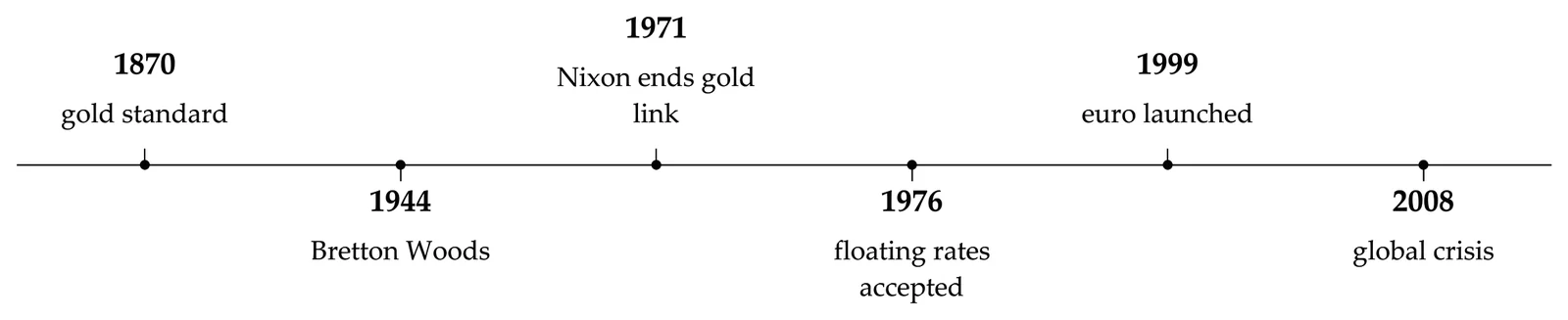
- Classical gold standard (about 1870–1914). Currencies were fixed to gold and capital moved freely, with London as the centre; governments accepted deflation to defend gold.
- Interwar breakdown. Attempts to restore gold in the 1920s failed; the Great Depression brought devaluations, exchange controls and the collapse of cooperation.
- Bretton Woods (1944–1971). Currencies were pegged to the dollar, the dollar to gold at 35 dollars an ounce, capital controls were allowed, and the IMF lent to countries in temporary difficulty.
- The Triffin dilemma. Robert Triffin (1960) warned that the world needed more dollars for liquidity, but more dollars abroad would undermine confidence in their gold value.
- Collapse and floating. The Nixon shock of 1971 ended dollar-gold convertibility; floating rates were accepted at Jamaica in 1976.
- Financial globalisation. From the 1980s capital controls were lifted, private capital flows grew enormously and financial crises became frequent.
- Dollar dominance. Despite the euro (1999) and the inclusion of China’s renminbi in the IMF’s Special Drawing Rights basket (2016), the dollar remains the main reserve and trade currency.
Setser: A Neo-Westphalian Financial System
Brad Setser, in A Neo-Westphalian International Financial System? (2008), observed that in the 2000s the largest flows of capital were no longer from private investors in rich countries to poor countries. Instead, governments of emerging economies, especially China and the oil exporters, built up huge foreign exchange reserves and sovereign wealth funds, and lent heavily to the United States. Capital flowed uphill, from poorer to richer countries, and states, not markets, became key financial actors. He called this a neo-Westphalian system, in which state power re-entered global finance.
Wade: Choking the South
Robert Wade, in Choking the South (2006), argues that the rules of the global economy, made largely by rich countries through the IMF, the World Bank and the WTO, shrink the development space of poor countries. Rules on capital account liberalisation, intellectual property and investment prevent them from using the policies that today’s rich countries once used. Developing countries also hold large dollar reserves as costly self-insurance against crises, in effect lending cheaply to the United States. For Wade, the system is skewed in favour of the core.
5.2 Global Financial Institutions: The IMF and the World Bank
Williams: Global Economic Institutions
Marc Williams, in Global Economic Institutions (2012), explains that the IMF, the World Bank and the WTO form the institutional core of global economic governance. They were created under American leadership to prevent a return to the chaos of the 1930s, and their voting rules reflect the economic weight, and the political power, of their members. Williams shows how their roles expanded over time and how they became targets of criticism from developing countries and social movements.
The IMF
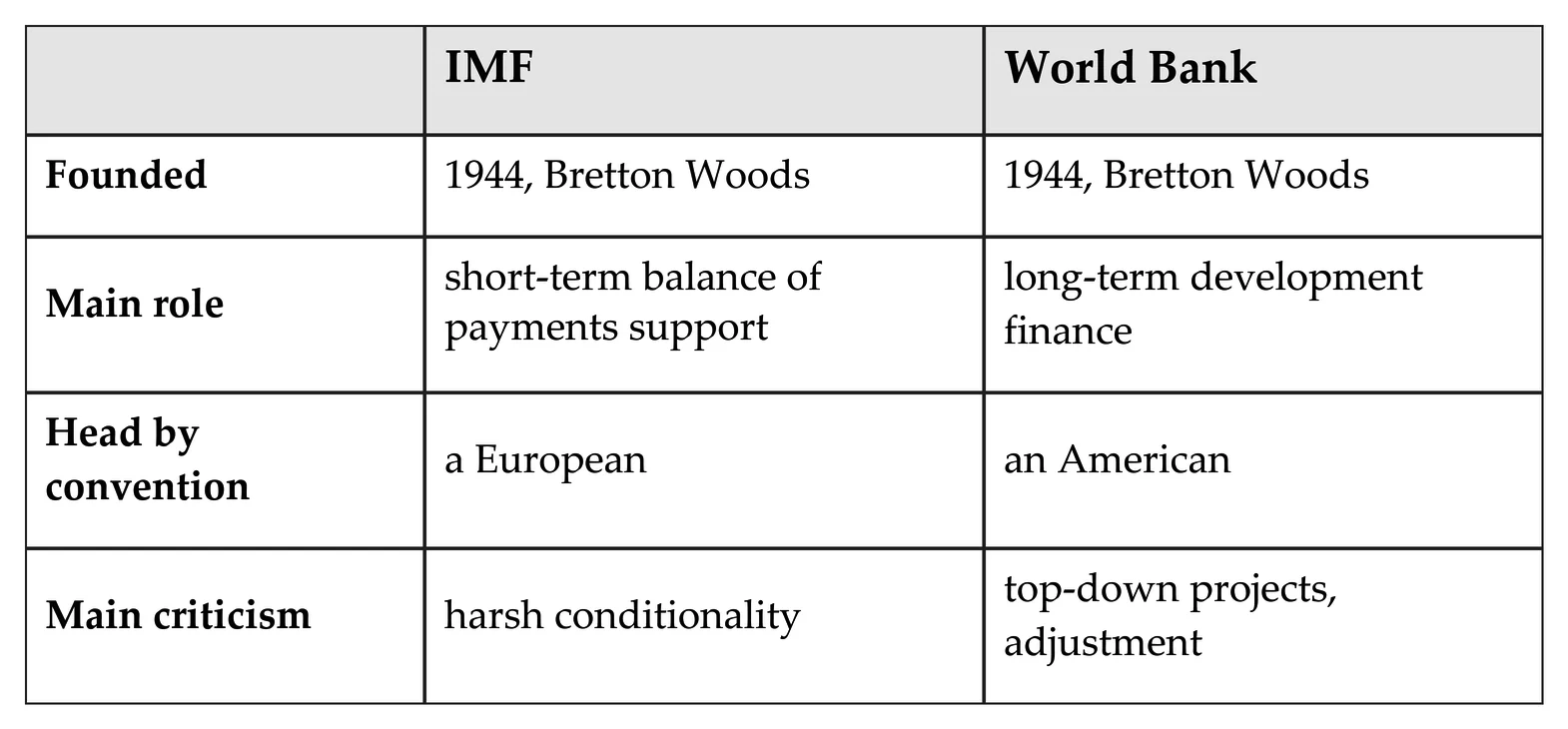
The International Monetary Fund was created to promote monetary cooperation, stable exchange rates and balanced growth of trade, and to lend to members facing balance of payments difficulties. Votes depend on quotas, so the United States holds about 16 per cent of votes and a veto over major decisions that need 85 per cent. After the Bretton Woods system ended, the IMF became mainly a lender to developing countries in crisis, attaching conditionality, i.e. policy conditions such as cutting deficits, devaluing the currency and liberalising markets.
Lisa Martin, in Distribution, Information, and Delegation to International Organizations: The Case of IMF Conditionality (2006), uses principal-agent theory to explain why powerful states delegate authority to the IMF. Delegation lets them benefit from the Fund’s expertise and makes lending appear neutral rather than political. But the design of conditionality also reflects the distributional interests of major shareholders, and the IMF staff gain more autonomy when those states disagree. Critics such as Joseph Stiglitz, in Globalization and Its Discontents (2002), argued that IMF conditions in the Asian crisis of 1997 made recessions worse.
The World Bank
The World Bank began as the International Bank for Reconstruction and Development, financing Europe’s recovery, and then turned to long-term loans for development projects such as dams, roads and power. Its presidents have always been American. In the 1980s it promoted structural adjustment alongside the IMF. Antje Vetterlein, in Seeing Like the World Bank on Poverty (2012), shows how the Bank’s understanding of poverty shifted from income growth towards a multidimensional view including health, education and social development, shaped by its internal culture and expertise. Robert Picciotto (2003) argued that a new World Bank for a new century must focus on global public goods, partnership with borrowers and accountability for results.
- India and the IMF. India borrowed from the IMF in 1981 and during the 1991 crisis; the 1991 programme accompanied liberalisation.
- India and the World Bank. India has been one of the largest borrowers of the World Bank, especially from its concessional arm, the International Development Association, in earlier decades.
- Reform. The 2010 quota reform, effective only in 2016, increased the shares of emerging economies, but India’s vote share remains below three per cent.
5.3 Regional Financial Institutions and the Global South
Rana and Pardo: Complementarity
Pradumna Rana and Ramon Pacheco Pardo, in Rise of Complementarity between Global and Regional Financial Institutions: Perspectives from Asia (2018), argue that regional institutions in Asia, such as the Chiang Mai Initiative Multilateralisation and the Asian Infrastructure Investment Bank, are not rivals that will replace the IMF and the World Bank. They increasingly complement them, through co-financing, shared standards and cooperation in crises. The Asian financial crisis of 1997, when many Asian countries felt humiliated by IMF conditions, was the main spur for building regional safety nets.
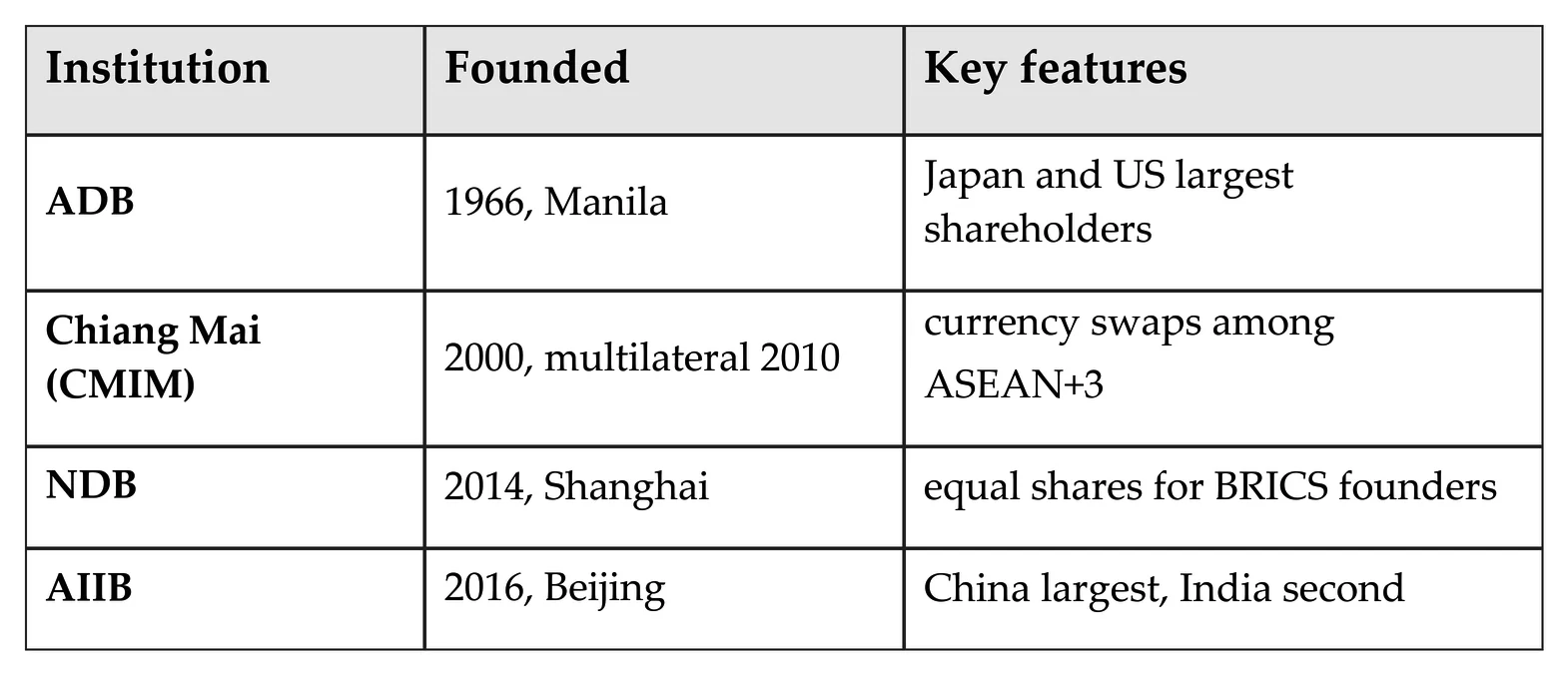
- Asian Development Bank (1966). Based in Manila, with Japan and the United States as the largest shareholders and Japanese presidents. Robert Wihtol (1988) describes how its early focus on large infrastructure gradually expanded to agriculture and rural development.
- Chiang Mai Initiative (2000). A network of currency swaps among ASEAN countries, China, Japan and South Korea, multilateralised in 2010.
- New Development Bank (2014). Founded by the BRICS at Fortaleza, headquartered in Shanghai, with equal shares for the five founders; its first president was India’s K. V. Kamath. A Contingent Reserve Arrangement of 100 billion dollars was created at the same time.
- Asian Infrastructure Investment Bank (2016). Led by China and based in Beijing; India is its second-largest shareholder and one of its largest borrowers.
Cooper: The BRICS New Development Bank
Andrew F. Cooper, in The BRICS’ New Development Bank: Shifting from Material Leverage to Innovative Capacity (2017), argues that the NDB’s significance lies less in the size of its lending, which is modest compared with the World Bank, than in its innovative capacity: faster project approval, lending in local currencies, green bonds and a governance structure based on equality among founders. It shows that emerging powers can build institutions on their own terms.
Oatley: The Global Capital Flow Cycle
Thomas Oatley, in International Political Economy (2019), describes a recurring capital flow cycle for developing countries. In a boom, capital pours in, credit and asset prices rise, and governments and firms borrow in foreign currency. When conditions change, often because interest rates rise in the United States, investors flee in a sudden stop, currencies collapse, debts become unpayable and countries turn to the IMF. The cycle explains the Latin American debt crisis of 1982, the Mexican crisis of 1994, the Asian crisis of 1997 and the pressures on emerging markets in 2013 and 2022.
Nel: What Emerging Powers Want
Philip Nel, in Redistribution and Recognition: What Emerging Regional Powers Want (2010), argues that India, Brazil and South Africa seek both redistribution, i.e. a fairer share of resources and voice in institutions, and recognition, i.e. respect and status as equals. Their push for IMF quota reform, the G20 and new banks such as the NDB reflects both aims.

5.4 Important Questions
- Question 1 Trace the evolution of the international monetary and financial system.
- Question 2 Discuss the role of the IMF and the World Bank in the global political economy.
- Question 3 Discuss the rise of regional financial institutions and their relationship with global institutions.
- Question 4 Discuss the problems faced by developing countries in international finance.
DU asks the same idea in different words. So learn one broad answer for each question below; the same answer works for every question joined by OR.
Important Question 1
Trace the evolution of the international monetary and financial system.
OR
Examine the Bretton Woods system and the reasons for its collapse.
OR
Discuss the role of the dollar in the international monetary system.
Model Answer
“The dollar is our currency, but it’s your problem.”
— John Connally, US Treasury Secretary, to European finance ministers (1971)
Introduction. The international monetary system is the set of rules and institutions governing exchange rates and international payments. It has evolved from the gold standard to the Bretton Woods system and then to floating rates and dollar dominance. Eric Helleiner shows that each stage reflected political choices and the power of leading states.
1. Meaning
The monetary system governs how currencies are exchanged, how rates are set and who provides liquidity in crises.
2. The Trilemma
A country cannot have fixed rates, free capital and independent monetary policy together; each era chose a different pair.
3. The Gold Standard
From about 1870 to 1914, currencies were fixed to gold and capital moved freely, with London at the centre.
4. Interwar Collapse
Efforts to restore gold failed, and the Depression brought devaluations, controls and the breakdown of cooperation.
5. Bretton Woods Design
In 1944, currencies were pegged to the dollar and the dollar to gold at 35 dollars an ounce, with the IMF to help countries in difficulty.
6. Embedded Liberalism
Capital controls allowed governments to pursue full employment while keeping exchange rates stable.
7. The Triffin Dilemma
Robert Triffin warned that the world needed more dollars, but more dollars abroad would erode confidence in their gold value.
8. The Nixon Shock
In August 1971, Nixon ended dollar-gold convertibility, and floating rates were accepted at Jamaica in 1976.
9. Connally’s Remark
Connally’s statement that the dollar was America’s currency but others’ problem showed how US power shaped the system.
10. Financial Globalisation
From the 1980s, capital controls were lifted, private flows grew and crises became frequent.
11. Setser’s Neo-Westphalian System
Brad Setser showed that emerging-economy governments became major creditors, with capital flowing uphill to the US.
12. Dollar Dominance
The dollar remains the main reserve and trade currency, giving the US what critics call an exorbitant privilege.
13. Challenges to the Dollar
The euro, the renminbi’s inclusion in the SDR basket and trade in local currencies, including India’s rupee settlement, seek alternatives.
14. Sanctions and the Dollar
The use of the dollar system for sanctions, as against Russia in 2022, has encouraged some states to reduce dependence on it.
15. India’s Choices
India moved from a fixed rate to a market-determined rate after 1993 while keeping some capital controls.
16. Criticism
Critics such as Wade argue that the system favours the core and forces poor countries to hold costly reserves.
17. Digital Currencies
Central bank digital currencies, such as the digital rupee piloted by the RBI from 2022, and new cross-border payment links may gradually change how international payments work.
18. SDRs as a Reserve Asset
The IMF created Special Drawing Rights in 1969 as a supplementary reserve asset; large allocations in 2009 and 2021 helped countries during the global financial crisis and the pandemic.
19. Evaluation
The monetary system reflects the power of leading states and changes when that power or its political foundations change.
Conclusion. Thus, the international monetary system has moved from gold to Bretton Woods to floating rates under dollar dominance. Connally’s remark that the dollar was America’s currency but the world’s problem captures the political nature of money, as Helleiner and Setser show.
Important Question 2
Discuss the role of the IMF and the World Bank in the global political economy.
OR
Critically examine IMF conditionality.
OR
Discuss the changing role of the World Bank in addressing poverty.
Model Answer
“To promote international monetary cooperation through a permanent institution which provides the machinery for consultation and collaboration on international monetary problems.”
— Articles of Agreement of the IMF, Article I(i)
Introduction. The IMF and the World Bank, created at Bretton Woods in 1944, are central institutions of global economic governance. The IMF lends to countries with balance of payments problems, while the World Bank finances development. Both have been praised for providing stability and finance and criticised for conditionality, unequal voting and policies that often hurt the poor.
1. Origins at Bretton Woods
Both were created in 1944 under American leadership to prevent a return to the chaos of the 1930s.
2. Purposes of the IMF
The IMF promotes monetary cooperation, exchange rate stability and balanced growth of trade, and lends in crises.
3. Quotas and Voting
Votes depend on quotas, giving the US about 16 per cent of votes and a veto over decisions needing 85 per cent.
4. Conditionality
IMF loans come with conditions such as cutting deficits, devaluing currencies and liberalising markets.
5. Martin’s Principal-Agent View
Lisa Martin explains that powerful states delegate to the IMF to use its expertise and make lending appear neutral.
6. Distribution and Autonomy
Conditionality reflects the interests of major shareholders, though staff gain autonomy when those states disagree.
7. Structural Adjustment
In the 1980s and 1990s, IMF and World Bank adjustment programmes cut public spending and opened economies across the South.
8. Stiglitz’s Critique
Joseph Stiglitz argued that IMF conditions worsened the Asian crisis of 1997 by imposing austerity in a downturn.
9. The World Bank’s Evolution
The Bank moved from reconstruction to project lending, then adjustment, and later to poverty reduction and governance.
10. Vetterlein on Poverty
Antje Vetterlein shows how the Bank’s view of poverty widened from income to health, education and social development.
11. Picciotto’s New Bank
Robert Picciotto called for a Bank focused on global public goods, partnership and accountability.
12. Williams on Global Institutions
Marc Williams shows that these institutions reflect the power of their members and face legitimacy challenges.
13. India’s Experience
India borrowed from the IMF in 1981 and 1991, and the 1991 programme accompanied its liberalisation.
14. Leadership Convention
By convention the IMF is headed by a European and the World Bank by an American, which developing countries criticise.
15. Reform
The 2010 quota reform, effective in 2016, raised emerging economies’ shares, but India’s vote remains below three per cent.
16. Positive Role
The institutions provided emergency finance in crises such as 2008 and the pandemic, and support for low-income countries.
17. Global Financial Safety Net
After 2008, the IMF’s resources were tripled at the G20 London summit of 2009, and it created more flexible credit lines, showing how crises strengthen global institutions.
18. Climate and Development
The World Bank and IMF have increasingly linked lending to climate goals, through instruments such as the IMF’s Resilience and Sustainability Trust (2022).
19. Evaluation
The IMF and World Bank are indispensable but need fairer voting and more flexible policies to retain legitimacy.
Conclusion. Thus, the IMF and the World Bank were created to promote monetary cooperation and development. As Martin and Williams show, they reflect the interests of powerful states, and reforms of voting and conditionality are essential to make them legitimate for the Global South.
Important Question 3
Discuss the rise of regional financial institutions and their relationship with global institutions.
OR
Examine the significance of the BRICS New Development Bank.
OR
Discuss the role of the Asian Development Bank and the AIIB in Asian development.
Model Answer
“Mobilizing resources for infrastructure and sustainable development projects in BRICS and other emerging and developing economies.”
— Fortaleza Declaration of the Sixth BRICS Summit (15 July 2014), on the purpose of the New Development Bank
Introduction. Alongside the IMF and the World Bank, regional and new financial institutions have grown, especially in Asia. The Asian Development Bank, the Chiang Mai Initiative, the AIIB and the BRICS New Development Bank reflect both the needs of developing regions and the desire of emerging powers for a greater voice. Scholars debate whether they rival or complement the Bretton Woods institutions.
1. Why Regional Institutions
Regional institutions offer finance suited to regional needs and give regional states greater voice.
2. The Asian Development Bank
The ADB, set up in 1966 in Manila, is led by Japan and the US and finances infrastructure and development in Asia.
3. Wihtol on the ADB
Robert Wihtol describes how the ADB’s early focus on infrastructure gradually expanded to agriculture and rural development.
4. The 1997 Shock
Harsh IMF conditions in the Asian crisis led Asian states to build their own safety nets.
5. The Chiang Mai Initiative
Launched in 2000 and multilateralised in 2010, it provides currency swaps among ASEAN, China, Japan and South Korea.
6. The New Development Bank
The BRICS founded the NDB in 2014, with equal shares, headquarters in Shanghai and India’s K. V. Kamath as first president.
7. The Contingent Reserve Arrangement
A 100-billion-dollar reserve pool among the BRICS offers support in balance of payments crises.
8. Cooper’s Innovative Capacity
Andrew Cooper argues that the NDB matters for its innovations, such as local currency lending and green bonds, more than its size.
9. The AIIB
The China-led AIIB began in 2016; India is its second-largest shareholder and a major borrower.
10. Rana and Pardo’s Complementarity
Rana and Pardo argue that Asian regional institutions increasingly complement global ones through co-financing and shared standards.
11. Nel on Emerging Powers
Philip Nel shows that emerging powers seek redistribution of resources and recognition of status through such institutions.
12. Rivalry or Reform
Some see the AIIB and NDB as challenges to Western dominance, others as pressure for reform of existing institutions.
13. China’s Influence
China’s leading role in the AIIB and its Belt and Road lending raise concerns about debt and influence.
14. India’s Balancing
India participates in the AIIB and NDB while opposing the Belt and Road Initiative, balancing benefits and concerns.
15. Limits
Regional institutions remain small compared with global needs and face political tensions among members.
16. Infrastructure Gap
Asia’s huge needs for infrastructure finance mean that all these institutions can play a role.
17. European Lessons
Europe built its own financial institutions, such as the European Stability Mechanism (2012), after the eurozone crisis, showing that regional safety nets are a global trend.
18. Local Currency Lending
Lending in local currencies, which the NDB has emphasised, reduces the exchange rate risk that developing borrowers face when they borrow in dollars.
19. Standards and Safeguards
Critics feared that new banks would lower environmental and social standards, but the AIIB adopted safeguard policies close to those of the World Bank and often co-finances projects with it.
20. Evaluation
Regional institutions diversify finance and voice for the South, mostly complementing rather than replacing global ones.
Conclusion. Thus, regional institutions from the ADB to the NDB, created to mobilise resources for infrastructure and sustainable development, reflect the rise of emerging powers. As Rana, Pardo and Cooper show, they increasingly complement global institutions while pushing them towards reform.
Important Question 4
Discuss the problems faced by developing countries in international finance.
OR
Examine Robert Wade’s argument in Choking the South.
OR
Discuss the global capital flow cycle and its impact on developing countries.
Model Answer
“No power on earth can stop an idea whose time has come.”
— Manmohan Singh, Budget Speech (24 July 1991), quoting Victor Hugo
Introduction. Developing countries face special problems in international finance: volatile capital flows, debts in foreign currency, dependence on the dollar and limited voice in global institutions. Thomas Oatley describes a recurring capital flow cycle of booms and crises, and Robert Wade argues that the rules of the system choke the development space of the South. India’s 1991 crisis shows these pressures.
1. Need for Foreign Exchange
Developing countries need foreign currency to pay for imports and debts, making them vulnerable to shortages.
2. Borrowing in Foreign Currency
Because they often cannot borrow in their own currencies, a fall in the exchange rate raises the burden of their debts.
3. Oatley’s Capital Flow Cycle
Thomas Oatley describes booms in which capital pours in, followed by sudden stops when investors flee.
4. Petrodollars and the 1982 Crisis
Oil money lent to Latin America in the 1970s led to the debt crisis of 1982 when US interest rates rose.
5. The Asian Crisis
Short-term inflows to East Asia reversed in 1997, causing currency collapses and deep recessions.
6. India’s 1991 Crisis
Falling reserves forced India to pledge gold and borrow from the IMF in 1991, leading to liberalisation.
7. Manmohan Singh’s Reforms
Manmohan Singh’s 1991 budget, declaring that no power could stop an idea whose time had come, launched reforms.
8. Wade’s Choking the South
Robert Wade argues that global rules made by rich countries shrink the development space of poor countries.
9. Costly Self-Insurance
Developing countries hold large dollar reserves to guard against crises, in effect lending cheaply to the United States.
10. Setser’s Uphill Flows
Setser shows that capital flowed from poorer emerging economies to the US in the 2000s, reversing expectations.
11. Conditionality
IMF loans in crises come with austerity and liberalisation, which can deepen hardship.
12. Debt Relief
Initiatives such as HIPC (1996) and the G20 Common Framework (2020) sought to ease the debts of the poorest countries.
13. New Lenders
China’s lending, as in Sri Lanka and Zambia, has added new creditors and complicated debt restructuring.
14. India’s Reserves
India built reserves of around 700 billion dollars by 2024, a buffer against capital flight.
15. Voice in Institutions
Developing countries seek greater voice in the IMF and World Bank and support new institutions such as the NDB.
16. Criticism
Some argue that domestic mismanagement, not only global rules, causes crises in developing countries.
17. Spillovers from US Policy
When the US Federal Reserve raises interest rates, capital often leaves emerging markets, as in the taper tantrum of 2013, when the rupee fell sharply.
18. Sovereign Debt Distress
Sri Lanka’s default in 2022 showed how falling reserves, heavy foreign debt and shocks can lead to crisis; India provided about four billion dollars of support.
19. Capital Controls Reconsidered
After repeated crises, even the IMF accepted in 2012 that capital flow management measures can be appropriate in some circumstances, a shift that supports the policy space developing countries demand.
20. Evaluation
International finance offers capital but exposes developing countries to volatility and rules that limit their choices.
Conclusion. Thus, developing countries face volatile capital flows, dollar dependence and restrictive rules, as Oatley and Wade show. India’s 1991 crisis, when Manmohan Singh declared that no power on earth could stop an idea whose time had come, shows how finance can force policy change.
Short Notes
(a) Triffin dilemma
Robert Triffin’s warning (1960) that a national currency serving as world reserve must flow abroad to provide liquidity, but this erodes confidence in its value.
(b) Conditionality
The policy conditions, such as cutting deficits, devaluing the currency and liberalising markets, that the IMF attaches to its loans.
(c) New Development Bank
The development bank founded by the BRICS in 2014, headquartered in Shanghai, with equal shares for its five founders, to finance infrastructure and sustainable development.
More notes: DSE-3a International Political Economy
These notes are prepared by PADHO TO AISE for study help. They are not an official University of Delhi publication.