
Semester VII DSE-9 Contemporary Political Economy
Unit III · 18 min read · Updated 24 Nov 2026
As per the University of Delhi (DU) BA (Hons) Political Science syllabus
Contents
- 3.1 Culture and Development
- 3.2 Environment and Development
- 3.3 The Knowledge Economy
- 3.4 Gender, Globalisation and Development
- 3.5 Important Questions
- Discuss the relationship between culture, globalisation and development.
- Discuss the relationship between environment and development.
- Discuss the knowledge economy and its implications for development.
- Discuss the gender dimension of globalisation and development.
- Short Notes
विकास को लोगों द्वारा भोगी जाने वाली वास्तविक स्वतंत्रताओं के विस्तार की प्रक्रिया के रूप में देखा जा सकता है।
Development can be seen as a process of expanding the real freedoms that people enjoy.
— Amartya Sen, Development as Freedom (1999)
DEVELOPMENT was once measured simply by economic growth. Today, scholars recognise that development raises deeper issues. Culture: does globalisation spread a single Western culture, or allow cultures to mix and resist? Environment: can growth continue without destroying the planet, and who bears the costs? Knowledge economy: as knowledge becomes the main source of wealth, who controls it, and who is left behind? These issues are also deeply gendered. This chapter draws on John Tomlinson, Stephen Marglin, Amartya Sen, Satyajit Singh, Jill Steans, J. Ann Tickner and Nitza Berkovitch.

3.1 Culture and Development
Globalisation spreads films, music, brands and lifestyles across the world. Some see this as cultural imperialism, the domination of Western, especially American, culture. John Tomlinson argues that cultural globalisation is more complex, involving mixing and local adaptation. Stephen Marglin argues that Western development has devalued local forms of knowledge, calling for the decolonisation of the mind, while Amartya Sen warns against treating culture as destiny.
3.2 Environment and Development
Rapid growth has caused climate change, deforestation, pollution and the displacement of communities by large projects. The idea of sustainable development seeks to balance economic growth, social equity and environmental protection. Satyajit Singh shows how large dams in India served powerful interests while displacing the poor. The environmentalism of the poor links ecological protection with livelihoods and justice.

3.3 The Knowledge Economy
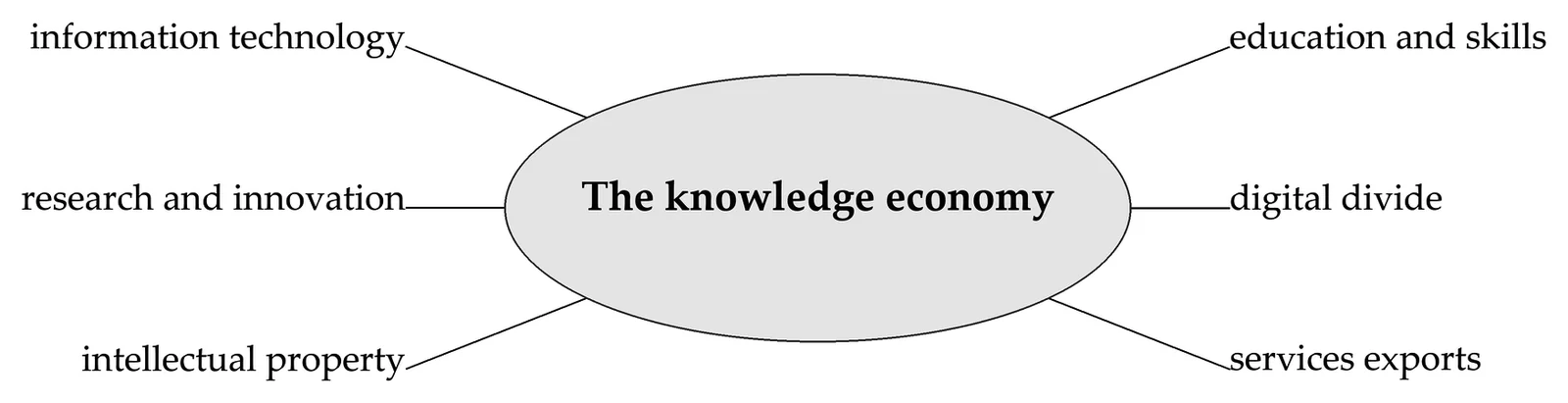
In the knowledge economy, information, research, innovation and skills are the main sources of wealth. India’s information technology sector shows its opportunities, while debates over intellectual property, traditional knowledge and the digital divide show its risks. Control over knowledge has become a central issue of global political economy.
3.4 Gender, Globalisation and Development
Globalisation affects women and men differently. Women form much of the cheap labour in export factories and global care chains, while structural adjustment often increased their burdens. Jill Steans and J. Ann Tickner show how gender shapes the global economy and world politics, and Nitza Berkovitch traces the growth of the international women’s movement.

3.5 Important Questions
- Question 1 Discuss the relationship between culture, globalisation and development.
- Question 2 Discuss the relationship between environment and development.
- Question 3 Discuss the knowledge economy and its implications for development.
- Question 4 Discuss the gender dimension of globalisation and development.
DU asks the same idea in different words. So learn one broad answer for each question below; the same answer works for every question joined by OR.
Important Question 1
Discuss the relationship between culture, globalisation and development.
OR
Is globalisation a form of cultural imperialism? Discuss.
OR
Examine Stephen Marglin’s idea of the decolonisation of the mind.
Model Answer
“As a source of exchange, innovation and creativity, cultural diversity is as necessary for humankind as biodiversity is for nature.”
— UNESCO, Universal Declaration on Cultural Diversity (2001), Article 1
Introduction. Culture, the shared values, beliefs, practices and ways of life of a people, is closely linked to development. Early development thinking saw traditional cultures as obstacles to progress. Globalisation has raised new questions: is the world becoming culturally uniform under Western influence, or are cultures mixing and resisting? Scholars such as Tomlinson, Marglin and Sen offer different answers.
1. Meaning of Culture
Culture includes language, religion, art, customs, values and knowledge. It shapes how people understand the world, what they value and how they live, and therefore how they experience development.
2. Culture in Development Thinking
Modernisation theorists saw traditional values as barriers to growth and expected developing countries to adopt Western values of rationality and individualism. Max Weber had linked capitalism to a particular cultural ethic.
3. Cultural Globalisation
Television, cinema, the internet, global brands and migration spread cultural products across borders. Hugh Mackay shows how media and television carry global images into local homes, while local audiences interpret them in their own ways.
4. Cultural Imperialism
Critics argue that globalisation spreads Western, especially American, culture, consumerism and values, weakening local cultures. This view is called cultural imperialism. George Ritzer described the spread of standardised fast-food methods as McDonaldization.
5. Tomlinson’s Critique
John Tomlinson argues that the idea of cultural imperialism is too simple. Audiences are not passive, global products are adapted locally, and globalisation creates complex cultural mixtures rather than simple domination by one culture.
6. Hybridisation and Glocalisation
Many scholars speak of hybridisation, the mixing of cultures, and glocalisation, the adaptation of global products to local tastes. Indian cinema, which has become global while remaining distinctive, is an example.
7. Marglin: Decolonising the Mind
Stephen Marglin argues that Western development privileges episteme, abstract scientific knowledge, over techne, the practical knowledge rooted in local experience. This devalues indigenous knowledge and communities, and he calls for the decolonisation of the mind.
8. Sen on Culture and Identity
Amartya Sen argues that culture matters but is not destiny. Cultures are diverse and changing, global interactions are not new or only Western, and reducing people to a single cultural identity can fuel conflict.
9. Glen’s North–South Perspective
John Glen shows that globalisation is experienced differently in the North and the South. For many in the South, cultural globalisation comes with economic dependence, making cultural questions inseparable from questions of power.
10. Resistance and Identity
Cultural globalisation has also provoked resistance and assertions of identity, from movements defending local languages to religious fundamentalism. Benjamin Barber described the conflict between Jihad and McWorld in 1995.
11. India and Cultural Globalisation
After 1991, satellite television and later streaming platforms brought global media to India, while Indian films, yoga and cuisine spread worldwide. The UN declared an International Day of Yoga from 2015.
12. Protecting Diversity
UNESCO’s Universal Declaration on Cultural Diversity (2001) and its Convention on the Protection and Promotion of the Diversity of Cultural Expressions (2005) affirm countries’ right to support their cultures.
13. Culture as a Resource
Culture can support development through tourism, creative industries and social cohesion, and local knowledge can guide sustainable practices in agriculture and health.
14. Language and Development
Language is a central part of culture and of access to development. English has become the global language of business, science and the internet, giving advantages to those who speak it and disadvantaging others. In India, debates continue over English and Indian languages in education; the National Education Policy of 2020 encourages teaching in the mother tongue in the early years while expanding opportunities to learn other languages.
15. Evaluation
Globalisation neither simply destroys nor simply enriches cultures. Development must respect cultural diversity while allowing cultures to change through exchange.
Conclusion. Thus, globalisation has intensified cultural exchange, raising fears of cultural imperialism. Tomlinson shows that the reality involves mixing and local adaptation, Marglin calls for decolonising minds dominated by Western knowledge, and Sen warns against treating culture as destiny. Development must respect cultural diversity.
Important Question 2
Discuss the relationship between environment and development.
OR
Examine the idea of sustainable development.
OR
Discuss the political economy of large dams in India with reference to Satyajit Singh.
Model Answer
“Sustainable development is development that meets the needs of the present without compromising the ability of future generations to meet their own needs.”
— World Commission on Environment and Development, Our Common Future (1987)
Introduction. Economic development has often come at the cost of the environment, through deforestation, pollution, climate change and the destruction of livelihoods. The idea of sustainable development seeks to reconcile growth with environmental protection. But environmental issues are also political: they involve conflicts over who benefits from development and who bears its costs.
1. The Tension
Industrialisation, mining, dams and intensive agriculture produce growth but also environmental damage. Poor countries argue that they need growth to reduce poverty, while environmentalists warn of ecological limits.
2. Limits to Growth and Stockholm
The Limits to Growth (1972) warned that exponential growth would exhaust resources. At the Stockholm Conference of 1972, Indira Gandhi asked whether poverty and need were not the greatest polluters, highlighting the South’s development concerns.
3. Sustainable Development
The Brundtland Commission’s report Our Common Future (1987) defined sustainable development as meeting present needs without compromising future generations, integrating economic, social and environmental goals.
4. Rio and Common but Differentiated Responsibilities
The Earth Summit at Rio in 1992 produced the climate convention, the biodiversity convention and Agenda 21. It recognised common but differentiated responsibilities, accepting that rich countries bear greater responsibility for environmental damage.
5. Climate Agreements
The Kyoto Protocol of 1997 set binding targets for developed countries, and the Paris Agreement of 2015 asked all countries to set nationally determined contributions to limit warming.
6. The Sustainable Development Goals
In 2015, the United Nations adopted seventeen Sustainable Development Goals to be achieved by 2030, linking poverty reduction, health, education, equality and environmental protection.
7. Singh on Large Dams
Satyajit Singh, in Taming the Waters (1997), examines the political economy of large dams in India. He shows that dams were promoted by an alliance of politicians, engineers, contractors and rich farmers, while their costs, displacement and ecological damage fell on the poor.
8. The Narmada Struggle
The Sardar Sarovar dam on the Narmada displaced many tribal and peasant families. The Narmada Bachao Andolan made it an international symbol of the conflict between development and the rights of the displaced.
9. The Environmentalism of the Poor
Ramachandra Guha and Joan Martinez-Alier described the environmentalism of the poor: struggles by peasants, tribals and fisherfolk to protect the resources on which their livelihoods depend, as in the Chipko movement.
10. Climate Justice
Developing countries argue that rich countries caused most historical emissions and should cut emissions faster and provide finance and technology. Climate change hurts the poor most, raising questions of justice.
11. India’s Commitments
At Glasgow in 2021, India pledged to reach net-zero emissions by 2070 and expand non-fossil electricity capacity, combining development needs with climate action.
12. Green Growth and Degrowth
Some argue that technology can decouple growth from environmental harm, an approach called green growth. Others argue that rich countries must reduce consumption, an approach called degrowth.
13. Environmental Governance in India
India passed the Environment (Protection) Act in 1986 and created the National Green Tribunal in 2010, while courts have developed environmental rights under Article 21.
14. Forests and Communities
Conservation policies have sometimes excluded forest communities from protected areas, an approach critics call fortress conservation. The Forest Rights Act of 2006 recognised the rights of tribal and forest-dwelling communities and gave gram sabhas a role in managing forests, reflecting the view that local communities can be partners in conservation rather than threats to it.
15. Pollution and Health
Development has brought severe air and water pollution to Indian cities and rivers. Air pollution in north India, worsened by vehicles, industry, construction and the burning of crop residue, is among the worst in the world and harms public health. The National Clean Air Programme, launched in 2019, set targets for reducing particulate pollution in many cities.
16. Evaluation
Environment and development are inseparable. Sustainable development requires not only technology but also justice in sharing the costs and benefits of development.
Conclusion. Thus, development has often damaged the environment, as Satyajit Singh’s study of large dams shows. The idea of sustainable development, from Brundtland to the SDGs, seeks to reconcile growth and ecology, while movements of the poor and demands for climate justice show that environmental issues are also questions of power and equity.
Important Question 3
Discuss the knowledge economy and its implications for development.
OR
Examine the role of intellectual property in the global knowledge economy.
OR
How has the knowledge economy shaped India’s development?
Model Answer
“Knowledge has become the key economic resource and the dominant, and perhaps even the only, source of comparative advantage.”
— Peter Drucker, Managing in a Time of Great Change (1995)
Introduction. In the late twentieth century, knowledge, information and innovation became the main sources of wealth in advanced economies. This knowledge economy is driven by information technology, research, education and services. It offers developing countries new opportunities, as India’s information technology sector shows, but also creates new inequalities and conflicts over the control of knowledge.
1. Meaning
The knowledge economy is an economy in which the production, distribution and use of knowledge are the main drivers of growth, rather than land, labour or physical capital alone.
2. Post-Industrial Society
Daniel Bell, in The Coming of Post-Industrial Society (1973), argued that advanced economies were shifting from manufacturing to services, with theoretical knowledge becoming central. Peter Drucker spoke of the rise of knowledge workers.
3. The Network Society
Manuel Castells, in The Rise of the Network Society (1996), described a new economy organised through global information networks, in which those connected gain power and those excluded fall behind.
4. The ICT Revolution
Computers, the internet and mobile phones transformed production, communication and finance, enabling global value chains and new services such as software and business process outsourcing.
5. India’s IT Sector
India became a global centre for software and IT-enabled services, with export revenues of around 200 billion dollars a year by the mid-2020s, creating millions of skilled jobs and a new middle class.
6. Intellectual Property
In the knowledge economy, patents, copyrights and trademarks protect innovations. The WTO’s TRIPS agreement required strong protection, which critics argue favours rich countries and raises the cost of medicines and technology.
7. Traditional Knowledge
Developing countries have fought the patenting of traditional knowledge. A US patent on the healing use of turmeric was revoked in 1997 after India showed prior knowledge, and India created a Traditional Knowledge Digital Library from 2001.
8. Education and Skills
The knowledge economy rewards education and skills. India’s young population could be a demographic dividend, but only if education and training improve in quality and reach.
9. The Digital Divide
Access to digital technology is unequal by income, region, gender and caste. The digital divide risks excluding the poor from opportunities in the knowledge economy.
10. Digital Public Infrastructure
India built digital public infrastructure, such as Aadhaar and the Unified Payments Interface launched in 2016, which expanded digital payments and services, though concerns about exclusion and privacy remain.
11. Knowledge and Inequality
The knowledge economy can concentrate gains among skilled workers and technology firms, while automation and artificial intelligence threaten routine jobs, widening inequality.
12. Marglin’s Critique
Stephen Marglin warns that the dominance of scientific, codified knowledge devalues practical and local knowledge, reducing diversity in ways of knowing and living.
13. Knowledge as a Public Good
Some argue that knowledge should be treated as a public good, through open access, open-source software and public research, to make its benefits widely available.
14. Research and Innovation
A strong knowledge economy depends on research and innovation. India spends well under one per cent of its national income on research and development, much lower than China, South Korea or the United States, and most of it comes from government. Increasing investment in universities, research and start-ups is seen as essential for India to move up global value chains.
15. Data and Platforms
In the digital economy, data has become a key resource, and a few large technology platforms control vast amounts of it. This raises concerns about monopoly power, privacy and the sharing of gains. Countries, including India, debate rules on where data is stored, how platforms compete and how citizens’ personal data is protected.
16. Evaluation
The knowledge economy offers new paths to development but also new inequalities. Its benefits depend on education, access and fair rules for intellectual property.
Conclusion. Thus, the knowledge economy makes knowledge the main source of wealth, as Bell, Drucker and Castells described. It has opened opportunities for India through information technology, but conflicts over intellectual property, traditional knowledge and the digital divide show that its benefits depend on fair rules and wide access.
Important Question 4
Discuss the gender dimension of globalisation and development.
OR
Examine the impact of globalisation on women in the global South.
OR
Discuss the growth of the international women’s movement with reference to Berkovitch.
Model Answer
“The personal is international.”
— Cynthia Enloe, Bananas, Beaches and Bases (1989)
Introduction. Globalisation and development affect women and men differently. Women form a large share of the workforce in export industries and global care chains, often in low-paid and insecure jobs, and bear much of the burden of economic crises and cuts in public services. Feminist scholars such as Jill Steans and J. Ann Tickner have shown how gender shapes the global economy, and Nitza Berkovitch has traced the growth of the international women’s movement.
1. A Gendered Process
Globalisation changes patterns of work, migration, family and politics, and these changes are shaped by gender. Feminist scholars argue that the global economy cannot be understood without attention to gender.
2. Export Industries
Many export factories in garments, electronics and food processing employ mainly young women, valued as cheap and docile labour. Such jobs give women income but often involve long hours, low wages and insecurity.
3. Global Care Chains
Arlie Hochschild described global care chains, in which women from poorer countries migrate to care for children and elderly people in richer ones, while their own families are cared for by others.
4. Women and Migration
Women migrate as domestic workers, nurses and care workers, sending remittances home. They often face exploitation, abuse and limited legal protection in host countries.
5. Steans on the Gender Dimension
Jill Steans shows that globalisation has gendered effects: structural adjustment cut public services, increasing women’s unpaid care work, while the expansion of informal and flexible work drew women into insecure employment.
6. Tickner on Gender in World Politics
J. Ann Tickner, a leading feminist scholar of international relations, argues that world politics has been shaped by masculine ideas of power, security and the state, and that women’s experiences and perspectives have been excluded from its study and practice.
7. Berkovitch on the Women’s Movement
Nitza Berkovitch traces the international women’s movement from nineteenth-century associations, such as the International Council of Women founded in 1888, to the global networks that shaped United Nations policy on women.
8. UN Conferences
The UN held world conferences on women in Mexico City (1975), Copenhagen (1980), Nairobi (1985) and Beijing (1995). The Beijing Platform for Action set a global agenda for women’s rights and empowerment.
9. CEDAW
The Convention on the Elimination of All Forms of Discrimination against Women, adopted in 1979, is often called an international bill of rights for women. India ratified it in 1993.
10. Microfinance
Microfinance, pioneered by Muhammad Yunus’s Grameen Bank, which won the Nobel Peace Prize in 2006, provides small loans to poor women. Critics note that it can increase debt without changing structural inequality.
11. Southern Feminist Networks
Networks such as Development Alternatives with Women for a New Era (DAWN), formed in 1984, brought the perspectives of women of the global South into international debates on development.
12. Women in India’s Globalised Economy
In India, women work in garment factories, information technology firms and as community health workers. Globalisation has created new opportunities for educated women while many poor women remain in informal work.
13. Criticisms
Some argue that global women’s agendas reflect Northern priorities, and that empowerment programmes may focus on individual entrepreneurship rather than structural change.
14. Trafficking and Violence
Globalisation has also expanded the trafficking of women and girls across borders for sex work, domestic servitude and forced labour. The United Nations adopted the Palermo Protocol against trafficking in persons in 2000. Feminists debate how to protect trafficked women without restricting the movement and choices of women migrants.
15. Evaluation
Globalisation has gendered effects, creating both opportunities and new forms of exploitation for women. Feminist analysis and the international women’s movement have made gender central to development.
Conclusion. Thus, globalisation and development are deeply gendered, drawing women into export industries and global care chains while increasing their burdens. Steans and Tickner show how gender shapes the global economy and world politics, and Berkovitch traces how the international women’s movement made women’s rights part of the global agenda.
Short Notes
(a) Cultural imperialism
The idea that globalisation spreads the culture and values of powerful countries, especially the United States, weakening local cultures. Scholars such as John Tomlinson argue that the reality is more complex, involving local adaptation and mixing.
(b) Common but differentiated responsibilities
A principle of international environmental law, recognised at Rio in 1992, that all countries share responsibility for protecting the environment, but developed countries bear greater responsibility because of their historical emissions and resources.
(c) Global care chains
Arlie Hochschild’s term for the series of links in which women from poorer countries migrate to provide care in richer countries, while others care for their own families at home.
More notes: DSE-9 Contemporary Political Economy
These notes are prepared by PADHO TO AISE for study help. They are not an official University of Delhi publication.