
Semester VII DSE-9 Contemporary Political Economy
Unit IV · 18 min read · Updated 24 Nov 2026
As per the University of Delhi (DU) BA (Hons) Political Science syllabus
Contents
- 4.1 Resources: Natural and Human
- 4.2 Regional Diversity
- 4.3 Routes: The Belt and Road and the ASEAN Highway
- 4.4 Important Questions
- Discuss the development dilemmas posed by natural resources in the era of globalisation.
- Discuss the importance of human resources for development in the era of globalisation.
- Discuss the impact of globalisation on regional diversity and inequality.
- Discuss the Belt and Road Initiative and the ASEAN Highway as routes of development and dilemmas of globalisation.
- Short Notes
लोकतंत्र, राष्ट्रीय संप्रभुता और वैश्विक आर्थिक एकीकरण — हम इनमें से कोई दो साथ रख सकते हैं, पर तीनों को पूरी तरह एक साथ कभी नहीं।
Democracy, national sovereignty and global economic integration are mutually incompatible: we can combine any two of the three, but we can never have all three simultaneously and in full.
— Dani Rodrik, The Globalization Paradox (2011)
GLOBALISATION promises growth, but it also confronts countries with hard choices. How should natural resources be used, and who should benefit? How can human resources, a country’s people and their skills, be developed when talent and labour move across borders? Why does globalisation deepen regional inequalities within and between countries? And what do new routes, such as China’s Belt and Road Initiative and the Asian and ASEAN highways, mean for development and sovereignty? This chapter examines these development dilemmas, drawing on Mark Kesselman, David Held and Anthony McGrew, Frank Lechner and John Boli, and Satyajit Singh.

4.1 Resources: Natural and Human
Globalisation has increased the demand for natural resources, such as minerals, oil, water and land, bringing revenue to some countries but also the resource curse, conflict and environmental damage. It has also made human resources, education, skills and health, central to competitiveness. Countries such as India hope to benefit from a demographic dividend but face challenges of education, jobs and the migration of skilled workers.
4.2 Regional Diversity
Globalisation does not affect all regions equally. Investment and growth concentrate in cities, coastal areas and regions with infrastructure and skills, while others lag behind. In India, the gap between richer western and southern states and poorer states of the north and east widened after liberalisation. At the global level, countries have formed regional blocs to manage integration, while India has struggled with regional cooperation in South Asia.
4.3 Routes: The Belt and Road and the ASEAN Highway
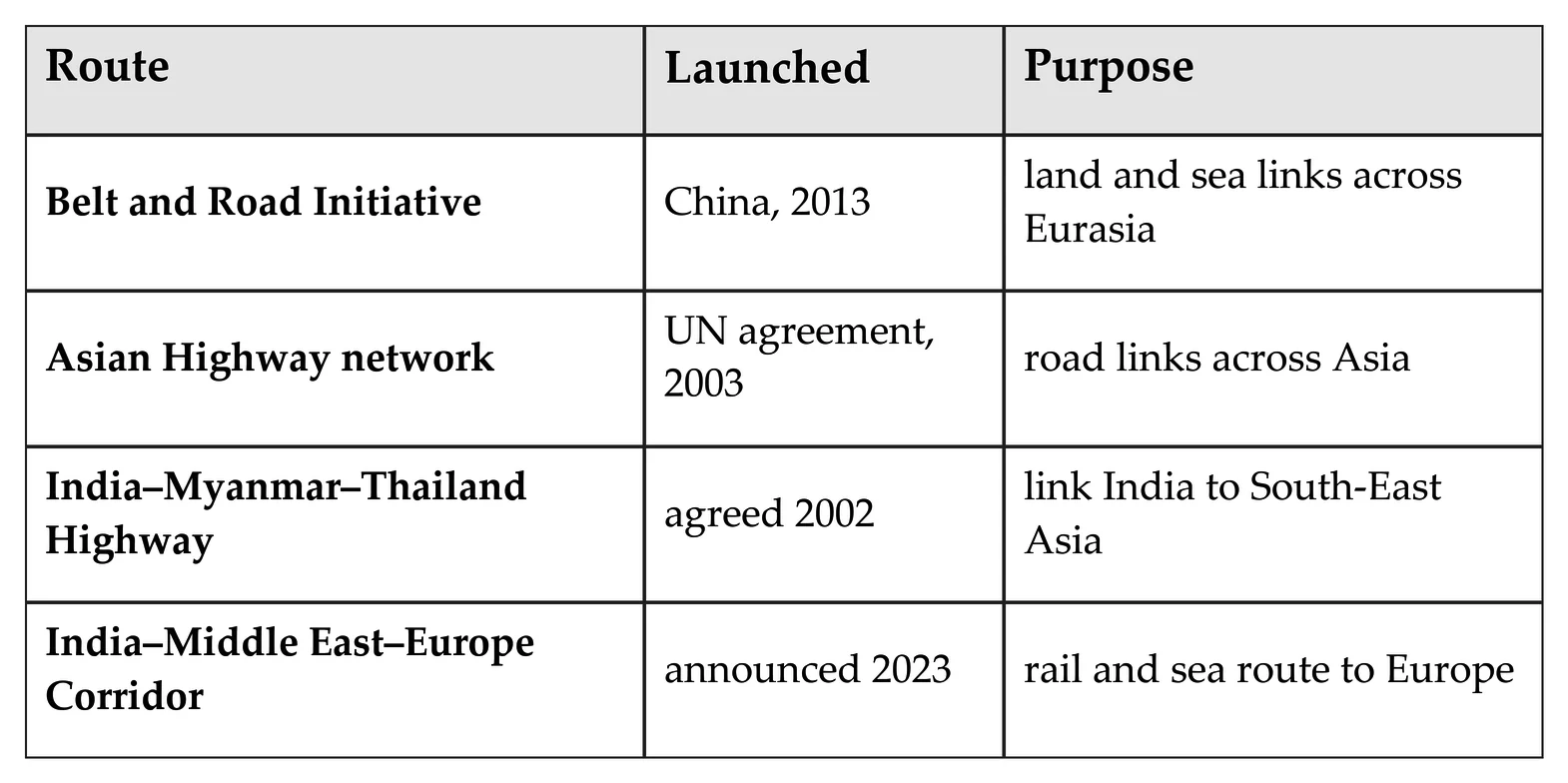
New transport and trade routes have become instruments of development and geopolitics. China’s Belt and Road Initiative finances ports, railways and roads across Asia, Africa and Europe. India opposes its flagship China–Pakistan Economic Corridor, which passes through territory India claims. India has instead promoted links to South-East Asia, such as the India–Myanmar–Thailand Trilateral Highway, part of wider plans for an Asian and ASEAN highway network, and the India–Middle East–Europe Economic Corridor.
4.4 Important Questions
- Question 1 Discuss the development dilemmas posed by natural resources in the era of globalisation.
- Question 2 Discuss the importance of human resources for development in the era of globalisation.
- Question 3 Discuss the impact of globalisation on regional diversity and inequality.
- Question 4 Discuss the Belt and Road Initiative and the ASEAN Highway as routes of development and dilemmas of globalisation.
DU asks the same idea in different words. So learn one broad answer for each question below; the same answer works for every question joined by OR.
Important Question 1
Discuss the development dilemmas posed by natural resources in the era of globalisation.
OR
What is the resource curse? Discuss with examples.
OR
Examine the conflicts over natural resources in India.
Model Answer
“That the ownership and control of the material resources of the community are so distributed as best to subserve the common good.”
— Constitution of India, Article 39(b)
Introduction. Natural resources such as minerals, oil, water, forests and land are essential for development. Globalisation has increased demand for them, bringing investment and revenue but also conflicts, environmental damage and inequality. The central dilemma is how to use resources for growth while protecting the environment and ensuring that local communities share in the benefits.
1. Natural Resources and Development
Resources provide raw materials for industry, energy for growth and export earnings. For many developing countries, they are the main link to the global economy.
2. Globalisation and Demand
Rapid growth in China and other emerging economies produced a commodity boom in the 2000s, raising prices for oil, metals and minerals and drawing investment into resource extraction across Africa, Latin America and Asia.
3. The Resource Curse
The economist Richard Auty used the term resource curse in 1993 for the paradox that countries rich in natural resources often grow more slowly, suffer more corruption and conflict and develop weaker institutions than countries without them.
4. Dutch Disease
Resource exports can raise the value of a country’s currency, making its manufacturing and agriculture less competitive. This effect is called Dutch disease, after the decline of Dutch industry following natural gas discoveries in the 1960s.
5. Conflict and Resources
Control over oil, diamonds and minerals has fuelled civil wars, as in parts of Africa, where conflict minerals financed armed groups. Resources can become a prize to be captured rather than a basis for development.
6. Water and Rivers
Water is increasingly contested within and between countries. India and Pakistan shared the Indus waters under a treaty of 1960, which India placed in abeyance in April 2025 after a terrorist attack, showing how resources become entangled with security.
7. Singh on Large Dams
Satyajit Singh shows that large dams in India, built to use water for irrigation and power, concentrated benefits among powerful groups while displacing the poor and damaging ecosystems, a dilemma of resource-based development.
8. Mining in India
Much of India’s mineral wealth lies in tribal regions of central and eastern India. Mining has brought revenue but also displacement and conflict, as at Niyamgiri. District Mineral Foundations, created in 2015, are meant to share mining revenue with affected communities.
9. The Energy Transition
The shift to clean energy increases demand for critical minerals such as lithium, cobalt and rare earths, whose processing is dominated by China. India launched a National Critical Mineral Mission in 2025 to secure supplies.
10. Kesselman on Globalisation
Mark Kesselman’s reader on the politics of globalisation shows how struggles over resources and the environment have become global issues, involving states, corporations and transnational movements.
11. Governing the Commons
Elinor Ostrom showed in Governing the Commons (1990) that local communities can manage shared resources such as forests and fisheries sustainably through their own rules, challenging the idea that only privatisation or state control can prevent overuse.
12. Who Benefits
The key political question is who benefits from resources: national governments, corporations, local elites or the communities who live on resource-rich land. Article 39(b) of the Constitution directs that resources serve the common good.
13. Sustainability
Overuse of resources threatens future generations. Sustainable development requires using renewable resources within their limits and managing non-renewable ones carefully.
14. The Global Land Rush
After the food price crisis of 2007–08, governments and investors from richer countries acquired large areas of farmland in Africa, Asia and Latin America to grow food and biofuels for export. Critics called this a global land grab, arguing that it displaced small farmers and pastoralists with weak land rights, while supporters claimed it brought investment and technology to agriculture.
15. Evaluation
Natural resources offer opportunities for development but also pose dilemmas of conflict, inequality and environmental damage. Good governance and fair sharing of benefits are essential.
Conclusion. Thus, globalisation has increased demand for natural resources, bringing revenue but also the resource curse, Dutch disease, conflict and environmental damage. In India, mining and dams have displaced communities, as Singh shows, and the challenge is to govern resources so that they serve the common good and future generations.
Important Question 2
Discuss the importance of human resources for development in the era of globalisation.
OR
What is the demographic dividend? Discuss India’s prospects.
OR
Examine the dilemmas of brain drain and labour migration.
Model Answer
“People are the real wealth of a nation.”
— United Nations Development Programme, Human Development Report (1990)
Introduction. In a globalised knowledge economy, a country’s people, their education, skills and health, are its most important resource. Human resources determine productivity, innovation and competitiveness. But globalisation also allows skilled and unskilled workers to move across borders, creating dilemmas of brain drain, migration and inequality. India, with a large young population, faces both great opportunities and serious challenges.
1. Human Capital
Economists Theodore Schultz (1961) and Gary Becker (1964) developed the idea of human capital: investments in education, training and health increase people’s productivity and earnings, just like investment in machines.
2. Human Development
The first Human Development Report of 1990, led by Mahbub ul Haq with Amartya Sen, introduced the Human Development Index, measuring development by health, education and income rather than income alone.
3. The Demographic Dividend
A demographic dividend arises when the working-age share of the population is large relative to dependants, allowing faster growth if workers are productively employed. India’s working-age population will remain large for the next two decades.
4. Education Challenges
India has expanded school enrolment, but surveys such as the Annual Status of Education Report show that many children cannot read or do basic arithmetic at the expected level. Without better learning, the dividend may not be realised.
5. Health
Public spending on health in India remains under two per cent of national income, and malnutrition affects many children. Healthy workers are essential for productive human resources.
6. Skills and Jobs
Programmes such as Skill India, launched in 2015, aim to train young people, but the economy must also create enough good jobs. Educated unemployment shows a mismatch between skills and opportunities.
7. Brain Drain
Many highly educated Indians, especially doctors, engineers and scientists, have migrated to richer countries, a loss of talent called brain drain, after the state invested in their education.
8. Brain Gain and Circulation
Migration can also bring benefits: remittances, investment, knowledge and networks. Indian professionals abroad have contributed to India’s information technology industry, and some return with skills and capital, a process called brain circulation.
9. Low-Skilled Migration
Millions of Indian workers migrate to the Gulf countries for construction and services. They send large remittances but often face exploitation under sponsorship systems that tie them to employers.
10. Remittances
India is the world’s largest recipient of remittances, receiving over 120 billion dollars a year in the mid-2020s, which support families, consumption and foreign exchange reserves.
11. Women’s Participation
India’s low participation of women in paid work means much of its human potential is underused. Increasing women’s employment could add significantly to growth.
12. Automation and the Future of Work
Automation and artificial intelligence threaten routine jobs, raising questions about how countries with large young workforces can create employment in a globalised, technology-driven economy.
13. Policy Responses
India’s National Education Policy of 2020, skill programmes and health insurance schemes aim to strengthen human resources, though implementation and funding remain challenges.
14. The Kerala Experience
Kerala shows the value of investing in people. Through public education, health care and social reform, it achieved literacy, life expectancy and low infant mortality comparable to much richer countries, despite modest income. Its educated workers, especially nurses, found work across the world, and their remittances became an important part of the state’s economy.
15. Lessons from East Asia
South Korea, Taiwan and later China invested heavily in universal schooling, technical education and public health before and during their rapid growth. This educated and healthy workforce allowed them to move from low-wage manufacturing to advanced industries, a lesson often cited for India’s efforts to turn its demographic dividend into sustained development.
16. Evaluation
Human resources are central to development under globalisation. India’s demographic dividend is an opportunity that depends on education, health, jobs and fair migration policies.
Conclusion. Thus, people are the real wealth of nations, and human capital and human development are central to growth in a globalised economy. India’s demographic dividend offers great potential, but weak learning, health and job creation, along with the dilemmas of brain drain and labour migration, must be addressed to realise it.
Important Question 3
Discuss the impact of globalisation on regional diversity and inequality.
OR
Why does globalisation produce uneven regional development?
OR
Examine regional disparities in India in the era of liberalisation.
Model Answer
“The State shall, in particular, strive to minimise the inequalities in income, and endeavour to eliminate inequalities in status, facilities and opportunities, not only amongst individuals but also amongst groups of people residing in different areas or engaged in different vocations.”
— Constitution of India, Article 38(2)
Introduction. Globalisation does not spread its benefits evenly across space. Investment, jobs and growth tend to concentrate in some regions, cities and countries, while others lag behind or decline. This uneven development creates regional inequalities within countries and between them, raising political tensions and challenges for policy. In India, regional disparities widened after liberalisation.
1. Uneven Development
Capitalist development has always been uneven, concentrating wealth in some places. Globalisation intensifies this, as capital moves to locations offering the best infrastructure, skills, markets and incentives.
2. Cumulative Causation
Gunnar Myrdal (1957) argued that growth in prosperous regions draws capital and skilled labour from poorer ones, a backwash effect that can outweigh the spread of benefits, causing regional gaps to widen through cumulative causation.
3. Hirschman’s View
Albert Hirschman (1958) argued that growth is necessarily unbalanced at first, concentrating in growth poles, but that benefits may later trickle down to other regions, though polarisation can persist.
4. Global Patterns
Globally, growth has concentrated in East Asia and parts of South Asia, while many African and some Latin American regions lag. Within countries, coastal and urban regions often grow faster than inland and rural ones, as in China.
5. India’s Regional Disparities
In India, per capita income in the richest states is several times that of the poorest. States in the west and south, such as Maharashtra, Gujarat, Karnataka and Tamil Nadu, have grown faster than Bihar, Uttar Pradesh and others.
6. Liberalisation and Divergence
After 1991, private investment flowed to states with better infrastructure, skilled labour and governance, widening the gap between leading and lagging states. Ashish Bose had earlier coined the term BIMARU for the lagging states of Bihar, Madhya Pradesh, Rajasthan and Uttar Pradesh.
7. Policy Responses in India
The Finance Commission transfers more resources to poorer states, and programmes such as the Backward Regions Grant Fund (2007) and the Aspirational Districts Programme (2018) target lagging areas.
8. Regional Movements
Regional inequalities have fuelled demands for new states and greater autonomy, such as the creation of Telangana in 2014 and demands from regions such as Vidarbha.
9. Regional Blocs
Held and McGrew show that globalisation has been accompanied by regionalism: countries form regional blocs such as the European Union, ASEAN and Mercosur to manage integration and strengthen their bargaining power.
10. India and Regional Integration
South Asian integration through SAARC, founded in 1985, has made little progress because of India–Pakistan tensions. India has turned to BIMSTEC and ties with ASEAN, but withdrew from the Regional Comprehensive Economic Partnership in 2019.
11. Diversity as Strength
Regional diversity in culture, ecology and economy can also be a strength, allowing different regions to develop according to their own advantages if policies support them.
12. World Culture and Local Places
Lechner and Boli show that globalisation spreads common models of the state, education and development across the world, but these are adapted differently in different regions.
13. Critique
Critics argue that market-led globalisation inevitably widens regional gaps and that only strong public investment and redistribution can reduce them.
14. Evaluation
Globalisation produces uneven regional development, which must be addressed through public investment, fiscal transfers and regional cooperation.
Conclusion. Thus, globalisation concentrates growth in some regions and leaves others behind, as Myrdal’s theory of cumulative causation explains. In India, regional disparities widened after liberalisation, prompting fiscal transfers and targeted programmes, while regional blocs shape integration at the global level.
Important Question 4
Discuss the Belt and Road Initiative and the ASEAN Highway as routes of development and dilemmas of globalisation.
OR
Examine India’s position on China’s Belt and Road Initiative.
OR
How do connectivity routes shape development and geopolitics in Asia?
Model Answer
“We are of firm belief that connectivity initiatives must be based on universally recognized international norms, good governance, rule of law, openness, transparency and equality.”
— Ministry of External Affairs, Government of India, statement on the Belt and Road Forum (13 May 2017)
Introduction. Transport and trade routes have always shaped economic and political power, from the ancient Silk Road to colonial railways. Today, large connectivity projects, such as China’s Belt and Road Initiative and the Asian and ASEAN highway networks, promise to boost trade and development. But they also raise dilemmas of debt, sovereignty, environment and geopolitical rivalry, which are central to India’s foreign and economic policy.
1. Routes and Political Economy
Routes connect markets, resources and people. Those who build and control routes gain economic and political influence, which is why connectivity has become a major arena of international competition.
2. The Belt and Road Initiative
China announced the Silk Road Economic Belt in Kazakhstan and the Maritime Silk Road in Indonesia in 2013. Together they became the Belt and Road Initiative, financing ports, railways, roads and power projects in many countries.
3. China’s Aims
The initiative aims to use China’s surplus industrial capacity, secure energy and trade routes, develop its western regions and expand its economic and political influence across Eurasia and beyond.
4. Major Projects
Key projects include the China–Pakistan Economic Corridor, launched in 2015 and linking western China to the port of Gwadar, and Sri Lanka’s Hambantota port, leased to a Chinese company for 99 years in 2017 after Sri Lanka struggled to repay debts.
5. The Debt Trap Debate
Critics accuse China of debt-trap diplomacy, lending to poor countries to gain strategic assets. Other researchers argue that the evidence is mixed and that many problems stem from poor planning by borrowing governments. The debate shows the risks of large loan-financed projects.
6. India’s Position
India has refused to join the Belt and Road Initiative and boycotted its forum in 2017, mainly because the China–Pakistan Economic Corridor passes through territory India claims, violating its sovereignty. India insists on transparency, sustainable debt and respect for sovereignty.
7. The Asian Highway Network
The United Nations Economic and Social Commission for Asia and the Pacific promoted the Asian Highway network, adopted through an intergovernmental agreement in 2003, linking over 140,000 kilometres of roads across more than thirty countries.
8. The ASEAN Highway and the Trilateral Highway
ASEAN countries plan an ASEAN Highway network linking member states. India, Myanmar and Thailand agreed in 2002 to build a Trilateral Highway from north-east India to Thailand, but progress has been slow because of conflict and difficult terrain.
9. Act East Policy
India’s Look East Policy of 1991, renamed Act East in 2014, seeks closer economic and strategic ties with South-East Asia. Connectivity through roads, the Kaladan multimodal project and ports is central to it, especially for developing the north-east.
10. Alternative Corridors
India supports alternatives such as the India–Middle East–Europe Economic Corridor announced in 2023 and the Chabahar port in Iran, for which India signed a ten-year operating agreement in 2024. Western initiatives also offer infrastructure finance.
11. Development Benefits
Better routes can lower transport costs, expand trade, connect landlocked regions and attract investment, helping lagging regions such as north-east India and inland areas of neighbouring countries.
12. Dilemmas
Connectivity projects can also bring unsustainable debt, environmental damage, displacement of local communities, loss of sovereignty and dependence on a single great power, while drawing countries into geopolitical rivalry.
13. Geopolitics of Routes
Analysts describe China’s ports around the Indian Ocean as a string of pearls that could encircle India. Routes have thus become instruments of strategic competition as well as development.
14. Evaluation
Connectivity routes are vital for development under globalisation, but they pose dilemmas of debt, sovereignty and environment. India’s approach combines opposition to the Belt and Road with promotion of alternative routes.
Conclusion. Thus, routes such as China’s Belt and Road Initiative and the Asian, ASEAN and Trilateral highways promise trade and development but raise dilemmas of debt, sovereignty, environment and rivalry. India opposes the Belt and Road because of sovereignty concerns and instead promotes Act East connectivity and alternative corridors.
Short Notes
(a) Resource curse
The paradox, named by Richard Auty in 1993, that countries rich in natural resources often grow more slowly and suffer more corruption, conflict and weak institutions than countries without such resources.
(b) Demographic dividend
The potential boost to growth when the working-age share of the population is large relative to dependants. It is realised only if workers are educated, healthy and productively employed.
(c) China–Pakistan Economic Corridor
A flagship Belt and Road project launched in 2015 to link western China with the port of Gwadar in Pakistan through roads, railways and energy projects. India opposes it because it passes through territory India claims.
(d) Act East Policy
India’s policy of closer economic, strategic and cultural ties with South-East and East Asia, launched as the Look East Policy in 1991 and renamed Act East in 2014. Connectivity projects such as the Trilateral Highway and the Kaladan project are central to it.
More notes: DSE-9 Contemporary Political Economy
These notes are prepared by PADHO TO AISE for study help. They are not an official University of Delhi publication.