

Generic Electives (GE) GE-14 Fundamental Rights, Duties and Directive Principles of State Policy
Unit 1 · 27 min read · Updated 27 Nov 2026
As per the University of Delhi (DU) Generic Elective (GE) syllabus offered by the Department of Political Science
Contents
- 1.1 The Preamble and Its Significance
- Key Words of the Preamble
- Is the Preamble Part of the Constitution
- Significance of the Preamble
- 1.2 Basic Features of the Constitution
- A Borrowed Constitution
- 1.3 The Basic Structure Debate
- Milestones of the Debate
- Elements of the Basic Structure
- The Debate over the Doctrine
- The Basic Structure Idea Abroad
- 1.4 Important Questions
- Discuss the significance of the Preamble of the Indian Constitution.
- Discuss the salient features of the Indian Constitution.
- Explain the basic structure doctrine and trace its evolution.
- Discuss the procedure for the amendment of the Indian Constitution under Article 368 and the limits on Parliament’s amending power.
- Short Notes
संविधान चाहे कितना भी अच्छा क्यों न हो, यदि उसे चलाने वाले लोग बुरे निकलें तो वह निश्चित रूप से बुरा सिद्ध होगा।
However good a Constitution may be, it is sure to turn out bad because those who are called to work it, happen to be a bad lot.
— B.R. Ambedkar, Speech in the Constituent Assembly (25 November 1949)
TTHE Constitution of India, adopted on 26 November 1949 and in force from 26 January 1950, is the supreme law of the country. It creates the institutions of government, distributes power among them and protects the rights of citizens. This first chapter introduces the Constitution through its Preamble, which states its ideals, and its basic features, which give it a distinctive character. It then studies the basic structure debate, the long contest between Parliament and the Supreme Court over how far the Constitution can be amended, which shapes the protection of Fundamental Rights, Directive Principles and Fundamental Duties studied in the rest of this paper.
1.1 The Preamble and Its Significance
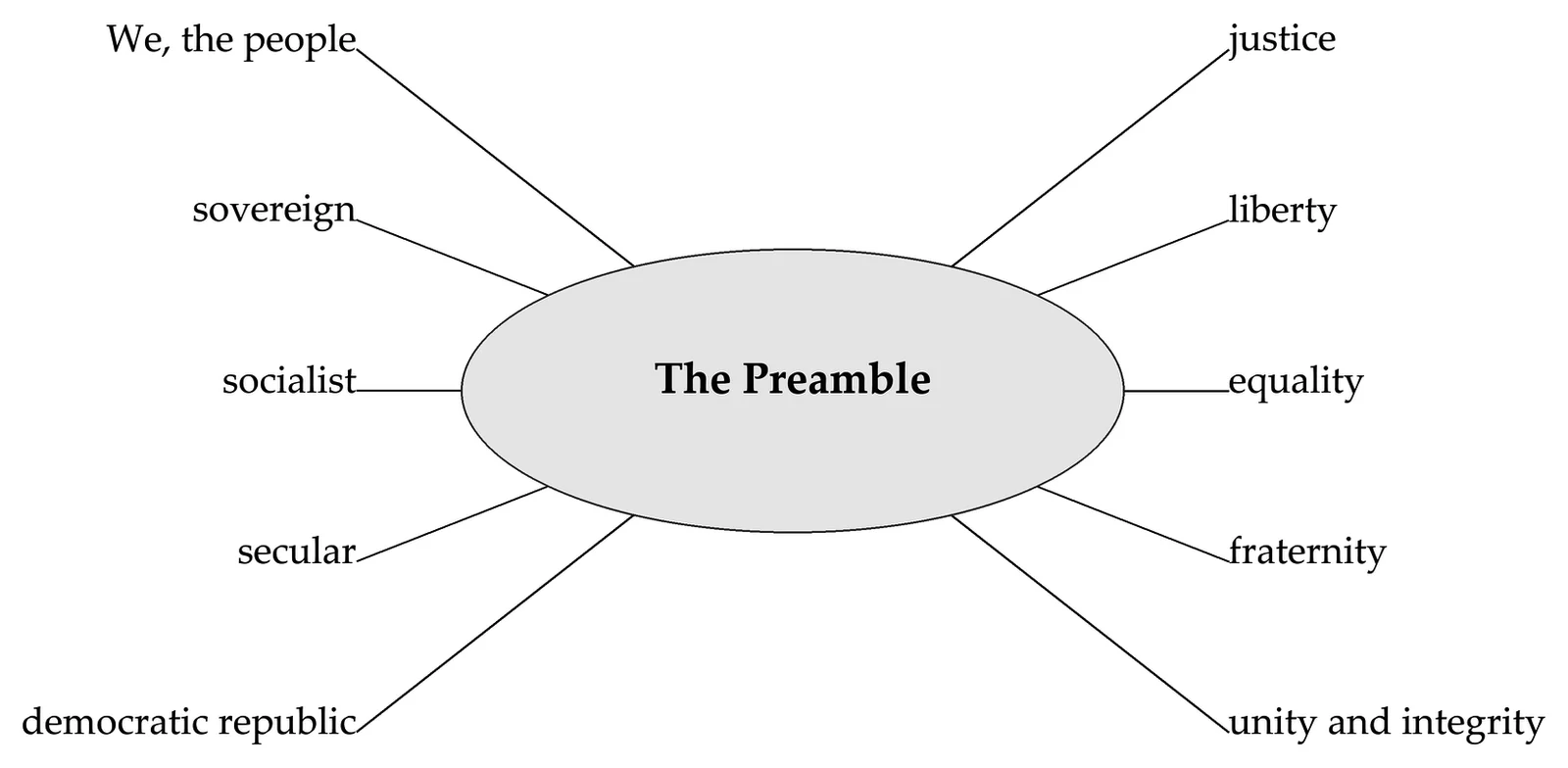
A constitution is the body of fundamental rules that establishes the organs of government, defines their powers and their relations with one another, and sets out the rights of citizens and the limits of state power. The Preamble is the introduction to the Constitution, stating the source of its authority, the nature of the state and the objectives it seeks to achieve. It was based on the Objectives Resolution moved by Jawaharlal Nehru on 13 December 1946 and adopted by the Constituent Assembly on 22 January 1947. The Preamble begins with the words We, the people of India, showing that the Constitution draws its authority from the people, not from the British Parliament or any ruler.
Key Words of the Preamble
- Sovereign. India is independent internally and externally, free to decide its own policies; membership of the Commonwealth or the UN does not limit this sovereignty.
- Socialist. Added in 1976, it means democratic socialism, i.e. reducing inequality of income, status and opportunity through a mixed economy, not abolishing private property.
- Secular. Also added in 1976, it means that the state has no religion of its own, treats all religions equally and does not discriminate on grounds of religion; the Supreme Court in S.R. Bommai (1994) held secularism to be part of the basic structure.
- Democratic. Power rests with the people, who elect their government through universal adult franchise; democracy includes political, social and economic dimensions.
- Republic. The head of state, the President, is elected and not hereditary, and every public office is open to all citizens.
- Justice. Social, economic and political justice, an idea inspired partly by the Russian Revolution, aims at removing inequalities of caste, wealth and power.
- Liberty. Liberty of thought, expression, belief, faith and worship, protected by Fundamental Rights.
- Equality. Equality of status and of opportunity, protected by Articles 14 to 18.
- Fraternity. A sense of brotherhood among all Indians, assuring the dignity of the individual and the unity and integrity of the nation; Ambedkar stressed that without fraternity, liberty and equality would not last.
Is the Preamble Part of the Constitution
In the Berubari reference of 1960, the Supreme Court said that the Preamble was not part of the Constitution, though it was a key to understanding the minds of its makers. In Kesavananda Bharati (1973), the Court reversed this view and held that the Preamble is part of the Constitution and can be amended, but not so as to destroy the basic structure. In the LIC case of 1995, it again affirmed that the Preamble is an integral part of the Constitution. The Preamble is not enforceable in a court of law, i.e. it is non-justiciable, and it is neither a source of power nor a limit on the powers of the legislature, but courts use it to interpret ambiguous provisions. In 2024, the Supreme Court dismissed petitions challenging the addition of socialist and secular in 1976, noting that these words had become part of the Constitution’s identity.
Significance of the Preamble
- Source of authority. It declares that sovereignty lies with the people of India.
- Nature of the state. It describes India as a sovereign, socialist, secular, democratic republic.
- Objectives. It sets out the goals of justice, liberty, equality and fraternity, which guide the whole Constitution.
- Aid to interpretation. Courts refer to it when the meaning of a provision is unclear.
- Political philosophy. K.M. Munshi described it as the political horoscope of the new republic, and the political scientist Ernest Barker admired it so much that he quoted it at the beginning of his Principles of Social and Political Theory (1951).
1.2 Basic Features of the Constitution
The Indian Constitution has several features that together give it a distinctive character. Granville Austin, in The Indian Constitution: Cornerstone of a Nation (1966), described it as first and foremost a social document, aimed at bringing about a social revolution through democratic means.
- The lengthiest written constitution. The original Constitution had 395 articles in 22 parts and 8 schedules; after many amendments it has more than 450 articles and 12 schedules, because it covers both the Union and the states, detailed administrative provisions and the special needs of a diverse society.
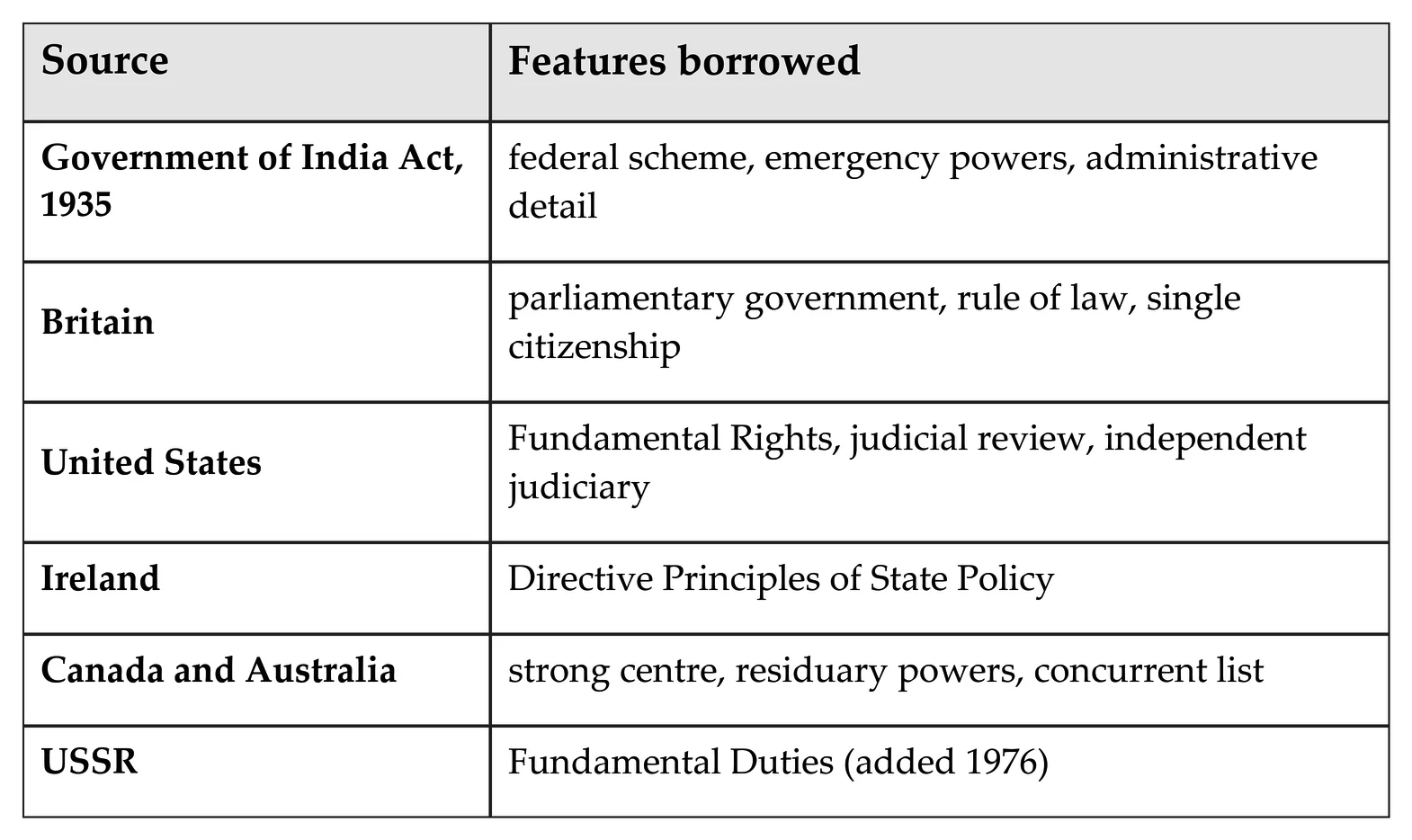
- Drawn from many sources. The makers borrowed from the Government of India Act of 1935 (the federal scheme, emergency provisions and much administrative detail) and from other constitutions, adapting them to Indian conditions.
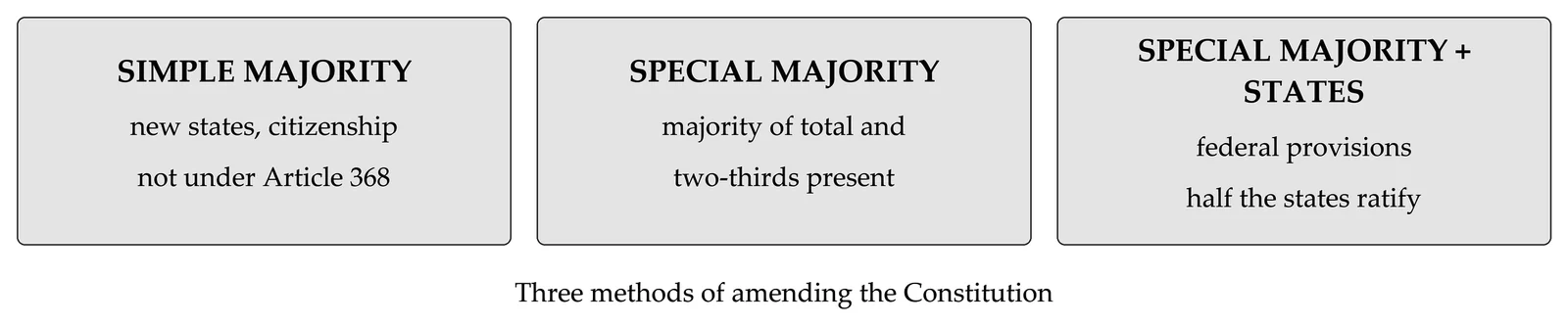
- Blend of rigidity and flexibility. Under Article 368, some provisions can be amended by a simple majority, most by a special majority of Parliament and some only with the ratification of half the states.
- Federal system with a unitary bias. Article 1 calls India a Union of States; power is divided between the Union and the states, but the Union has strong powers, such as residuary powers, emergency powers and control over all-India services, which led K.C. Wheare to call India quasi-federal.
- Parliamentary government. Following the British model, the real executive, the Council of Ministers headed by the Prime Minister, is collectively responsible to the Lok Sabha, while the President is a constitutional head.
- Independent and integrated judiciary. A single hierarchy of courts, headed by the Supreme Court, enforces both Union and state laws and has the power of judicial review.
- Fundamental Rights, Directive Principles and Fundamental Duties. Part III guarantees justiciable rights, Part IV sets out non-justiciable principles of social and economic policy, and Part IVA lists the duties of citizens.
- Secular state. The state does not favour any religion and guarantees freedom of conscience and religion to all.
- Universal adult franchise. Every citizen aged eighteen or above can vote, a bold decision in 1950 for a largely illiterate society; the voting age was lowered from twenty-one in 1989.
- Single citizenship. All Indians have one citizenship of India, unlike the dual citizenship of the United States.
- Independent constitutional bodies. The Election Commission, the Comptroller and Auditor General and the Union Public Service Commission ensure free elections, financial accountability and merit in public services.
- Emergency provisions. Articles 352 to 360 allow the Union to take extraordinary powers in national, state and financial emergencies.
- Three tiers of government. The 73rd and 74th Amendments of 1992 added panchayats and municipalities, creating local self-government.
A Borrowed Constitution
Critics in the Constituent Assembly and after called the Constitution a borrowed document, a patchwork of the Government of India Act and foreign constitutions. Ambedkar replied on 4 November 1948 that there was nothing to be ashamed of in borrowing, since the fundamentals of constitutions were by then well known, and that the makers had adapted these provisions to Indian conditions. Scholars point out that features such as reservations, the Directive Principles in their Indian form, the special provisions for Scheduled Areas and the mixture of federal and unitary features were original responses to Indian problems.
1.3 The Basic Structure Debate
The basic structure doctrine holds that Parliament can amend any part of the Constitution under Article 368, but it cannot alter its basic structure or essential features. The doctrine emerged from a long conflict between Parliament, which wanted to carry out land reforms and social policies, and the Supreme Court, which sought to protect Fundamental Rights, especially the right to property.
Milestones of the Debate
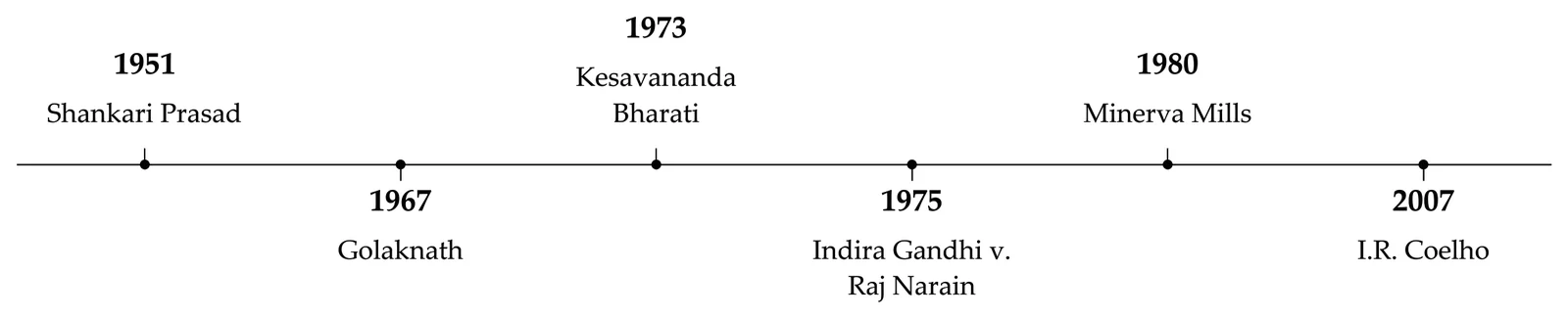
- 1951 → In Shankari Prasad, the Court upheld the First Amendment, holding that Parliament could amend Fundamental Rights, since an amendment is not a law under Article 13.
- 1965 → In Sajjan Singh, the Court again upheld Parliament’s power, but Justices Hidayatullah and Mudholkar doubted whether Fundamental Rights could be abridged, and Mudholkar raised the idea of basic features.
- 1967 → In Golaknath, an eleven-judge bench, by six to five under Chief Justice Subba Rao, held that Parliament could not amend Fundamental Rights.
- 1971 → The 24th Amendment declared that Parliament could amend any part of the Constitution, including Fundamental Rights.
- 1973 → In Kesavananda Bharati, decided on 24 April 1973 by a bench of thirteen judges by seven to six, the Court overruled Golaknath and upheld the 24th Amendment, but held that Parliament cannot destroy the basic structure of the Constitution.
- 1975 → In Indira Gandhi v. Raj Narain, the Court applied the doctrine to strike down part of the 39th Amendment, holding free and fair elections to be part of the basic structure.
- 1976 → The 42nd Amendment tried to remove all limits on the amending power by adding clauses (4) and (5) to Article 368.
- 1980 → In Minerva Mills, the Court struck down these clauses, holding that limited amending power and the balance between Fundamental Rights and Directive Principles are themselves basic features.
- 1981 to 2007 → Waman Rao (1981) applied the doctrine to laws placed in the Ninth Schedule after 24 April 1973, and I.R. Coelho (2007) confirmed that such laws can be tested against the basic structure.
- 2015 → In the NJAC case, the Court struck down the 99th Amendment, holding that judicial independence is part of the basic structure.
Elements of the Basic Structure
The Court has never given a complete list, but over the years it has identified elements such as the supremacy of the Constitution, the republican and democratic form of government, secularism, separation of powers, federalism, the unity and integrity of the nation, judicial review, free and fair elections, the rule of law, the independence of the judiciary, the welfare state, the parliamentary system, limited amending power and the harmony and balance between Fundamental Rights and Directive Principles.
The Debate over the Doctrine
- Supporters. The doctrine protects the identity of the Constitution against temporary majorities; it prevented the dangers seen during the Emergency of 1975–77; and similar ideas have been adopted in countries such as Bangladesh and in the German idea of an eternity clause.
- Critics. It gives unelected judges the power to decide what the Constitution’s essentials are, with no clear text to guide them; it is vague and has been expanded over time; and it can block reforms supported by elected representatives.
- Origins. The German jurist Dietrich Conrad’s lecture on implied limits of amendment, delivered in India in 1965, is often credited with influencing the doctrine.
- A middle view. Many scholars argue that the doctrine should be applied sparingly, only to protect the core of constitutional democracy, while leaving ordinary policy choices to Parliament.
The Basic Structure Idea Abroad
The Indian doctrine has travelled beyond India. The Supreme Court of Bangladesh adopted a similar doctrine in 1989, and courts in countries such as Kenya and Belize have discussed implied limits on constitutional amendment. Germany’s Basic Law of 1949 contains an explicit eternity clause (Article 79(3)) that forbids amendments affecting human dignity, democracy and federalism. Scholars such as Yaniv Roznai have studied this global spread of unconstitutional constitutional amendment doctrines, in which India’s Kesavananda Bharati judgment is a leading example.
1.4 Important Questions
- Question 1 Discuss the significance of the Preamble of the Indian Constitution.
- Question 2 Discuss the salient features of the Indian Constitution.
- Question 3 Explain the basic structure doctrine and trace its evolution.
- Question 4 Discuss the procedure for the amendment of the Indian Constitution under Article 368 and the limits on Parliament’s amending power.
DU asks the same idea in different words. So learn one broad answer for each question below; the same answer works for every question joined by OR.
Important Question 1
Discuss the significance of the Preamble of the Indian Constitution.
OR
Explain the key words of the Preamble of the Indian Constitution.
OR
Is the Preamble a part of the Constitution? Discuss with reference to judicial decisions.
Model Answer
“We, the people of India, having solemnly resolved to constitute India into a Sovereign Socialist Secular Democratic Republic and to secure to all its citizens: Justice, social, economic and political.”
— The Preamble to the Constitution of India
Introduction. The Preamble is the introduction to the Constitution of India. It states the source of the Constitution’s authority, the nature of the Indian state and the objectives it aims to achieve. Based on Nehru’s Objectives Resolution of 1946, it has been called the soul and the key of the Constitution. Though not enforceable in court, it guides the interpretation of the whole Constitution.
1. Origin of the Preamble
The Preamble is based on the Objectives Resolution moved by Jawaharlal Nehru in the Constituent Assembly on 13 December 1946 and adopted on 22 January 1947. It summarises the aims of the freedom struggle and the vision of the founders for the new republic.
2. We, the People of India
The opening words declare that the Constitution is adopted by the people of India themselves, through their Constituent Assembly, on 26 November 1949. Sovereignty lies with the people, not with any ruler or foreign authority, which marks a break with colonial rule.
3. Sovereign
India is free to decide its internal and external affairs without control by any external power. Membership of the Commonwealth or international organisations is voluntary and does not limit Indian sovereignty.
4. Socialist
Added by the 42nd Amendment in 1976, socialist means democratic socialism: the state should reduce inequalities of income and opportunity through a mixed economy and welfare measures, as the Directive Principles require, while respecting democracy and private property.
5. Secular
Also added in 1976, secular means that the state has no official religion, treats all religions equally and guarantees freedom of religion to all. The Supreme Court in S.R. Bommai (1994) declared secularism part of the basic structure.
6. Democratic Republic
India is democratic because the people elect their government through universal adult franchise and the government is accountable to them. It is a republic because the head of state is elected, not hereditary, and all public offices are open to all citizens.
7. Justice
The Preamble promises social, economic and political justice: social justice through the removal of caste and other discrimination, economic justice through a fairer distribution of wealth, and political justice through equal political rights for all.
8. Liberty and Equality
It promises liberty of thought, expression, belief, faith and worship, and equality of status and of opportunity. These ideals are protected by the Fundamental Rights, especially Articles 14 to 28.
9. Fraternity
Fraternity, assuring the dignity of the individual and the unity and integrity of the nation, is the sense of brotherhood among Indians. Ambedkar warned that without fraternity, liberty and equality could not survive, especially in a society divided by caste.
10. Is the Preamble Part of the Constitution
In the Berubari reference of 1960, the Supreme Court said the Preamble was not part of the Constitution. In Kesavananda Bharati (1973), it held that the Preamble is part of the Constitution and may be amended, but not so as to destroy the basic structure. The LIC case of 1995 confirmed this view.
11. Amendment of the Preamble
The Preamble has been amended only once, by the 42nd Amendment of 1976, which added socialist, secular and integrity. In 2024, the Supreme Court dismissed challenges to these additions, holding that they reflect the Constitution’s values.
12. Value in Interpretation
Although the Preamble is not justiciable and is not a source of power, courts use it to interpret ambiguous provisions in light of the Constitution’s objectives, as in cases on secularism, equality and the basic structure.
13. Views of Scholars
K.M. Munshi called the Preamble the political horoscope of the republic, Thakurdas Bhargava described it as the soul of the Constitution, and Ernest Barker quoted it at the start of his Principles of Social and Political Theory (1951) because he thought it stated the essence of good political order.
14. Evaluation
The Preamble expresses the philosophy of the Constitution, joining liberal ideals of liberty with social ideals of justice and equality. Its promises remain partly unfulfilled, but it continues to inspire citizens and guide courts.
Conclusion. Thus, the Preamble declares that the people of India have given themselves a Constitution to create a sovereign, socialist, secular, democratic republic securing justice, liberty, equality and fraternity. Recognised in Kesavananda Bharati as part of the Constitution, it is the key to its philosophy and a constant guide to its interpretation.
Important Question 2
Discuss the salient features of the Indian Constitution.
OR
Is the Indian Constitution a borrowed constitution? Discuss its main features.
OR
Examine the federal and unitary features of the Indian Constitution.
Model Answer
“It is workable, it is flexible and it is strong enough to hold the country together both in peace time and in war time.”
— B.R. Ambedkar, Constituent Assembly (4 November 1948)
Introduction. The Constitution of India, framed by the Constituent Assembly between 1946 and 1949, is one of the most detailed constitutions in the world. It combines features borrowed from many sources with original provisions suited to Indian conditions. Its salient features reflect the founders’ aims of building a united, democratic and just nation out of a diverse and unequal society.
1. The Lengthiest Written Constitution
The original Constitution had 395 articles, 22 parts and 8 schedules, and today it has more than 450 articles and 12 schedules. Its length reflects India’s size and diversity, the inclusion of state constitutions, detailed administrative provisions and the experience of the Government of India Act of 1935.
2. Drawn from Many Sources
The makers drew on the Government of India Act of 1935 for the federal scheme and emergency provisions, on Britain for parliamentary government and the rule of law, on the United States for Fundamental Rights and judicial review, on Ireland for the Directive Principles, and on Canada and Australia for federal features.
3. Rigid and Flexible
The Constitution is partly rigid and partly flexible. Some provisions can be changed by a simple majority, most require a special majority of Parliament under Article 368, and federal provisions also need the ratification of half the state legislatures.
4. Federation with a Unitary Bias
Power is divided between the Union and the states through three lists in the Seventh Schedule, but the Union has residuary powers, emergency powers, control over all-India services and the power to create new states. K.C. Wheare called India quasi-federal, while others call it cooperative federalism.
5. Parliamentary Government
India follows the British model of parliamentary government: the President is the constitutional head, while real power lies with the Council of Ministers headed by the Prime Minister, which is collectively responsible to the Lok Sabha. The same system operates in the states.
6. Independent and Integrated Judiciary
India has a single, integrated system of courts headed by the Supreme Court. The judiciary is independent, with security of tenure and salaries, and has the power of judicial review to strike down laws that violate the Constitution.
7. Fundamental Rights
Part III guarantees six groups of Fundamental Rights: equality, freedom, against exploitation, freedom of religion, cultural and educational rights, and constitutional remedies. They are justiciable, and Article 32 allows citizens to approach the Supreme Court directly.
8. Directive Principles and Fundamental Duties
Part IV contains the Directive Principles, non-justiciable guidelines for social and economic policy aimed at a welfare state, and Part IVA, added in 1976, lists eleven Fundamental Duties of citizens.
9. Secularism
The state has no official religion, guarantees freedom of religion and treats all religions equally. Indian secularism allows the state to reform religious practices and support religious minorities, unlike the strict separation found in some Western countries.
10. Universal Adult Franchise
Every citizen aged eighteen or above can vote without any qualification of property, education or sex. This was a bold step in 1950, giving political equality to all citizens from the start of the republic.
11. Single Citizenship and Independent Bodies
All Indians enjoy a single citizenship of India. Independent bodies such as the Election Commission, the Comptroller and Auditor General and the Union Public Service Commission protect free elections, financial accountability and merit.
12. Emergency Provisions and Local Government
Articles 352 to 360 provide for national, state and financial emergencies, during which the Union gains extraordinary powers. The 73rd and 74th Amendments of 1992 added constitutional status for panchayats and municipalities, creating a three-tier system.
13. The Borrowed Constitution Debate
Critics called the Constitution a borrowed patchwork. Ambedkar replied that there was no shame in borrowing well-tested principles and that they had been adapted to Indian needs. Features such as reservations and special provisions for tribal areas were original responses to Indian conditions.
14. Evaluation
The Constitution’s features reflect a balance between unity and diversity, liberty and social justice, and stability and change. It has survived more than seventy-five years, adapting through amendments and judicial interpretation.
Conclusion. Thus, the Indian Constitution is a lengthy, written document drawn from many sources, partly rigid and partly flexible, federal with a unitary bias and parliamentary in form. With Fundamental Rights, Directive Principles, an independent judiciary, secularism and universal adult franchise, it is, as Granville Austin said, the cornerstone of the Indian nation.
Important Question 3
Explain the basic structure doctrine and trace its evolution.
OR
Discuss the significance of the Kesavananda Bharati case.
OR
Examine the conflict between Parliament and the judiciary over the amendment of Fundamental Rights.
Model Answer
“Since the Constitution had conferred a limited amending power on the Parliament, the Parliament cannot under the exercise of that limited power enlarge that very power into an absolute power.”
— Chief Justice Y.V. Chandrachud, Minerva Mills v. Union of India (1980)
Introduction. The basic structure doctrine holds that Parliament has wide power to amend the Constitution under Article 368, but it cannot destroy its basic structure or essential features. The doctrine, first laid down in Kesavananda Bharati (1973), emerged from a long conflict between Parliament and the Supreme Court over the amendment of Fundamental Rights, and it has become a central principle of Indian constitutional law.
1. The Background
After independence, governments passed land reform laws that affected the right to property. When courts struck down some of these laws, Parliament amended the Constitution, beginning with the First Amendment of 1951, which created the Ninth Schedule to protect such laws from judicial review.
2. Shankari Prasad (1951)
In Shankari Prasad, the Supreme Court upheld the First Amendment, ruling that the word law in Article 13 did not include constitutional amendments, so Parliament could amend Fundamental Rights.
3. Sajjan Singh (1965)
In Sajjan Singh, the Court again upheld Parliament’s power, but Justices Hidayatullah and Mudholkar expressed doubts; Mudholkar asked whether Parliament could change the basic features of the Constitution, planting the seed of the doctrine.
4. Golaknath (1967)
In Golaknath, an eleven-judge bench, by six to five, held that Parliament could not amend Fundamental Rights, since an amendment is a law under Article 13. This reversed earlier decisions and limited Parliament’s power.
5. The 24th and 25th Amendments
Parliament responded with the 24th Amendment of 1971, asserting its power to amend any part of the Constitution, and the 25th Amendment, which restricted judicial review of laws giving effect to certain Directive Principles.
6. Kesavananda Bharati (1973)
In Kesavananda Bharati, a thirteen-judge bench, by seven to six, overruled Golaknath and upheld the 24th Amendment, but held that Parliament cannot alter the basic structure of the Constitution. Justice H.R. Khanna’s opinion was decisive in forming the majority.
7. Indira Gandhi v. Raj Narain (1975)
The Court applied the doctrine for the first time to strike down a constitutional amendment, invalidating part of the 39th Amendment, which had placed the election of the Prime Minister beyond judicial review, and holding free and fair elections to be part of the basic structure.
8. The 42nd Amendment
During the Emergency, the 42nd Amendment of 1976 added clauses (4) and (5) to Article 368, declaring that no amendment could be questioned in any court and that there was no limit on Parliament’s amending power.
9. Minerva Mills (1980)
In Minerva Mills, the Court struck down these clauses, holding that limited amending power is itself part of the basic structure, and that the harmony and balance between Fundamental Rights and Directive Principles is an essential feature.
10. Later Cases
Waman Rao (1981) applied the doctrine to laws added to the Ninth Schedule after 24 April 1973, S.R. Bommai (1994) added secularism and federalism, I.R. Coelho (2007) confirmed review of Ninth Schedule laws, and the NJAC judgment (2015) protected judicial independence.
11. Elements of the Basic Structure
Elements recognised by the Court include the supremacy of the Constitution, democracy, secularism, federalism, separation of powers, judicial review, free and fair elections, the rule of law, judicial independence and the balance between Fundamental Rights and Directive Principles.
12. Arguments in Favour
Supporters argue that the doctrine protects the Constitution’s identity from temporary majorities, prevented the dangers of the Emergency and has been followed in other countries such as Bangladesh.
13. Criticisms
Critics argue that the doctrine has no basis in the text, gives unelected judges vast power, is vague and keeps expanding, and can block democratic reforms supported by elected representatives.
14. Basic Structure in Recent Cases
The doctrine continues to be applied. In Supreme Court Advocates-on-Record Association (2015), the Court struck down the National Judicial Appointments Commission as violating judicial independence, a basic feature, while in Janhit Abhiyan (2022) it upheld reservation for economically weaker sections, holding that it did not breach the basic structure.
15. Evaluation
Despite criticism, the doctrine has become a settled part of Indian constitutional law and has helped preserve the democratic and liberal core of the Constitution against majoritarian pressures.
Conclusion. Thus, the basic structure doctrine evolved from Shankari Prasad and Golaknath through Kesavananda Bharati in 1973 to Minerva Mills and later cases, establishing that Parliament can amend but not destroy the essential features of the Constitution. It balances parliamentary sovereignty with constitutional supremacy, though debate over judicial power continues.
Important Question 4
Discuss the procedure for the amendment of the Indian Constitution under Article 368 and the limits on Parliament’s amending power.
OR
Is the Indian Constitution rigid or flexible? Discuss with reference to the amendment procedure.
OR
Examine the relationship between Parliament’s amending power and judicial review.
Model Answer
“Notwithstanding anything in this Constitution, Parliament may in exercise of its constituent power amend by way of addition, variation or repeal any provision of this Constitution in accordance with the procedure laid down in this article.”
— Constitution of India, Article 368(1)
Introduction. A constitution must be able to change with the needs of society while preserving its core principles. The Indian Constitution provides for its amendment under Article 368, combining flexibility and rigidity. Over more than a hundred amendments have been made, but the Supreme Court has held that Parliament’s amending power is limited by the basic structure of the Constitution.
1. Need for Amendment
The founders wanted a constitution that could adapt to changing circumstances without being easily changed by passing majorities. Nehru said that a constitution must be flexible enough to allow growth, while Ambedkar stressed that the amendment process was easier than in most federal constitutions.
2. Amendment by Simple Majority
Some provisions, such as the admission or creation of new states, changes in state boundaries, citizenship and the creation or abolition of legislative councils, can be changed by a simple majority of Parliament, and such changes are not considered amendments under Article 368.
3. Amendment by Special Majority
Most provisions, including Fundamental Rights and Directive Principles, can be amended by a special majority: a majority of the total membership of each House and two-thirds of the members present and voting.
4. Special Majority with State Ratification
Provisions affecting the federal structure, such as the election of the President, the powers of the Union and states, the Supreme Court and High Courts, representation of states in Parliament and Article 368 itself, need a special majority and ratification by at least half the state legislatures.
5. Procedure
An amendment bill can be introduced in either House by a minister or a private member, needs no prior permission of the President, must be passed by each House separately with the required majority, and must be signed by the President, who cannot withhold assent since the 24th Amendment of 1971.
6. Rigid or Flexible
The Constitution is more flexible than the American Constitution, which requires ratification by three-quarters of the states, and more rigid than the British, which can be changed by ordinary law. This balance has allowed more than a hundred amendments.
7. Major Amendments
Important amendments include the First (1951) on land reform and free speech, the 42nd (1976) during the Emergency, the 44th (1978) restoring safeguards, the 73rd and 74th (1992) on local government, the 101st (2016) on GST, the 103rd (2019) on economically weaker sections and the 106th (2023) on women’s reservation.
8. The Question of Limits
The central question has been whether Parliament can amend any part of the Constitution, including Fundamental Rights. Shankari Prasad and Sajjan Singh said yes, Golaknath said no, and Kesavananda Bharati gave the final answer: yes, but not the basic structure.
9. The Basic Structure Limit
Since 1973, every amendment can be tested against the basic structure. Courts have struck down parts of the 39th Amendment (1975), the 42nd Amendment’s clauses on Article 368 (1980) and the 99th Amendment creating the NJAC (2015).
10. Judicial Review of Amendments
Judicial review of amendments makes the Supreme Court the final guardian of the Constitution’s identity. Parliament’s attempt in 1976 to exclude review was struck down in Minerva Mills, which held limited amending power to be a basic feature.
11. Constituent Power and Legislative Power
The 24th Amendment clarified that Parliament exercises constituent power when amending the Constitution, distinct from its ordinary legislative power. The basic structure doctrine limits even this constituent power.
12. Criticism of Easy Amendment
Some critics argue that the Constitution has been amended too often, especially during the Emergency, weakening its sanctity. Others argue that frequent amendment shows its adaptability in a changing society.
13. Balance between Parliament and Courts
The amendment process reflects a balance between parliamentary sovereignty, drawn from Britain, and judicial review, drawn from the United States. The basic structure doctrine is the Indian solution to the tension between the two.
14. Evaluation
Article 368 has allowed the Constitution to change with the times while the basic structure doctrine has protected its core. Together they have helped the Constitution survive political crises and social change.
Conclusion. Thus, Article 368 allows amendment by special majority, with state ratification for federal provisions, while some provisions change by simple majority, making the Constitution partly rigid and partly flexible. Since Kesavananda Bharati, Parliament’s wide amending power has been limited by the basic structure, which courts protect through judicial review.
Short Notes
(a) Objectives Resolution
The resolution moved by Jawaharlal Nehru in the Constituent Assembly on 13 December 1946 and adopted on 22 January 1947, setting out the aims of the Constitution; it became the basis of the Preamble.
(b) Kesavananda Bharati case
The 1973 case in which a thirteen-judge bench of the Supreme Court held by seven to six that Parliament can amend any part of the Constitution but cannot destroy its basic structure.
(c) Quasi-federal
K.C. Wheare’s description of the Indian Constitution as federal in form but with strong unitary features, such as residuary and emergency powers of the Union.
More notes: GE-14 Fundamental Rights, Duties and Directive Principles of State Policy
These notes are prepared by PADHO TO AISE for study help. They are not an official publication.