
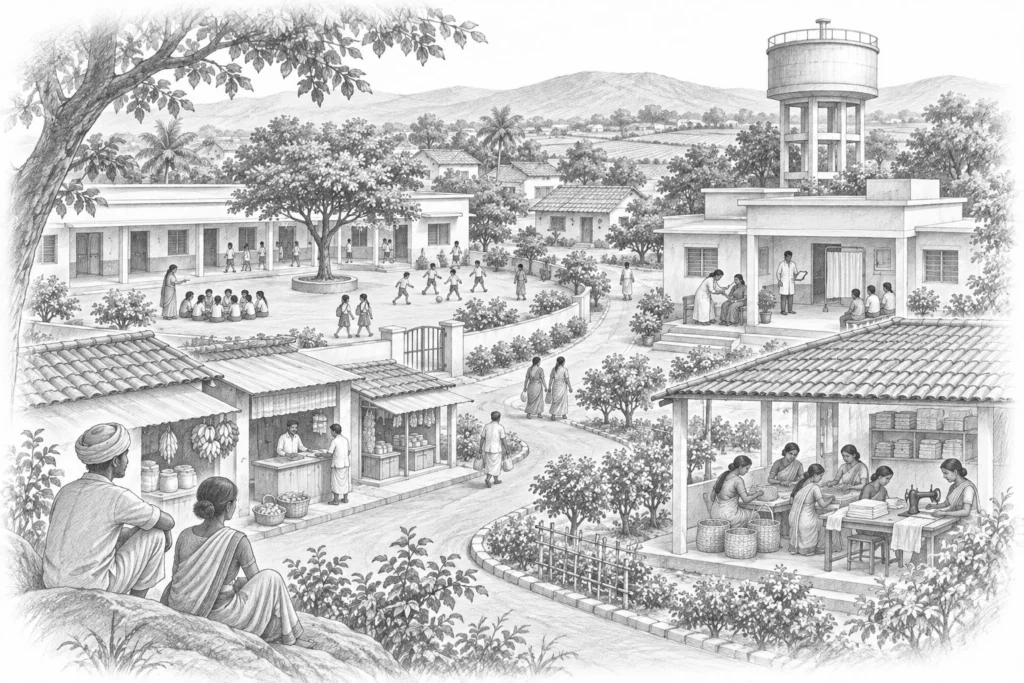
Generic Electives (GE) GE-14 Fundamental Rights, Duties and Directive Principles of State Policy
Unit 3 · 25 min read · Updated 27 Nov 2026
As per the University of Delhi (DU) Generic Elective (GE) syllabus offered by the Department of Political Science
Contents
- 3.1 Concept, Classification and Significance
- Features of the Directive Principles
- Classification
- Significance and Criticism
- 3.2 Economic and Social Rights, Gandhian and Liberal Principles
- Economic and Social Rights
- Gandhian Principles
- Liberal-Intellectual Principles
- 3.3 Fundamental Rights, Directive Principles and the Courts
- Milestones in the Relationship
- Judicial Recognition and Public Interest Litigation
- Implementation by Legislation
- 3.4 Important Questions
- Discuss the nature and significance of the Directive Principles of State Policy.
- Classify the Directive Principles of State Policy and discuss the socialist, Gandhian and liberal principles.
- Discuss the relationship between Fundamental Rights and Directive Principles of State Policy.
- Examine the judicial recognition and implementation of the Directive Principles of State Policy.
- Short Notes
इस भाग में दिए गए उपबंध किसी न्यायालय द्वारा प्रवर्तनीय नहीं होंगे, किंतु फिर भी इनमें दिए गए तत्त्व देश के शासन में मूलभूत हैं।
The provisions contained in this Part shall not be enforceable by any court, but the principles therein laid down are nevertheless fundamental in the governance of the country.
— Constitution of India, Article 37
IIF Fundamental Rights protect the individual against the state, the Directive Principles of State Policy tell the state what it must do for the people. Part IV of the Constitution, Articles 36 to 51, sets out the goals of a welfare state: a just social order, adequate livelihood, fair wages, education, health, village self-government, protection of the environment and international peace. They cannot be enforced in court, yet Article 37 calls them fundamental in the governance of the country. This chapter studies their concept and classification, the economic, social, Gandhian and liberal principles they contain, their relationship with Fundamental Rights, and how courts and governments have given them effect.

3.1 Concept, Classification and Significance
Directive Principles of State Policy are the guidelines that the Constitution gives to the Union and state governments for making laws and policies. In simple words, they are the goals of social and economic policy that the state must keep in mind. The idea was borrowed from the Irish Constitution of 1937, which contained Directive Principles of Social Policy, and Indian versions drew on the Karachi Resolution of 1931, the ideas of Gandhi and the socialist programme of the Congress. Ambedkar compared them to the Instruments of Instructions issued to the Governor-General and Governors under the Government of India Act of 1935, with the difference that they were instructions to the legislature and executive of a free India.
Features of the Directive Principles
- Non-justiciable. Article 37 says that they cannot be enforced by any court; a citizen cannot sue the government for failing to implement them.
- Fundamental in governance. The same article declares them fundamental in the governance of the country and makes it the duty of the state to apply them in making laws.
- Positive directions. Unlike most Fundamental Rights, which restrain the state, they require the state to act to promote welfare.
- A welfare state. Together they aim at economic and social democracy, i.e. a society in which political equality is matched by economic and social justice.
- Addressed to all levels of government. The term State has the same broad meaning as in Article 12, including the Union, the states and local bodies.
- Flexible and evolving. They can be implemented gradually as resources allow and have been expanded by amendments.
Classification
The Constitution does not classify the Directive Principles, but scholars group them by their ideological source into three categories:
- Socialist or economic principles, which aim at social and economic justice, such as Articles 38, 39, 39A, 41, 42, 43, 43A and 47.
- Gandhian principles, which reflect Gandhi’s programme of village reconstruction, such as Articles 40, 43, 43B, 46, 47 (prohibition) and 48 (cow protection).
- Liberal-intellectual principles, which reflect liberal ideas, such as Articles 44 (uniform civil code), 45, 48 (modern agriculture), 48A, 49, 50 and 51.
Significance and Criticism
- Moral and political guide. They give governments a standard of policy and citizens a standard for judging governments; Ambedkar said that a government that ignored them would have to answer for it before the electorate.
- Economic democracy. Ambedkar argued that they aim at economic democracy, without which political democracy would be incomplete.
- Aid to interpretation. Courts use them to interpret laws and Fundamental Rights, as in reading the right to livelihood and education into Article 21.
- Continuity of policy. They provide a common framework for governments of different parties.
- Criticism: no legal force. In the Constituent Assembly, K.T. Shah described them as a cheque on a bank payable only when the resources of the bank permit, and others called them pious wishes.
- Criticism: illogical arrangement and conflict. Critics argue that they are loosely arranged, sometimes vague, and can conflict with Fundamental Rights and with each other.
3.2 Economic and Social Rights, Gandhian and Liberal Principles
Economic and Social Rights
- Article 38. The state shall secure a social order in which justice, social, economic and political, informs all institutions; clause (2), added in 1978, directs it to minimise inequalities of income, status and opportunity.
- Article 39. The state shall direct its policy towards securing an adequate means of livelihood for all, distribution of material resources to serve the common good, prevention of concentration of wealth, equal pay for equal work for men and women, protection of workers’ health and of children from abuse, and opportunities for children to develop in freedom and dignity.
- Article 39A. Added in 1976, it requires equal justice and free legal aid, so that no one is denied justice because of economic or other disabilities.
- Article 41. Within the limits of economic capacity, the state shall secure the right to work, to education and to public assistance in unemployment, old age, sickness and disablement.
- Articles 42 and 43. They direct just and humane conditions of work, maternity relief and a living wage for workers; Article 43A, added in 1976, calls for workers’ participation in management.
- Article 47. The state shall regard raising the level of nutrition and the standard of living and improving public health as among its primary duties.
These provisions reflect the influence of socialist ideas and the Karachi Resolution of 1931. They describe economic and social rights that many other constitutions, such as South Africa’s of 1996, later made justiciable, but which India’s founders thought could not be enforced immediately in a poor country.
Gandhian Principles
- Article 40. Organise village panchayats as units of self-government, a principle realised through the 73rd Amendment of 1992.
- Article 43. Promote cottage industries on an individual or cooperative basis in rural areas.
- Article 43B. Promote voluntary formation, autonomous functioning and democratic control of cooperative societies.
- Article 46. Promote the educational and economic interests of the weaker sections, especially Scheduled Castes and Scheduled Tribes, and protect them from social injustice and exploitation.
- Article 47. Bring about prohibition of the consumption of intoxicating drinks and drugs injurious to health, except for medicinal purposes.
- Article 48. Prohibit the slaughter of cows and calves and other milch and draught cattle and improve their breeds.
The Gandhian principles were included as a compromise with members who wanted the Constitution to reflect Gandhi’s vision of a decentralised, village-based society. Ambedkar was sceptical of the village as a unit, but the Assembly placed village panchayats among the directives.
Liberal-Intellectual Principles
- Article 44. Endeavour to secure a uniform civil code for citizens throughout India.
- Article 45. Provide early childhood care and education for all children until they complete the age of six years, as amended in 2002.
- Article 48. Organise agriculture and animal husbandry on modern and scientific lines.
- Article 48A. Protect and improve the environment and safeguard forests and wildlife, added in 1976.
- Article 49. Protect monuments and places of artistic or historic interest.
- Article 50. Separate the judiciary from the executive in the public services of the state.
- Article 51. Promote international peace and security, just and honourable relations between nations, respect for international law and settlement of disputes by arbitration.

3.3 Fundamental Rights, Directive Principles and the Courts
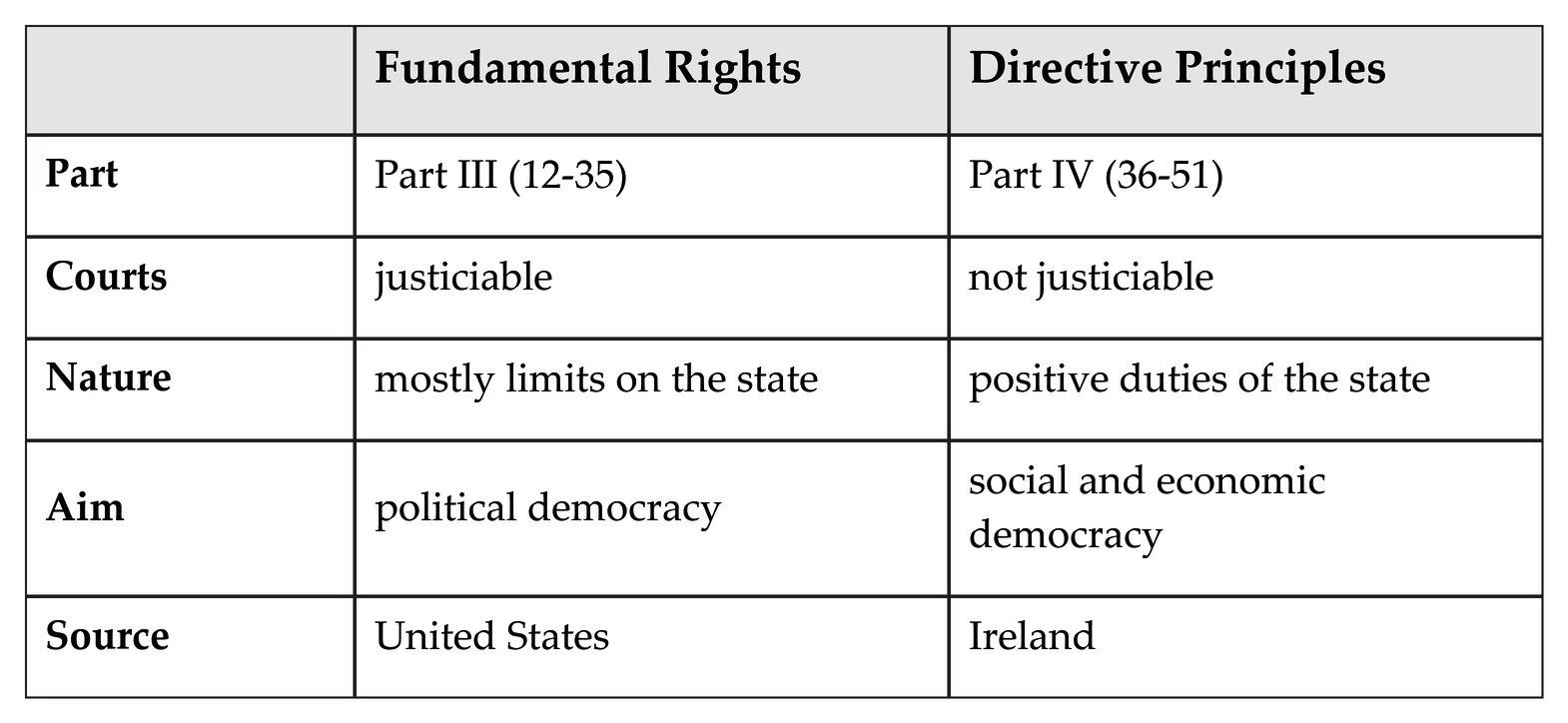
The relationship between justiciable Fundamental Rights and non-justiciable Directive Principles has been one of the main themes of Indian constitutional history, because laws implementing the directives, such as land reform, often seemed to violate rights such as property and equality.
Milestones in the Relationship
- 1951 → In Champakam Dorairajan, the Supreme Court held that the directives must conform to and run subsidiary to Fundamental Rights, striking down caste-based reservations in admissions; Parliament responded with Article 15(4) in the First Amendment.
- 1958 → In the Kerala Education Bill reference, the Court adopted the doctrine of harmonious construction, trying to give effect to both as far as possible.
- 1967 → In Golaknath, the Court held that Fundamental Rights could not be amended even to implement directives.
- 1971 → The 25th Amendment added Article 31C, protecting laws giving effect to Articles 39(b) and (c) from challenge under Articles 14 and 19.
- 1973 → Kesavananda Bharati upheld the first part of Article 31C but struck down the clause excluding judicial review.
- 1976 → The 42nd Amendment extended Article 31C to all the directives, giving them primacy over Articles 14 and 19.
- 1980 → In Minerva Mills, the Court struck down this extension, holding that the Constitution rests on the balance between Parts III and IV and that neither has absolute primacy.
- 2024 → In Property Owners Association v. State of Maharashtra, a nine-judge bench held that not every private resource is a material resource of the community under Article 39(b).
Judicial Recognition and Public Interest Litigation
From the late 1970s, the Supreme Court used the directives to give content to Fundamental Rights, especially Article 21, and through public interest litigation it made some directives enforceable in practice:
- Dignity and livelihood. In Francis Coralie Mullin (1981), the Court held that the right to life includes the right to live with dignity, and in Olga Tellis (1985) it linked the right to livelihood with Articles 39(a) and 41.
- Bonded labour. In Bandhua Mukti Morcha (1984), it read Article 21 with Articles 39, 41 and 42 to require the release and rehabilitation of bonded labourers.
- Education. In Mohini Jain (1992) and Unni Krishnan (1993), it held that children up to fourteen have a right to education, leading to Article 21A in 2002 and the Right to Education Act of 2009.
- Free legal aid. In Hussainara Khatoon (1979), it used Article 39A to require legal aid for undertrial prisoners.
- Environment. In cases filed by M.C. Mehta, it read Article 48A with Article 21 to protect the right to a clean environment.
- Food. In the PUCL right to food case from 2001, it used Articles 21 and 47 to turn food schemes into legal entitlements.
Implementation by Legislation
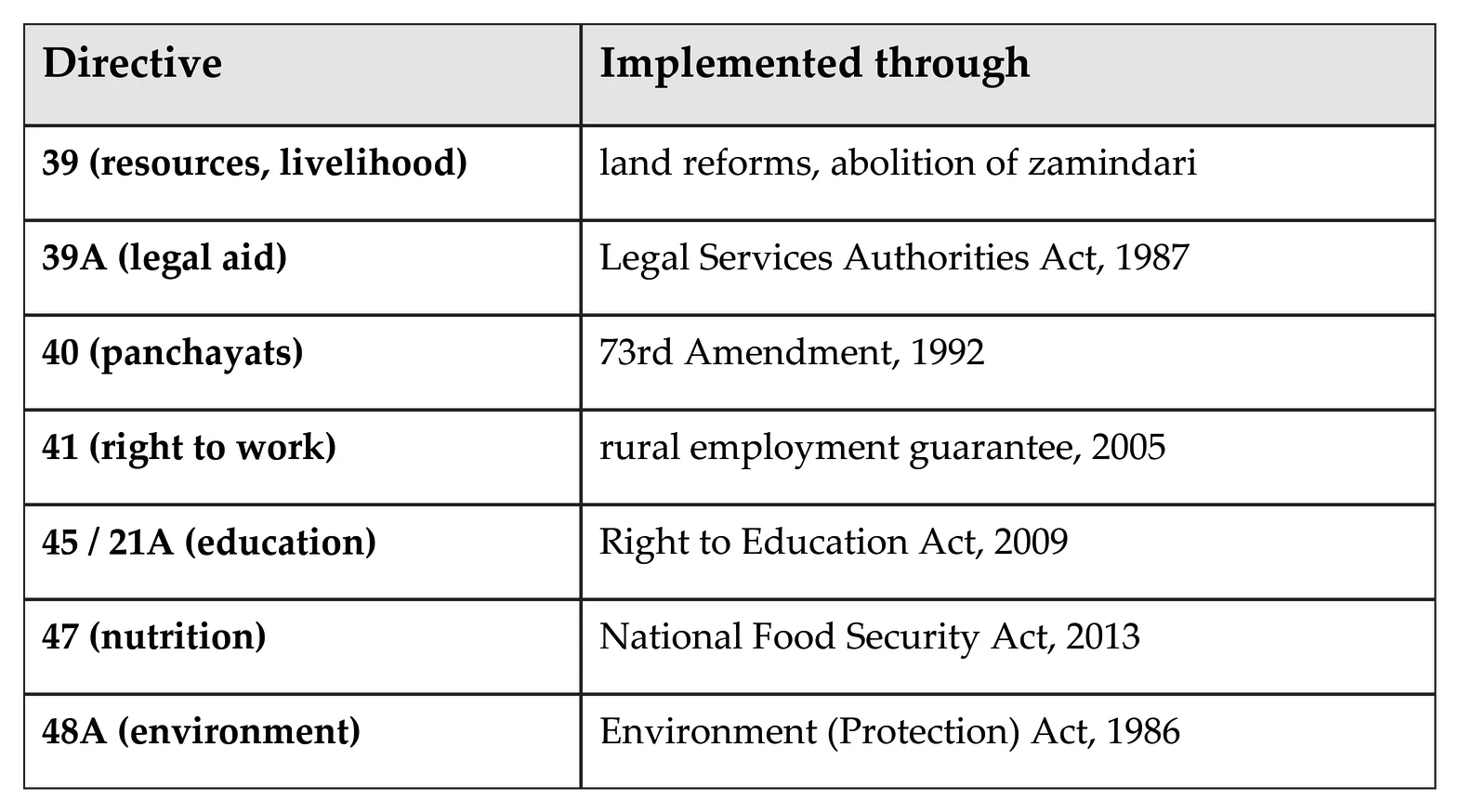
Governments have implemented many directives through laws and policies: land reforms and the abolition of zamindari (Article 39), the Equal Remuneration Act of 1976 (39(d)), the Legal Services Authorities Act of 1987 (39A), the 73rd Amendment on panchayats (40), the Environment (Protection) Act of 1986 (48A), the separation of the judiciary from the executive under the Code of Criminal Procedure of 1973 (50), the rural employment guarantee of 2005 (41) and the National Food Security Act of 2013 (47). The uniform civil code under Article 44 remains debated; the Supreme Court urged it in Shah Bano (1985) and Sarla Mudgal (1995), and Uttarakhand enacted a state code in 2024.
3.4 Important Questions
- Question 1 Discuss the nature and significance of the Directive Principles of State Policy.
- Question 2 Classify the Directive Principles of State Policy and discuss the socialist, Gandhian and liberal principles.
- Question 3 Discuss the relationship between Fundamental Rights and Directive Principles of State Policy.
- Question 4 Examine the judicial recognition and implementation of the Directive Principles of State Policy.
DU asks the same idea in different words. So learn one broad answer for each question below; the same answer works for every question joined by OR.
Important Question 1
Discuss the nature and significance of the Directive Principles of State Policy.
OR
‘The Directive Principles are like a cheque on a bank payable at the convenience of the bank.’ Discuss.
OR
Examine the concept and features of the Directive Principles of State Policy.
Model Answer
“The Directive Principles are like the Instrument of Instructions which were issued to the Governor-General and to the Governors of the Colonies and to those of India by the British Government under the 1935 Act.”
— B.R. Ambedkar, Constituent Assembly (19 November 1948)
Introduction. The Directive Principles of State Policy, in Part IV of the Constitution, Articles 36 to 51, are guidelines for the state in making laws and policies. They set out the goals of a welfare state, social and economic justice, but they are not enforceable in courts. Their significance lies in guiding governments and shaping the interpretation of the Constitution, though critics have called them mere pious wishes.
1. Meaning
Directive Principles are instructions to the Union and state governments, legislatures and local bodies to pursue certain social and economic goals. They tell the state what it should do, whereas Fundamental Rights mainly tell the state what it must not do.
2. Sources
The idea was borrowed from the Directive Principles of Social Policy in the Irish Constitution of 1937, and the content drew on the Karachi Resolution of 1931, Gandhian ideas and the socialist programme of the Congress.
3. Non-Justiciable
Article 37 says that the directives are not enforceable by any court. The founders believed that a poor country could not guarantee rights such as work and education immediately, so they made them goals rather than legal rights.
4. Fundamental in Governance
Article 37 also declares that the directives are fundamental in the governance of the country and that the state has a duty to apply them in making laws, so they are binding as political and moral obligations.
5. The Instrument of Instructions
Ambedkar compared the directives to the Instruments of Instructions issued to colonial Governors under the 1935 Act, with the difference that these were instructions to the governments of a free and democratic India, enforced by the electorate.
6. Classification
Scholars classify the directives into socialist principles, such as Articles 38, 39 and 41 to 43; Gandhian principles, such as Articles 40, 43, 46, 47 and 48; and liberal-intellectual principles, such as Articles 44, 45, 48A, 49, 50 and 51.
7. Aim of a Welfare State
Together the directives aim at a welfare state in which the government secures livelihood, fair wages, education, health and social security, reducing inequalities of income, status and opportunity.
8. Economic Democracy
Ambedkar argued that political democracy without economic democracy would be incomplete. The directives aim to give social and economic content to the political equality guaranteed by universal adult franchise and Fundamental Rights.
9. Guide to Governments and Voters
The directives provide a common standard of policy for governments of all parties and allow citizens and the opposition to judge governments by their performance on these goals at elections.
10. Aid to Interpretation
Courts use the directives to interpret laws and Fundamental Rights. The Supreme Court has read the right to livelihood, education, health and a clean environment into Article 21 by drawing on the directives.
11. The Cheque Criticism
K.T. Shah described the directives as a cheque on a bank payable only when the resources of the bank permit, and others called them pious wishes, because citizens cannot enforce them and governments can ignore them.
12. Other Criticisms
Critics also argue that the directives are illogically arranged, vague in places, conservative in parts (such as cow protection) and capable of creating conflict between the Union and the states and with Fundamental Rights.
13. Achievements
Despite criticism, many directives have been implemented through land reforms, panchayati raj, legal aid, environmental laws, employment guarantee, food security and the right to education, showing their practical influence.
14. Evaluation
The directives have proved to be more than pious wishes. They have shaped legislation, guided judicial interpretation and given the Indian Constitution its commitment to social justice.
Conclusion. Thus, the Directive Principles are non-justiciable but fundamental guidelines for building a welfare state in India. Borrowed from Ireland and shaped by socialist and Gandhian ideas, they aim at economic and social democracy. Though criticised as a cheque payable at the bank’s convenience, they have guided legislation and judicial interpretation for more than seventy-five years.
Important Question 2
Classify the Directive Principles of State Policy and discuss the socialist, Gandhian and liberal principles.
OR
Discuss the economic and social rights contained in the Directive Principles.
OR
Examine the Gandhian principles in the Directive Principles of State Policy.
Model Answer
“The State shall take steps to organise village panchayats and endow them with such powers and authority as may be necessary to enable them to function as units of self-government.”
— Constitution of India, Article 40
Introduction. The Directive Principles of State Policy are not arranged by the Constitution into groups, but scholars classify them according to the ideas they reflect. Three main strands can be identified: socialist or economic principles, Gandhian principles and liberal-intellectual principles. This classification shows how the Constitution blended different ideological traditions of the national movement.
1. Basis of Classification
The classification is based on the ideological source of each directive. It helps students understand that Part IV is not a single programme but a compromise among socialist, Gandhian and liberal members of the Constituent Assembly.
2. Socialist Principles: Article 38
Article 38 directs the state to secure a social order in which justice, social, economic and political, informs all institutions of national life, and since 1978 to minimise inequalities of income, status and opportunity among individuals and groups.
3. Socialist Principles: Article 39
Article 39 directs the state to secure adequate means of livelihood, distribute material resources to serve the common good, prevent concentration of wealth, ensure equal pay for equal work, protect workers’ health and protect children from exploitation.
4. Other Economic and Social Rights
Article 39A provides free legal aid, Article 41 the right to work, education and public assistance, Articles 42 and 43 humane conditions of work, maternity relief and a living wage, Article 43A workers’ participation in management and Article 47 nutrition and public health.
5. Influence of Socialism
These principles reflect the influence of socialist ideas in the national movement, especially of Nehru and the Congress Socialists, and the Karachi Resolution of 1931, which linked political freedom with economic freedom for the masses.
6. Gandhian Principles: Village Self-Government
Article 40 directs the state to organise village panchayats as units of self-government, reflecting Gandhi’s vision of gram swaraj. This directive was realised through the 73rd Amendment of 1992.
7. Gandhian Principles: Cottage Industries and Cooperatives
Article 43 promotes cottage industries in rural areas, and Article 43B, added in 2011, promotes cooperative societies, reflecting Gandhi’s idea of a decentralised, village-based economy.
8. Gandhian Principles: Weaker Sections, Prohibition and Cattle
Article 46 promotes the educational and economic interests of Scheduled Castes, Scheduled Tribes and weaker sections, Article 47 calls for prohibition of intoxicating drinks and Article 48 for prohibition of cow slaughter, reflecting Gandhian moral and social concerns.
9. Liberal Principles: Uniform Civil Code and Education
Article 44 directs the state to secure a uniform civil code, and Article 45 now provides for early childhood care and education, reflecting liberal ideals of equality before law and modern education.
10. Liberal Principles: Agriculture, Environment and Heritage
Article 48 calls for modern, scientific agriculture and animal husbandry, Article 48A for protection of the environment, forests and wildlife, and Article 49 for protection of monuments of national importance.
11. Liberal Principles: Judiciary and World Peace
Article 50 directs the separation of the judiciary from the executive, and Article 51 the promotion of international peace and security, respect for international law and settlement of disputes by arbitration, reflecting Nehru’s internationalism.
12. Tensions among the Principles
The three strands sometimes pull in different directions: Gandhian village self-sufficiency and prohibition sit uneasily with liberal modernisation and industrial growth, and the uniform civil code raises tensions with religious freedom.
13. Implementation of the Strands
Governments have implemented socialist principles through labour laws, land reforms and welfare schemes, Gandhian principles through panchayati raj and cooperatives, and liberal principles through environmental laws and the separation of the judiciary, but unevenly.
14. Evaluation
The classification reveals the Constitution’s ideological pluralism. By combining socialist, Gandhian and liberal principles, the founders created a broad consensus for social transformation through democratic means.
Conclusion. Thus, the Directive Principles can be classified into socialist principles aimed at economic and social justice, Gandhian principles aimed at village self-government, cottage industries and moral reform, and liberal principles aimed at modernisation, equality before law and international peace. This blend reflects the compromise among the traditions of the national movement.
Important Question 3
Discuss the relationship between Fundamental Rights and Directive Principles of State Policy.
OR
Examine the conflict between Fundamental Rights and Directive Principles with reference to judicial decisions.
OR
‘The Constitution is founded on the bedrock of the balance between Parts III and IV.’ Discuss.
Model Answer
“The Indian Constitution is founded on the bed-rock of the balance between Parts III and IV.”
— Chief Justice Y.V. Chandrachud, Minerva Mills v. Union of India (1980)
Introduction. Fundamental Rights and Directive Principles are two parts of the same constitutional vision. Fundamental Rights protect individual liberty and are enforceable in courts, while Directive Principles aim at social and economic justice and are not enforceable. Laws implementing the directives often seemed to conflict with rights, especially the right to property, leading to a long struggle between Parliament and the courts, which ended in the idea of balance and harmony.
1. Differences between the Two
Fundamental Rights are justiciable, mainly negative restraints on the state, and aim at political democracy; Directive Principles are non-justiciable, positive directions to the state, and aim at social and economic democracy. Rights protect individuals; directives promote the welfare of the community.
2. Complementary Aims
Both parts share the aim of securing justice, liberty, equality and fraternity, as stated in the Preamble. Granville Austin described them as the conscience of the Constitution, working together to achieve a social revolution.
3. Champakam Dorairajan (1951)
In Champakam Dorairajan, the Supreme Court held that the directives must conform to and run subsidiary to Fundamental Rights, striking down caste-based quotas in medical admissions. Parliament responded by adding Article 15(4) through the First Amendment.
4. Harmonious Construction
In the Kerala Education Bill reference of 1958, the Court adopted the doctrine of harmonious construction, holding that while rights prevail in a conflict, courts should try to give effect to both as far as possible.
5. Golaknath and Parliament’s Response
In Golaknath (1967), the Court held that Parliament could not amend Fundamental Rights. Parliament responded with the 24th and 25th Amendments of 1971, the latter adding Article 31C to protect laws implementing Articles 39(b) and (c) from challenge under Articles 14 and 19.
6. Kesavananda Bharati (1973)
In Kesavananda Bharati, the Court upheld the first part of Article 31C, accepting that laws for distributing material resources could be protected, but struck down the part that excluded judicial review, and laid down the basic structure doctrine.
7. The 42nd Amendment
The 42nd Amendment of 1976 extended Article 31C to all the Directive Principles, giving them primacy over Articles 14 and 19, which threatened to subordinate individual rights entirely to state policy.
8. Minerva Mills (1980)
In Minerva Mills, the Court struck down this extension, holding that the Constitution rests on the balance between Parts III and IV and that giving absolute primacy to either would destroy the harmony of the Constitution, a basic feature.
9. Directives as Interpretive Aids
Since the 1980s, courts have used the directives to expand Fundamental Rights, reading the rights to livelihood, education, health and a clean environment into Article 21, so the two parts reinforce each other.
10. Rights Drawn from Directives
Some directives have become Fundamental Rights: the right to education for children aged six to fourteen, derived from Article 45, became Article 21A in 2002, showing that the boundary between the two is not fixed.
11. Recent Developments
In 2024, a nine-judge bench in Property Owners Association held that not every private resource is a material resource of the community under Article 39(b), showing that the balance between property rights and redistribution continues to be debated.
12. Views of Scholars
Granville Austin saw the two parts as complementary, while critics argued that the directives were weakened by being non-justiciable. Many scholars now argue that rights and directives together form an integrated vision of social justice.
13. Practical Significance
The relationship matters for policy: land reforms, reservations, labour laws, welfare schemes and environmental regulations have all been shaped by the balance between individual rights and social goals.
14. Evaluation
The relationship has moved from conflict to harmony. Courts now treat Fundamental Rights and Directive Principles as complementary, with neither having absolute priority, in keeping with the Constitution’s goal of combining liberty with social justice.
Conclusion. Thus, the relationship between Fundamental Rights and Directive Principles evolved from subordination of the directives in Champakam Dorairajan to harmonious construction, the conflicts of Golaknath and the 42nd Amendment, and finally the balance declared in Minerva Mills. Today the two parts are seen as complementary, together expressing the Constitution’s commitment to liberty and social justice.
Important Question 4
Examine the judicial recognition and implementation of the Directive Principles of State Policy.
OR
How have courts used public interest litigation to give effect to the Directive Principles? Discuss with landmark judgments.
OR
Discuss the steps taken by the state to implement the Directive Principles.
Model Answer
“The State shall regard the raising of the level of nutrition and the standard of living of its people and the improvement of public health as among its primary duties.”
— Constitution of India, Article 47
Introduction. Although the Directive Principles are not enforceable in court, they have been given effect in two ways. Governments have implemented many of them through legislation and policy, and the courts, especially through public interest litigation since the late 1970s, have used them to expand the meaning of Fundamental Rights and to direct governments to act. As a result, several directives have become real entitlements for citizens.
1. Legislative Implementation
From the 1950s, states abolished zamindari and carried out land reforms under Article 39, and Parliament passed laws on wages, labour welfare and social security, showing that governments treated the directives as guides to policy.
2. Panchayati Raj
Article 40 was implemented through community development, the Balwantrai Mehta Committee’s panchayati raj of 1959 and finally the 73rd Amendment of 1992, which gave panchayats constitutional status.
3. Social Welfare Laws
The Equal Remuneration Act of 1976 implemented Article 39(d), the Legal Services Authorities Act of 1987 Article 39A, the rural employment guarantee of 2005 Article 41 and the National Food Security Act of 2013 Article 47.
4. Environment and Judiciary
The Environment (Protection) Act of 1986 implemented Article 48A, and the Code of Criminal Procedure of 1973 separated the judiciary from the executive under Article 50.
5. The Rise of Public Interest Litigation
After the Emergency, judges such as P.N. Bhagwati and V.R. Krishna Iyer relaxed the rules of standing so that public-spirited persons could approach the courts on behalf of the poor, making the courts an active instrument for realising the directives.
6. Dignity and Livelihood
In Francis Coralie Mullin (1981), the Court held that the right to life includes the right to live with human dignity, and in Olga Tellis (1985) it linked the right to livelihood of pavement dwellers with Articles 39(a) and 41.
7. Bonded Labour and Workers
In Bandhua Mukti Morcha (1984), the Court read Article 21 with Articles 39, 41 and 42 to order the identification, release and rehabilitation of bonded labourers in stone quarries.
8. Education
In Mohini Jain (1992) and Unni Krishnan (1993), the Court held that children up to the age of fourteen have a right to education under Article 21 read with Article 45, leading to Article 21A and the Right to Education Act of 2009.
9. Legal Aid
In Hussainara Khatoon (1979), concerning thousands of undertrial prisoners in Bihar, the Court used Article 39A to hold that free legal aid is part of a fair procedure under Article 21.
10. Environment
In cases filed by M.C. Mehta and others, the Court read Article 48A with Article 21 to recognise the right to a clean environment and ordered the closure or relocation of polluting industries.
11. Food and Nutrition
In the PUCL right to food case, begun in 2001, the Court used Articles 21 and 47 to turn food schemes, such as cooked mid-day meals in schools, into legal entitlements and appointed commissioners to monitor them.
12. The Uniform Civil Code
Article 44 remains largely unimplemented at the national level. The Supreme Court urged a uniform civil code in Shah Bano (1985) and Sarla Mudgal (1995), and Uttarakhand enacted a state code in 2024, but the issue remains politically contested.
13. Limits of Judicial Implementation
Critics argue that judicial activism can strain the separation of powers, and that court orders are often poorly implemented because of limited resources and administrative capacity.
14. Evaluation
Through legislation and judicial interpretation, many Directive Principles have moved from paper to practice, though implementation remains uneven and some directives, such as the uniform civil code and prohibition, remain contested.
Conclusion. Thus, the Directive Principles have been implemented through land reform, panchayati raj, welfare and environmental laws, and recognised by courts through public interest litigation in cases on dignity, bonded labour, education, legal aid, environment and food. Though non-justiciable in form, many have become enforceable in substance through their link with Article 21.
Short Notes
(a) Article 31C
An article added by the 25th Amendment of 1971 to protect laws giving effect to Articles 39(b) and (c) from challenge under Articles 14 and 19; its extension to all directives in 1976 was struck down in Minerva Mills (1980).
(b) Uniform civil code
The directive in Article 44 that the state shall endeavour to secure a common set of personal laws for all citizens in matters such as marriage, divorce, inheritance and adoption.
(c) Harmonious construction
The principle of interpretation, used by the Supreme Court from 1958, that Fundamental Rights and Directive Principles should be read together so as to give effect to both as far as possible.
More notes: GE-14 Fundamental Rights, Duties and Directive Principles of State Policy
These notes are prepared by PADHO TO AISE for study help. They are not an official publication.